Calculating rental yield is the best way to see how much income a property truly makes compared to its cost. It's a simple comparison of your annual rent to the property's total value. The result is a clean percentage that shows you your return on investment.
Understanding Rental Yield in Monterey Bay

Before you can improve your investment returns, you need a clear picture of what you're earning now. For property owners in the Monterey Bay area—from Salinas to Carmel—rental yield is a key number. It cuts through the noise and shows you exactly how hard your asset is working for you.
Think of it as your property's financial scorecard. Knowing your yield helps you:
- Compare properties fairly: See which investment offers the better return.
- Make smart decisions: Know when to adjust rent or cut costs.
- Secure financing: Lenders often look at yield to gauge an investment's risk.
Gross Yield vs. Net Yield
There are two ways to look at rental yield. Each one tells a different part of your financial story.
Gross rental yield gives you a quick, high-level look at your property's earning potential before expenses. It’s a handy tool for making initial comparisons when you're looking for new investment opportunities.
Net rental yield, on the other hand, tells the real story of your property's profit. This calculation includes all operating expenses—the nitty-gritty costs of ownership. It gives you a much more accurate picture of your actual cash flow.
For any serious investor, net yield is the bottom line. It reveals what you truly pocket after paying for everything from Monterey County property taxes to an unexpected maintenance call.
Let’s look at how these two important metrics stack up.
Gross vs. Net Rental Yield at a Glance
This table breaks down the key differences between Gross and Net Rental Yield. It shows what each one calculates and reveals about your investment's financial health.
| Metric | Gross Rental Yield | Net Rental Yield |
|---|---|---|
| Formula | (Annual Rent / Property Value) x 100 | (Annual Rent – Annual Expenses) / Property Value x 100 |
| What It Measures | The total income potential before any costs are deducted. | The actual profit as a percentage of the property's value. |
| Best For | Quick, high-level comparisons between potential properties. | Getting an accurate, real-world picture of an investment's performance. |
| Includes | Only the annual rental income and the property's purchase price. | All operating costs: taxes, insurance, maintenance, vacancies, etc. |
While both are useful, the net yield gives you the financial clarity you need to make smart decisions.
The simplest formula focuses on gross yield. It's calculated as (Annual Rental Income / Property Purchase Price) x 100%. For instance, if you buy a home in Salinas for $600,000 that brings in $42,000 in annual rent, your gross yield is 7%.
Getting a handle on these figures is the first step in mastering professional property management in Monterey and maximizing your returns.
How to Calculate Gross Rental Yield
Let's start with the most straightforward metric: gross rental yield. Think of this as a quick calculation to get an initial read on an investment property. It gives you a high-level snapshot of its earning potential before any costs are factored in.
The calculation itself is simple. You only need two numbers: your total annual rental income and the total cost you paid to get the property.
The Basic Formula
Here's the formula every investor should know:
(Annual Rental Income / Total Property Cost) x 100 = Gross Rental Yield %
This simple equation gives you a clear percentage. This makes it incredibly useful for comparing different properties at a glance.
This chart shows how straightforward the process is. It breaks it down into three easy parts.
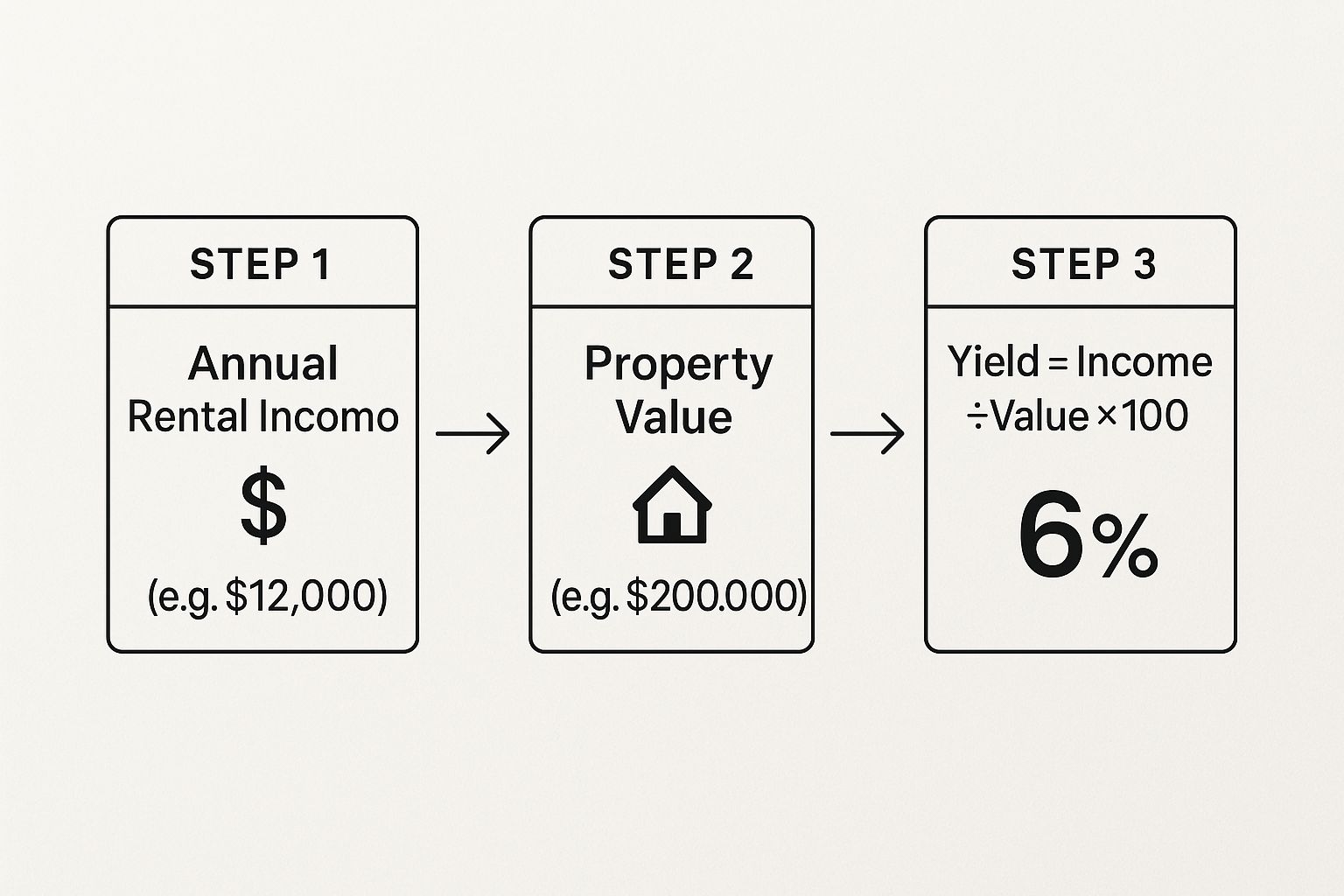
As you can see, you just need your income and total cost. Then, a quick division gives you the yield percentage.
A Salinas Example
Let's walk through a real-world example. Imagine you found a promising single-family home in Salinas to buy as a rental property.
First, you must figure out the Total Property Cost. Many new investors make a mistake here—they only use the purchase price. For an accurate picture, you must include every upfront expense.
- Purchase Price: $650,000
- Closing Costs (legal fees, inspections): $15,000
- Initial Renovations (new paint, flooring): $10,000
- Total Property Cost: $675,000
Next is your Annual Rental Income. If the market rent for the home is $3,500 per month, the math is simple.
- Monthly Rent: $3,500
- Annual Rental Income: $3,500 x 12 = $42,000
Now we have our two key figures. We can plug them right into the formula.
Gross Yield Calculation:
($42,000 / $675,000) x 100 = 6.22%
For this Salinas property, your gross rental yield is 6.22%. This number gives you a solid baseline for the property's performance. It’s an essential first step before digging deeper into the more detailed net yield calculation.
Finding Your True Profit with Net Rental Yield
Gross yield is a good number to start with, but it's not the whole story. If you want to know how an investment property is really performing, you need to look at the net rental yield. This is the number that serious investors in Monterey Bay focus on because it shows what's left after all the bills are paid.
Think of it as the difference between what your property could make and the actual cash that hits your bank account. To get that number, you must be honest about the real costs of owning a rental property.
Identifying Your Operating Expenses
First, you need a full list of all your annual operating costs. These are the expenses required to keep your property safe, occupied, and generating rent. Forgetting even one of these can throw off your entire calculation.
For a typical Monterey County property, your list will include:
- Property Taxes: Your annual bill from the county.
- Landlord Insurance: This protects your property and covers liability.
- Maintenance & Repairs: Budget for leaky faucets, appliance issues, and general upkeep.
- Vacancy Costs: No property stays occupied 100% of the time. Set aside 5-10% of your gross annual rent to cover gaps between tenants.
- Property Management Fees: If you hire a firm, this fee covers tenant screening and maintenance calls.
This list isn’t complete. You might also have costs for landscaping, pest control, or certain utilities depending on your property.
Calculating Your Net Operating Income (NOI)
Once you've added up all your annual expenses, you subtract that total from your gross rental income. The number you're left with is your Net Operating Income (NOI). This is the profit your property generates before you account for financing costs, like your mortgage payment.
Staying organized here is key. Using one of the best accounting software options for landlords can make tracking these expenses much simpler.
Net Yield in Action: The Salinas Example
Let's go back to our Salinas property. We already established a Total Property Cost of $675,000 and a Gross Annual Rental Income of $42,000.
Now, let's list the estimated annual operating expenses:
- Property Taxes (approx. 1.25%): $8,438
- Landlord Insurance: $1,200
- Maintenance & Repairs (5% of rent): $2,100
- Vacancy (5% of rent): $2,100
- Property Management (8% of rent): $3,360
- Total Annual Expenses: $17,198
With these figures, we can find the NOI:
$42,000 (Gross Income) – $17,198 (Total Expenses) = $24,802 (NOI)
Finally, we plug that NOI into the net yield formula:
($24,802 / $675,000) x 100 = 3.67%
The net yield of 3.67% gives a much more realistic view of the property's profitability compared to the 6.22% gross yield. This is the number that truly matters for budgeting and making smart investment decisions.
What Is a Good Rental Yield?
So, you’ve run the numbers and have your net rental yield. But what does that number really tell you? The truth is, there’s no single magic number for a "good" rental yield. The right figure depends on your financial goals and the specific market you're investing in.
Some investors focus on immediate cash flow. Others play the long game, prioritizing a property's value climbing over time. Your ideal yield depends on which strategy you value more.
Balancing Cash Flow with Growth
Here in the Monterey Bay area, there's a balance between cash flow and long-term growth. A property in a high-demand location like Carmel might only produce a net yield of 3-4%. That might sound low, but you're often getting strong, stable appreciation in return.
On the other hand, a rental in Salinas could deliver a higher net yield, potentially 5-6% or more. That means more cash in your pocket each month. However, its long-term appreciation might not be as predictable.
Smart investors know that rental yield is just one piece of the puzzle. A slightly lower yield in a market with a strong economy and consistent demand is often a safer and more profitable long-term bet.
Local Market Influences
You can't evaluate a yield in a vacuum. Local economic trends and tenant demand have a massive impact. A strong local economy, like the one we have in Monterey, creates a stable tenant pool. That stability can make a moderate yield more attractive because it comes with a lower risk of vacancy.
In fact, the National Association of Realtors (NAR) notes that 86% of real estate investors consider rental income a key factor in their property decisions. This shows just how vital yield is to the big picture. You can learn more about how yield impacts growth to get a deeper understanding of this dynamic.
Ultimately, a good rental yield meets your financial needs while balancing risk and reward. It’s about making a strategic choice that builds your wealth in our unique Monterey Bay market.
Common Mistakes to Avoid When Calculating Yield

Learning how to calculate rental yield is a huge step. But a simple mistake can throw off the entire result. An inaccurate number can cause you to overestimate your cash flow or choose a poor investment.
One of the most common errors is forgetting to include all initial purchase costs. It's an easy mistake to just use the sale price in the formula. But your true investment includes closing costs, inspection fees, and any upfront renovations. Overlooking these items will make your yield look artificially high.
Another major slip-up is underestimating your annual operating expenses.
Underestimating Annual Expenses
To get a true net yield, you have to account for every dollar your property costs you to run. A vague guess for maintenance or ignoring the chance of vacancy will skew your results.
Here are some costs that are often underestimated:
- Vacancy: No property stays filled 100% of the time. A smart approach is to set aside 5-10% of your gross annual rent to cover periods between tenants.
- Maintenance: This isn't just for emergencies. You need a budget for routine upkeep like painting and servicing appliances. A good rule of thumb is to budget 1-2% of the property’s value each year for this.
- Capital Expenditures (CapEx): These are big-ticket items that wear out over time, like a new roof or HVAC system. Setting aside a separate fund ensures you’re not caught off guard.
Relying on old rent estimates is another critical mistake. The rental market here in Monterey County can shift quickly.
To avoid this, get accurate rental comps from a local expert who understands each neighborhood. For more guidance, check out our other property management tips.
How to Improve Your Rental Yield
Your rental yield isn't a static number. You can actively shape it. Boosting your property's ROI follows two main paths: you either increase your rental income or you lower your operating costs. Both demand a smart approach.
Often, the most direct way to see a change is to raise your income. This goes beyond a simple rent increase. We're talking about thoughtful upgrades that tenants in the Monterey Bay area truly value.
Smart Strategies for Boosting Income
Think about what amenities are in high demand. It might surprise you what a difference some key features can make.
- Adding an in-unit washer and dryer is almost always a win.
- Upgrading to energy-efficient stainless steel appliances modernizes the kitchen.
- Improving outdoor spaces, like a private patio, can be a huge draw.
Even smaller changes can justify a higher rent. Installing smart thermostats or allowing pets can open your property to a wider tenant base.
Reducing Your Operating Expenses
Now for the other side of the equation: cost control. Every dollar you trim from your annual expenses flows directly to your net operating income. The secret here is to be proactive, not reactive.
A preventative maintenance plan is your best defense against expensive, surprise repairs. Regularly servicing HVAC systems and checking for leaks will save you money in the long run.
It's also smart to periodically review your insurance policies and property tax assessments. For investors managing properties from afar, handling local costs is critical. Our guide on rental property management for out-of-town owners offers deeper insights for that scenario.
Frequently Asked Questions About Rental Yield
Here are answers to the most common questions we get about rental yield in the Monterey Bay area.
What is a good rental yield in Monterey County?
A "good" net rental yield in Monterey County is typically between 4% and 6%. However, this can vary. A location like Carmel might have a lower yield but stronger long-term appreciation, while Salinas often offers better immediate cash flow.
Should I include mortgage payments in my net yield calculation?
No, the standard net yield formula does not include mortgage payments. This calculation measures the property's performance on its own, separate from your financing. Including your mortgage helps you find your cash-on-cash return, which is a different and useful metric.
How do I estimate potential vacancy costs?
A good rule of thumb is to budget 5-10% of your gross annual rent for potential vacancy. This is a safe estimate for most properties. For a more precise figure based on current local demand, a professional property manager can provide the most accurate data.
Can my rental yield change over time?
Yes, your rental yield will change over time. It can go up or down as your rental income and operating costs change. This is why you should recalculate your yield at least once a year to stay informed about your investment's true performance.
How can a property manager help improve my yield?
A professional property manager helps improve your yield in two key ways. First, we use expert market knowledge to set the optimal rent price, ensuring you don't leave money on the table. Second, we manage proactive maintenance and have a network of trusted vendors to control operating costs, which directly boosts your net income.
Take Control of Your Investment’s Performance
Understanding how to calculate rental yield is the first step toward making smarter, more profitable investment decisions. By tracking both your gross and net yield, you get a complete financial picture of your property's health. This allows you to identify opportunities for growth and protect your bottom line.
If you want to maximize your returns and ensure your Monterey Bay property is performing at its best, we’re here to help. Contact Torrente Property Management today at (831) 582-8916 to discuss a personalized strategy for your investment.