Meta Description: A guide for Monterey Bay investors comparing property management software like AppFolio, Buildium, and TenantCloud. Find the right tool for your rental portfolio.
Choosing the right tools for your rental properties is a critical decision. For investors here in Monterey Bay, a solid property management software comparison shows that while some platforms are built for seamless, all-in-one use, others offer deep customization for more complex portfolios.
This guide will help you understand your needs, compare top platforms, and decide if DIY management is the right path for your Monterey, Salinas, or Carmel properties.
Why Smart Software Is Crucial For Monterey Investors

Managing rental properties in Monterey County comes with unique challenges that spreadsheets and sticky notes just can't handle. From navigating the distinct rental markets of Salinas and Carmel to ensuring timely maintenance, the operational demands are significant. This is where modern technology becomes a game-changer.
Property management software automates the most time-consuming parts of being a landlord. It acts as your central command center for tenant screening, rent collection, expense tracking, and resident communication. This isn't just a trend; it's a fundamental shift in how successful real estate investments are managed today.
The proof is in the numbers. The global market for this software is booming, projected to grow from $27.95 billion in 2025 to $54.16 billion by 2032, according to GlobeNewswire. This massive industry-wide move reflects a demand for tools that make landlords more efficient and profitable. You can dig into the full market analysis on GlobeNewswire for more on this trend.
The Local Advantage of Digital Tools
For landlords in the Monterey Bay area, the right software provides tangible benefits that solve local problems. We use these tools to provide responsive, personalized service built on a foundation of integrity.
- Streamlined Operations: You can automate rent reminders and collections, which keeps your cash flow consistent whether your property is in Pacific Grove or Soledad.
- Enhanced Tenant Relations: Tenants get a private online portal to pay rent or submit a maintenance request anytime. That convenience boosts satisfaction and retention.
- Financial Clarity: Get a clear, real-time snapshot of your portfolio's financial health. Automatic income and expense tracking is a lifesaver come tax season.
Adopting a robust software platform isn’t just about the technology. It’s about freeing up your time to focus on high-value activities, like finding your next investment property, instead of getting buried in administrative busywork.
A detailed property management software comparison is your first step toward transforming a rental property from a time-consuming job into a more passive, profitable asset. It gives you the organization and efficiency needed to thrive in our competitive local market.
How To Define Your Portfolio's Needs
Jumping into a property management software comparison without a clear picture of your needs is a classic mistake. It's a recipe for frustration, leaving you at risk of overpaying for features you'll never use or getting stuck with a system that can't handle your day-to-day challenges.
Before you look at a single platform, you must take stock of your rental operation. The goal is to build a personalized checklist of "must-haves" and "nice-to-haves" to guide your search. This self-assessment ensures your choice is driven by real-world needs, not a slick sales pitch.
Assess Your Current Portfolio
Start with the basics: what do you manage right now? The demands of a single-family home in Carmel are worlds away from those of a multi-unit apartment building in Salinas. An honest look at the size and complexity of your portfolio is the only place to start.
Ask yourself these key questions:
- How many units do you manage? This number directly impacts pricing, as most software is priced on a per-unit or tiered basis.
- What kind of properties are they? Single-family homes, duplexes, or small apartment buildings? The answer dictates the complexity you'll need for maintenance tracking and tenant communication.
- Where are your properties located? If you're managing rentals across Monterey, Seaside, and Soledad, you need robust, centralized tools to stay organized.
A common pitfall is a landlord with a few single-family homes choosing software built for massive apartment complexes. They end up paying for enterprise-level tools that are completely irrelevant to their portfolio.
Identify Your Must-Have Features
Once you understand your portfolio's scope, pinpoint the core functions you can't operate without. Think about your biggest administrative headaches and where you lose the most time. The right software should solve these specific problems first.
For most landlords we work with in the Monterey Bay area, the non-negotiables usually include:
- Online Rent Collection: Automated rent is essential. It stabilizes your cash flow, reduces late payments, and provides the convenience modern tenants expect.
- Maintenance Request Tracking: A digital system for tenants to submit tickets is vital for being responsive and keeping a clear repair history.
- Financial Reporting: Your software must generate clean income/expense statements, rent rolls, and other reports that make tax time less of a nightmare.
- Tenant Communication Portal: A central hub for announcements and messages builds trust and ensures everyone is on the same page.
Many of our clients are out-of-area investors. For them, any feature supporting remote oversight is a top priority. If that sounds like you, our guide to Monterey second home property management offers specific advice on protecting your asset from a distance.
A Deep Dive Into Core Software Features
Picking the right property management platform is about choosing the engine that will drive your rental business. A genuine property management software comparison means looking past marketing jargon and getting into the nitty-gritty of how core features work for a landlord in the Monterey Bay area.
The difference between a "good" feature and a "great" one is in the details. For example, a superior rent collection system offers tenants an easy-to-use portal, provides transparent fee structures, and integrates seamlessly with your accounting.
Accounting and Financial Reporting
Solid financial oversight is the bedrock of any healthy rental portfolio. Your software should be your digital bookkeeper, giving you a crystal-clear picture of your property's financial health at a moment's notice. This empowers you to make smarter, more profitable decisions.
Top-tier platforms excel at detailed, customizable financial statements. A landlord in Salinas with several properties can pull a profit and loss (P&L) statement for each individual unit, then a consolidated report for the whole portfolio. This gives you the precision to see which properties are thriving.
This demand for better data is why the property management software market is booming. The market is projected to grow from $6.07 billion to $6.67 billion between 2024 and 2025 alone, hitting $9.79 billion by 2029. Landlords need sophisticated analytics. You can read the full research on this market expansion to understand how essential data-driven management has become.
Tenant Screening and Onboarding
Finding and keeping reliable tenants is everything, and your software's screening tools are your first line of defense. A robust platform delivers a comprehensive background check covering credit history, eviction records, and criminal background, all while staying compliant with Fair Housing laws.
The best software provides a clean, easy-to-digest report, often with a clear recommendation based on criteria you set. Platforms like AppFolio and Buildium have made this a core part of their offering, helping you make confident decisions faster.
A seamless onboarding process sets the tone for the entire landlord-tenant relationship. When tenants can apply, sign a lease, and pay their deposit all from one online portal, it creates a professional and positive first impression.
Maintenance Management and Communication
Few things tank tenant satisfaction faster than poorly handled maintenance. A great software solution turns the chaos of texts and emails into a clean, organized, and trackable workflow. Our community-focused approach means we prioritize responsive communication.
Here’s what a streamlined process looks like:
- Ticket Submission: A tenant submits a maintenance request through their portal with a description and photos.
- Work Order Creation: You receive an instant notification and convert the ticket into a formal work order.
- Vendor Assignment: You assign the job to one of your trusted local vendors directly from the platform.
- Status Tracking: Both you and the tenant can see the real-time status of the repair.
- Invoice and Payment: Your vendor submits their invoice through the system for payment and logging.
This structured approach ensures nothing gets lost. It provides total transparency and creates a permanent, documented history of every repair for every property.
Mobile Accessibility and Owner Portals
In this day and age, being chained to a desktop is not an option. A powerful mobile app is a must-have for any modern landlord. Whether you’re at a property in Carmel or on vacation, you need full control of your portfolio from your phone.
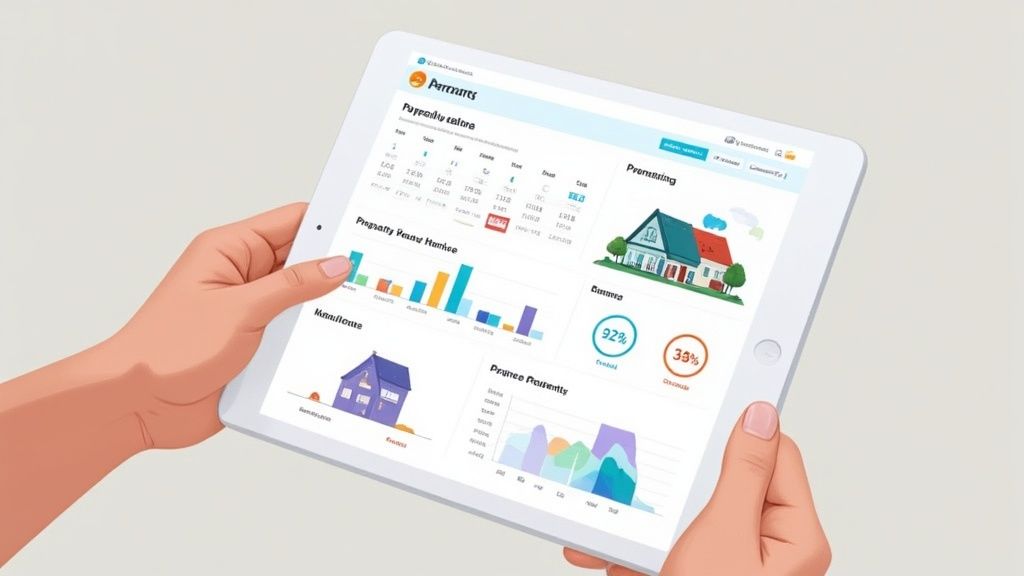
This screenshot shows the clean mobile interface of AppFolio, a popular choice known for its all-in-one capabilities.
A well-designed app puts critical information like vacancies, maintenance requests, and financial snapshots right at your fingertips. It truly puts your business in your pocket.
Software Feature Matrix For Monterey Landlords
To help you visualize how these platforms stack up, this matrix offers a side-by-side evaluation. It's designed to help Monterey landlords quickly see which system is the best fit for their specific needs.
| Feature Category | AppFolio | Buildium | TenantCloud | Best For |
|---|---|---|---|---|
| Accounting | Robust, all-in-one system with corporate accounting capabilities. | Excellent, user-friendly accounting tailored for property managers. | Basic accounting features suitable for smaller portfolios. | Buildium for its balance of power and ease of use. |
| Tenant Screening | Comprehensive, integrated screening with customizable criteria. | Strong screening tools with various reporting levels. | Basic screening available, with some features as add-ons. | AppFolio for deep, integrated background checks. |
| Maintenance | Advanced work order system with mobile vendor access. | Solid tracking and communication tools. | Simple ticketing system, good for direct landlord management. | AppFolio for complex or multi-vendor workflows. |
| Ease of Use | Powerful but has a steeper learning curve due to extensive features. | Highly intuitive and praised for its user-friendly interface. | Very simple and easy to navigate, ideal for beginners. | TenantCloud for new landlords or those with few units. |
| Pricing Model | Per-unit fee with a monthly minimum, best for larger portfolios. | Tiered pricing that scales with portfolio growth. | Freemium model with affordable paid tiers, great for starting out. | TenantCloud for budget-conscious landlords. |
Ultimately, this comparison shows there's no single "best" software. The right choice depends on your portfolio size, budget, and management style. For a new landlord, TenantCloud is a great start. For a growing portfolio, Buildium or AppFolio are smarter investments.
Decoding Pricing and The Total Cost Of Ownership
The price you see on a software website is just the beginning. A proper property management software comparison requires digging deeper than the advertised monthly fee to understand the Total Cost of Ownership (TCO). This means uncovering every possible charge, from setup fees to transaction costs that can eat into your profits.
Understanding these pricing structures is essential. The software that’s a perfect fit for your five-unit property in Monterey might become a financial burden when you expand to fifty units. You need to know how costs will scale with your portfolio.
Common Pricing Models Explained
Most software providers use one of a few common pricing models. Learning to spot them helps you make a smart financial decision for your rental business.
- Per-Unit Per-Month: This is the most straightforward model. You pay a fixed fee—say, $1.50—for each rental unit every month. It’s transparent but can get pricey for large portfolios.
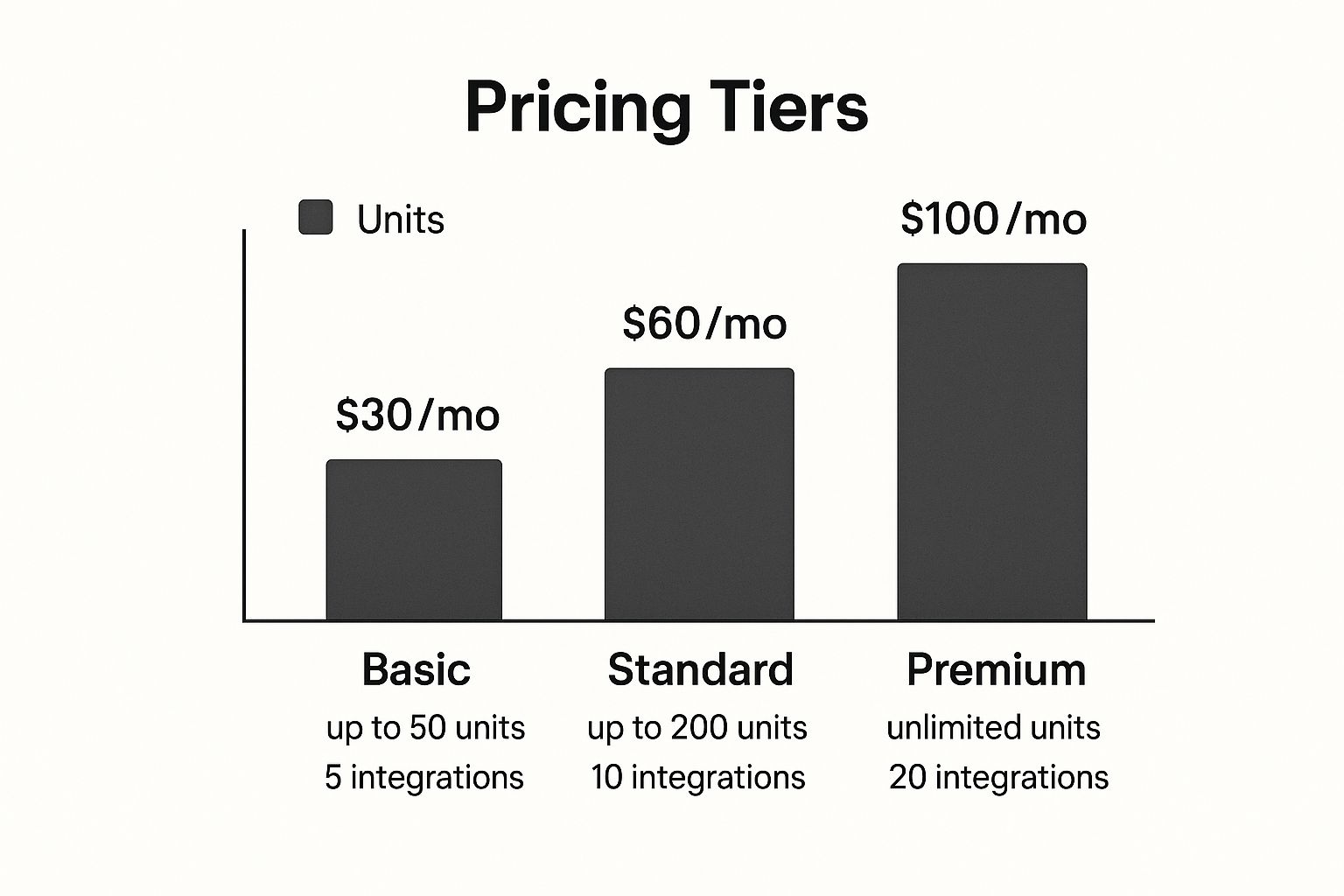
- Tiered Subscriptions: Platforms package features into different plans, like Basic, Growth, and Premium. This lets you avoid paying for tools you don't need, but critical features may be locked in a more expensive plan.
- Freemium: Some companies offer a free, basic version to get you started, hoping you'll upgrade. It’s great for new landlords, but free plans rarely have the robust tools needed for serious management.
Uncovering The Hidden Costs
Calculating your TCO means finding all the extra fees that aren't advertised on the front page. This is where many landlords get caught off guard, throwing a carefully planned budget off track.
Assume nothing is truly free. When talking to a sales rep, ask directly about costs for every transaction—tenant payments, background checks, eSignatures—to uncover the real price tag.
Keep a sharp eye out for these common add-on expenses:
- Implementation or Onboarding Fees: Many companies charge a one-time fee to set up your account.
- Tenant Screening Charges: The cost of pulling credit and background reports is often passed on to you or the applicant.
- ACH/Credit Card Processing Fees: Expect either a flat fee (like $1 per ACH transfer) or a percentage (2.9% for credit cards).
- eSignature and Document Storage Fees: Watch out for limits on basic plans.
- Premium Support: Priority service may come with an extra monthly fee.
This kind of tiered structure, like the one shown below from Buildium, is exactly what you should look for. It clearly shows which features are added as you move up in price.
This transparency makes it easier to compare what you’re getting for your money. It’s especially important for financial tools, a topic we explore in our guide to the best accounting software for landlords.
Matching The Right Software To Your Investor Profile
Choosing the right property management software is about finding a tool that fits your investor profile. What works for a hands-on landlord in Pacific Grove is different from what a busy professional with properties across Monterey County needs.
We've outlined three common investor profiles we see in the Monterey Bay area. See which one sounds most like you to zero in on the software that matches your budget, goals, and work style.
Profile 1: The Hands-On DIY Landlord
This investor owns one to four properties—perhaps a single-family home in Seaside and a duplex in Salinas. They live locally, prefer to be involved, and have trusted handymen on speed dial. Their main goal is organization without a hefty price tag.
For this landlord, simplicity and affordability are everything. They need the basics done right: online rent collection, simple maintenance tracking, and easy expense logging.
- Best-Fit Software: TenantCloud is the clear winner. Its free and low-cost plans offer all the core tools a DIY landlord needs.
- Why It Works: It solves the biggest headaches for a small-scale landlord—chasing rent checks and tracking repairs—at a price that makes sense.
Profile 2: The Growth-Focused Investor
This investor manages five to twenty units and aims for expansion. They are focused on efficiency, scalability, and data-driven decisions. They understand that a smart monthly investment in the right software pays for itself as they grow.
This investor needs a robust, all-in-one platform with advanced accounting, detailed financial reports, and professional tenant lifecycle tools.
- Best-Fit Software: Buildium is perfectly suited for this profile. Its tiered pricing grows with the portfolio, hitting a sweet spot between powerful features and a user-friendly design.
- Why It Works: Buildium provides the operational engine for expansion. Its analytics, built-in screening, and owner portals provide the professional toolkit a growing business needs. Find more ideas in our property management tips.
Profile 3: The Busy Professional
This landlord is often an out-of-area owner or a local professional with little time for hands-on management. They value automation and premium service, willing to pay for a top-tier solution that requires minimal involvement.
For this investor, the software must be a comprehensive, mobile-first platform that automates as much as possible. These cloud-based property management solutions are popular for their flexibility. You can learn more about property management software market trends to see how these systems are evolving.
- Best-Fit Software: AppFolio is the go-to choice here. Its higher price point is justified by its powerful, all-in-one system and outstanding mobile app.
- Why It Works: AppFolio is built for automation and efficiency at scale. Its advanced capabilities give busy professionals complete oversight of their assets with a minimal time commitment.
When Professional Management Is The Smarter Choice
After a property management software comparison, it's clear these platforms offer powerful tools. But software is just a tool. It can automate tasks, but it can’t replace the critical thinking, local knowledge, and human touch needed for stress-free property ownership.
For many investors, the real path to better returns and more personal time isn’t found in a new dashboard. It’s found in a strategic partnership with a professional property management firm.
The Limits Of DIY Automation
Software can schedule a maintenance reminder, but it can’t build a trusted relationship with a local plumber who will show up on a holiday weekend. It can process a rent payment, but it can’t have a nuanced, bilingual conversation with a tenant in Salinas to solve a problem before it escalates.
This is the real difference between automation and actual management. Technology handles the “what,” but professional managers—people with local expertise—handle the “how” and the “why.”
Software makes an excellent assistant, but it can't be the CEO of your real estate investment. A professional manager acts as your trustworthy partner on the ground, using technology while providing the judgment that software can't deliver.
How We Combine Technology And Personalized Service
At Torrente Property Management, we bridge this gap. We use sophisticated technology behind the scenes to keep things efficient and transparent. Our owners and tenants get modern conveniences like online portals for payments, reports, and maintenance requests.
But our true value is found where the software ends.
- Boots-on-the-Ground Presence: We are physically present at your Monterey, Carmel, or Salinas properties, conducting inspections and meeting tenants.
- Local Vendor Network: We coordinate with our vetted network of local Monterey County professionals to ensure you get quality work at fair prices.
- Expert Tenant Relations: Our bilingual (English/Spanish) team handles all communication with care, fostering positive, long-term relationships with your tenants.
- Peace of Mind: We provide comprehensive solutions for rental property management for out-of-town owners, ensuring your asset is protected no matter where you are.
Choosing professional management isn’t giving up on technology. It’s upgrading to a full-service solution where advanced tech is paired with irreplaceable human expertise.
FAQs: Your Property Management Software Questions Answered
Diving into new technology always brings up questions. To help you feel more confident as you compare property management software, we’ve answered the most common queries we get from landlords in the Monterey Bay area.
How do I choose the right software for my Monterey properties?
Start by assessing your portfolio size and specific needs. A DIY landlord with one unit in Carmel has different requirements than a growth-focused investor with ten units in Salinas. Use our investor profiles above to identify the best fit for your situation.
Is my tenant data secure on these platforms?
Yes, reputable software providers use industry-standard encryption and robust security protocols to protect sensitive information. Before committing, always check for essential security features like two-factor authentication to ensure trustworthiness and data integrity.
Can software help me with California tenant laws?
Software is a great organizational tool, but it is no substitute for professional legal advice. A good platform can provide state-specific lease templates and secure document storage, but it cannot interpret complex local ordinances in places like Monterey or Salinas.
What is the typical learning curve for this software?
Most modern platforms like Buildium and AppFolio are designed to be user-friendly, but you should still plan for an adjustment period. Expect to spend a few days to a couple of weeks to feel comfortable, and take advantage of the tutorials and support they offer.
Does software replace a property manager?
No, software automates tasks but cannot replace human expertise and personalized service. A platform can collect rent but can't provide the local market knowledge, trusted vendor relationships, or critical judgment that a person can. To learn more, see what a property management company does.
Ready to take the next step in optimizing your rental property's performance? Whether you need help choosing the right software or want to learn more about our full-service management solutions, we're here to help.
Contact Torrente Property Management today at (831) 582-8916 for a personalized consultation.