
Direct Answer: Managing apartments in Salinas is harder than most landlords expect — California rental law, local registration requirements, and tenant screening mistakes trip up even experienced owners early on.
Most landlords in Salinas don’t plan to become landlords. They inherit a fourplex from a parent, relocate for work and can’t sell, or buy a rental thinking it’ll run itself. Then the first difficult tenant shows up, or the first compliance notice from the City, and the learning curve gets very real very fast.
Salinas is one of the most active rental markets on the Central Coast. Monterey County has some of the most tenant-protective rental laws in California, and the City of Salinas adds its own layer of local requirements on top of state law. Missing either one can cost you.
This article pulls together the things experienced Salinas apartment owners most often say they wish someone had told them before they started. No fluff — just the specific lessons that tend to show up the hard way.
1. California’s Security Deposit Cap Changed in 2024 — and Many Landlords Still Don’t Know
As of July 1, 2024, California law (AB 12) limits security deposits to one month’s rent for most residential rentals — regardless of whether the unit is furnished. This was a significant change from the old two-month cap that landlords had relied on for years.
For a typical Salinas apartment renting at $1,800 to $2,200/month, that means your maximum deposit is the same number. You can no longer charge first month, last month, and a deposit separately and still stay legal.
There are limited exceptions — landlords who own two or fewer residential properties with no more than four total units can still collect up to two months. But if you own more than that, the one-month cap applies. The penalty for overcharging isn’t just returning the extra amount — a tenant can sue for damages. Getting this wrong on the front end is an expensive mistake that’s completely avoidable.
2. Salinas Has a Residential Rental Registration Program
The City of Salinas runs a Residential Rental Registration (RRR) program that requires landlords to register their rental properties and pay an annual fee. A lot of out-of-area owners — and even some local ones — find out about this program only after receiving a notice.
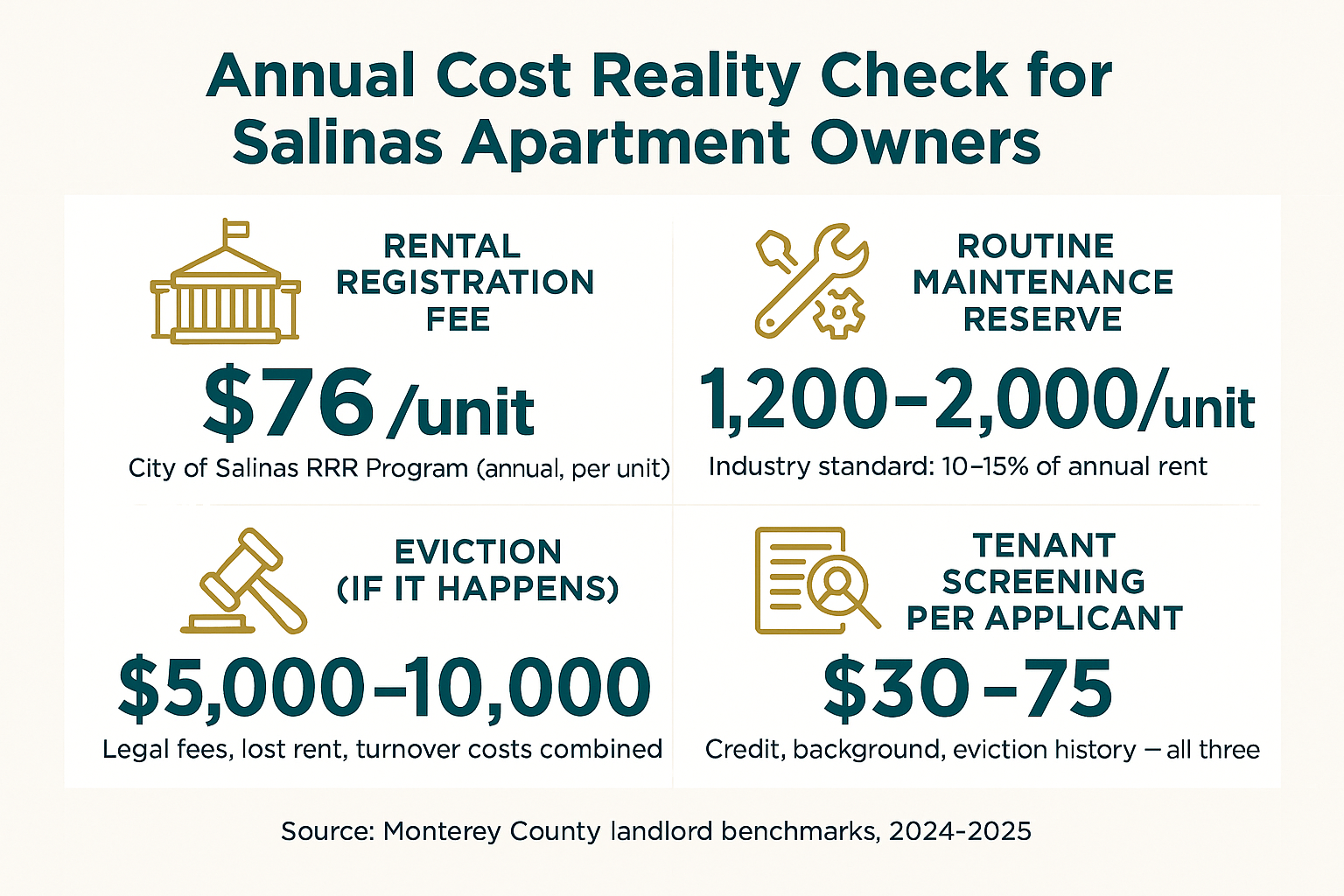
Registration fees are based on unit count and are currently set at $76.15 per unit per year (verify the current rate with the City, as fees adjust). The program also triggers periodic property inspections to verify habitability standards are being met.
Failing to register doesn’t just mean a fee — it can complicate your ability to enforce a lease or collect rent in an eviction proceeding. Courts in Monterey County have ruled against landlords on procedural grounds when registration was lapsed. If you own rental property in Salinas, registration isn’t optional. It’s the cost of doing business in this market.
For a broader view of what managing apartments here actually involves, this guide to apartment property management in Salinas covers the operational side in detail.
3. Tenant Screening Is Where Most Apartment Problems Start
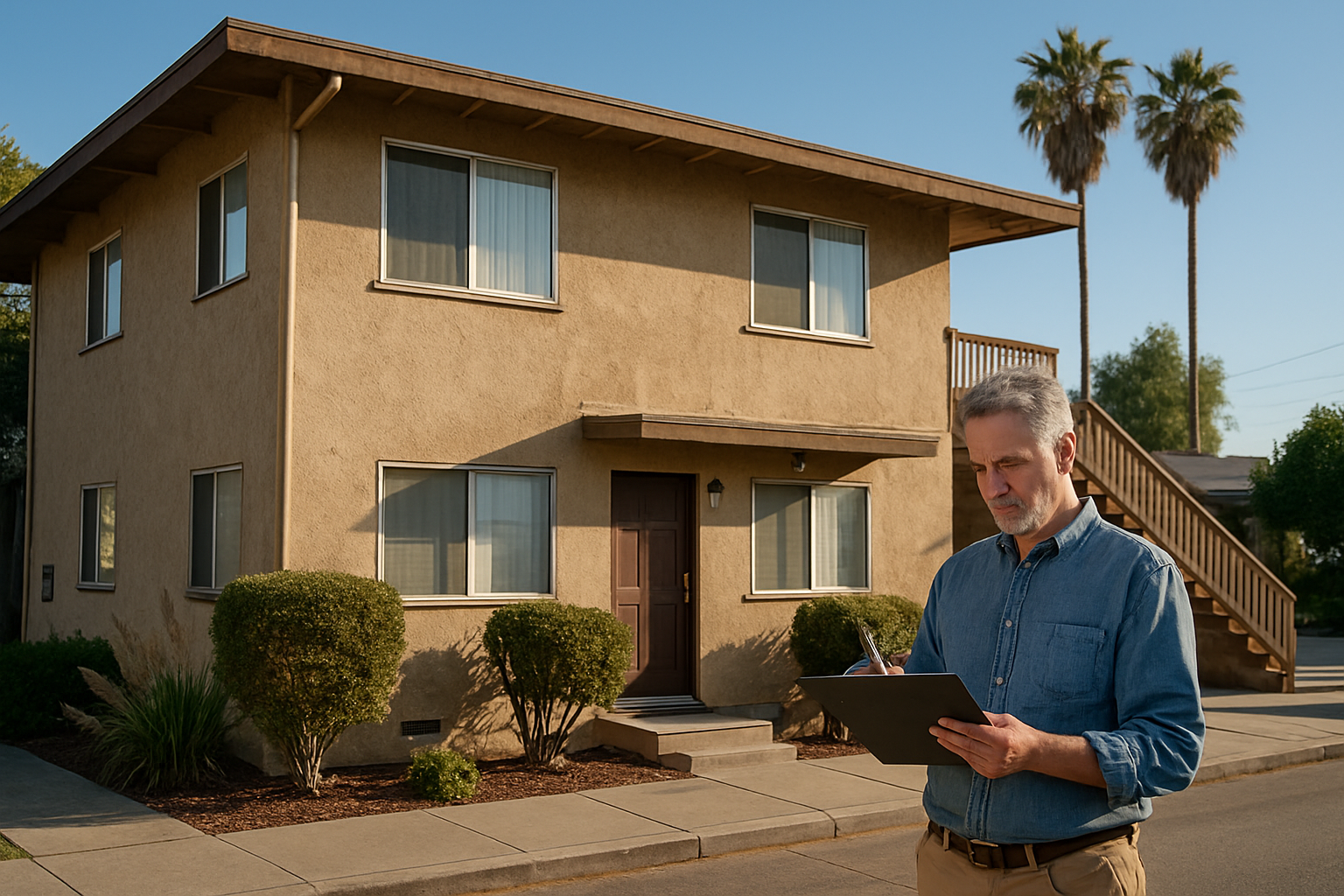
Ask any experienced Salinas landlord what their worst rental year looked like, and almost every story starts the same way: they approved someone they had a bad feeling about, or they moved too fast to fill a vacancy.
In a market where evictions can take 3 to 6 months and legal fees can reach $5,000 to $10,000, the cost of one bad tenant placement far exceeds a month or two of vacancy. Screening isn’t about being picky for its own sake — it’s about protecting what’s often a $500,000+ asset.
A solid screening process for Salinas apartments includes:
- Credit check — look for patterns, not just a score
- Rental history verification — actually call prior landlords, not just the most recent one
- Income verification — most Salinas landlords require gross monthly income of at least 3x the rent
- Background check — criminal history review in compliance with California’s fair chance housing rules
- Eviction history search — a separate search from a credit report; don’t skip it
California law restricts how you can use certain background information, including specific rules under the Fair Chance Ordinance that apply in some jurisdictions. Knowing those rules before you reject an applicant keeps you out of fair housing complaints. Understanding what makes tenants reliable over time is just as important as the screening checklist itself.
What Salinas Landlords Actually Spend Per Unit Per Year
These are the real recurring costs most first-time apartment owners in Salinas underestimate when building their rental budget.
4. AB 1482 Rent Control Applies to Most Salinas Apartments — and Landlords Often Discover This at the Worst Time
California’s AB 1482 (Tenant Protection Act) caps annual rent increases at 5% plus local CPI, or 10% — whichever is lower — for most apartments in California that aren’t exempt. In Salinas, where CPI has been running around 3–4%, that generally means you’re capped at 8–9% annually.
But the bigger issue is the just cause for eviction requirement. Once a tenant has lived in a covered unit for 12 months, you need a legally recognized reason to end their tenancy — not just a desire to re-rent at a higher rate. Covered reasons include non-payment, lease violations, or owner move-in (with proper notice and relocation assistance in some cases).
Exemptions include single-family homes (with proper written notice to tenants) and condos, properties built within the last 15 years, and some others. But a standard Salinas apartment complex built before 2010 is almost certainly covered.
This matters most when landlords try to raise rents aggressively after a market shift, or when they want to move a family member into a unit. Not knowing the rules going in creates real legal exposure. This overview of the current Salinas property management landscape covers how these rules are playing out for local owners right now.
AB 1482 Quick Reference: Covered vs. Exempt Salinas Rentals
Most Salinas apartment owners are covered by AB 1482 rent and eviction protections. Here’s a basic reference — always confirm your specific property with a licensed professional.
| Property Type | AB 1482 Covered? | Key Notes |
|---|---|---|
| Apartment complex built before 2010 | Yes | Rent cap + just cause eviction required |
| Single-family home (with written notice) | Exempt | Must provide AB 1482 exemption notice in lease |
| Condo sold separately | Exempt | Must notify tenant in writing |
| New construction (built 2010 or later) | Exempt for 15 years from cert of occupancy | Exemption expires; track the date |
| Duplex where owner occupies one unit | Exempt | Owner-occupied exemption applies |
5. Maintenance Response Time Is a Legal Issue, Not Just a Customer Service One
California law requires landlords to maintain rental units in a habitable condition at all times. In practice, this means responding to habitability issues — water leaks, heating failures, pest infestations — within a timeframe courts take seriously. A 24-hour response for emergency conditions is the standard most property managers and attorneys recommend.
In Salinas, where rental housing stock includes a lot of older buildings, deferred maintenance is common. But “I didn’t know” is not a legal defense when a tenant withholds rent, calls the City’s Code Enforcement office at 831-758-7157, or pursues a repair-and-deduct remedy under California Civil Code Section 1942.
The practical issue for apartment owners managing from a distance — or managing multiple units while holding a day job — is having reliable vendors on call. Plumbers, HVAC techs, and electricians in the Salinas/Monterey area are busy. Without pre-established relationships, a 24-hour response can quickly turn into a 72-hour wait and a code complaint.
This is one of the most common reasons landlords eventually decide a property manager is worth the cost — not because they can’t manage the property, but because they can’t manage it fast enough.
6. The Move-Out Inspection Process Has Strict Rules — and Most Landlords Miss the Pre-Move-Out Step
California is one of the few states that requires landlords to offer tenants a pre-move-out inspection — also called an initial inspection — so tenants have a chance to fix issues before they lose their deposit. Skipping this step, even if unintentional, can forfeit your right to make certain deductions.
The timeline matters:
- Request the initial inspection within 2 weeks of the tenant’s notice to vacate
- Conduct the inspection no earlier than 2 weeks before the move-out date
- Provide a written itemized statement of deficiencies after the inspection
- Return the deposit (or itemized deductions) within 21 calendar days of the tenant vacating
Deductions must be for damage beyond normal wear and tear — a term California courts interpret more narrowly than most landlords expect. Repainting a room because a tenant lived there for four years is typically wear and tear. Repainting because of crayon drawings on the walls is not.
Documentation is everything. Move-in and move-out photo sets, dated and organized, are the only evidence that holds up if a tenant disputes deductions in small claims court.
7. Managing Apartments Long-Distance Is a Different Job Entirely
A lot of Salinas apartment owners don’t live in Salinas. Some are in the Bay Area, some are out of state, and some are military families managing inherited properties during deployment. Distance changes everything about how property management works.
The problems that are manageable when you live nearby — a tenant who pays late, a slow maintenance vendor, a lease renewal that needs handling — become genuinely difficult to manage from Sacramento or Phoenix. And Salinas tenants, like tenants everywhere, can tell when a landlord isn’t watching closely.
Remote ownership works best when there’s a clear system in place:
- A local point of contact who can walk a property within hours, not days
- An online portal for rent collection, maintenance requests, and documentation
- Regular property inspections — at minimum annually, ideally twice a year
- A vendor network that doesn’t require the owner to coordinate every job
For property owners considering what that structure should look like, this comparison of property management companies in the Salinas market outlines what to look for in a local management partner. And this guide on what landlords commonly overlook when hiring a property manager is worth reading before making that decision.
Frequently Asked Questions from Salinas Apartment Owners
Do I have to register my rental property with the City of Salinas even if I only own one unit?
Yes. The Salinas Residential Rental Registration program applies to rental units regardless of how many you own. The registration fee is currently $76.15 per unit per year, and unregistered properties can face complications in lease enforcement and eviction proceedings. Register through the City of Salinas Code Enforcement division.
My apartment building was built in 2005. Does AB 1482 apply to it?
Almost certainly yes. AB 1482 exempts buildings for 15 years from their certificate of occupancy. A building from 2005 is well past that window, so both the rent cap (5% + CPI or 10%, whichever is lower) and just cause for eviction requirements apply. Double-check your specific certificate of occupancy date to be sure.
A tenant says I owe them relocation assistance for a rent increase. Is that true?
It depends. AB 1482 requires one month’s rent in relocation assistance if a landlord terminates a tenancy for a no-fault reason — like owner move-in or substantial remodel — in a covered unit. A rent increase alone doesn’t trigger relocation assistance. But if a tenant vacates because you raised rent above the legal cap, you may have larger legal exposure. When in doubt, talk to a California landlord-tenant attorney before acting.
How long do I have to return a security deposit after a tenant moves out?
21 calendar days from the date the tenant vacates. The deposit — or an itemized written statement of deductions with receipts — must be mailed or delivered within that window. Missing this deadline can result in a court awarding the tenant up to twice the deposit amount in penalties.
Is it worth hiring a property manager for a small apartment building in Salinas?
For most owners managing more than two units, or managing from any distance at all, the answer is usually yes — not because management is impossible to do yourself, but because the compliance requirements, maintenance coordination, and tenant relations work adds up fast. A local manager typically charges 8–10% of monthly rent collected. For a 4-unit building in Salinas collecting $8,000/month, that’s $640–$800/month for someone handling all of it. Most landlords who’ve tried it both ways say the trade-off is worth it.
Managing Salinas Apartments and Want a Second Opinion?
Torrente Properties has been working with apartment owners across Monterey County for over 25 years — including landlords who came to us after learning these lessons the expensive way. If you own rental property in Salinas, Monterey, Seaside, or anywhere on the Central Coast and want to talk through your situation, our team is easy to reach at (831) 582-8916 or through the contact form at torrenteproperties.com.