
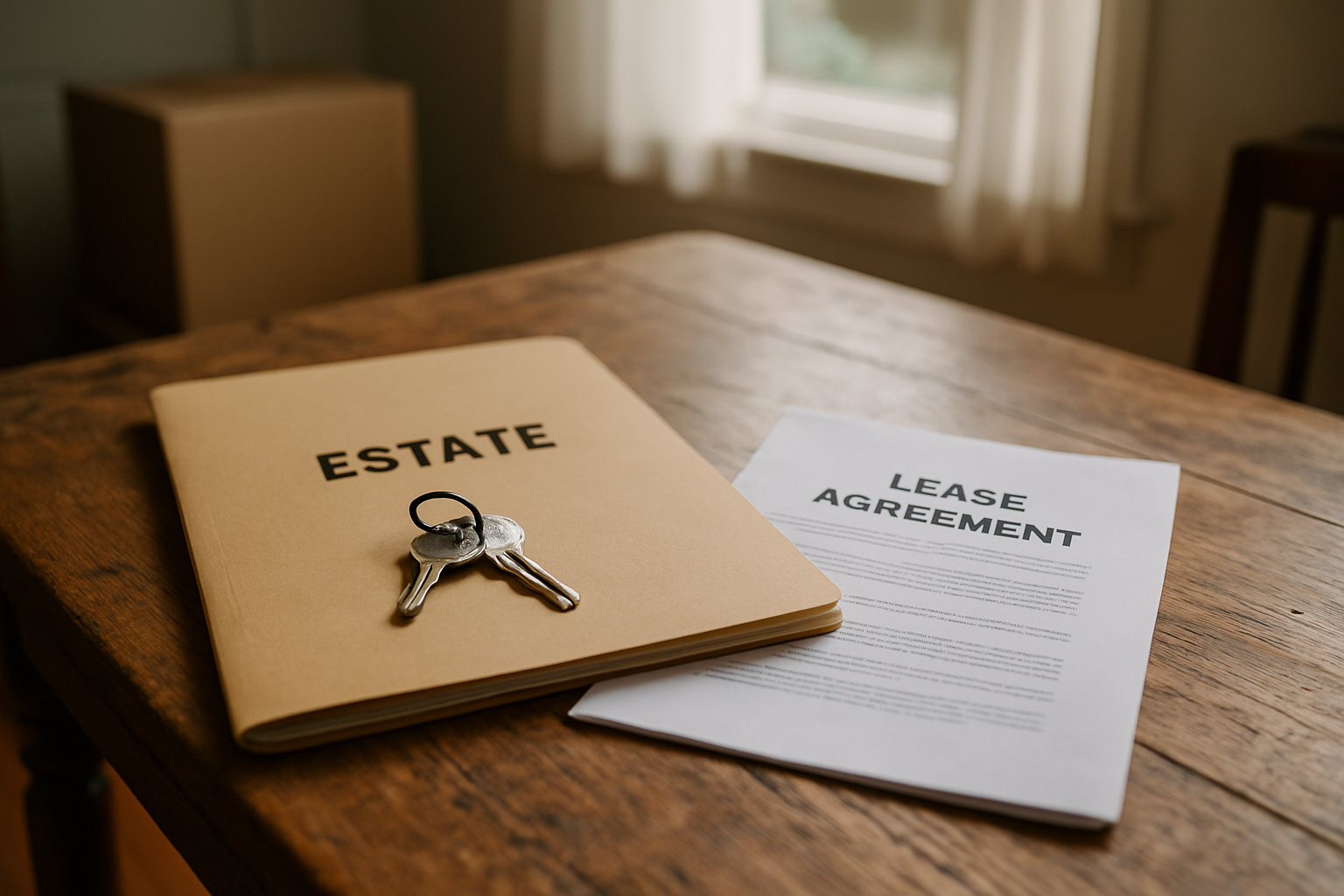
Inheriting a Rental Property in Monterey Bay: What Comes Next
Almost nobody plans to become a landlord this way. A parent passes, a house in Salinas or Seaside changes hands, and suddenly you are responsible for a property you may not have set foot in for years.
I have sat with a lot of families in this exact spot in Monterey County. The grief is real, the family conversations are complicated, and on top of all that, the house needs decisions made about it.
The good news is that most of what matters happens in the first 60 to 90 days. Below is how I would walk through it: who is living there, what the insurance company thinks about it, and what California expects from you once you take the keys.
First Question: Is Someone Already Living There?
If a tenant is in the home, you did not inherit a blank slate. You inherited an active lease, and California expects you to honor it.
That means the remaining lease term stays in place, the rent stays where it is until you follow the proper process to change it, and the tenant keeps every protection they already had. If the property qualifies under AB 1482, that includes rent cap limits and just cause rules for ending a tenancy under California Civil Code Section 1946.2.
This is where I see heirs get into trouble. Several owners have come to me after assuming they could simply ask a long-term tenant to move out so the house could be sold or remodeled.
Here is what actually needs to happen when you step into the landlord role:
- Find the lease. If there is no written lease, the tenancy is likely month to month, and that still carries protections.
- Track down the security deposit. You are responsible for it, even if you never received the money.
- Notify the tenant in writing of the ownership change and where rent goes now.
- Document the current condition of the unit with dated photos before anything changes.
- Get clear on rent history before you consider any increase. Our guide on raising rent in 2026 walks through the limits.
A tenant who has lived there four or five years under a handshake arrangement with your parent is common around here. That relationship deserves care, and it also deserves paperwork.
If the House Is Sitting Empty, Your Insurance Is the Clock
An empty inherited home feels like the safe option. It is usually the riskiest one.
Most standard homeowner policies contain a vacancy clause. After roughly 30 to 60 days with nobody living there and no documented oversight, an insurer can deny a claim for water damage, vandalism, or theft. That is a brutal thing to learn after a pipe lets go.
Call the insurance carrier early and tell them the truth about occupancy. You may need a vacant property endorsement, and the premium change is far cheaper than a denied claim.
The other thing empty houses do around here is quietly fall apart:
- Coastal moisture in Pacific Grove, Carmel, and Monterey feeds dry rot and mildew in closed-up rooms.
- Winter storms overload clogged gutters and find every soft spot in a roof.
- Water heaters and supply lines fail with nobody there to hear it.
- Landscaping and mail pileup advertise that the place is unoccupied.
This is why I push for scheduled, photo-documented inspections on any vacant home. Our seasonal maintenance program checks the exterior, plumbing, leak risk, water heater, and smoke and carbon monoxide detectors four times a year and sends the owner a report with photos.
Even if you never hire anyone, put your own inspection dates on a calendar and keep the photos. Documentation is what protects you with the insurance company.
Three Paths for an Inherited Monterey Bay Property
Every heir I work with ends up choosing one of three directions. Each has a different cost profile and a different set of obligations.
| Path | What It Requires | Main Risk to Watch |
|---|---|---|
| Rent it long term | Property prep, market pricing, screening, lease, ongoing maintenance and reporting | Under-screening the first tenant to fill the vacancy fast |
| Hold it vacant while the estate settles | Insurance review, documented inspections, utilities kept on, landscaping upkeep | Vacancy clause denials and unnoticed water damage |
| Prepare it for sale | Repairs, cleaning, landscaping, staging, and a realistic pricing analysis | Trying to remove a sitting tenant without following the legal process |
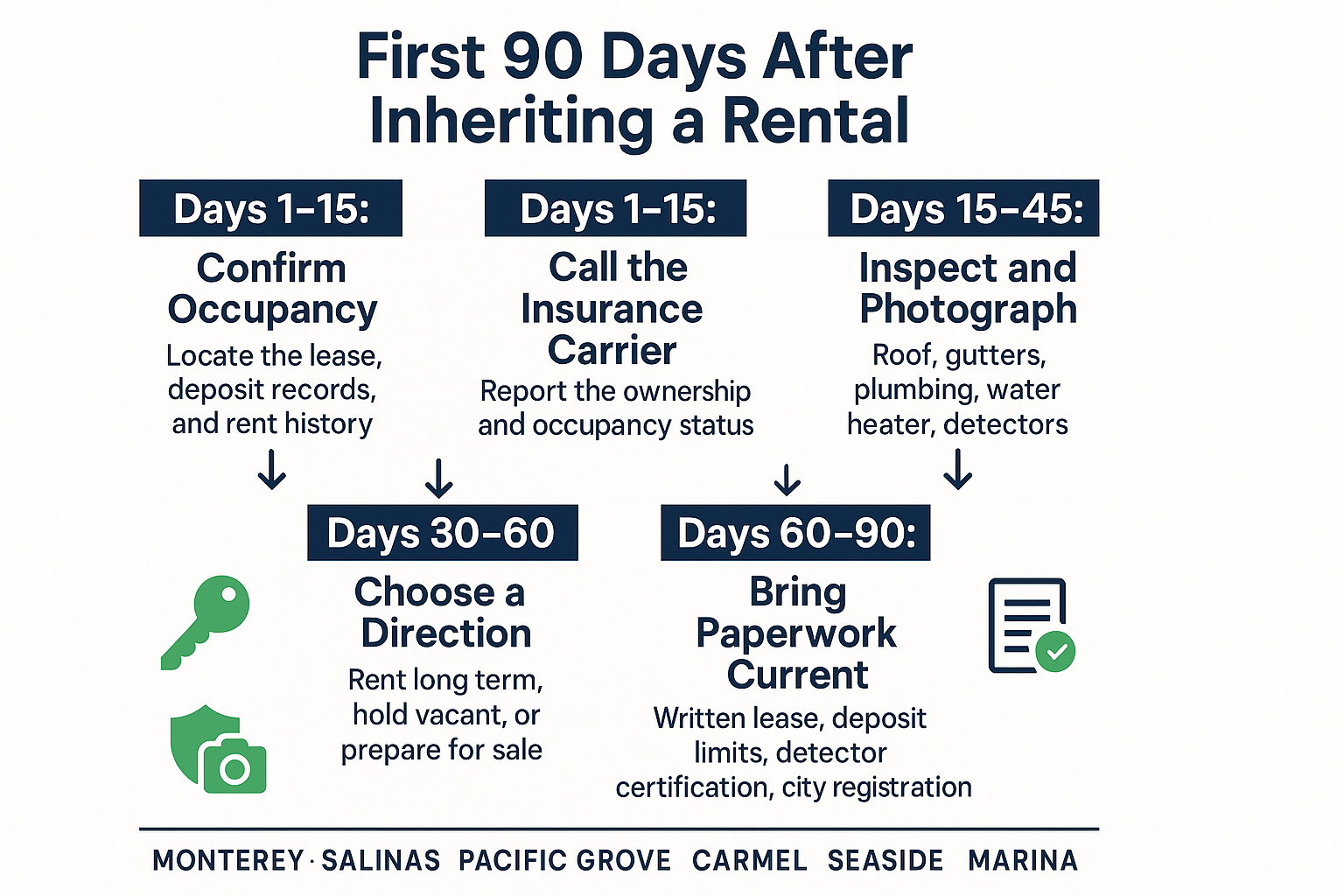
The First 90 Days, In Order
This is the sequence I recommend to heirs, and the order genuinely matters.
The Rules Changed Since Your Parent Was the Landlord
If you decide to rent, understand that the rulebook is not the one your parent used. Two changes matter most.
First, the security deposit. Since July 1, 2024, California caps residential security deposits at the equivalent of one month's rent for most owners, furnished or unfurnished.
That used to be two months. If you inherited a home full of your parent's furniture and good condition you want to protect, your cushion just got cut in half.
What replaces that cushion is process:
- Real screening. Credit, nationwide criminal background, eviction history, and verified income and employment. Our tenant screening walkthrough covers what a thorough process includes.
- Move-in documentation. Dated photos and video of every room, appliance, and surface before keys change hands.
- A written lease that spells out condition, maintenance responsibilities, and notice terms.
Second, compliance. A home your parent managed informally for thirty years often has gaps. Working smoke and carbon monoxide detectors are required. Cities have their own layers too, including the Salinas rental registration program and Monterey's rule against residential rentals under 30 days.
Deferred maintenance shows up here as well. Getting a house from "Dad kept it running" to a documented, legal rental is real work, and what actually has to happen before a rental goes live is worth reading before you list it.
When Siblings Own It Together
Shared ownership is where good intentions go sideways. Three heirs with three opinions about repairs, rent, and whether to sell will stall a property for months.
Settle a few things in writing early:
- One point of contact for decisions, vendors, and any manager you hire.
- A spending limit that one person can approve without a family meeting.
- How rent income and expenses get split and who handles the tax reporting.
- A timeline for revisiting the keep-or-sell question.
And if most of you live out of the area, plan for that reality. Many of the owners I work with are in Southern California, out of state, or overseas, which is exactly why how out-of-area owners manage a Monterey Bay rental is one of the questions I answer most.
Frequently Asked Questions About Inherited Rental Property in Monterey Bay
Can I ask the tenant to move out so I can sell the house?
Not casually. If the property falls under AB 1482, you need a legally recognized reason and proper written notice, and some reasons require relocation assistance. Selling a home with a tenant in place is often the cleaner path. Talk to a real estate attorney before you send any notice.
What if there is no written lease, just a verbal agreement my parent had?
That is still a tenancy, usually month to month, and the tenant still has full protections. The transition is a reasonable time to put a written lease in place going forward, but you cannot change the terms retroactively or without proper notice.
How long can the house sit empty before insurance becomes a problem?
Many policies start limiting coverage somewhere around 30 to 60 days of vacancy. The exact language varies by carrier, so read your policy and call your agent. Documented, scheduled inspections help, and a vacant property endorsement may be the right fix.
What does property management cost if I decide to rent it out?
Fees in Monterey County generally run as a percentage of collected rent, with a separate leasing fee when a new tenant is placed. The range depends on property type, unit count, and condition. We break the factors down in our cost guide, and we are happy to quote your specific property.
Do I really need to redo the smoke and carbon monoxide detectors?
Yes. California requires working smoke alarms and carbon monoxide detectors in rental homes, and this is one of the most common gaps I find in a house that has been owner-occupied for decades. It is inexpensive to fix and a serious liability if you skip it.
Thinking Through an Inherited Property in Monterey County?
If you are sorting out a home in Monterey, Salinas, Seaside, Marina, or anywhere on the Peninsula, we are glad to talk it through, in English or Spanish. Our team has worked with Monterey County families in this situation for more than 25 years, and sometimes the most useful thing is just a clear read on your options. You can reach us at (831) 582-8916 or through the contact form at torrenteproperties.com whenever you are ready.

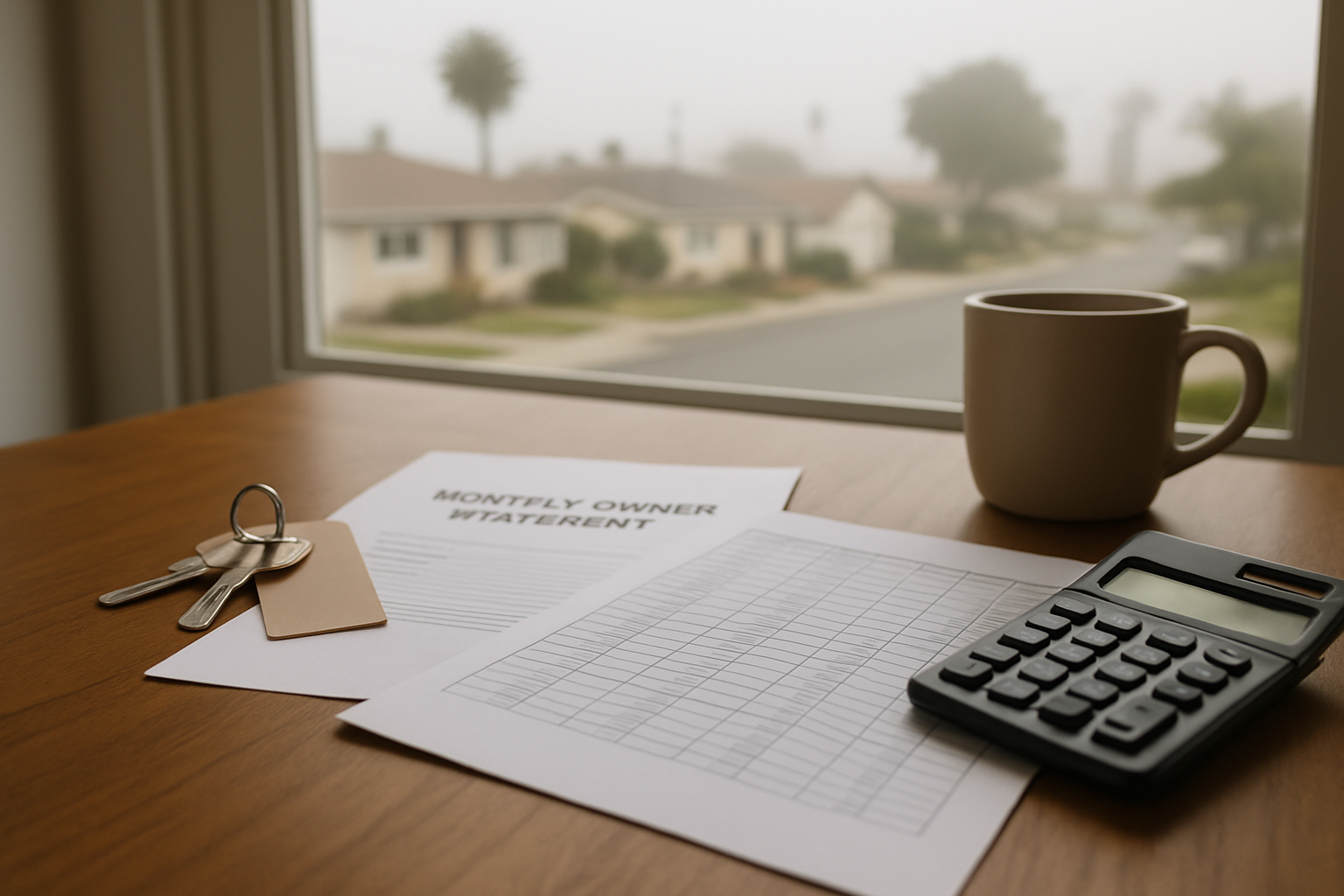
What a Property Management Fee Actually Covers in California
Almost every owner who calls me asks the same two things in the same breath: what would my place rent for, and what do you charge? The second question is the one people misread most often.
A monthly management fee and a leasing fee are two different things. So is a vendor invoice. When owners compare companies without knowing which is which, they end up comparing numbers that were never the same number to begin with.
I want to walk through the line items the way I would on a phone call with a homeowner in Salinas or Pacific Grove. What the monthly fee usually buys, what tends to be billed on the side, and the questions worth asking any manager before you sign.
What does the monthly management fee actually cover?
In California, the monthly fee is typically a percentage of collected rent. It pays for the ongoing, unglamorous work of keeping a tenancy running.
In most agreements you should expect it to include:
- Rent collection and follow-up on late payments
- Tenant communication, including after-hours calls
- Maintenance coordination with vendors and follow-through
- Monthly owner statements showing income and expenses
- Lease compliance monitoring, including notices and renewals
- Routine and move-in/move-out inspections
Compliance is the part owners tend to undervalue until it bites. California capped most residential security deposits at one month's rent as of July 1, 2024, and the city of Monterey does not allow residential rentals under 30 days. Salinas owners also have the city's Residential Rental Registration program to keep current.
If you own a multifamily building with balconies or elevated walkways, AB 2579 and SB 721 inspection deadlines apply to you as well. Ask directly whether tracking that sort of thing sits inside the monthly fee or outside it. For a broader look at local rates, this breakdown of what property management costs in the Monterey Bay area is a reasonable starting point.
Why is tenant placement billed separately?
Because it is a different job with a different workload. Placing a tenant is front-loaded work that happens once, while the monthly fee covers work that repeats.
Across the industry, a leasing or placement fee commonly lands somewhere between half a month's rent and one full month's rent, though it varies by firm and by property. That charge generally covers property prep and staging advice, rental pricing analysis, photos and listings, showings, full credit, background and rental history screening, and drafting and executing the lease.
A few things to pin down before you assume anything:
- Is the fee charged again at renewal, or only for a new tenant?
- Is there a re-leasing discount if a tenant leaves early?
- Are marketing costs like photography included or added?
Some owners only want this piece and plan to handle the rest themselves. That is a real option, and the tradeoffs are covered well in this comparison of tenant placement versus full management.
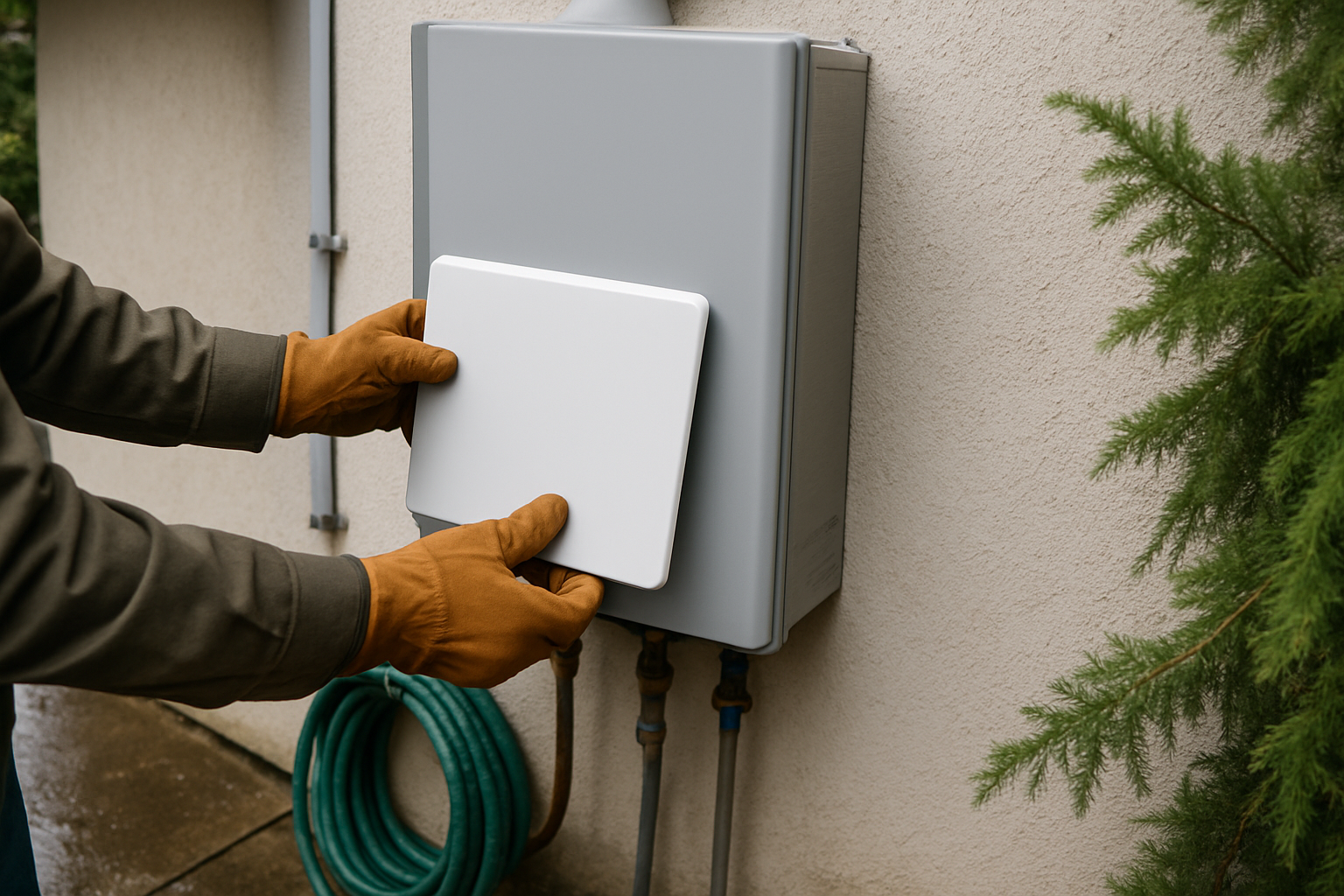
How is maintenance billed, and where do owners get surprised?
This is the murkiest line item in the whole agreement, and it is where I see the most confusion.
"We coordinate maintenance" can mean three very different billing models:
- The owner pays only the vendor's invoice, with coordination included in the monthly fee
- The owner pays the vendor invoice plus a flat coordination fee per work order
- The owner pays the vendor invoice with a percentage markup added
None of those is automatically wrong. But you should know which one you are agreeing to, in writing, before the first repair happens.
The second question matters just as much: who is doing the work? A manager with standing relationships with licensed and insured local vendors gets a plumber to a Seaside duplex faster and at a more predictable price than someone calling whoever answers. On the Peninsula, where salt air chews through exterior finishes and winter storms find every soft spot in a roof, response speed is not a small thing.
Ask how emergencies are handled at 11pm on a Sunday, and ask what dollar threshold requires your approval before work begins.
Fee line items and the question to ask about each
Here is the quick version I would run through with an owner comparing two proposals side by side. Every firm handles these differently, so treat the middle column as typical, not universal.
| Line item | Usually part of the monthly fee? | What to ask |
|---|---|---|
| Rent collection and late follow-up | Yes | How are late fees handled and who keeps them? |
| Tenant placement and screening | No, billed separately | Is it charged again at renewal? |
| Maintenance coordination | Depends on the firm | Flat fee, markup, or included? |
| Monthly owner statements | Yes | Can I see a sample statement? |
| Year-end income and expense summary | Often yes | Is it formatted for Schedule E? |
| Paying mortgage, insurance, property taxes | Sometimes an add-on | Can you pay these from collected rent? |
| Routine inspections | Usually limited number | How many per year, with photos? |
| Eviction handling and court time | No | What is billed hourly versus included? |
Annual cost of management versus annual risk of going it alone
Several owners have written in asking about fees and a rent estimate in the same message, which tells me they are doing the math before they commit. This is the math worth doing.
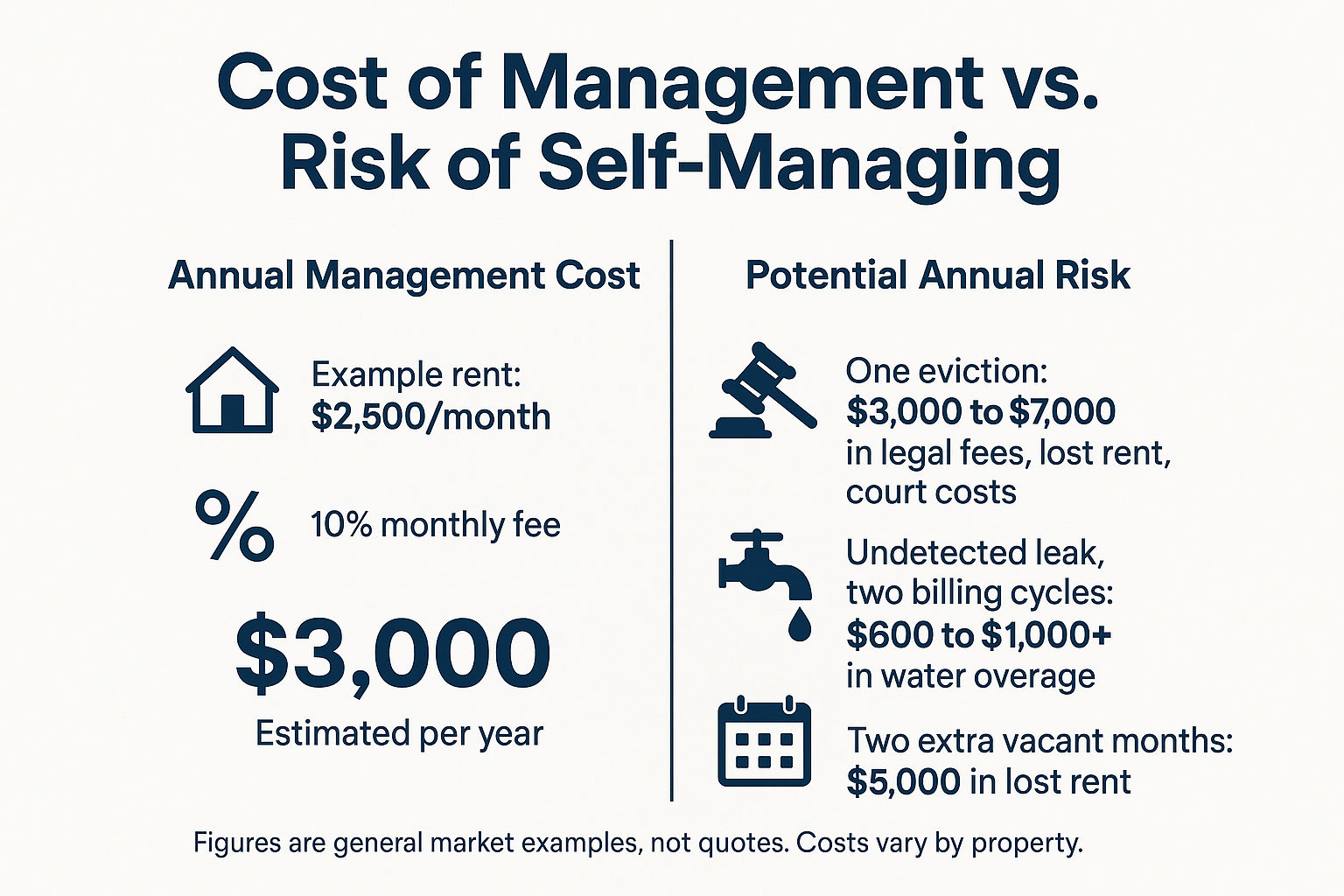
Is the fee worth it on a $2,500 Salinas rental?
Run the numbers rather than guessing. On a rental collecting $2,500 a month, a 10% monthly management fee works out to roughly $3,000 a year. That is the number to hold up against what can go sideways.
General market context, not a promise: an eviction in California often runs somewhere in the range of $3,000 to $7,000 once you add legal fees, lost rent, and court costs, and the process is slower than most first-time landlords expect. The California courts' self-help guide to eviction lays out the steps and gives you a realistic sense of the timeline.
A single undetected leak is smaller but still real. Two billing cycles of water running unnoticed on a Cal Am account can easily add $600 to $1,000 or more in overage before anyone notices the meter.
And two extra months of vacancy on that same Salinas house is $5,000 gone, which no fee structure can recover after the fact. Slow marketing and mispricing are the usual culprits.
What about tax season and owner reporting?
Owners underestimate this one until March. A clean monthly statement plus a year-end income and expense summary turns Schedule E preparation from an afternoon of shoebox archaeology into a short conversation with your accountant.
Some firms also pay owner obligations directly out of collected rents:
- Mortgage payments
- Property insurance
- Property taxes
That removes the timing headache entirely, which matters a lot for out-of-area owners and military families juggling a move. Ask whether it is included in the base fee or billed as an add-on.
Owner portal access belongs in the same conversation. One reviewer put it simply: "everything from payments to communication is easy to manage." If you are 500 miles away, that access is not a nicety. It is how you keep control of a Monterey property from a distance.
Does a manager increase profit or just maintain the property?
Honest answer: it depends on what you are comparing against.
Compared to a vacancy that stretched two extra months because of slow marketing, or a roof leak that turned into dry rot because nobody looked, professional management nearly always improves net annual income. Compared to an attentive local owner who already has a good plumber, knows California notice rules, and lives fifteen minutes from the property, the margin narrows considerably.
The owners who benefit most in my experience are the ones who are far away, stretched thin, or newly inherited into a rental they never planned to own. If you want the longer version of that argument, we wrote it up here: do property managers really increase profit.
At Torrente Property Management, we would rather an owner do that math clearly than sign up on a hunch.
Frequently Asked Questions About California Property Management Fees
What does the monthly property management fee cover in California?
Typically rent collection, tenant communication, maintenance coordination, monthly owner statements, lease compliance monitoring, and routine inspections. Tenant placement is a separate charge in most agreements.
Why is the leasing fee charged on top of the monthly fee?
Placing a tenant is one-time, front-loaded work: pricing, prep, photos, listings, showings, full screening, and lease drafting. Across the industry it commonly runs from about half a month's rent up to a full month's rent, depending on the firm and the property. Ask whether it is charged again at renewal, because that answer varies.
Do managers mark up repair invoices?
Some do, some charge a flat coordination fee, and some pass the vendor invoice through at cost. Get the model in writing before the first work order, and ask whether their vendors are licensed and insured.
Can a property manager pay my mortgage and property taxes from rent?
Many can, including us. It is worth asking whether that service sits inside the monthly fee or is billed as an add-on, since it varies by company.
Is management worth it on a single rental in Salinas or Marina?
On a $2,500 rental, a 10% fee is roughly $3,000 a year. If that single property is your only rental and you live nearby with good vendor contacts, the math is closer. If you are out of the area, or if one bad tenancy would genuinely hurt, the coverage usually pays for itself.
What is never included in a management fee?
Court costs and attorney fees for an eviction, capital improvements, insurance deductibles, and the actual cost of repairs. Those are owner expenses no matter who manages the property.
Want the numbers for your own property?
Every property in Monterey County is a little different, so the only fee figure that means anything is the one written against your actual address, rent, and condition. Our team works across Monterey, Salinas, Seaside, Marina, Pacific Grove, Carmel, and Pebble Beach, in English and Spanish. If you would like a straight walk-through of the line items for your place, we are reachable at (831) 582-8916 or through the contact form at torrenteproperties.com.

How Landlords in Salinas Find Tenants Who Actually Stay
Almost every owner who calls me about a Salinas rental says some version of the same thing: they just want good tenants. Sometimes it is a first-time landlord near Salinas Valley Memorial. Sometimes it is someone who already lived through a bad placement and is not willing to roll the dice again.
That worry is fair. Salinas has a deep, active renter pool, but the range in applicant quality is real, and one bad decision can cost you a year of income and repairs.
Here is what I have learned after years of placing tenants across Salinas, Seaside, and the Peninsula: the difference between a tenant who stays three years and one who leaves after eight months is almost never luck. It is screening, property prep, and how the tenancy is handled after move-in.
What a Real Screening Process Actually Includes
Most owners who self-manage run a credit check and call it done. A credit report is useful, but by itself it tells you very little about how someone treats a house.
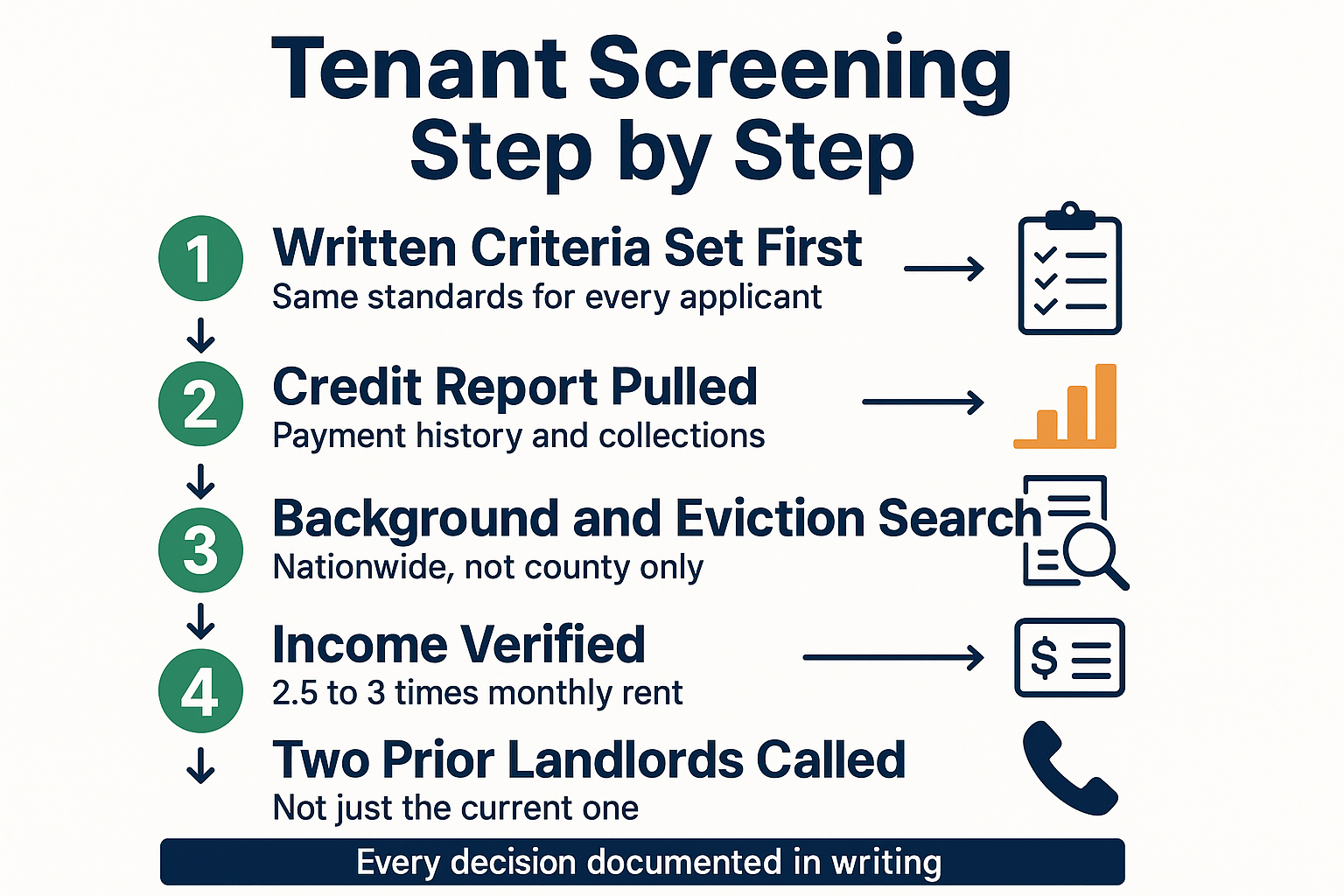
A complete screening for a Salinas rental should include all of the following, every time, for every adult applicant:
- A full credit report, not just a score
- A nationwide criminal background check, not a county-only search
- An eviction history search across California and other states
- Income or employment verification, typically at 2.5 to 3 times the monthly rent in gross income
- Calls to at least two previous landlords, not only the current one
That last item is the one I care about most. A landlord who is trying to get rid of a problem tenant has every reason to give a glowing reference and move the problem along.
The landlord before them has nothing to gain and usually tells you the truth. When I call two back, I ask specific questions: Did rent arrive on time? What did the unit look like at move-out? Would you rent to them again?
If you want the longer version of how this works step by step, I wrote about it in what a real tenant screening process looks like.
What Each Screening Step Catches and What It Misses
No single check gives you the whole picture. This is how I think about what each one is actually good for.
| Screening Step | What It Reveals | What It Misses |
|---|---|---|
| Credit report | Payment patterns, collections, debt load, prior rental collections | Cash-based finances, how someone treats a property |
| Criminal background check | Convictions across states, not just Monterey County | Nothing about payment reliability |
| Eviction search | Prior court filings and judgments | Move-outs settled informally with no filing |
| Income verification | Whether rent is realistically affordable | Job stability, hours that fluctuate seasonally |
| Prior landlord calls | Real behavior: late rent, damage, neighbor complaints | Only as good as the questions you ask |

The Applicant Pool Is Decided Before Anyone Applies
You cannot screen your way to a great tenant if only weak applicants apply. The listing itself sets the pool.
A Salinas rental posted on one free classified site with four dark cell phone photos pulls a different crowd than the same home listed with clean photography and pushed to the major rental platforms. Same house, different applicants.
Property prep before the photos matters just as much. Small things signal how you will run the tenancy:
- Deep clean, including inside appliances and window tracks
- Fresh paint on scuffed walls and touched-up trim
- Working light fixtures in every room, blinds open, photos shot in daylight
- Yard cut back and edged, exterior pressure washed if needed
- Smoke and carbon monoxide detectors tested and current
When someone walks into a unit that is clean and cared for, they read that as a landlord who pays attention. Applicants who plan to be careless self-select out. The ones who want a place they can settle into lean in.
I have seen owners save a few hundred dollars skipping prep and then lose far more sitting vacant an extra three weeks. There is a real checklist to this, and I walked through it in getting a Monterey Bay rental ready.
Pricing plays into it too. Overpriced listings sit, and the applicants who eventually apply are often the ones who could not qualify elsewhere. How rental prices actually get set is worth reading before you pick a number.
The Screening Sequence I Follow
This is the order I work through an application, and why each step comes where it does.
Fair Housing Rules Limit What You Can Screen On
This is where self-managing owners get into trouble without meaning to. California fair housing law applies in full in Salinas, and it is stricter than federal law in a few places.
A few things owners often get wrong:
- Source of income is protected. You cannot reject an applicant because they hold a Section 8 voucher. When a voucher covers part of the rent, the income test applies to the tenant's share, not the full rent.
- Screening standards must be identical for everyone. Asking one applicant for extra documentation and not another is how complaints start.
- Advertising language matters. Phrases describing who the home would "suit" can be read as steering.
The California Civil Rights Department publishes the current protected classes and enforcement process, and it is worth a read if you are placing a tenant yourself.
The protection here is documentation. When I have written criteria applied the same way to every applicant, and a file showing exactly how each application was scored, a complaint has something factual to run into.
One more Salinas-specific item: the city's Residential Rental Registration program applies to rental properties in city limits, and California capped most security deposits at one month's rent as of July 1, 2024. That cap changes the math on how much cushion you have if a placement goes badly, which is another reason to get the screening right upfront.
Keeping the Tenant Is Where the Money Actually Is
Owners think hard about placement and almost never think about retention. That is backwards, because turnover is expensive.
Every turnover in Salinas costs you some mix of:
- Lost rent during the vacant weeks
- Cleaning, paint, carpet, and repair between tenants
- The leasing fee if a professional handles the placement
- Your own time on showings and paperwork
Costs vary by property and condition, but a single turnover often runs into the equivalent of a month or more of rent once everything is added up. A tenant who renews for one extra year keeps that money in your pocket.
Retention starts at placement, with honest conversations. If the water heater is on its last legs or street parking is tight, say so before they sign. Tenants who feel misled at move-in start looking early.
After that, it comes down to boring consistency: maintenance requests answered quickly, clear communication about lease terms, and rent increases handled with proper notice. Our reviews say it better than I can, with tenants describing the process as "straightforward and fast" and repairs handled "timely."
That is not a courtesy. It is what makes someone renew instead of packing. If you are weighing how much of this you want to handle yourself, tenant placement versus full management breaks down where the line usually falls.
Frequently Asked Questions About Finding Good Tenants in Salinas
How much income should a Salinas applicant have?
The common standard is gross monthly income of 2.5 to 3 times the rent. Whatever number you pick, apply it identically to every applicant and put it in writing before you start showing the property.
Can I refuse an applicant with a Section 8 voucher?
No. Source of income is a protected class in California, and that includes housing vouchers. You can still screen for credit, rental history, and background, and you apply your income standard to the tenant's portion of the rent rather than the full amount.
How long does it usually take to fill a Salinas rental?
It depends heavily on price, condition, and time of year. A well-priced, clean home with good photos generally moves faster than an overpriced or dated one. Listings that sit for weeks are almost always telling you something about the rent number or the prep work.
Is it worth checking landlords beyond the current one?
Yes, and I would call it the single highest-value step. A current landlord who wants a problem tenant gone has a reason to be generous. The landlord two moves back usually gives you the honest version.
What if I already have a tenant I inherited when I bought the property?
You take the tenancy as it stands, including the existing lease terms. Get the lease, deposit records, and payment history in hand right away, then focus on clean communication going forward. Many inherited tenants turn into long-term ones once someone starts answering the phone.
Thinking Through Your Next Placement in Salinas?
If you own a rental in Salinas, Monterey, or anywhere along the Monterey Bay and want to talk through screening criteria, prep, or what your home would realistically rent for, our team at Torrente Property Management is happy to have that conversation. You can reach us at (831) 582-8916 or through the contact form at torrenteproperties.com. We work in both English and Spanish, and we are here in Monterey County year-round.

Renting Out a Seaside Property: What the Local Market Actually Requires
Almost every Seaside owner who contacts me opens with the same two questions. What will my property rent for, and what do I need to do to get it ready?
Those are the right questions. Seaside is one of the busier rental markets on the Monterey Peninsula, with military personnel connected to the former Fort Ord area, civilian workers commuting to Monterey and Salinas, and families who got priced out of Pacific Grove and Carmel.
I have seen these inquiries come from every kind of Seaside owner: 2-bedroom single-family homes, townhomes, and owner-occupied houses with a back unit. Below is what the local market actually asks of you before a tenant ever signs.
Pricing a Seaside Rental: County Averages Will Cost You Money
The most common mistake I see is an owner pulling a rent estimate for "Monterey County" and treating it as gospel. Seaside is not one market. Rents move block by block.
A home near the Fremont Boulevard corridor with off-street parking prices differently than a similar house up in the hills with a steep driveway and no garage. Condition matters just as much as the bedroom count.
Here is what actually goes into a local rent analysis:
- What comparable units leased for in the last 60 to 90 days, not what they were listed at
- Kitchen, flooring, and paint condition, which can swing rent more than square footage
- Off-street parking, a real value driver in Seaside neighborhoods with tight street parking
- Laundry hookups, garage access, and usable yard space
- Commute access to Highway 1, downtown Monterey, and the CSUMB area
- Whether utilities are separately metered, which matters for duplexes and back units
The cost of guessing goes both ways. Overprice by a small amount and you may sit vacant an extra three or four weeks, which usually wipes out a full year of the difference you were chasing.
Underprice and you lock that number in for the length of the lease. If you want context on how management fees fit into the overall math, we covered what property management actually costs in the Monterey Bay area in a separate breakdown.
What Moves Rent in Seaside
These are the factors I weigh most heavily when I price a Seaside home, and the ones owners tend to overlook.
| Factor | Why It Matters in Seaside | What Owners Often Miss |
|---|---|---|
| Parking | Street parking is tight in many neighborhoods | A garage or driveway can shorten vacancy noticeably |
| Kitchen and flooring condition | Tenants compare against newer Marina and East Garrison inventory | Cosmetic updates often pay back within the first lease term |
| Commute position | Tenants work in Monterey, Salinas, and the CSUMB area | Minutes to Highway 1 affects applicant volume |
| Laundry | In-unit or hookups are a top filter for family renters | Shared laundry limits the applicant pool |
| Furnished vs unfurnished | Some military and travel-role tenants prefer furnished | Furnished changes pricing, wear, and deposit handling |
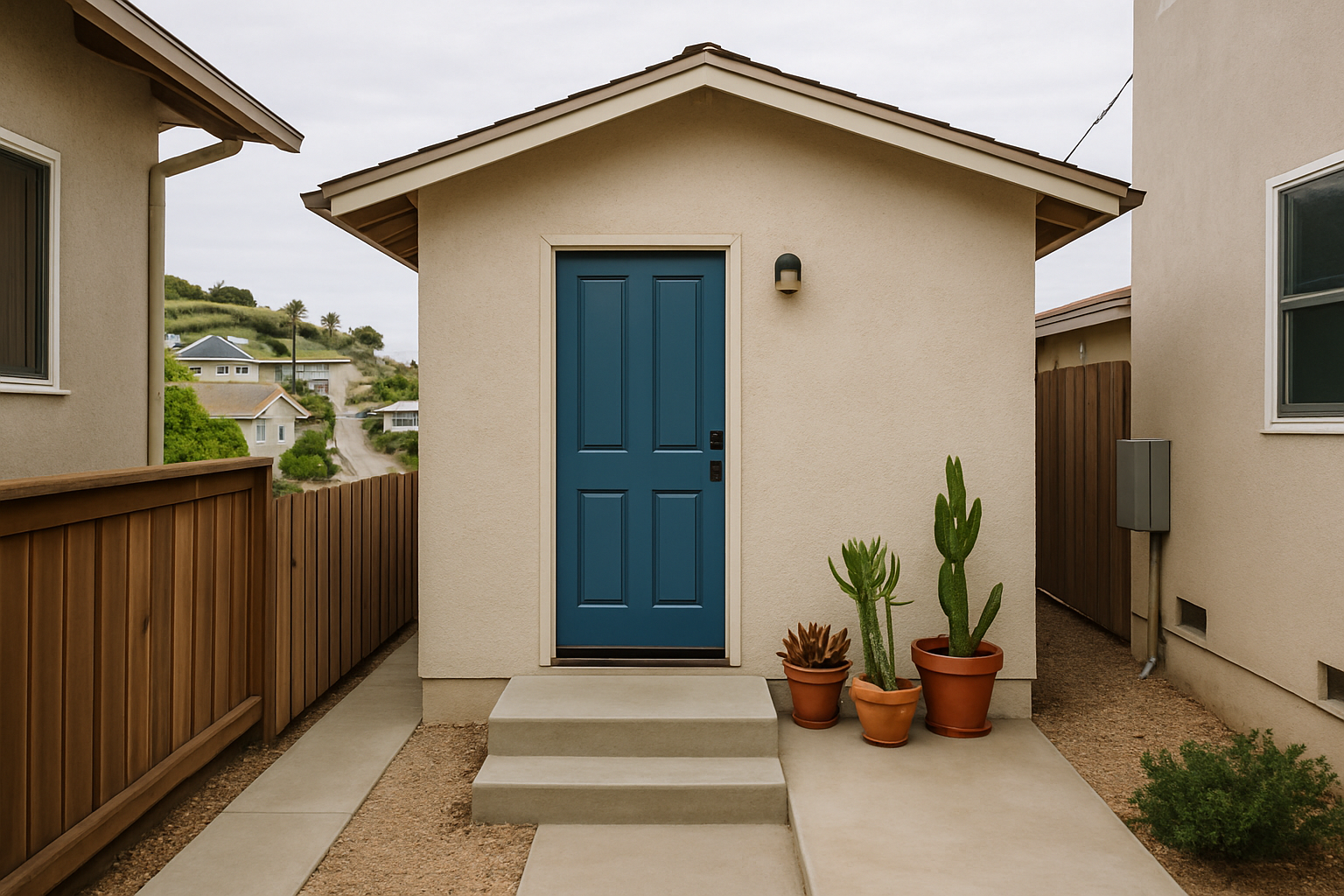
Renting an ADU or Your Own Home Does Not Change the Rules
Two Seaside situations come up constantly. One is the owner moving out of their primary residence and renting it. The other is the owner staying put and renting the accessory unit out back.
Both of these turn you into a landlord under California law, with the same obligations as any other rental property owner. Living twenty feet away does not create an exemption.
That means you are responsible for:
- Habitability standards, including working heat, plumbing, hot water, and weatherproofing
- Smoke and carbon monoxide detectors in the required locations, tested and documented
- Required lead paint disclosure for homes built before 1978, which describes a lot of Seaside housing stock
- 24 hours written notice before entering, even for a unit in your own backyard
- Consistent screening standards applied to every applicant, which is a fair housing requirement, not a preference
One more detail catches owner-occupants regularly. If a single utility meter serves both your living space and the rental unit, California requires you to disclose that in writing and spell out how the cost is handled before the tenant signs.
The informal handshake version of this arrangement is where most disputes start. Written lease, written disclosures, documented condition. If you have never done this before, what landlords wish they knew before renting their first property is worth reading first.
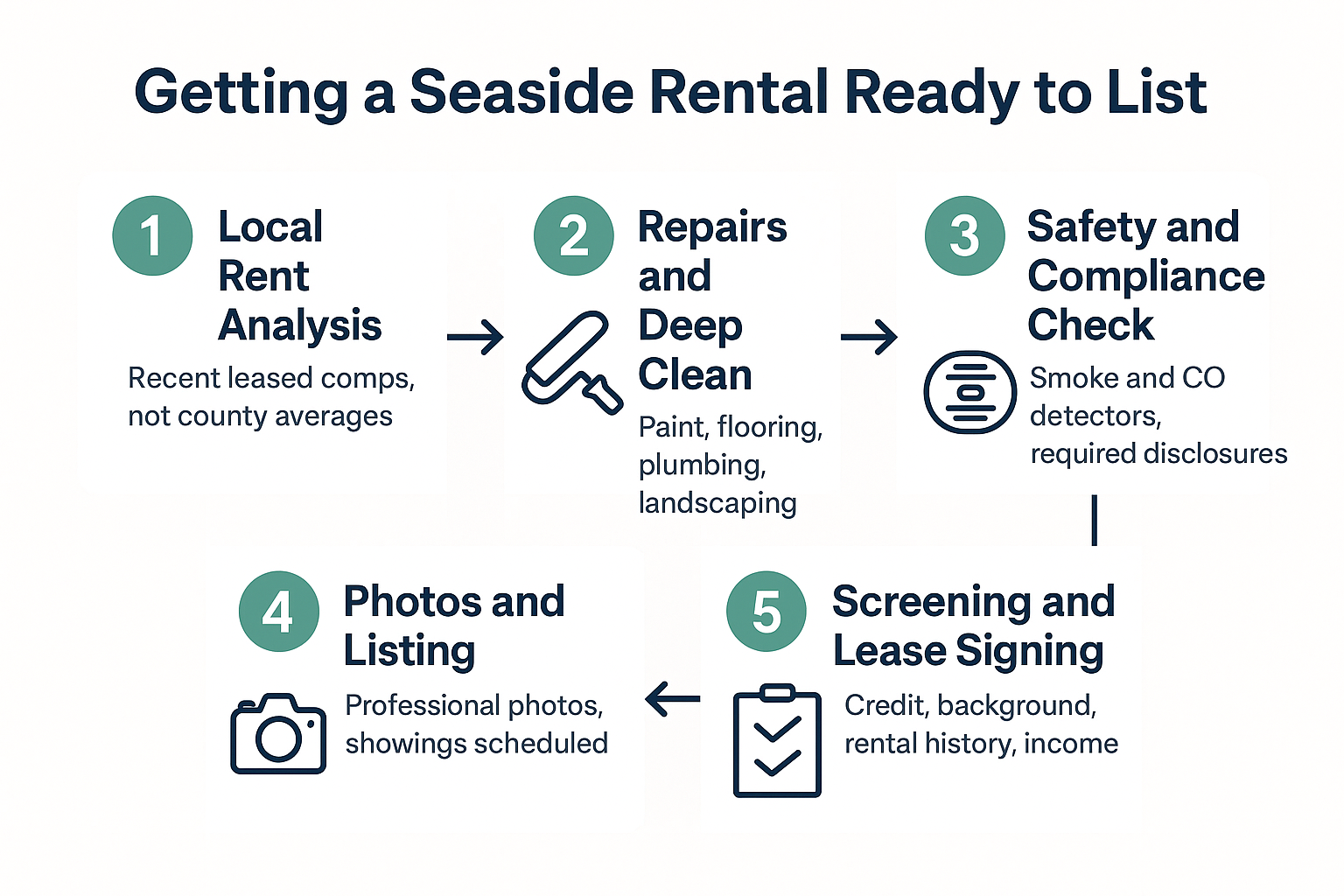
The Order I Work Through a Seaside Turnover
Owners often want to list first and fix later. It works better in the other order, and here is the sequence I follow.
The Deposit Cap Changed the Math for Seaside Landlords
This is the change I spend the most time explaining. As of July 1, 2024, California caps most residential security deposits at one month's rent, furnished or unfurnished.
Before that, an unfurnished rental could carry a deposit of up to two months. On a Seaside rental at $2,500 a month, the maximum cushion dropped from $5,000 to $2,500. You can read the bill text through the state's official California legislative information portal.
There is a narrow exception for small landlords who are natural persons owning no more than two residential rental properties totaling no more than four units. That exception does not apply when the tenant is an active duty servicemember, which matters a great deal in Seaside. Confirm your own situation with an attorney before you rely on it.
Less cushion means the front end of the process has to carry more weight:
- Thorough screening, meaning credit, nationwide criminal background, eviction history, and verified income and employment
- Photo and video documentation of every room, appliance, wall, and floor before move-in, dated and stored
- A signed move-in condition checklist that the tenant actually walks through with you
- An itemized deposit statement with receipts within 21 days of move-out, which is the legal deadline
- Awareness that tenants can request a pre-move-out inspection so they have a chance to fix issues themselves
When a deposit dispute goes sideways, it is almost never because the landlord was wrong about the damage. It is because nobody documented the before.
Why Maintenance Response Speed Matters More Here
Seaside's tenant pool includes a lot of military households, and in my experience they are excellent renters. They pay on time, they take care of the place, and they communicate clearly.
They also tend to have clear expectations about response standards, and they are more likely than the average tenant to put a maintenance request in writing and follow up through official channels if it goes unanswered. That is not a warning about military tenants. It is a reason to have a repair process that genuinely functions.
What that looks like in practice:
- Work orders submitted and tracked through a portal so nothing lives only in a text thread
- 24/7 coverage for true emergencies like water intrusion, no heat, or a roof leak during a winter storm
- Licensed, insured local vendors who already know the property and answer the phone
- Routine and move-in/move-out inspections so small problems get caught before they become claims
One owner review put the standard plainly: "their coordination and follow-through were timely and effective." That is the bar. If you are weighing how much of this you want to handle yourself, our comparison of tenant placement versus full management walks through the split.
Frequently Asked Questions About Renting Out a Seaside Property
What does a property management company in Seaside typically charge?
Most Monterey County firms structure fees as a percentage of collected monthly rent, with a separate one-time leasing or tenant placement fee. The percentage varies with property type, unit count, and how much prep the property needs, so the only honest number is a quoted one. Ask for the full fee schedule in writing, including what is and is not included in maintenance coordination.
Can I rent out my ADU while I am still living in the main house?
Yes, and it is common in Seaside. Just treat it as a real tenancy with a written lease, required disclosures, working smoke and CO detectors, and 24 hours written notice before you enter. If one meter serves both units, you have to disclose that in writing and agree on how the utility cost is handled.
How long does it usually take to lease a Seaside rental?
It depends far more on price and condition than on season. A well-priced, clean, move-in-ready home in a good Seaside pocket typically draws applications quickly, while an overpriced or dated unit can sit for weeks. The vacancy cost of an aggressive rent number almost always exceeds the extra income you were hoping for.
Do I have to accept a housing voucher?
In California, source of income is a protected category, and that includes housing choice vouchers. You can still apply your standard screening criteria to every applicant, but the income calculation has to account for the voucher portion. Apply the same standards to everyone and document them.
What if damage at move-out exceeds one month's rent?
You can pursue the balance beyond the deposit, but recovering it is a separate and slower process. That is exactly why the deposit cap raised the stakes on screening and on move-in documentation. Strong photo evidence and a signed condition checklist are what make a claim stick.
Thinking Through Your Seaside Rental?
If you own a home, townhome, or back unit in Seaside and you are working out what it should rent for and what needs to happen first, our team is local and happy to talk it through. We have been managing properties across Seaside, Monterey, Marina, and Salinas for more than two decades, in English and Spanish. You can reach Torrente Property Management at (831) 582-8916 or through the contact form at torrenteproperties.com.

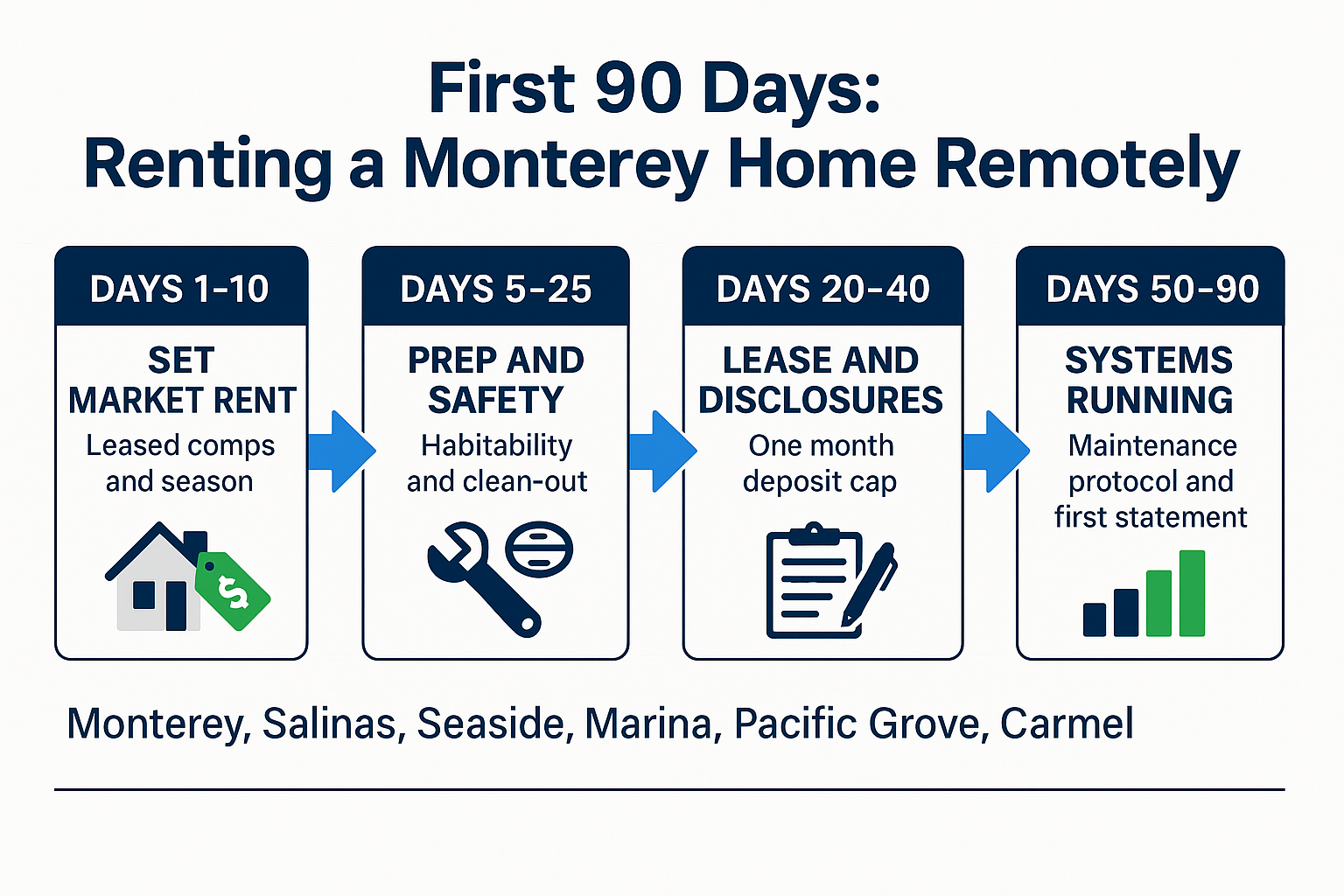
The First 90 Days of Renting Out a Monterey Home From Another State
You accepted a job in another state, or orders came through, or you just could not sell at the price you wanted. Either way, your Monterey home is about to become a rental, and you are about to become a landlord from 500 or 3,000 miles away.
The first 90 days decide almost everything. Rent price, prep work, the lease, the deposit, move-in photos, and that first 9 p.m. maintenance call all happen inside this short window.
I have watched owners handle this window well and I have watched it go sideways. Below is the timeline I would follow, week by week, for a home in Monterey, Seaside, Marina, Pacific Grove, or Salinas.
Days 1 to 10: Set the Rent Before You Set Anything Else
Almost every owner who contacts us about renting a home asks two questions in the same message: what do you charge, and what will my place rent for. That instinct is right. Everything else in the first 90 days depends on the rent number.
A real market rent analysis is not a Zillow guess. Here is what actually goes into it:
- Active comparables in the same submarket, because that is your live competition
- Recently leased comparables, which tell you what tenants actually paid, not what owners asked
- Size and condition adjustments for square footage, bed and bath count, parking, yard, and updates
- Neighborhood demand, which is very different in Pebble Beach than it is in the Alisal area of Salinas
- Seasonal timing, which people underestimate constantly
That last one matters more here than in most markets. Around the Peninsula, summer brings school moves, Naval Postgraduate School and DLI arrivals, and hospital hires. A 3-bedroom Monterey home listed in August often supports meaningfully more rent than the same home listed in November, and the spread can run in the range of a couple hundred dollars a month.
If your move date is flexible by even three weeks, that timing decision is worth having a conversation about before you list.
Days 5 to 25: Get the House Legally and Physically Rentable
This is the step first-time remote landlords skip, because when you lived there it felt fine. A home that was comfortable for you is not automatically a home that meets California habitability standards for a paying tenant.
At minimum, before anyone moves in, the property needs:
- Working plumbing with hot and cold water and no active leaks
- Working heat in every living area
- Safe electrical, including GFCI outlets near water and no exposed splices
- Smoke alarms in each bedroom, outside sleeping areas, and on every level
- Carbon monoxide alarms on every level with sleeping areas if there is gas, a fireplace, or an attached garage
- Working locks on all exterior doors and windows
Then there is the deferred stuff. Owner-occupied homes on the Peninsula almost always have a few of these waiting: a slow drain someone learned to live with, a sticking slider, dry rot on a south-facing trim board, a garage full of paint cans and holiday bins.
Clear all personal property out. Anything you leave behind becomes something you are responsible for repairing or replacing.
Cosmetics matter too, but only where they move the rent. Fresh paint, clean carpet, tidy landscaping, and clean windows typically pay for themselves in shorter vacancy. A remodeled kitchen usually does not, at least not in year one. If you want a fuller picture of what these line items add up to, we broke it down in the hidden costs of managing a Monterey home from out of state.

Days 20 to 40: The Lease Is Not a Formality
A lease you pulled off the internet or wrote from memory is where remote landlords get hurt. California requires specific disclosures in residential leases, and missing one can weaken your position later when it matters most.
The items that get left out most often:
- Megan's Law disclosure, required in essentially every residential lease. The state maintains the official Megan's Law database the notice points tenants toward.
- Lead-based paint disclosure and pamphlet for any home built before 1978, which covers a huge share of housing in Pacific Grove, downtown Monterey, and older Salinas neighborhoods
- Bed bug information notice
- Local addenda that apply to your specific city
On the deposit: as of July 1, 2024, most residential landlords in California are capped at one month's rent for the security deposit, furnished or not. If you were planning on two months because that is what you paid as a tenant years ago, that plan is out of date.
City rules stack on top of state rules. Salinas runs a Residential Rental Registration program for rental properties. The City of Monterey prohibits residential rentals of fewer than 30 days, so your lease term needs to respect that. Santa Cruz has its own rental inspection requirements.
Sign electronically, keep the executed copy somewhere you can retrieve it in 30 seconds, and give the tenant a full copy the same day.
The First 90 Days at a Glance
Here is the same timeline in one view, along with the spot where I most often see owners lose money or leverage.
| Phase | What Gets Decided | Where Owners Slip |
|---|---|---|
| Days 1-10 | Market rent, listing timing, rent vs sell | Pricing off a website estimate instead of leased comps |
| Days 5-25 | Habitability items, deferred repairs, clean-out | Leaving personal property and unfinished repairs behind |
| Days 20-40 | Lease, disclosures, deposit, city registration | Generic lease form missing required California disclosures |
| Days 35-50 | Screening, approval, move-in condition report | No dated photo record of condition at handover |
| Days 50-90 | Maintenance protocol, first statement, first inspection | No local responder and no written reporting baseline |
Days 35 to 50: Screen Well, Then Document the Handover
Screening is the last moment you have full control. Once keys change hands, your options narrow considerably.
A real screen covers credit, nationwide criminal background, eviction history, income and employment verification, and calls to prior landlords. Apply the same written standard to every applicant, every time.
Then document condition. This is the single cheapest insurance policy in the whole process:
- Dated photos of every room, including inside cabinets, closets, and the garage
- Photos of all appliances and their serial plates
- Exterior shots of roof edges, gutters, fencing, decks, and drainage
- Meter readings and detector test dates
- A written move-in condition report signed by the tenant
Without that record, a deposit deduction 24 months from now is your word against theirs. With it, the conversation is short and usually friendly.
Your 90-Day Remote Landlord Sequence
This is the order I would run it in, and roughly when each piece should land.
Days 45 to 60: Decide Who Answers the Phone at 2 a.m.
This is the part remote owners underestimate most. A tenant who cannot reach anyone about a repair is a tenant building a paper trail, and in California an unaddressed habitability issue can turn into a rent withholding or repair-and-deduct problem fast.
Set the protocol in writing before move-in, not after the first call:
- How requests get submitted, ideally through one portal so there is a timestamp
- Response standard for non-emergencies, commonly acknowledged within one business day
- What counts as an emergency: no heat, no water, active leak, sewage backup, gas smell, lockout, broken exterior door
- Who physically shows up, with a licensed and insured vendor already lined up for plumbing, electrical, and roofing
That last bullet is the one you cannot solve from Denver or Virginia Beach. A phone number is not a response. When a water heater lets go in a Seaside single-story at midnight, somebody has to be able to reach the shutoff within the hour.
Winter storms make this concrete. Monterey Bay gets driving rain and wind off the water, and roof leaks, clogged gutters, and water intrusion cluster in January and February. We wrote more about how distance changes day-to-day response in how out-of-area owners actually manage a Monterey Bay rental.
Days 60 to 90: Your First Owner Statement Sets the Baseline
Month one reporting is not busywork. If you do not have a clean record of month one, you have nothing to compare month six against.
A monthly owner statement should show, at minimum:
- Rent collected, with the date received and any late fee applied
- Deposits held, listed separately from income, because that money is not yours
- Itemized expenses with vendor name, invoice number, and what was done
- Management fee and leasing fee, shown as line items
- Owner obligations paid on your behalf, such as mortgage, insurance, or property taxes if that is part of the arrangement
- Net disbursement to you and the date it was sent
Keep every one of them. That file does three jobs later: it makes your Schedule E straightforward at tax time, it supports an insurance claim if storm damage hits, and it becomes the income record a buyer's lender asks for if you eventually sell with a tenant in place.
Round out the quarter with a first interior and exterior inspection. Ninety days in is early enough to catch a housekeeping problem, an unauthorized pet, or a slow leak while it is still cheap. For a sense of how fee structures work locally, see our breakdown of what property management really costs in Salinas.
A Few Monterey-Specific Wrinkles Worth Knowing
Some situations here come with their own rules and rhythms.
Military owners. PCS timelines rarely line up with the rental calendar, and deployment makes self-management close to impossible. We covered that in detail in PCS orders and your Monterey Bay home.
Furnished rentals. Plenty of Peninsula owners consider leaving the furniture, and it can work for the 30-day-plus corporate and academic market. It also changes your inventory, insurance, and condition documentation. Read renting your home furnished in the Monterey Bay area before you decide.
Vacancy between owner and tenant. If the home will sit empty for a stretch while you prep, it should still be checked on a schedule. Coastal moisture, wind, and unoccupied plumbing do not wait politely.
One more thing worth saying plainly. Our team works in both English and Spanish, which matters in Salinas and Seaside where a large share of owners and residents prefer Spanish. Communication gaps cause more landlord problems than almost anything else.
Frequently Asked Questions About Renting a Monterey Home From Out of State
How long does it usually take to get a Monterey home leased?
It depends on price, condition, and season. A well-priced, move-in ready home in Monterey or Marina during spring and summer often leases quickly, while the same home listed in late fall can take noticeably longer. Overpricing by even a small margin is the most common reason a listing sits.
Can I collect two months of security deposit if I am renting the home furnished?
Generally no. Since July 1, 2024, most California residential landlords are limited to one month's rent for the security deposit regardless of whether the unit is furnished. There is a narrow exception for certain small landlords, so confirm your situation before you write the lease.
What does property management cost around Monterey County?
Fees vary by property type, unit count, condition, and what is included. Most owners here see a monthly management fee based on a percentage of collected rent, plus a separate leasing fee when a new tenant is placed. Because the details differ property by property, the honest answer is to ask for a quote on your specific home.
Do I need to register my rental with the city?
Possibly. Salinas operates a Residential Rental Registration program, Santa Cruz has rental inspection requirements, and multifamily owners statewide are subject to SB 721 and AB 2579 balcony and exterior elevated element inspection deadlines. Rules depend on your city and property type, so check before you list.
Should I just have a friend or family member check on the place?
It works until it does not. A neighbor can grab mail, but they cannot legally screen applicants, hold a deposit in compliance with state law, or dispatch a licensed plumber at 2 a.m. That arrangement also strains the relationship the first time something goes wrong.
Planning your first 90 days as a remote Monterey landlord?
If you are working through rent pricing, prep, or the lease for a home in Monterey, Salinas, Seaside, Marina, Pacific Grove, or Carmel, our team is here in Monterey County and happy to talk it through. You can reach us at (831) 582-8916 or through the contact form at torrenteproperties.com. We work in English and Spanish, and there is no pressure either way.
5 Situations Where a Salinas Landlord Needs Professional Help
Almost nobody plans to hire a property manager. In my experience, owners call at a very specific moment, when something changes and the old way of handling the rental stops working.
I hear the same five stories over and over from owners in Salinas, Monterey, Seaside, and Marina. A tenant of many years gives notice. Military orders come through. A parent's house becomes your responsibility. The third rental tips the balance. Or a city notice shows up with a deadline on it.
This list walks through those five moments, what tends to go wrong in each one, and what to handle first. The goal is simple: help you see the tipping point coming instead of reacting to it after the fact.
1. A Long-Term Tenant Finally Moves Out After Years in the Home
This is the highest-stakes turnover there is, and most owners underestimate it. One Monterey owner reached out to us after tenants moved out following 31 years in the property. No recent rent data, no inspection records, no management structure in place.
When someone has lived in a home for a decade or more, three things are usually true at once:
- The unit needs far more prep than a normal turnover, from flooring and paint to appliances and dry rot repairs
- You have not priced or marketed the property in years, so your rent number is a guess
- There is no move-in condition report to compare against, which makes deposit decisions harder to defend
That last one matters because California's deposit rules changed. The one-month cap took effect July 1, 2024, which leaves less cushion for damage than owners used to have.
Getting the pricing right on the first listing is the part I would not wing. Overprice it and you sit vacant for weeks in a market where every empty month erases a big slice of annual return. Underprice it and you live with that number through renewals. Our guide to raising rent in 2026 explains how those decisions compound.

2. Military Orders Move You Out on a Short Timeline
This one is specific to our market. Between the Naval Postgraduate School in Monterey, the Defense Language Institute at the Presidio of Monterey, and the families spread across former Fort Ord housing in Marina and Seaside, we see a steady stream of owners who bought a home here and then received orders.
One caller described buying a Salinas home two years earlier, getting PCS orders, and needing to set rent, list it, screen applicants, and be gone within a few months.
The pressure in that scenario is not the paperwork. It is the calendar. You are packing, out-processing, and possibly house-hunting somewhere else at the same time.
What tends to slip when the timeline is tight:
- Screening gets rushed, and a weak applicant looks acceptable because the clock is running
- Deferred repairs go unaddressed and become emergency calls after you leave
- Nobody is local to handle a water heater failure or a storm-related roof leak in January
If you are going to be out of state, the handoff needs to be finished before you leave, not sorted out from three time zones away.
3. You Inherited a Property and There Is No Management in Place
Inherited rentals are their own category. Often an adult child in another county is suddenly responsible for a house in Salinas or Pacific Grove that a parent managed personally for decades, with handshake arrangements and no written records.
The common gaps I run into:
- No current written lease, or a lease from the 1990s that no longer matches California law
- Rent well below market, sometimes by hundreds of dollars a month
- No documentation of the security deposit that was originally collected
- Deferred maintenance on the roof, plumbing, and water heater that nobody tracked
If a tenant is still living there, you inherited that tenancy along with the building, including whatever protections and notice requirements come with it. Raising rent, updating the lease, and correcting deposit handling all have to be done in the right order.
And if the home is sitting empty while the family decides whether to rent or sell, that is where scheduled inspections and vacant home oversight matter. Empty houses on the Peninsula develop water intrusion and pest problems quietly, and nobody notices until the damage is expensive.
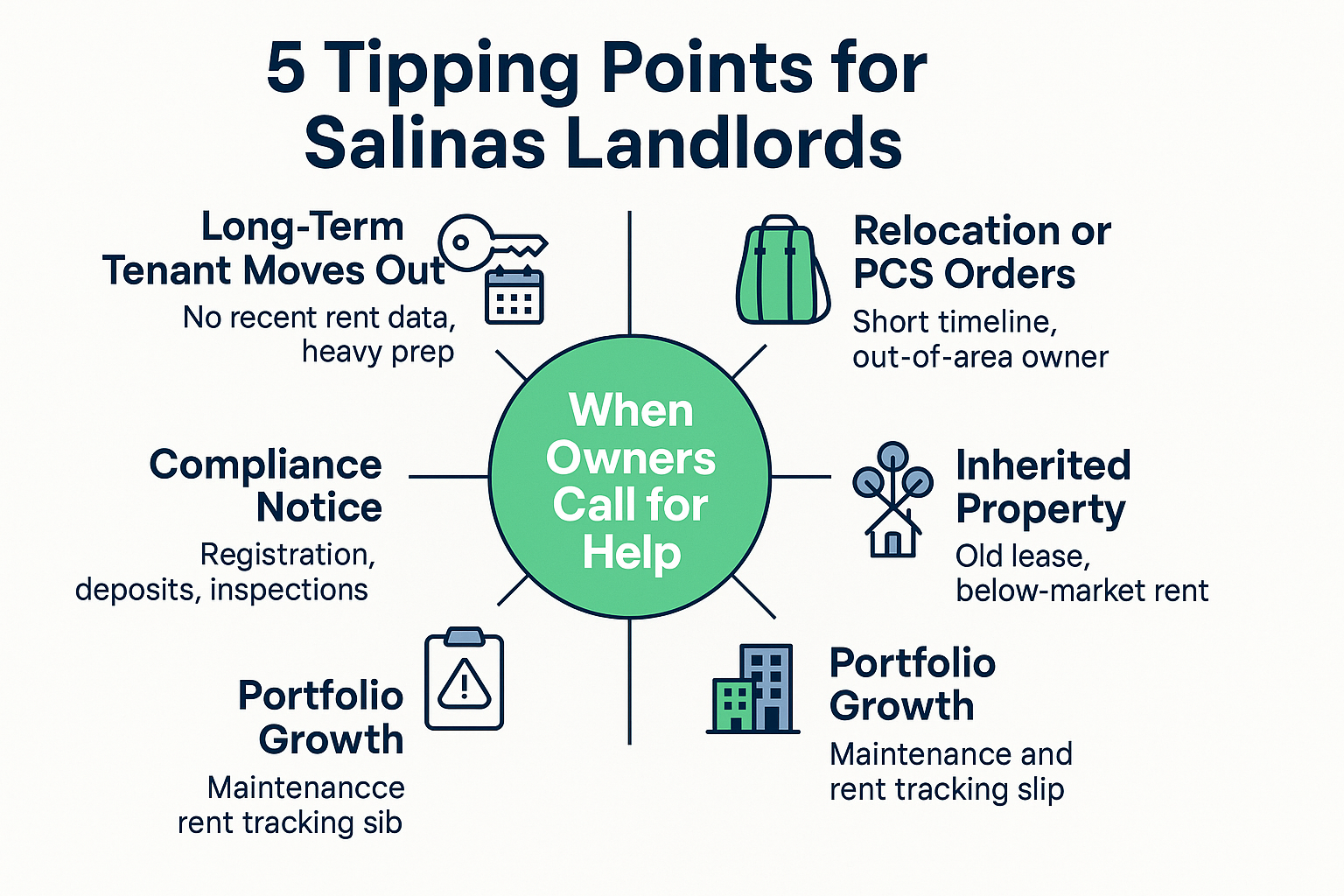
The Five Tipping Points at a Glance
Here is a quick visual of the five moments that most often push a Salinas owner from self-managing to hiring help.
4. Your Two or Three Rentals Have Outgrown a Spreadsheet
Owners are often surprised that the breaking point comes at three properties, not thirty. I get form submissions from owners with a handful of units across Salinas and the surrounding valley, and the symptoms are nearly identical every time.
One owner told us managing everything alone had become demanding as the portfolio grew, and they needed dedicated support to keep things running. That is the honest version of what scale feels like.
What breaks first:
- Maintenance requests pile up because you are the only intake point
- You stop knowing current market rent on each unit, so renewals default to whatever last year's number was
- Vendor scheduling eats your evenings, especially when one property has a plumber coming and another has a tenant moving out
- Bookkeeping gets fuzzy, which is a problem in January when your accountant asks for numbers
The fee math changes at this point too. Coordination overhead across several doors usually costs more in time, vacancy, and bad decisions than a management fee does. A long-time owner with several properties under our management put it plainly in a review: "everything runs smoothly." That is really what you are buying. Our breakdown of what Salinas landlords actually need from a property manager goes deeper on which pieces matter most.
5. A Compliance Notice Lands in Your Mailbox
This is the trigger nobody sees coming. An owner gets a registration violation letter or a housing complaint, and I hear from them within days.
The rules most often behind those calls in our area:
- Salinas Residential Rental Registration, which requires owners of covered rental units to register and keep that registration current. Our Salinas rental registration guide covers what the program asks for right now
- AB 12, which capped most residential security deposits at one month's rent as of July 1, 2024. You can read the bill text on the California Legislature's website
- SB 721 and AB 2579 balcony and exterior elevated element inspections for multifamily buildings with three or more units, with ongoing re-inspection cycles after the first report
- Smoke and carbon monoxide detector requirements, which come up during any complaint-driven inspection
Each of these carries real financial exposure if you ignore it. The frustrating part is that fixing them before a notice arrives is usually straightforward and cheap. Fixing them under a deadline, with a fine attached, is neither.
What to Handle First in Each Situation
If you recognize yourself in one of the five, here is where I would start.
| Situation | Biggest Risk | First Move |
|---|---|---|
| Long-term tenant moves out | Mispriced rent and undocumented condition | Get a current rental pricing analysis and a photo-documented condition report |
| Military or job relocation | Rushed screening under time pressure | Lock in the leasing and screening process before your report date |
| Inherited property | Outdated lease and unclear deposit history | Review the existing tenancy documents and current rent versus market |
| Two or more rentals | Missed maintenance and stale renewals | Centralize maintenance intake and reporting in one place |
| Compliance notice | Fines and repeat violations | Confirm registration status and detector compliance in writing |
Frequently Asked Questions About Landlord Services in Salinas
What do property management fees usually look like in the Salinas area?
Fees in Monterey County are commonly structured as a percentage of collected rent for ongoing management, plus a separate leasing or tenant placement fee when a unit turns over. The actual number depends on property type, unit count, condition, and how much prep work is involved, so it is worth asking for a written quote on your specific property rather than working from a general range.
Can I hire help just for tenant placement instead of full management?
Yes, and we get this question often from owners who feel comfortable handling rent collection themselves. Placement-only work covers property prep, pricing, marketing, showings, full credit, background, and rental history screening, and lease drafting and execution. After that, the day-to-day is yours.
I am being relocated in two months. Is that enough time?
Usually, yes, but it is tight if the home needs prep work. The sequence that works is a condition walkthrough and repair list first, then pricing and marketing, then screening. Starting the conversation early gives you the option of overlapping prep with your own packing instead of stacking everything into the final weeks.
The house is empty while my family decides whether to rent or sell. What happens in the meantime?
Vacant homes in the Monterey Bay area need eyes on them, especially in winter. Scheduled inspections that check the roof, gutters, drainage, plumbing, water heater, and detectors, with photo documentation sent to you, catch the small problems while they are still small. That applies to seasonal homes on the Peninsula as much as vacant rentals in Salinas.
Do you work with Spanish-speaking owners and tenants?
Yes. We handle communication in both English and Spanish, which matters in the Salinas and Monterey rental markets where a large share of owners and residents prefer Spanish.
Recognize Your Situation on This List?
If one of these five moments is in front of you, a short conversation about your property and your timeline is usually enough to tell you what needs attention first. Our team works with owners across Salinas, Monterey, Seaside, Marina, Pacific Grove, Carmel, and Pebble Beach, and we are glad to talk through the specifics with you in English or Spanish. Torrente Property Management can be reached at (831) 582-8916 or through the contact form at torrenteproperties.com.

How Maintenance Decisions Affect Your Rental's Bottom Line in Salinas
Rent hits your account every month. The property looks fine from the outside. And yet the numbers at the end of the year never quite match what you expected.
After more than two decades handling rentals across Salinas, Monterey, and Seaside, I can tell you where most of that money goes. It is almost never one big disaster. It is small repairs handled late, at the worst possible hour, at the worst possible price.
Below I walk through the actual math on deferred maintenance, why water leaks cost more here than in most of California, and what a real seasonal calendar looks like for a Salinas Valley rental.
The Real Math on a Deferred Repair
Let me use a water heater, because I see this one constantly.
At a routine inspection, a tech notices rust weeping at the base of a 12 year old tank and a slow drip into the pan. Nothing has failed yet. You schedule the replacement for a Tuesday morning three weeks out.
That job is a known quantity. Costs vary by unit size, venting, and whether the install triggers code items like seismic strapping or an expansion tank, but it is one planned invoice at a standard daytime labor rate.
Now run the other version. Nobody looked at it. The tank splits at 9 pm on a Saturday in a Creekbridge rental with the water heater in the garage.
Here is what that turns into:
- After-hours labor. Contractors around Monterey County generally bill emergency and weekend calls at something like 1.5 to 2.5 times their normal daytime rate.
- Water damage. Fifty gallons across a garage slab, sometimes into an adjoining hallway or closet.
- Drying and remediation. Fans, moisture readings, possibly baseboard and drywall.
- Flooring repair. Especially if the water reaches carpet or laminate.
- Tenant goodwill. Sometimes a rent credit, sometimes just a tenant who now doubts you.
Same water heater. The second version can easily land at several times the cost of the first. The only difference was whether anyone was looking.

Why Water Leaks Punish Owners Harder on the Monterey Peninsula
This is the one that surprises out of area owners the most.
Water on the Monterey Peninsula is metered and priced in tiers. In the Cal Am service area covering Monterey, Pacific Grove, and Seaside, going over an allotment does not just cost more per gallon. It can also pull in conservation related surcharges on top of the overage.
So a running toilet flapper, a thirty cent part, becomes expensive fast. A slow leak under a kitchen sink that nobody reports for 30 to 60 days can add hundreds of dollars to a bill, and the household never used a drop of that water on purpose.
Salinas owners are not off the hook either. Tiered residential rates are the norm across the valley, and irrigation leaks in a back yard system can run for weeks without anyone noticing.
Here is the part that hurts more than the bill. When a tenant pays water and gets a bill three times normal because a repair sat in a queue, you have created a real dispute.
I have watched owners lose tenants who paid on time for years over exactly this. Replacing that tenant costs a turnover, a vacancy, and new leasing fees. The remedy is boring and cheap: regular inspection cadence plus fast repair response.
Caught Early Versus Caught Late
This is not a price list. It is a comparison of how the same five issues behave depending on when they get found.
| Issue | Found at a scheduled inspection | Found after failure |
|---|---|---|
| Water heater showing rust and a slow drip | Planned weekday swap, one invoice, standard labor rate | After-hours call at roughly 1.5 to 2.5x daytime rate, plus drying and flooring repair |
| Running toilet or slow sink leak | Minor part and short labor visit | Inflated water bill over 30 to 60 days, possible conservation surcharge, tenant dispute |
| Clogged gutters and blocked downspout | Seasonal cleaning before the rains | Fascia rot, stucco staining, sometimes an interior ceiling leak claim |
| Aging HVAC or wall heater | Off-season service or planned replacement | Emergency call during a heat spike, long wait for a licensed tech, uncomfortable tenant |
| Dry rot at window trim or fascia | Localized wood repair and repaint | Framing repair, window replacement, water intrusion investigation |
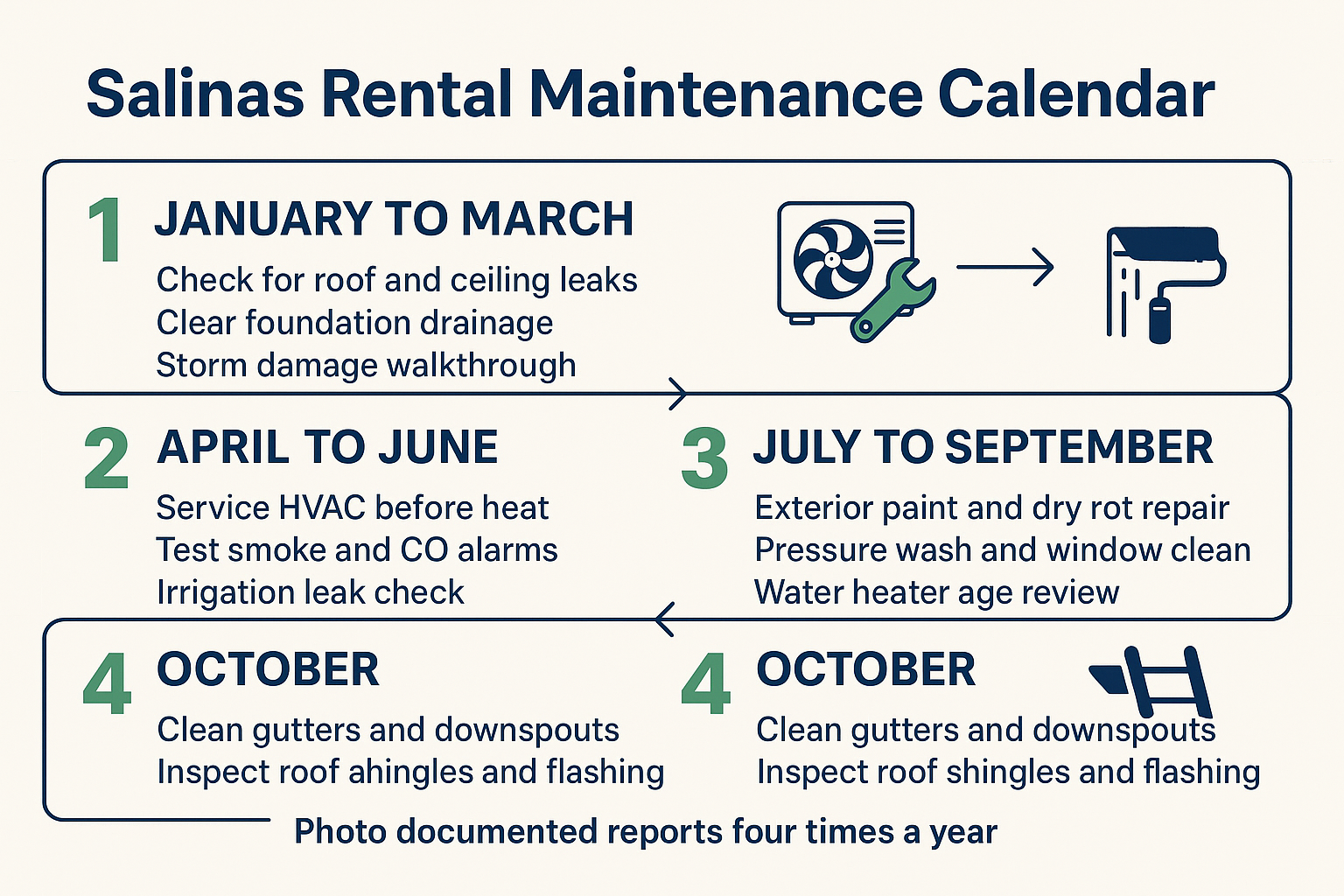
A Maintenance Calendar for a Salinas Valley Rental
Seasonal work here follows a real schedule. Coastal fog, valley heat, and a concentrated November through March rainy season each set their own deadlines.
October Is the Deadline That Costs the Most to Miss
Most of the expensive winter claims I see trace back to work that did not happen in October.
Our rain arrives in a narrow window. When it comes, it comes hard, and a blocked downspout has nowhere to send that water except into siding, fascia, or a foundation.
The pre-rain list is short and it has clear financial logic behind every item:
- Gutter and downspout cleaning. Full gutters back water up under the roof edge.
- Roof inspection. Missing, curling, or lifted shingles and cracked flashing around vents and chimneys.
- Drainage clearing at the foundation. Grade, area drains, and anything that redirects runoff away from the slab.
- Dry rot check at fascia boards and window frames. Soft wood in October becomes an open door in January.
- Weather sealing. Door sweeps and window caulking, especially on the wind-exposed sides.
An owner who skips this in October is often filing a roof leak claim by mid January. And an insurance claim carries a deductible, a paper trail, and future premium consequences that a gutter cleaning does not.
If you want a deeper walkthrough of storm season prep, we covered it in detail in getting your Monterey Bay rental ready for a heavy winter.
Detectors Are Not Just Maintenance, They Are a Legal Obligation
This one is not about money directly. It is about exposure.
California requires working smoke alarms in every sleeping area and hallway leading to sleeping areas. Carbon monoxide devices are required in dwelling units with an attached garage or any fossil fuel burning appliance, which covers most single family rentals in Salinas and Monterey. The requirement sits in California Health and Safety Code section 17926.
Here is the part owners get wrong. The obligation is on you, not the tenant.
Waiting for a tenant to mention a chirping alarm is not compliance. And if something happens, "nobody told me" is not a defense.
Routine inspections that test each device and log the result are the practical answer. Photo documentation with a date on it is what turns a maintenance task into actual evidence that you met the requirement.
Vendor Access Is Part of the Cost Equation
Self-managing owners often tell me they can hire the same plumber I can. Usually true. The difference is when you get on the calendar.
Picture a September heat spike in Salinas. Every landlord in the city is calling the same small pool of licensed HVAC contractors on the same afternoon. A cold caller with one unit sits behind everyone with an existing account.
Steady volume changes that in two ways:
- Faster scheduling, because you are a repeat customer rather than a one-off job.
- Steadier pricing, since regular work rarely gets quoted at walk-in rates.
- Known quality, because I already know which vendors show up and which do not.
Fewer days without heat or AC means fewer angry tenants and fewer renewal problems. That is a real line item, even though it never shows up on an invoice.
Several owners have reached out to us after realizing that distance made this impossible to manage well, which is the same reason many owners eventually decide that self-managing has stopped making sense. One long-time client put it simply in a review: their properties "run smoothly" because someone local is handling response times.
Frequently Asked Questions About Rental Maintenance in Salinas
How often should a Salinas rental actually be inspected?
For an occupied single family rental, quarterly works well for exterior and system checks, with move-in and move-out inspections on top of that. Our Seasonal Property Maintenance Program runs on that cadence and delivers a photo documented report four times a year, which matters most for vacant homes and out-of-area owners.
Who pays for maintenance, the owner or the property manager?
The owner pays for the work. A manager coordinates the vendor, reviews the invoice, and reports the cost on your monthly statement. Fee structures vary by property and scope, so the honest answer on your specific numbers comes from a conversation, not a website. We break down the general landscape in our article on what property management really costs in Salinas.
Can I just have my tenant report problems as they come up?
Tenants report what they notice. They do not notice a rusting water heater in a garage, a hairline crack in roof flashing, or a slow irrigation leak in a side yard. Those are exactly the items that get expensive, which is why scheduled inspection beats waiting for a phone call.
Does a repair budget make sense for a single rental?
Yes. Setting aside a reserve each month smooths out the years when a roof, a heater, and an appliance all come due together. The right number depends on the age of the home, the systems in it, and whether you are in a 1950s Oldtown Salinas house or a newer build in Marina or East Garrison.
Do I have other Salinas compliance items besides detectors?
Yes. Salinas runs a Residential Rental Registration program, and California's security deposit cap changed to one month's rent as of July 1, 2024 for most residential rentals. Both are separate from maintenance but they hit the same owners, and both are worth confirming before your next lease.
Want a Clearer Picture of Your Property's Maintenance Position?
If you own a rental in Salinas, Monterey, Seaside, or anywhere from Prunedale down to King City, we are glad to talk through where your property stands and what a realistic maintenance calendar would look like for it. Our team is local, bilingual in English and Spanish, and available at (831) 582-8916 or through the contact form at torrenteproperties.com. No pressure, just a straight conversation about your property.
What New Multifamily Owners in Marina Need to Know Before Renting
Owning one rental house teaches you a lot. Owning a 15-unit multifamily property teaches you that almost none of it transfers.
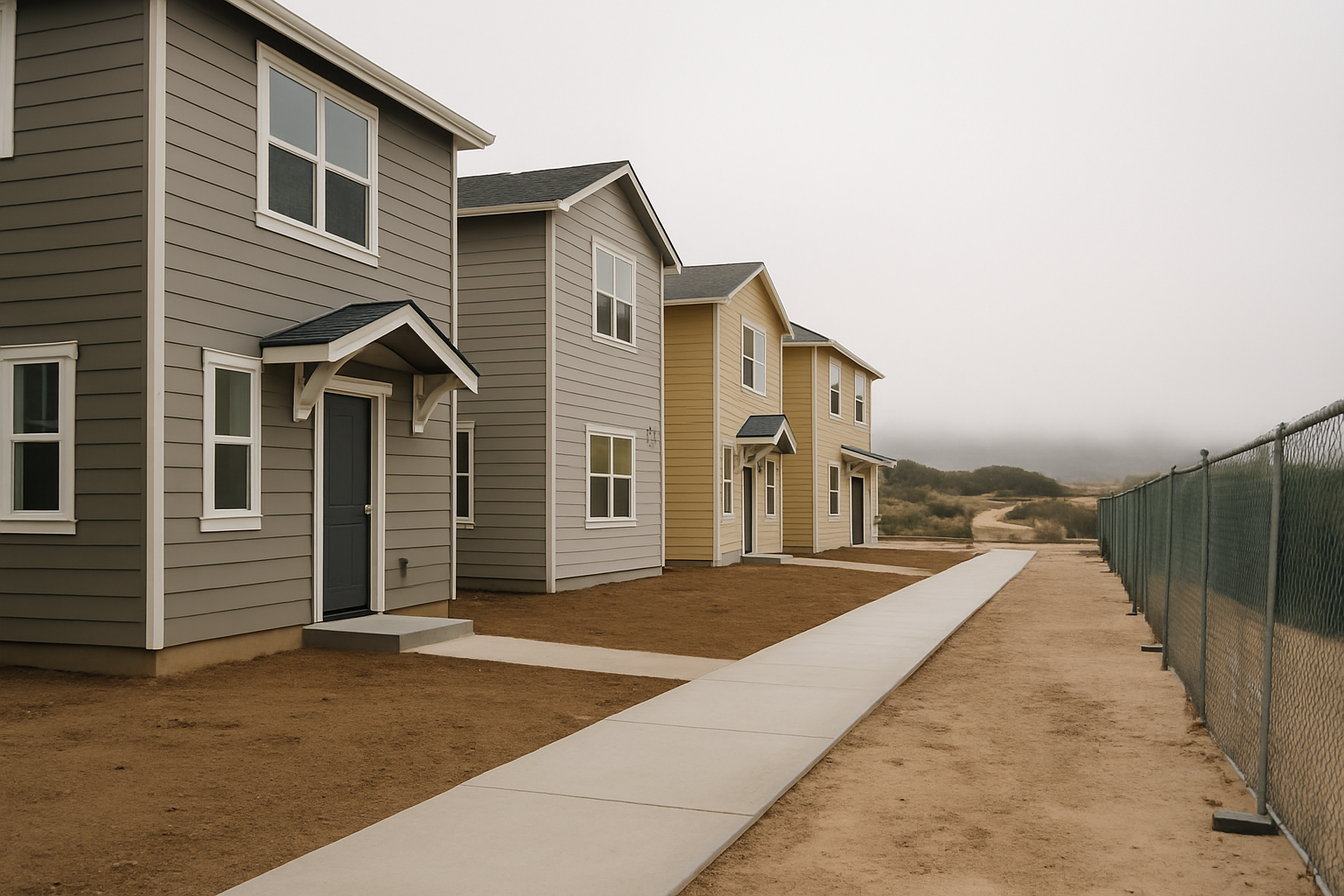
I've watched Marina grow from a quiet stretch past the Fort Ord gates into one of the busiest building markets in Monterey County. New multifamily projects are going up on small parcels, and the owners behind them are often people who have never leased more than one unit at a time.
The three things that trip them up are always the same: lease-up timing, per-unit pricing, and the paperwork and maintenance load that arrives the day the first tenant moves in. That's what I want to walk through here.
Lease-Up Is a Schedule Problem, Not a Marketing Problem
With a single-family home, you list it, show it, and fill it. With three 5-plex buildings, you are running fifteen small leasing campaigns that all compete with each other.
Here's what that actually looks like. If your certificate of occupancy lands in September, you have missed the peak Monterey Bay leasing window, which runs roughly April through August when families relocate and CSU Monterey Bay and Naval Postgraduate School households are shuffling housing.
That doesn't mean you can't lease in fall. It means the plan has to change:
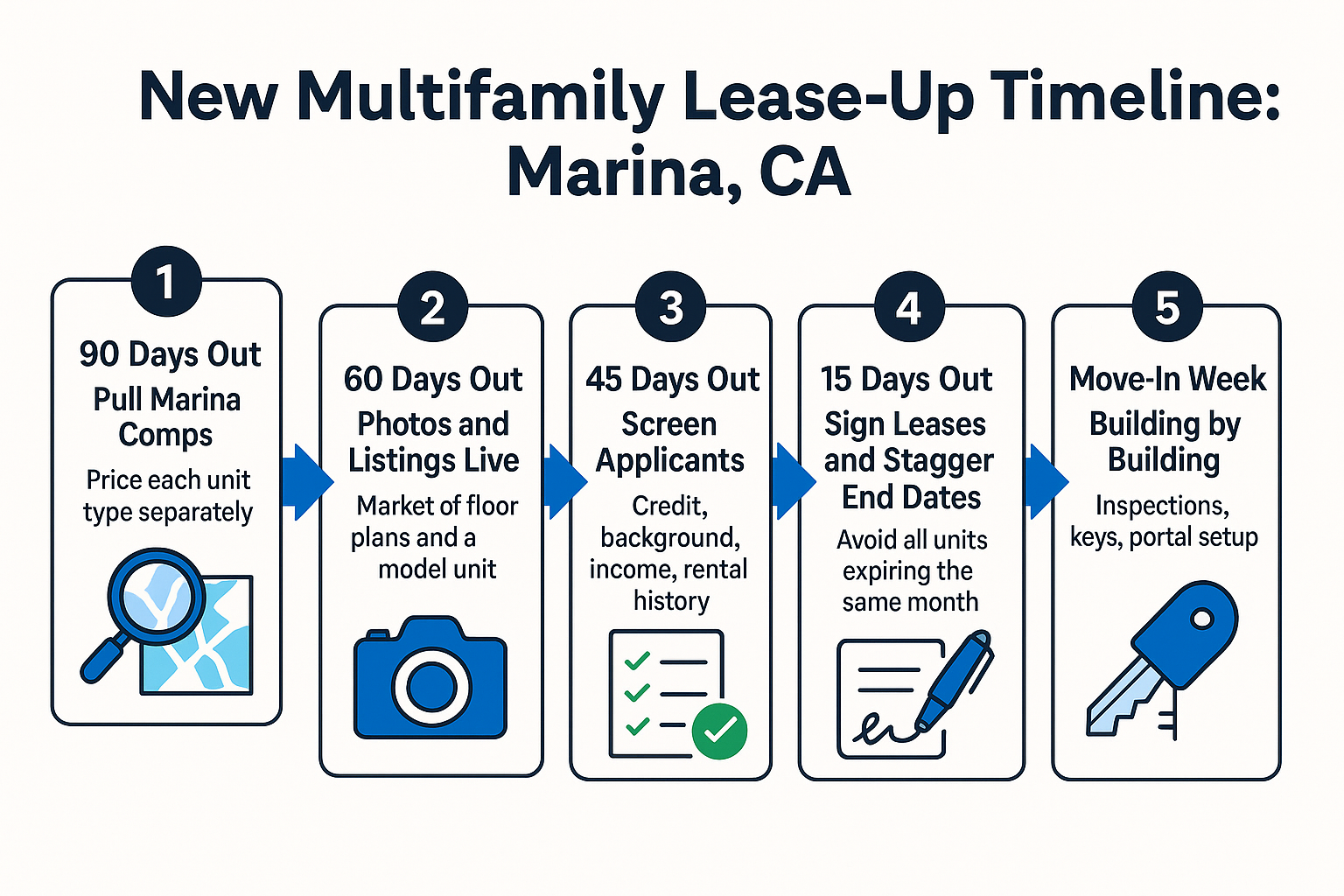
- Start marketing 45 to 60 days before completion, not after. Pre-leasing off floor plans and a model unit is normal for new construction in Marina.
- Sequence move-ins by building, so the first 5-plex is producing income while the third is still getting final inspections.
- Stagger lease end dates on purpose. If all fifteen leases expire the same month, you have built yourself a turnover cliff every single year.
- Expect the 3-bedroom units to lease slower than the 1-bedrooms in the shoulder season, since family moves cluster around the school calendar.
I'd rather sign a 14-month lease on a unit finished in September than a 12-month lease that dumps it back on the market the following fall. Small decision, real money.

Pricing a Mixed Unit Mix in Marina Takes Local Comps, Not Averages
A building with two 3-bed/2-bath units and three 1-bed/1-bath units is really two different rental businesses under one roof. They attract different tenants, they compete against different listings, and they move at different speeds.
The 1-bedrooms in Marina tend to draw single professionals, graduate students, and service members without dependents. The 3-bedrooms compete against detached houses in the Dunes, Marina Heights, and nearby East Garrison, which is a completely different pool of renters with different expectations for parking and storage.
Statewide rent averages are useless here. What matters is:
- Active and recently leased comparables inside Marina, pulled within the last 60 to 90 days
- Whether the comp is new construction with in-unit laundry and modern appliances, or a 1980s unit with none of that
- Parking count per unit, which carries real weight on a 0.4-acre parcel
- Distance to the Highway 1 on-ramps and the Marina Village shopping area, which shapes commuter appeal to Monterey and Seaside
Monterey County rents shift by neighborhood and by season, so I won't quote you a number here. But run the math on the risk: setting rent $150 under market on just two units costs you around $3,600 a year, every year, and it resets your renewal ceiling too. For more on how increases work once tenants are in place, see raising rent in 2026 for Monterey Bay landlords.
How the Two Unit Types Behave Differently in Marina
This is the general pattern I see across small multifamily buildings on this side of the bay. Your property will have its own quirks.
| Factor | 1 Bed / 1 Bath | 3 Bed / 2 Bath |
|---|---|---|
| Typical renter | Single professional, grad student, service member | Family or two-income household |
| Competing inventory | Other apartments in Marina and Seaside | Detached homes in the Dunes and East Garrison |
| Average time to lease | Usually faster year-round | Strongly tied to the school calendar |
| Turnover frequency | Higher, often annual | Lower, tenants tend to stay longer |
| Turn cost between tenants | Lower, smaller footprint | Higher, more flooring, paint, and cleaning |
| Pricing risk | Small dollar error, repeated often | Large dollar error on a long lease |
A Realistic Lease-Up Timeline for a New Marina Multifamily Building
Here is the sequence I'd want in place well before the final inspection, working backward from your completion date.
Deed-Restricted Units Come With Homework You Cannot Skip
Plenty of new Marina projects include one or two deed-restricted affordable units, often set at a percentage of area median income like 110% AMI. On paper it's two units out of fifteen. In practice it's a permanent administrative job.
Those units carry ongoing obligations that a spreadsheet won't cover:
- Verifying and documenting household income before move-in, using the correct income limits for Monterey County
- Annual recertification on a fixed schedule, with source documents kept on file
- Rent limits that are set by the program, not by what the market would pay
- Reporting to the administering agency, with deadlines that do not move for you
The income limits themselves are published and updated annually by the California Department of Housing and Community Development, and they change. Certifying a household using last year's numbers is one of the easier ways to create a problem.
Get this wrong and you're not looking at a slap on the wrist. Improper certification or a missed reporting deadline can put your standing with the program at risk. If you interview managers, ask each one directly how they handle income documentation and recertification, and who on their team owns that calendar.
Maintenance at 15 Units Is a Different Animal
One tenant calling about a water heater is a Tuesday. Ten tenants with your cell number is a second job you did not apply for.
The difference is triage. When requests overlap, somebody has to decide what gets a vendor today and what waits until Thursday, and that decision has to be consistent across every unit so no tenant feels ignored.
A workflow that holds up at this scale looks like this:
- A tenant portal for every work order, so requests are timestamped and documented instead of buried in texts
- A tiered response protocol: no heat, no water, active leaks, and lockouts get same-day emergency response; a sticky window gets scheduled
- A vendor bench, not a single handyman, with licensed and insured plumbers, electricians, and HVAC techs who can be on site in hours
- Coordinated access across occupied units, so one plumber visit covers four units instead of four separate trips
- Photo-documented move-in and move-out inspections, which matter more than ever under California's one-month security deposit cap that took effect July 1, 2024
New buildings also come with warranty windows. Tracking which appliance, roof, or water heater is still under warranty during the first couple of years saves real money, and nobody remembers that on their own three years in.
One more item for multifamily specifically: if your buildings have balconies, walkways, or elevated stairs, they fall under California's exterior elevated element inspection rules. I wrote about what the SB 721 deadline means for Monterey Bay multifamily owners if that applies to you.
When Self-Managing Stops Making Sense
I've never told a Marina owner with one duplex that they need a manager. Plenty of people handle two units fine.
The line usually shows up somewhere between five and ten units, and it isn't about the rent roll. It's about whether you can answer a 9 p.m. leak call, hold a leasing standard across fifteen applications, and keep compliance paperwork current in the same week.
If you want the honest cost side of that decision, management fees in the Monterey Bay area are typically a percentage of collected rent plus a separate leasing fee, and the percentage often drops as unit count goes up. I break the structure down in what property management actually costs in the Monterey Bay area, and when a Salinas apartment actually needs a property manager applies just as well to Marina.
Frequently Asked Questions About Multifamily Property Management in Marina, CA
How early should I start marketing a new multifamily building in Marina?
I'd start 45 to 60 days before your expected certificate of occupancy. Renters in Monterey County usually search 30 to 45 days ahead of their move date, so listing after completion means you're paying a mortgage on empty units while you catch up.
Can I use the same rent for every 1-bedroom in the building?
Usually close, but not identical. Ground floor versus upper floor, parking assignment, and whether a unit faces the street or the interior all move the number. Small differences per unit are normal and they add up across fifteen doors.
What happens if I miss a recertification deadline on a deed-restricted unit?
It depends on the program and the administering agency, but consequences can include compliance findings, required corrective action, and trouble with your standing in the program. This is the one area where I tell owners not to improvise. Put it on a calendar and assign it to a specific person.
Do management fees go down when you manage more units?
Generally yes. A fifteen-unit property is more efficient to manage per door than one scattered single-family home, and fee structures in Monterey County usually reflect that. The exact number depends on the property, the unit mix, and what services you actually need, so it's worth a direct conversation rather than a website estimate.
Is the Marina rental market strong enough to fill fifteen units?
Demand in Marina is supported by steady pieces: the CSU Monterey Bay and former Fort Ord footprint, the Naval Postgraduate School pipeline in Monterey, and commuters who want Peninsula access at a lower price than Carmel or Pacific Grove. Filling fifteen units is realistic. Filling them all in the same 30 days is where the planning matters.
Planning a Multifamily Lease-Up in Marina?
If you have a new building coming online in Marina or anywhere between Santa Cruz and King City, we're happy to talk through pricing, timing, and what the first year of operations actually looks like. Our team works across Monterey County and handles multifamily properties alongside single-family homes, in English and Spanish. You can reach us at (831) 582-8916 or through the contact form at torrenteproperties.com.
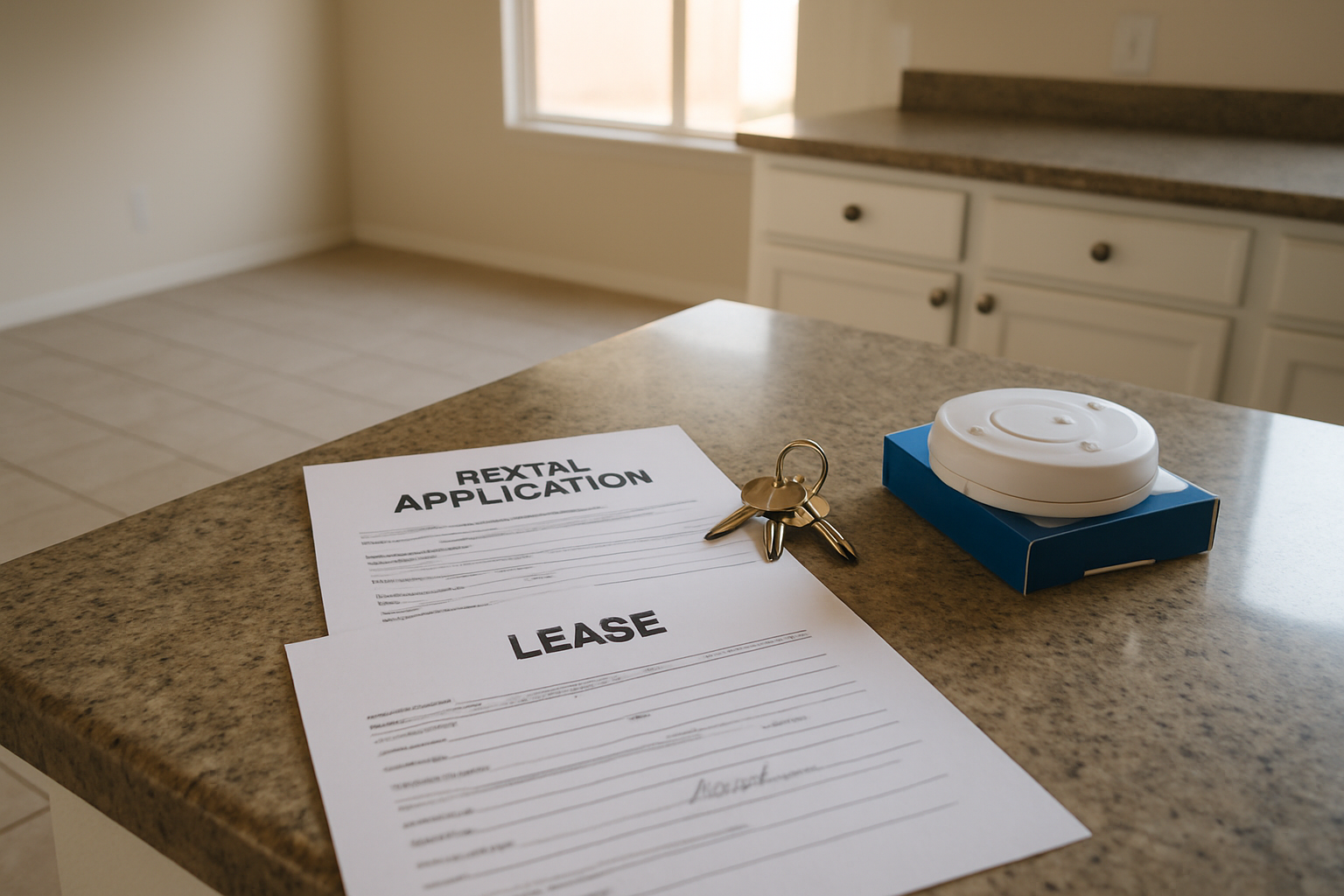
Tenant Placement vs. Full Management: What Salinas Owners Should Know
A version of the same question lands in our contact form every few weeks from Salinas owners. It usually reads something like: can you just find and screen a tenant for me, write the lease, and then I will take it from there?
The answer is yes. That service exists, and in the industry it is called tenant placement or leasing-only service. It is a real, separate product, not a watered-down version of full management.
But the line between the two matters more than most owners expect, especially in Monterey County where rental law shifts every year or two. I want to walk you through what placement actually covers, where the value is concentrated, and how to do the honest math on which one fits your situation.
What tenant placement in Salinas actually includes
Tenant placement is a one-time engagement with a clear finish line. The work starts before the listing goes live and ends when the new tenant has keys in hand.
Here is what is typically in scope:
- Rental pricing analysis based on real comparable rents in your specific pocket of Salinas, not a statewide average
- Property prep guidance, meaning what to clean, paint, repair, or landscape before photos
- Listing and marketing, including photography and syndication to the major rental sites
- Showings handled by a real person who can answer questions on the spot
- Full screening, including credit, nationwide criminal background, eviction history, and income verification
- Lease drafting and execution with current California disclosures and any local addenda
- Move-in coordination, including the walkthrough, condition documentation, deposit collection, and detector checks
And here is what placement does not include, which is where owners sometimes get surprised:
- Monthly rent collection and chasing late payments
- Maintenance calls, vendor dispatch, and after-hours emergencies
- Routine inspections during the tenancy
- Notices, rent increase compliance, and lease renewals
- Move-out accounting and deposit itemization when the tenant leaves
Once the lease is signed, you are the landlord of record and the point of contact. That is fine for some owners and genuinely difficult for others.
Screening is where the value of a professional placement is concentrated
If I had to point to one part of placement that earns its fee, it is the screen. Everything else can be learned. A bad screen costs real money and takes months to undo.
A thorough screen in California has four legs, and each one checks something different:
- Credit report. Not just the score. I look at collections, charge-offs, and whether the balances suggest an applicant is already stretched thin before rent is added.
- Nationwide criminal background check. County-only searches miss anyone who moved here from out of state, which is common along the Monterey Bay given military and agricultural relocation.
- Eviction history search. A prior unlawful detainer filing will not always show on credit. This is the check owners skip most often when they screen on their own.
- Income and employment verification. The common standard is gross monthly income of roughly 2.5 to 3 times the rent, confirmed with pay stubs or an employer, not just a stated number on the application.
One Salinas owner reached out to us wanting help screening applicants for a three-bedroom near Salinas Valley Memorial. That submarket draws a lot of healthcare employment, and owners there tend to assume a hospital paystub is the whole story. It is one data point out of four.
Missing a single leg of the screen is expensive. An unlawful detainer in Monterey County Superior Court can stretch out for months, and between lost rent, legal costs, and turnover repairs, owners often end up out far more than a year of management fees would have run. If you want the longer version, we broke down what a real tenant screening process looks like in its own guide.
The four checks behind a real tenant screen
Each of these checks catches something the others miss. Skipping one is where most placement problems start.
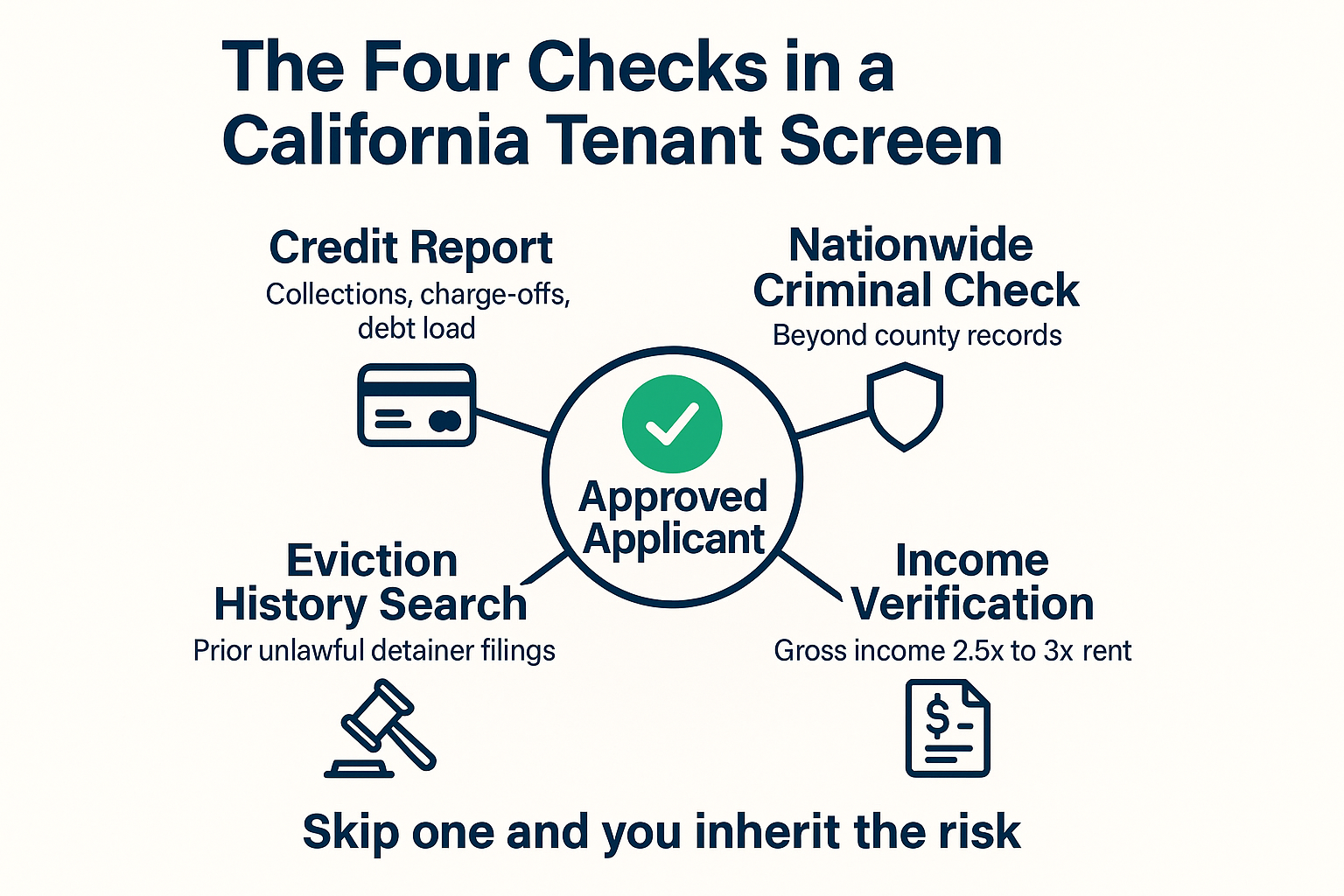
Side-by-side: tenant placement vs. full management
This is the breakdown I sketch out for owners on the phone. The left column ends at move-in. The right column keeps going.
| Task | Tenant Placement | Full Management |
|---|---|---|
| Rental pricing analysis | Included | Included |
| Property prep and listing | Included | Included |
| Showings and applications | Included | Included |
| Credit, criminal, eviction, income screening | Included | Included |
| Lease drafting and signing | Included | Included |
| Move-in walkthrough and documentation | Included | Included |
| Monthly rent collection | Owner handles | Included |
| Maintenance and 24/7 emergency response | Owner handles | Included |
| Routine and move-out inspections | Owner handles | Included |
| Notices, renewals, rent increase compliance | Owner handles | Included |
| Monthly statements and year-end summaries | Owner handles | Included |
| Re-leasing at turnover | New engagement | Included |
The lease is not paperwork, it is your liability document
This is the piece owners underestimate most. California rental law has changed enough in the last two years that a lease written in 2023 is already behind.
The biggest one: AB 12 took effect July 1, 2024, capping security deposits at one month's rent for most residential rentals, whether the unit is furnished or not. You can read the bill text on the California Legislature's site if you want the exact language.
I still see owners using a template pulled off the internet that allows two months plus a pet deposit. That single clause can turn a routine move-out into a dispute you lose.
There is also a local layer. Salinas runs a Residential Rental Registration program, and the City of Monterey prohibits rentals under 30 days, which changes how a lease term needs to be written on the Peninsula. A generic form does not know any of that.
So if you go the placement route, the lease is the one thing I would not hand back to yourself. Getting a current, locally correct lease drafted is a large share of what you are paying for.
Do the turnover math honestly before you decide
Here is the part I bring up even when it costs us the ongoing business. Placement makes real sense for some owners.
If you live in Salinas or Prunedale, you are handy, you have a plumber you trust, and you are comfortable answering the phone on a Sunday, placement-only can work well. You pay once, you get a screened tenant and a solid lease, and you run it from there.
But think through what happens in year two or three when that tenant gives notice. You are now on your own to:
- Re-screen a new applicant pool from scratch
- Draft a lease that reflects whatever the law says by then
- Coordinate the turn: paint, carpet, cleaning, landscaping
- Handle move-out accounting inside California's deposit itemization deadline
Every turnover is a fresh placement decision. Fees vary by property and scope, but placement is commonly quoted as a percentage of one month's rent or a flat fee, while ongoing management usually runs as a monthly percentage of collected rent. Ask for both numbers in writing so you can compare them over a three-year hold, not one month. We walk through the cost drivers in what property management really costs in Salinas.
Where placement tends to break down is distance. Several owners have come to us after a relocation, a deployment, or an inheritance, and the pattern is consistent: the placement went fine, then the first roof leak or the first late payment happened from four states away. If you are managing from outside the area, the time cost of self-management usually swallows the fee savings. Our team sees that math play out often enough that we now ask about it on the first call, and there is more on it in our guide to how out-of-area owners actually manage a Monterey Bay rental.
Frequently Asked Questions About Tenant Placement in Salinas
Can I hire someone just to screen applicants and write the lease?
Yes. That is exactly what tenant placement is, and it is one of the more common requests we get from Salinas and Prunedale owners. You get pricing, marketing, showings, full screening, lease drafting, and move-in coordination, then you take over as landlord.
How long does tenant placement usually take from listing to move-in?
It depends on price, condition, and season, but a well-priced Salinas single-family home in decent shape typically moves through marketing, showings, screening, and lease signing in a matter of weeks rather than months. Overpricing is the single biggest cause of a long vacancy, and a vacant month usually costs more than the pricing difference you were holding out for.
If I use placement and the tenant turns out badly, who handles it?
You do. That is the honest tradeoff. Once the lease is signed under a placement-only arrangement, notices, disputes, and any legal process are the owner's responsibility, which is why the quality of the screen matters so much on the front end.
Can I start with placement and switch to full management later?
Usually, yes, and quite a few owners do exactly that. They try self-managing for a year, decide they would rather not be the emergency contact, and move to full management at renewal or at the next turnover.
Is placement a good fit for a furnished rental?
It can be, though furnished units add complications. You will want a detailed inventory and condition record at move-in, and remember the one month deposit cap under AB 12 applies to furnished units too, so the extra deposit cushion owners used to rely on is no longer available.
Still deciding which route fits your Salinas property?
If you are weighing placement against ongoing management for a home in Salinas, Marina, Seaside, or anywhere along the Peninsula, we are happy to talk it through and give you both sets of numbers so you can compare them side by side. You can reach our team at (831) 582-8916 or through the contact form at torrenteproperties.com. Whichever direction you go, knowing the tradeoffs before you list is worth the conversation.

How Remote Homeowners Keep Control of a Monterey Property
A roof issue that goes unreported for two weeks during a Monterey Bay rainy season is not a $400 repair anymore. By the time a tenant finally mentions it, or you happen to ask, you are looking at drywall damage, possible mold, and a contractor schedule that stretches into spring. That gap between when something breaks and when you find out about it is the core problem every out-of-area owner faces.
I have worked with homeowners across Salinas, Monterey, Seaside, and Pacific Grove for over two decades, and the situation that comes up most is not bad tenants or high vacancy. It is distance creating a blind spot, a property quietly losing value while the owner manages it from a spreadsheet in another state.
This article is for property owners who either live out of the area already or are planning to leave. We will cover the three things that actually determine whether remote ownership works: maintenance response, financial visibility, and seasonal timing. Get those right, and managing a Monterey County property from a distance is genuinely doable.
The Real Problem With Managing Maintenance From a Distance
Over the past couple of years, I have heard a version of the same story from multiple owners who initially tried to handle their Monterey Bay rental by phone and email. The friction points were almost always identical.
First, they did not have a local vendor relationship. When a tenant called about a plumbing issue, they were Googling contractors in a market they no longer lived in, getting quotes they could not verify, and hoping the person who showed up was licensed. Second, they could not tell whether a maintenance request was urgent or optional. A tenant saying the garbage disposal is making noise is very different from a tenant saying water is coming through the ceiling, but from two states away, both arrive as a text message. Third, they had not physically seen the property in months, sometimes longer.
That last one is the one that costs people the most. What can go wrong in an empty house is a longer list than most owners expect, and the Monterey Bay climate, with its seasonal storms and persistent moisture, accelerates problems that drier climates might let sit for a while.
A manager with boots on the ground changes the entire equation:
- Maintenance requests get triaged by someone who knows what urgent actually looks like
- Trusted, licensed, insured local vendors respond faster because they have an established relationship
- 24/7 emergency coordination means a call at 2 a.m. does not land on your cell phone
- Routine and move-in/move-out inspections create a documented record before a dispute ever starts
For owners who have been coordinating repairs remotely, the shift in stress level when this function is handled locally is almost always the first thing they mention.

What a Monthly Owner Statement Actually Tells You
Monthly financial statements and an owner portal are not just administrative conveniences. For an absentee owner, they are the primary way you know whether your property is generating income or quietly losing it.
I have had owners log into their portal for the first time and realize they had never had a clear picture of what their property was actually netting month to month. A well-structured monthly statement should show you:
- Rent received and the date it was collected
- Any late fees collected, itemized separately
- Maintenance costs with the vendor name, the work performed, and the amount paid
- Owner disbursement, what actually hit your account
- Year-end summaries formatted for tax purposes
That level of detail matters when your accountant asks why a particular month was low. It also matters if you ever need to show a lender, a partner, or a family member what the property has been doing financially.
The owner portal takes this further. You can log in and see your current ledger, review past statements, and submit questions without a phone call. For someone managing from out of state, that kind of access removes a lot of the anxiety that comes with not being local. You can check in at midnight if you want to, and you do not have to wait for a return call.
For a broader look at how management fees factor into your net income, what property management actually costs in the Monterey Bay area breaks that down in plain terms.
Utility Oversight: A Specific Problem Most Owners Do Not See Coming
One situation that comes up more than people expect involves properties where utilities are not cleanly separated. I have seen this in Monterey specifically, a property with a single PG&E or Cal Am Water meter shared across two units, where the owner is paying the master bill and attempting to recover costs from tenants proportionally.
From across the country, that kind of arrangement is genuinely hard to manage. You are relying on the tenant to pay their share, manually reconciling bills, and hoping no one disputes the split. When something goes wrong, a spike in usage, a tenant who stops paying their portion, a billing error, you are dealing with it from a time zone away.
A local manager handles utility oversight as part of ongoing management: tracking which utilities are owner-paid, verifying that cost-recovery arrangements are documented in the lease, and flagging when something looks off. That is the kind of detail that falls through the cracks when you are self-managing from a distance.
For owners thinking through how this kind of management structure compares to handling things yourself, when self-managing your rental stops making sense is worth reading before you decide.
What Remote Ownership Actually Requires
This overview breaks down the four functions that determine whether absentee property ownership works, and what each one involves in practice.
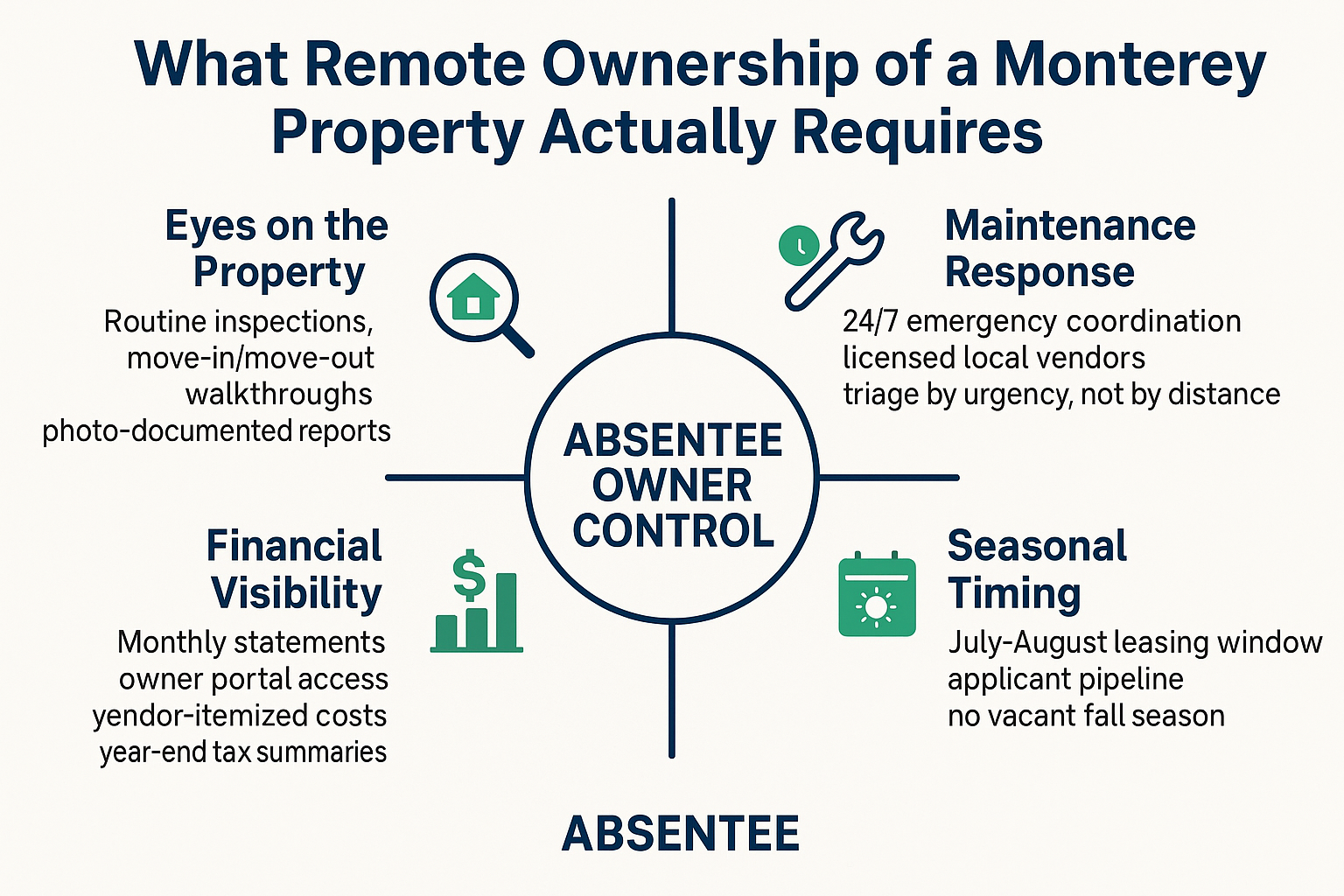
Why Missing the Summer Leasing Window Costs More Than You Think
The Monterey Bay rental market has a seasonal rhythm that matters a lot if your property turns over in the summer. July and August are consistently the strongest months for tenant placement locally, demand is high, applicants are active, and well-priced properties in Monterey, Seaside, and Marina move quickly.
An out-of-area owner managing their own turnover often misses this window. They are coordinating repairs remotely, waiting on a vendor to finish a paint job, and posting the listing two weeks later than they should. By mid-September, the applicant pool is thinner and you may sit vacant into October or November.
A manager with an existing applicant pipeline and a team handling prep, photography, listings, and showings locally can move from vacancy to signed lease in a timeframe a remote owner working from a spreadsheet simply cannot match. Every week of vacancy in Monterey County represents real lost income, and the cost of a slow turnover often exceeds a full year of management fees.
For owners who have been through a turnover on their own and are considering handing it off, how to hand off a rental you have been managing yourself walks through what that transition actually looks like.
Self-Management vs. Local Manager: What Changes for Remote Owners
This comparison covers the functions that matter most when you are managing from out of the area, not every task, just the ones where distance creates the biggest risk.
| Function | Self-Managing Remotely | With a Local Manager |
|---|---|---|
| Maintenance triage | Tenant texts you; you judge urgency without seeing it | Manager assesses in person; dispatches appropriately |
| Emergency repairs | You find a contractor by phone from out of state | 24/7 coordination through established local vendors |
| Property inspections | Months may pass with no eyes on the property | Routine scheduled inspections with photo documentation |
| Leasing timing | Turnover pace depends on your availability | Local pipeline, active marketing during peak July-Aug window |
| Financial tracking | DIY spreadsheet; hard to share or audit | Itemized monthly statements and owner portal access |
| Utility oversight | Manual reconciliation; disputes handled by phone | Documented lease terms; manager monitors and flags issues |
| Insurance documentation | No inspection record if a claim is filed | Photo-documented reports create a defensible timeline |
Insurance, Liability, and Why Documentation Matters More Than Owners Expect
This is the one area where I see absentee owners most underprepared. A vacant or recently vacated property with no active inspection record creates real exposure, and most owners do not think about it until a claim is filed.
California's Department of Consumer Affairs notes that documentation disputes are among the most common friction points between landlords and tenants at move-out. A photo-documented inspection report, completed by a licensed professional at regular intervals, does several things:
- It establishes the condition of the property before and after occupancy
- It creates a dated, verifiable record if a tenant disputes a deduction or an insurer questions a claim
- It demonstrates that the owner was exercising reasonable oversight, which matters in California, where the legal standard for habitability is well-defined and actively enforced
For vacant or seasonal properties, this is even more critical. A property sitting empty on the Monterey Peninsula during a wet winter, think the storms that hit Pebble Beach and Carmel hard in early 2023, can sustain water intrusion, roof damage, or drainage failures that go undetected for weeks. An inspection record showing the property was checked before and after that weather event is a meaningful asset if you ever need to file a claim.
Our Seasonal Property Maintenance Program addresses this directly: quarterly exterior and interior checks, water intrusion review, safety item verification, and a photo report delivered to the owner four times a year. For out-of-area owners, that program is often the first thing that gives them genuine peace of mind about a property they cannot see themselves.
If you own a second home on the Peninsula that spends part of the year vacant, owning a second home on the Monterey Peninsula while you are not there covers the specific risks and what to do about them.
Frequently Asked Questions About Remote Property Ownership in Monterey
How do I know what's happening at my property if I live out of state?
The most reliable combination is regular scheduled inspections with photo reports plus access to an owner portal where you can see your financials at any time. You should not have to call to find out what is going on, a well-run management relationship means the information comes to you.
What happens if there's an emergency at my property and I'm not reachable?
A local manager with 24/7 emergency maintenance coordination handles it without waiting for you to respond. Emergencies get triaged, the right vendor gets dispatched, and you get notified with the details after the situation is stabilized. You are informed, not the first call.
I've been managing my Monterey rental myself from out of state for two years. What am I probably missing?
In my experience, the most common gaps are: deferred maintenance that a tenant mentioned casually and you did not flag as urgent, a leasing timeline that missed the peak summer window, and no physical inspection record if something goes wrong. The financial side is also usually less clear than owners realize, most are netting less than they think once you account for vacancy, untracked maintenance, and time spent coordinating. Renting out your Monterey Bay home from a distance goes deeper on this.
How much does property management cost for a Monterey rental?
Management fees in the Monterey Bay area typically fall somewhere in a range based on the property type, the scope of services, and whether you need full-service management or just tenant placement. The fee structure varies, and the right way to get an accurate number is to have a conversation about your specific property. What property management really costs in Salinas covers how these fees are typically structured.
My property in Seaside has been vacant for a few months. Is that a problem from a liability standpoint?
It can be. A vacant property with no recent inspection record creates exposure if a visitor is injured, if a neighbor reports an issue, or if you need to file an insurance claim. Regular documented inspections, even quarterly, establish that you were exercising reasonable care as a property owner. California law does not take a forgiving view of neglected properties, occupied or not.
Can a property manager handle paying my mortgage, insurance, and property taxes from rental income?
Yes. Full-service management can include paying owner obligations directly from collected rent, mortgage, insurance premiums, property taxes, so you are not manually moving money every month. This is something we handle for a number of our out-of-area clients.
Ready to Stop Managing Your Monterey Property From a Distance?
If you own a rental or seasonal home in Monterey County and you have been trying to hold it together by phone and email, we are happy to walk through what a different approach would look like for your specific situation. Our team manages properties across Monterey, Salinas, Seaside, Pacific Grove, Marina, Carmel, and Pebble Beach, and we have been doing it for over 25 years. Reach us at (831) 582-8916 or through the contact form at torrenteproperties.com.