Understanding your duties as a California landlord can feel complicated, but it boils down to a few key rules. This guide outlines the essential landlord responsibilities in California, giving Monterey Bay property owners a clear roadmap. Your main job is to provide a safe home, handle money like security deposits correctly, and respect tenant privacy.
Over 56% of California renter households spend more than 30% of their income on housing, making them "rent burdened" (California Budget & Policy Center). This financial pressure means it's more important than ever for landlords to follow the rules and maintain their properties.
The Foundation of California Landlord Duties
Knowing your legal duties is the first step to a successful rental business. It also helps you build good relationships with your tenants. For landlords in Salinas or Carmel, this means balancing state laws with our local market needs.
These rules aren't just red tape. They create a fair and stable system for everyone. Following them protects your investment and reputation.
For property owners who live far from their rental, managing these duties can be a challenge. Many seek professional help to ensure everything is done right. If this sounds like you, our guide on rental property management for out of town owners offers practical advice.
Key Areas of Landlord Responsibility
We can group the core landlord responsibilities in California into a few main categories. Mastering these will set you up for success.
- Habitability: This is the most important one. You must make sure the property is safe, clean, and livable. This includes working plumbing, heating, and electrical systems.
- Financial Duties: You must manage all money matters correctly. This means handling security deposits by the book and following legal limits on rent increases.
- Tenant Rights: You must respect a tenant's right to privacy. This includes giving proper notice before entering the unit and following all fair housing laws.
- Legal Procedures: California has specific legal processes for things like ending a lease or eviction. You must follow them exactly.
This guide will explain each of these areas, giving you the knowledge to manage your Monterey Bay property with confidence.
Providing a Safe and Habitable Home
Every lease in California includes an "implied warranty of habitability." This is a legal promise that you will provide a home that is safe and livable. It's one of the most basic landlord responsibilities in California.

This promise goes beyond appearances. It means the core systems that make a house a home must work correctly.
The Habitability Checklist
To meet this legal standard, your rental property must have several key features in good working order. These are non-negotiable items that protect your tenant's health and safety.
A property is considered habitable if it has:
- Effective Weatherproofing: A solid roof, unbroken windows, and walls that keep the weather out.
- Functional Plumbing and Gas: Working toilets, sinks, and gas lines that meet code.
- Reliable Water Supply: Access to both hot and cold running water.
- Adequate Heating: A functioning heating system is required by law.
- Safe Electrical Systems: All wiring, outlets, and lights must be safe.
- Clean and Sanitary Conditions: The building and grounds must be clean and free of pests and garbage.
For landlords in coastal areas like Monterey, our damp climate adds another task. You must be proactive about preventing mold to keep the home habitable.
Responding to Repair Requests
When a tenant reports a serious issue, like a broken heater, the clock starts ticking. California law says you must make necessary repairs in a reasonable time, usually 30 days. For urgent issues, you must act much faster.
Ignoring repairs can have serious consequences. A tenant might use the "repair and deduct" remedy, where they fix the issue and subtract the cost from their rent. Responsive maintenance is a critical legal duty.
What Is Normal Wear and Tear?
Landlords often get confused about the difference between damage and normal wear and tear. You are responsible for fixing things that break down from normal use. Tenants are responsible for damage they cause.
- Normal Wear and Tear (Landlord's Job): Includes faded paint, minor carpet wear, or loose grout.
- Damage (Tenant's Job): Covers things like a hole in the wall, a broken window, or deep pet scratches on the floor.
Knowing this difference is key to managing your budget and your tenant relationships. Properly maintaining your property fulfills your legal duty and protects you from liability claims. You can learn more about premises liability in California to understand these risks.
Understanding Rent Control and Increase Limits
In California, you can't just raise the rent whenever you want. The state has specific rules to prevent sudden, large rent hikes that can force good tenants to move.
The most important law is the Tenant Protection Act, also known as AB 1482. This law sets clear caps on how much you can increase rent each year. This creates a more stable financial situation for both you and your tenants.

While you can set the initial rent at the market rate, any future increases must follow these strict rules.
The Statewide Rent Cap Formula
The law limits annual rent increases to 5% plus the local inflation rate, or a maximum of 10%, whichever is lower. This cap applies to most rental properties that are more than 15 years old.
The goal is to stop extreme rent gouging while letting landlords keep up with costs. Newer buildings (under 15 years old) are exempt to encourage new construction. You can review the research on California's rent control laws for more details.
It's critical to know the inflation rate for your area to calculate the increase correctly. Landlords in Monterey County follow this state law, as we have no stricter local rent control rules.
Providing Proper Notice for Rent Increases
A legal rent increase is only half the battle. You must also give your tenant proper written notice. The state is very strict about this.
- For increases of 10% or less: You must give at least a 30-day written notice.
- For increases over 10%: A longer 90-day written notice is required.
This must be a formal written notice, not a text or email. If you don't give proper notice, the rent increase is not valid.
Key Exemptions to Rent Control
While AB 1482 covers many properties, some are exempt. Knowing if your property is exempt is very important.
Here are the main exemptions:
- Newer Construction: Properties built within the last 15 years.
- Single-Family Homes: Most single-family homes and condos, unless owned by a corporation or real estate investment trust (REIT).
- Duplexes: A duplex where the owner lives in one of the units.
Even if your property is exempt from rent caps, you must still give proper written notice for all rent increases.
Managing Security Deposits the Right Way
Handling a security deposit is a legal trust. In California, you can only collect a deposit equal to one month's rent for most properties. This helps keep moving costs down for tenants in the Monterey Bay area.
There is no such thing as a "non-refundable" deposit in California. The money belongs to the tenant until you have a legal reason to use it.
Returning Deposits and Making Deductions
Once a tenant moves out, a strict 21-day countdown begins. Within this time, you must either return the full security deposit or provide an itemized list of deductions.
Failing to meet this deadline can result in serious penalties. A court could order you to pay the tenant up to three times the deposit amount for mishandling it. Using the best accounting software for landlords can help you track these details accurately.
What You Can and Cannot Deduct
Understanding what you can legally deduct from a deposit is critical. This is one of the most important landlord responsibilities in California. The law separates tenant-caused damage from "normal wear and tear."
Here’s a table to help you tell the difference.
| Deduction Type | Allowable Examples | Prohibited Examples |
|---|---|---|
| Damage | Large hole in a wall, cracked window, badly stained carpet. | Faded paint, minor scuffs on walls, worn-out carpet from normal use. |
| Cleaning | Leaving the unit extremely dirty, requiring deep cleaning. | Standard cleaning that would be needed between any two tenants. |
| Unpaid Rent | Rent the tenant still owes after they move out. | Charging for future rent after a new tenant has already moved in. |
Always document the property's condition with photos at move-in and move-out.
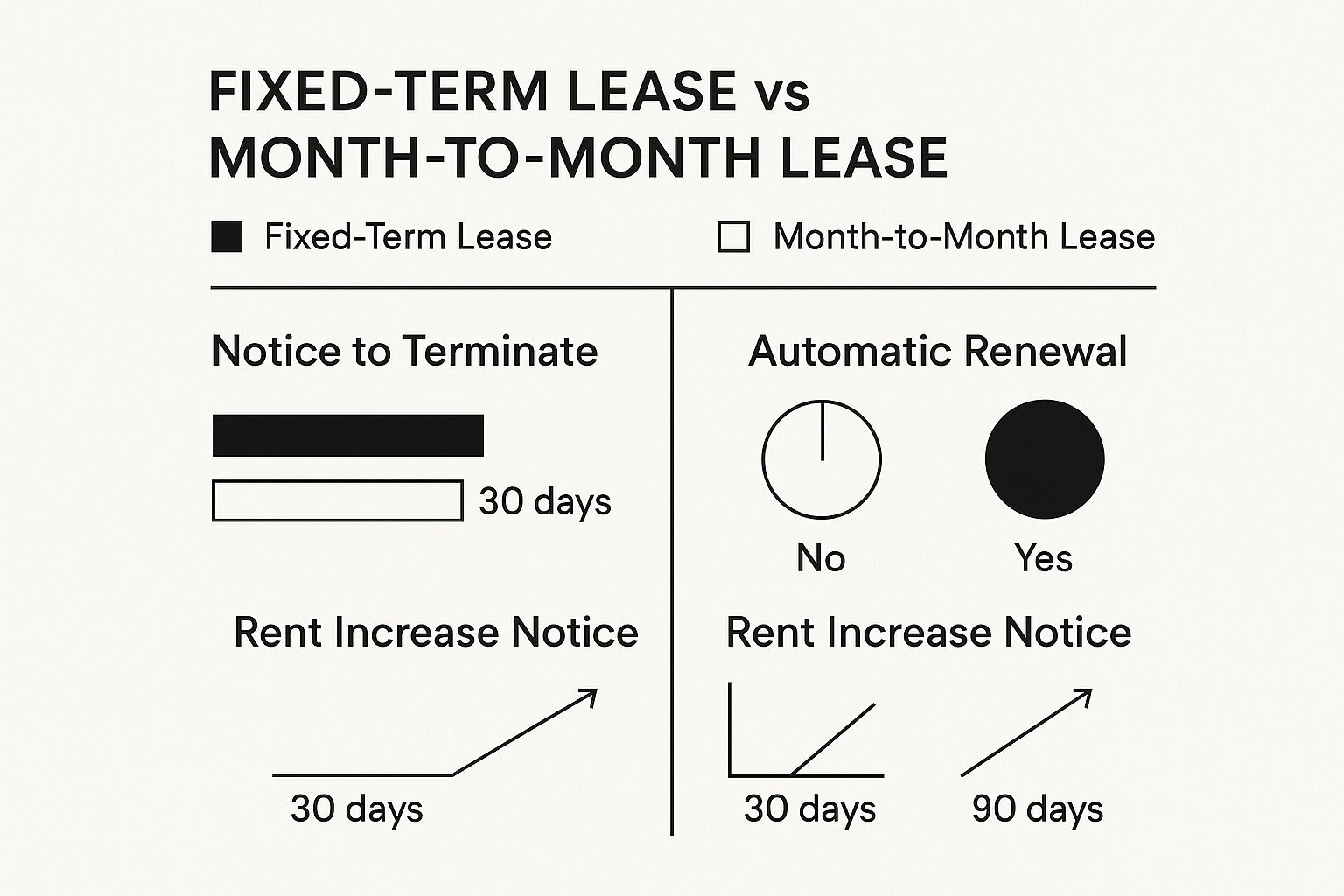
This chart shows how different lease types have different notice rules, highlighting the need for landlords to know the specifics of their agreements.
Navigating Evictions and Tenant Disclosures
Every tenancy ends eventually. In California, eviction is a strict legal process, not a personal decision. For most tenants, you must have a valid reason, known as "just cause," to ask them to leave.
Your duty to be transparent starts when you first list the property. California law requires you to provide tenants with several written disclosures. Getting these rules right is a key part of your landlord responsibilities in California.
Understanding Just Cause Eviction
The Tenant Protection Act (AB 1482) requires landlords to have a "just cause" to evict tenants in properties over 15 years old. Without a valid reason, you could be responsible for the tenant's moving costs.
"Just cause" reasons are split into two types:
- At-Fault Just Cause: These are related to the tenant's actions, like not paying rent or causing major damage.
- No-Fault Just Cause: These are related to your own needs, like moving into the unit yourself or taking the property off the rental market.
For no-fault evictions, you usually must provide relocation assistance equal to one month's rent.
Required Disclosures Before Move-In
The law requires you to provide a checklist of written disclosures before a tenant signs a lease. This builds trust and sets a positive tone for your relationship.
Some common required disclosures include:
- Lead-Based Paint: For homes built before 1978, you must provide a pamphlet on lead hazards.
- Pest Control: If you use a regular pest control service, you must give tenants a copy of the notice.
- Demolition Permits: If you plan to tear down the unit, you must inform potential tenants.
- Flood Zone: You must state in the lease if the property is in a designated flood hazard area.
Before you get to the lease, it's vital to screen applicants well. This should always include the need to perform comprehensive credit checks to assess their financial history.
The Right to Privacy and Proper Entry
A tenant's home is their private space. You cannot just show up and enter whenever you want. Except in an emergency, the law requires you to give reasonable written notice before entering.
"Reasonable" usually means at least 24 hours' notice. The notice must state the date, approximate time, and reason for the visit. Following this simple rule respects your tenant's right to quiet enjoyment of their home. To prepare for the end of a tenancy, use our tenant move-out inspection checklist to ensure a smooth process.
FAQs About California Landlord Laws
Understanding landlord responsibilities in California can be tough. Here are answers to some common questions we hear from property owners in the Monterey Bay area.
This section can serve as a quick guide for managing your property correctly.
What happens if I do not make required repairs?
If you fail to fix serious habitability issues, tenants have legal options. They could withhold rent, use the "repair and deduct" remedy, or even break the lease and move out without penalty. Promptly handling maintenance is the best way to avoid costly legal disputes.
Can I prohibit pets in my California rental?
Yes, you can generally enforce a "no pets" policy. However, you must make an exception for service and assistance animals, which are protected under the Fair Housing Act. You cannot charge a pet deposit or extra rent for these animals. For more practical advice, see our collection of property management tips.
How much notice must I give a tenant to move out?
For a month-to-month tenant who has lived in the property for less than one year, you must give a 30-day written notice. If they have lived there for a year or more, you must provide a 60-day written notice. If your property is covered by the Tenant Protection Act, you also need a "just cause" reason.
Do I have to pay interest on a security deposit?
No, California state law does not require you to pay interest on security deposits. While a few cities have local rules requiring it, this is not the case for properties in Monterey, Salinas, or Carmel. Landlords in Monterey County are not obligated to pay interest on these funds.
What are the main financial duties of a landlord?
Your main financial duties include collecting rent, managing security deposits according to state law (returning them within 21 days with an itemized list of any deductions), and following the legal caps for any rent increases. Keeping clear and accurate records is essential for all financial matters.
Staying on top of these responsibilities is key to running a successful rental business. If you need an expert to help manage your property, Torrente Property Management is here for you. Call us today at (831) 582-8916 to see how we can protect your investment and give you peace of mind.