
Navigating California's landlord-tenant laws can feel complex. But the main goal is simple: to create a fair and safe system for property owners and tenants. If you own a rental in the Monterey Bay area, understanding these rules is key. It protects your investment and helps build good relationships with your tenants.
Your Guide to California Rental Rules

For property owners in Monterey, Salinas, and Carmel, California’s rental laws are the foundation of a successful investment. They cover nearly every part of the landlord-tenant relationship. Think of them as a clear roadmap, not a set of hurdles.
Following these rules helps you avoid legal issues and build a trustworthy reputation. The rental market here is large. According to the Public Policy Institute of California, renters occupy 44% of households statewide. When you respect the law, you serve your tenants well. This often leads to longer, more stable tenancies.
Key Areas Covered by State Law
California’s landlord-tenant laws provide a full framework for managing your rentals. The details are important.
Here are the key areas you must understand:
- Lease Agreements: What your rental contracts must legally include.
- Habitability Standards: Your duty to provide a safe and livable home.
- Security Deposits: Strict limits on how much you can collect and firm rules for returning it.
- Rent Increases: Statewide caps and how to properly notify tenants.
- Eviction Procedures: The legal "just cause" reasons and the exact steps to follow.
- Tenant Privacy: A tenant's right to privacy and the rules for entering the property.
A strong grasp of these laws allows you to act confidently and fairly. This prevents small problems from becoming expensive disputes and is the foundation of professional property management.
This guide breaks down these topics into simple, actionable information. We want to bring clarity to Monterey Bay landlords. While we focus on statewide laws, remember that local rules can also apply. Property owners should always know local guidelines, like those in this guide to San Diego Short Term Rental Laws.
Your Core Duties as a California Landlord

At the heart of California law is the implied warranty of habitability. This is a basic promise in every lease, written or not. It guarantees your rental is safe and livable from day one.
Meeting this standard is your legal duty. It builds the trust needed for stable tenancies in communities like Salinas and Monterey.
Providing a Safe and Livable Home
The warranty of habitability is specific. California law lists the conditions a property must meet. Failing to meet them can lead to serious legal and money troubles.
Your main duties include ensuring the property has:
- Effective Weatherproofing: The roof and walls must not leak. Windows and doors must be intact.
- Working Utilities: This includes safe plumbing, gas, and electrical systems that meet code.
- Hot and Cold Running Water: You must provide a system that delivers both, plus a working heater.
- Clean and Sanitary Conditions: The property and common areas must be clean and free of pests.
- Secure Premises: Tenants need to feel safe. This means working locks on all entry doors and windows.
Keeping good records of repairs is smart. It proves you are meeting your duties. Many landlords use the best accounting software options for landlords to track these expenses and create a clear paper trail.
Respecting Tenant Privacy: The Right of Entry
Even though you own the property, your tenant has a right to privacy. This means you cannot just show up unannounced. California law is clear about when a landlord can enter an occupied rental.
You must provide reasonable written notice before entering. This is usually 24 hours. The notice must state the date, approximate time, and reason for your visit.
Important Takeaway: Unless there is a true emergency—like a fire or major flood—entering without proper notice is a serious violation of a tenant's rights.
Legally accepted reasons for entry include:
- To make necessary or agreed-upon repairs.
- To show the unit to new tenants, buyers, or lenders.
- In a genuine emergency.
- With a court order.
- If you believe the tenant has abandoned the property.
Always document every notice of entry. A simple log can prevent misunderstandings. It shows you acted in good faith and respected the landlord-tenant laws California requires.
Key Landlord Responsibilities and Tenant Rights
| Landlord Responsibility | Corresponding Tenant Right |
|---|---|
| Provide a habitable dwelling with working utilities, plumbing, and heat. | The right to a safe, sanitary, and livable home. |
| Maintain common areas and keep them free of hazards and pests. | The right to use shared spaces without risk of injury or infestation. |
| Give proper 24-hour written notice before entering the rental unit. | The right to privacy and "quiet enjoyment" of their home. |
| Make necessary repairs in a timely manner after being notified. | The right to have maintenance issues addressed promptly. |
| Ensure all entry doors and windows have working security locks. | The right to a secure home protected from unauthorized entry. |
By meeting these duties, you follow the law and create a respectful rental environment for everyone.
How to Handle Security Deposits Correctly

Security deposits are a common source of conflict. When you handle them by the rules, they protect your property without causing problems. Following California’s guidelines is your best defense against future disputes.
A security deposit is a safety net. It is refundable and belongs to the tenant until you have a valid reason to make deductions. Understanding the rules for every property owner in the Monterey Bay area is essential.
How Much Can You Legally Collect?
Rules on security deposit amounts have changed. As of 2024, a new law limits security deposits to just one month's rent for most rentals. This change helps reduce high move-in costs for renters.
There is one key exception. Small landlords who own no more than two properties (with four or fewer units total) can still ask for up to two months' rent.
It’s critical to remember that you can't charge a "non-refundable" deposit. California law treats all deposits, including pet or cleaning fees, as part of the refundable security deposit.
Making Lawful Deductions
When a tenant moves out, you can only use the security deposit for specific reasons. Deducting for "normal wear and tear" is a common mistake.
California law allows deductions for only four reasons:
- Unpaid Rent: To cover any rent the tenant still owes.
- Damage Beyond Normal Wear and Tear: This is for fixing damage caused by the tenant, like a large hole in the wall. It does not include faded paint or minor scuffs.
- Cleaning Costs: To return the unit to the same level of cleanliness it was at move-in.
- Restoring or Replacing Personal Property: If your lease allows, you can use the deposit to fix items like furniture you provided.
The Critical 21-Day Return Deadline
California gives you a firm deadline: 21 calendar days after a tenant moves out to handle their deposit. Within that time, you must either:
- Return the full security deposit.
- Send an itemized list of all deductions, plus any remaining balance.
This itemized statement must be detailed. You need to include receipts for any repairs or cleaning services. If you did the work yourself, you must describe the work and charge a reasonable hourly rate.
Missing this deadline has serious consequences. A court can order you to return the entire deposit and pay extra damages. A thorough tenant move-out inspection checklist helps create a clear record to justify any deductions.
Navigating the California Eviction Process
Evicting a tenant is a serious legal process. In California, you cannot just change the locks. The process is ruled by "just cause" eviction laws. This means you must have a valid, legal reason to end a tenancy.
For property owners in Monterey County, understanding these rules is non-negotiable. A small mistake, like serving the wrong notice, can derail the entire process. This forces you to start over, costing you time and money.
The Two Types of Just Cause Eviction
California law divides valid eviction reasons into two types: "at-fault" and "no-fault." Each has its own rules and notices.
At-Fault Just Cause means the tenant did something wrong. These are common reasons for eviction:
- Failure to Pay Rent: The tenant has not paid their rent on time.
- Lease Violations: Breaking a major rule in the lease, like having an unauthorized pet.
- Creating a Nuisance: The tenant’s behavior disturbs other residents.
- Illegal Activity: Using the property for an unlawful purpose.
No-Fault Just Cause happens when the landlord needs the property back for reasons unrelated to the tenant. Landlords often must pay relocation assistance in these cases. Common reasons include:
- Owner Move-In: The owner or a close family member will live in the unit.
- Substantial Remodel: Major renovations make it unsafe for the tenant to live there.
- Removing the Property from the Rental Market: The owner decides to stop renting the property.
The eviction process is a specific legal path. The chart below shows the first steps every landlord must follow.
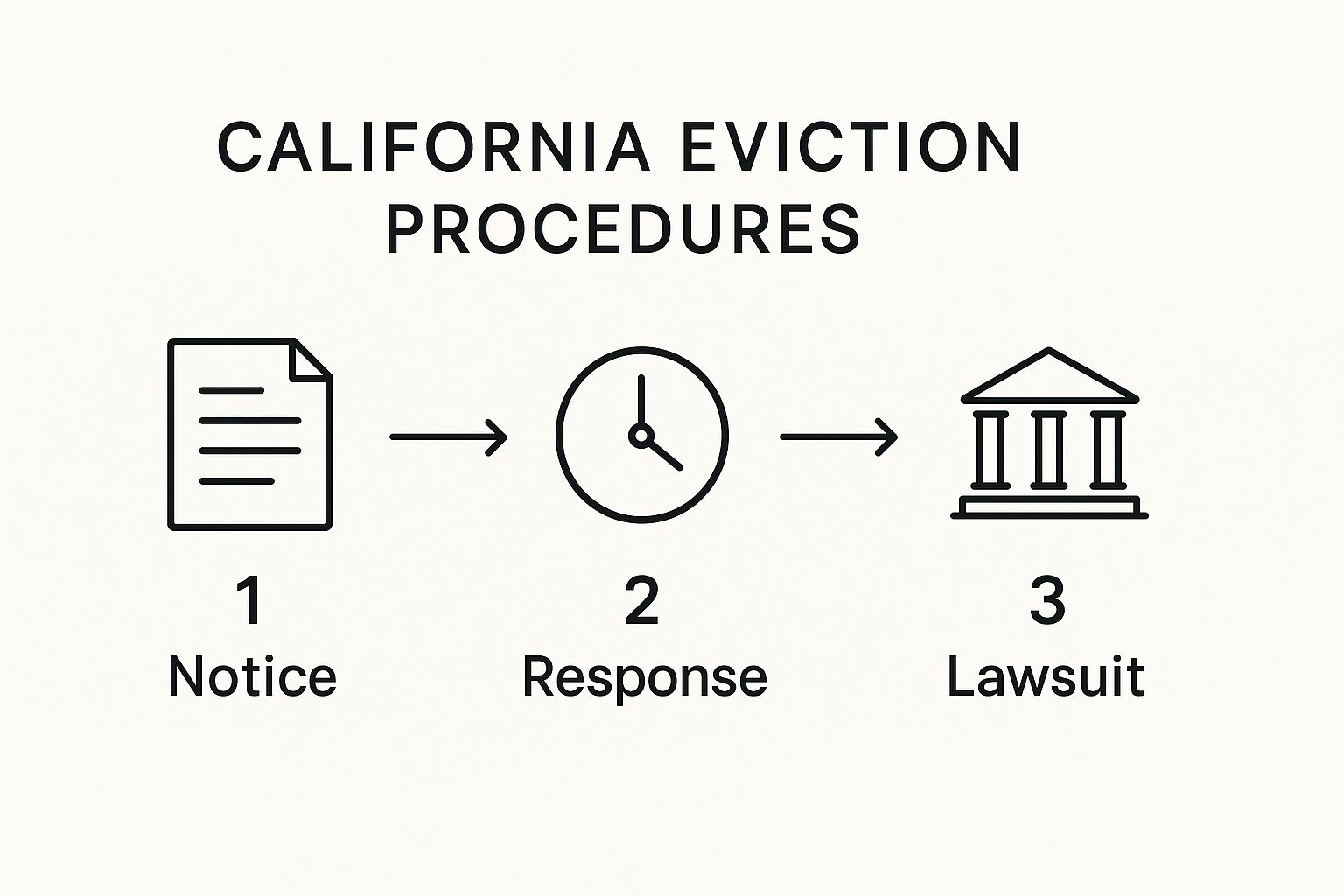
As you can see, everything starts with serving the correct legal notice. This gives the tenant time to respond before you can file with the court.
Understanding the Proper Eviction Notices
The type of notice you serve depends on the reason for the eviction. Using the wrong one will get your case dismissed.
For example, if a tenant is behind on rent, you must serve a "3-Day Notice to Pay Rent or Quit." This notice gives them three days to pay the full amount or move out. It must state the exact rent due.
If a tenant breaks another lease rule, you use a "3-Day Notice to Cure or Quit." This gives them three days to fix the problem. If they don't, they must move out.
The Tenant Protection Act of 2019 was a major game-changer. This law established the "just cause" rules for most properties over 15 years old. It also required relocation assistance for no-fault evictions.
The Unlawful Detainer Lawsuit
What if the tenant ignores your notice? If they don't fix the issue or move out, your next step is to file an unlawful detainer lawsuit. This is the formal court process for eviction in California.
You cannot physically remove the tenant yourself. Only a sheriff with a court order can legally do that.
Crucial Point: An unlawful detainer is a fast legal process, but it requires perfect paperwork. Any error can cause a judge to dismiss your case, forcing you to start over.
An eviction is one of the biggest property ownership challenges without a property management company. The legal details are complex. That’s why many owners in the Monterey Bay area rely on professional help to ensure every step is handled correctly.
A Landlord's Guide to Rent Increases and Rent Control
Managing rent increases while following California's laws can be tricky. The Tenant Protection Act (TPA) of 2019 placed a cap on annual rent hikes. It was designed to prevent sudden, large increases that force good tenants to move.
Getting this right is a must for any landlord. The statewide rule limits annual rent increases to 5% plus the local inflation rate, with a hard cap of 10%. This is the law for properties covered by the TPA.
Does Statewide Rent Control Apply to Your Property?
Before raising the rent, you must first know if the TPA covers your property. While the law is broad, many common rental types are exempt.
Your property is likely exempt from the state cap if it is:
- Newer Construction: Housing built within the last 15 years.
- Single-Family Homes: Most single-family homes and condos, unless owned by a corporation or a real estate investment trust (REIT).
- Duplexes: If you own a duplex and live in one of the units as your main home.
If your property in Monterey or Salinas doesn't fit into one of these groups, you must follow the statewide limits. For more on managing your property's finances legally, check out our expert property management tips.
Navigating Local Rent Control Ordinances
While the state law sets a baseline, some cities have their own rent rules. About 14 California cities have local ordinances, and some are stricter than the state's. You can learn more about the history of rent control in California to understand its background.
The good news for Monterey County landlords is that cities like Monterey, Salinas, and Carmel do not currently have their own local rent control laws. This simplifies things, as you only need to follow the statewide Tenant Protection Act. Still, it's always smart to stay informed.
Providing Proper Notice for Rent Increases
Legally raising the rent is also about giving proper written notice. The amount of time you must give depends on how much you increase the rent.
- For an increase of 10% or less, you must give at least 30 days' written notice.
- For an increase of more than 10% (only possible on exempt properties), you must give at least 90 days' written notice.
Key Takeaway: Serving notice correctly is a legal requirement. If you fail to do this, your rent increase could be invalid, leading to disputes with your tenant.
Partnering with a Property Manager to Stay Compliant
Keeping up with California’s changing rental laws can feel like a full-time job. One small mistake can lead to big financial penalties or legal trouble. This is where a knowledgeable property manager becomes so valuable.
For property owners, especially those living outside the Monterey Bay area, a local expert is a necessity. A property manager is your compliance partner. We are here to make sure your investment runs smoothly and legally.
The Value of Local Expertise
A professional property manager understands the local real estate market. At Torrente Property Management, our team knows the unique challenges in places like Monterey, Salinas, and Carmel. We handle the complex details so you can avoid stress.
This local expertise provides real benefits:
- Ironclad Leases: We create leases that follow the latest landlord tenant laws California has enacted, protecting you from common legal traps.
- Correct Procedures: We manage every step with precision, from handling security deposits by the 21-day rule to serving proper notices.
- Navigating Disputes: If a conflict arises, we act as a professional buffer. We aim to resolve issues legally before they escalate.
By trusting your property to a management team, you protect your asset from the risks of non-compliance. It's an investment in your peace of mind.
A Partner in Protection and Profitability
Managing a rental is about more than collecting rent. It's about protecting its physical and financial health. A great manager also thinks about the property's security, which helps tenants feel safe. For more on this topic, you can explore residential manager security resources.
This is especially important for absentee owners. Managing from afar brings its own challenges. Our services are designed to bridge that distance. We provide the hands-on care needed to maintain your property's value. Learn more about how we support rental property management for out-of-town-owners.
Partnering with Torrente Property Management means you have a team committed to your success. We handle the daily legal and operational work. This allows you to enjoy the benefits of your investment without the headaches.
Common Questions About California Rental Laws
Landlords in the Monterey Bay area often have the same questions about the law. Here are some of the most common queries with simple answers to give you quick clarity.
Can a Landlord Enter a Property Without Notice?
No, unless there is a true emergency like a fire or major flood. For all other reasons—like repairs or showings—California law requires "reasonable" written notice.
Legally, 24 hours is considered reasonable. Your notice must state the date, a general time, and the reason for the visit.
How Much Can I Legally Raise the Rent?
This can be tricky. For properties covered by the state's Tenant Protection Act (TPA), you can raise the rent by 5% plus the local inflation rate, but never more than 10% in total per year.
Many properties are exempt, including most single-family homes and buildings less than 15 years old. You must confirm if your property is covered by these rules before raising the rent.
What Is Considered "Normal Wear and Tear"?
"Normal wear and tear" is the minor, expected decline of a property from everyday living. This includes things like slightly faded paint, small scuffs on walls from furniture, or worn carpet in high-traffic areas.
You cannot deduct the cost to fix these items from a security deposit. Damage is different. It results from neglect or accidents, like a large hole in a wall or a cracked window. You can deduct for damage.
Key Distinction: Wear and tear is an expected cost of being a landlord. Damage is a result of a tenant's actions and can be charged to them.
What Happens If I Miss the 21-Day Security Deposit Deadline?
Missing this deadline is a serious mistake. You have 21 days after a tenant moves out to return their deposit or provide an itemized list of deductions. If you miss it, a court can order you to return the entire security deposit.
If a judge finds you acted in "bad faith," they can award the tenant extra damages, up to twice the deposit amount. This is a deadline you cannot ignore.
Do I Have to Provide a Lease in Spanish?
Yes, but only if you negotiated the lease terms mainly in Spanish. California law requires this to ensure tenants understand what they are signing.
If you discussed the rental terms in Spanish, you must provide a translated copy of the lease in Spanish before the tenant signs the English version. This is important in Monterey County, where many community members are Spanish-speaking.
Keeping up with these laws is essential for protecting your investment. At Torrente Property Management, our deep local expertise means we manage your properties in full compliance, giving you peace of mind. Call us today at (831) 582-8916 or learn more about how our team can help.