
"What do property managers actually do for their monthly fee?" It’s a fair question. The simplest answer? They act as the CEO of your real estate investment.
That fee covers all the day-to-day operations that protect your asset, ensure steady income, and free up your time. It pays for an expert to handle everything from marketing your property to fielding late-night repair calls. In fact, a 2022 survey found that 27% of landlords say their biggest challenge is managing property maintenance and repairs (Source: BiggerPockets). A property manager takes that entire burden off your shoulders.
Breaking Down The Value Behind The Fee

It’s easy for Monterey Bay property owners to see a management fee as just another expense. But it’s more accurate to view it as an investment in professional oversight and your own peace of mind.
Without an expert handling the details, landlords often scramble to deal with stressful and costly situations on their own. This is where a dedicated professional makes all the difference, providing full-time attention to protect your valuable asset.
What Your Monthly Management Fee Typically Covers
A great way to understand the value is by breaking down the services into key categories. This table shows the essential services almost always included in a standard monthly management fee.
| Service Category | Core Functions |
|---|---|
| Operational Management | Marketing vacancies, screening tenants, handling all tenant communication, and enforcing lease terms. |
| Financial Oversight | Ensuring timely rent collection, managing security deposits, and providing detailed monthly financial statements. |
| Maintenance Coordination | Managing a network of vetted vendors for everything from routine upkeep to urgent, middle-of-the-night repairs. |
| Legal & Risk Management | Navigating complex landlord-tenant laws, ensuring compliance, and managing evictions if necessary. |
Each of these areas is packed with tasks that can quickly turn into a financial or legal nightmare for a self-managing owner.
- Operational Management: This is the frontline work. It includes marketing empty units, running thorough background checks on applicants, and handling all tenant communication.
- Financial Oversight: They ensure rent is collected on time, every time. You get clear monthly statements showing your income and expenses, which makes tax time much easier.
- Maintenance Coordination: From a leaky faucet to a major plumbing issue, they manage a network of reliable, vetted vendors. A huge part of this is handling crises. Having a team with proven insights into emergency water damage prevention and restoration for property managers can be the difference between a minor repair and a major loss.
- Legal Compliance: California’s landlord-tenant laws are notoriously complex. A professional manager stays on top of it all, protecting you from hefty fines and legal liability.
Thinking you’re saving money by going it alone can be a costly mistake. Exploring the real hidden costs of self-management often reveals how a professional fee pays for itself through efficiency and risk avoidance.
The Three Pillars of Property Management
So, what are you paying for with that monthly property management fee? It helps to break a manager's role into three core areas: Operational, Financial, and Legal Management.
These are the three pillars holding up your investment. Each one requires different skills, but they all work together to protect your asset and ensure it performs at its best. A good manager does a lot more than just collect rent.
Pillar 1: Operational Management
This is the hands-on, day-to-day work. It’s what most people picture when they think of a property manager—the person showing the unit and handling repairs.
Great operational management is proactive, not just reactive. It’s about spotting potential issues before they become expensive problems and having solid systems to deal with them efficiently.
Key operational duties include:
- Marketing and Leasing: Every day a property sits vacant, you lose money. A manager's first job is to get it rented fast with high-quality photos and compelling listings. In a competitive market like Monterey Bay, that means knowing how to make a rental in Salinas stand out.
- Property Showings and Tenant Screening: Your manager handles all inquiries and conducts professional showings. More importantly, they perform a rigorous tenant screening process with credit checks, background checks, and employment verification. This is one of the most critical steps in protecting your investment.
- Maintenance and Repairs: This is where a manager’s value really shines. They handle every maintenance call from tenants and have a network of vetted, reliable, and often more affordable vendors.
- Emergency Response: When a pipe bursts at 2 AM, your property manager gets the call, not you. This 24/7 availability is a huge part of what you’re paying for. A professional firm has an emergency hotline to address urgent issues around the clock.
- Routine Inspections: A great manager conducts regular inspections to catch small issues—a leaky faucet or a crack in the drywall—before they turn into major repairs. This preserves the long-term value of your property.
Pillar 2: Financial Management
The second pillar is all about the money. This is the administrative backbone of property management, making sure your investment is performing financially and all accounting is handled with precision.
This part requires careful record-keeping and a real understanding of real estate finance. It’s about giving you a clear, accurate picture of your investment’s health month after month.
Core financial responsibilities are:
- Rent Collection: A professional manager has strict systems for collecting rent on time, including online payment portals. They also handle the difficult task of chasing down late payments and enforcing late fees.
- Expense Management: Your manager pays the bills associated with the property, from property taxes to invoices from plumbers and landscapers. This ensures your obligations are met on time.
- Financial Reporting: Every month, you receive a detailed financial statement. This report breaks down all income and expenses, giving you a transparent view of how your property is performing.
Pillar 3: Legal and Risk Management
This final pillar is arguably the most important and the one most often overlooked. Your manager’s job is to be your shield, protecting you from the legal and financial risks of being a landlord.
California has some of the most complex landlord-tenant laws in the country. Trying to navigate them without expert knowledge is a huge liability.
This legal oversight is a massive part of what your monthly fee covers. Knowing what to ask a potential manager about their legal knowledge is critical. You can get a head start by reviewing some 10 expert questions to ask a property management company.
Legal and risk management services include:
Lease Drafting and Enforcement: A manager uses legally sound lease agreements drafted to protect your interests while complying with all state and local laws, including specific ordinances here in Monterey County. They are also responsible for consistently and fairly enforcing every term in that lease.
Regulatory Compliance: Landlord-tenant law is always changing. A professional manager stays on top of all fair housing laws and state regulations to ensure your property remains compliant. This is what keeps you out of legal hot water.
Handling Evictions: If a tenant needs to be removed, the eviction process is a legal minefield. A property manager understands the precise legal steps required to conduct an eviction lawfully, from serving the correct notices to representing you in court.
How Property Management Fees Are Structured
Understanding property management fees doesn't have to be complicated. Once you know the common ways companies charge for their services, you can compare proposals with confidence. Let's pull back the curtain on the pricing models you'll most likely see here in the Monterey Bay area.
Think of a property manager's job as balancing three core pillars: day-to-day operations, careful financial management, and critical legal compliance. Your monthly fee keeps all three pillars strong.
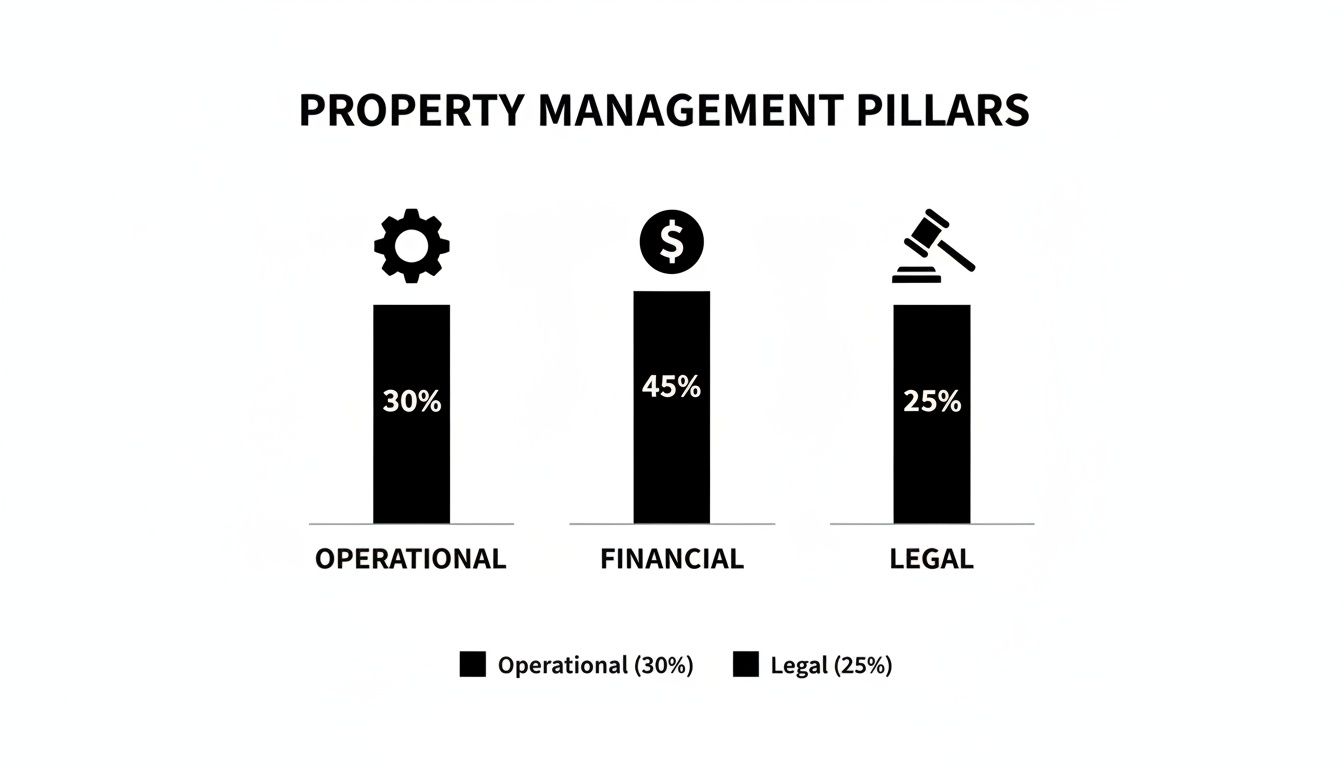
As you can see, the role is a mix of hands-on work, detailed financial oversight, and making sure everything stays legally sound.
The Percentage-Based Fee Model
The most common structure is the percentage-based fee. The management company takes a set percentage of the monthly rent collected from your tenant.
This model aligns our goals with yours—if you don't get paid, we don't either. For example, if your Pacific Grove home brings in $3,000 a month and the management fee is 8%, your monthly cost would be $240. It’s clean, easy to calculate, and tied to your property's performance.
Industry Standard: Monthly management fees usually fall between 8% and 12% of the collected rent. For single-family homes, 10% is a common benchmark. You can get another perspective on service fees by demystifying commission rates and included services in a different industry.
The Flat-Fee Model
Another option is the flat-fee model. Instead of a percentage, the manager charges a fixed dollar amount every month, no matter the rent.
This model gives you predictable costs, which is great for budgeting. It’s often a better deal for owners with higher-end rentals, since the fee doesn't climb as the rent increases.
What Is Usually Not Included
It’s important to know that the monthly management fee covers ongoing, day-to-day work. Certain big, one-time events are typically charged separately for transparency.
Here are the common services that often carry a separate, one-time fee:
- Leasing Fee: Also called a "tenant placement fee," this is a one-time charge for finding and screening a new tenant.
- Lease Renewal Fee: Some companies charge a smaller fee to handle the paperwork and negotiations for renewing a lease with a great tenant.
- Major Project Supervision: If your property needs a big upgrade, your manager might charge a fee to oversee the project and coordinate contractors.
- Eviction Services: While your manager handles the process, the direct costs of an eviction (like court fees) are typically passed on to the owner.
For a more detailed breakdown of costs in our local market, check out our guide on what to expect from affordable property management in Salinas.
Calculating the Real Return on Your Management Fee
It’s easy to look at a property management fee as just another expense. But savvy owners see it as a strategic investment in their property's long-term health and their own peace of mind.
A great property manager delivers value through both measurable financial gains and invaluable quality-of-life improvements. When you add it all up, that monthly fee often pays for itself.
The Tangible ROI You Can Measure
Tangible returns are the hard dollars and cents a professional manager puts back in your pocket. These are the concrete financial benefits that directly impact your bottom line.
Here are the most common ways a manager delivers a financial return:
- Shorter Vacancy Periods: An expert manager uses professional marketing and a streamlined process to fill vacancies fast. Cutting a vacancy from four weeks to one can save you hundreds, if not thousands, of dollars.
- Lower Maintenance and Repair Costs: Property managers have a roster of vetted, reliable vendors in the Monterey Bay area. This means you often get higher-quality work at a better price.
- Avoiding Costly Legal Mistakes: A single legal misstep—like a mishandled eviction—can trigger fines and legal fees that would dwarf years of management fees. An expert in California’s complex landlord-tenant laws is your best defense.
The Intangible ROI You Can Feel
Just as important is the return that doesn’t show up on a financial statement but dramatically improves your life as an owner. This is the peace of mind that comes from knowing a professional is handling the day-to-day grind.
Think of it this way: a property manager buys back your time and energy. You are trading a predictable monthly fee for an unpredictable amount of stress, late-night calls, and weekend emergencies.
This is the value of reclaimed freedom. It’s the vacation you can actually take without worrying about a plumbing emergency back home. For a deeper dive into financial metrics, our guide on what Net Operating Income is can provide valuable insights.
The Advantage of Local Monterey Bay Expertise
Anyone can manage a property. But managing one well in the Monterey Bay is a completely different ballgame. This is where deep, local knowledge becomes your single greatest asset.
A truly local manager understands the subtle but critical differences that define our area. They know the right rent for a condo in Pacific Grove versus a single-family home in Prunedale because they live and breathe this market every day.

Navigating Local Ordinances and Regulations
More importantly, a Monterey Bay expert is your shield. They’re familiar with the specific local ordinances, zoning rules, and DRE compliance that can easily trip up an out-of-area manager.
This insider knowledge protects your investment from costly fines and legal headaches you never saw coming.
Bilingual Communication for a Diverse Community
Our local expertise also comes down to clear communication. With over 35% of Monterey County households speaking Spanish at home, our bilingual (English/Spanish) service isn’t just a perk—it’s essential for good business (Source: U.S. Census Bureau).
Being able to communicate clearly with everyone means:
- Faster Tenant Placement: We can effectively market to and screen a larger, more diverse pool of great applicants.
- Better Maintenance Coordination: Clear instructions with local tradespeople prevent misunderstandings and ensure repairs are done correctly the first time.
- Stronger Tenant Relationships: When tenants feel heard and understood, they’re more likely to stay longer, which cuts down on expensive turnover.
This hands-on, community-focused approach is what truly sets a local expert apart. We look after your property with the same care we’d give our own. To learn more, read our guide on why smart second homeowners rely on local property managers for peace of mind.
Conclusion: What Does a Property Manager Do For Their Fee?
When it comes down to it, what are you really getting for your monthly management fee? You're hiring a professional partner whose entire job is to maximize your income and minimize your stress.
A great property manager steps in as the operational, financial, and legal expert for your investment. They handle everything from the day-to-day grind to navigating the complexities of California landlord-tenant law. The right manager doesn't just collect rent—they deliver peace of mind and measurable returns.
Ready to experience the relief that comes with having a dedicated professional managing your Monterey Bay property? Contact Torrente Property Management today at (831) 582-8916 for a personalized consultation.
FAQs About Property Management Fees
How much do property managers typically charge?
Most property management companies in the Monterey Bay area charge a monthly fee between 8% to 12% of the collected rent. For a property renting at $3,000 per month, an 8% fee would be $240. Some companies may offer a flat-fee model instead.
Is the management fee charged if the property is vacant?
Reputable firms, including Torrente Property Management, do not charge a monthly management fee when your property is vacant. Our philosophy is that we only get paid when you get paid. Always confirm this policy before signing an agreement.
What services are usually excluded from the monthly fee?
The monthly fee covers ongoing supervision. One-time events like finding a new tenant (leasing fee), overseeing a major renovation, or handling the direct costs of an eviction (court fees) are typically billed separately.
Why shouldn't I just hire the cheapest property manager?
Choosing a manager based on the lowest price can backfire. A rock-bottom fee often signals a lower level of service, which can lead to poor tenant screening, higher turnover, and costly legal mistakes. A quality manager saves you money in the long run through efficiency and risk protection.
Does the monthly fee cover maintenance and repair costs?
No, the monthly fee does not include the actual cost of parts and labor for repairs. The fee pays for the service of coordinating the maintenance, which includes fielding tenant calls, dispatching vendors, and managing invoices. The repair bill itself is a separate owner expense.
At Torrente Property Management, our commitment is to maximize your returns while delivering complete peace of mind. To learn more about how our expert, local management can benefit your Monterey Bay property, visit us at https://torrenteproperties.com.