Imagine your rental property is a small business. Its profit, after paying daily bills but before the mortgage and taxes, is its Net Operating Income (NOI). This one number shows how profitable your investment truly is. It's a key metric for success.
For savvy real estate investors, understanding NOI is crucial. In fact, a Nareit T-Tracker report showed a 4.8% year-over-year increase in NOI for Real Estate Investment Trusts (REITs), showing how important it is for tracking performance.
Why NOI Matters to Monterey Bay Investors

As a property owner, you see rent coming in and bills going out. How do you know if your investment is doing well? The answer is your Net Operating Income.
NOI gives you a clear look at your rental's financial health. It focuses only on income and expenses from daily operations. This gives you a stable way to measure performance each year.
Your Most Valuable Metric
Whether you own a home in Salinas or a multi-unit property in Carmel, NOI is your most important number. It tells you if the property itself is a profitable business. This is separate from your personal financing choices.
A strong NOI is the foundation of smart real estate investing. It helps you:
- Make Better Decisions: Know when it's the right time to raise rents, invest in upgrades, or refinance.
- Assess Property Value: A higher NOI directly leads to a higher property valuation. It's that simple.
- Secure Financing: Lenders look at NOI to see if a property generates enough income to cover loan payments.
Understanding this concept is key. It helps you become a strategic investor managing a valuable asset right here in the Monterey Bay area.
Breaking Down the NOI Calculation
The formula for Net Operating Income (NOI) is simple. It comes down to two things: what your property earns and what it costs to run. Understanding these parts is key to measuring your property's financial performance.
The basic formula is: Gross Operating Income (GOI) – Operating Expenses = Net Operating Income (NOI). Let’s look at each part of that equation.
Your Property’s Total Earnings
First, we need to find your Gross Operating Income (GOI). This is more than just the rent you collect. GOI includes every bit of income your property generates in a year.
Think beyond the rent check. Do you charge for pets? What about parking or laundry machines? All that extra money is part of your GOI. This gives you a full picture of your property's earning potential.
This infographic shows the three steps for calculating your property's net operating income.
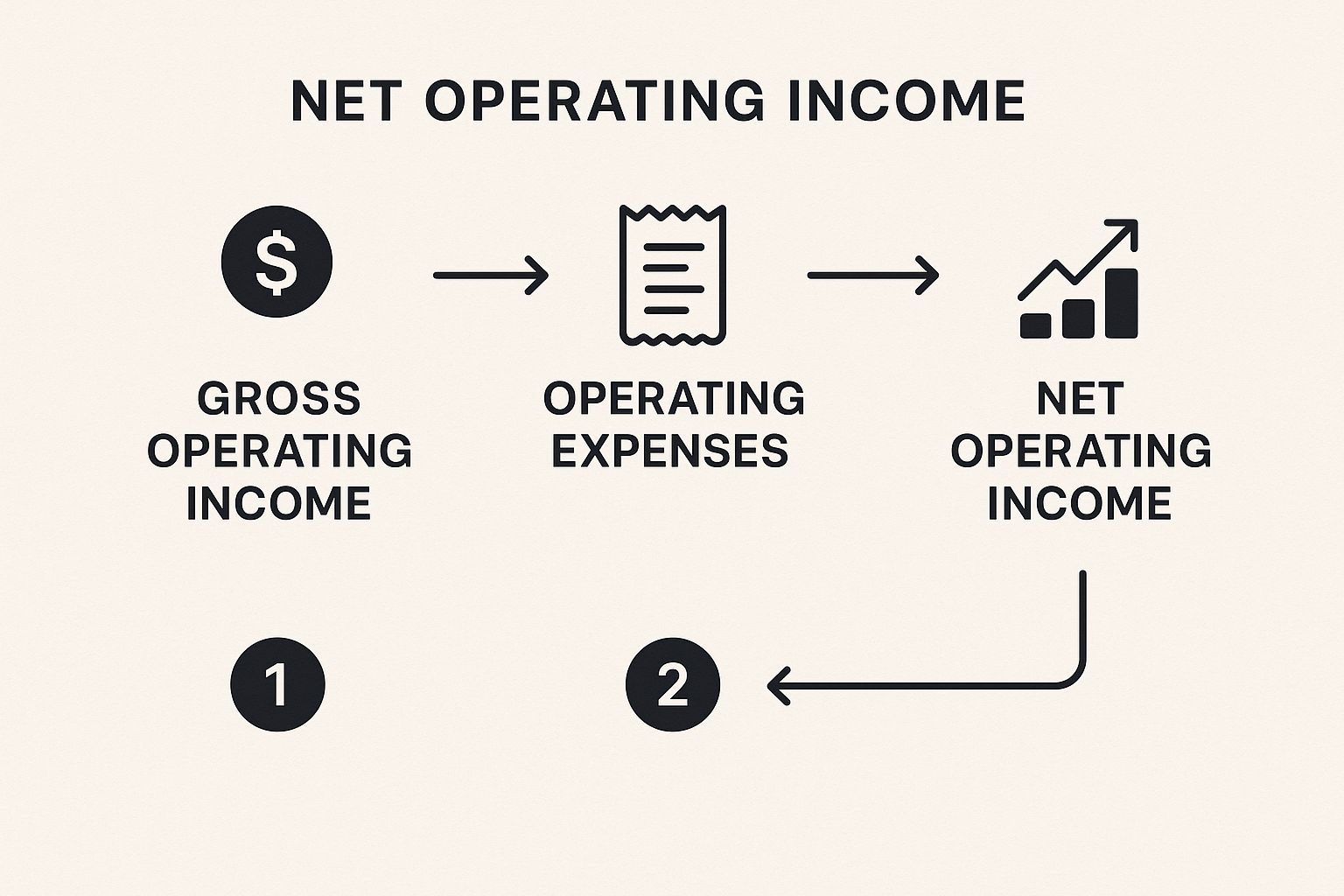
As you can see, NOI is the true profit left after you subtract the daily running costs from the total income.
What It Costs to Run Your Property
Next, you add up your Operating Expenses. These are all the necessary, regular costs to keep your Monterey Bay property safe, functional, and occupied. They are the predictable bills that come with being a landlord.
Common operating expenses include:
- Property Taxes: Your annual payments to the county.
- Insurance: Coverage for liability and property damage.
- Utilities: Costs not paid by tenants, like water for common areas.
- Routine Maintenance: Things like landscaping, pest control, and small repairs.
- Property Management Fees: The cost of having a professional team handle the daily tasks.
Keeping good track of these expenses is very important. If you need a better way to stay organized, our guide on the best accounting software for landlords can help you streamline everything.
Important Note: Operating expenses do not include your mortgage payment, income taxes, or large capital projects like a new roof. NOI focuses only on the operational health of the property itself.
When you subtract these operating costs from your gross income, you get your Net Operating Income. That number gives you an honest assessment of your property’s profitability.
A Practical Guide to Calculating Your NOI

Now you understand the theory behind NOI. Let’s put it into practice. Calculating your Net Operating Income is a simple process that shows you exactly how your property is performing.
The formula is your guide: NOI = Gross Operating Income (GOI) – Operating Expenses.
To make this real, we'll walk through an example. We'll use a rental home in Salinas, California. Follow along, and you’ll be able to run these numbers on your own Monterey Bay investment.
Step 1: Add Up Your Gross Operating Income
First, we need to add up every dollar the property brings in over a year. This total is your Gross Operating Income (GOI).
- Monthly Rent: Let’s say the home rents for $3,000 per month. Annually, that’s $36,000.
- Other Income: The tenant also pays a $50 monthly pet fee. This adds another $600 to your yearly income.
Add them together to get your GOI.
Gross Operating Income (GOI) = $36,000 (Rent) + $600 (Pet Fees) = $36,600
This number is the property's maximum earning potential before any bills are paid. It's our starting point.
Step 2: Calculate Your Total Operating Expenses
Next, we subtract all the regular costs that keep the property running. Remember, we are not including the mortgage or major improvements here.
Here is a breakdown of typical annual expenses for a Salinas rental:
- Property Taxes: About $4,500 for the year.
- Property Insurance: A standard policy is around $1,200 annually.
- Repairs & Maintenance: It’s smart to budget $1,800 for routine upkeep.
- Property Management Fees: A typical 8% fee on collected rent is $2,880.
- Vacancy: Always plan for empty periods. Budgeting for one month of vacancy, or $3,000, is wise.
Let's total these to get our annual operating costs.
Total Operating Expenses = $4,500 + $1,200 + $1,800 + $2,880 + $3,000 = $13,380
Step 3: Find Your Net Operating Income
This is the final step. We subtract the total operating expenses from our gross operating income.
$36,600 (GOI) – $13,380 (Operating Expenses) = $23,220 (NOI)
So, for our Salinas property, the Net Operating Income is $23,220. This number reveals the property's standalone profitability. It's a key metric for savvy investors and businesses.
Why NOI Is Crucial for Real Estate Investors
So, you've calculated your Net Operating Income. What does that number actually do for you? For real estate investors, lenders, and appraisers, your property’s NOI is the best way to judge its health and value. It is the most important number for making smart financial decisions.
Think of NOI as the engine of your investment. A bigger, more efficient engine makes the entire vehicle more valuable. In the same way, a higher NOI makes your property more profitable and worth more money.
How NOI Connects to Property Value
NOI directly shapes your investment’s worth through a metric called the Capitalization Rate, or "Cap Rate." This is a simple formula used in real estate to quickly compare different investments.
The formula is: Cap Rate = Net Operating Income / Property Value
This equation shows a direct link between your NOI and your property's value. If your NOI goes up while the market cap rate stays the same, your property’s value increases. Lenders and appraisers use this logic when deciding a property's worth.
For property owners in the competitive Monterey Bay market, maximizing NOI is the key to building a successful rental portfolio.
How a Higher NOI Boosts Your Bottom Line
Let's see how a small change in NOI can have a big impact on a property's value. We'll assume a market Cap Rate of 5%. Watch what happens when we improve the NOI.
| Property Scenario | Annual NOI | Cap Rate | Estimated Property Value |
|---|---|---|---|
| Baseline Property | $30,000 | 5% | $600,000 |
| Improved NOI Property | $33,000 | 5% | $660,000 |
By increasing the NOI by just $3,000 a year, the property's value jumped by $60,000. This could come from adding a small fee for storage or reducing utility costs.
This is why focusing on NOI is so important. Every dollar you add to your NOI directly builds your long-term wealth. For more ideas, check out our property management tips for local landlords.
Common Mistakes When Calculating NOI

Calculating your Net Operating Income is a powerful step. However, a simple mistake can mess up your financial picture. A wrong NOI can make a property seem more or less profitable than it really is. This can lead to bad investment decisions.
Let's break down the most common errors and how to avoid them.
Mixing Up Operating and Capital Expenses
This is the most common mistake. It is important to separate routine costs from major investments.
- Operating Expenses are daily costs like landscaping, insurance, and minor repairs.
- Capital Expenditures (CapEx) are big projects like a new roof or a full kitchen remodel.
Including a $15,000 roof replacement in your operating expenses would crush your NOI. It would make a healthy property look like a financial failure on paper.
Forgetting to Account for Vacancy
It is great to be optimistic. However, assuming your property will be occupied 100% of the time will inflate your NOI. Tenant turnover is a normal part of being a landlord, even in a strong market like Monterey County.
Smart investors always budget for vacancy, usually between 5% and 10% of the potential rent. This creates a realistic safety net in your numbers. Skipping this step can lead to a surprise income shortage.
For owners of second homes, managing empty periods is key. Our guide on vacant home caretaker services in Monterey Bay offers tips for protecting your asset during those times.
Ways to Boost Your Property's NOI
Understanding what net operating income is gives you a clear picture of your property's health. Improving it is how you build long-term wealth. Boosting your NOI is about two simple things: making more money and spending less.
Small, smart changes can have a huge impact on your property's cash flow and value. Let's look at some practical ways you can do this for your Monterey Bay rental.
How to Increase Your Revenue
The most obvious way to raise income is by increasing rent, but don’t stop there. Think creatively about how your property can earn extra money on the side.
- Add Profitable Amenities: Could you add coin-operated laundry? Or offer reserved parking for a monthly fee? These small additions create new income streams.
- Use a Utility Billing System: For multi-unit properties, a Ratio Utility Billing System (RUBS) is a great tool. It lets you charge tenants for their share of utilities like water, which can lower your costs.
- Review and Adjust Rent: Make sure your rent matches the current market rates in Salinas or Carmel. A professional market analysis can show if you are charging too little.
Even if you manage a property from far away, you can still optimize your revenue. Our guide on rental property management for out-of-town owners has great tips for maximizing returns.
How to Reduce Your Expenses
Cutting costs is the other side of the NOI coin. Smart expense management is about being efficient and proactive. This stops small problems from becoming expensive emergencies.
Here are a few ways to get your operating expenses under control:
- Use Preventative Maintenance: Don't wait for things to break. Regular service on HVAC systems and fixing small leaks prevents costly emergency calls.
- Invest in Energy Efficiency: Simple upgrades like LED lighting or low-flow toilets can lead to big savings on utility bills over time.
- Shop for Insurance Annually: Don't just auto-renew your landlord insurance. Get quotes from different providers each year to find the best price.
By working to increase what you earn and decrease what you spend, you directly improve your NOI. This puts more cash in your pocket today and makes your property more valuable for the future.
FAQs About Net Operating Income
It is normal to have a few questions about Net Operating Income. Here are quick answers to common questions from property owners in the Monterey Bay area.
What is net operating income in simple terms?
Think of Net Operating Income (NOI) as your property's annual profit. It is the money it earns from rent after paying its daily bills but before you pay your mortgage or income taxes.
Is a higher NOI always better?
Yes, a higher NOI is almost always better. It means your property is more profitable and running well. A strong NOI increases your property's value and makes it more attractive to lenders and buyers.
How is NOI different from cash flow?
NOI shows the property's earning power before financing. Cash flow is the money left after you pay the mortgage. The simple math is: Cash Flow = NOI – Mortgage Payments.
Are property management fees an operating expense?
Yes, they are. If you hire a professional property manager, those fees are a standard operating expense. You subtract them from your Gross Operating Income when calculating NOI.
Why aren't capital expenditures included in NOI?
Capital Expenditures (CapEx) are major upgrades, like a new roof. They are not regular costs but long-term investments that boost the property's value. Because of this, they are kept separate from the NOI calculation, much like items on a tenant move-out inspection checklist are handled.
Maximize Your Investment with Expert Guidance
Understanding and improving your Net Operating Income is the key to a successful real estate portfolio in Monterey Bay. By focusing on this critical number, you can make smarter decisions and build long-term wealth.
If you want to take your property's performance to the next level, our team at Torrente Property Management is here to help. We provide personalized service to help you get the most out of your investment.
Contact Torrente Property Management today at (831) 582-8916 to learn how we can boost your NOI.