
What Does It Cost to Have Someone Watch an Empty Carmel or Pebble Beach Home?
If you own a house in Carmel Highlands, Pebble Beach, or Pacific Grove that sits closed up from October to May, you have probably wondered what it costs to have someone check on it. Most owners never ask out loud, because they assume the answer is either too high or too vague to be worth the call.
I get the hesitation. Home watch is one of the few services where the price is almost never posted, and owners want to know whether they are paying per visit or per month before anything else.
So let me walk through what actually moves that number on the Monterey Peninsula, what a paid walkthrough includes that an informal arrangement does not, and how to judge whether you are getting your money's worth.
What Actually Moves the Price of Home Watch on the Monterey Peninsula
There is no flat rate for this, and anyone who quotes you one before asking about your house is guessing. Here is what a real quote is built on:
- Visit frequency. Monthly, quarterly, or every two weeks. This is the biggest single lever.
- Square footage and layout. A 1,400 square foot condo off Munras takes a fraction of the time a 4,000 square foot house with a crawlspace, three baths, and a detached garage does.
- Drive time and access. Getting out to Carmel Highlands or through the Pebble Beach gates eats more of the day than an in-town Monterey stop. Gate codes, lockboxes, and narrow driveways all add minutes.
- Documentation. A written, photo-backed report costs more to produce than a text that says "all looked fine."
- Vendor coordination. Some arrangements bundle calling a plumber and meeting them at the door. Others bill that separately by the hour.
- Property features. Pools, wells, septic, irrigation systems, and furnished interiors all add checkpoints.
For general market context, home watch nationally tends to be quoted per visit for a standard single-family walkthrough, with monthly plans bundling two to four visits at a lower per-stop rate. Coastal California markets usually sit above the national middle because of drive time and home size. Treat any number you read online as background, not a quote for your address.

What a Paid Walkthrough Catches That a Camera Does Not
Most owners are not choosing between two management companies. They are choosing between a professional and a neighbor with a key.
A neighbor glances at the front of the house. A scheduled inspection walks the full perimeter and looks at things that only show up when you go looking.
Our quarterly seasonal maintenance program is a good example of what that list looks like:
- Exterior: roof condition, gutters, siding, and how water is draining away from the foundation
- Plumbing and leak risk: under sinks, around toilets, at the washer connections
- Water heater condition: rust at the base, moisture on the pan, the condition of the strapping
- Safety items: smoke and carbon monoxide detectors, including dead batteries
- A photo-documented report sent to the owner four times a year
A camera in the entryway sees the entryway. It does not see a slow supply line drip under a guest bath sink that has been wicking into the subfloor since Thanksgiving. It does not see the downspout at the back corner that plugged with cypress needles and is now dumping rainwater against the foundation.
That is the real gap. Not security, but the slow damage nobody is standing in front of.
Neighbor, Gardener, Alarm Company, or Scheduled Inspection
Owners almost always try an informal option first, and some of them work fine for what they are. Here is an honest comparison.
| Who is watching | What it is genuinely good at | What it misses | Written record? |
|---|---|---|---|
| Neighbor with a key | Spotting an open gate, a package pile, or an obvious break-in | Anything that requires going inside and looking under, behind, or above | No |
| Gardener or landscaper | Broken sprinklers, overgrowth, fire fuel near the structure, exterior changes | Water heater, plumbing, attic, detectors, interior moisture | Rarely |
| Alarm or camera system | Entry events and motion in covered areas, real-time alerts | Slow leaks, roof and gutter condition, drainage, anything out of frame | Event log only |
| Scheduled property inspection | Full interior and exterior walkthrough on a set schedule, vendor coordination | Nothing between visits, which is why frequency matters | Yes, with dated photos |
The Six Factors Behind Your Quote
When I price a home watch arrangement for a Peninsula property, these are the inputs. Each one pushes the number up or down.

Why More Winter Visits Can Cost You Less
Frequency is where owners try to save, and it is often where the math turns against them.
Forecasters have been carrying an El Nino advisory with a strong signal into the 2026 to 2027 winter, and that pattern historically tilts California toward wetter conditions and a more active atmospheric river track. You can follow the current status through NOAA's Climate Prediction Center ENSO updates.
Now run the numbers on a closed-up house. Census figures put the median property value in Monterey County at roughly $781,000, and inside the city of Monterey closer to $1.08 million. A roof leak or a failed supply line in a house like that is not a small-dollar problem.
Found in week one, it is a vendor call and a dry-out. Found in week ten, it is often:
- Dry rot repair in the framing
- Flooring replacement across a room or two
- Cabinet and drywall work
- An insurance deductible, plus whatever the claim does to your premium
Against that, the cost of adding one or two extra walkthroughs during the rainy months is small. I am not trying to scare anyone. I am saying that when the sky is open and the house is closed, the interval between visits is the risk.
Judge the Service by the Report, Not the Reassurance
Here is the test I would apply if I were the one hiring. A visit with no written record is close to worthless six months later.
A report worth paying for has:
- Dated photos, not a summary sentence
- A list of the specific items checked, so you know what was and was not looked at
- What changed since the last visit
- Any recommendation with a rough cost attached, so you can decide instead of guess
That matters most for owners managing a house from another state, which is a big share of the people I talk with. You are not looking for reassurance. You are looking for proof that someone was actually there and actually looked.
There is a second benefit. A documented history of inspections is the record that helps when a repair turns into an insurance conversation. Showing a dated series of photos of a sound roof, followed by storm damage, is a very different conversation than having nothing at all.
If you are weighing this against full management because you are also thinking about renting the place, it is worth reading up on what property management actually costs in the Monterey Bay area before you decide which path fits.
Frequently Asked Questions About Home Watch Costs
Is home watch billed per visit or per month?
Both are common. Many arrangements are quoted per visit, and owners who want a set schedule often move to a monthly or quarterly plan that bundles the visits at a lower per-stop rate. Ask which structure you are being quoted before you compare two providers, because the headline number means nothing without it.
How long does a walkthrough actually take?
It depends on the house. A smaller in-town condo can be done thoroughly in well under an hour. A larger Pebble Beach or Carmel Highlands property with a crawlspace, multiple baths, and a long exterior perimeter takes considerably longer, and the drive out and back is part of what you are paying for.
I have cameras and an alarm. Do I still need someone walking the property?
Cameras and alarms are good at what they do, which is telling you when something enters the frame. They cannot read a water heater, check a drain line, look at gutter condition, or test a smoke detector. The damage that costs owners the most around here is usually water, and water almost never happens in front of a camera.
Does the price change if my house is in Pebble Beach instead of Monterey?
Usually yes, and it is mostly about time rather than the zip code. Gate access, longer driveways, larger square footage, and the drive itself all add to a visit. An in-town Monterey or Pacific Grove property is typically on the lower end for the same level of service.
If something is wrong, do you handle the repair or just tell me?
That is a question to ask directly, because it varies. Some arrangements stop at the report. Ours includes coordinating licensed vendors and meeting them at the property, and whether that coordination is bundled into the fee or billed separately is part of what the quote spells out.
Want a Number Tied to Your Address?
Our quarterly walkthroughs are done by a small local team rather than a national dispatch network, and we work in English and Spanish across Monterey, Carmel, Pacific Grove, Pebble Beach, Seaside, Marina, and Salinas. Broker-owner Aurelia Torrente has spent more than 25 years in Monterey County real estate and holds the Accredited Residential Manager credential. Pricing depends on the property, so if you want a figure for your house, the office is at (831) 582-8916 or through the contact form at torrenteproperties.com. As one Seaside owner put it, "They have all the qualities of someone we can trust with our properties."


Switching Property Managers in Monterey County With Tenants Already in Place
Most owners who call me about switching managers are not unhappy shoppers. They are people whose situation changed suddenly, and there is a tenant living in the house while they figure it out.
One owner in Seaside reached out after her property manager passed away. Her tenants had been in the same house for four years, rent was current, and she had no idea who was holding the deposit or the lease.
Another owner up in North Salinas simply wanted to know what professional management would cost and how the process worked, because there was a tenant already in place and he did not want to disturb anything.
This article is about that exact situation: changing property management companies with a tenant already in place, not a first-time handoff from self-managing. If you have been running the property yourself, handing off a rental you have been managing yourself covers different ground.
The Lease Keeps Running While You Change Who Manages It
Here is the part that puts a lot of owners at ease. Changing managers does not change the lease.
The tenant's rights, the rent amount, the due date, the lease end date, and the deposit all carry forward exactly as written. You are swapping the company that collects and coordinates, not rewriting the deal.
That also means you cannot use the switch as a reason to raise rent early, shorten a term, or ask a tenant to re-apply. A new manager steps into the shoes of the old one.
What actually changes for the tenant is small on paper and large in practice:
- Where rent goes starting on the cutover date
- Who to call for a leaking water heater at 11 p.m.
- Which portal holds their lease and payment history
- Who holds the security deposit
Get those four things communicated clearly and most transitions are uneventful. Miss one and you create a problem that did not need to exist.

What Physically Has to Move From the Old Manager to the New One
This is where most transitions quietly go wrong. Money transfers fine. Paper does not.
Here is the file I want in hand before I take over an occupied property:
- The signed lease and every addendum, including pet, parking, and utility agreements
- The security deposit funds themselves, wired or delivered, not just reported
- The original itemized deposit receipt showing what was collected and when
- Move-in condition photos and the signed checklist
- The full rent payment ledger for the tenancy
- Any prior rent increase notices, with dates and amounts
- Any written warnings, cure notices, or complaints
- Keys, mailbox keys, gate remotes, and any access codes
- Appliance and roof warranty paperwork
- Smoke and carbon monoxide detector installation and test records
The deposit and the move-in photos matter most, and they matter together. A deposit that arrives without move-in photos is nearly impossible to defend at move-out, because you have no baseline to compare the property against.
Also pay attention to deposit size. California has capped most residential security deposits at one month's rent since July 1, 2024 under AB 12, so a tenancy that started before that date may legally hold more. That history needs to travel with the file instead of getting rebuilt from memory two years later.
The Handoff File: What Each Item Actually Protects
I use a version of this list every time I take over an occupied home in Monterey or Salinas. The right column is the part owners tend to underestimate.
| File Item | Why It Matters | What Happens Without It |
|---|---|---|
| Signed lease and addenda | Sets rent, term, and every rule you can enforce | No enforceable terms beyond what the tenant agrees to remember |
| Security deposit funds | Belongs to the tenant, held on their behalf | Owner may owe it out of pocket at move-out |
| Itemized deposit receipt | Proves the exact amount collected and when | Disputes over the balance owed back |
| Move-in photos and checklist | The baseline for judging damage vs. normal wear | Deductions are hard to justify and easy to challenge |
| Rent payment ledger | Shows payment history and any balance | Late payment patterns and credits disappear |
| Rent increase notices | Establishes the last increase date and amount | Risk of an improper increase under state limits |
| Detector records | Documents smoke and CO compliance | No proof of installation or testing dates |
| Keys, remotes, access codes | Basic access for maintenance and inspections | Rekeying costs and delayed emergency response |
Read Your Termination Clause Before You Do Anything Else
Owners often assume they can walk away whenever they like. Your management agreement usually says otherwise.
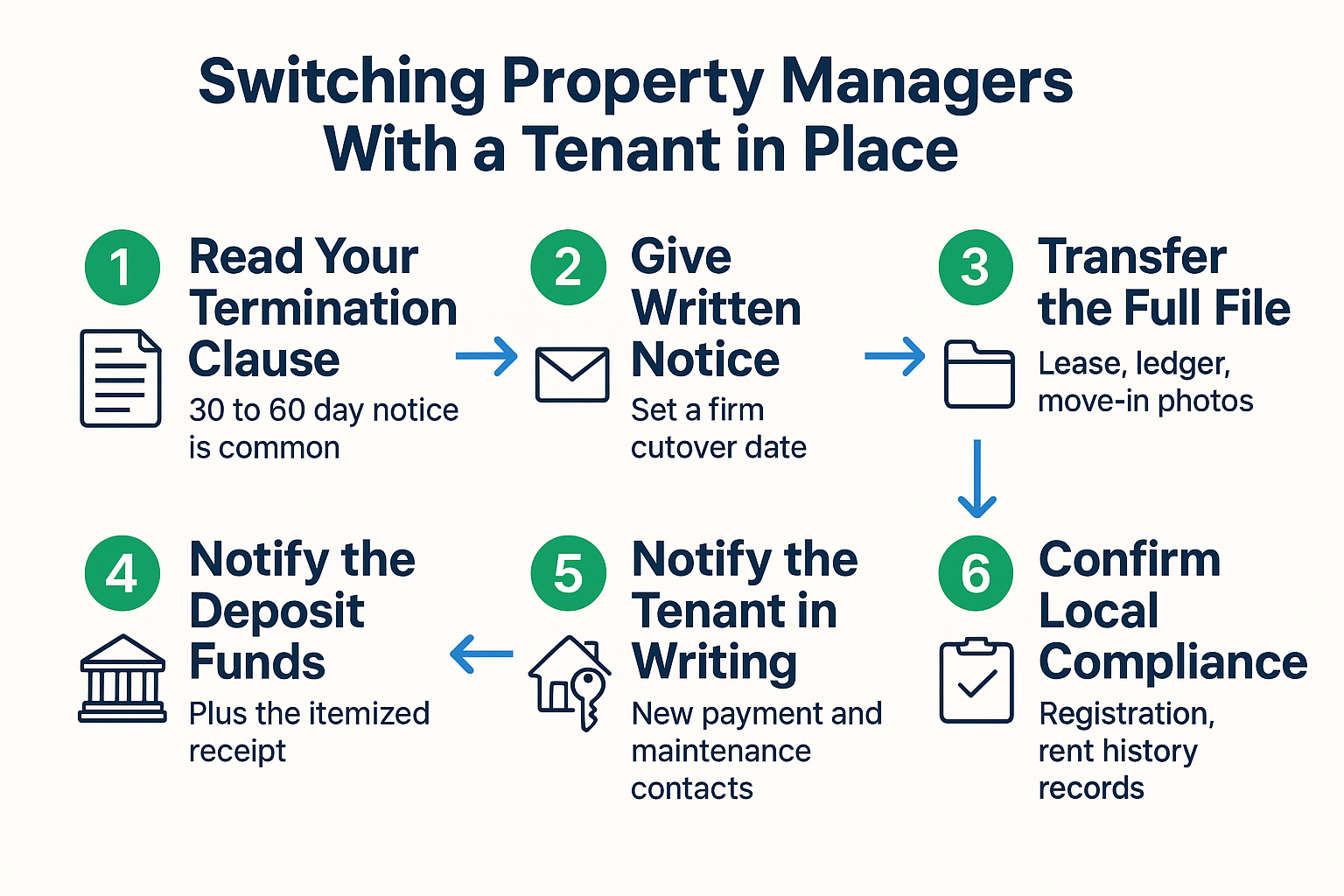
Most agreements require written notice, and 30 to 60 days is common in the Monterey Bay market. The number that governs you is whatever your own contract says, so read it first.
Three clauses to look at closely:
- The termination clause, including how notice must be delivered and whether there is an early exit fee
- Any leasing fee already earned on the current tenant, and whether the outgoing company claims a share of future rent for that placement
- Whether the agreement auto-renews on an anniversary date you are about to pass
Then think about timing. Cut over on a clean rent cycle so the tenant never pays two different companies in the same month.
I also try to avoid July and August cutovers. Peak moving season on the Peninsula stretches every vendor, lender, and locksmith thin, and a fall transition is simply easier to coordinate.
The Mid-Tenancy Switch, Start to Finish
This is the order I work in when an owner brings me an occupied property in Monterey County.
A Manager Change Is When Good Tenants Start Looking Around
Read enough rental reviews around Monterey Bay and a pattern shows up. Tenants read silence as being ignored, and confusion about where to send rent turns into a payment problem within one cycle.
A long-term tenant who has paid on time for four years is an asset. Rattle that person and you can lose them over something that cost you nothing to prevent.
So I send a written notice to the tenant before the cutover, and it says all of this plainly:
- The exact date the new company takes over
- Where and how to pay rent, starting with that first payment
- The maintenance number and the after-hours emergency number
- Portal login instructions for rent, work orders, and lease documents
- Clear confirmation that the deposit transferred with the file and was not spent
That last line does more work than owners expect. Deposits are the number one thing tenants worry about when a company name changes on the rent envelope.
The math is not close either. In a market where a Monterey two-bedroom commonly rents somewhere in the $3,000 range, losing a paying tenant over a communication gap costs far more than the entire transition. Vacancy, turnover cleaning, and re-leasing add up fast.
The Local Rules Do Not Pause While You Are Between Managers
Compliance keeps running whether or not anyone is watching the file. A few items matter specifically here.
In Salinas, the Residential Rental Registration program requires registration and annual fees. Decide during the handoff who files and who pays for the year in question, in writing, rather than assuming the other party has it.
Rent increase history under AB 1482 matters too. Your new manager needs the date and amount of the last increase before touching rent, and that information should come from the ledger, not from recollection.
If you own a multifamily building, pull the exterior elevated element inspection records tied to SB 721 and AB 2579. Balcony, stair, and walkway inspection reports belong in the transferred file, because those deadlines follow the building, not the manager.
None of this is a lecture. It is the paper trail that protects you if a dispute ever lands in front of a judge or an insurance adjuster. Owners managing from out of the area feel this most, which is why keeping control of a Monterey property from a distance comes down to documentation more than anything else.
What to Look for in the Company Taking Over
A mid-tenancy takeover is one of the moments where a small local office beats a call center. Someone has to chase down a deposit receipt from a company that may be winding down, and that takes phone calls and relationships.
When you interview a replacement, ask how they handle the file transfer specifically. If the answer is vague, keep looking. If you are still comparing options, choosing a rental management company in Monterey Bay and what management actually costs in the Monterey Bay area are both worth reading before you sign anything.
Our office is owner-led by a licensed broker with more than 25 years in Monterey County, holds the Accredited Residential Manager credential, and works in both English and Spanish across the Salinas and Monterey markets. Our 5-star Google rating comes largely from owners describing steady communication over years, including one who wrote that we have managed several properties and "everything runs smoothly."
That is really what a good transition should feel like from the owner's side. Quiet.
Frequently Asked Questions About Changing Property Managers Mid-Tenancy
Can I switch property managers if my tenant is in the middle of a lease?
Yes. The lease belongs to you and the tenant, not to the management company. The rent, term, and deposit all carry forward unchanged, and the new manager takes over administration on the cutover date.
How much notice do I have to give my current property management company?
Check your agreement, because that document controls. Thirty to sixty days of written notice is common around Monterey County, and some contracts also auto-renew on an anniversary date, so read the whole termination section before you send anything.
What happens to the security deposit when I change companies?
The actual funds should transfer to the new manager's trust account, along with the itemized receipt showing what was collected and when. Do not accept a summary line on a statement in place of the money. Also confirm the deposit amount matches the lease, since tenancies that began before July 1, 2024 may legally hold more than one month's rent.
My property manager passed away and I do not know who has my records. What do I do?
Start with the tenant, who usually has a copy of the lease and payment confirmations, then contact the brokerage of record and the bank holding the trust account. This happens more often than people expect, and it is workable. It just takes someone local making calls on your behalf.
Will my tenant have to sign a new lease?
No. The existing lease stays in force. The new manager may add a short notice of change in management for the file and set the tenant up in a new portal, but that is administrative and does not alter the tenant's terms.
What is the worst time of year to make the switch?
Midsummer. July and August are peak moving months on the Peninsula, so vendors and schedules are stretched. A fall cutover on a clean rent cycle is easier on everyone, including the tenant.
Thinking Through a Mid-Tenancy Transition?
If you own a rental anywhere from Salinas and Prunedale down to Carmel and Pebble Beach and you are weighing a change while a tenant is still in the home, we are happy to talk through the file, the timing, and the notice period on your specific agreement. Our office is at (831) 582-8916, and there is a contact form at torrenteproperties.com. No rush and no pressure, just a straight conversation about what your situation actually needs.

What Happens When You Stop Managing Your Rental Yourself
Most owners I talk to did not decide to hire help on a calm Tuesday. They decided after one bad night. A tenant stopped paying, a water heater let go at 11 p.m., or a lease renewal got handled the wrong way and suddenly the whole arrangement felt heavier than it did a year ago.
One owner in North Salinas reached out after self-managing for more than two years. He was not in crisis. He just wanted to know the cost and the process of handing things over with a tenant already in place.
That question comes up more than any other, so this article walks through what actually changes when you stop managing yourself. What the handoff looks like, what leaves your plate, and how the fee stacks up against what you are already paying in time and risk.
The mid-tenancy handoff is quieter than owners expect
The biggest hesitation I hear is not about money. It is about rocking the boat with a good tenant.
One Seaside owner had tenants who had been in the home for four years and paid on time the whole way. She worried that bringing in a manager would unsettle a relationship that took years to build. It does not work that way.
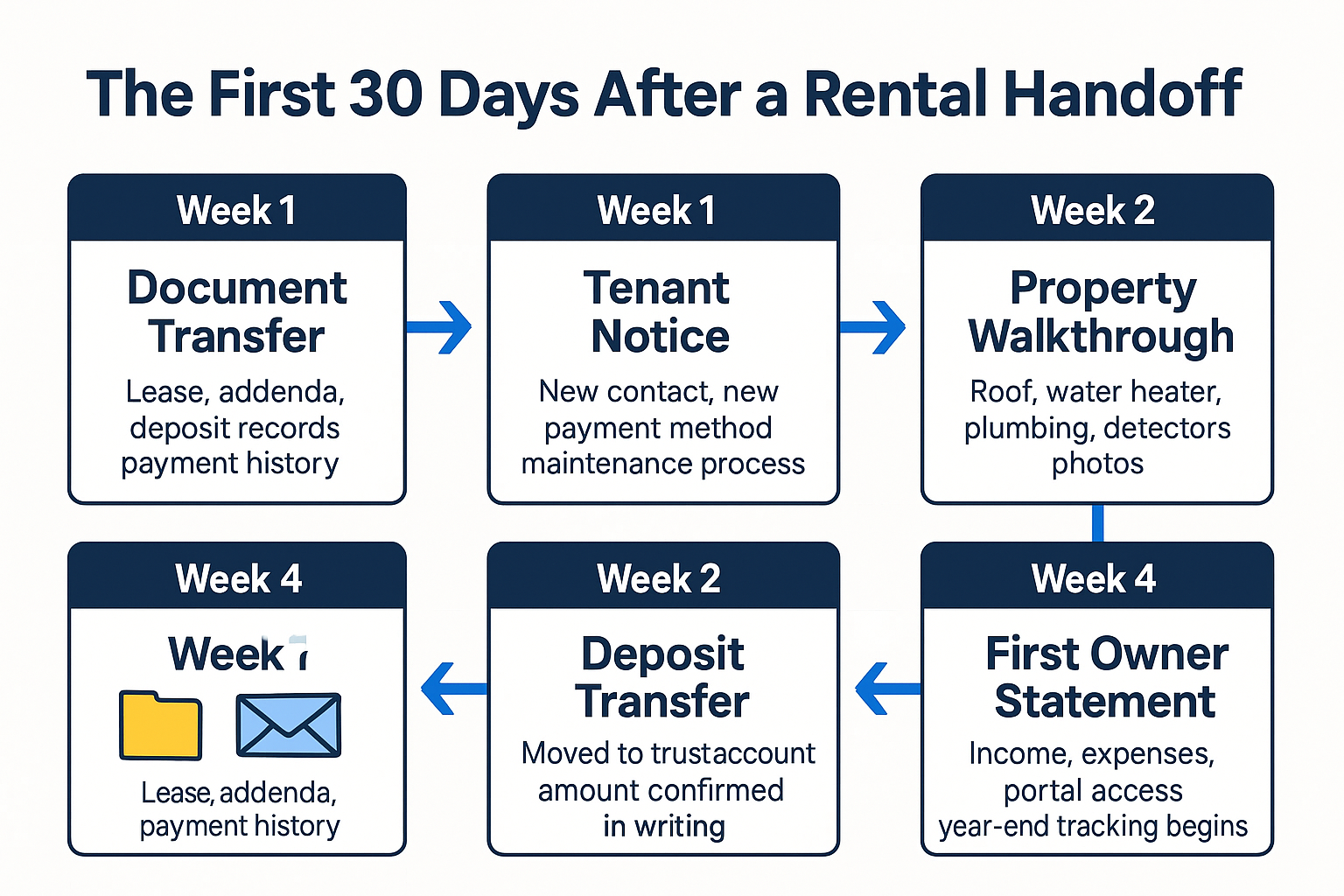
A mid-tenancy handoff is mostly paperwork on our end and one letter on the tenant's end. Here is what typically happens in the first couple of weeks:
- The existing lease stays exactly as written. Rent amount, term, pet terms, and renewal dates all carry over.
- The tenant gets a written notice with the new management contact, the new place to send rent, and how to submit maintenance requests.
- The security deposit transfers to the new management trust account, with the amount documented in writing.
- We collect the lease, any addenda, the move-in inspection record, and the payment history from you.
- A walkthrough gets scheduled so someone has actually laid eyes on the roof, water heater, and detectors.
For a tenant who is already paying on time, almost nothing about their life changes except a better way to report a leaking faucet. If you want the step by step version, we covered it in detail in how to hand off a rental you have been managing yourself.

What actually stops landing on your plate
The part owners underestimate is the mental weight, not the task list. Several owners have described the same pattern to me: long conversations, excuses, late payments, and a slow drift into being a friend instead of a landlord.
If you are conflict-avoidant, self-managing punishes you. Every awkward conversation costs you something, so you put it off, and putting it off costs more.
After a handoff, these come off your plate entirely:
- Rent collection and late notices. You are not the one sending the text on the sixth.
- After-hours calls. A burst pipe in Pacific Grove at midnight goes to a coordinator, not to you.
- Vendor scheduling. Getting a licensed plumber out to Marina and confirming the work got done.
- Turnover coordination. Cleaning, paint, landscaping, and re-listing between tenants.
- Detector and safety checks. Smoke and carbon monoxide compliance at move-in and turnover.
What stays with you is oversight, and that is the point. Monthly statements show income, expenses, and what was repaired. The owner portal holds the documents. Big spending decisions still come to you before the money is spent.
One owner told me it felt like buying back mental bandwidth. That is honest. You still own the asset. You just stop being the front desk.
Self-managing versus managed: who handles what
This is the split I walk owners through on a first call. It is not about capability. It is about where your hours go each month.
| Task | Self-managing owner | After the handoff |
|---|---|---|
| Rent collection and late follow-up | You text, call, and negotiate | Handled through the portal with a set process |
| 11 p.m. emergency repair | You find a vendor from bed | 24/7 coordination with local licensed vendors |
| Annual lease renewal and rent review | You guess at market rent | Priced against current Monterey County comparables |
| Move-out inspection and deposit accounting | You document it and hope it holds up | Photo documented, itemized within the legal window |
| Salinas rental registration paperwork | Yours to track and renew | Tracked as part of ongoing administration |
| Financial records for taxes | Shoebox or spreadsheet | Monthly statements plus a year-end summary |
The first 30 days after you hand over the keys
Here is the typical sequence for an owner switching mid-tenancy with a paying tenant already in the home.
The fee you see versus the cost you are already paying
Owners compare a management fee against zero. That is the wrong comparison, because self-managing is not free. It is just billed in hours and risk instead of dollars.
On cost, I will be straight with you: rates vary by property type, unit count, and how much turnover work is involved. Across the Monterey Bay area, monthly full-service management is commonly quoted as a percentage of collected rent, with leasing or tenant placement often billed separately as a one-time fee. Anything more specific than that depends on your actual property, so ask for a written quote rather than trusting a number in an article. We break the structure down further in what a property management fee actually covers in California.
Now the invisible side. Compliance mistakes are where self-managing owners get hurt, and California has moved fast in the last two years:
- Security deposits are capped at one month's rent for most residential rentals as of July 1, 2024, under California Civil Code Section 1950.5. Collecting more, or holding an older larger deposit incorrectly, creates real exposure.
- Deposit accounting has a strict deadline after move-out, with itemized documentation. Missing it is one of the most common and most expensive errors I see.
- Salinas runs a Residential Rental Registration program, which means ongoing registration and renewal for covered rentals. Owners often forget it exists between renewal cycles. We keep a current rundown in the Salinas rental registration guide.
- The City of Monterey prohibits rentals under 30 days, so lease terms need to reflect that.
Add up an improperly handled deposit, a mispriced renewal, and a vacancy that ran two weeks long, and the math on a management fee looks different than it did at the start of the year. If you are still weighing it, when self-managing your rental stops making sense walks through the tipping points I see most often.
What it feels like a year in
The honest answer is that it feels boring, in the best way. You get a statement each month, an occasional note about a repair, and a call before anything expensive happens.
One Salinas owner with multiple rentals put it plainly in a review: "Ashley has been very thorough with taking care of multiple rental properties in Salinas. It's refreshing knowing we have that piece of mind..."
That is roughly the experience owners describe after the first six months. Not excitement. Just a property that runs without needing you in the middle of it.
For owners who live out of the area, from Prunedale to out of state entirely, the shift is even sharper. There is more on that in how out-of-area owners actually manage a Monterey Bay rental.
Frequently Asked Questions About Handing Off a Rental You Manage Yourself
Can I hire a property manager if I already have a tenant in the home?
Yes, and it is one of the most common situations we take on. The lease stays in force as written, the tenant keeps their same terms, and they simply receive notice of who to pay and who to contact for repairs.
Will switching upset a long-term tenant who has been reliable?
In my experience, good tenants usually welcome it. They get a real maintenance process instead of texting the owner and waiting. The change they notice most is a faster response when something breaks.
What happens to the security deposit I am holding?
It transfers into the management trust account and the amount is documented in writing for both you and the tenant. If your deposit predates the one month cap that took effect July 1, 2024, that gets reviewed as part of the handoff so the accounting is clean at move-out.
How long does the whole handoff take?
For a single-family home with a tenant in place, expect a couple of weeks from signed agreement to the first full month of managed operations. Properties with missing lease documents or deferred maintenance take longer, because we want a walkthrough on record before we take responsibility for the condition.
Do I lose control over decisions about my own property?
No. Routine repairs get handled under an approval limit you set. Anything above that comes to you first, and you see every dollar in and out on the monthly statement.
Is this available in Spanish?
Yes. Our team works in both English and Spanish, which matters in the Salinas and Monterey markets for both owners and tenants.
Thinking through a handoff on your own rental?
If you are self-managing a property anywhere from Salinas and Seaside to Carmel and Pacific Grove and want to understand what the transition would actually look like, our team is happy to walk you through it, tenant in place or not. You can reach us at (831) 582-8916 or through the contact form at torrenteproperties.com. No pressure either way, just a straight answer about your property and the Monterey County market it sits in.

Before the First Big Rain: What to Check on a Monterey Bay Property
Every fall I get the same call from owners across Monterey County. The first real storm hits, water shows up somewhere it should not be, and now everyone on the Peninsula is trying to book the same roofer at the same time.
The forecast is worth planning around this year. NOAA's Climate Prediction Center is carrying an El Nino Advisory with a greater than 90% chance of a very strong event through fall and winter 2026-27, and roughly 97% odds the pattern holds into early spring 2027. On the Central Coast, that setup has historically meant a wetter season with a more active atmospheric river track.
We have written before about getting a Monterey Bay rental ready for a Super El Nino winter at a high level. This piece is different. This is the physical walkthrough itself, done in order, with what to look at first and why. You are protecting an asset that in Monterey County carries a median value somewhere around $781,000, and north of $1 million inside the city of Monterey.
Step 1: Start Where the Water Starts
Almost everything that fails here fails because of water and where it went. So walk the property the way rain does, from the top down.
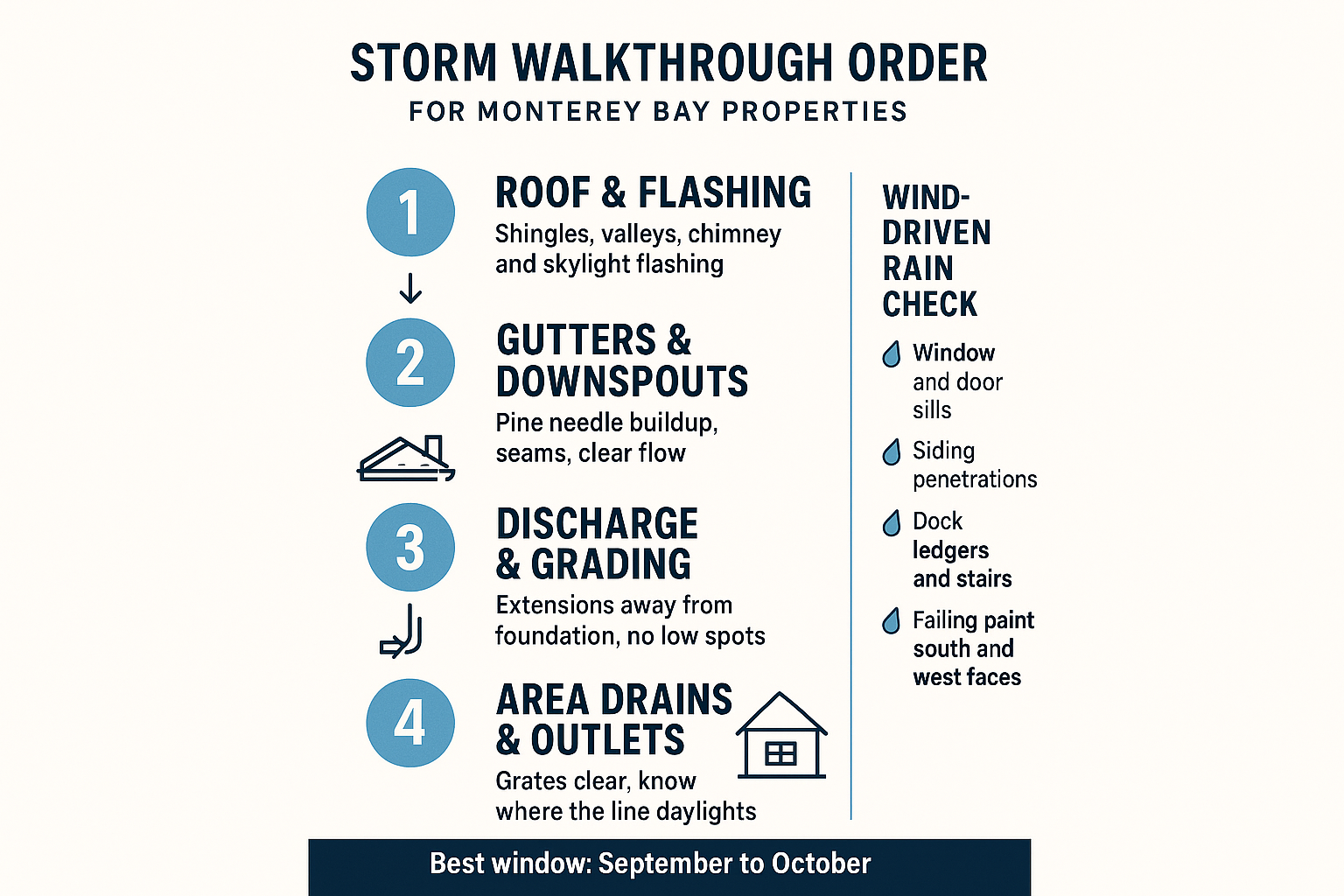
Start at the roof surface. You are not climbing up unless you do that for a living, but you can see a lot from the ground with binoculars or from a second story window.
- Missing, lifted, or curled shingles, especially on the windward face
- Flashing at chimneys, skylights, and valleys, which is where most leaks actually begin
- Debris piles sitting in valleys or behind chimneys
- Sagging or separated gutter seams
Then the gutters and downspouts. This is the single highest return item on the whole list, and it is the one owners skip most.
Homes under the Monterey pine and cypress canopy in Carmel, Pebble Beach, and Pacific Grove fill with needles fast. I have seen gutters packed solid by mid-November on houses that were cleaned in August. Needles mat down and hold water like a sponge.
A clogged downspout is a couple hundred dollar problem in October. That same clog in February can mean a soaked subfloor and dry rot repairs that run into the thousands. Costs vary with roof height, pitch, and access, so get your own quotes.

Step 2: Follow the Water Away From the Foundation
Getting water off the roof is only half of it. The other half is where it lands.
Stand at the base of each downspout during or right after a rain if you can. That is the fastest way to spot trouble.
- Does the downspout have an extension carrying water at least a few feet out, or is it dumping right against the stem wall?
- Is soil sloped away from the house, or has it settled into a low spot that ponds?
- Are area drains and their outlets clear, or is the grate covered in leaves?
- Where does the drain line actually daylight? If nobody knows, that is worth finding out before December.
Grading matters more in some parts of the county than others. Around Salinas, heavier clay soils and flatter lots hold standing water long after the rain stops. Water that sits next to a foundation finds its way in.
Last stop on this leg is the crawlspace. Check that vents are open and not blocked by soil or plantings, and look for standing water, damp insulation, or a musty smell under the floor. A flashlight and five minutes at the access hatch tells you a lot.
Step 3: Check the Building Envelope for Wind-Driven Rain
This is where Monterey Bay is different from inland California, and it is the step most generic checklists miss.
Our storms arrive with sustained wind and gusts strong enough to push rain sideways. Water gets driven into places a vertical rain never touches, then sits there.
Walk the outside of the building and look hard at the south and west faces:
- Window and door sills, especially where caulk has cracked or pulled away
- Siding penetrations for hose bibs, dryer vents, cable, and electrical
- Deck ledger connections where the deck attaches to the house
- Exterior stairs, railings, and the underside of landings
- Any spot where paint is failing, bubbling, or chalky
Press on suspect trim with a screwdriver. Older housing stock in Seaside, Pacific Grove, and parts of Salinas commonly hides dry rot behind trim that looks perfectly fine from ten feet away. If the tip sinks, you found it early, which is the good version of that discovery.
One note for multifamily owners: buildings with elevated walkways and balconies have separate state inspection obligations under SB 721, on their own deadlines. That is a different conversation from storm prep, but do not let it fall off your radar.
The Walkthrough, In Order
This is the same sequence I use on a property, top down and outward. Following the order keeps you from missing the cause while you chase the symptom.
Step 4: The Empty House Gets Its Own List
If nobody lives at the property, you have the most exposure and the least visibility. A slow leak in an occupied home gets noticed in a day. In a vacant Carmel second home, it can run for two months.
One seasonal Carmel owner reached out to us asking for exactly this: scheduled inspections of the home during long stretches away. That request comes in more than any other from second home owners on the Peninsula.
For a vacant or seasonal property, add these before the season starts:
- Water heater age and condition. Look at the manufacture date, the base of the tank, and any rust at fittings.
- Supply lines and angle stops under sinks and behind the washer. Braided steel lines age out.
- Main shutoff. Is it labeled, accessible, and does it actually turn?
- Heat left on low to keep interior moisture and condensation down.
- Photo documentation with dates, so if something does go wrong, you can pin it to a window of time.
One more call to make: your insurance carrier. Ask directly how your policy treats an extended vacancy, because many carriers limit coverage once a property sits empty past a set number of days. Do not assume, and do not take a number off the internet. Ask your agent about your policy.
If you are weighing how often someone should actually be laying eyes on the place, we covered that in detail in our guide on how often a vacant home in Monterey Bay should be checked.
Timing: What to Do When
Sequencing is most of the value here. Once the first real storm lands, the trades book out and pricing changes.
| Task | Best Window | Why the Timing Matters |
|---|---|---|
| Gutter and downspout cleaning | Late September to October | Pine and cypress needle drop peaks before the rain arrives |
| Roof and flashing inspection | September | Roofers on the Peninsula book out for weeks after the first storm |
| Tree trimming and limb removal | September | Crews get slammed after the first wind event of the season |
| Drainage and grading work | September to early October | Needs dry soil to do the work properly |
| Water heater and supply line check | Anytime before November | Owner-level check, no contractor needed |
| Sandbags on hand (if you are in a flood-prone spot) | October | County seasonal supply, do not wait for the storm watch |
Step 5: Local Logistics Owners Often Miss
A few things that are specific to this county and easy to set up now.
Sandbags and sand are available seasonally through Monterey County, generally with ready-made or fill-your-own bags at local fire stations and free sand stockpiles for unincorporated areas. Availability and locations change year to year, so check with the county before you drive out.
ALERT Monterey County lets residents register a phone number for emergency notifications. If you own here but live somewhere else, register anyway. Knowing an evacuation order went out near your property is worth the two minutes.
Risk is not even across the county. Owners near the 2020 burn scars and along the Pajaro River corridor carry a different profile after the 2023 levee breach that put thousands of people under evacuation orders. If that is you, your prep list starts earlier and includes debris flow and access planning, not just gutters.
On cost, I will not quote you numbers I cannot stand behind. Gutter cleaning, tree work, and drainage repair all price off scope, roof height, and access, and emergency call-out rates during a storm are a different conversation entirely. Get two or three quotes in September while contractors still have room on the calendar. For a broader look at budgeting, our breakdown of what property management actually costs in the Monterey Bay area walks through how these expenses tend to show up over a year.
Step 6: Make It Repeating Instead of a Scramble
The owners who come through winter clean are almost never the ones who did a heroic October weekend. They are the ones with a schedule.
A documented walkthrough four times a year covers the same ground every time:
- Roof, gutters, siding, and drainage
- Plumbing and visible leak risk
- Water heater condition
- Smoke and carbon monoxide detectors
The part that matters most for out-of-area owners is the photo report with dates. When you can compare October to January photos of the same corner of the same wall, you catch slow problems early and you can prove when something started.
That repeating, documented check is the gap most national firms and larger offices leave wide open for second homes and vacant properties on the Peninsula. It is also why one Seaside owner of four-plus years wrote that we "have all the qualities of someone we can trust with our properties."
If you are managing a property from another state, our guide on how remote homeowners keep control of a Monterey property covers the systems side of this.
Frequently Asked Questions About Storm Prep on Monterey Bay Properties
When is the real deadline to get this done?
September and October. Once the first significant storm lands, roofers, gutter cleaners, tree crews, and drainage contractors across the Peninsula and Salinas Valley are booked out for weeks.
How likely is a wet winter this year, really?
NOAA's Climate Prediction Center is carrying an El Nino Advisory with a greater than 90% chance of a very strong event for fall and winter 2026-27. You can read the current status yourself in the ENSO Diagnostic Discussion. Strong El Nino has historically tilted the Central Coast toward a wetter, more active storm track, though no forecast is a guarantee for any one address.
Does my homeowners insurance cover the house while it sits empty?
Maybe, and maybe not past a certain point. Many carriers limit or change coverage once a property has been vacant beyond a set number of days. Call your agent and ask about your specific policy language rather than guessing.
What if I already have a tenant in place? Is this still on me?
Yes for the building systems. Tenants may keep an eye on things day to day, but roof, gutters, drainage, and structural items sit with the owner. Setting expectations in writing before the season starts prevents most of the disagreements I see in December.
I live out of state. Can I skip the walkthrough if the house looks fine on the last visit?
A house that looked fine in July can hide a clogged drain line and a soft deck ledger. The value of a fall check is catching the cheap version of a problem instead of the expensive one.
Want a set of eyes on the property before the rain starts?
Our team is based in Monterey County, works across Monterey, Salinas, Pacific Grove, Carmel, Pebble Beach, Seaside, and Marina, and speaks both English and Spanish. If you would like to talk through what your property needs before the season turns, Torrente Property Management can be reached at (831) 582-8916 or through the contact form at torrenteproperties.com. No rush and no pressure, just a conversation about the place.

What a Property Management Fee Actually Covers in California
Almost every owner who calls me asks the same two things in the same breath: what would my place rent for, and what do you charge? The second question is the one people misread most often.
A monthly management fee and a leasing fee are two different things. So is a vendor invoice. When owners compare companies without knowing which is which, they end up comparing numbers that were never the same number to begin with.
I want to walk through the line items the way I would on a phone call with a homeowner in Salinas or Pacific Grove. What the monthly fee usually buys, what tends to be billed on the side, and the questions worth asking any manager before you sign.
What does the monthly management fee actually cover?
In California, the monthly fee is typically a percentage of collected rent. It pays for the ongoing, unglamorous work of keeping a tenancy running.
In most agreements you should expect it to include:
- Rent collection and follow-up on late payments
- Tenant communication, including after-hours calls
- Maintenance coordination with vendors and follow-through
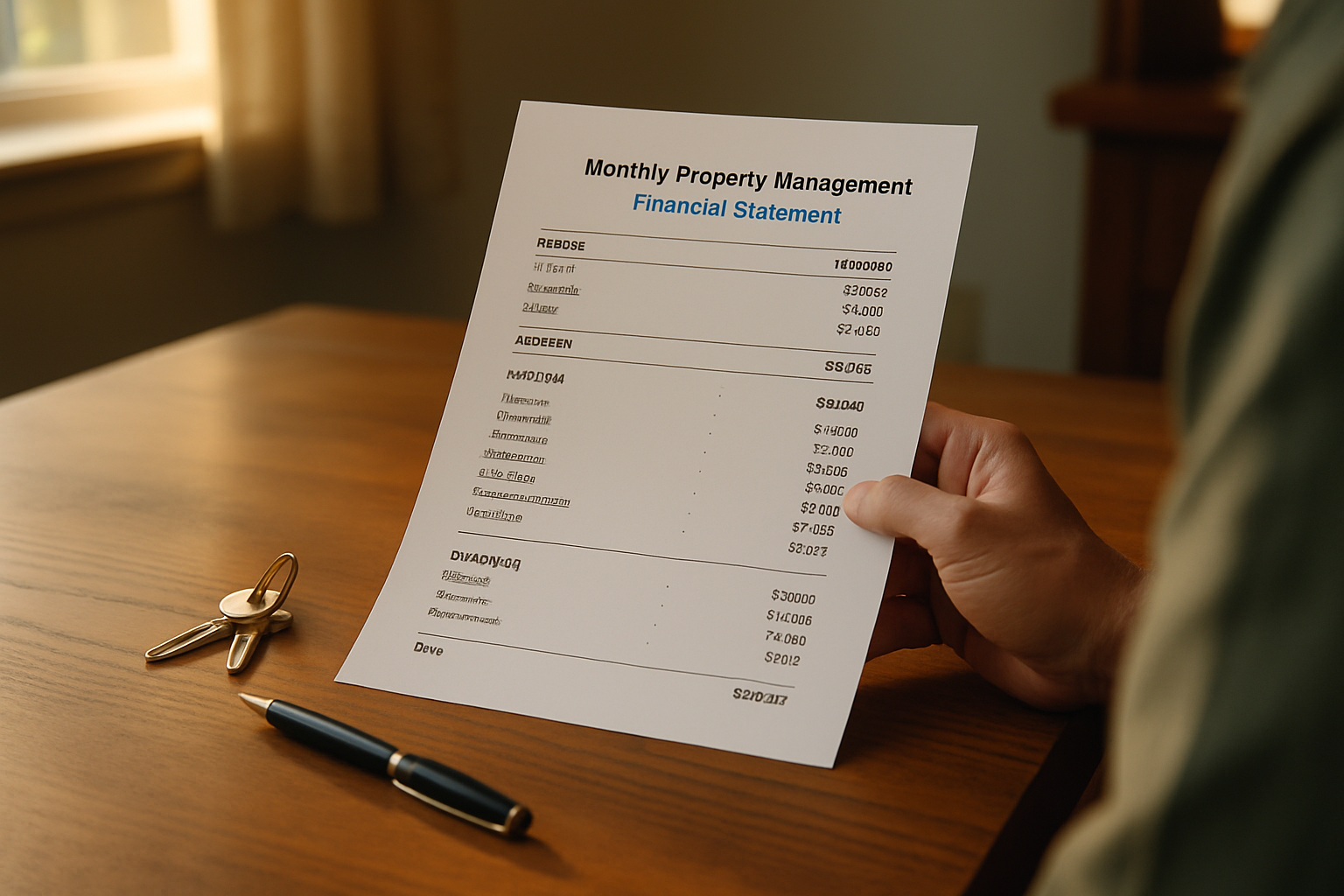
- Monthly owner statements showing income and expenses
- Lease compliance monitoring, including notices and renewals
- Routine and move-in/move-out inspections
Compliance is the part owners tend to undervalue until it bites. California capped most residential security deposits at one month's rent as of July 1, 2024, and the city of Monterey does not allow residential rentals under 30 days. Salinas owners also have the city's Residential Rental Registration program to keep current.
If you own a multifamily building with balconies or elevated walkways, AB 2579 and SB 721 inspection deadlines apply to you as well. Ask directly whether tracking that sort of thing sits inside the monthly fee or outside it. For a broader look at local rates, this breakdown of what property management costs in the Monterey Bay area is a reasonable starting point.
Why is tenant placement billed separately?
Because it is a different job with a different workload. Placing a tenant is front-loaded work that happens once, while the monthly fee covers work that repeats.
Across the industry, a leasing or placement fee commonly lands somewhere between half a month's rent and one full month's rent, though it varies by firm and by property. That charge generally covers property prep and staging advice, rental pricing analysis, photos and listings, showings, full credit, background and rental history screening, and drafting and executing the lease.
A few things to pin down before you assume anything:
- Is the fee charged again at renewal, or only for a new tenant?
- Is there a re-leasing discount if a tenant leaves early?
- Are marketing costs like photography included or added?
Some owners only want this piece and plan to handle the rest themselves. That is a real option, and the tradeoffs are covered well in this comparison of tenant placement versus full management.
How is maintenance billed, and where do owners get surprised?
This is the murkiest line item in the whole agreement, and it is where I see the most confusion.
"We coordinate maintenance" can mean three very different billing models:
- The owner pays only the vendor's invoice, with coordination included in the monthly fee
- The owner pays the vendor invoice plus a flat coordination fee per work order
- The owner pays the vendor invoice with a percentage markup added
None of those is automatically wrong. But you should know which one you are agreeing to, in writing, before the first repair happens.
The second question matters just as much: who is doing the work? A manager with standing relationships with licensed and insured local vendors gets a plumber to a Seaside duplex faster and at a more predictable price than someone calling whoever answers. On the Peninsula, where salt air chews through exterior finishes and winter storms find every soft spot in a roof, response speed is not a small thing.
Ask how emergencies are handled at 11pm on a Sunday, and ask what dollar threshold requires your approval before work begins.
Fee line items and the question to ask about each
Here is the quick version I would run through with an owner comparing two proposals side by side. Every firm handles these differently, so treat the middle column as typical, not universal.
| Line item | Usually part of the monthly fee? | What to ask |
|---|---|---|
| Rent collection and late follow-up | Yes | How are late fees handled and who keeps them? |
| Tenant placement and screening | No, billed separately | Is it charged again at renewal? |
| Maintenance coordination | Depends on the firm | Flat fee, markup, or included? |
| Monthly owner statements | Yes | Can I see a sample statement? |
| Year-end income and expense summary | Often yes | Is it formatted for Schedule E? |
| Paying mortgage, insurance, property taxes | Sometimes an add-on | Can you pay these from collected rent? |
| Routine inspections | Usually limited number | How many per year, with photos? |
| Eviction handling and court time | No | What is billed hourly versus included? |
Annual cost of management versus annual risk of going it alone
Several owners have written in asking about fees and a rent estimate in the same message, which tells me they are doing the math before they commit. This is the math worth doing.
Is the fee worth it on a $2,500 Salinas rental?
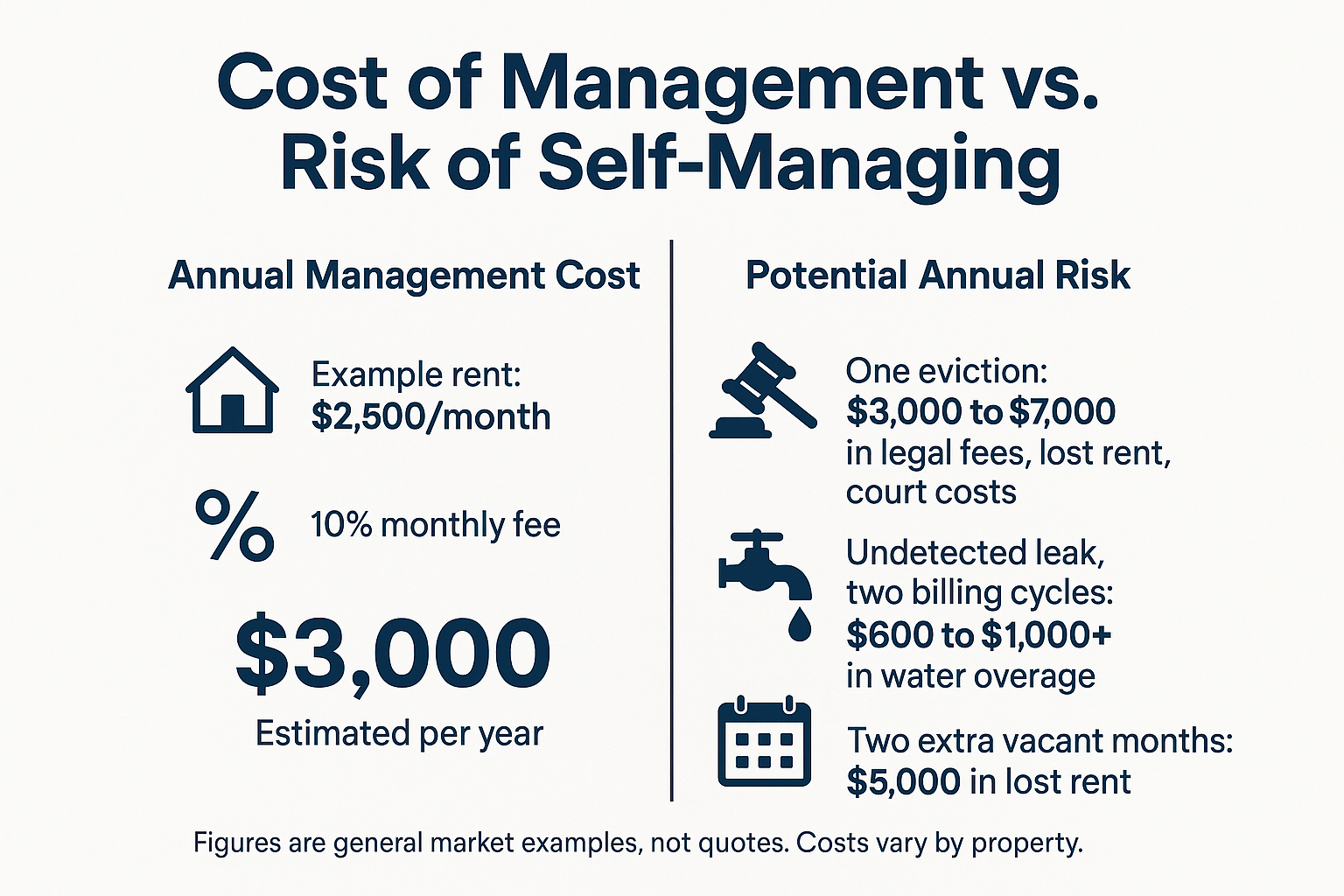
Run the numbers rather than guessing. On a rental collecting $2,500 a month, a 10% monthly management fee works out to roughly $3,000 a year. That is the number to hold up against what can go sideways.
General market context, not a promise: an eviction in California often runs somewhere in the range of $3,000 to $7,000 once you add legal fees, lost rent, and court costs, and the process is slower than most first-time landlords expect. The California courts' self-help guide to eviction lays out the steps and gives you a realistic sense of the timeline.
A single undetected leak is smaller but still real. Two billing cycles of water running unnoticed on a Cal Am account can easily add $600 to $1,000 or more in overage before anyone notices the meter.
And two extra months of vacancy on that same Salinas house is $5,000 gone, which no fee structure can recover after the fact. Slow marketing and mispricing are the usual culprits.
What about tax season and owner reporting?
Owners underestimate this one until March. A clean monthly statement plus a year-end income and expense summary turns Schedule E preparation from an afternoon of shoebox archaeology into a short conversation with your accountant.
Some firms also pay owner obligations directly out of collected rents:
- Mortgage payments
- Property insurance
- Property taxes
That removes the timing headache entirely, which matters a lot for out-of-area owners and military families juggling a move. Ask whether it is included in the base fee or billed as an add-on.
Owner portal access belongs in the same conversation. One reviewer put it simply: "everything from payments to communication is easy to manage." If you are 500 miles away, that access is not a nicety. It is how you keep control of a Monterey property from a distance.
Does a manager increase profit or just maintain the property?
Honest answer: it depends on what you are comparing against.
Compared to a vacancy that stretched two extra months because of slow marketing, or a roof leak that turned into dry rot because nobody looked, professional management nearly always improves net annual income. Compared to an attentive local owner who already has a good plumber, knows California notice rules, and lives fifteen minutes from the property, the margin narrows considerably.
The owners who benefit most in my experience are the ones who are far away, stretched thin, or newly inherited into a rental they never planned to own. If you want the longer version of that argument, we wrote it up here: do property managers really increase profit.
At Torrente Property Management, we would rather an owner do that math clearly than sign up on a hunch.
Frequently Asked Questions About California Property Management Fees
What does the monthly property management fee cover in California?
Typically rent collection, tenant communication, maintenance coordination, monthly owner statements, lease compliance monitoring, and routine inspections. Tenant placement is a separate charge in most agreements.
Why is the leasing fee charged on top of the monthly fee?
Placing a tenant is one-time, front-loaded work: pricing, prep, photos, listings, showings, full screening, and lease drafting. Across the industry it commonly runs from about half a month's rent up to a full month's rent, depending on the firm and the property. Ask whether it is charged again at renewal, because that answer varies.
Do managers mark up repair invoices?
Some do, some charge a flat coordination fee, and some pass the vendor invoice through at cost. Get the model in writing before the first work order, and ask whether their vendors are licensed and insured.
Can a property manager pay my mortgage and property taxes from rent?
Many can, including us. It is worth asking whether that service sits inside the monthly fee or is billed as an add-on, since it varies by company.
Is management worth it on a single rental in Salinas or Marina?
On a $2,500 rental, a 10% fee is roughly $3,000 a year. If that single property is your only rental and you live nearby with good vendor contacts, the math is closer. If you are out of the area, or if one bad tenancy would genuinely hurt, the coverage usually pays for itself.
What is never included in a management fee?
Court costs and attorney fees for an eviction, capital improvements, insurance deductibles, and the actual cost of repairs. Those are owner expenses no matter who manages the property.
Want the numbers for your own property?
Every property in Monterey County is a little different, so the only fee figure that means anything is the one written against your actual address, rent, and condition. Our team works across Monterey, Salinas, Seaside, Marina, Pacific Grove, Carmel, and Pebble Beach, in English and Spanish. If you would like a straight walk-through of the line items for your place, we are reachable at (831) 582-8916 or through the contact form at torrenteproperties.com.

How to Hand Off a Rental You Have Been Managing Yourself
Most landlords who reach out to us have already been managing on their own for one to three years. They handled the lease themselves, collected rent by check or Venmo, texted with the tenant when something broke, and assumed it would stay manageable. Then something shifted, a maintenance issue they couldn't coordinate from a distance, a tenant situation that got uncomfortable, or just the slow accumulation of small decisions that never stop coming.
The question I hear most often is not whether to make the switch. It's how. Owners in Salinas, Seaside, Marina, and across Monterey County want to know what actually needs to happen before a property manager can step in, especially when there's already a tenant in place.
This guide walks through that process in plain terms. No guesswork, no vague advice. Just the real steps, in order.
Step 1: Gather Your Documentation Before Anyone Shows Up
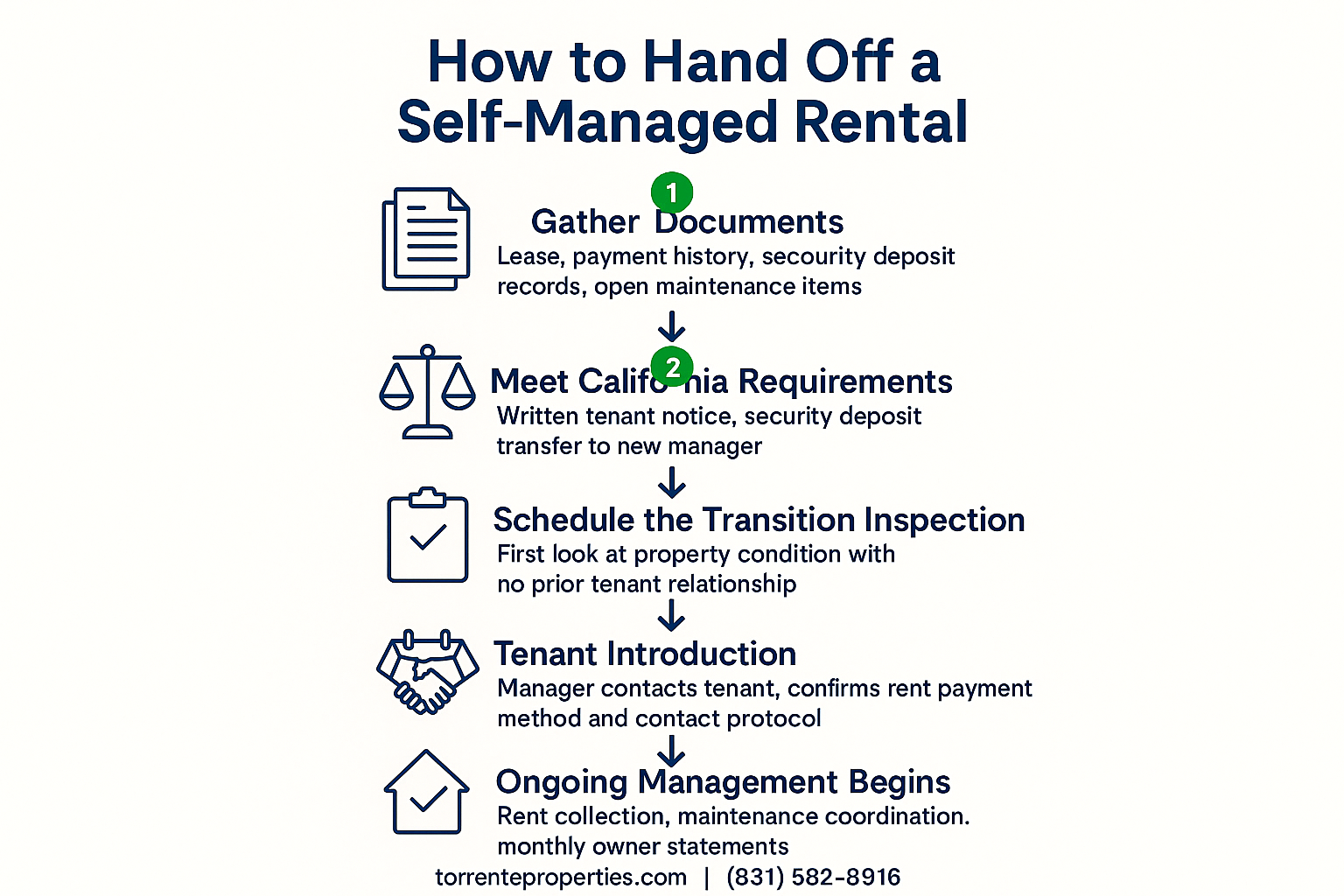
The first thing a property manager needs is a clear picture of what they're walking into. Before any agreement is signed or any tenant is contacted, you'll want to pull together:
- The current lease, the full signed document, including any addenda or side agreements
- Tenant contact information, phone number, email, and emergency contact if you have it
- Rent payment history, ideally a written record, even if it's a simple spreadsheet of dates and amounts
- Security deposit records, the amount collected, where it's held, and what bank account or trust account it sits in
- Any open maintenance issues, things the tenant has mentioned or that you know need attention
If you've been collecting rent informally, cash, peer-to-peer payment apps, or handshake arrangements, that's worth being upfront about. It doesn't disqualify you from making the switch, but it means there are a few extra steps to establish a clean baseline before management begins.
Owners who have clear records from the start tend to have much smoother transitions. The documentation gap is almost always what slows things down, not the tenant, not the property itself.
Step 2: Understand What California Law Requires When Management Changes
This step surprises a lot of self-managing landlords. When you bring on a property manager in California, it's not just a handshake agreement between you and the management company. There are legal requirements that protect the tenant too.
Under California law, two things have to happen:
- The tenant must be notified in writing of the change in management and the name and contact information of the new entity they should pay rent to
- The security deposit must be transferred to the incoming property manager, either placed in their trust account or formally documented as held by the owner on their behalf
The California Department of Consumer Affairs landlord/tenant guide outlines these obligations clearly. Skipping either step creates legal exposure, and it also sets a bad tone with a tenant who may already be uncertain about the change.
For properties in Salinas, there's an additional layer: if your property is registered under the Salinas Residential Rental Registration program, the registration should reflect current ownership and management contact information. An experienced local manager will know to check that.
The Self-Management Handoff at a Glance
Here's a quick look at the full transition sequence from self-managing landlord to professionally managed rental.

Step 3: The Transition Inspection, Expect to Learn Something
One of the most valuable parts of the handoff is also the one owners least expect: the property inspection.
When a manager who has no prior relationship with your tenant walks through the property, they often surface issues that have been quietly sitting there. Tenants who communicate directly with an owner they know personally sometimes avoid mentioning small problems, a slow drain, a window that sticks, a water stain on the ceiling, because they don't want to cause friction or seem demanding.
A property manager asking those same questions in a routine, professional inspection gets different answers. And a fresh set of eyes catches things that neither party mentioned.
For owners in Salinas, Seaside, or Marina who live out of the area, that inspection is often the first current, objective look at their property's condition in months, sometimes longer. What they find is rarely catastrophic, but deferred maintenance has a way of compounding quietly. Catching it early is almost always less expensive than catching it late.
This is also a good moment to review what actually needs to happen to get a Monterey Bay rental in shape, even for a property that already has a tenant in place.
Step 4: What Happens to the Existing Tenant
This is the part that makes a lot of self-managing landlords nervous: they've built a real relationship with their tenant, and they don't want the transition to damage that.
The good news is that the tenant doesn't have to move, doesn't get re-screened, and doesn't lose any of their existing rights. Here's how it typically works:
- The current lease stays in place until its natural expiration or renewal date
- The property manager reaches out to introduce themselves and confirms the new process for rent payments and maintenance requests
- The tenant benefits from having a clear, professional point of contact, someone they can reach 24/7 for emergencies instead of texting a landlord at midnight
The lease review is where things get more nuanced. Even a lease from 2024 may be missing required disclosures tied to changes in California law that took effect in 2025 or 2026. Those gaps don't have to be fixed mid-tenancy, but they do need to be corrected at renewal. If you want to understand what your rental lease may be missing under current California law, that's worth reading before the next renewal comes up.
For owners who have been managing remotely, the handoff also means they stop being the person a tenant calls when the heater goes out at 10 p.m. That shift alone is significant.
Self-Management vs. Professional Management: What Changes at Handoff
Here's a side-by-side look at what shifts when a self-managing landlord transitions to professional management, and what stays the same.
| Area | Self-Managing | After Handoff |
|---|---|---|
| Rent Collection | Owner collects directly, check, app, or cash | Manager collects through owner/tenant portal, deposits to owner |
| Maintenance Calls | Tenant calls or texts owner directly | Tenant contacts manager; 24/7 emergency line in place |
| Lease Compliance | Owner's responsibility to track law changes | Manager reviews lease at renewal, flags required updates |
| Security Deposit | Held by owner, often in personal account | Transferred to manager's trust account per California law |
| Property Inspections | Varies, often infrequent or owner-initiated | Scheduled move-in/move-out and routine inspections with photo records |
| Financial Reporting | Owner tracks manually | Monthly owner statements generated through management portal |
| Existing Tenant | No change in tenancy | No change in tenancy, lease stays, tenant is notified of new contact |
The Part Nobody Talks About: What the Transition Actually Feels Like
I've watched a lot of owners go through this process. The practical steps are manageable. What catches people off guard is how much mental weight they'd been carrying without fully realizing it.
Handling late-night maintenance calls, fielding tenant concerns directly, tracking rent payments manually, and staying current on California rental law changes, none of those tasks feel enormous on their own. But they accumulate. And for owners who are 50 or older, managing from out of the area, or dealing with an inherited property they never planned to have, that weight can quietly become exhausting.
One of our long-term clients who owns several properties in Salinas described it well: their review mentioned that 'everything runs smoothly', which sounds simple, but for someone who spent years troubleshooting on their own, smooth is everything. And one owner specifically shared this about working with our team: 'Ashley has been very thorough with taking care of multiple rental properties in Salinas. It's refreshing knowing we have that piece of mind...', Hilda M.
That word, refreshing, comes up a lot. Not because management is magic, but because having a consistent, local, professional team carrying those daily decisions is a genuinely different experience than carrying them yourself.
If you're wondering whether you've reached that point, this breakdown of when self-managing stops making sense is worth a few minutes of your time.
Frequently Asked Questions About Switching From Self-Management
Do I have to wait until my tenant moves out to make the switch?
No. The transition can happen with a tenant in place. The lease stays active, and the tenant is simply notified in writing that a new management company is handling things going forward. The handoff timing is a conversation between you and the property manager, it doesn't require a vacancy.
What if I've been collecting rent informally and don't have good records?
That's more common than people expect, and it's not a dealbreaker. It does mean there are a few extra steps to establish a clean starting point, confirming the deposit amount, documenting what's been paid, and getting the tenant's information on file properly. A property manager can walk you through exactly what's needed. The goal is a clean baseline before ongoing management begins.
What happens to my security deposit when I bring on a manager?
Under California law, the security deposit needs to be transferred to the incoming manager, typically placed in their trust account. The tenant must also be notified in writing of where their deposit is being held. This is a required step, not optional, and a licensed property manager will handle the documentation for you.
Will the property manager raise my tenant's rent right away?
Not automatically. Rent adjustments are something you discuss with your manager, and they're subject to California's rent increase rules, including AB 1482 protections that cap annual increases for many properties at 5% plus local CPI, or 10% total, whichever is lower. If you want to understand how rent changes work in 2026, this guide for Monterey Bay landlords covers it.
How much does professional property management cost in Monterey County?
Management fees vary depending on property type, location, and the scope of services. Generally speaking, monthly management fees for residential properties in Monterey County tend to fall somewhere in the range of 8% to 12% of collected rent, though that varies. There are often separate fees for leasing, inspections, and other services. For a specific quote based on your property, this breakdown of what property management costs in the Monterey Bay area is a good starting point.
What if my lease has outdated language or is missing required disclosures?
California rental law changes regularly, and leases from even a year or two ago may be missing required disclosures. The property manager will review the lease during the transition and flag anything that needs to be corrected at renewal. Mid-tenancy changes require tenant agreement, so most corrections happen at the renewal stage, not immediately.
Ready to Hand Off the Day-to-Day?
If you've been managing your own rental in Monterey County and you're ready to understand what a transition actually looks like for your specific situation, we're glad to walk through it with you. Whether you have a tenant in place, a property that needs some attention first, or just a lot of questions, our team is here to give you a straight answer. Reach us at (831) 582-8916 or through the contact form at torrenteproperties.com.
What Property Management Actually Costs in the Monterey Bay Area
The question I hear most often from first-time landlords is some version of: 'What do you charge?' It shows up in our contact form, on phone calls, and in every first conversation with a property owner who is just starting to research management companies. And honestly, that question makes complete sense, most people have no idea how property management fees are structured before they start looking.
What surprises me is how rarely anyone gets a straight, useful answer. A lot of firms list a percentage on their website and leave it there. But that number alone doesn't tell you what you're actually paying for, what's not included, or how fees add up across the first year of management.
This is my attempt to answer the fee question honestly, using what I've seen working with landlords across Monterey, Salinas, Seaside, and the broader Monterey Bay area. I'll cover how the two main fee types work, what affects the number you'll be quoted, and what to actually compare when you're evaluating firms.
How Are Property Management Fees Structured?
Almost every property management firm charges fees in two separate layers, and understanding both matters.
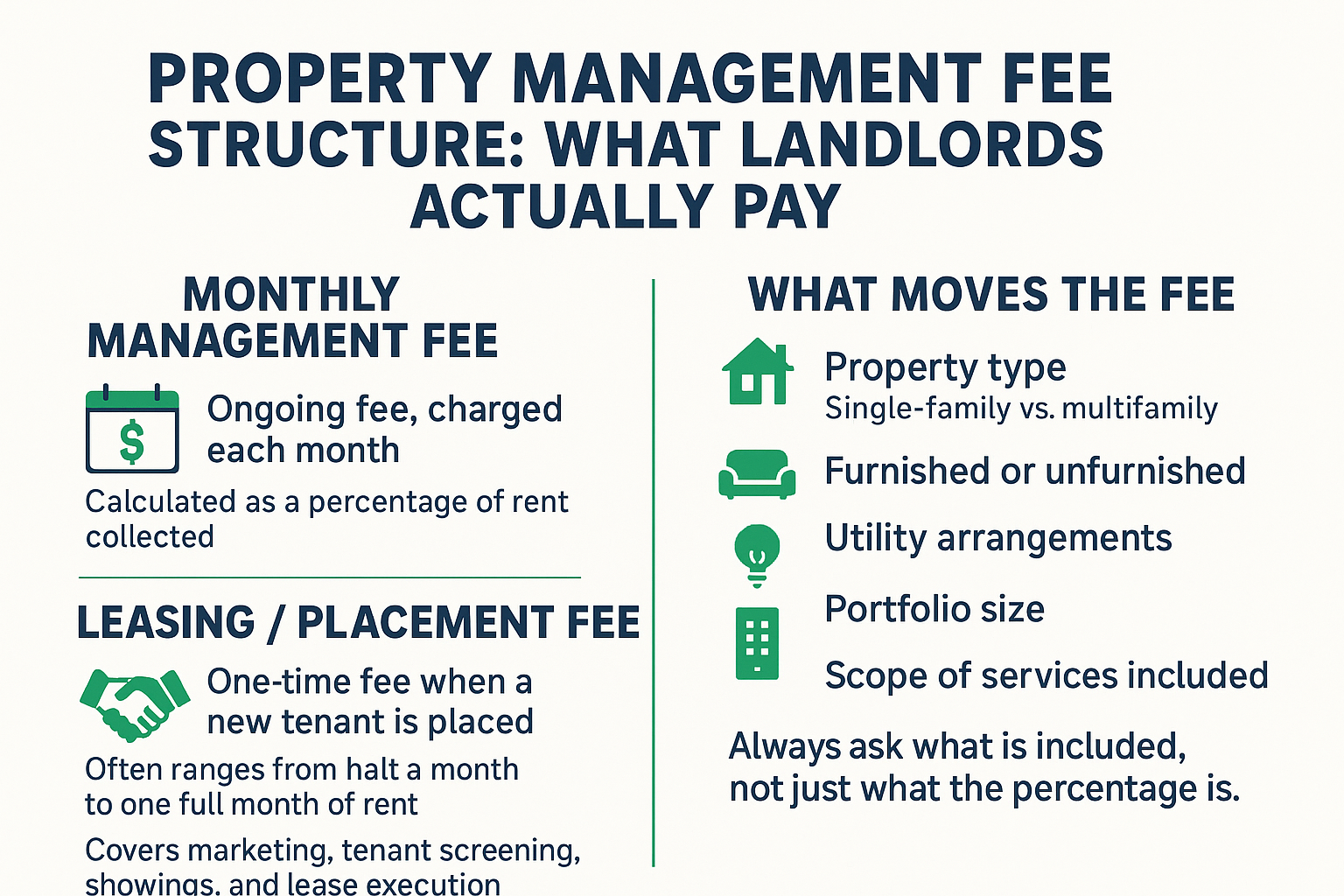
The first is the monthly management fee. This is an ongoing charge, usually calculated as a percentage of the rent collected each month. In California, this percentage generally falls somewhere in a range that varies depending on the market, the property type, and what the firm actually does for that fee. Because the Monterey Bay area carries higher prevailing rents than many California markets, even a modest percentage translates into a real dollar amount per month.
The second is the leasing or tenant placement fee. This is a one-time charge when a new tenant is placed. It compensates the management company for the time and cost of marketing the property, screening applicants, showing the unit, and executing the lease. Many firms charge the equivalent of half a month's rent to one full month's rent for this service.
The leasing fee is the one that catches new landlords off guard most often. I've spoken with owners who asked only about the monthly rate, then were surprised when their first statement showed a placement charge. Asking about both upfront is the right move.
For context on what the full process of getting a rental ready and leased actually involves, Getting a Monterey Bay Rental Ready: What Actually Has to Happen walks through the preparation side in detail.
What Factors Actually Move the Fee Up or Down?
Fee percentages are not one-size-fits-all, even within the same market. Several things affect where a quote lands:
- Property type. Single-family homes and smaller portfolios often sit at a higher percentage than large apartment complexes. The reason is simple: the fixed overhead per unit is greater when a manager is running one property versus twenty.
- Furnished versus unfurnished rentals. A furnished unit involves more coordination, inventory tracking, more frequent turnover prep, and sometimes more detailed inspections. Several owners who have contacted us about furnished condos in Monterey and Marina have asked specifically whether this changes the fee structure. It often does.
- Utility arrangements. Properties with shared or sub-metered utilities, or where the owner pays certain utilities directly, add a layer of billing and oversight. That complexity gets factored into how a scope of work is built.
- Portfolio size. An owner with several units in Salinas may be quoted differently than someone placing a single home in Carmel for the first time. Volume and relationship history both play a role.
- Scope of services included. This is the biggest variable of all, and I'll come back to it.
The bottom line is that a percentage alone means nothing without knowing what work that percentage covers. A firm quoting a lower monthly rate that excludes routine inspections, after-hours emergency response, or detailed financial reporting is not the same offering as a slightly higher rate that includes all of that.
The Two Layers of Property Management Fees at a Glance
This infographic breaks down the two main fee categories and the key factors that affect where your quote lands.
Monthly vs. Leasing Fee: What Each One Covers
Here is a quick reference for how the two main fee types differ in timing, purpose, and what they typically include.
| Fee Type | When It's Charged | What It Generally Covers |
|---|---|---|
| Monthly Management Fee | Every month rent is collected | Rent collection, maintenance coordination, inspections, financial statements, tenant communication, owner portal access |
| Leasing / Placement Fee | Once per new tenant placement | Property marketing, rental pricing analysis, showings, credit and background screening, lease drafting and execution |
| Additional Fees (varies by firm) | Situational | Lease renewal fees, maintenance coordination markups, early termination fees, ask upfront what applies |
The Real Comparison Is About Scope, Not Just Price
When owners start comparing management companies, the instinct is to line up the percentages and pick the lowest one. I understand that instinct. But it leads to bad decisions more often than good ones.
The right question is: what does each firm actually do for that fee?
A management company that charges a lower monthly rate but does not include routine property inspections, after-hours emergency calls, or detailed monthly financial statements is not offering a lower-cost version of the same thing. It's a different product. And the gaps tend to show up at the worst times, like when a pipe bursts at 11 p.m. or when you need documentation for an insurance claim.
Reviews from our clients consistently mention responsiveness and follow-through on maintenance as reasons they stay with us year after year. One long-term client who owns several properties in Salinas specifically described the peace of mind that comes from knowing everything is handled. That kind of operational consistency has real costs behind it, and firms with thinner fee structures are often not delivering it.
If you're evaluating firms and want to understand what full-service management actually looks like in practice, When Self-Managing Your Rental Stops Making Sense is a good place to start. And for out-of-area owners trying to understand the true cost of going it alone, The Hidden Costs of Managing a Monterey Home From Out of State lays out what those gaps actually cost.
A Note on Vacant and Seasonal Properties
Not every property owner needs full rental management. Some of the inquiries we receive come from seasonal homeowners in Carmel or Pebble Beach who are not renting their property at all, they just need someone to check on it regularly while they're away.
For those situations, caretaker and home watch services are a separate service category with their own pricing structure. The scope is different: scheduled property inspections, exterior monitoring, utility checks, landscaping coordination, and detailed reports to the owner. It's not tied to rent collection because there's no tenant.
For anyone wondering what can actually go wrong in a vacant property and why regular inspections matter, What Can Go Wrong in an Empty House, and Who's Responsible covers the real risks in plain terms. And How Often Should Someone Check on a Vacant Home in Monterey Bay? gets into the practical question of frequency.
The point is that 'what does property management cost' has a different answer depending on what you're actually asking for. A vacant home in Pacific Grove needs a different service than a rented four-unit building in Salinas, and the fee structure reflects that.
Frequently Asked Questions About Property Management Fees
What is your management fee?
This is the most common first question we get, and the honest answer is: it depends on the property and scope of work. We don't post a flat percentage on the website because a furnished studio in Marina, a single-family home in Seaside, and a four-unit building in Salinas all involve different levels of work. The best way to get an accurate number is to contact us directly so we can understand your specific situation.
Is the leasing fee separate from the monthly management fee?
Yes, and this is the piece that surprises most new landlords. The leasing fee is a one-time charge when a new tenant is placed. The monthly management fee is an ongoing charge for day-to-day management. They are two separate costs, and any firm you evaluate should be willing to explain both clearly before you sign anything.
Do fees change if the property is furnished?
Potentially, yes. Furnished rentals involve more coordination, inventory tracking, move-in and move-out documentation, and sometimes more frequent unit prep between tenants. Several owners who have come to us about furnished condos in Monterey and Marina have asked exactly this question. It's worth discussing during your initial conversation with any management company.
Are there fees when the property is vacant?
This varies by firm. Some charge a reduced fee or no management fee during vacancy periods. Others charge a flat monthly amount regardless. Ask this question directly, and also ask whether the company will actively work to minimize vacancy time through accurate pricing and responsive marketing. For background on how rental prices actually get set in this market, How Monterey Bay Rental Prices Actually Get Set is worth reading.
What other fees should I ask about?
Beyond the monthly and leasing fees, some firms charge separately for lease renewals, maintenance coordination markups, or early termination. Ask each company you speak with for a complete list of every fee that could appear on your owner statement, not just the headline rate. California's Department of Real Estate requires property managers to be licensed brokers, so checking a firm's license status is also a reasonable due-diligence step.
How do I know if I'm getting a fair deal?
Compare scope, not just price. Ask each firm what is included in the monthly fee: routine inspections, after-hours emergency response, financial reporting, tenant communication, portal access. A lower percentage that excludes those things is not a better deal, it's fewer services. The real test is what happens when something goes wrong at midnight or when you need a clear monthly statement to review your property's performance.
Ready to Get a Real Answer on What Management Would Cost for Your Property?
If you own a rental or vacant property anywhere in Monterey County, whether that's a single-family home in Salinas, a condo in Pacific Grove, or a seasonal property in Carmel, we're happy to have a straightforward conversation about what management actually looks like for your specific situation and what it would cost. You can reach our team at (831) 582-8916 or send us a message through the contact form at torrenteproperties.com.

What Does a Property Management Company Do? A Complete Guide for Property Owners
As a property owner in the beautiful Monterey Bay Area, you've likely asked yourself, "What does a property management company do?" and whether hiring one is worth the investment. I'm Aurelia Torrente, founder of Torrente Property Management. After 23 years in the real estate management business, I'd like to share my expertise on precisely what we do and how we can make your life easier.
What Does a Property Management Company Do: Core Services and Benefits
When property owners ask me, "What does a property management company do?" We become your property's caretaker, business manager, and legal protector. At Torrente Property Management, we handle everything from finding quality tenants to maintaining your property's value, allowing you to enjoy passive income without the active headaches. This gives you a sense of relief and peace of mind.
Comprehensive Tenant Acquisition
Finding the right tenant is the most crucial aspect of what we do. Our process includes:
- Marketing your property effectively across multiple platforms
- Conducting thorough showings to qualified prospects
- Implementing rigorous screening procedures, including background checks, credit history, income verification, and rental references
- Handling all lease documentation and move-in procedures
According to the California Department of Real Estate, proper tenant screening is one of the most critical aspects of successful property management and risk mitigation. Our professional management for residential and commercial properties follows all California fair housing laws, ensuring you get reliable and responsible tenants.
Property Maintenance and Inspections
Regular maintenance isn't just about fixing what's broken—it's about preventing costly issues before they occur. As a property management company in Salinas and throughout Monterey County, we:
- Conduct routine property inspections
- Coordinate with trusted local contractors for repairs and maintenance
- Handle emergencies 24/7
- Implement preventative maintenance programs
- Maintain detailed documentation of property condition
The U.S. Department of Housing and Urban Development emphasizes that proper maintenance is not just good business—it's often legally required. Our apartment complex property management services in Salinas and the Monterey Bay Area ensure that your properties remain in excellent condition while meeting all local and federal requirements.
Financial Management and Reporting
As trusted Salinas property managers, we take the financial aspects of property management seriously. Our services include:
- Setting optimal rental rates based on market analysis
- Collecting rent efficiently (with online payment options)
- Managing security deposits under California law
- Handling delinquencies when necessary
- Providing detailed monthly and annual financial reports
- Coordinating with tax professionals at year-end
According to research from UC Berkeley's Terner Center for Housing Innovation, professional property management can significantly improve cash flow and return on investment for property owners.
Legal Compliance and Risk Management
One of the most valuable aspects of what a property management company in Salinas does is navigate the complex world of landlord-tenant law. We:
- Stay current on all federal, state, and local housing regulations
- Ensure your property meets all health and safety codes
- Handle legal documentation and record-keeping
- Manage eviction proceedings when necessary
- Provide liability protection through proper protocols
The regulatory landscape for rental properties is constantly changing. The California Department of Consumer Affairs provides extensive guidance on landlord-tenant law, which we monitor closely to ensure our rental property management practices in Salinas remain compliant.
What Does a Property Management Company Do for Different Property Types?
Different property types require specialized knowledge and approaches. Here's how our property management services for the Monterey Bay Area adapt to various property types:
Single-Family Homes
For individual house rental management in Salinas and surrounding areas, we provide:
- Personalized attention to each property
- Detailed move-in/move-out inspections
- Yard and exterior maintenance coordination
- Strategic upgrades to maximize rental value
- Tenant relations focused on longer-term occupancy
Many of our clients who own single-family rentals, particularly appreciate our hands-on approach to house rental management in Salinas, which maintains their properties as if they were our own.
Multi-Family and Apartment Complexes
Our apartment property management in Salinas services are designed for efficiency and scalability:
- On-site management when appropriate
- Standard area maintenance and upgrades
- Tenant community building
- Strategic unit turnover to minimize vacancy
- Economies of scale for maintenance and services
The Monterey County Housing Authority provides excellent resources for multi-family property owners, which we leverage to enhance our apartment property management services in Salinas.
Commercial Properties
Commercial property management demands a different approach, which is why our Professional Management for Residential and Commercial Properties includes specialized services:
- Lease negotiation with business tenants
- Triple-net lease management
- Commercial-specific maintenance coordination
- Business tenant relations
- Strategic property improvement planning
Addressing Common Property Management Challenges
When considering what a property management company does, it's essential to understand how we handle the inevitable challenges of property ownership. At Torrente Property Management, we specialize in solving property management challenges efficiently:
Tenant Issues
Even with thorough screening, issues with tenants can still arise. Our approach includes:
- Professional communication protocols
- Documented violation notices when necessary
- Mediation of disputes
- Legal compliance in all tenant interactions
- Performance of essential evictions when required
Our goal is always to maintain happy tenants while protecting your property and investment. This balanced approach is a cornerstone of managers' effectiveness. Salinas ' property managers are effective.
Maintenance Emergencies
When emergencies happen, a quick response is critical. Our property management services for owners in Salinas include:
- 24/7 emergency response systems
- Pre-established relationships with emergency service providers
- Clear protocols for different emergency types
- Immediate owner notification for major issues
- Detailed documentation for insurance purposes
Vacancy Management
Minimizing vacancy periods is essential for ROI. Our Best Salinas property management strategies include:
- Proactive lease renewal negotiations
- Pre-marketing properties before current tenants vacate
- Efficient turnover processes
- Market-appropriate pricing strategies
- Seasonal adjustments based on local market trends
The Value of Local Expertise in Property Management
As a property management company in Salinas, CA, our deep understanding of the Monterey Bay Area market provides significant advantages:
Market Knowledge
We serve diverse communities throughout the region, including Monterey, Marina, Pacific Grove, Pebble Beach, Seaside, Carmel, Salinas, Prunedale, and Soledad. This broad coverage gives us unique insights into:
- Neighborhood-specific rental trends
- Local economic factors affecting rental rates
- Community development plans that impact property values
- Seasonal rental patterns are unique to the Monterey Bay Area
- Local tenant demographics and preferences
Our office, located at 200 Camino Aguajito, Suite 303, Monterey, CA 93940, is centrally positioned to serve the entire region.
Established Vendor Relationships
Over our 23 years in business, we've built a network of reliable local contractors and service providers who offer:
- Priority response for our managed properties
- Competitive pricing through volume relationships
- Quality artistry backed by our ongoing oversight
- Specialized knowledge of local building characteristics
- Compliance with local building codes and regulations
Community Connections
Our deep roots in the community enhance our Salinas property management services through:
- Relationships with local officials and departments
- Knowledge of upcoming regulatory changes
- Community resources that benefit property owners
- Access to local economic development information
- Understanding of neighborhood dynamics and trends
Technology and Innovation in Modern Property Management
When asking "What does a property management company do?" today's property owners should expect modern technological solutions. Our innovative property management approach includes:
Owner Portal Access
Our secure online portal provides property owners with:
- Real-time access to financial statements
- Maintenance request tracking
- Document storage and retrieval
- Communication logs
- Property performance metrics
Digital Tenant Services
We make life easier for tenants, which improves retention:
- Online rent payment options
- Maintenance request submission system
- Electronic lease signing
- Automated communications
- Community announcements
Advanced Property Marketing
For Available Residential Rentals in Monterey, CA, we utilize:
- Professional photography
- Virtual tours
- Targeted online advertising
- Social media promotion
- Syndication across multiple listing platforms
Choosing the Right Property Management Company
Understanding what a property management company does is just the first step. Knowing how to choose the right one is equally important. Here's what to look for:
Experience and Reputation
With 23 years in the business, Torrente Property Management has built a reputation for:
- Consistency and reliability
- Problem-solving capabilities
- Ethical business practices
- Industry knowledge
- Community investment
Transparent Fee Structure
When evaluating a property management contract, look for transparency regarding:
- Management fee structure (percentage vs. flat fee)
- Additional service fees
- Maintenance markup policies
- Leasing and renewal fees
- Vacancy fees (if any)
Our property management agreement clearly outlines all fees and services, so there are never surprises.
Communication Practices
Effective communication is essential for successful property management:
- Regular reporting schedules
- Emergency notification protocols
- Owner input on major decisions
- Accessibility of the management team
- Response time standards
As real property management professionals, we take pride in providing clear and timely communication with our owners.
Common Questions About Property Management
Can You Negotiate Rent with a Property Management Company?
A common question we receive is, "Can you negotiate rent with a property management company?" The answer is yes, but within reason. While we set rental rates based on market analysis to maximize your returns, we understand there are situations where flexibility makes business sense:
- Long-term, high-quality tenants
- Seasonal market fluctuations
- Competitive rental markets
- Property condition considerations
- Length of lease terms
Our approach strikes a balance between maximizing rental income and minimizing vacancy and turnover costs.
What Property Management Issues Should Owners Be Aware Of?
Common property management issues that we help owners navigate include:
- Regulatory compliance challenges
- Tenant screening pitfalls
- Maintenance budget planning
- Emergency response protocols
- Market fluctuations
Our experienced team anticipates and addresses these issues proactively rather than reactively.
How to Achieve Better Property Management Results?
For better property management outcomes, we recommend:
- Regular property improvements and updates
- Proactive maintenance schedules
- Competitive but fair rental rates
- Clear communication with tenants
- Building reserves for capital expenditures
As preferred property management professionals, we implement these best practices for all properties in our portfolio.
The Torrente Property Management Difference
What truly sets us apart as reliable property management professionals is our commitment to both our property owners and our community. After 23 years serving the Monterey Bay Area, we've developed systems that work specifically for this region's unique rental market.
When you choose Torrente Property Management, you're not just hiring a service provider—you're gaining a partner dedicated to protecting and growing your investment. From our office at 200 Camino Aguajito Suite 303, Monterey, CA 93940, we serve the entire region with personalized attention and professional expertise.
Ready to Experience Professional Property Management?
If you're tired of the stress and time commitment of managing your properties, we'll Help You Find The Perfect Rental tenants and handle all aspects of management. Our Monterey property management company has the experience, systems, and local knowledge to maximize your returns while minimizing your involvement.
To learn more about what a property management company does and how we can help with your properties, please contact us at (831) 582-8916 or visit our website. We're excited to show you how professional property management can transform your investment experience.

Can You Negotiate Rent with a Property Management Company? Expert Insights from a Salinas Property Management Professional
As the founder of Torrente Property Management, a trusted name with over 23 years of experience in the real estate management business across the Monterey Bay Area, I've guided countless property owners through the complexities of rental negotiations. One question I frequently hear is, 'Can you negotiate rent with a property management company? ' The answer might surprise you.
Understanding When and How to Negotiate Rent with a Property Management Company
Negotiating rent isn't just possible—it's often an expected part of the property management relationship. As a property management company in Salinas, we understand the local market dynamics that influence rental rates and negotiation strategies. The key is knowing how to approach these conversations professionally and with market awareness.
The Value of Professional Negotiation in Property Management
When you partner with trusted Salinas property managers, you gain access to expertise in setting optimal rental rates. As property owners, you might wonder if you can effectively negotiate with tenants, property managers, or both, and where you should draw the line on concessions.
The Salinas Rental Market: Context for Negotiation
Before discussing whether you can negotiate rent with a property management company, it's essential to understand the local context. Salinas has experienced significant shifts in the rental market over the past few years, with demand fluctuating across different neighborhoods and property types.
According to the California Department of Housing and Community Development, Monterey County's average rental rates have increased by 3.5% over the past year. This government data helps property owners contextualize reasonable rates for their investments.
Factors Influencing Rental Rates in Salinas
As a property management company that Salinas residents trust, we consider multiple factors when advising property owners on rental rates:
- Neighborhood demand and amenities
- Property size and condition
- Seasonal fluctuations in the rental market
- Local economic indicators
- Comparable properties in the area
Setting the Stage: When Can You Negotiate Rent with a Property Management Company?
The question of whether you can negotiate rent with a property management company comes down to timing, approach, and market conditions. For property owners working with companies like Salinas Property Management, negotiations typically happen at several key junctures:
1. Initial Property Management Agreement
When first partnering with a rental property management company in Salinas, there is often room to negotiate management fees, services included, and strategies for setting rental rates. The property management agreement should clearly outline these terms.
2. Periodic Market Adjustments
The question "Can you negotiate rent with a property management company?" becomes particularly relevant during annual reviews. The best apartment property management in Salinas will proactively suggest adjustments based on market conditions.
3. Tenant Turnover Periods
When tenants vacate, it creates a natural opportunity to reassess and negotiate new rental terms with your rental property management partner in Salinas.
Effective Strategies for Negotiating with Your Property Management Company
Now that we've established that you can negotiate rent with a property management company, let's discuss practical approaches for property owners:
Research Local Market Rates
Before entering negotiations, review comparable properties. Research conducted by the Monterey County Housing Authority shows that well-researched pricing leads to 15% shorter vacancy periods—vital information for owners considering apartment complex property management in Salinas and the Monterey Bay Area.
Understand Your Management Company's Perspective
As Best Salinas property management professionals, we consider multiple factors when advising on rent:
- Vacancy minimization
- Tenant quality and retention
- Long-term property value
- Maintenance requirements
- Market competitiveness
Prepare Your Case with Data
When discussing whether you can negotiate rent with a property management company, bring supporting evidence for your proposed rates. This might include:
- Recent improvements to the property
- Comparable rental listings
- Changes in local amenities or services
- Market trend reports
The Property Manager's Perspective on Rent Negotiations
At Torrente Property Management, we approach rent negotiations as a collaborative process. Rather than simply answering "can you negotiate rent with a property management company" with a yes or no, we prefer to discuss strategic approaches that balance:
- Maximizing owner returns
- Maintaining high occupancy rates
- Attracting quality tenants
- Building sustainable long-term value
The Value of Professional Insight in Negotiations
One advantage of working with house rental management in Salinas is access to professional market knowledge. While the internet provides general information, experienced Salinas property managers offer nuanced insights into specific neighborhoods, tenant demographics, and seasonal fluctuations.
Common Negotiation Scenarios for Property Owners
When property owners ask if they can negotiate rent with a property management company, they're often considering specific scenarios. Here are some everyday situations and approaches:
Scenario 1: Initial Property Onboarding
When you first bring your property to a management company, clearly communicate your income expectations and be open to professional guidance on realistic rental rates.
Scenario 2: Tenant Renewal Negotiations
For existing properties with tenants approaching lease renewal, discuss potential rate increases with your apartment property management partner in Salinas, weighing the benefits of modest gains against the need for tenant retention.
Scenario 3: Market Downturns
During challenging market periods, proactively discuss adjustment strategies with your house rental management team in Salinas, potentially including temporary rate adjustments to maintain occupancy.
What Property Management Companies Consider in Rent Negotiations
Understanding the management company's perspective helps answer the question: Can you negotiate rent with a property management company? As Professional Management for Residential and Commercial Properties, we consider several factors:
1. Vacancy Costs vs. Rental Rate
A property that generates 95% of its potential rent while consistently occupied often outperforms one that targets 100% of the market rate but experiences vacancies. This is a key consideration for companies providing property management services in the Monterey Bay Area.
2. Tenant Quality and Retention
Higher-quality tenants who stay longer, pay reliably, and maintain the property well may justify flexible negotiation strategies, which we emphasize through our 'happy tenants' approach.
3. Competitive Market Positioning
Properties must remain competitive while maximizing returns—a balance we strike through our innovative property management practices.
Benefits of Strategic Rent Negotiation for Property Owners
When property owners ask if they can negotiate rent with a property management company, they're often seeking specific benefits:
Reduced Vacancy Rates
Strategic pricing reduces vacancy periods. According to research from the U.S. Department of Housing and Urban Development, properties priced within 3-5% of optimized market rates experience 37% shorter vacancy periods.
Quality Tenant Attraction
Working with reliable property management professionals can help attract tenants who will maintain your property and pay rent on time and consistently.
Optimized Long-Term Returns
Sometimes, accepting a slightly lower rate secures a high-quality, long-term tenant, ultimately delivering better returns than charging the maximum market rate with higher turnover.
When Negotiation May Not Be the Best Approach
While you can negotiate rent with a property management company, there are situations where other strategies might be more effective:
During Peak Demand Periods
In high-demand seasons, negotiating downward may unnecessarily leave money on the table. This is where real property management pros provide valuable market timing guidance.
With High-Demand Properties
Unique or exceptionally well-located properties may command premium rates without negotiation. Understanding what a property management company does in these situations is valuable for maximizing returns.
When Market Data Supports Current Rates
Sometimes the question isn't whether you can negotiate rent with a property management company, but whether you should. When comprehensive market data supports current rates, maintaining them may be the optimal strategy.
Addressing Common Concerns About Rent Negotiation
Property owners considering whether they can negotiate rent with a property management company often have specific concerns:
Will Negotiating Hurt My Bottom Line?
While this is a natural concern, professional property management services for Salinas owners focus on optimizing long-term returns rather than short-term rates.
How Do I Know If I'm Getting a Fair Deal?
Working with transparent, better property management companies provides access to comprehensive market data supporting rate recommendations.
What If My Property Manager Resists Negotiation?
Understanding property management challenges from both perspectives facilitates productive conversations about rental rates.
Our Approach at Torrente Property Management
At Torrente Property Management, when clients ask if they can negotiate rent, we emphasize our collaborative approach. With over 23 years of serving communities from Salinas to Monterey, we've developed effective strategies for:
- Setting competitive initial rates
- Making data-driven adjustment recommendations
- Balancing owner returns with tenant satisfaction
- Navigating market fluctuations strategically
- Addressing property management issues proactively
Finding the Right Property Management Partner for Negotiation
The question of whether you can negotiate rent with a property management company ultimately depends on finding the right partner. Look for:
Transparent Communication
The best management companies provide precise data to support their rental rate recommendations, which is essential for preferred property management relationships.
Market Expertise
Companies with deep knowledge of specific areas, like property management in Salinas, CA, provide more accurate pricing guidance.
Collaborative Approach
Rather than dictating terms, quality managers work with owners to develop strategies aligned with their investment goals.
Clear Contractual Terms
Review the property management contract carefully to understand how rental rates are determined and adjusted.
Taking the Next Step: Discussing Rent Strategies
If you're wondering "if you can negotiate rent with a property management company in the Salinas or Monterey Bay area, I invite you to contact our team at Torrente Property Management.
With extensive experience managing properties across Monterey, Marina, Pacific Grove, Pebble Beach, Seaside, Carmel, Salinas, Prunedale, and Soledad, we provide strategic guidance for property owners seeking to optimize their rental income while maintaining high occupancy with quality tenants.
Resources for Property Owners
For property owners researching whether they can negotiate rent with a property management company, we recommend these additional resources:
- Browse our Available Residential Rentals in Monterey, CA, to see current market rates
- Learn how We'll Help You Find The Perfect Rental for insights into the tenant perspective
- Contact Us at our office located at 200 Camino Aguajito, Suite 303, Monterey, CA 93940, or call Office: (831) 582-8916
When you partner with Torrente Property Management, you're not just getting a service provider—you're gaining an experienced advisor dedicated to optimizing your property investment through strategic rental rate management.

Better Property Management: Transforming Property Owner Experiences in Salinas and the Monterey Bay Area
As a property owner in Salinas or anywhere across the Monterey Bay area, you understand that managing rental properties involves much more than simply collecting rent each month. The journey toward better property management begins with recognizing that your investment deserves professional care that increases value, minimizes hassles, and optimizes returns. At Torrente Property Management, we've dedicated over two decades to perfecting a property management approach that truly serves owners like you.
Why Better Property Management Matters in Salinas
The quest for better property management in Salinas isn't just about finding someone to handle day-to-day operations—it's about partnering with experts who understand the unique characteristics of our local market. Salinas property owners face specific challenges that differ from those in coastal communities or other parts of California. From addressing agricultural workforce housing needs to navigating local regulations, the complexity of property management in Salinas, CA, requires specialized knowledge and experience.
According to the California Department of Housing and Community Development, property owners must navigate an increasingly complex regulatory environment while maintaining profitability. Our experience as trusted property managers in Salinas has positioned us to guide you through these complexities with ease.
The Torrente Approach to Better Property Management
When I established our company 23 years ago, my vision was simple yet ambitious: create a property management company in Salinas that treats each property as if it were our own. Today, our team at Torrente Property Management continues to uphold this vision through several core principles:
- Local expertise: We understand Salinas—its neighborhoods, market trends, and rental dynamics
- Proactive maintenance: Preventing issues saves more than reacting to emergencies
- Strategic tenant placement: Finding quality tenants who respect your property
- Financial optimization: Maximizing your returns while maintaining property value
- Transparent communication: Keeping you informed without overwhelming you with details
These principles form the foundation of reliable property management that our clients have come to expect and appreciate.
Common Property Management Challenges in Salinas
Every market presents its own set of property management challenges, and Salinas is no exception. Understanding these challenges is the first step toward implementing better property management solutions:
Seasonal Rental Fluctuations
The agricultural economy of Salinas creates unique rental patterns throughout the year. As a property management company that Salinas residents trust, we have developed strategies to maintain high occupancy rates despite seasonal shifts. Our approach includes:
- Strategic lease timing that aligns with local employment patterns
- Targeted marketing to diverse tenant demographics
- Flexible lease structures that benefit both owners and tenants
Regulatory Compliance
Staying up to date with local ordinances, state laws, and federal regulations presents a significant challenge for individual property owners. The City of Salinas Housing Division continually updates rental property requirements, making professional management increasingly valuable.
Our team specializes in navigating these regulatory waters, ensuring your property remains compliant while avoiding unnecessary expenses or legal complications. This expertise is particularly valuable for owners of apartment property management companies in Salinas, where the complexities of multi-unit properties multiply compliance requirements.
Maintenance and Property Preservation
The Salinas climate and regional characteristics create specific maintenance needs that require local knowledge. From water conservation measures during drought periods to addressing seasonal pest control issues, managing house rentals in Salinas demands vigilant attention to detail.
Our preventative maintenance programs have saved property owners thousands of dollars by addressing minor issues before they become expensive emergencies. This proactive approach represents one of the most significant advantages of partnering with Salinas property managers who understand local property needs.
The Financial Benefits of Better Property Management
Many property owners initially hesitate to engage professional management services due to cost concerns. However, our experience consistently demonstrates that better property management improves financial outcomes through several mechanisms:
Optimized Rental Pricing
Setting the right rental price requires more than checking a few online listings. Our comprehensive market analysis considers:
- Specific neighborhood trends within Salinas
- Property condition and amenities
- Seasonal fluctuations in the local rental market
- Comparative value propositions for potential tenants
This data-driven approach enables us to maximize your rental income while maintaining competitive positioning that minimizes vacancy periods. For comprehensive rental property management in Salinas that owners can trust, a proper pricing strategy is essential.
Reduced Vacancy Periods
Every day your property sits vacant represents income lost forever. Our property management services for owners in Salinas include aggressive marketing strategies that minimize these costly vacancy periods:
- Professional photography and virtual tours
- Strategic listing placement across multiple platforms
- Pre-screening to expedite qualified tenant identification
- Efficient showing and application processes
These techniques have allowed us to maintain vacancy rates significantly below market averages for properties under our management.
Maintenance Cost Control
Without professional oversight, maintenance costs can quickly spiral out of control. Our established contractor relationships and volume discounts translate to direct savings for property owners. Additionally, our preventative maintenance programs help avoid costly emergency repairs that often plague self-managed properties.
For apartment property management, Salinas properties, these savings multiply across units, significantly improving overall investment performance.
The Technology Advantage in Better Property Management
Modern, effective property management requires leveraging technology to improve efficiency and quality of service. As leaders in innovative property management, we've invested in systems that benefit both property owners and tenants:
Owner Portal Access
Our secure owner portal provides 24/7 access to:
- Real-time financial reporting
- Maintenance request tracking
- Document storage and retrieval
- Communication history
This transparency gives you complete visibility into your property's performance without requiring you to manage day-to-day details personally. Our owner portal is designed to be user-friendly, saving you time and effort in managing your property.
Tenant-Friendly Systems
Creating happy tenants is crucial to the success of property investment. Our tenant portal allows for:
- Online rent payment
- Maintenance request submission
- Lease document access
- Community announcements
These conveniences improve tenant satisfaction while increasing on-time payments and lease renewals, both critical factors in investment performance. Our tenant portal is designed to enhance the tenant experience and promote satisfaction and retention.
Selecting the Right Property Management Partner in Salinas
Understanding what a property management company does is the first step in selecting the right partner. Beyond basic services, here are key factors to consider when evaluating Best Salinas property management companies:
Experience and Local Knowledge
Our 23+ years serving the Monterey Bay area, including Salinas, have given us insights that recently established management companies cannot match. This experience translates to better decision-making and problem-solving capabilities for your property, especially when navigating the unique challenges of the Salinas market.
Transparent Fee Structure
It's essential to understand what you're paying for. While some companies advertise deceptively low rates that hide additional fees, we believe in complete transparency regarding our property management contract terms and fee structures.
Communication Philosophy
Poor communication is one of the most common complaints property owners have about management companies. Our commitment to responsive and clear communication ensures you're never left wondering about your property's status or performance.
References and Reputation
As preferred property management providers in Salinas, we encourage prospective clients to research our reputation. Our longstanding community presence and high client retention rates speak to the quality of our service.
Our Comprehensive Services for Salinas Property Owners
When considering rental property management in Salinas, it's essential to understand the range of services offered. Our comprehensive service package for Salinas property owners includes:
Tenant Acquisition and Screening
Finding quality tenants begins with effective marketing. Our multi-channel approach ensures maximum visibility for your Available Residential Rentals in Monterey, CA, and surrounding areas, including Salinas. Beyond marketing, our rigorous screening process includes:
- Income verification
- Employment history
- Rental references
- Credit evaluation
- Background checks
This thorough approach significantly reduces the risk of problematic tenancies and ensures real property management pros handle your tenant selection process.
Lease Administration
Creating and enforcing legally sound leases protects your interests while establishing clear expectations for tenants. Our lease administration services include:
- Customized lease agreements that reflect your specific property needs
- Professional move-in documentation and property condition reports
- Rent collection and enforcement procedures
- Lease renewal negotiations to maximize tenant retention
Many property management issues stem from improper lease documentation or enforcement—areas where our expertise provides significant value.
Financial Management
Beyond basic rent collection, our financial services provide comprehensive oversight of your investment:
- Detailed monthly statements
- Annual financial summaries for tax preparation
- Expense management and approval systems
- Reserve fund maintenance recommendations
These services ensure you maintain complete financial visibility while avoiding the time-consuming aspects of property accounting.
Maintenance Coordination
Our house rental management, Salinas maintenance services, balance cost control with property preservation:
- 24/7 emergency response capabilities
- Preventative maintenance scheduling
- Vendor management and quality control
- Cost-effective repair solutions
This systematic approach protects your property value while controlling expenses—a key component of better property management.
Understanding the Property Management Agreement
The foundation of our relationship with property owners is the property management agreement. This document clearly outlines responsibilities, expectations, and terms of service. Key elements include:
- Scope of services provided
- Fee structure and payment terms
- Owner and manager responsibilities
- Term and termination provisions
- Property condition standards
We encourage thorough review and discussion of this agreement to ensure mutual understanding and alignment of expectations.
Frequently Asked Questions About Better Property Management
Property owners often have questions about professional management services. Here are answers to some common inquiries:
Can you negotiate rent with a property management company?
Yes, we frequently hear questions about negotiating with a property management company. While we establish recommended rental rates based on market analysis, we always welcome owner input and collaborate to set pricing strategies that align with your investment goals.
What makes Torrente different from other property managers?
As a Salinas property management company with deep community roots, our difference lies in our local expertise, owner-centric approach, and commitment to transparent communication. Our longevity in the market reflects our clients' satisfaction and the high quality of our service.
How do you handle problem tenants?
Our thorough screening process helps minimize problematic tenancies. According to California landlord-tenant law, we address issues promptly and professionally when they arise. Our goal is always to resolve the problems while protecting your property and investment interests.
What areas do you serve?
While this article focuses on Property Management Services for the Monterey Bay Area, we specifically serve Monterey, Marina, Pacific Grove, Pebble Beach, Seaside, Carmel, Salinas, Prunedale, and Soledad.
Our Commitment to Better Property Management
As the founder of Torrente Property Management, I am committed to better property management. I understand that your property isn't just an asset—it's an essential part of your financial future. Our approach combines professional expertise with personal care, ensuring your investment receives the attention it deserves.
Our deep roots in Salinas and the broader Monterey Bay community inform everything we do. When you partner with Torrente Property Management, you're not just hiring a service provider—you're gaining a dedicated ally in your investment journey.
For property owners seeking Professional Management for Residential and Commercial Properties, our experience, systems, and commitment to excellence provide peace of mind along with optimized returns.
Experience the Difference of Better Property Management
If you're ready to experience the benefits of truly professional property management, we invite you to contact us to discuss your specific needs. Whether you own residential units that require apartment complex property management in Salinas or the Monterey Bay Area, or single-family homes that need house rental management in Salinas, we have solutions tailored to your situation.
Our office is conveniently located at 200 Camino Aguajito, Suite 303, Monterey, CA 93940. We can be reached by phone at Office: (831) 582-8916 or by fax at (831) 718-8794. You can also email us at torrenteproperties@gmail.com.
Remember, we'll Help You Find The Perfect Rental for your needs, or provide the management services that will transform your property ownership experience. As the Monterey property management company with a reputation for excellence, we look forward to showing you what better property management is all about.
With our CalBRE# 02053751 license and more than two decades of service to the community, better property management isn't just our promise—it's our proven track record.