If you're a landlord in California, you know the legal landscape is always changing. Keeping up with constant updates to rent control, security deposits, and tenant rights can feel like a full-time job. It’s tough to know what’s mandatory—and what could get you sued if you get it wrong.
Staying informed isn’t just good practice; it’s the only way to protect your investment and maintain peace of mind. As we head into 2026, understanding the new rules is more important than ever.
Why Staying Current on Rental Laws Is Non-Negotiable
Ignoring new legislation is a major risk for any property owner. The rules that applied last year might not protect you today, leading to costly compliance mistakes.
The Pace of Legal Changes
Things move fast in California’s rental market. In fact, a Q1 report noted 11 new landlord-tenant laws passed in California in 2025 alone. These aren't minor tweaks. They include major updates that impact your daily operations, such as:
- Photo Documentation: Mandated requirements for before-and-after tenancy photos to justify security deposit deductions.
- Credit Reporting Options: New rules for offering tenants the option to report positive rent payments to credit bureaus.
- Notice Timelines: Updated timelines and requirements for nonpayment notices and other critical communications.
To really get a handle on these regulations, it helps to understand the broader field of Property Law.
Common (and Costly) Missteps
Many landlords skim headlines or rely on outdated advice. This can lead to illegal lease clauses, mishandled security deposits, or improper notice delivery—all common triggers for lawsuits or tenant complaints. As I've covered before, the legal shifts reshaping rental management in California/ are complex.
The best way to stay compliant is to use a plain-English checklist. Update lease templates yearly, document property conditions thoroughly, and understand city-specific rent caps in places like Monterey or Salinas. If this sounds like a lot, it’s because it is—and it’s why many landlords choose professional support.
Navigating Rent Caps and Just Cause Eviction Rules
If you own rental property in California, the Tenant Protection Act of 2019 (AB 1482) is a law you must know inside and out. It sets limits on how much you can raise rent and gives specific reasons you can ask a tenant to leave. Misunderstanding these rules is one of the fastest ways to land in legal trouble.
The Annual Rent Cap Formula
The law puts a firm ceiling on annual rent increases. You can raise the rent by 5% plus the local Consumer Price Index (CPI), but the total increase can never go over 10%. This formula helps you adjust for inflation while protecting tenants from sudden price hikes.
For example, imagine you own a rental in Monterey with a monthly rent of $2,500. If the local CPI is 3.5%, your maximum increase is calculated like this:
- 5% (base rate) + 3.5% (local CPI) = 8.5% total increase.
- $2,500 x 8.5% = $212.50.
- Your new maximum rent would be $2,712.50.
It’s critical to use the current CPI for your specific region every year.
This visual guide helps simplify key areas of California rental law, helping you make compliant decisions regarding rent increases, security deposits, and property maintenance.
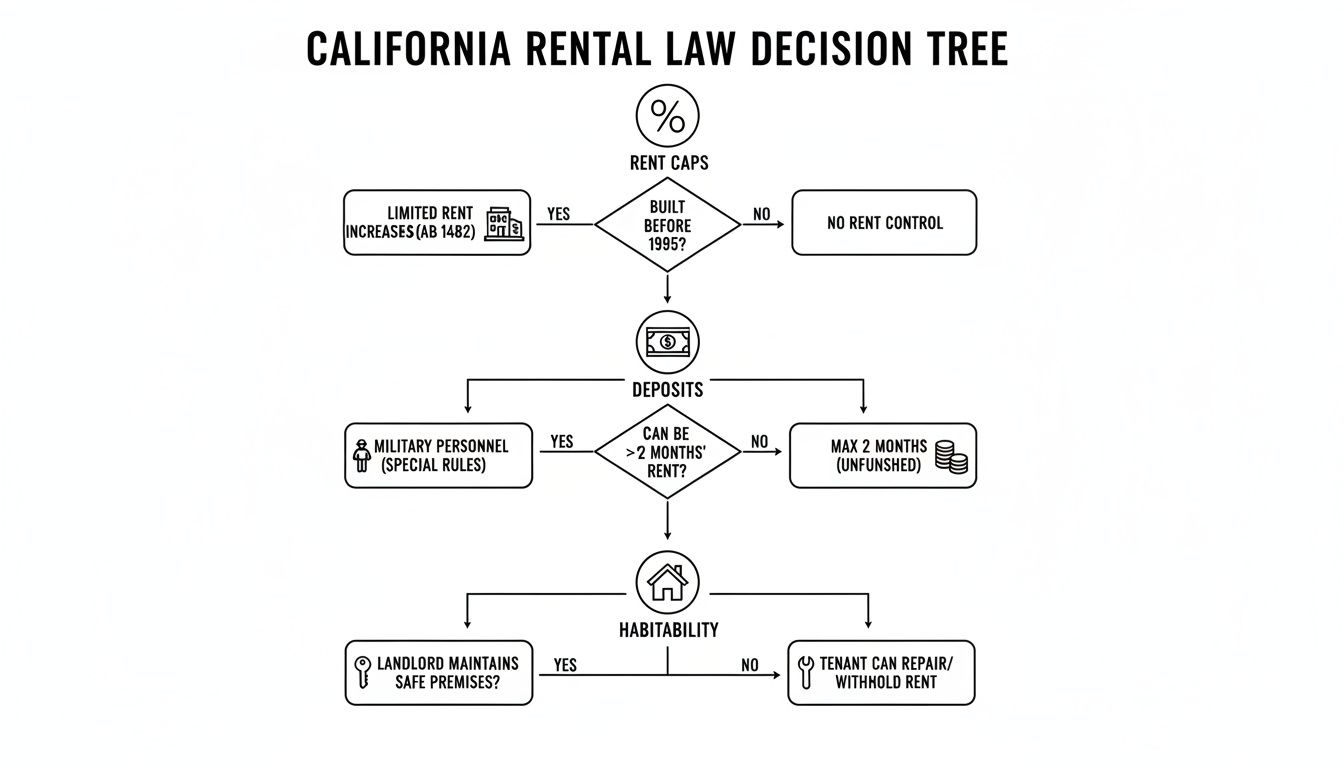
As the decision tree shows, each area of the law has its own set of specific rules and exceptions that landlords must follow to avoid penalties.
To discover more about the 2025-2026 legal shifts for California landlords, it’s important to understand the specifics.
The Two Types of Just Cause Eviction
Besides capping rent, AB 1482 also requires a "just cause" for eviction. This means you can't end a tenancy after the first year without a legally valid reason. These reasons fall into two clear categories.
1. At-Fault Just Cause
This happens when the tenant has done something wrong or violated the lease. Common examples include:
- Failing to pay rent
- Causing major damage to the property
- Engaging in criminal activity on the premises
- Breaking a significant lease rule
In these cases, you must give the tenant a formal notice to fix the problem (like paying overdue rent) before you can start an eviction.
2. No-Fault Just Cause
This is when you, the owner, need to end the tenancy for reasons unrelated to the tenant's behavior. Valid reasons include:
- You or a direct family member plan to move in.
- You are taking the property off the rental market.
- You need to comply with a government order to vacate.
- You're planning major renovations that require the unit to be empty.
A key detail for no-fault evictions is that you must provide relocation assistance to the tenant, usually equal to one month's rent. This is a detail many independent landlords miss.
Meeting New Habitability and Appliance Standards
The definition of a “habitable” rental is getting a major update in 2026. For a long time, California law has required properties to be safe and livable. But new rules are getting more specific, especially about kitchens.
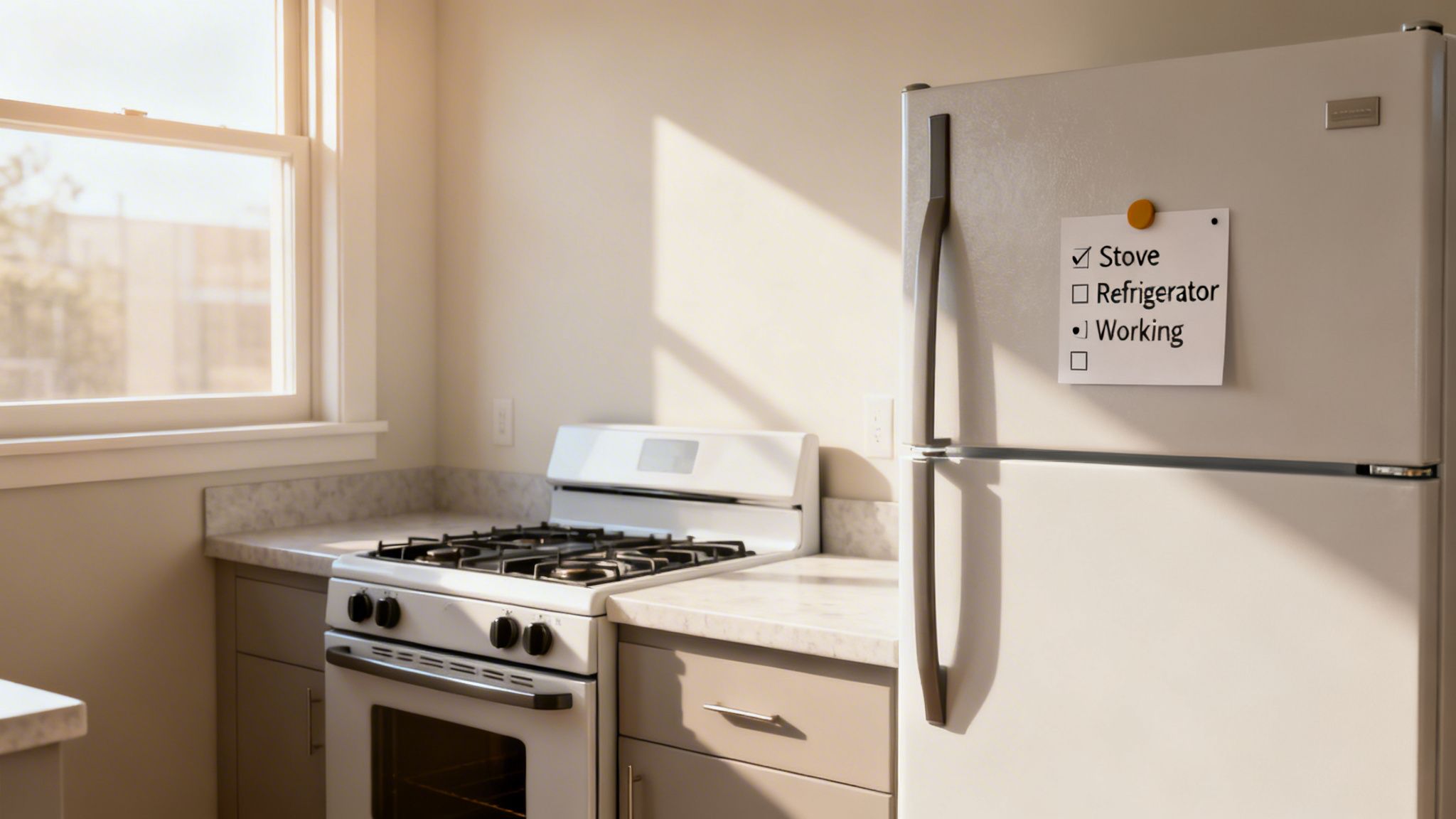
Starting January 1, 2026, a new law mandates that landlords must provide working stoves and refrigerators in most rental units. Before, these appliances were in a gray area. This law makes them a clear requirement.
Here in Monterey County, this update changes expectations for both tenants and landlords. It’s a big deal for military families in Monterey needing move-in-ready homes or for agricultural workers in Salinas who need a functional kitchen.
Which Properties Are Affected?
This new law applies to most long-term residential rentals, but there are a few exceptions. You are not required to provide these appliances if:
- Tenant-Supplied Appliances: The lease clearly states the tenant will provide their own.
- Communal Kitchens: The property has shared kitchens, like in some dorms.
- Certain Subsidized Housing: Some specific types of subsidized housing have different rules.
You must review your lease agreements to see if your units must comply.
Your Responsibility for Maintenance and Repairs
Just providing the appliances isn't enough. You are also responsible for their maintenance and repair. If a stove or refrigerator breaks, you must fix it promptly.
If you don't, tenants may have the right to withhold rent or break their lease. Landlords can also face steep daily fines for violations.
A helpful resource for planning updates is this article on what price range of appliances to buy for rental apartments. At Torrente Property Management, we help clients turn this legal requirement into a smart upgrade.
Understanding Major Changes to Security Deposit Rules
Security deposits have always been a point of friction between landlords and tenants. Starting in 2026, the rules are getting even tighter, making it more important than ever to handle them perfectly. The goal is to boost transparency and fairness.
One of the biggest changes is a new statewide cap. For most rental properties, landlords can now only charge a security deposit equal to one month's rent. This change is designed to lower the financial barrier for renters.

Exceptions to the One-Month Rule
While the one-month cap applies to most, there is a key exception for small, independent landlords. If you own no more than two residential rental properties with no more than four total units, you may be exempt.
This exception allows qualifying small landlords to collect up to two months' rent for an unfurnished unit. However, you must confirm you meet the exact criteria before charging more than one month's rent.
Strict Deadlines and Itemization Rules
The process of returning a deposit is also heavily regulated. You have a strict 21-day deadline to either return the full security deposit or provide an itemized statement of deductions after a tenant moves out.
Your itemized statement must be very detailed. You must list every repair or cleaning charge and provide copies of receipts. Vague claims like "general cleaning" without proof of cost will not hold up if challenged. You can review more key landlord-tenant laws in California.
Ordinary Wear and Tear vs. Actual Damage
This is where many landlords get into trouble. A security deposit can only be used to cover actual damage beyond normal wear and tear. You cannot charge for faded paint or minor scuffs on the wall.
- Wear and Tear (Not Deductible): Faded paint, gently worn carpets, minor scratches.
- Actual Damage (Deductible): Large holes in the wall, broken windows, pet stains on carpet.
Because the line can feel blurry, good documentation is your best defense. This is where professional management makes a huge difference. At Torrente Property Management, we conduct exhaustive move-in and move-out inspections with time-stamped photos to create a clear record.
How Torrente Property Management Ensures Your Compliance
Keeping up with California’s rental laws is a full-time job, but it doesn't have to be yours. This is where professional management becomes a necessity, not a convenience. At Torrente Property Management, we offer full legal compliance as part of our real estate management service.
We act as your compliance shield. We stay current on Monterey and California law, automatically updating your leases and policies. This keeps you out of court and in control.
Proactive Lease and Policy Updates
An outdated lease is a common trap for landlords. An agreement from 2025 could easily be out of compliance by 2026. We solve this with annual lease updates that build in every new state and local rule.
When a law changes, your lease agreements are updated to match. No guesswork, no last-minute stress. It's handled.
Expert Documentation and Financial Handling
Tenant disputes often come down to documentation. A solid paper trail protects you when disagreements arise. Our team handles everything from move-in documentation to eviction compliance.
Our process includes:
- Automated Compliance Checks: Our systems flag key deadlines to ensure notices are sent on time.
- DRE-Compliant Trust Accounting: Security deposits are handled according to strict state regulations for total transparency.
- Meticulous Record-Keeping: Every notice and invoice is logged, creating a comprehensive history for each property.
Deep Local and Bilingual Expertise
State law is only half the battle. Cities like Salinas and Monterey often have their own local rules. Our team has deep roots in the Monterey Bay community, giving us an unmatched understanding of these local details. For more, learn how to stay compliant with landlord rules in our guide.
Plus, our fully bilingual team is a key advantage. Clear communication in English and Spanish prevents misunderstandings that can lead to legal issues. This comprehensive approach gives you peace of mind that your investment is managed with integrity.
Protect Your Investment With Expert Guidance
Staying on top of California's rental market in 2026 requires constant attention. The key to protecting your assets is staying ahead of the rules.
A Quick Recap of Your 2026 Duties
To keep things simple, your core responsibilities for 2026 boil down to three key areas:
- Adhere to Rent Caps: Always use the correct local CPI when calculating rent increases and never exceed the legal limit.
- Meet Habitability Standards: Ensure your units have required, working appliances like stoves and refrigerators.
- Follow Security Deposit Rules: Strictly follow the new one-month deposit cap and the 21-day deadline for returning funds.
Falling short in any of these areas can create serious financial and legal risks.
The Surest Path to Compliance
For landlords in the Monterey Bay area, the best way to ensure compliance is to partner with a trusted, local expert. If you own property in Salinas, Monterey, or surrounding areas, let Torrente help you navigate the legal side of being a landlord. We keep your property—and your paperwork—bulletproof.
Check out these 5 reasons to hire a property manager in 2026.
Let us show you how our local expertise can safeguard your investment. We treat every property as if it were our own, ensuring your rentals are both profitable and compliant.
Contact Torrente Property Management today at (831) 582-8916.
FAQs on California's 2026 Rental Laws
New laws bring new questions. Here are clear answers to some of the most common questions landlords and tenants have about the changes for 2026.
Do the 2026 rent cap laws apply to my single-family home?
For the most part, single-family homes are exempt from statewide rent caps and just cause eviction rules. However, this only applies if the home is not owned by a corporation, REIT, or LLC. You must also provide tenants with a written disclosure stating the property is exempt.
What happens if my tenant lived in the property before these new laws passed?
The new laws apply to all current tenants once they take effect. For example, the requirement to provide a stove and refrigerator applies regardless of how long someone has lived there. You must bring your property and lease agreements up to current standards for all residents.
Can I still screen prospective tenants based on their credit score in 2026?
Yes, you can still use credit scores as part of your screening process. However, California law requires transparency. If you deny an application based on a credit report, you must provide a written notice explaining why and give them the contact information for the credit reporting agency you used.
As a military service member renting out my home while deployed, do any special rules apply?
Yes, they do. Active service members may be exempt from the one-month security deposit limit. If you are an active service member and rent out no more than two properties (with four or fewer total units), you may be able to collect up to two months' rent for an unfurnished unit.
What are the new rules for providing receipts for security deposit deductions?
The new rules demand total transparency. You cannot just estimate repair costs. You must provide tenants with copies of the actual invoices or receipts from the vendors who did the work. If you did the repairs yourself, you must provide a detailed breakdown of the work, hours, and hourly rate.
At Torrente Property Management Inc., we handle these complexities so you don't have to. Our team ensures every lease, notice, and deposit is managed with expert precision, keeping you compliant and your investment secure. Visit us at https://torrenteproperties.com to learn how we can bring you peace of mind.