Direct Answer: Salinas landlords need a property manager who handles pricing analysis, active tenant placement, local compliance, and monthly financial reporting — not just rent collection.
There’s a moment most Salinas landlords recognize — when the phone calls, the maintenance issues, and the paperwork start to feel like a second job. One multi-unit owner who contacted our team put it directly: managing everything on my own has become increasingly demanding as she worked to grow her portfolio. That’s not a complaint. That’s an inflection point.
Salinas is one of the most active rental markets on California’s Central Coast, with an average rent sitting around $2,595 for a single-family home. But strong rental demand doesn’t automatically make self-management easier. It just raises the stakes when something goes wrong — a vacancy that lingers two months too long, a tenant who slips through screening, or a compliance requirement you didn’t know existed.
This article focuses on the three things that matter most to Salinas rental owners right now: knowing what your property should actually rent for, understanding what compliance requires in 2026, and knowing what a mid-tenancy transition to professional management looks like. If you’re searching for Salinas property management, those are the real questions worth answering first.
Why Rental Pricing in Salinas Is a Local Skill, Not a Formula
One of the most common situations we hear from Salinas owners is that they want to know what their property would realistically rent for before they commit to anything. That’s exactly the right question — and it’s one that doesn’t have a clean online answer.
Pricing a Salinas rental requires knowing the neighborhood, the unit’s condition, and what comparable listings are doing right now. North Salinas and South Salinas carry meaningfully different rental ranges for the same bedroom count. A three-bedroom in a well-kept North Salinas neighborhood will price differently than an identical floor plan near downtown — even if both are in good condition.
Beyond location, a few factors consistently move the number:
- Bedroom count — three-bedroom homes are the most in-demand unit type in most Salinas zip codes
- Condition and recent updates — fresh flooring, updated kitchens, and clean curb appeal command a premium
- Furnished vs. unfurnished — furnished rentals can command higher monthly rents but attract a different tenant pool and have different wear-and-tear considerations
- Current comparable listings — the rental market shifts seasonally, so last year’s price isn’t necessarily this year’s price
Owners who price based on what they need to cover their mortgage — rather than what the market will actually bear — tend to either leave money on the table or sit with a vacancy that costs them more than a lower rent would have. A professional manager runs this analysis before a vacancy is listed, not after it’s been sitting for six weeks.
For more on what goes into pricing and positioning a Salinas rental, Salinas Property Management: 2026 Guide & Tips covers the current market in depth.
Salinas Compliance in 2026: What the Rules Actually Require Right Now
Salinas has its own regulatory layer that sits on top of California’s statewide landlord-tenant law — and it’s in an unusually uncertain moment.
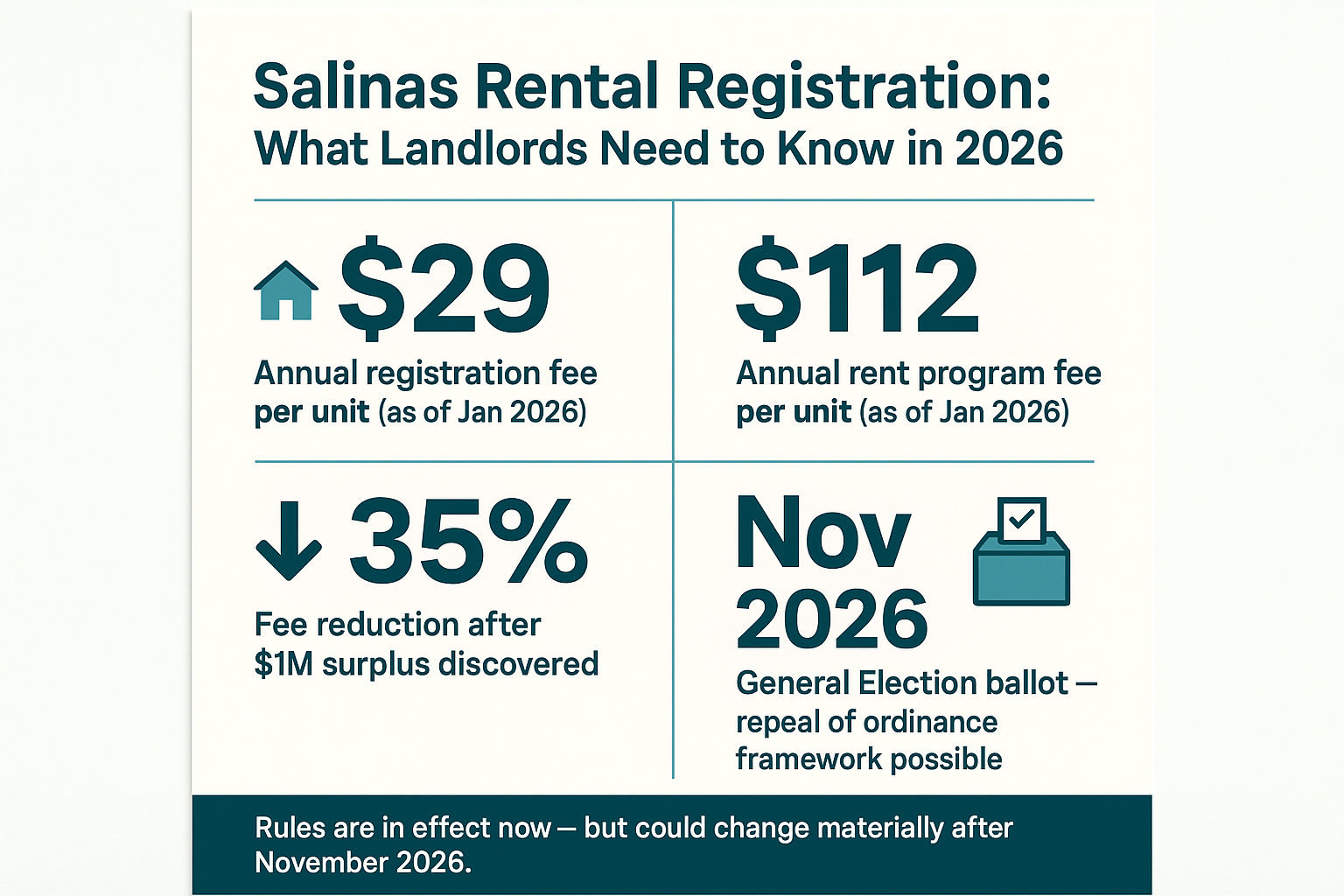
The city’s Residential Rental Registration program requires landlords to register their units annually and pay associated fees. As of January 2026, those fees were reduced roughly 35% after the city discovered it had accumulated nearly a $1 million surplus. The current fees are approximately $29 per unit for registration and $112 for the rent program fee — but those numbers are worth confirming directly with the city, as program details can change.
More significantly: in September 2025, the Salinas City Council voted to place a repeal of the entire rental ordinance framework on the November 2026 General Election ballot. That means Salinas landlords are managing under rules that could change materially in late 2026 — and no one knows yet which direction voters will go.
What does that mean practically?
- Registration is still required today — non-compliance carries real penalties, and the surplus discovery doesn’t suspend the obligation
- The outcome of the 2026 ballot measure is genuinely uncertain — owners shouldn’t assume the program disappears or that it stays exactly as-is
- Lease terms, rent adjustment provisions, and tenant protections may all be affected depending on what voters decide
For owners managing in Salinas without local guidance, this is the kind of detail that gets missed. A manager with deep local roots watches these changes in real time and adjusts how leases are drafted and how properties are administered accordingly.
If you’re newer to owning Salinas rentals and want more grounding in the compliance landscape, What Salinas Landlords Wish They Knew Before Renting Their First Property is worth reading before your next lease cycle.
Salinas Rental Registration at a Glance (2026)
Here’s a quick summary of where the Salinas Residential Rental Registration program stands right now and what landlords need to know before the rules potentially change.
What Happens When You Already Have a Tenant and Want to Hand Things Over
A large share of Salinas owners who reach out to a property manager aren’t starting from zero. Many already have a tenant in place — sometimes one who’s been there for years — and they’re trying to figure out whether a mid-tenancy transition is even possible without disrupting the relationship.
One caller described over two years of self-managing a North Salinas single-family home and wanting to understand the cost and process of bringing in professional management with a current tenant still living there. That situation is more common than most owners expect, and it’s less disruptive than most fear.
Here’s what typically happens in the first 30 days of a mid-tenancy handover:
- Notice is sent to the tenant introducing the management company as the new point of contact for rent, maintenance, and communication
- Existing lease documents are reviewed for any terms that conflict with current California law or that need to be updated at the next renewal
- A property inspection is scheduled to establish a baseline condition record
- Rent payment instructions are updated so rent flows through the new system from the next due date forward
- Owner financial reporting begins — monthly statements, not quarterly check-ins
Most tenants adapt quickly. They often prefer having a dedicated point of contact over texting an owner directly. And for owners, the relief is immediate — one person to call, one portal to check, one statement to review each month.
If you’re weighing whether this is worth doing at all, Do Property Managers Really Increase Profit, or Just Maintain the Property? breaks down the economics honestly.
Self-Management vs. Full-Service Management: What Changes Day-to-Day
This isn’t about which option is better in the abstract — it’s about what each one actually looks like in practice for a Salinas rental owner.
| Task | Self-Managing Owner | Full-Service Manager |
|---|---|---|
| Rental pricing before listing | Owner estimates based on gut or Zillow | Market analysis using current Salinas comparables by submarket |
| Tenant screening | Owner reviews applications, may miss red flags | Full credit, background, income, and rental history verification |
| Lease compliance | Owner tracks state and city rules independently | Lease drafted and updated to reflect current CA law and Salinas requirements |
| Maintenance coordination | Owner fields calls, finds vendors, follows up | 24/7 emergency coordination, vendor relationships, documented follow-through |
| Financial reporting | Owner tracks income/expenses manually | Monthly owner statements, year-end summaries, payment of owner obligations |
| Regulatory changes | Owner monitors city council actions independently | Manager tracks Salinas ordinance changes and adjusts as rules evolve |
Why Local Knowledge and Language Capability Are Harder to Replicate Than Software
A lot of property management companies offer an online portal. That’s table stakes in 2026 — it doesn’t tell you anything meaningful about how a property will actually be managed.
What’s harder to replicate is 25 years of working the Salinas and Monterey County market — knowing which vendors show up when they say they will, which neighborhoods are trending in rental demand, and what a reasonable repair cost actually looks like versus what a vendor is hoping to charge.
In Salinas specifically, bilingual English/Spanish management isn’t a minor feature. A large portion of the rental population in Salinas is Spanish-speaking, and that affects everything from how a lease gets explained to a new tenant, to how a maintenance issue gets reported and resolved. When communication breaks down because of language, small problems become expensive ones.
Owners who’ve worked with large out-of-area property management companies often describe the same experience: a portal that works fine, and a management team that doesn’t know their neighborhood, their tenant base, or the local compliance environment. What Landlords Often Overlook When Choosing a Property Management Company gets into this in more detail — it’s worth reading before you make a final decision.
And if you’re managing multiple Salinas units and want a clearer picture of what apartment-level management looks like specifically, Master Apartment Property Management Salinas is a useful companion read.
Frequently Asked Questions About Salinas Property Management
How much does property management cost in Salinas?
Management fees vary based on the number of units, the scope of services, and the company you choose. In Monterey County generally, monthly management fees often fall somewhere in a percentage range of gross monthly rent, with additional fees for tenant placement and lease renewals. Because pricing depends heavily on your specific property and situation, it’s worth getting a direct quote rather than assuming a number from a general source.
Do I have to register my rental property with the City of Salinas?
Yes — as of 2026, Salinas requires landlords to register rental units annually under the city’s Residential Rental Registration program. Current fees are approximately $29 per unit for registration and $112 for the rent program fee, though those numbers were reduced in January 2026 and should be confirmed with the city directly. The program’s future is uncertain: a repeal measure is on the November 2026 General Election ballot, but the rules are in effect right now and non-compliance carries penalties.
Can I switch to a property manager if my tenant is already living there?
Yes, and it’s more straightforward than most owners expect. A manager typically sends a formal notice introducing themselves as the new point of contact, reviews the existing lease, schedules a baseline property inspection, and transitions rent collection — all within the first 30 days. Most tenants adapt quickly and often prefer having a dedicated management contact over reaching the owner directly.
How do I know what rent to charge for my Salinas property?
There’s no single answer — pricing depends on your specific neighborhood within Salinas (North vs. South carry different ranges), bedroom count, condition, furnishing status, and what comparable properties are actively renting for right now. A professional manager pulls current market data and runs a pricing analysis before the property is listed, not after it’s been sitting vacant.
Does it matter whether a property manager speaks Spanish in Salinas?
In Salinas, yes — it matters more than most owners initially realize. A significant portion of tenants in Salinas are Spanish-speaking, and clear bilingual communication affects lease clarity, maintenance reporting, and how quickly problems get resolved. Language barriers tend to slow down the kind of routine communication that keeps small issues from becoming expensive ones.
Ready to Talk Through What Your Salinas Property Actually Needs?
Torrente Properties has managed residential rentals across Salinas and Monterey County for over 25 years — including mid-tenancy transitions, multi-unit portfolios, and properties where the owner lives hours away. If you’d like to talk through your specific situation, our team is reachable by phone at (831) 582-8916 or through the contact form at torrenteproperties.com. No pressure — just a real conversation with someone who knows this market.