Direct Answer: Effective January 1, 2026, California AB 628 requires landlords to provide working stoves and refrigerators in any lease signed, renewed, or amended on or after that date — or face potential habitability claims.
If you renewed a lease in Salinas, re-rented a unit in Seaside, or are preparing to place a tenant in a Monterey townhouse this year, your legal obligations just changed — and most landlords haven’t caught up yet.
California Assembly Bill 628 took effect January 1, 2026, adding working stoves and refrigerators to the legal definition of a habitable dwelling. That sounds like a minor update. But a unit without a functioning stove or refrigerator can now be classified as legally uninhabitable, which opens the door to habitability claims, rent withholding arguments, and serious complications if you ever need to pursue an eviction.
And AB 628 didn’t arrive alone. The same legislative cycle brought a wave of other changes — to security deposit returns, eviction notice requirements, and a new tenant defense tied to Social Security benefit delays. This article walks through what matters most for property owners in Monterey County and what to do before your next lease renewal.
What AB 628 Actually Says — and Where Owners Get It Wrong
Before 2026, California’s habitability standards under Civil Code Section 1941.1 required things like working plumbing, heating, and weatherproofing. Appliances weren’t part of that framework. AB 628 changed that by adding functioning stoves and refrigerators to the required conditions for a unit to be considered livable.
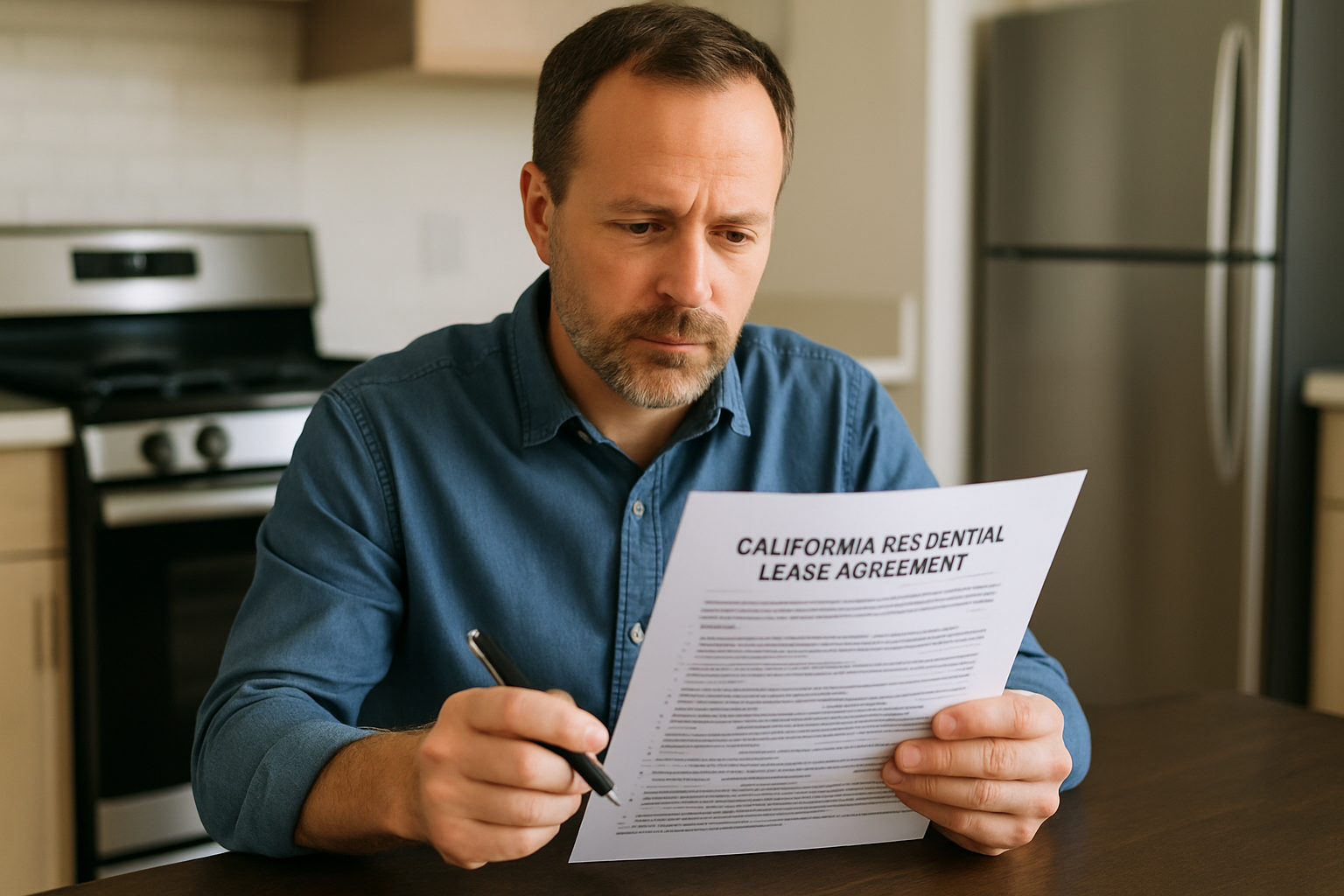
The law applies to any lease that is entered into, amended, or renewed on or after January 1, 2026. If your tenant signed a new lease in March 2026 or you issued a lease renewal this spring, you’re covered by this law — regardless of when the property was originally built or previously leased.
Here’s where owners frequently miss the nuance:
- Tenant-supplied refrigerators are allowed, but only if both parties agree in writing at lease signing, and that written agreement must explicitly state the landlord bears no maintenance or replacement responsibility. A verbal understanding doesn’t protect you.
- Recall obligations are real. If a covered appliance — stove or refrigerator — is subject to a manufacturer recall, the landlord has 30 days to repair or replace it. This isn’t optional.
- The exemption mechanics matter. An owner who assumes a tenant’s fridge relieves them of responsibility — without a proper written waiver in the lease — is exposed if that appliance fails and the tenant asserts a habitability claim.
For Salinas landlords managing multiple units, this adds another layer of pre-lease documentation to track across a portfolio. Getting it wrong on one unit can create ripple effects.
The Pre-Lease Appliance Checklist Every Landlord Needs Right Now
The practical question isn’t whether AB 628 applies to your property — if you’re signing or renewing leases in 2026, it almost certainly does. The question is what to do before the tenant moves in.
Here’s a simple checklist to run through before every lease in 2026:
- Confirm the stove is present and functional. Test all burners and the oven. Note any issues in writing before lease signing.
- Confirm the refrigerator is present and functional. Check temperature, seals, and any visible defects.
- Photograph both appliances at move-in with timestamps. These photos are your baseline if a habitability dispute arises later.
- Decide the arrangement clearly in the lease. Is the landlord providing the appliances, or is the tenant supplying their own? If the tenant is bringing their own refrigerator, the lease must include a written waiver of landlord responsibility for that appliance.
- Check for active recalls on any appliances you’re providing. The CPSC recall database (cpsc.gov) is searchable by brand and model number.
This documentation baseline is the single most important protection you have. If a tenant later claims uninhabitability — or withholds rent citing a broken refrigerator — your move-in records are what either validates or undermines your position.
Owners who are renting out a Salinas property for the first time often underestimate how much the paper trail matters. AB 628 makes that documentation non-negotiable.
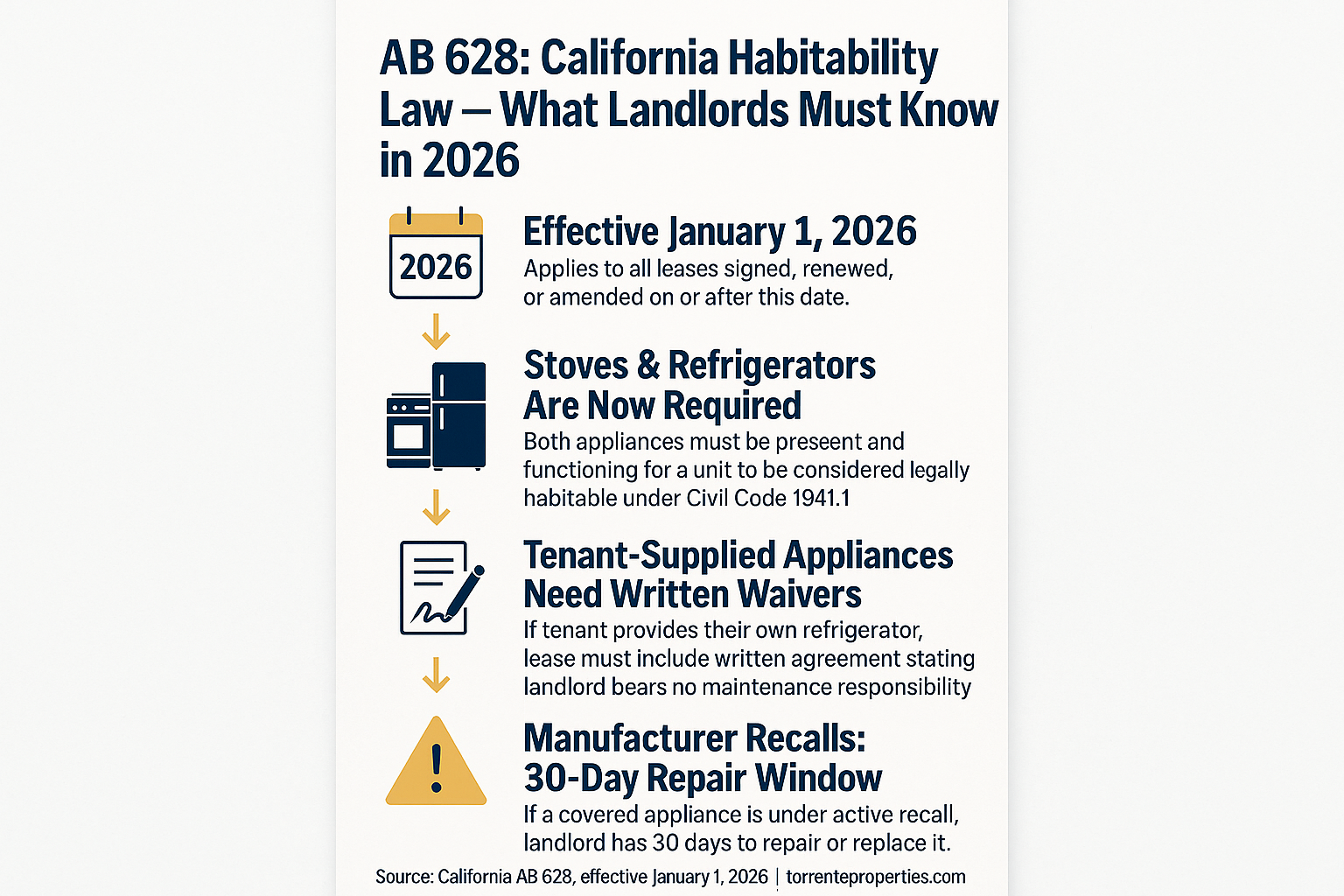
AB 628 at a Glance: What Changes for California Landlords in 2026
This infographic summarizes the key requirements of AB 628 and how they apply to lease decisions before and after January 1, 2026.
AB 628 Is Part of a Bigger Wave — And the Other Changes Matter Too
AB 628 is the most immediately actionable change for landlords preparing leases right now. But it’s one piece of a broader set of 2026 compliance shifts that, taken together, represent real legal exposure for owners who aren’t tracking them.
AB 414 updated the rules around security deposit returns. Tenants can now request electronic refunds, and the law clarifies how itemized deductions must be broken out when multiple tenants share a unit. If you’re used to issuing a single check and a one-line statement, that approach may no longer meet the legal standard.
AB 747 added required information to proof-of-service documents for eviction notices. This is the kind of procedural change that gets landlords into trouble — not because they did anything wrong substantively, but because a defective notice can derail an otherwise valid eviction case.
And perhaps the most significant addition for income property owners: a new Social Security hardship defense, effective January 1, 2026, allows tenants whose benefits have been delayed or interrupted to assert that as a defense in an unlawful detainer case. Courts can stay the eviction up to six months while the situation is evaluated. For a landlord in Monterey or Seaside managing a single-family rental, a six-month delay in regaining possession of a property is a serious financial consequence — not a technicality.
None of these changes individually is unmanageable. But owners who aren’t tracking them collectively are operating with real exposure. California’s landlord-tenant framework in 2026 rewards landlords who stay current on compliance — and it penalizes those who don’t, often at the worst possible moment.
For a broader picture of what’s shifted in the local rental market this year, this 2026 guide to Monterey property management covers the operating environment in more detail.
2026 California Landlord Law Changes: Quick Reference
Here’s a side-by-side summary of the four key changes that took effect January 1, 2026, and what each one means in practice for landlords in Monterey County.
| Law | What Changed | What It Means for You |
|---|---|---|
| AB 628 | Stoves and refrigerators added to habitability definition | Both appliances must be present and functional in any lease signed or renewed in 2026 |
| AB 628 (exemption) | Tenant may supply their own refrigerator with written waiver | Oral agreements don’t protect you — the waiver must be in the lease document itself |
| AB 414 | Electronic security deposit returns; itemized deductions for shared units | Deposit accounting must now break out each tenant’s share when multiple people are on the lease |
| AB 747 | Additional required info on eviction proof-of-service documents | A procedurally defective notice can derail a valid eviction — format matters now more than before |
| Social Security Hardship Defense | Tenants can assert benefit delays as a defense in unlawful detainer cases | Courts may stay an eviction up to 6 months — significant risk for owners of single-unit properties |
Why Distance Makes AB 628 Compliance Harder
Many of the property owners across the Monterey Peninsula — seasonal residents in Carmel, out-of-area investors with units in Marina, military families managing a Pacific Grove home during a deployment — aren’t on the ground when something breaks.
Under California’s general habitability standards, appliance failures must be addressed within a reasonable time after the landlord receives notice. That’s always been true. But AB 628 raises the stakes by making a non-functioning stove or refrigerator a potential habitability violation rather than just a maintenance issue.
Here’s what the gap looks like in practice: a tenant submits a maintenance request on a Monday. A local property manager sees it the same day and dispatches a vendor. An out-of-area owner gets an email — if the tenant sends one — and starts making calls from out of state, trying to find a repair person they’ve never worked with in a market they’re not in.
By the time that second scenario resolves, the delay itself has become part of the problem. A tenant who has been without a functioning refrigerator for ten days while their landlord arranges a repair from Sacramento has a much stronger habitability argument than one whose issue was addressed in 48 hours.
For owners who manage remotely, the hidden costs of managing a Monterey property from out of state go beyond management fees — compliance failures that stem from delayed response are some of the most expensive mistakes a landlord can make. And for seasonal homeowners who leave properties vacant during parts of the year, the caretaker and property watch services available for Monterey Bay homes are a practical way to maintain eyes on the ground year-round.
Frequently Asked Questions About AB 628 and California Habitability Law
Does AB 628 apply to leases that were already signed before 2026?
If the original lease was signed before January 1, 2026 and has not been amended or renewed since, AB 628 does not retroactively apply. But the moment you issue a new lease, process a renewal, or make a formal amendment — even something as routine as adding a tenant to the existing agreement — the updated law applies.
What if my tenant already owns a refrigerator and wants to bring it themselves?
That’s allowed, but the arrangement has to be documented correctly. Both parties must agree in writing at lease signing, and the written agreement must explicitly state that the landlord bears no responsibility for maintenance or replacement of that appliance. A verbal agreement or a general clause about tenant-supplied furnishings won’t be sufficient protection if a dispute arises.
What counts as ‘not functional’ under AB 628? Does a refrigerator have to be completely dead, or does a minor issue qualify?
The law doesn’t define a bright-line standard for ‘functional,’ which is part of what makes this tricky. A refrigerator that doesn’t maintain safe food temperatures — typically below 40°F — is clearly non-functional. Minor cosmetic issues or a slow ice maker probably wouldn’t rise to the level of a habitability claim. But anything affecting the appliance’s core purpose is worth addressing promptly and documenting.
I have a 4-unit property in Salinas. Does the new Social Security hardship defense really mean I could wait six months to regain possession?
It can. The defense allows a tenant whose Social Security benefits have been delayed or interrupted to raise that fact in an unlawful detainer proceeding, and a court has the discretion to stay the eviction for up to six months while the situation is evaluated. Whether a court grants the stay — and for how long — will depend on the specific circumstances. But for a single-unit owner or a small multi-family landlord, this is a real timeline risk that’s worth understanding before it becomes relevant.
How does AB 414 change the security deposit return process for properties with multiple tenants?
AB 414 clarifies that when multiple tenants share a unit, the itemized accounting for the security deposit must break out each tenant’s share of any deductions. Issuing a single combined statement that doesn’t address individual tenants may no longer meet the legal standard. Tenants can also now request that the refund be sent electronically rather than by check.
I’m planning to lease my house in Monterey before moving out of the area. What do I actually need to do before handing over the keys?
Before signing a lease in 2026, confirm that your stove and refrigerator are present and fully functioning, photograph both appliances with timestamps, and make sure your lease documents reflect the correct arrangement — whether you’re providing the appliances or the tenant is. If there’s any ambiguity about who owns or is responsible for the refrigerator, resolve it in writing before the lease is signed, not after. And if you’re going to be managing the property from a distance, have a plan for how maintenance requests will be received and acted on quickly — because under California law, ‘reasonable time’ for repairs is measured from when you receive notice, not when it’s convenient to respond.
Questions About How These Changes Affect Your Property?
If you own a rental in Monterey County — whether it’s a single-family home in Seaside, a multi-unit in Salinas, or a seasonal property in Carmel — and you’re unsure how the 2026 lease changes apply to your situation, Torrente Properties is available to talk it through. Our team has been navigating California landlord-tenant law in this market for over 25 years, and we’re happy to help you understand what your next lease needs to reflect. Reach us at (831) 582-8916 or through the contact form at torrenteproperties.com.