
Direct Answer: Managing a Monterey home remotely adds real costs most owners don’t see coming — emergency travel, compliance fines, deferred repairs, and missed rent that quietly erase your returns.
Most out-of-state landlords do the math on their Monterey property and it looks fine on paper. Monthly rent coming in, mortgage going out, something left over. But that math almost always leaves out the costs that don’t show up until something goes wrong — and something always goes wrong eventually.
Monterey County is one of the most expensive rental markets on the Central Coast. Rents are strong, but so are the stakes. A missed maintenance call, a compliance misstep, or a bad tenant situation can turn a profitable rental into a money-losing headache fast — especially when you’re managing it from Denver or Dallas.
This article breaks down the real costs of remote self-management — not the obvious ones, but the ones that quietly chip away at what you thought you were earning.
The Emergency Trip You Didn’t Budget For
When a water heater fails at a rental in Monterey and you’re sitting in Phoenix, you have two choices: find a local vendor you trust to handle it without supervision, or get on a plane. Most first-time remote landlords don’t have that vendor network yet, so they fly.
A last-minute round-trip to Monterey Regional Airport from most major out-of-state cities runs $400 to $900. Add a rental car, two nights at a hotel near the peninsula, and your time — and a water heater replacement that should have cost $1,200 suddenly costs you $2,500 or more out of pocket.
This isn’t an edge case. It’s one of the most common hidden costs remote landlords describe after their first year. And it’s rarely a one-time thing. Properties generate emergencies on their own schedule, not yours.
Even when you skip the trip and try to coordinate remotely, unmanaged repairs often take longer, and California law requires landlords to address habitability issues promptly. Delayed repairs in Monterey can expose you to rent withholding claims under California Civil Code 1942 — which is a much bigger problem than the repair itself.
If you want to understand what happens to a property when you’re not nearby to catch problems early, what happens to your Monterey property when you’re 500 miles away goes deeper on exactly that.

California Compliance Costs That Catch Out-of-State Owners Off Guard
California has some of the most landlord-specific regulations in the country, and Monterey County adds its own layer on top of state law. Owners who live here stay current because they’re in it every day. Owners in other states often don’t find out about a requirement until they’re already out of compliance.
A few of the most common compliance gaps for remote owners right now:
- Security deposit cap: As of July 1, 2024, California capped security deposits at one month’s rent for most residential properties. Owners who collected two months before this law changed and haven’t adjusted are holding deposits incorrectly.
- Salinas Residential Rental Registration: Rental properties in Salinas must be registered with the city. The registration fee is relatively low, but failing to register can result in fines and complications during eviction proceedings.
- AB 1482 rent increase limits: Most single-family rentals and multifamily properties in Monterey County that are more than 15 years old fall under California’s statewide rent cap. Raising rent above the annual limit — currently CPI + 5%, capped at 10% — exposes you to legal liability.
- SB 721 balcony inspections: If you own a multifamily property in Monterey with exterior elevated elements — decks, balconies, stairways — inspections were required by January 1, 2025. Missing this deadline carries real liability if something fails.
None of these are obscure rules. But when you’re managing a property from out of state and not plugged into local real estate news, they’re easy to miss. And the cost of catching up after the fact is almost always higher than the cost of staying current.
For a broader look at what remote landlords often overlook, what landlords often overlook when choosing a property management company covers some of these blind spots in more detail.
What Remote Self-Management Actually Costs Versus What Owners Expect
These are real cost categories remote Monterey landlords encounter, with honest ranges based on current local conditions. Many of these never appear in a landlord’s initial pro forma.
| Cost Category | What Owners Expect | What It Often Costs |
|---|---|---|
| Emergency travel (per trip) | Nothing — “I’ll handle it remotely” | $600–$2,500 depending on origin city |
| Compliance fine (deposit/registration) | $0 | $500–$2,000+ depending on violation |
| Deferred maintenance repair | $300–$500 | $1,500–$5,000 after delayed action |
| Vacancy from slow re-leasing | 1–2 weeks | 4–8 weeks if priced or marketed poorly |
| Bad tenant placement cost | $0 upfront | $3,000–$8,000 in lost rent or damages |
| Vendor markup (no local relationships) | Market rate | 10–25% above market on some trades |
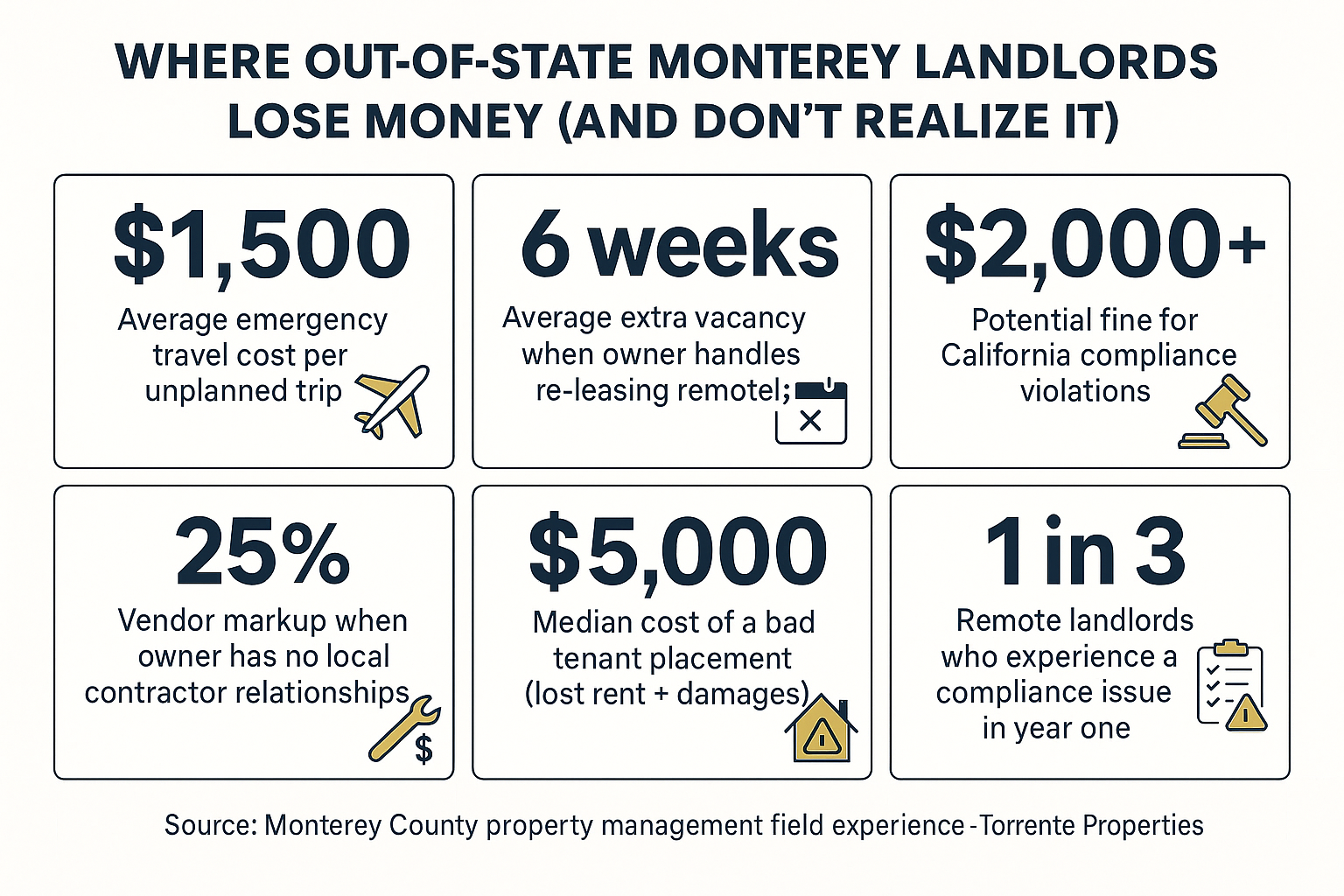
The Real Cost Breakdown for Out-of-State Monterey Landlords
This infographic shows how hidden costs stack up for remote property owners over the course of a typical year — organized by category so you can see where money quietly leaks out.
The Slow Leak: Vacancy and Below-Market Rent
Emergency costs are dramatic. But the slower losses often do more damage over time — and they’re almost invisible until you run the numbers at year end.
Vacancy is the clearest example. A Monterey rental sitting empty for six weeks instead of two costs you roughly a month’s rent in lost income — anywhere from $2,000 to $4,500 depending on the property and location. That loss happens when a property is priced wrong, listed on only one platform, or shown infrequently because the owner can’t be there to open the door.
Below-market rents are just as expensive, and more common than people think. Owners who set rent once and don’t adjust it annually — because they’re not tracking the local market from out of state — often leave $150 to $400 per month on the table. Over a two-year lease, that’s $3,600 to $9,600 you never collected.
This isn’t a criticism of landlords who try to manage their own properties. It’s a real structural disadvantage of operating from a distance. A landlord in Salinas or Pacific Grove can see what comparable units are renting for because they’re living it. An owner in another state is working from data that’s already a month or two old.
The difference between listing your house and actually managing it does a good job of explaining why these two things require very different skill sets — and why conflating them is where a lot of owners run into trouble.
What Seasonal and Second-Home Owners Face Specifically
Not every out-of-state owner is a traditional landlord. A significant number of Monterey Peninsula property owners have second homes or seasonal properties that sit vacant for months at a time — and managing those remotely carries a different set of risks.
Vacant homes on the coast are exposed to moisture intrusion, pest activity, and weathering in ways that occupied homes aren’t. A small roof leak that a tenant would notice and report within days can go undetected for weeks in a vacant property — and by the time the owner visits, what was a $400 repair has turned into a $6,000 remediation.
For seasonal homeowners specifically, there’s also the issue of security. Pebble Beach and Carmel properties have been targeted for break-ins during extended owner absences, and a home that clearly hasn’t been checked on in months is a more visible target than one with regular activity.
This is where scheduled property inspections and home watch services fill a real gap. Regular walkthroughs, utility monitoring, and maintenance coordination can catch problems when they’re still small — which is the entire point. Caretaker services for seasonal homes on the Monterey Bay outlines what that kind of service actually covers if you’re not sure what to look for.
Frequently Asked Questions About Managing a Monterey Property From Out of State
How much does it actually cost to self-manage a Monterey rental from out of state?
It varies a lot depending on how the year goes. In a smooth year with no vacancies or emergencies, you might spend very little. But most remote owners encounter at least one emergency trip, one compliance issue, or one extended vacancy in any given two-year window. When those happen, the out-of-pocket costs typically run $3,000 to $10,000 — often more than what professional management would have cost over the same period.
Do I really need to worry about California rental law if I only own one property?
Yes. California’s tenant protection laws apply regardless of how many properties you own. AB 1482 rent caps, the one-month security deposit limit, just-cause eviction requirements, and habitability standards all apply to single-family rentals in Monterey County. Ignorance of the law isn’t a defense — and the penalties for violations can be significant.
Is it legal to manage my own rental property in California if I live out of state?
Yes, it’s legal. But California does require that landlords be reachable and responsive — and some local ordinances like Salinas’ rental registration program require accurate contact information on file. The legal part isn’t the problem. The practical part is.
What’s the biggest mistake out-of-state Monterey landlords make?
Underestimating how fast small problems become large ones when no one is watching the property regularly. A slow drain, a small water stain, an HVAC filter that hasn’t been changed — these are things a tenant might not mention and an absentee owner won’t see. By the time something forces attention, the repair is usually much bigger than it had to be.
My property is vacant right now, not rented. Does any of this still apply to me?
Vacant properties carry their own risks — moisture, pest intrusion, security vulnerabilities, and deferred maintenance that compounds without anyone noticing. Seasonal and vacant homes on the Monterey Peninsula are especially vulnerable to marine air and weather-related damage. Regular inspections and a local point of contact are worth it even when no tenant is in place.
Want a Clear Picture of What Your Monterey Property Is Actually Costing You?
Torrente Properties works with property owners across Monterey County — including many who manage from out of state and are realizing the math doesn’t add up the way they expected. If you own a rental or vacant home in Monterey, Pacific Grove, Salinas, Carmel, or anywhere on the peninsula, our team can walk you through what local management actually looks like and what it would cost. Reach us by phone at (831) 582-8916 or through the contact form at torrenteproperties.com.