
Direct Answer: Listing gets you a tenant. Managing keeps your property protected, your income steady, and your obligations legal — month after month, not just on move-in day.
A lot of property owners in Monterey County assume that once they find a tenant and collect the first month’s rent, the hard part is over. It isn’t. Getting a house listed and filled is a one-time event. Managing that same house is a job that runs every day — whether you’re across town in Salinas or across the country in another state.
These two things get confused all the time, and the confusion costs landlords real money. We’ve seen owners in Pacific Grove and Marina come to us after a rough year of self-managing — not because they couldn’t find tenants, but because nobody told them what came after.
This article breaks down where the listing ends and where the actual management begins. If you’re weighing whether to handle this yourself or bring in professional help, understanding that line is the most useful place to start.
What the Listing Phase Actually Covers
The listing phase is finite. It starts when you decide to rent and ends when a signed lease is in hand and a qualified tenant has moved in. Done right, it takes two to four weeks in most Monterey County markets.
Here’s what’s included in a solid listing process:
- Property preparation — cleaning, minor repairs, touch-up paint, and anything that affects first impressions or rental price
- Rental pricing analysis — setting a rate that’s competitive for the neighborhood, not just a number you picked from Zillow
- Professional photos and listings — distributed across platforms where Monterey County renters actually search
- Showings and applicant screening — credit checks, background checks, income verification, and rental history review
- Lease drafting and execution — a California-compliant lease that protects you legally from day one
That’s a meaningful amount of work, and getting any part of it wrong has consequences. A tenant who looked good on paper but wasn’t properly screened, or a lease missing required California disclosures, can turn into an expensive problem. But once that work is done, it’s done. What comes next is a different category entirely.
Some landlords understand this well. Others discover it the hard way — usually around month three.

Where Management Starts — and What It Actually Requires
The day after move-in is when property management begins. And unlike the listing phase, it doesn’t have an end date.
Management means being responsible for the property in an ongoing, often unpredictable way. For landlords who live out of the area, that responsibility can feel heavy fast. A pipe bursts on a Friday night in Seaside. The tenant calls. Someone has to answer, find a licensed plumber, authorize the work, and document the cost — that night.
The day-to-day management workload includes:
- Rent collection and late payment follow-through — including knowing when and how to issue a legal pay-or-quit notice under California law
- Maintenance coordination — fielding requests, vetting vendors, getting work done at fair prices, and keeping records
- Routine and move-out inspections — documenting property condition with the kind of detail that holds up if there’s ever a dispute over a security deposit
- Monthly owner financial statements — tracking income, expenses, and what you actually cleared after repairs and fees
- Compliance tracking — California rental law changes frequently; the one-month security deposit cap that took effect July 1, 2024 caught some self-managing landlords off guard
- Vendor oversight — making sure the landscaper shows up, the HVAC filter gets changed, and small issues don’t become expensive ones
None of this is glamorous. And most of it doesn’t show up in the listing phase at all. Understanding what a property manager really handles makes the scope clearer than most owners expect before they get into it.
Listing vs. Management: What Each Phase Covers
Here’s a side-by-side look at where one phase ends and the other begins — and which one most people underestimate.
| Task | Listing Phase | Ongoing Management |
|---|---|---|
| Rental pricing analysis | ✓ Yes | Periodic only |
| Property photos and marketing | ✓ Yes | As needed |
| Tenant screening and placement | ✓ Yes | On turnover |
| Lease drafting | ✓ Yes | On renewal/turnover |
| Rent collection | — | ✓ Every month |
| Maintenance coordination | — | ✓ Ongoing |
| Routine inspections | Move-in only | ✓ Scheduled |
| Financial reporting | — | ✓ Monthly |
| Compliance monitoring | — | ✓ Ongoing |
| Vendor management | — | ✓ Ongoing |
| Emergency response (24/7) | — | ✓ Year-round |
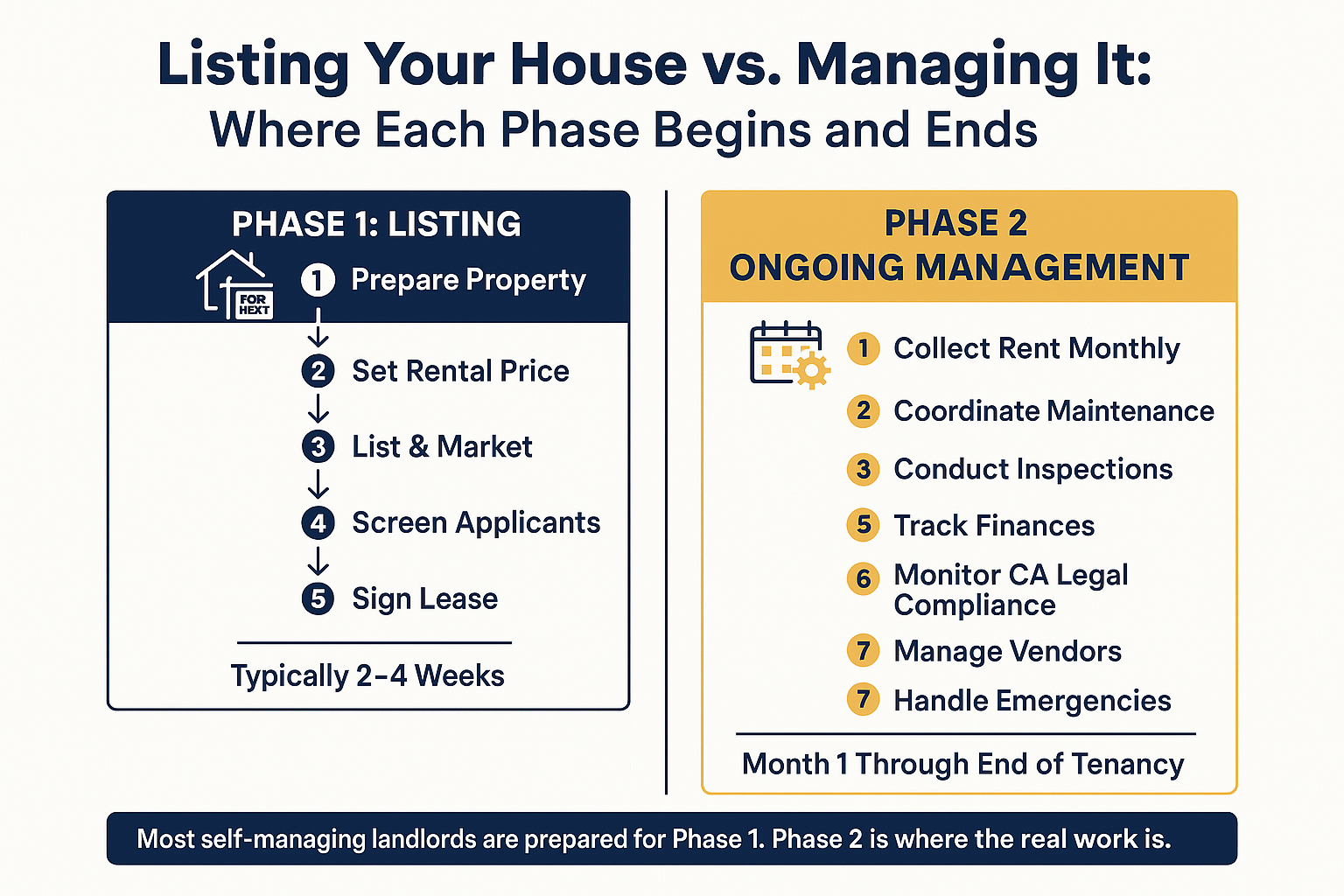
The Property Owner’s Timeline: From Listing to Long-Term Management
This timeline shows the two distinct phases of rental ownership and what falls inside each one — helpful for owners deciding where they need support.
Why Monterey County Makes Management Harder Than Most Markets
California landlord-tenant law is already more complex than most states. But Monterey County adds its own layers that catch owners off guard — especially those who moved away and are managing remotely.
Salinas has a Residential Rental Registration program that requires landlords to register rental units with the city. Missing that registration isn’t just an oversight — it can affect your ability to enforce a lease. The City of Monterey prohibits short-term rentals under 30 days entirely. And multifamily property owners across the county are working against inspection deadlines tied to AB 2579 and SB 721, which require exterior elevated elements like balconies and decks to be inspected by a licensed professional on a set schedule.
For a landlord managing a Salinas property from out of state, keeping up with these local requirements while also handling day-to-day management isn’t just inconvenient — it’s genuinely risky. Missing a compliance deadline can mean fines, delays, or worse.
This is also why comparing a flat-fee online listing service to a full-service local property manager isn’t a fair comparison. One hands you a tenant. The other keeps you on the right side of California law for as long as that tenant is in your property.
The Decision Most Landlords Face Eventually
At some point, most rental property owners in Monterey County face the same question: is the time and stress of self-managing worth it compared to what professional management costs?
For some owners — especially those who live nearby, have just one property, and genuinely enjoy the work — self-managing can make sense. But for owners who are retired, relocated, out of state, or simply don’t want a second job, the math often looks different than expected.
Full-service property management in Monterey County typically runs between 8% and 12% of monthly rent collected. On a home renting for $2,800/month in Salinas, that’s roughly $224–$336/month. In exchange, you’re handing off the 3 a.m. phone calls, the tenant disputes, the vendor coordination, and the compliance tracking.
What that fee doesn’t account for is what a good manager saves you: a faster vacancy fill, a more carefully screened tenant who stays longer, and maintenance issues caught early before they turn into a $4,000 repair. Whether professional management actually increases your bottom line depends on your situation — but the costs of getting management wrong are real and specific.
Owners who inherit a property in Carmel or Pacific Grove and suddenly become accidental landlords tend to underestimate both the time commitment and the local knowledge required. How the housing market has pushed more homeowners into landlord roles has made this a more common situation than it used to be.
Frequently Asked Questions About Listing vs. Managing a Rental Property
Can I just hire someone to find a tenant and then manage the property myself?
Yes, and some landlords do this successfully — especially if they live nearby and have some experience. But be aware that whoever places your tenant may not be available to help when problems come up later. If you go this route, make sure your lease is California-compliant and that you understand Salinas or Monterey’s local rental registration requirements before your tenant moves in.
What happens when a tenant stops paying rent? Who handles that?
If you’re self-managing, you do. That means issuing a 3-day pay-or-quit notice in the correct legal format, following California’s specific timeline, and potentially initiating an unlawful detainer action if the tenant doesn’t comply. A property manager handles this entire process on your behalf — including the paperwork and, if necessary, coordinating with a real estate attorney.
Is the security deposit cap new in California?
Yes. As of July 1, 2024, California law limits security deposits to one month’s rent for most residential tenancies, regardless of whether the unit is furnished. Previously, landlords could collect up to two months. If you haven’t updated your lease language since then, it’s worth reviewing.
What’s the difference between a property manager and a caretaker service?
A property manager handles occupied rental properties — tenants, rent collection, maintenance, and compliance. A caretaker service is for vacant or seasonal homes where there’s no tenant but the property still needs someone checking on it regularly. Torrente Properties offers both, which is relatively uncommon and makes a real difference for seasonal residents and second-home owners on the Monterey Peninsula.
How do I know if a property management company is actually doing the work they say they are?
Ask specifically about monthly financial statements, inspection frequency, and how they handle maintenance requests. A good manager can show you documented records — not just a summary. Referencing their standing with local organizations like the Monterey County Association of Realtors is also a reasonable way to evaluate legitimacy. What landlords often overlook when choosing a property management company is a useful read if you’re comparing options.
Ready to Know Exactly What Your Property Needs?
If you own a rental in Monterey County — whether it’s occupied, vacant, or somewhere in between — Torrente Properties can give you a clear picture of what’s actually involved in managing it well. Our team has been working with Monterey Bay property owners for over 25 years, and we’re happy to talk through your situation without pressure or obligation. Call us at (831) 582-8916 or reach out through the contact form at torrenteproperties.com.