
Direct Answer: When no one is actively watching your Monterey property, small problems become expensive ones fast. Distance doesn’t create risk — unmanaged distance does.
You bought property on the Monterey Peninsula — maybe a rental in Seaside, a second home in Pacific Grove, or a house in Salinas you inherited and couldn’t quite bring yourself to sell. Now you live in Sacramento, Phoenix, or Portland, and there’s a quiet anxiety that comes with not knowing what’s happening on the other end of that investment.
That anxiety isn’t irrational. Monterey County’s rental market moves fast, maintenance issues don’t wait for your next visit, and California’s landlord-tenant laws change regularly. Most of what goes wrong for out-of-area owners doesn’t happen dramatically — it happens gradually, quietly, while you’re 500 miles away dealing with your actual life.
This article walks through the two things that matter most: what really breaks down when you’re not nearby, and what a realistic management plan looks like for properties along the Central Coast.
The Problems That Start Small and Get Expensive
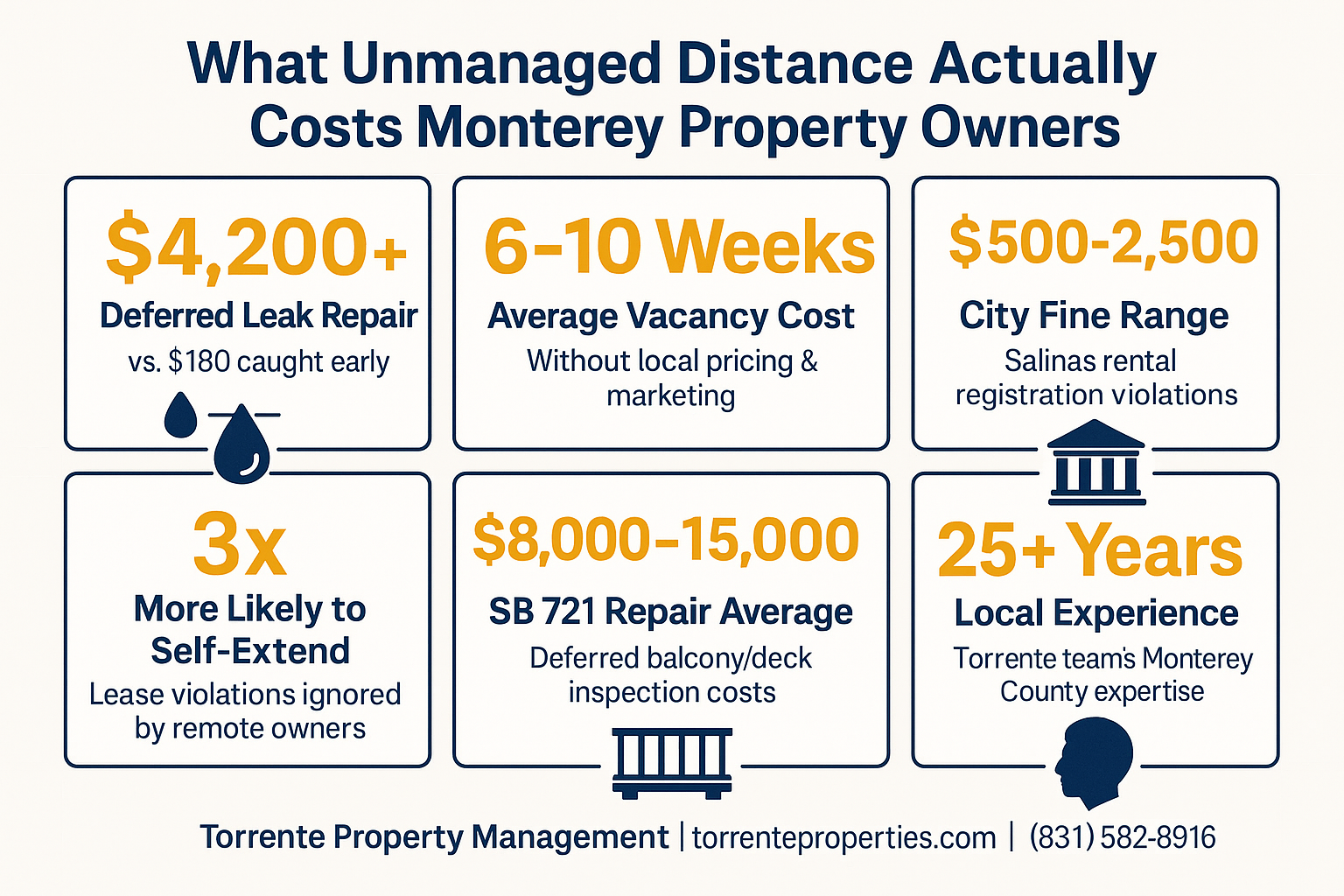
The most common story we hear from new clients goes something like this: a tenant reported a small leak under the bathroom sink six weeks ago. The owner said they’d handle it on their next visit. By the time anyone looked at it, the subfloor had rotted through and the repair cost $4,200 instead of the $180 it would have been at first call.
Distance doesn’t cause deferred maintenance — it just removes the accountability that keeps it from happening. When you’re local, you notice the peeling paint, the dripping faucet, the gate that won’t latch. When you’re in another state, you only find out when the tenant gets frustrated enough to tell you, or when something fails completely.
The same pattern plays out with tenant behavior. A tenant who knows the owner is a four-hour flight away will often feel less observed. That’s not a character judgment — it’s just human nature. Without regular inspections, small lease violations (unauthorized pets, unapproved occupants, neglected landscaping) become established patterns that are much harder to address legally once they’ve gone on for months.
In Salinas especially, where multi-unit properties are common and tenant turnover can be higher, renting out your house without a local presence changes the entire dynamic of what you can reasonably expect to catch and correct.
The practical risks of unmanaged distance include:
- Unreported maintenance that compounds into structural damage
- Lease violations that go undetected for months
- Missed inspections that put you out of compliance with local programs
- Vendor overcharging when there’s no local eye on the work
- Late rent that drags on because no one is following up consistently

What California Law Requires — Whether You’re Here or Not
California doesn’t care where you live. Your obligations as a landlord apply regardless of your zip code, and Monterey County has several compliance layers that catch out-of-area owners off guard.
Security deposits are capped at one month’s rent as of July 1, 2024, under a law that changed long-standing rules many landlords still think are current. If you collected two months’ deposit from a tenant before that date and haven’t adjusted your practices for new leases, you may be exposed.
Salinas landlords also have to contend with the city’s Residential Rental Registration program, which requires landlords to register their rental units and pay annual fees. Failure to register can result in fines and complicate any future eviction proceedings. It’s the kind of administrative detail that’s easy to stay current on when you’re local — and easy to miss when you’re not.
For properties with balconies or exterior elevated elements in multifamily buildings, SB 721 sets inspection deadlines that many owners still haven’t addressed. If your Monterey or Salinas apartment building has any exterior stairway, deck, or balcony, there are licensed inspector requirements and repair timelines that carry real legal weight.
Understanding what a property manager actually handles day-to-day goes well beyond rent collection — it includes staying current on exactly these kinds of regulatory requirements so you don’t find out about a violation through a fine notice.
The Real Cost of Unmanaged Distance
This breakdown shows how quickly deferred problems and missed compliance steps add up for out-of-area owners in Monterey County.
Vacant and Seasonal Homes Face a Different Set of Risks
Not every out-of-area owner has a tenant. Many people own seasonal homes on the Monterey Peninsula — places they visit in summer or over the holidays — and those properties sit vacant for months at a time. Vacancy carries its own specific risks that are easy to underestimate.
A home that looks occupied is a harder target for vandalism and break-ins. A home that’s clearly vacant — mail piling up, overgrown landscaping, lights never on — signals opportunity. In coastal areas like Pebble Beach and Carmel, where second homes are common, this isn’t a theoretical concern.
Beyond security, vacant homes develop problems that tenanted homes rarely do. Water heaters that sit idle can corrode. HVAC systems that don’t cycle regularly can fail. Roof issues go unnoticed for entire seasons. Pest intrusions start in the crawl space and are well established before anyone finds them.
For owners in this situation, a scheduled property inspection program — sometimes called home watch or caretaker services — provides the regular eyes-on presence that prevents these silent problems. This typically means bi-weekly or monthly visits to check the property inside and out, coordinate any needed maintenance, and confirm that utilities and systems are functioning. It’s a fundamentally different service than tenant management, but equally important for the right property type.
Rented vs. Vacant: What Can Go Wrong and When
The risks look different depending on whether your Monterey County property is occupied or sitting empty. Here’s a practical comparison of the most common issues by property type.
| Risk Category | Rented Property | Vacant/Seasonal Property |
|---|---|---|
| Maintenance Detection | Tenant may report — or may not for weeks | No one to notice until next visit |
| Lease Compliance | Violations can go unobserved without inspections | N/A — no tenant |
| Security | Occupied appearance deters break-ins | Visible vacancy increases risk |
| Regulatory Compliance | Registration, deposit rules, habitability laws | Utility oversight, municipal codes |
| Cost of Delayed Action | Lease violation harder to remedy after months | Structural damage accumulates silently |
| Ideal Solution | Full-service property management | Caretaker / home watch program |
What a Realistic Management Plan Actually Looks Like
A lot of out-of-area owners assume they can handle things with a combination of a handyman they trust and a neighbor who keeps an eye out. That setup works until it doesn’t — and it usually stops working at the worst possible time.
A real management plan for a distant property owner covers three layers that a handyman-and-neighbor arrangement almost never does:
1. Proactive tenant screening and lease management. The single biggest driver of long-term rental income is tenant quality. A thorough screening process — credit, background, rental history, income verification — done before move-in prevents the majority of problems that happen during tenancy. What makes some rental properties consistently attract reliable tenants starts with who you put in the property, not what you do afterward.
2. Scheduled property inspections. Move-in and move-out inspections are standard. But regular mid-tenancy inspections — typically every 3 to 6 months — are what actually catch lease violations and maintenance issues before they become legal or financial problems. Most self-managing out-of-area owners skip these entirely because they’re not physically present to do them.
3. Vendor relationships and financial oversight. A local property manager with established vendor relationships gets faster service and better pricing than a remote owner calling around from out of state. In Monterey County, where skilled tradespeople are in high demand, that access matters. Monthly owner statements and year-end financial summaries also give you a clear picture of your property’s performance without having to piece it together from bank records.
For owners who are evaluating whether professional management makes financial sense, do property managers really increase profit breaks down the numbers in plain terms worth reading before you decide.
Frequently Asked Questions About Managing Monterey Property From a Distance
How often should someone inspect a rental property in Monterey County?
At minimum, a move-in inspection, a mid-tenancy inspection every 3 to 6 months, and a move-out inspection. In Salinas, where the city’s rental registration program may also trigger compliance checks, more frequent inspections are worth it. For vacant or seasonal homes, bi-weekly or monthly walkthroughs are standard practice to catch issues early.
Do I need to be registered as a landlord in Salinas even if I only own one unit?
Yes. Salinas’ Residential Rental Registration program applies to residential rental units in the city regardless of how many you own. There’s an annual registration fee and failure to comply can complicate future eviction proceedings. If you’re unsure whether your property is registered, that’s worth checking immediately.
My tenant handles small repairs themselves and deducts from rent. Is that legal in California?
California law does allow a limited form of ‘repair and deduct’ — but only under specific conditions, and the deduction is capped at one month’s rent. This is a situation where having a proper lease, a clear maintenance reporting process, and a local point of contact prevents most of the ambiguity. Verbal arrangements with tenants around maintenance deductions create legal exposure for the owner.
What’s the difference between a property manager and a home watch or caretaker service?
A property manager handles everything related to a tenant — leasing, rent collection, maintenance coordination, compliance, and lease enforcement. A home watch or caretaker service is for vacant or seasonal properties with no tenant. It focuses on regular inspections, utility oversight, security monitoring coordination, and flagging maintenance issues before they get serious. Some firms offer both — which is useful if your property situation changes seasonally.
Can I manage my Monterey rental from out of state without hiring anyone?
Technically, yes. Practically, most owners who try it find that response times suffer, vendor relationships are hard to build remotely, and California’s regulatory requirements are difficult to stay current on from a distance. The risk isn’t that it’s impossible — it’s that the gaps compound quietly until something forces your attention.
Ready to Stop Worrying About What You Can’t See?
If you own a rental or second home in Monterey, Salinas, Pacific Grove, Seaside, or anywhere along the Central Coast, Torrente Property Management offers the kind of local, hands-on oversight that out-of-area owners genuinely rely on. Our team is based here, knows these neighborhoods, and treats every property we manage with the same attention we’d give our own. Reach us at (831) 582-8916 or through the contact form at torrenteproperties.com — we’re happy to talk through your specific situation.