
Direct Answer: Rental prices in Monterey Bay are set by real-time local comps, unit condition, and location within a submarket — not by mortgage payments, neighbor estimates, or online averages.
The most common question I hear from owners across Monterey, Salinas, Seaside, and Marina is some version of the same thing: “How much can I rent my property for?” Some come in with a number already in mind — usually their mortgage payment, or something a neighbor mentioned at the mailbox. Others ask for both a furnished and unfurnished estimate for the same property before we’ve even had a conversation about the unit’s condition.
I understand why that question feels like it should have a simple answer. It doesn’t. Rental pricing in Monterey County is a real-time, property-specific analysis — not a formula you can pull from a spreadsheet. The inputs shift faster than most owners realize, and getting the number wrong, even by a few hundred dollars, can cost you more than you’d expect.
This article walks through how rental prices actually get set in our market, what variables move the needle most, and why owners who guess — even educated guesses — tend to leave money on the table or pay for it in vacancy.
Averages Tell You Almost Nothing About Your Specific Unit
Consumer-facing rent indices currently show something in the range of $2,750 average rent in Monterey and around $2,595 in Salinas. Those numbers aren’t meaningless, but they’re also not what your unit will rent for.
Averages blend together a renovated 3-bedroom near Salinas Valley Memorial Hospital, a dated studio in South Salinas, and a furnished condo near the Monterey Wharf. Those properties don’t belong in the same number. What actually drives your price is a set of factors that compound each other:
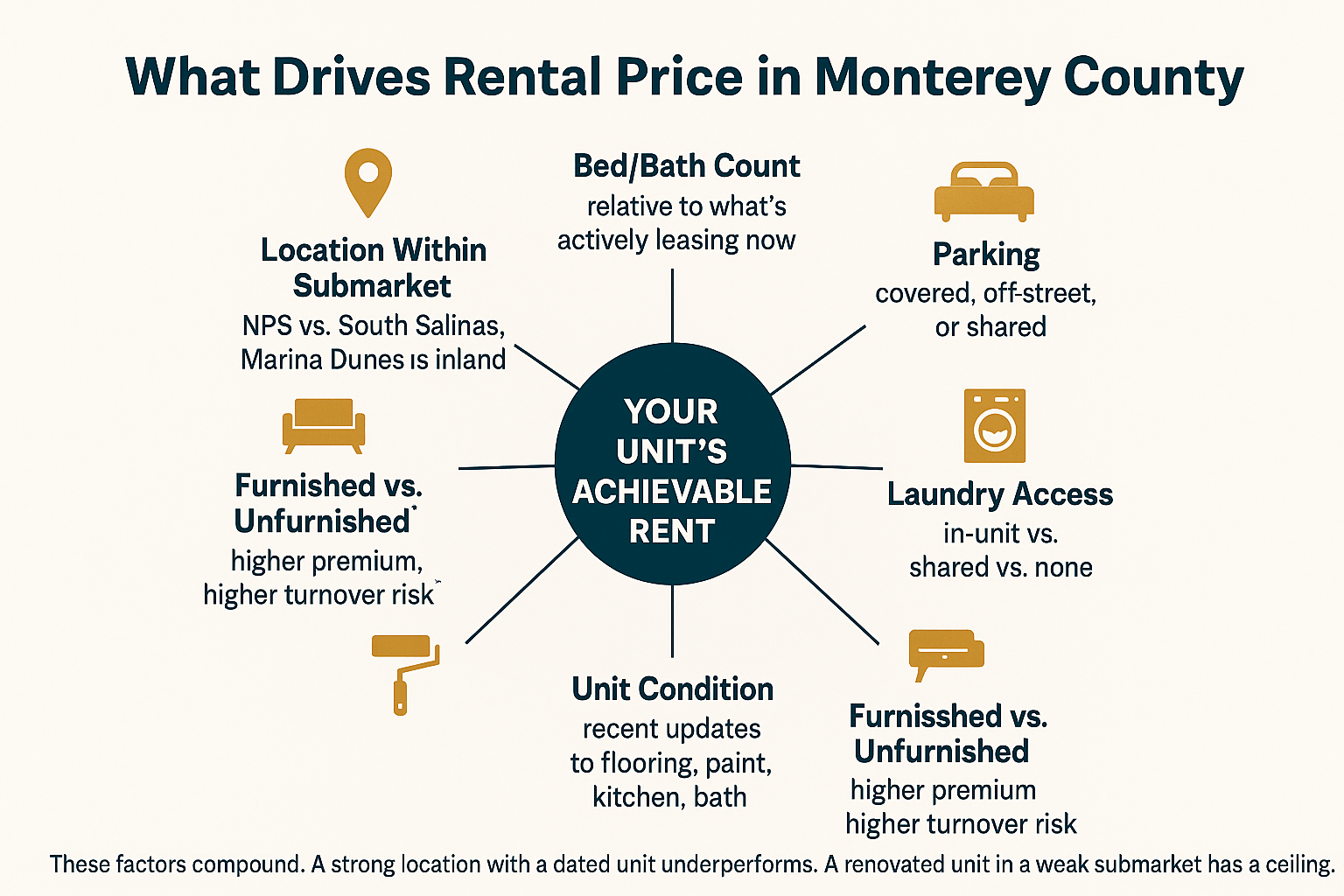
- Location within the submarket — a property near Naval Postgraduate School attracts a different tenant pool and commands different pricing than one several miles south in the same city
- Bedroom and bathroom count relative to what’s actually available and leasing right now
- Square footage compared to active comps, not just listed properties sitting on the market
- Parking — covered, off-street, or shared makes a real difference in competitive submarkets
- Laundry access — in-unit washer/dryer versus shared laundry versus none affects both price and tenant quality
- How recently the unit was updated — flooring, paint, kitchen fixtures, and bathroom condition show up in photos and in applications
I’ve seen a renovated 3/2 near Salinas Valley Memorial price significantly higher than a comparable unit a mile away that hadn’t been touched in a decade. The gap isn’t cosmetic — it shows up in who applies, how fast it rents, and what price it actually holds.
For owners thinking through what they can realistically expect before they’re ready to list, understanding what landlords in Salinas wish they’d known earlier is a good place to start.

The Furnished vs. Unfurnished Question Is More Complicated Than It Looks
Several owners who’ve reached out to us asked specifically about furnished rentals — some in Marina, some in Monterey, a few in Prunedale. The question usually comes framed as “can I charge more if I furnish it?” The honest answer is: sometimes yes, but the tradeoffs are real.
Furnished units can command a meaningful premium over unfurnished, particularly when the property is well-located and the furnishings are in good condition. But furnished rentals also tend to attract shorter-term tenants — people in temporary housing, contractors on project assignments, relocation employees. That means higher turnover, and turnover has costs: re-leasing time, cleaning, furniture inspection, and the real possibility that your couch doesn’t survive the next tenant the way it survived the last one.
There’s also the ongoing management layer that owners underestimate. Furnished inventory requires tracking — what’s there, what’s damaged, what needs replacing at move-out. That’s a separate process on top of a standard move-out inspection, and it takes time.
For a property you’re leaving behind while relocating — like several owners I’ve spoken with who were preparing to move out of the area — furnished can make sense if the goal is a shorter lease term and you want the option to return. But for owners looking at this as a long-term income property, unfurnished with well-qualified long-term tenants usually produces steadier returns with fewer headaches.
There’s no universal answer. It depends on the property, the location, your financial goals, and how long you plan to hold the asset. What I’d caution against is assuming furnished automatically means higher yield once you factor in turnover and inventory costs.
What Actually Drives Your Rental Price in Monterey County
These are the variables that move the needle on achievable rent — and how they interact with each other.
Why Overpricing a Vacancy Is a Math Problem, Not Just a Strategy Problem
I want to be direct about something I see regularly: owners who price too high because they’re anchored to a number they want, not the number the market will bear. They list at that number, sit for three or four weeks without serious applications, then reduce. And now they have a listing with days-on-market history that prospective tenants can see.
In a market where Monterey County rents have shown real movement — including reported softening in late 2025 — overpricing a vacancy isn’t just a minor miscalculation. Every week without a tenant is rent you never recover. No future rent increase makes up for lost weeks.
Let me make this concrete. Suppose a property is worth $2,400/month based on actual comps, but an owner lists at $2,600 hoping to capture upside. If that $200/month premium causes the unit to sit vacant for three extra weeks, the owner has already lost roughly $1,800 in uncollected rent — more than the entire annual difference the premium would have generated ($200 × 12 = $2,400, minus the $1,800 vacancy loss = net gain of about $600 for the year, assuming the tenant stays a full year and never pushes back on the higher rate).
And that calculation doesn’t include the cost of utilities you’re covering during vacancy, the wear on the property sitting empty, or the lower quality of applicants who tend to apply to listings that have been sitting.
For owners who want to understand the full picture of what vacancy really costs, the hidden costs of managing a Monterey home from out of state covers some of these dynamics in more detail.
Overpricing Math: What a 3-Week Vacancy Actually Costs
This table shows how different pricing gaps translate to vacancy losses versus annual premium gains — assuming a 12-month tenancy.
| Monthly Overpricing | 3-Week Vacancy Loss | Annual Premium (12 months) | Net Annual Gain |
|---|---|---|---|
| $100/month | ~$900 | $1,200 | ~$300 |
| $200/month | ~$1,800 | $2,400 | ~$600 |
| $300/month | ~$2,700 | $3,600 | ~$900 |
| $400/month | ~$3,600 | $4,800 | ~$1,200 |
What You Do Before Listing Affects What You Can Charge
One of the most overlooked factors in setting rental price is the condition of the unit before it hits the market. I’ve talked with owners who had detailed renovation plans they wanted to execute before listing, and others who simply asked: “What can I do in the next few months to increase rental value without spending a lot?” That’s exactly the right question.
The improvements that actually move the needle on rent and leasing speed tend to be inexpensive and cosmetic:
- Fresh interior paint — neutral, clean, and consistent throughout the unit
- Clean or replaced flooring — tired carpet is one of the fastest ways to lose good applicants
- Functioning fixtures — leaky faucets, broken blinds, and burnt-out lighting read as neglect to prospective tenants
- Clean appliances and clean grout — photos matter more than most owners realize
What generally doesn’t move the rental price needle in proportion to cost: full kitchen remodels, bathroom gut renovations, or high-end landscaping. Those may add long-term property value, but they rarely translate to a rent increase that justifies the spend in the near term.
Presentation also affects who applies. A unit that photographs well and shows clean attracts more qualified applicants — and more applicants means more selection. What makes some rental properties consistently attract reliable tenants covers this in more depth.
For owners managing the Salinas market specifically, the Salinas Rental Registration Program is also worth reviewing before you list — compliance requirements affect your timeline and your legal standing as a landlord.
Frequently Asked Questions About Setting Rental Prices in Monterey Bay
Can I just use Zillow or Rentometer to figure out what to charge?
Those tools give you a general range, but they’re built on aggregated data that often lags the actual market by weeks or months. They also can’t account for what’s actively leasing right now at the submarket level — a street in the Marina Dunes rents differently than a street five blocks inland. They’re a starting point, not a pricing decision.
My neighbor rents a similar house for $2,800. Shouldn’t I be able to get the same?
Maybe — but “similar” is doing a lot of work in that sentence. Bedroom count, parking, laundry, unit condition, and the specific location within the neighborhood all affect price. And you don’t know what your neighbor’s tenant is actually paying versus what was asked. A real comp analysis looks at recently leased properties, not asking prices or neighbor estimates.
Does furnishing my property always result in higher rent?
Not always, and not always net-positive when you factor in turnover. Furnished units can command a premium, but they also tend to attract shorter-term tenants who move on sooner. More turnover means more vacancy, more cleaning, more inventory management, and more re-leasing costs. For some properties and owners, furnished makes sense. For others, a well-priced unfurnished unit with a stable long-term tenant is the better income outcome.
How long is too long for a rental to sit on the market before I should adjust the price?
In a healthy Monterey County market, a well-priced unit in good condition should generate serious inquiries within the first one to two weeks. If you’re past three weeks with no qualified applications, the price is almost certainly the issue — not the marketing. The longer you wait to adjust, the more days-on-market history accumulates, which signals to applicants that something is wrong with the property.
I want to rent my property for enough to cover my mortgage. Is that realistic?
It depends entirely on when you bought and what you paid. In some cases, yes — especially if the property has been held for a while and the mortgage is lower than current market rents. But the market doesn’t care what your mortgage payment is. If current comps don’t support your number, pricing above market to cover costs will likely just produce a longer vacancy, which costs more than the shortfall would have.
Want a Real Rental Estimate for Your Property?
If you own a property in Monterey, Salinas, Seaside, Marina, Pacific Grove, or anywhere else in Monterey County and you’re trying to figure out what it would actually rent for — not a ballpark, but a number grounded in current local comps — our team is available to walk through it with you. Torrente Properties can be reached at (831) 582-8916 or through the contact form at torrenteproperties.com.