
Direct Answer: Salinas landlords must register all rental units annually and pay current fees of $29 per unit plus $112 for the rent program. The ordinance remains fully enforceable in 2026, with a potential repeal vote set for November 2026.
If you own rental property in Salinas and you’re not 100% sure your units are currently registered with the city, you’re not alone. I talk to landlords every week — many of them managing from out of the area — who are completely unaware the Salinas Residential Rental Registration program even exists, let alone that fees were recently restructured or that the entire ordinance framework could change after November 2026.
This isn’t a technicality you can sort out later. The City of Salinas has been explicit that registration compliance is the foundation of its landlord-tenant oversight system, and enforcement has been updated alongside the new fee structure. Missing a renewal or letting your information go stale can create real legal exposure.
What follows is a straightforward breakdown of what the program currently requires, what changed with the 2026 fee reduction, and what the upcoming ballot measure actually means for your obligations — starting today.
What the Salinas Rental Registration Program Actually Requires
The Salinas Residential Rental Registration program requires landlords to register every rental unit in the city and keep that registration current on an annual basis. It applies to residential rental properties — single-family homes, duplexes, apartment buildings, and similar housing — within city limits.
At its core, the program requires three things:
- Register each unit with the city, including accurate owner and contact information
- Pay annual fees for each registered unit
- Keep your information current — if you sell, change your mailing address, or alter how the property is managed, the city expects that to be reflected in the registry
That third point is where I see the most problems from owners who are self-managing from a distance. People move, phone numbers change, a property gets transferred to a trust — and the registration just sits there with outdated information. The city’s enforcement strategy is built partly around accurate data, so stale records aren’t a minor clerical issue.
If you’re managing a Salinas property from San Jose, Los Angeles, or anywhere outside Monterey County, staying on top of annual renewal cycles without a local point of contact is genuinely difficult. I’ve seen landlords miss renewals simply because the notice went to an old address. As we’ve written about before, what changes when you’re not around affects a lot more than just maintenance calls.
The 2026 Fee Reduction — and What You’re Paying Now
As of January 2026, the City of Salinas reduced its rental registration fees by approximately 35% after a city audit found a surplus of nearly $1 million in the program fund. That’s a meaningful shift, and most landlords I’ve spoken with this year haven’t heard about it yet.
The current fee structure looks like this:
- Rental registry fee: $29 per unit
- Rent program fee: $112 per unit
For a landlord with a single-family home, that’s $141 total annually. For someone managing a 4-unit building — like several owners who’ve reached out to us recently — that’s $564 per year. The fees are real, but they’re not the financial burden they once were.
What concerns me more than the fees themselves is the enforcement posture the city paired with this reduction. When a city conducts an audit, restructures its fee schedule, and publicly describes an updated enforcement strategy all in the same breath, that signals increased scrutiny — not less. The fee went down; the attention to compliance did not.
For context on what a single compliance misstep can cost compared to annual registration fees, it’s worth reading our breakdown of the hidden costs of managing a Monterey home from out of state — the math applies equally to Salinas.
The November 2026 Ballot Measure — What It Means Right Now
In September 2025, the Salinas City Council voted 5-2 to place a measure on the November 2026 General Election ballot that would repeal the entire rental ordinance framework — including the registration program and related rent stabilization policies.
I want to be direct about what that means and what it doesn’t mean.
What it does not mean: the ordinances are not suspended, paused, or weakened today. Every requirement in the current registration program is fully in effect and enforceable right now. If the ballot measure fails in November, nothing changes. If it passes, the changes would take effect after the election is certified — which means we’re likely talking about early 2027 at the earliest before anything shifts.
What it does mean: Salinas landlords are operating under rules that may look substantially different by mid-2027. That matters for how you structure leases, how you plan rent increases, and how you think about long-term compliance obligations.
The smartest thing you can do between now and November 2026 is stay current. Register your units, pay your fees, keep your contact information accurate, and watch how the vote plays out. Letting compliance lapse on the assumption the ordinance might go away is a gamble I wouldn’t take — especially given the city’s stated enforcement posture.
Salinas Rental Compliance: Two Layers, One Property
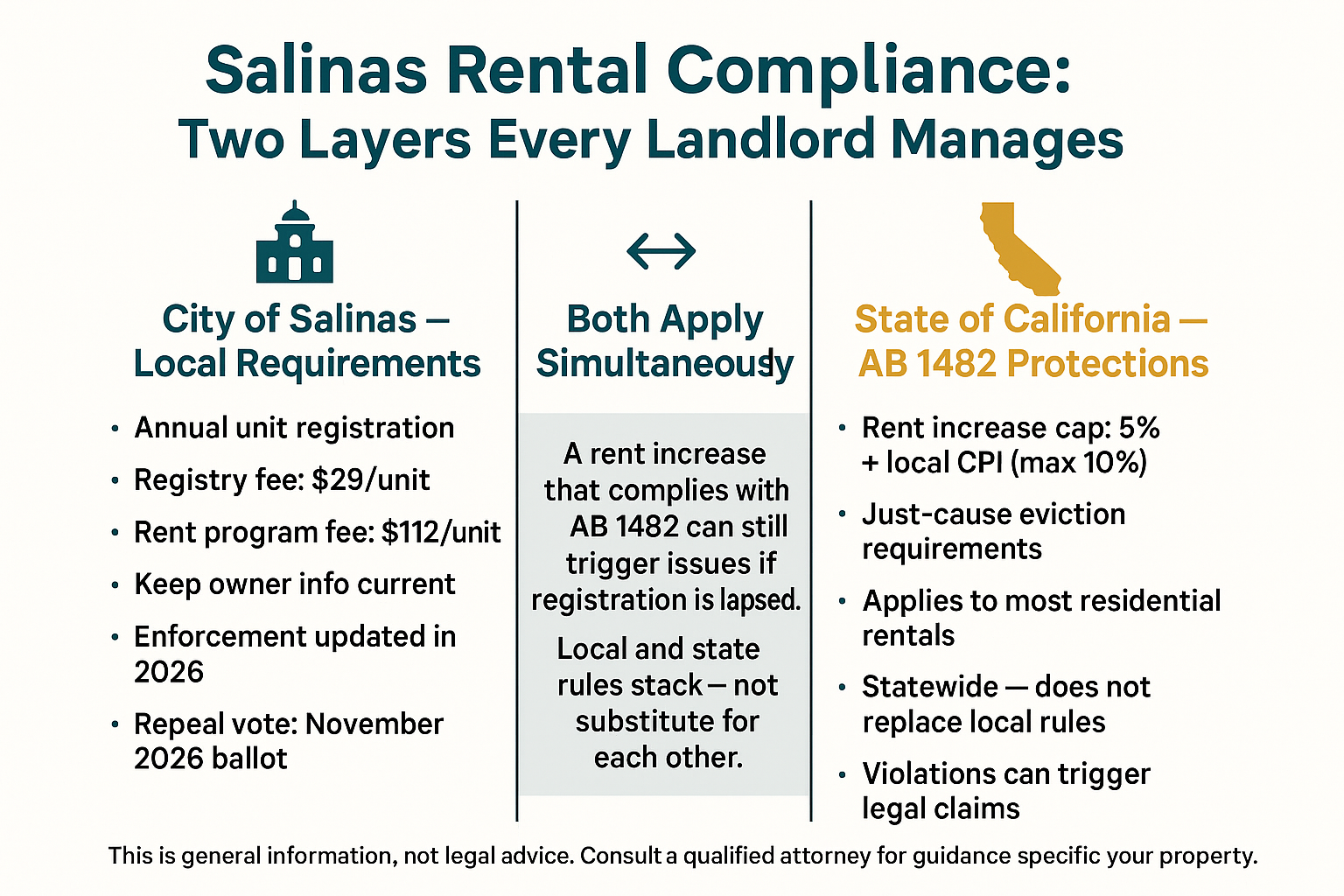
Salinas landlords are operating under both city-level registration requirements and California’s statewide tenant protection framework simultaneously. This diagram shows how those two layers interact.
The State Layer: AB 1482 Runs Alongside the City Program
The Salinas registration program doesn’t exist in isolation. California’s AB 1482 — the Tenant Protection Act — adds a second layer of compliance that every Salinas landlord is navigating at the same time.
Under AB 1482, most residential rentals in California are subject to:
- Annual rent increase caps of 5% plus local CPI, with a hard ceiling of 10%
- Just-cause eviction requirements, meaning you can’t remove a tenant without a qualifying reason after they’ve been in the unit 12 months
These are statewide rules. They don’t replace Salinas’s local program — they stack on top of it. A rent increase that technically falls within the AB 1482 cap can still create legal exposure if your unit isn’t properly registered, because an unregistered landlord has a weaker position in any dispute.
This is the part of the compliance picture that most landlords I talk to aren’t thinking about. They ask about fees and services. They’re not thinking about what happens if a tenant challenges a rent increase and the landlord’s registration is lapsed or incomplete. A single procedural error in this environment can easily generate legal costs that exceed a full year of property management fees — and that’s before any attorney gets involved.
For a deeper look at how California’s 2026 habitability and lease changes intersect with these obligations, our guide to AB 628 and what it means for California landlords is worth reading alongside this one.
Salinas Rental Registration: Current Fee Structure at a Glance
These are the fees in effect as of January 2026, following the city’s fee reduction. Annual totals will vary based on the number of units you own.
| Fee Type | Amount Per Unit | Annual Total (4 Units) |
|---|---|---|
| Rental Registry Fee | $29 | $116 |
| Rent Program Fee | $112 | $448 |
| Combined Annual Total | $141 per unit | $564 for 4 units |
| Prior Fee Structure (pre-2026) | Approximately 35% higher | — |
Who’s Most at Risk of Falling Out of Compliance
In my experience working with property owners across Salinas, Monterey, Seaside, and the broader Monterey Bay area, the landlords most likely to have compliance gaps are not negligent people. They’re busy people — often living in the Bay Area, Southern California, or out of state — who bought a rental property years ago, got it set up, and have been in a kind of maintenance mode ever since.
The profile I see most often:
- Out-of-area owners who aren’t monitoring Salinas city announcements or local policy changes
- Accidental landlords who inherited a property or couldn’t sell and started renting without going deep on local requirements
- Self-managing landlords who handle everything themselves and have no local contact watching for renewal notices or fee changes
The January 2026 fee reduction is a perfect example. It’s genuinely good news for landlords — but most of the Salinas property owners who’ve reached out to us recently had no idea it happened. If you’re not plugged into local news and city communications, information like that just doesn’t reach you.
If any of this sounds familiar, what Salinas landlords actually need from a property manager gets into the specific gaps that show up most often — and how having a local set of eyes on your property changes the picture.
Frequently Asked Questions About the Salinas Rental Registration Program
Do I have to register every unit separately, or just the property address?
You register each individual unit. If you own a 4-unit building, that’s four registrations and four sets of fees. The $29 registry fee and $112 rent program fee apply per unit, not per property.
What happens if my unit isn’t registered or my registration has lapsed?
The city has enforcement mechanisms in place, and the consequences go beyond a fine. An unregistered landlord is in a weaker legal position if a tenant raises a rent dispute, challenges an eviction, or files a complaint with the city. The exposure can easily exceed the cost of staying current on fees. I always frame it this way: the registration fee is the cheapest part of compliance.
If the November 2026 ballot measure passes, do I still need to register my units?
Until the vote is certified and any repeal takes effect — which would likely be early 2027 at the earliest — every current requirement stays fully in force. Letting registration lapse now based on a ballot measure that hasn’t passed is a real risk. Stay current through the vote and adjust when there’s something definitive to adjust to.
Does the Salinas registration program affect how much I can raise rent?
The registration program and California’s AB 1482 rent increase cap are separate rules that run at the same time. AB 1482 limits most residential rent increases to 5% plus local CPI, with a 10% maximum ceiling. The city’s registration program is about tracking and oversight — but the two layers interact. A landlord who isn’t registered has less standing if any aspect of their tenancy gets disputed.
I own a property in Salinas but I live out of state. How do I keep up with changes like this?
This is the most common situation I hear about. The honest answer is that staying current from a distance requires either a reliable local contact or a property manager who monitors city communications on your behalf. Annual renewal notices, fee changes, new ordinances — those don’t travel well across state lines when you’re self-managing. It’s one of the most practical reasons landlords in your situation end up working with a local management team.
Want a Local Set of Eyes on Your Salinas Property?
Our team at Torrente Properties works with landlords across Salinas, Monterey, Seaside, Pacific Grove, and the broader Monterey Bay area — including many owners who are managing from a distance and need someone on the ground who knows the local rules. If you have questions about your registration status, the upcoming ballot measure, or what it would look like to hand off management to a local team, we’re happy to talk through your specific situation. Reach us at (831) 582-8916 or through the contact form at torrenteproperties.com.