
Direct Answer: If your property manager collects rent but rarely visits, screens little, and reacts slowly to problems, you have rent collection — not real property management.
A lot of Carmel rental owners think their property is being managed because the rent shows up every month. But rent showing up is not the same thing as your property being protected, your tenant being properly screened, or your investment being actively watched.
Carmel is not a typical rental market. Properties here — whether on a quiet street off Junipero or tucked near the Carmel Mission — often rent for $3,500 to $6,500 per month. The stakes are high. A missed inspection or a slow maintenance response can quietly cost you thousands in deferred damage.
This article breaks down the difference between passive rent collection and actual management, so you can honestly assess whether what you have is working — or just appearing to work.
What Rent Collection Looks Like vs. What Management Actually Involves
Rent collection means someone has access to your tenant’s bank account or payment portal and moves money to yours each month. That’s a transaction, not a service.
Real property management is everything that happens before, during, and after that payment — the work that determines whether your property holds its value, your tenant stays long-term, and you’re not blindsided by a $12,000 repair that could have been caught at $800.
Here’s what a genuinely managed Carmel rental includes that passive collection does not:
- Scheduled walk-through inspections — not just when the tenant complains
- Proactive vendor coordination — licensed contractors who know Monterey County permit requirements
- Lease enforcement — following up on lease violations, not hoping the tenant self-corrects
- Move-in and move-out documentation — detailed condition reports that protect you legally
- Monthly financial statements — itemized, not just a deposit with no explanation
- Owner communication — actual updates, not silence until something breaks
If you’re not seeing most of those things, you’re paying management fees for a service that resembles a billing agent more than a property manager. As we explain in The Difference Between Listing Your House and Actually Managing It, getting a tenant placed is only the beginning of the job.

The Specific Risks of Passive Management in the Carmel Market
Carmel properties have some characteristics that make passive management especially risky. The coastal climate — fog, salt air, and heavy moisture — is harder on building materials than inland areas. Window seals fail faster. Wood siding and decking deteriorate in ways that aren’t visible from a curb check.
If no one is walking through the property every few months, small problems accumulate. A slow drain becomes a corroded pipe. A soft spot on the deck becomes a liability issue, particularly relevant now that California’s SB 721 exterior elevated element inspection requirements apply to multifamily properties — with inspection deadlines that owners need to be actively tracking.
Beyond physical condition, there’s the tenant relationship. Properties that are never visited tend to drift — tenants add pets that weren’t approved, make small modifications, or fall behind on lease terms that no one is enforcing. By the time you find out, you’re looking at a longer, more expensive correction.
And then there’s the financial picture. Many out-of-area Carmel landlords don’t realize how much they’re losing to management inertia — not dramatic losses, but a steady drain. The Hidden Costs of Managing a Monterey Home From Out of State outlines what that math actually looks like for owners who aren’t physically present to catch things early.
Rent Collection vs. Property Management: Side-by-Side
This breakdown shows what distinguishes real hands-on management from passive rent collection. If your current arrangement looks more like the left column, it’s worth asking why.
| Activity | Rent Collection Only | Full Property Management |
|---|---|---|
| Tenant screening | Basic credit check, maybe | Credit, background, income verification, rental history |
| Property inspections | Rarely or never | Scheduled — typically every 3-6 months |
| Maintenance response | Reactive when tenant calls | 24/7 coordination with vetted vendors |
| Lease enforcement | None or minimal | Active monitoring and documented follow-up |
| Financial reporting | Monthly deposit only | Itemized statement with receipts and owner access |
| Move-in/move-out | Key handoff | Full documented condition report with photos |
| Owner communication | When something goes wrong | Regular updates and proactive reporting |
| California compliance | Not tracked | Monitored — AB 1482, security deposit laws, local codes |
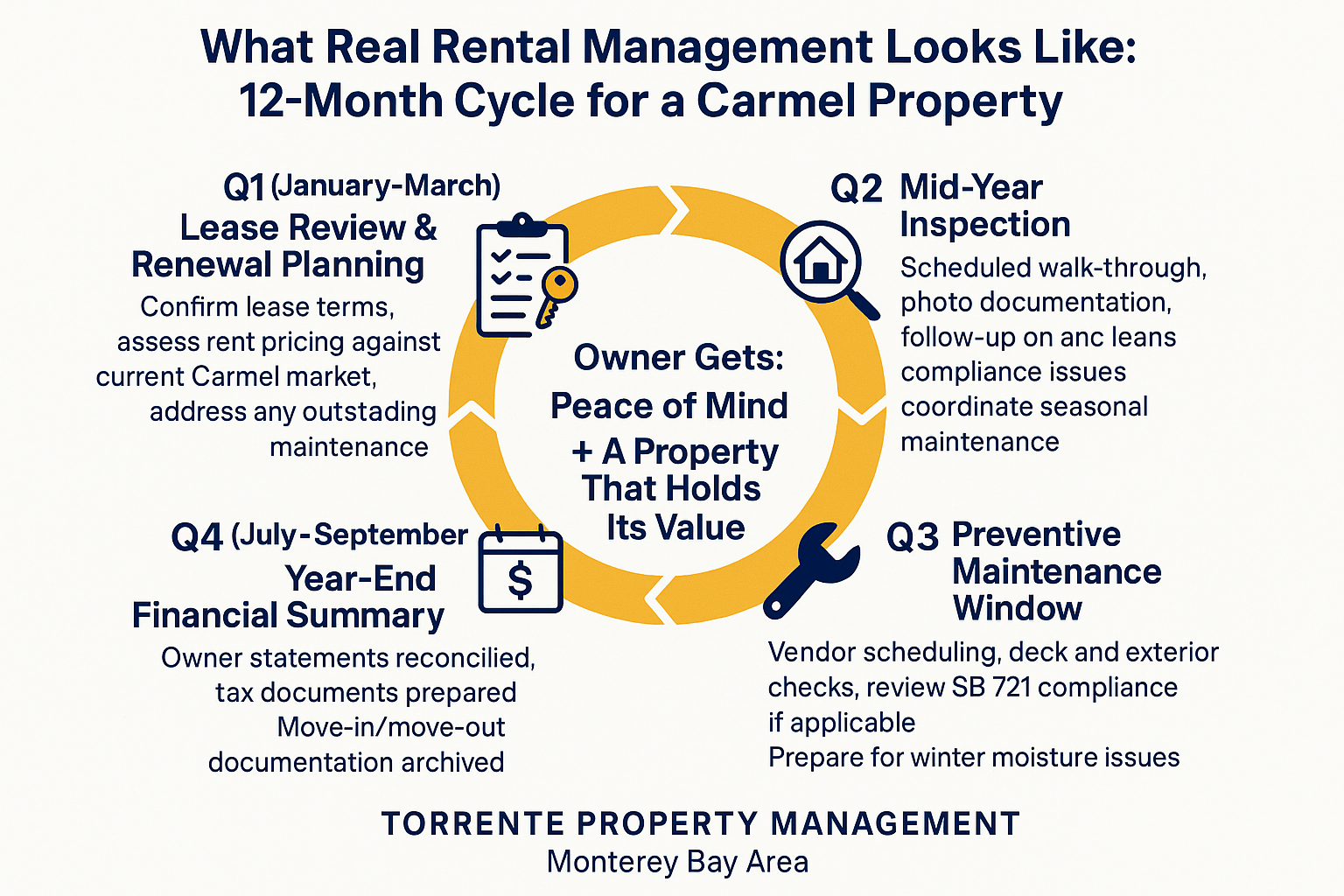
What a Well-Managed Carmel Rental Looks Like Over 12 Months
This infographic maps the full annual management cycle for a Carmel rental — showing what should happen each quarter if your property is actually being managed.
How to Tell If Your Current Management Is Actually Working
If you’re not sure where your arrangement falls, there are a few honest questions worth asking yourself.
When was the last time someone physically walked through your Carmel property? If the answer is more than six months ago — or you genuinely don’t know — that’s a gap. Inspections aren’t optional in a high-value coastal market; they’re how you catch the problems that don’t show up in a rent portal.
Do you receive itemized monthly statements? Not just a deposit confirmation, but a line-by-line breakdown showing what was collected, what was spent on maintenance, and what was disbursed to you. If your accounting is a mystery, that’s a flag.
Who placed your current tenant, and how were they screened? Full screening in the Carmel and Monterey area should include income verification (typically 3x monthly rent as a minimum threshold), a full credit report, prior landlord references, and a background check. If any of those were skipped, you have exposure you may not know about yet.
How quickly do maintenance issues get resolved? Slow maintenance doesn’t just frustrate tenants — it creates conditions that lead to turnover. And turnover in Carmel, where vacancy rates are low but re-leasing costs are real, can run $1,500 to $3,000 or more when you factor in cleaning, repairs, and re-marketing. What Makes Some Rental Properties Consistently Attract Reliable Tenants? covers how the day-to-day management quality directly affects who stays and who leaves.
A Note for Out-of-Area Carmel Owners
A significant portion of Carmel rental owners don’t live locally. Some are in the Bay Area. Others are in Southern California or out of state entirely. And many have second homes on the Peninsula that sit vacant for parts of the year.
For that group, the distance itself creates a specific vulnerability. You can’t do a drive-by. You’re entirely dependent on your management partner to tell you what’s happening — which means that if they’re not looking, you genuinely don’t know.
If your Carmel property is vacant for extended periods, management needs look different. That’s where property caretaker services — scheduled inspections, utility monitoring, security coordination, and maintenance oversight for vacant homes — fill the gap that a standard lease-focused manager won’t. We cover that side of ownership in detail for Carmel homeowners protecting properties without living in them.
The short version: distance is manageable, but only if someone local is paying attention on your behalf.
Frequently Asked Questions About Carmel Rental Management
What percentage does a property manager typically charge in the Carmel area?
In the Monterey Bay area, monthly management fees typically run 8% to 12% of collected rent, depending on the scope of services. On a Carmel rental at $4,500 per month, that’s roughly $360 to $540 per month. Some managers also charge a separate leasing fee — often equal to one month’s rent — when a new tenant is placed. Ask for a full fee schedule before you sign anything.
How often should a property manager inspect my Carmel rental?
A reasonable standard is once every 3 to 6 months for an occupied rental, with full photo documentation at move-in and move-out. The coastal climate in Carmel accelerates certain types of wear — moisture damage, wood deterioration, window seal failure — so more frequent checks are genuinely warranted here compared to drier inland markets.
My property manager collects rent on time. Isn’t that enough?
On-time rent collection means your tenant is paying — not that your property is in good condition, your lease is being followed, or your investment is protected. The value of real management shows up when something goes wrong: a lease violation, a maintenance emergency, a tenant who wants to leave early. If those situations aren’t being handled proactively, you’ll find out the hard way.
Does California’s new security deposit law affect Carmel landlords?
Yes. As of July 1, 2024, California limits security deposits to one month’s rent for most residential rentals — regardless of what a lease says or what was previously collected. If your lease still references a higher deposit amount, it may not be enforceable. A good local manager tracks these changes and keeps your lease documents current.
What’s the difference between property management and a home watch or caretaker service?
Property management is for occupied rentals — it covers tenant relations, rent collection, lease enforcement, and maintenance. A caretaker or home watch service is for vacant or seasonal properties — regular inspections, utility checks, security coordination, and catching problems before they become expensive. Some owners need one; some need both. If your Carmel property sits empty for months at a time, you likely need a caretaker service even if there’s no tenant in place.
Want a Straight Answer About How Your Carmel Property Is Really Being Handled?
Torrente Property Management has been working with Monterey County property owners for over 25 years — and we’re happy to give you an honest read on your current situation, no pressure attached. If you own a rental or vacant property in Carmel, Pacific Grove, Monterey, or anywhere across the Monterey Peninsula, reach out to our team directly at (831) 582-8916 or through the contact form at torrenteproperties.com.