
Direct Answer: When you rent out a Salinas home from a distance, California’s tenant protections, Salinas rental registration requirements, and day-to-day maintenance decisions all become your problem to manage without being there — which changes everything about how you need to operate.
A lot of Salinas homeowners become landlords the same way — a job relocation, a move closer to family, or just the decision that selling didn’t make sense right now. So the house stays, a tenant moves in, and suddenly you’re managing a property in Monterey County from Sacramento, or Phoenix, or somewhere overseas.
What most people don’t anticipate is how much the distance changes the math. The tasks that were easy when you were five minutes away — checking on a noise complaint, approving a repair, confirming the landscaping got done — become real logistical problems when you’re three time zones out.
This article focuses on two things that actually matter most when you’re renting out a Salinas home from a distance: California’s legal requirements that now apply to you as a landlord, and the practical reality of managing maintenance and tenant issues remotely. If you’re about to make this transition, both deserve more thought than most first-time landlords give them.
California Landlord Law Doesn’t Care Where You Live
Being out of the area doesn’t change your obligations under California law — it just makes them harder to stay on top of.
The most significant recent change for Salinas landlords: California’s security deposit cap dropped to one month’s rent for all residential rentals as of July 1, 2024 (AB 12). It doesn’t matter whether the property is furnished, unfurnished, or how many units you own. If you collected two months at any point and haven’t adjusted your practices, you’re already out of compliance.
Salinas adds another layer with its Residential Rental Registration program, which requires landlords to register rental properties with the city. If you’ve moved away and let that registration lapse, or never set one up properly, that’s a compliance gap that can create problems when you eventually try to resolve a tenant dispute or sell.
Beyond those two, California law generally requires:
- Written notice of entry at least 24 hours in advance for non-emergency situations
- Habitability standards that must be maintained regardless of how far away you are
- Repairs completed within a reasonable timeframe — courts have interpreted this as quickly as a few days for serious issues
- Proper security deposit accounting within 21 days of a tenant moving out, with itemized deductions
The problem with managing these from a distance isn’t that the rules are complicated — most are straightforward. The problem is that a delayed response to any of them, because you didn’t see the email or couldn’t coordinate a vendor in time, can turn a minor compliance issue into a legal one. You can read more about what Salinas landlords often overlook before getting started — a lot of it applies directly to single-family rentals too.
What Remote Maintenance Coordination Actually Looks Like
Maintenance is where most out-of-area Salinas landlords run into the most friction — and the most unexpected costs.
When you’re local, you can walk the property yourself, get a second opinion from a neighbor, or call three plumbers and pick the one who can come Tuesday. When you’re remote, you’re almost entirely dependent on who you have in your vendor network and how fast they respond.
Here’s what tends to go sideways without a system in place:
- A tenant reports a water heater issue on a Friday evening. You don’t see the message until Saturday morning. By Sunday, they’re without hot water — which is a habitability issue under California law.
- A slow roof leak gets reported but not treated as urgent. Six weeks later, the ceiling shows visible damage and the repair cost has doubled.
- A vendor does work you didn’t authorize at a price you didn’t agree to, because the tenant let them in and the job was done before you could respond.
None of these situations are unusual. They happen regularly to self-managing landlords who are out of the area, even ones who are genuinely trying to stay on top of things.
The cost difference between catching a plumbing issue early versus late can be $200 versus $2,000. In Salinas, where aging housing stock is common in neighborhoods like the East Market Street corridor and older sections of North Salinas, deferred maintenance tends to compound faster than owners expect.
Having a reliable local vendor network — plumbers, electricians, HVAC techs, and a general handyman — takes years to build. And coordinating them from out of state, while also holding down a job or managing family obligations, is a significant time commitment that most people underestimate before they try it. If you’re weighing what hands-on management actually involves, this breakdown of what a property manager really handles day-to-day is worth reading before you decide.
Self-Managing vs. Professional Management: The Remote Landlord Comparison
This is a practical look at how the two approaches differ specifically when you’re managing from out of the area — not a general comparison.
| Scenario | Self-Managing Remotely | With a Local Property Manager |
|---|---|---|
| Tenant reports a leak on Friday night | You see it Saturday; vendor search starts Monday | On-call coordination begins immediately |
| Salinas rental registration renewal | Your responsibility to track and file | Handled as part of ongoing compliance management |
| Security deposit return (21-day deadline) | You manage itemization, math, and mailing | Handled with documentation trail |
| Routine property inspection | Requires a trip or trust in a neighbor | Scheduled and documented with photos |
| AB 12 deposit compliance (July 2024 change) | Your responsibility to know and apply | Built into lease drafting from the start |
| Tenant communication response time | Depends on your schedule and time zone | Local team responds during business hours |
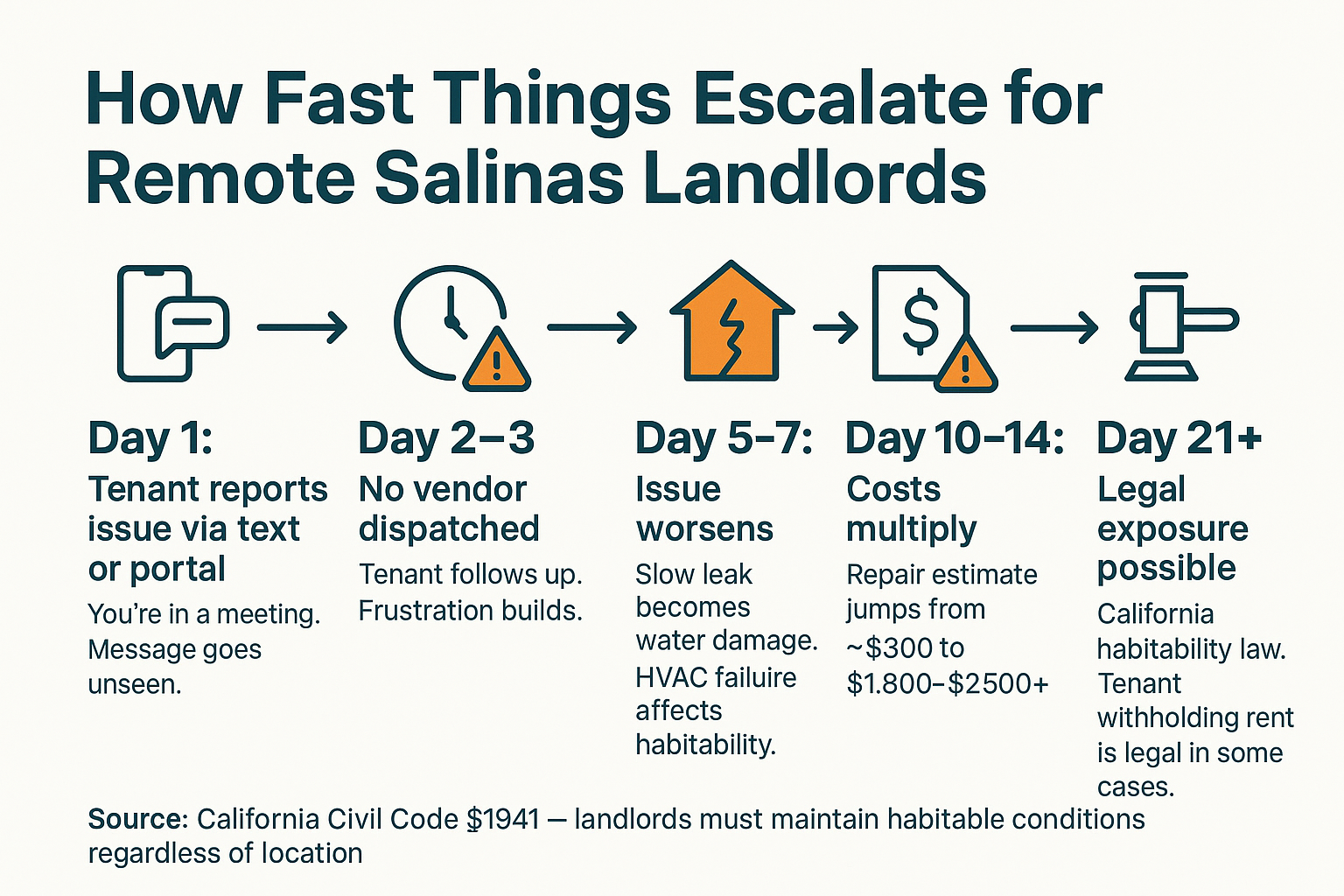
The Remote Landlord’s Risk Timeline
This shows how quickly a small, unaddressed issue can escalate when you’re managing a Salinas rental from out of the area.
The Tenant Screening Decision You Make Before You Leave
One of the decisions that has the most long-term impact on your experience as a remote landlord is one you make before you’re even gone: who you place in the property.
A well-screened tenant in a Salinas rental significantly reduces the number of problems you’ll deal with from a distance. A tenant who pays on time, reports issues promptly, and treats the property with basic care changes your workload from reactive to almost passive.
But tenant screening done poorly — or rushed because you wanted the vacancy filled before your move date — tends to follow you for the entire length of that lease.
Here’s what a thorough screening process should actually include:
- Full credit report review, not just a score — look at payment history and any prior evictions
- Income verification at a minimum of 2.5–3x the monthly rent (a common threshold in Monterey County)
- Rental history with actual calls to prior landlords, not just references the applicant provides
- Background check through a compliant tenant screening service
In Salinas, where the rental market sees consistent demand from agricultural workers, healthcare employees from Natividad Medical Center, and families relocating from more expensive parts of the Bay Area, there’s no shortage of applicants. The temptation to move quickly on a promising-looking application is real — but the cost of a bad placement when you’re managing from out of state is much higher than a few extra weeks of vacancy.
For a detailed look at what separates good tenant placement from fast vacancy fills, this piece on how property managers prioritize tenant quality covers the differences clearly.
Frequently Asked Questions About Renting Out a Salinas Home Remotely
Do I have to register my Salinas rental property if I live out of state?
Yes. Salinas’s Residential Rental Registration program applies to the property, not to where you live. If you’re renting out a home in Salinas, you’re expected to register it with the city. The registration requirement doesn’t go away because you’ve relocated.
How much can I charge for a security deposit in California now?
As of July 1, 2024, California limits security deposits to one month’s rent for residential properties — regardless of whether the unit is furnished or unfurnished, and regardless of how many units you own. The old two-month rule for furnished units no longer applies.
What happens if a tenant has a maintenance emergency and I can’t respond in time?
California Civil Code §1941 requires landlords to maintain habitable conditions. If a serious repair — no heat, no hot water, a significant leak — goes unaddressed for too long, tenants may have legal grounds to withhold rent or arrange repairs themselves and deduct the cost. The threshold is subjective, but courts tend to side with tenants on habitability issues when the landlord is unreachable or slow to act.
Is it legal for me to manage my own rental property from out of state?
Yes, it’s legal. There’s no California requirement that a landlord live locally or hire a property manager. But the legal obligations — response times, notice requirements, deposit accounting — apply equally whether you’re in Salinas or in another state.
If I hire a property manager, what does it actually cost in Salinas?
Management fees for residential properties in the Salinas and Monterey County area typically run 8–12% of monthly rent collected, depending on the company and the scope of services. Some companies charge separately for lease renewals, inspections, or maintenance coordination. On a home renting for $2,800/month, that’s roughly $224–$336/month — an amount most landlords recover quickly through fewer vacancy days, better tenant placement, and avoided repair escalations. For more context on whether the cost pencils out, this breakdown of whether property managers actually increase profit is worth reading.
Managing a Salinas Rental From a Distance? Let’s Talk.
Our team has worked with Monterey County property owners for over 25 years — including plenty of landlords who inherited a property, relocated for work, or simply reached the point where self-managing from out of state stopped making sense. If you’re renting out a Salinas home and want to talk through what professional management would actually look like for your specific situation, we’re easy to reach at (831) 582-8916 or through the contact form at torrenteproperties.com.