Direct Answer: Owners set budgets and approve capital spending. Managers run unit-level work like leasing, rent, and turns, plus building-level work like common areas, vendor contracts, and inspection records. Vendors do the licensed hands-on repairs.
Most owners of 6 to 16 unit buildings around Monterey, Seaside, and Marina call me with the same question, just worded differently. They want to know which jobs come off their plate and which ones stay theirs.
It is a fair question, and most landlord advice online answers it for a single house. A twelve-unit building is not twelve separate houses. There is a whole second column of work that a rental home simply does not have.
So that is what I want to lay out here: the split between unit-level work and building-level work, who handles each piece, and where self-managing owners tend to fall behind first. I am not going to cover pricing or on-site manager rules here. Those deserve their own space.
The split that shapes all Monterey apartment complex management
Every job at an apartment building falls into one of two buckets. Once you see the line, the division of labor makes sense fast.
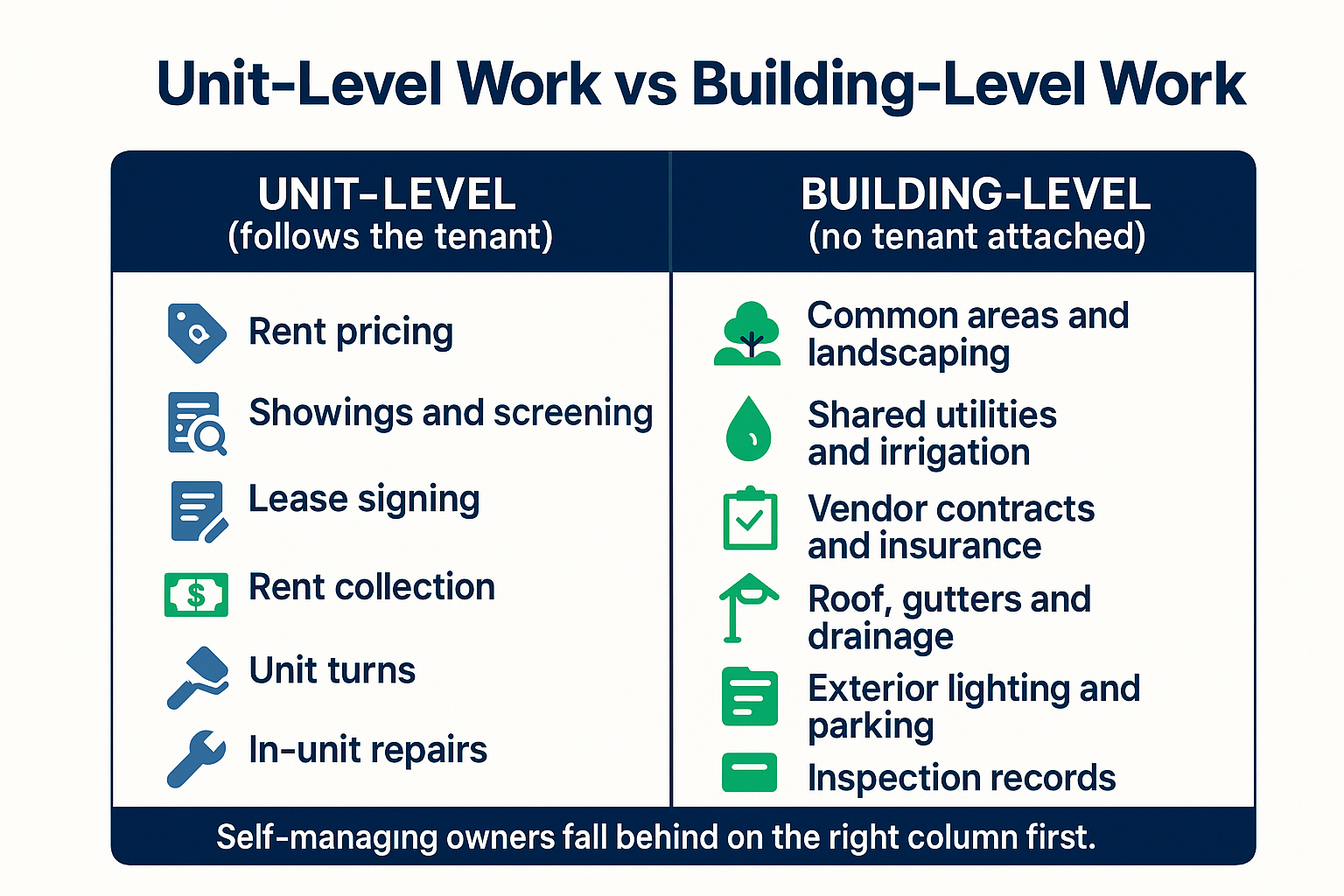
Unit-level work follows the tenant and the lease:
- Rent pricing and market analysis for that floor plan
- Listing, showings, and applicant screening
- Lease drafting and signing
- Rent and fee collection
- Move-in and move-out inspections
- The unit turn between residents
- Maintenance requests inside four walls
Building-level work has no tenant attached to it at all:
- Common areas, landscaping, and exterior lighting
- Parking lots, trash enclosures, and laundry rooms
- Shared utilities and irrigation
- Roof, gutters, siding, and drainage
- Standing vendor contracts and insurance certificates
- Inspection records and compliance paperwork
Here is what I see in the field. Owners who self-manage usually hold the unit-level column together, because a tenant calls and something happens. The building-level column has nobody calling, so it quietly slides.
That second column is also where the expensive surprises live. A missed rent payment costs you one month. A drainage problem that goes three winters unaddressed costs you framing.
Common areas: the clearest example of building-level work
Common areas are the cleanest illustration, because there is no tenant to hand them to. The landscaping, the irrigation, the exterior lights, the trash enclosure gate, all of it needs a standing vendor and somebody checking the work.
I think about a message our office received from a long-time tenant at a local rental. The owner had let the landscaper go about a year earlier and said a replacement was coming. It never happened.
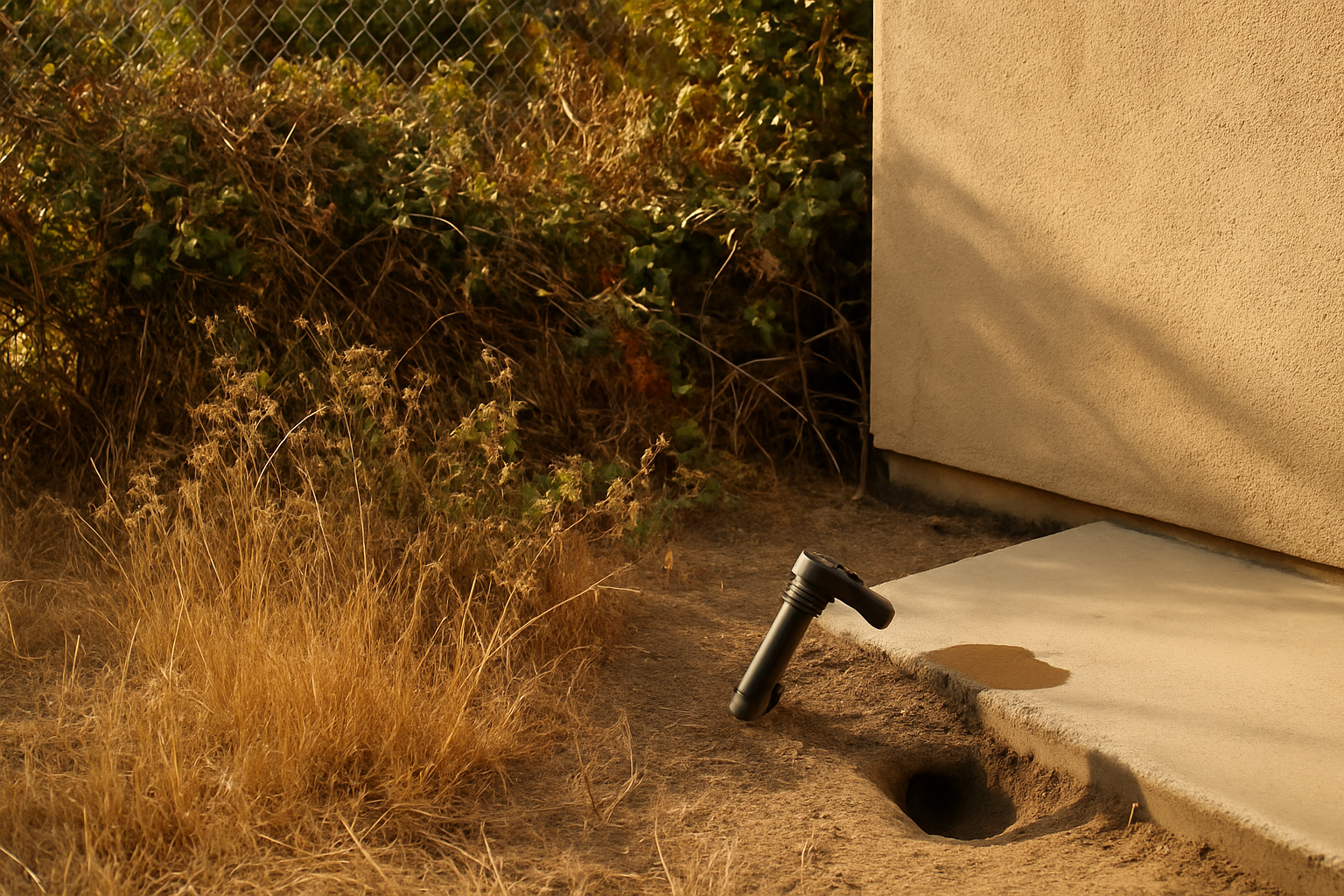
By the time the tenant wrote in, the yard was overgrown to the point of being a fire concern, poison oak had taken hold, ground squirrels had tunneled under the patio, and the irrigation system was broken while the water bill kept showing up every month.
Nothing about that story is unusual. It is what happens when a job belongs to nobody.
The lesson I take from it is that vendor coverage is a contract and a schedule, not a phone number in someone’s contacts. On a building we manage, that means a defined scope, a set visit frequency, a current license and insurance certificate on file, and an inspection after the work rather than an assumption it got done.
In a fire-prone county like ours, defensible space around a building is also a real exposure, not a cosmetic issue. Deferred landscaping at a Monterey or Prunedale property can turn into a code problem and an insurance conversation at the same time.
Owner, manager, vendor: a task-by-task breakdown
This is roughly how the three roles sort out on a small to midsize building in Monterey County. The pattern is consistent: the owner decides, the manager runs the process, the vendor performs the licensed work.
| Job | Owner | Manager | Vendor |
|---|---|---|---|
| Setting asking rent | Approves the number | Runs comparable rent analysis, adjusts for days on market | Not involved |
| Tenant screening | Sets written criteria with manager | Runs credit, background, eviction, income and rental history checks | Screening service provides reports |
| Unit turn after move-out | Approves scope above agreed limit | Documents condition, schedules trades, inspects finished work | Paint, flooring, cleaning, repairs |
| Landscaping and common areas | Approves the contract | Holds the schedule, verifies the work, keeps insurance current | Performs routine service |
| Roof leak during a storm | Approves the repair | Takes the after-hours call, dispatches, protects the unit, documents | Licensed roofer makes the repair |
| Capital projects | Makes the final call and funds it | Gathers bids, sequences work around occupied units | Performs the improvement |
| Compliance records | Stays informed | Keeps detector, inspection and notice records on file | Certified inspector where required |
Unit-level work versus building-level work
This is the split I sketch out on a whiteboard for nearly every new multifamily owner I meet.
Why the building-level calendar should start in October
Forecasters have been carrying a strong El Nino signal for the 2026-27 winter, which points toward a wetter than normal season on the Central Coast and a more active storm track. That changes the order of operations on a building.
These are the items I want handled in October, not February after water reaches a tenant’s unit:
- Roof condition and gutter cleaning, including downspout runoff
- Grading and drainage away from ground-floor slabs
- Dry rot on exterior stairs, walkways, and railings
- Water heater age and location relative to living space
- Smoke and carbon monoxide detector checks
There is a practical scheduling reason too. Roofers and drainage crews on the Peninsula fill up fast once the first real storm hits, and you end up bidding against every other owner in the same position.
Doing this work around occupied units takes planning. We stage one stack or one side of the building at a time, keep at least one parking row and one stairway usable, and give advance written entry notice per California Civil Code 1954, which generally means 24 hours in writing for non-emergency access.
If your building has elevated walkways, balconies, or exterior stairs, the inspection rules deserve separate attention. I wrote about what multifamily owners do now that the SB 721 deadline has passed because that record is building-level work nobody can delegate to a tenant.
Flat rents mean the money moves to operations
Let me speak investor to investor for a minute. Market trackers have put average Monterey apartment rents in the high 2,000s, with year over year movement well under one percent, and at least one tracker showing a slight decline. Treat those as general market context and price your own units off real comparable properties.
The takeaway is simple. You are not going to improve returns this year by raising the ask.
So the margin now sits in four places:
- Days off market, which is why turn speed matters more than it used to
- Tenant quality, because screening standards decide your next three years of collections
- Expenses caught early, before a slow drip becomes drywall and flooring
- Avoided compliance mistakes, including California’s one-month security deposit cap that took effect July 1, 2024
Building-level decisions need building-level numbers. That means monthly owner statements broken out by unit, a running maintenance history per unit, and year-end summaries that show which units are quietly eating the margin.
Most owners who self-manage have the rent roll in their head and the expenses in a shoebox. That works until you need to decide whether to re-pipe or keep patching, and then it is guesswork.
If you want the arithmetic on vacancy specifically, I broke it down in the real price of a slow unit turn.
Communication is an operations job, not a courtesy
At a building, how you communicate shows up in your numbers. Monterey County has a large Spanish-speaking resident base, especially in Salinas and parts of Seaside and Marina, and roughly three in ten county residents were born outside the United States.
We send entry notices, maintenance instructions, renewal paperwork, and rule reminders in both English and Spanish. That is not a nicety, it is how you get a notice followed the first time.
What that looks like in practice:
- Fewer missed or misunderstood entry appointments, which means fewer repeat trips by a vendor
- Small leaks reported early, while the fix is a supply line instead of subfloor and baseboard
- Cleaner documentation if a deposit or repair dispute comes up later
One owner who has been with us for years put the whole point plainly in a review: “They currently manage several of our properties and everything runs smoothly.” That kind of quiet is the product.
Frequently Asked Questions About Apartment Building Roles in Monterey County
What decisions still belong to me as the owner?
The money decisions and the standards. You approve the budget, set the spending limit where we stop and call you, sign off on capital projects, and approve the written screening criteria. Day-to-day dispatch, scheduling, documentation, and vendor oversight move to us.
Do you hire the vendors or do I?
We coordinate licensed and insured local vendors and hold the schedule, insurance certificates, and inspection follow-up. If you have a plumber or landscaper you already trust and they carry current license and insurance, we are usually glad to keep using them.
How is managing a twelve-unit building different from managing my rental house?
The unit-level work is similar, just multiplied. The real difference is the building-level column: common areas, shared utilities, exterior systems, standing vendor contracts, and inspection records. There is no tenant responsible for any of it, and that is where most self-managing owners get behind.
Does my building need a manager living on site?
It depends on the unit count. California has a threshold that triggers an on-site resident manager requirement for larger buildings, and it is a separate question from who handles leasing and maintenance. It is worth checking against your specific unit count before you plan staffing.
What should get done before winter storms?
Roof and gutter condition, downspout runoff, grading away from ground-floor slabs, dry rot on exterior stairs and walkways, and water heater age. Book it in October if you can, since crews on the Peninsula get booked solid after the first storm.
Sorting out the roles at your own building
Our team is Monterey-based and owner-led. Aurelia holds the Accredited Residential Manager designation through the Institute of Real Estate Management along with more than 25 years in Monterey County, we work in English and Spanish, and we manage both single-family homes and small to midsize apartment buildings from Santa Cruz down to King City. Our Google rating sits at five stars, and multifamily owners tend to describe the same outcome: things run without them having to chase anyone.
If you have questions about how the work divides up at a specific building, you are welcome to reach us at (831) 582-8916 or through the contact form at torrenteproperties.com.