
Direct Answer: At about $2,350 a month, a vacant Salinas apartment loses roughly $75 to $80 a day. A turn that drags three extra weeks quietly erases a large piece of that unit’s annual cash flow.
If you own a small apartment building in Salinas, you already know the lever you used to pull is stuck. Rents are flat. Asking for more on the listing is not going to fix a soft year the way it did three years ago.
So the money has to come from somewhere else. In my experience it comes from two places: vacancy days you never had to give up, and turns that get done right the first time.
This article walks the per-day math on a vacant unit, shows where the days actually disappear during a turn, and explains why the Monterey County leasing calendar is not the national one.
Why a Flat Rent Year Changes the Math on Turnover
Market trackers currently put average apartment rent in Salinas somewhere in the mid $2,300s, with year over year growth under 1 percent. Monterey reads higher, in the high $2,700s, with similar flatness, and at least one national tracker reads Monterey lower and slightly down.
Treat those as general market context, not a promise about your building. Rent on a 1970s fourplex off North Main behaves nothing like a renovated unit near Alisal.
But the direction is the point. When the market is barely moving, you cannot price your way out of a slow turn.
That leaves three levers you actually control:
- Days vacant between one lease ending and the next one starting
- Turn quality, which drives how fast the unit leases and who applies
- Retention, which skips the turn entirely
I have watched owners spend weeks arguing over a $50 bump on the ask while a unit sat empty for six weeks. The empty unit cost them ten times more than the bump would have earned. If you are still deciding whether outside help pays for itself at your size, this breakdown of when a Salinas apartment needs a manager is a fair place to start.
The Per-Day Cost of a Vacant Unit, Run on Your Own Building
Here is the math I run with owners, and you can run it on a napkin.
At roughly $2,350 a month, a vacant unit costs somewhere near $75 to $80 a day in lost rent. That is before utilities you are now paying, before the extra trips, before the marketing spend.
Now apply it:
- 7 extra days of vacancy: roughly $525 to $560 gone
- 21 extra days: roughly $1,575 to $1,680 gone
- 45 extra days: you have given back more than a month and a half of that unit’s year
On a six unit building where two units turn in a year, three extra weeks on each turn is real money off your net operating income. And it never shows up as a line item on a statement. It just shows up as a smaller number at the bottom.
The reason it stays invisible is that no single delay looks unreasonable. Two days waiting on a painter. Three days waiting on a flooring quote. Four days before the listing photos get taken.
Nobody made a bad decision. The calendar just ate the profit.
Where the Days Actually Hide in a Turn
Most owners picture a turn as paint and carpet. The paint is rarely the problem. The handoffs are the problem.
A normal turn runs through this sequence:
- Notice to vacate received
- Move-out inspection and photo documentation
- Punch list built and priced
- Paint and flooring scheduled
- Repairs completed and checked
- Listing photos taken and marketing posted
- Showings held
- Applications screened
- Lease signed and move-in date set
Run those one after another and you have nine chances to lose two or three days apiece. That is your month.
Run them overlapped and the whole thing compresses. I start marketing off the move-out inspection photos and a known ready date instead of waiting for a finished unit. Screening happens while the flooring crew is still working. Vendors get booked the day notice comes in, not the day the tenant hands back keys.
The unit does not lease faster because anyone worked harder. It leases faster because three things were happening at once instead of in a line.
Sequential Turn vs. Overlapped Turn
Same building, same vendors, same unit. The only difference is when each step gets started.
| Step | Run in Sequence | Run Overlapped |
|---|---|---|
| Vendor booking | After keys are returned | The day notice to vacate arrives |
| Punch list | After move-out walk | Drafted from the last routine inspection |
| Listing photos | After all work is finished | Scheduled for the day work wraps |
| Marketing launch | After photos are edited | Live with a known ready date |
| Showings | After unit is fully ready | Grouped once work is nearly done |
| Screening | After showings finish | Starts as applications arrive |
| Typical result | 30 to 45 vacant days | 10 to 20 vacant days |
Where Turn Money Really Goes, and What Owners Underestimate
Paint and flooring are the line items everyone budgets for. They are also the two most predictable costs in the whole job.
The schedule risk sits somewhere else:
- Vendor availability. A good painter in Salinas or Seaside in spring may be booked three weeks out.
- Appliance lead times. A replacement range or fridge can stall a move-in date all by itself.
- Smoke and carbon monoxide detector verification. Quick to do, easy to forget, and it can hold up a handover.
- Whatever is behind the wall. Dry rot, a slow supply line leak, or water intrusion nobody saw while the unit was furnished.
I will not quote fixed dollar figures for any of this, because vendor pricing across Monterey County swings hard with building age, unit access, and whether your fourplex has interior stairs. Get real quotes on your own building.
What I will say plainly is this: a cheap turn that produces a mediocre unit usually costs more than a slightly better turn. A tired unit sits longer, draws a weaker applicant pool, and pushes you toward accepting someone you would rather not have. Two extra weeks of vacancy at $75 a day will swallow the money you saved on the flooring, and then some.
If you want the wider view on pricing decisions, how rental prices actually get set around Monterey Bay covers the part owners most often guess at.
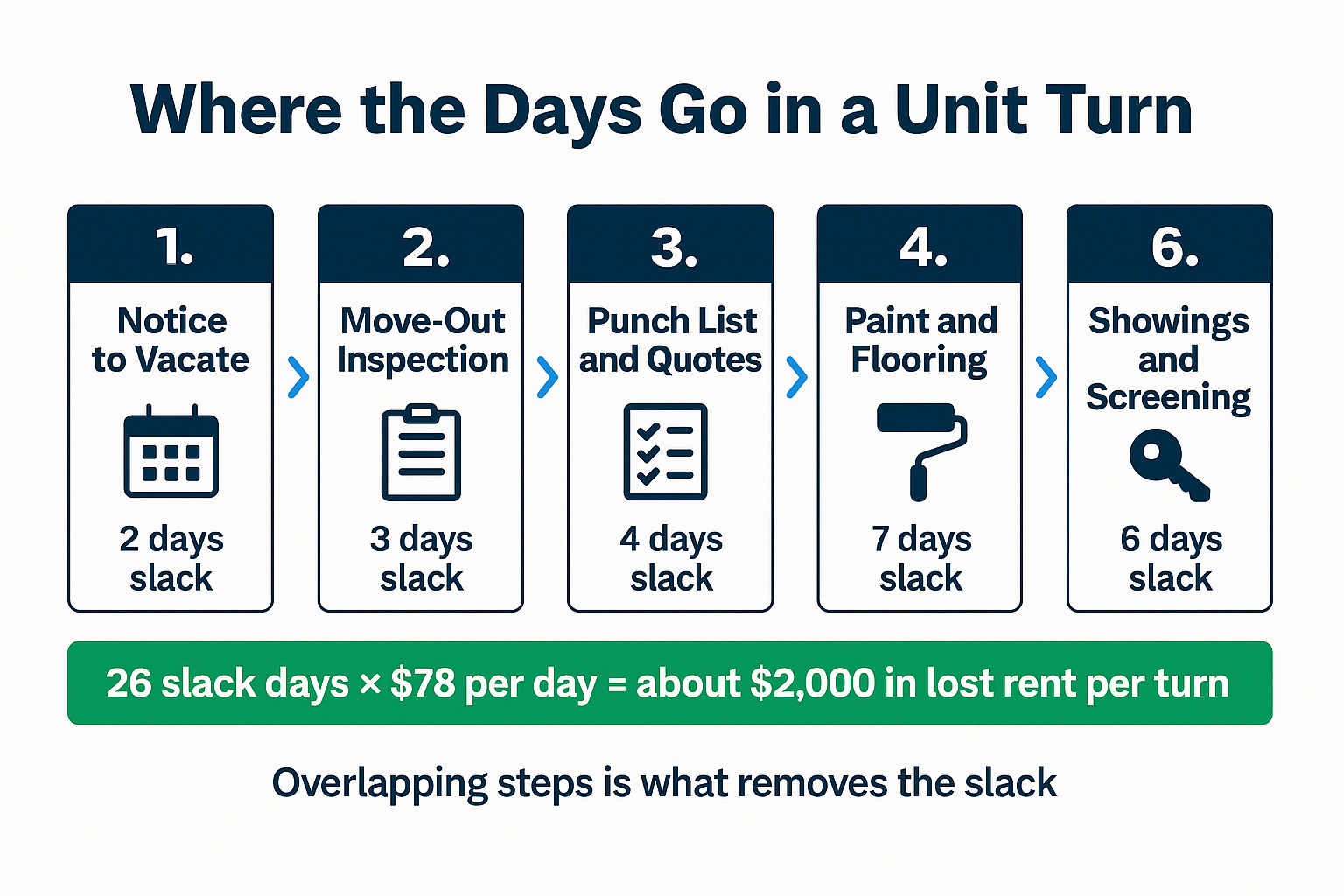
Where the Days Go in a Unit Turn
This shows how a few days of slack at each handoff compounds into a full month of lost rent.
Winter Is the Only Sane Window for Exterior Work
This is the piece most owners miss, and it costs them the most.
NOAA’s Climate Prediction Center is carrying a very strong El Nino for the 2026-27 winter, with coastal California leaning above normal for precipitation and the wettest stretch expected from roughly January into March 2027.
For a multifamily owner, the slow turnover months are your only real window for roof, gutter, siding, and drainage work. Once the rain sets in, that same work gets harder to schedule, more expensive, and far more disruptive to occupied units.
And a leak above an occupied unit is never just a repair. It becomes a repair, plus a habitability problem, plus a resident who starts looking at other buildings, plus a turn you did not plan for.
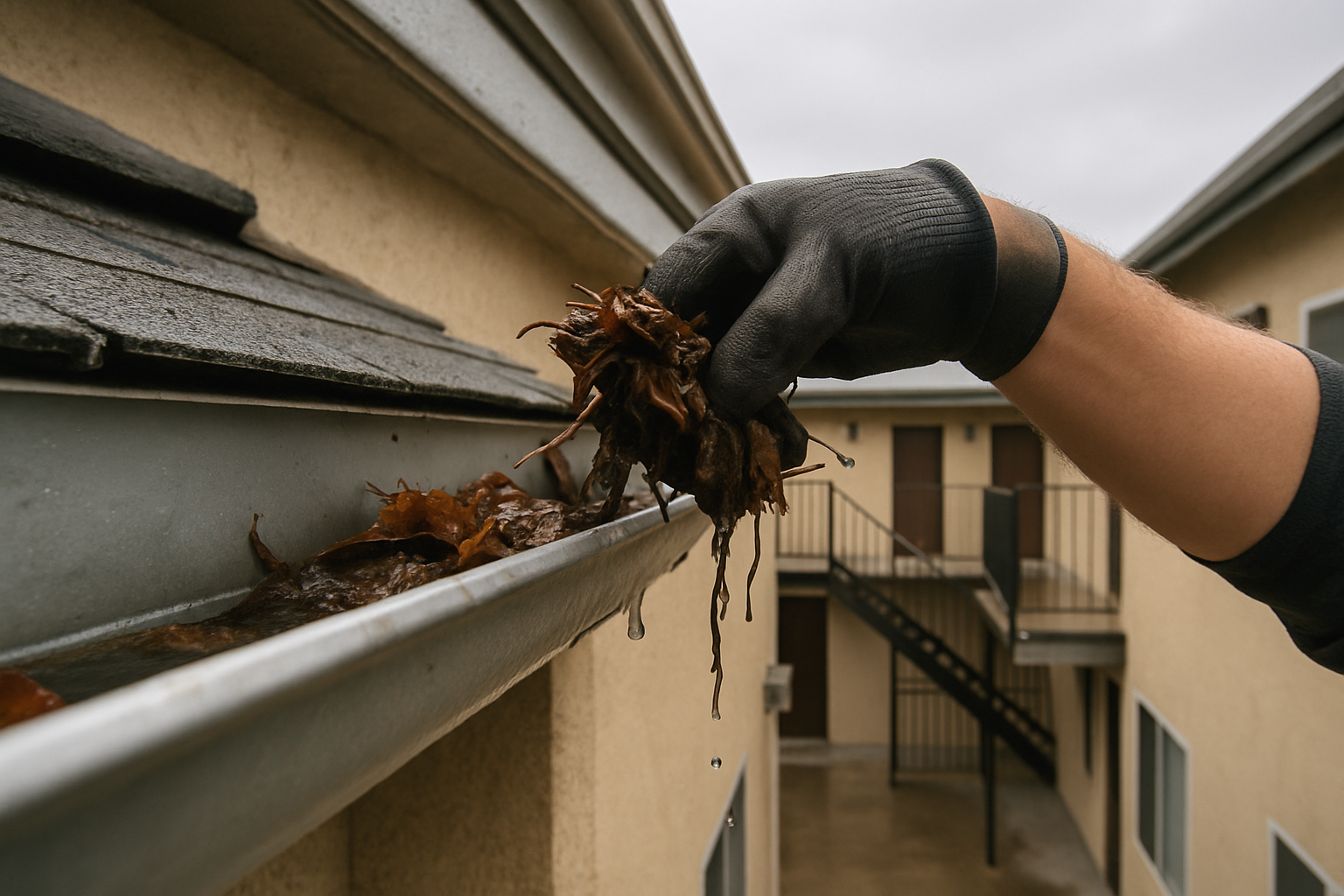
So I treat fall as the exterior season on the buildings we manage in Salinas, Seaside, and Marina. Gutters cleared, downspouts pointed away from the foundation, roof penetrations checked, grading looked at where water pools against a slab. It is stewardship, not panic. Our checklist for Monterey Bay properties before the first big rain walks the specifics.
The Cheapest Turn Is the One That Never Happens
No marketing improvement on earth beats a resident who renews. A renewal costs zero vacancy days and zero turn budget beyond normal upkeep.
What keeps a good resident from shopping around in January is not a gift card. It is three habits:
- Start renewal conversations 60 to 90 days before the lease ends, not two weeks out
- Answer maintenance requests in days, not weeks
- Communicate during a repair, so the resident is not guessing whether anyone is coming
That last one matters more than owners expect. A resident who knows a part is on order will wait. A resident who hears nothing starts browsing listings.
One of our residents put it this way in a review: “Whenever maintenance issues came up, their coordination and follow-through were timely and effective.” That is the whole retention strategy, honestly. Do what you said, when you said it.
A building with strong renewals gives you fewer turns to manage, which means the turns you do have get your full attention.
Peninsula Buildings and Salinas Buildings Run on Different Calendars
National leasing advice says December is dead. That advice is wrong for part of Monterey County.
The Naval Postgraduate School runs on a quarter system, with winter reporting dates right after Christmas and a graduation cycle in March. Peninsula buildings in Monterey, Seaside, and Marina see a genuine late December wave of households arriving and departing.
If you own on the peninsula and you schedule a turn to finish in mid January because “nobody moves in December,” you just handed yourself three weeks of vacancy for no reason.
Salinas runs on a different rhythm. Moves here track local workforce cycles and family schedules more than a school calendar, with more activity around spring and summer and steadier midweek demand year round.
The practical takeaway is to know which calendar your building sits on and back your turn schedule into it. Owners of newer multifamily on the peninsula may also want what new multifamily owners in Marina should know before their first lease-up.
One Compliance Note That Changes the Stakes in Salinas
This is narrow but it matters to the math above.
Salinas’ four rental ordinances, including rental registration and rent stabilization, remain in effect while voters decide a repeal measure on November 3, 2026. You can confirm current status directly with the City of Salinas rental registration and rent stabilization program.
Covered buildings are generally multifamily built before February 1995. Those owners face an annual per unit registration cost and a capped allowable increase formula, and the exact amounts change over time, so verify yours with the city rather than trusting a number in a blog post.
Here is the part that connects back to turnover. If your building is covered, you cannot raise rent later to make up for a sloppy turn. The increase is capped no matter how much vacancy you ate.
Which means turn speed and resident retention are not just nice operational goals. On a covered Salinas building, they are close to the only levers you have.
Frequently Asked Questions About Apartment Turnover and Vacancy Costs in Salinas
How many vacant days is normal for a small Salinas apartment building?
It depends on unit condition, season, and price, but a turn run with overlapping steps often lands in the 10 to 20 day range, while a turn run one step at a time commonly stretches to 30 to 45 days. The gap between those two is almost entirely scheduling, not market conditions.
Should I upgrade the unit during a turn or just make it rentable?
Do the work that shows in photos and on a walkthrough: paint, flooring, lighting, clean fixtures, working appliances. Skip cosmetic upgrades that do not change how the unit shows or what it commands. A unit that shows well from day one draws a stronger applicant pool, and a stronger pool is what protects you from a bad placement.
What does a turn actually cost in Monterey County?
There is no honest flat number. Vendor pricing swings with building age, unit size, access, and what turns up once the walls are exposed. Get quotes on your specific building, and budget separately for the unknowns behind the drywall, because that is the line item owners underestimate most.
Is it worth handing turns off to a manager on a small building?
That depends on how many days you are losing now. If two turns a year each run three weeks long, the vacancy cost alone often exceeds a year of management fees on a small building. What property management really costs in Salinas breaks down the fee side so you can compare against your own numbers.
Does bilingual leasing actually speed up filling units in Salinas?
Yes, in my experience it does. A meaningful share of qualified applicants in Salinas prefer to handle showings, applications, and lease questions in Spanish. Being able to run the whole process in either language removes a common source of delay and drop-off.
Thinking About Handing Off Your Turns?
Our team manages small and midsize apartment buildings across Salinas, Monterey, Seaside, and Marina, we hold a 5 star Google rating, and Aurelia is an Accredited Residential Manager with more than 25 years in Monterey County. We work in both English and Spanish, which matters for filling units quickly in Salinas. If you want to talk through the turn math on your own building, we are available at (831) 582-8916 or through the contact form at torrenteproperties.com.