
Direct Answer: California requires a manager, janitor, or other responsible person to live on the premises of any apartment house with 16 or more units when the owner does not live there. Buildings with 15 or fewer units are exempt.
Someone tells you that your apartment building needs a manager living on site. Maybe it came from a contractor, maybe from another owner at a Salinas property tour. You nod, and then you spend the next three weeks wondering if it is actually true.
It is true above a certain size. And the size is specific enough that owners buying into the 16-unit range or adding units to an existing building get caught by surprise all the time.
I have walked plenty of owners in Salinas, Seaside, and Marina through this. The housing rule is the easy part. The part that costs people money is what that on-site person legally is once they move in.
The rule itself: 16 units is the line
California Code of Regulations Title 25, Section 42 is the source. It requires a manager, janitor, housekeeper, or other responsible person to live on the premises of any apartment house with 16 or more apartments when the owner does not live there.
Here is the short version of what applies at each size:
- 16 or more units, owner off site: one responsible person must live on the premises.
- 15 or fewer units: no state resident requirement at all.
- More than four but fewer than 16 units, owner off site: you have to post a notice in a conspicuous place on the property with the owner’s name and address, or the name and address of the owner’s agent in charge.
That last one is the piece almost nobody knows about. I have inspected eight and twelve unit buildings across Salinas and Monterey where no such notice existed anywhere on the property, and the owner had no idea it was required.
The state has confirmed this reading in its own guidance. A California State Treasurer’s office memo on manager units notes that Section 42 calls for an onsite manager, maintenance person, or other responsible person for rental housing of 16 or more units.
The regulation does not say the person has to be a licensed property manager. It says responsible person. That distinction matters, and I will come back to it.
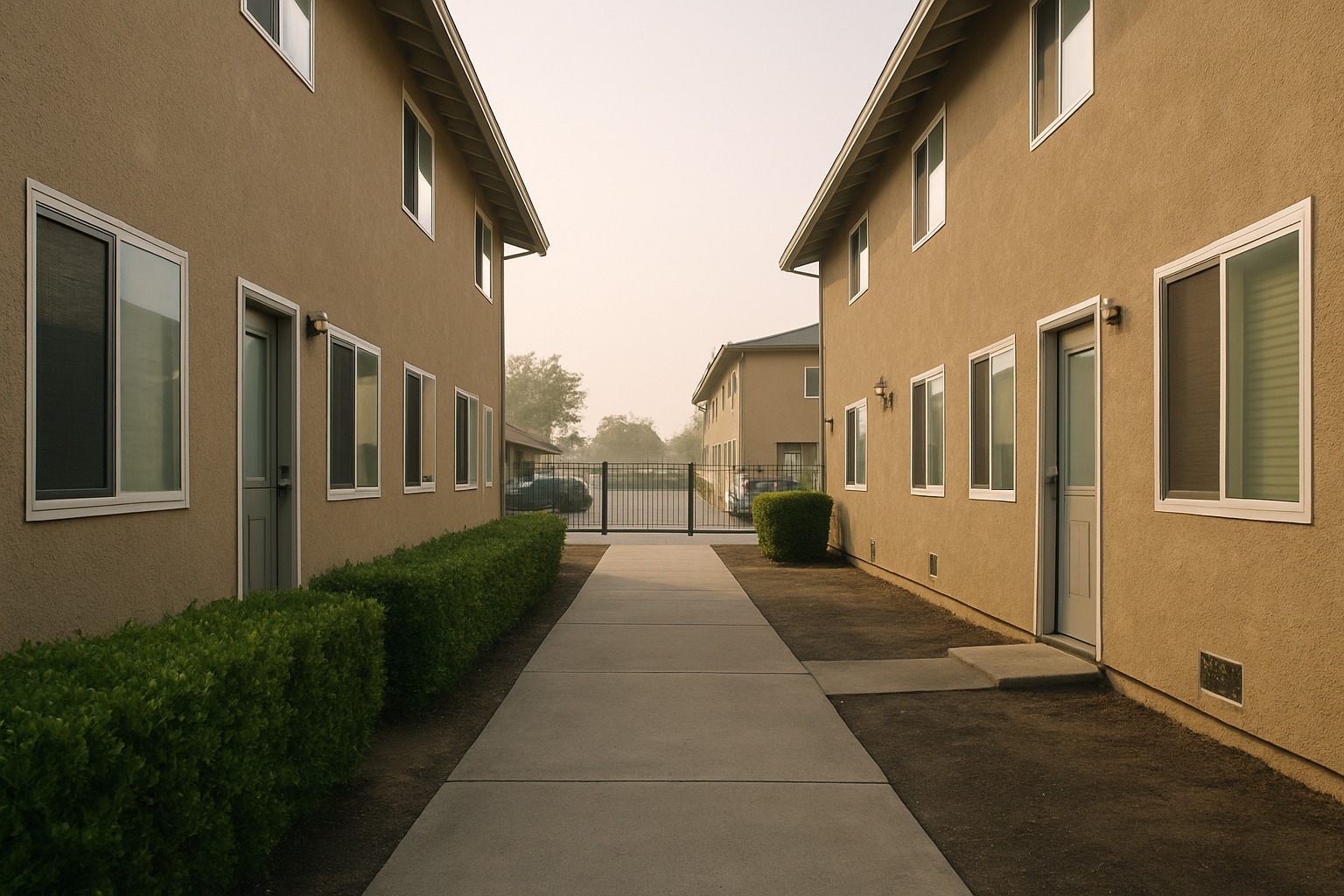
One parcel, one caretaker: the math owners guess at and get wrong
There is a line in the regulation that saves some owners real money and trips up others. Only one caretaker is required for all structures under one ownership on one contiguous parcel of land.
Say you own two eight-unit buildings in Monterey County. How that plays out depends entirely on the parcel lines:
- Both buildings on one contiguous parcel, one ownership: the unit count aggregates to 16, so the requirement kicks in, and one resident person covers the whole property.
- Two separate parcels a block apart: each building stands at eight units, and neither hits the 16-unit threshold on its own.
- Two adjacent parcels under the same ownership: this is where owners assume wrong. Adjacent is not automatically contiguous in the sense the rule uses, and separate parcels are separate buildings for counting purposes.
I tell owners to pull the actual parcel numbers before they make any staffing decision. Not the address, not what the mailman thinks, the assessor’s parcel map.
This also cuts the other direction. Owners who are buying a fifteen-unit building and planning to convert a storage room or add an ADU-style unit should run the number first. Unit sixteen changes your staffing obligation, and it changes your labor exposure with it.
Unit count and what the state requires
Here is the quick reference I use when an owner calls about a building they are considering. All of it assumes the owner does not live on the property.
| Units on the parcel | Resident person required? | Other state obligation |
|---|---|---|
| 1 to 4 | No | None under this rule |
| 5 to 15 | No | Post owner or agent name and address on site |
| 16 or more | Yes, one responsible person on the premises | Post owner or agent name and address on site |
| Two 8-unit buildings, one parcel | Yes, one person covers both | Counts aggregate under single ownership |
| Two 8-unit buildings, separate parcels | No | Each building counted on its own |
The three questions to answer before you staff a building
Most owners get this wrong by starting in the middle. The order of the questions is what keeps you out of trouble.
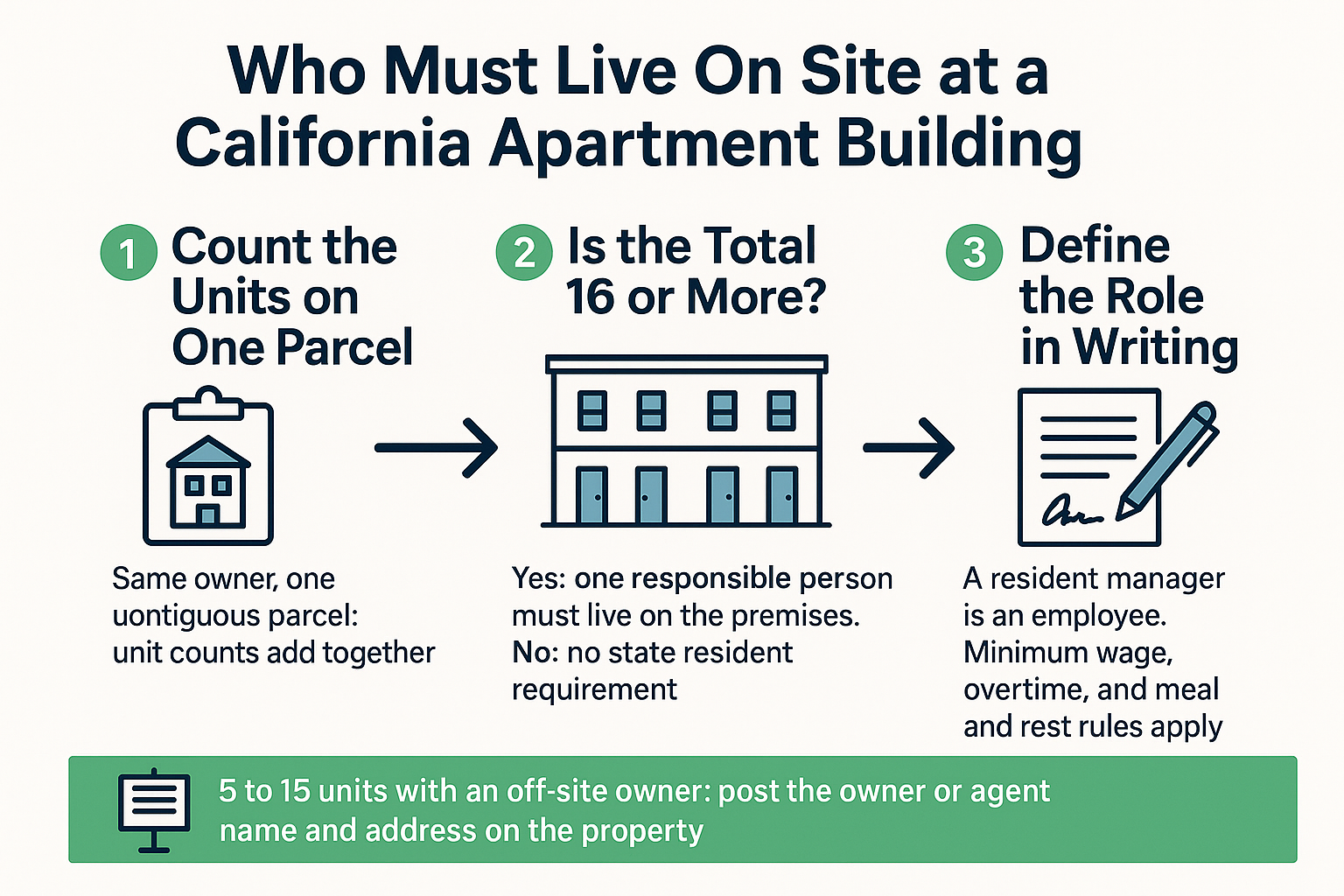
The real exposure is the labor side, not the housing rule
If the 16-unit rule is a speed bump, this is the pothole. Under California law, a resident manager is an employee, not an independent contractor.
That pulls in the whole employment framework:
- Minimum wage for hours actually worked, including time spent responding to calls.
- Overtime once hours cross the daily or weekly thresholds.
- Meal and rest period rules, which get complicated fast for someone who lives where they work.
- Payroll records and timekeeping, which most self-managing owners have never set up.
The arrangement I see most often in Monterey County is informal. An owner hands a long-term tenant a rent discount and, in exchange, that tenant handles lockouts, meets plumbers, and takes the 11 p.m. call about a running toilet.
That handshake does not satisfy the requirement on its own. State wage orders limit how much rent value can be credited against wages owed, and those figures move when the wage orders are updated. I am not going to print a number here as settled fact, because it changes. Confirm the current figures before you set up any arrangement, ideally with an employment attorney or payroll provider.
The practical risk is not a state inspector knocking. It is the day that resident person leaves unhappy and files a wage claim covering years of after-hours work that nobody was tracking.
No, the rule is not going away yet
Owners have heard rumors, so let me address it directly. AB 1771, introduced by Assemblymember Alvarez in February 2026, originally would have barred the state or any local entity from requiring a manager or caretaker to live on the premises.
On April 22, 2026 it cleared the Assembly Housing Committee, but only after being amended into a study bill. In its amended form it directs the Department of Housing and Community Development to analyze the requirement and report back to the Legislature by January 1, 2029 with recommendations on whether to keep it, modify it, or repeal it.
So the requirement is still in effect today. If you are underwriting a 16-unit purchase in Salinas on the assumption that the staffing obligation disappears in a year or two, that is a bad bet on a bill that got softened into a research assignment.
Two roles, not one overloaded tenant
Owners often assume that hiring professional management makes the resident requirement disappear. It does not. The regulation is about who lives there, and a management company does not live there.
What changes is the scope of the on-site person’s job. Done right, the resident person becomes a narrow, well-defined role:
- The after-hours point of contact for residents.
- The one with a master key for lockouts.
- The person who can physically reach a water or gas shutoff at 2 a.m.
- Eyes on the property for things a quarterly walk would miss.
Everything else sits off site: leasing and showings, credit and background screening, rent collection, vendor contracts, monthly owner statements, and tracking the compliance calendar. That split is the whole point. It also cuts your wage exposure, because the resident person is no longer acting as an all-purpose repair crew with untracked hours.
Salinas owners have a second calendar to watch alongside the staffing question. Units covered by the city’s rent stabilization ordinance are generally multifamily buildings built before February 1, 1995, and those units sit in the higher per-unit annual registration fee tier, roughly four times the fee charged for units not subject to stabilization.
Registration opens January 1 each year with a February deadline, and late penalties follow after mid-May. The city’s four rental ordinances were placed before voters on the November 3, 2026 ballot and remained in effect pending that decision, but that is its own subject. For staffing purposes, the fee tier matters mainly because it tells you which of your units carry the heavier annual paperwork load.
If you are still deciding whether the building is big enough to bring in help at all, that question is worth separating from this one. I covered it in when a Salinas apartment actually needs a property manager, and the follow-on costs of getting it wrong show up in the real price of a slow unit turn.
How we handle this for small and midsize buildings
For owners of small and midsize buildings across Salinas and Monterey, our team defines the on-site contact role separately from professional oversight, in writing, with the duties spelled out. Then we coordinate vendors directly, so the resident person is not doing work they are not being paid for.
Aurelia Torrente is an Accredited Residential Manager with more than 25 years in Monterey County, and we work in English and Spanish. That matters more than people expect when your on-site contact and a good share of your residents are Spanish speaking.
One owner who has been with us for years put it plainly in a Google review: “They currently manage several of our properties and everything runs smoothly.” – Jose L.
If you have been running a building yourself and the arrangement was never set up correctly, the transition is manageable. I walked through the mechanics of that in how to hand off a rental you have been managing yourself.
Frequently Asked Questions About On-Site Manager Requirements
Does hiring a property management company remove the on-site manager requirement?
No. The rule is about who lives on the premises, and an off-site management company does not satisfy that. What professional management changes is the scope of the resident person’s job, which becomes the after-hours contact and key holder rather than the person running leasing, accounting, and vendor work.
Can I just give a tenant a rent discount to be my on-site manager?
Not on its own. A resident manager is an employee under California law, so minimum wage, overtime, and meal and rest rules apply, and state wage orders limit how much rent value can be credited against wages owed. Those figures change with the wage orders, so confirm the current numbers before you set up any arrangement.
I own two eight-unit buildings. Do I need someone living on site?
It depends on the parcel. If both buildings sit on one contiguous parcel under one ownership, the counts add to 16 and one resident person covers the whole property. If they are two separate parcels, each is counted at eight units on its own and the requirement does not apply. Pull the assessor’s parcel map before you decide.
Is the on-site manager rule being repealed?
Not right now. AB 1771 started out as a repeal but was amended in April 2026 into a study bill that asks state housing officials to report back by January 1, 2029. The requirement is still in effect, so planning a building around a repeal that has not happened is risky.
Does the on-site person have to handle repairs?
The regulation says manager, janitor, housekeeper, or other responsible person. It does not require that person to be your repair crew. Keeping repairs with licensed vendors and limiting the resident role to access and after-hours contact is usually cleaner, both for the property and for your wage exposure.
What about the notice requirement for buildings under 16 units?
If you own a building with more than four but fewer than 16 units and you do not live there, a notice with your name and address, or the name and address of your agent in charge, has to be posted in a conspicuous place on the property. I find this missing on a lot of Salinas and Seaside buildings.
Want a second look at how your building is staffed?
If you own a building in the 16-unit range anywhere from Salinas to Carmel and you are not sure whether your current arrangement holds up, it is worth reviewing the parcel count and the resident role side by side. Torrente Property Management works with owners of small and midsize buildings across Monterey County, and we are glad to talk through how the pieces fit for your property. You can reach us at (831) 582-8916 or through the contact form at torrenteproperties.com.