
Direct Answer: Maintenance timing drives rental profit. Repairs caught at a scheduled inspection cost far less than the same repair handled as an after-hours emergency, and they keep good tenants from leaving.
Rent hits your account every month. The property looks fine from the outside. And yet the numbers at the end of the year never quite match what you expected.
After more than two decades handling rentals across Salinas, Monterey, and Seaside, I can tell you where most of that money goes. It is almost never one big disaster. It is small repairs handled late, at the worst possible hour, at the worst possible price.
Below I walk through the actual math on deferred maintenance, why water leaks cost more here than in most of California, and what a real seasonal calendar looks like for a Salinas Valley rental.
The Real Math on a Deferred Repair
Let me use a water heater, because I see this one constantly.
At a routine inspection, a tech notices rust weeping at the base of a 12 year old tank and a slow drip into the pan. Nothing has failed yet. You schedule the replacement for a Tuesday morning three weeks out.
That job is a known quantity. Costs vary by unit size, venting, and whether the install triggers code items like seismic strapping or an expansion tank, but it is one planned invoice at a standard daytime labor rate.
Now run the other version. Nobody looked at it. The tank splits at 9 pm on a Saturday in a Creekbridge rental with the water heater in the garage.
Here is what that turns into:
- After-hours labor. Contractors around Monterey County generally bill emergency and weekend calls at something like 1.5 to 2.5 times their normal daytime rate.
- Water damage. Fifty gallons across a garage slab, sometimes into an adjoining hallway or closet.
- Drying and remediation. Fans, moisture readings, possibly baseboard and drywall.
- Flooring repair. Especially if the water reaches carpet or laminate.
- Tenant goodwill. Sometimes a rent credit, sometimes just a tenant who now doubts you.
Same water heater. The second version can easily land at several times the cost of the first. The only difference was whether anyone was looking.

Why Water Leaks Punish Owners Harder on the Monterey Peninsula
This is the one that surprises out of area owners the most.
Water on the Monterey Peninsula is metered and priced in tiers. In the Cal Am service area covering Monterey, Pacific Grove, and Seaside, going over an allotment does not just cost more per gallon. It can also pull in conservation related surcharges on top of the overage.
So a running toilet flapper, a thirty cent part, becomes expensive fast. A slow leak under a kitchen sink that nobody reports for 30 to 60 days can add hundreds of dollars to a bill, and the household never used a drop of that water on purpose.
Salinas owners are not off the hook either. Tiered residential rates are the norm across the valley, and irrigation leaks in a back yard system can run for weeks without anyone noticing.
Here is the part that hurts more than the bill. When a tenant pays water and gets a bill three times normal because a repair sat in a queue, you have created a real dispute.
I have watched owners lose tenants who paid on time for years over exactly this. Replacing that tenant costs a turnover, a vacancy, and new leasing fees. The remedy is boring and cheap: regular inspection cadence plus fast repair response.
Caught Early Versus Caught Late
This is not a price list. It is a comparison of how the same five issues behave depending on when they get found.
| Issue | Found at a scheduled inspection | Found after failure |
|---|---|---|
| Water heater showing rust and a slow drip | Planned weekday swap, one invoice, standard labor rate | After-hours call at roughly 1.5 to 2.5x daytime rate, plus drying and flooring repair |
| Running toilet or slow sink leak | Minor part and short labor visit | Inflated water bill over 30 to 60 days, possible conservation surcharge, tenant dispute |
| Clogged gutters and blocked downspout | Seasonal cleaning before the rains | Fascia rot, stucco staining, sometimes an interior ceiling leak claim |
| Aging HVAC or wall heater | Off-season service or planned replacement | Emergency call during a heat spike, long wait for a licensed tech, uncomfortable tenant |
| Dry rot at window trim or fascia | Localized wood repair and repaint | Framing repair, window replacement, water intrusion investigation |
A Maintenance Calendar for a Salinas Valley Rental
Seasonal work here follows a real schedule. Coastal fog, valley heat, and a concentrated November through March rainy season each set their own deadlines.
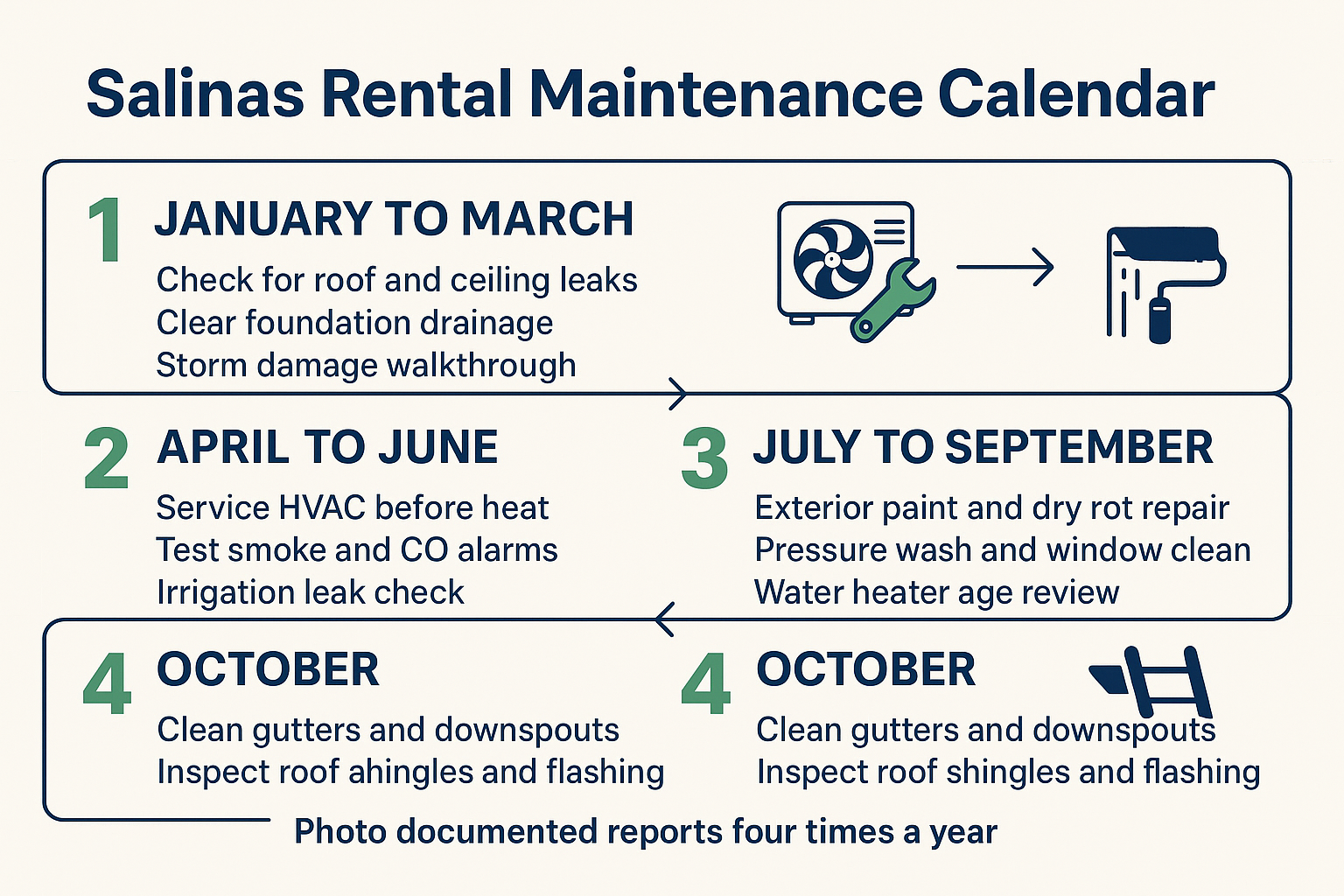
October Is the Deadline That Costs the Most to Miss
Most of the expensive winter claims I see trace back to work that did not happen in October.
Our rain arrives in a narrow window. When it comes, it comes hard, and a blocked downspout has nowhere to send that water except into siding, fascia, or a foundation.
The pre-rain list is short and it has clear financial logic behind every item:
- Gutter and downspout cleaning. Full gutters back water up under the roof edge.
- Roof inspection. Missing, curling, or lifted shingles and cracked flashing around vents and chimneys.
- Drainage clearing at the foundation. Grade, area drains, and anything that redirects runoff away from the slab.
- Dry rot check at fascia boards and window frames. Soft wood in October becomes an open door in January.
- Weather sealing. Door sweeps and window caulking, especially on the wind-exposed sides.
An owner who skips this in October is often filing a roof leak claim by mid January. And an insurance claim carries a deductible, a paper trail, and future premium consequences that a gutter cleaning does not.
If you want a deeper walkthrough of storm season prep, we covered it in detail in getting your Monterey Bay rental ready for a heavy winter.
Detectors Are Not Just Maintenance, They Are a Legal Obligation
This one is not about money directly. It is about exposure.
California requires working smoke alarms in every sleeping area and hallway leading to sleeping areas. Carbon monoxide devices are required in dwelling units with an attached garage or any fossil fuel burning appliance, which covers most single family rentals in Salinas and Monterey. The requirement sits in California Health and Safety Code section 17926.
Here is the part owners get wrong. The obligation is on you, not the tenant.
Waiting for a tenant to mention a chirping alarm is not compliance. And if something happens, “nobody told me” is not a defense.
Routine inspections that test each device and log the result are the practical answer. Photo documentation with a date on it is what turns a maintenance task into actual evidence that you met the requirement.
Vendor Access Is Part of the Cost Equation
Self-managing owners often tell me they can hire the same plumber I can. Usually true. The difference is when you get on the calendar.
Picture a September heat spike in Salinas. Every landlord in the city is calling the same small pool of licensed HVAC contractors on the same afternoon. A cold caller with one unit sits behind everyone with an existing account.
Steady volume changes that in two ways:
- Faster scheduling, because you are a repeat customer rather than a one-off job.
- Steadier pricing, since regular work rarely gets quoted at walk-in rates.
- Known quality, because I already know which vendors show up and which do not.
Fewer days without heat or AC means fewer angry tenants and fewer renewal problems. That is a real line item, even though it never shows up on an invoice.
Several owners have reached out to us after realizing that distance made this impossible to manage well, which is the same reason many owners eventually decide that self-managing has stopped making sense. One long-time client put it simply in a review: their properties “run smoothly” because someone local is handling response times.
Frequently Asked Questions About Rental Maintenance in Salinas
How often should a Salinas rental actually be inspected?
For an occupied single family rental, quarterly works well for exterior and system checks, with move-in and move-out inspections on top of that. Our Seasonal Property Maintenance Program runs on that cadence and delivers a photo documented report four times a year, which matters most for vacant homes and out-of-area owners.
Who pays for maintenance, the owner or the property manager?
The owner pays for the work. A manager coordinates the vendor, reviews the invoice, and reports the cost on your monthly statement. Fee structures vary by property and scope, so the honest answer on your specific numbers comes from a conversation, not a website. We break down the general landscape in our article on what property management really costs in Salinas.
Can I just have my tenant report problems as they come up?
Tenants report what they notice. They do not notice a rusting water heater in a garage, a hairline crack in roof flashing, or a slow irrigation leak in a side yard. Those are exactly the items that get expensive, which is why scheduled inspection beats waiting for a phone call.
Does a repair budget make sense for a single rental?
Yes. Setting aside a reserve each month smooths out the years when a roof, a heater, and an appliance all come due together. The right number depends on the age of the home, the systems in it, and whether you are in a 1950s Oldtown Salinas house or a newer build in Marina or East Garrison.
Do I have other Salinas compliance items besides detectors?
Yes. Salinas runs a Residential Rental Registration program, and California’s security deposit cap changed to one month’s rent as of July 1, 2024 for most residential rentals. Both are separate from maintenance but they hit the same owners, and both are worth confirming before your next lease.
Want a Clearer Picture of Your Property’s Maintenance Position?
If you own a rental in Salinas, Monterey, Seaside, or anywhere from Prunedale down to King City, we are glad to talk through where your property stands and what a realistic maintenance calendar would look like for it. Our team is local, bilingual in English and Spanish, and available at (831) 582-8916 or through the contact form at torrenteproperties.com. No pressure, just a straight conversation about your property.