
Direct Answer: Self-managing a rental makes sense until the time, legal complexity, or distance outweighs what you save on fees. For most landlords in Monterey County, that shift happens faster than expected.
Most landlords I’ve spoken with didn’t start out planning to self-manage forever. They started because it felt like the responsible thing to do — keep fees low, stay close to the property, know exactly what’s happening. And honestly, for a single nearby rental with a reliable long-term tenant, that logic isn’t wrong.
But something changes. A tenant gives notice. An owner relocates to another state. A property manager who’d been handling things for years steps away unexpectedly. Suddenly what felt manageable becomes a full second job — one you didn’t apply for and didn’t budget time for.
I’ve seen this happen with properties across Salinas, Seaside, Marina, and Monterey — and the owners who reach out aren’t failing. They’re being realistic. Recognizing the inflection point isn’t a defeat. It’s good judgment.
The Real Cost of Self-Management Is Mostly Invisible
When owners calculate whether professional management is worth it, they usually compare the management fee against the rent collected. That math looks straightforward. But it leaves out the part that actually costs the most: your time.
Think through what self-management actually involves on a recurring basis:
- Fielding maintenance calls — including the ones at 10pm about a broken heater
- Sourcing and coordinating vendors when something needs repair
- Tracking rent payments and following up on anything late
- Handling lease renewals, rent increase notices, and required disclosures
- Completing move-out accounting and security deposit returns within California’s 21-day window
- Staying current on California law changes that affect your lease or obligations
Each of those tasks takes real time. If you’re working full-time or living more than an hour from the property — and many owners I speak with are in the Bay Area, out of state, or managing properties they inherited — the hours add up fast. One owner in North Salinas described managing their rental for over two years before reaching out about professional management, noting that the process had become far more demanding than they’d anticipated. That’s an honest and common story.
When you assign even a modest hourly value to that time, the fee structure of professional management starts looking very different. There’s also a deeper issue: the hidden costs of managing a Monterey home from out of state go well beyond hours — deferred maintenance, missed rent increases, and compliance gaps all carry financial consequences that don’t show up until they’re already a problem.

Why Self-Screening Tenants Creates Legal Exposure
This one doesn’t get talked about enough. When a landlord shows the property themselves and interviews applicants directly, the screening process often becomes subjective without the owner realizing it. A good feeling about someone, a shared background, a conversational impression — these aren’t criteria, but they influence decisions.
California’s fair housing laws are specific and enforceable. Decisions that appear to favor or exclude applicants based on protected characteristics — even unintentionally — can result in formal complaints and real liability. The protection isn’t just for tenants. A documented, consistent screening process protects the owner.
A professional screening process applies the same criteria to every applicant:
- Credit history reviewed against a defined threshold
- Income verification at a set ratio to monthly rent
- Rental history checked with previous landlords
- Background screening applied uniformly
When those criteria are written down, applied consistently, and documented in a file, the owner has a defensible record. Several owners who reached out to our team asked specifically about help finding “good tenants” — which is the right instinct. But good tenants come from a good process, not from a gut feeling on a Saturday afternoon showing.
For a deeper look at what that screening process actually produces over time, what makes some rental properties consistently attract reliable tenants is worth reading.
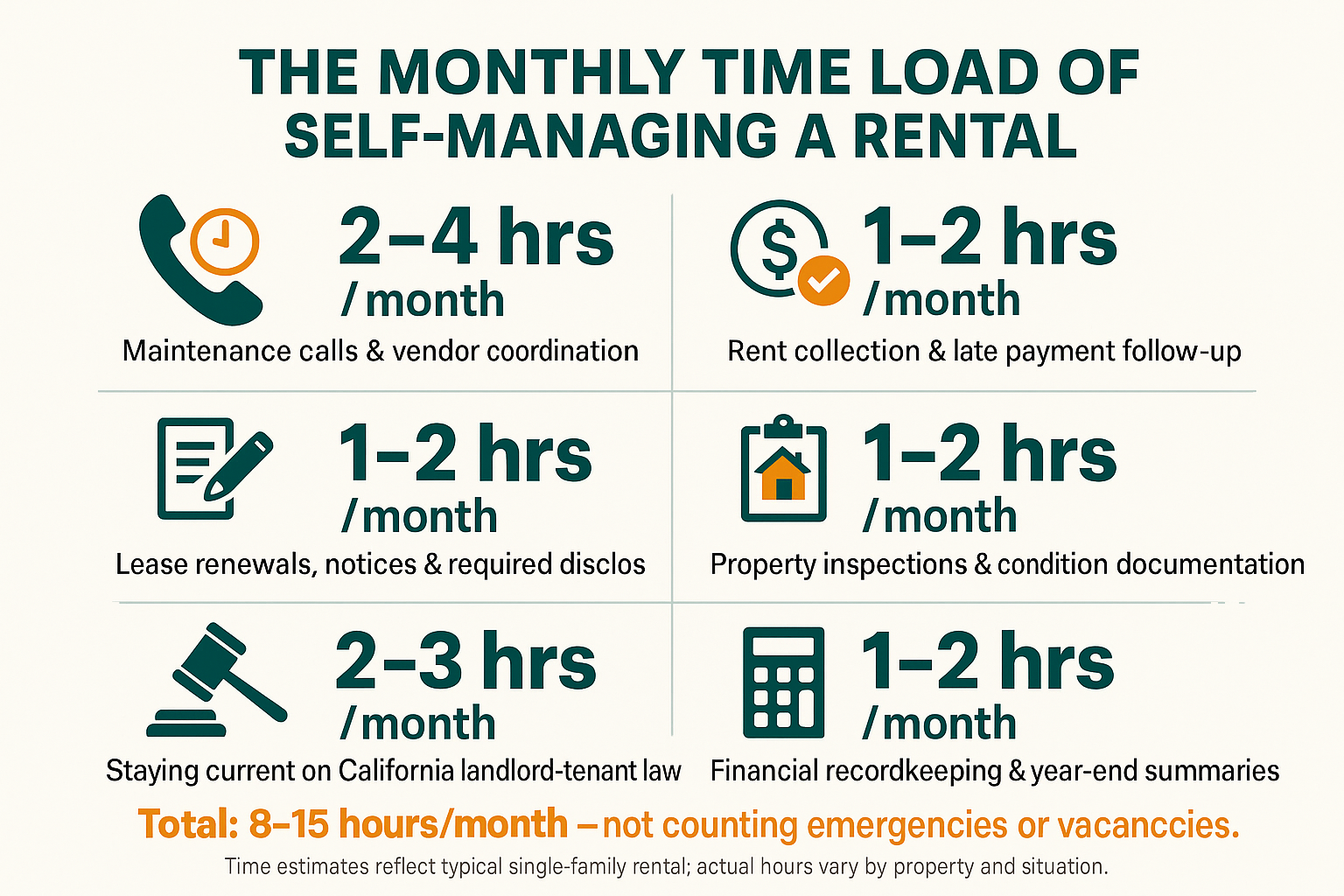
What Self-Management Actually Costs Per Month
This breakdown shows the recurring time and task load most self-managing landlords carry — and rarely account for when comparing options.
Self-Management vs. Professional Management: What Changes
This isn’t about which option is universally better — it’s about which one fits your actual situation. Here’s an honest side-by-side of what shifts when you hand off management.
| Task | Self-Managing Owner | Professional Manager |
|---|---|---|
| Tenant screening | Owner applies own judgment; documentation varies | Consistent written criteria applied to every applicant |
| Maintenance response | Owner sources vendors, coordinates access, follows up | Manager handles end-to-end with established vendor network |
| Late rent follow-up | Owner contacts tenant directly; can feel personal | Manager handles per lease terms, documented and neutral |
| California law compliance | Owner researches changes independently | Manager tracks AB/SB updates, security deposit rules, registration requirements |
| Lease renewals | Owner drafts or reuses prior lease | Manager prepares current, compliant lease reflecting law changes |
| After-hours emergencies | Owner receives the call | Manager’s team fields and responds |
| Financial reporting | Owner maintains own records | Monthly statements and year-end summaries provided |
The Part Nobody Talks About: Psychological Weight
There’s a version of this conversation that’s purely financial, and I’ve had it many times. But the version that actually moves people to act is different. It’s about being tired.
Tired of being the person a tenant calls at night. Tired of not knowing whether the property is being cared for. Tired of carrying the mental load of every unpaid bill, every maintenance request, every lease question — while also living your actual life.
One property owner who’d worked with our team described the experience simply as “peace of mind.” That phrase shows up again and again from owners who’ve made the transition. It’s not a marketing line — it’s what people say when they describe what changed.
This is especially true for owners who are geographically distant, for families managing an inherited property, and for landlords who’ve reached a point in life where they simply want the income without the operations. Wanting that isn’t laziness. It’s a legitimate reason to make a change, and it’s one of the most common things I hear from new clients.
For owners wondering whether professional management actually improves the financial outcome — not just the peace of mind — do property managers really increase profit, or just maintain the property addresses that question directly.
What Happens When You Already Have a Tenant in Place
One thing I hear regularly is the assumption that transitioning to professional management mid-tenancy is complicated — that it means disrupting a tenant relationship or waiting for the lease to expire. That’s not how it works in practice.
A competent property manager can step in with a current tenant in place. Here’s what that process typically looks like:
- Written introduction to the existing tenant explaining the management change and new contact information for rent and maintenance
- Transfer of rent collection to the management system, with clear instructions for the tenant
- Baseline property inspection to document current condition — this protects both the owner and the tenant
- Lease review to identify any terms that need to be updated, formalized, or brought into compliance with current California law
The tenant usually experiences minimal disruption. The owner gets operational relief almost immediately.
For properties in Salinas specifically, there are also registration requirements that a property manager should be handling on the owner’s behalf from day one. What the Salinas Rental Registration Program requires right now is something every Salinas landlord should understand regardless of who manages the property — but it’s one more thing that falls off a self-managing owner’s plate when a professional steps in.
California law has also changed in ways that affect what every lease must include. Your rental lease changed in 2026 covers what landlords need to know about recent habitability law updates — the kind of compliance detail that’s easy to miss when you’re managing everything yourself.
Frequently Asked Questions About Switching to Property Management
How much does professional property management typically cost in Monterey County?
Management fees in California generally run somewhere between 8% and 12% of monthly rent collected, though this varies based on property type, number of units, and the scope of services included. Leasing fees — charged when a new tenant is placed — are typically separate and can range from a partial to a full month’s rent depending on the company. The only way to get an accurate number for your specific property is to ask for a quote directly, since the details of what’s included vary considerably.
Can I switch to a property manager if my tenant is already living in the property?
Yes — and it’s more common than most owners realize. The manager introduces themselves to the tenant in writing, transfers rent collection, does a baseline inspection, and reviews the existing lease. The tenant’s day-to-day experience changes very little. The owner’s does.
What’s the real risk of screening tenants yourself?
The main risk is inconsistency. California’s fair housing protections apply to every part of the rental process, including how you evaluate and select applicants. If your screening decisions aren’t based on the same documented criteria for every applicant, you’re exposed — even if your intentions were good. A formal process with written standards protects you legally and tends to produce better tenants over time.
What happens to the security deposit when I transfer management?
In California, security deposits must be handled carefully during a management transition. The deposit typically transfers to the new manager, and the tenant should be notified in writing of where it’s being held. Under California law, residential security deposits are now capped at one month’s rent for unfurnished units as of July 1, 2024. A property manager should document the current deposit amount and confirm it’s properly accounted for at the time of transfer.
I live out of state — is that a problem for getting started?
Not at all. A significant portion of the owners we work with are out of the area — in the Bay Area, out of state, or managing inherited properties from a distance. The whole point of full-service management is that you don’t need to be local. Everything from lease execution to maintenance coordination to monthly financial reporting can be handled remotely on your behalf.
How do I know if my current rental price is set correctly before I hand off management?
Rental pricing in Monterey County is more nuanced than most owners expect — neighborhood, unit condition, current inventory, and seasonality all play a role. How Monterey Bay rental prices actually get set explains the factors in detail. A professional manager should conduct a current market analysis before setting or adjusting your price.
Ready to Stop Being the Person Tenants Call at 10pm?
If anything in this article sounds familiar — the hours, the distance, the accumulating weight of handling it alone — it’s worth having a conversation. Our team works with property owners across Monterey County, from Salinas and Seaside to Pacific Grove, Carmel, and Marina, and we’re happy to talk through your specific situation without any pressure. You can reach Torrente Properties at (831) 582-8916 or through the contact form at torrenteproperties.com.