
Direct Answer: New multifamily owners in Marina need three things settled before renting: accurate per-unit pricing from local comps, a staggered lease-up plan, and a maintenance and compliance system built for multiple units.
Owning one rental house teaches you a lot. Owning a 15-unit multifamily property teaches you that almost none of it transfers.
I’ve watched Marina grow from a quiet stretch past the Fort Ord gates into one of the busiest building markets in Monterey County. New multifamily projects are going up on small parcels, and the owners behind them are often people who have never leased more than one unit at a time.
The three things that trip them up are always the same: lease-up timing, per-unit pricing, and the paperwork and maintenance load that arrives the day the first tenant moves in. That’s what I want to walk through here.
Lease-Up Is a Schedule Problem, Not a Marketing Problem
With a single-family home, you list it, show it, and fill it. With three 5-plex buildings, you are running fifteen small leasing campaigns that all compete with each other.
Here’s what that actually looks like. If your certificate of occupancy lands in September, you have missed the peak Monterey Bay leasing window, which runs roughly April through August when families relocate and CSU Monterey Bay and Naval Postgraduate School households are shuffling housing.
That doesn’t mean you can’t lease in fall. It means the plan has to change:
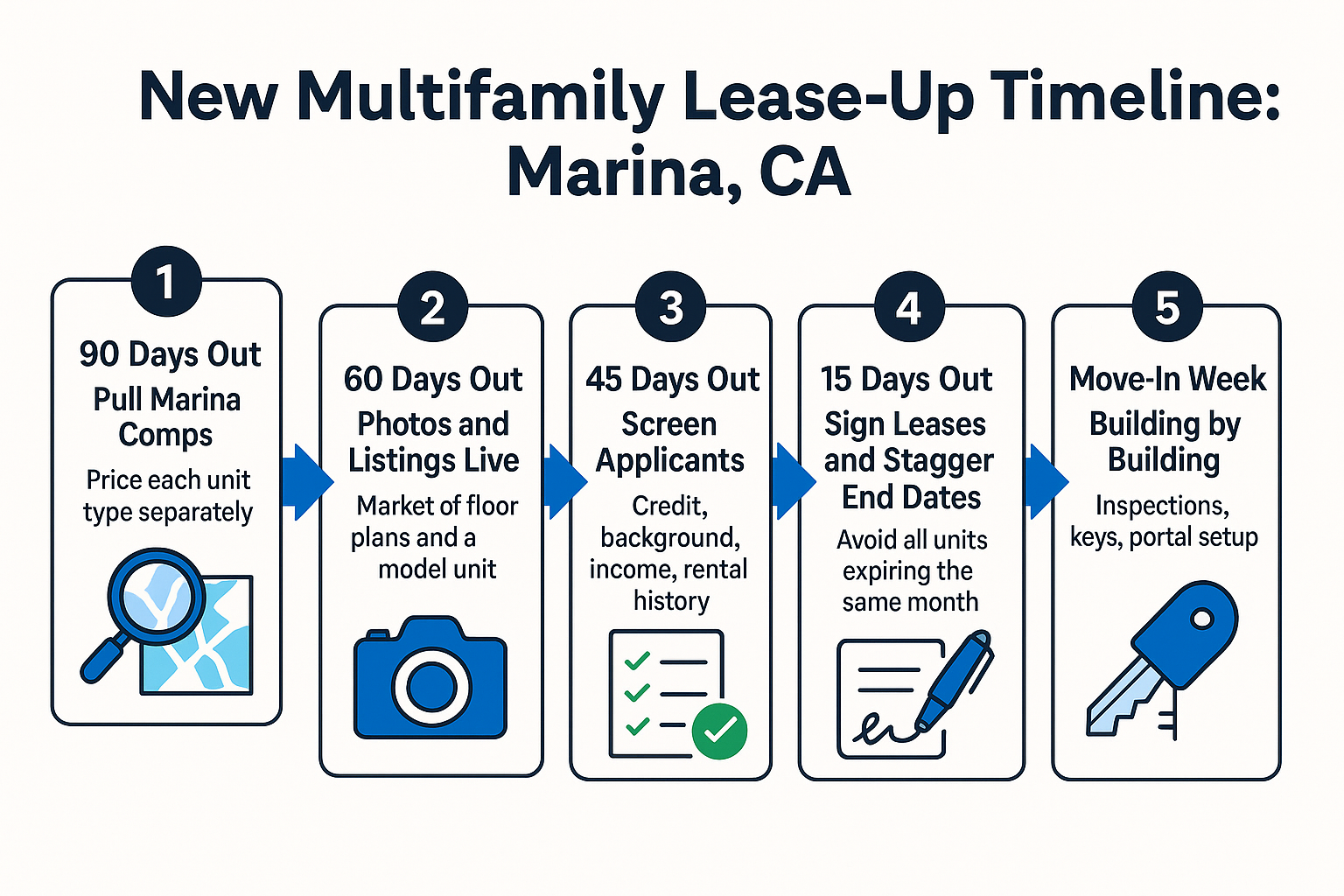
- Start marketing 45 to 60 days before completion, not after. Pre-leasing off floor plans and a model unit is normal for new construction in Marina.
- Sequence move-ins by building, so the first 5-plex is producing income while the third is still getting final inspections.
- Stagger lease end dates on purpose. If all fifteen leases expire the same month, you have built yourself a turnover cliff every single year.
- Expect the 3-bedroom units to lease slower than the 1-bedrooms in the shoulder season, since family moves cluster around the school calendar.
I’d rather sign a 14-month lease on a unit finished in September than a 12-month lease that dumps it back on the market the following fall. Small decision, real money.
Pricing a Mixed Unit Mix in Marina Takes Local Comps, Not Averages
A building with two 3-bed/2-bath units and three 1-bed/1-bath units is really two different rental businesses under one roof. They attract different tenants, they compete against different listings, and they move at different speeds.
The 1-bedrooms in Marina tend to draw single professionals, graduate students, and service members without dependents. The 3-bedrooms compete against detached houses in the Dunes, Marina Heights, and nearby East Garrison, which is a completely different pool of renters with different expectations for parking and storage.
Statewide rent averages are useless here. What matters is:
- Active and recently leased comparables inside Marina, pulled within the last 60 to 90 days
- Whether the comp is new construction with in-unit laundry and modern appliances, or a 1980s unit with none of that
- Parking count per unit, which carries real weight on a 0.4-acre parcel
- Distance to the Highway 1 on-ramps and the Marina Village shopping area, which shapes commuter appeal to Monterey and Seaside
Monterey County rents shift by neighborhood and by season, so I won’t quote you a number here. But run the math on the risk: setting rent $150 under market on just two units costs you around $3,600 a year, every year, and it resets your renewal ceiling too. For more on how increases work once tenants are in place, see raising rent in 2026 for Monterey Bay landlords.
How the Two Unit Types Behave Differently in Marina
This is the general pattern I see across small multifamily buildings on this side of the bay. Your property will have its own quirks.
| Factor | 1 Bed / 1 Bath | 3 Bed / 2 Bath |
|---|---|---|
| Typical renter | Single professional, grad student, service member | Family or two-income household |
| Competing inventory | Other apartments in Marina and Seaside | Detached homes in the Dunes and East Garrison |
| Average time to lease | Usually faster year-round | Strongly tied to the school calendar |
| Turnover frequency | Higher, often annual | Lower, tenants tend to stay longer |
| Turn cost between tenants | Lower, smaller footprint | Higher, more flooring, paint, and cleaning |
| Pricing risk | Small dollar error, repeated often | Large dollar error on a long lease |
A Realistic Lease-Up Timeline for a New Marina Multifamily Building
Here is the sequence I’d want in place well before the final inspection, working backward from your completion date.
Deed-Restricted Units Come With Homework You Cannot Skip
Plenty of new Marina projects include one or two deed-restricted affordable units, often set at a percentage of area median income like 110% AMI. On paper it’s two units out of fifteen. In practice it’s a permanent administrative job.
Those units carry ongoing obligations that a spreadsheet won’t cover:
- Verifying and documenting household income before move-in, using the correct income limits for Monterey County
- Annual recertification on a fixed schedule, with source documents kept on file
- Rent limits that are set by the program, not by what the market would pay
- Reporting to the administering agency, with deadlines that do not move for you
The income limits themselves are published and updated annually by the California Department of Housing and Community Development, and they change. Certifying a household using last year’s numbers is one of the easier ways to create a problem.
Get this wrong and you’re not looking at a slap on the wrist. Improper certification or a missed reporting deadline can put your standing with the program at risk. If you interview managers, ask each one directly how they handle income documentation and recertification, and who on their team owns that calendar.
Maintenance at 15 Units Is a Different Animal
One tenant calling about a water heater is a Tuesday. Ten tenants with your cell number is a second job you did not apply for.
The difference is triage. When requests overlap, somebody has to decide what gets a vendor today and what waits until Thursday, and that decision has to be consistent across every unit so no tenant feels ignored.
A workflow that holds up at this scale looks like this:
- A tenant portal for every work order, so requests are timestamped and documented instead of buried in texts
- A tiered response protocol: no heat, no water, active leaks, and lockouts get same-day emergency response; a sticky window gets scheduled
- A vendor bench, not a single handyman, with licensed and insured plumbers, electricians, and HVAC techs who can be on site in hours
- Coordinated access across occupied units, so one plumber visit covers four units instead of four separate trips
- Photo-documented move-in and move-out inspections, which matter more than ever under California’s one-month security deposit cap that took effect July 1, 2024
New buildings also come with warranty windows. Tracking which appliance, roof, or water heater is still under warranty during the first couple of years saves real money, and nobody remembers that on their own three years in.
One more item for multifamily specifically: if your buildings have balconies, walkways, or elevated stairs, they fall under California’s exterior elevated element inspection rules. I wrote about what the SB 721 deadline means for Monterey Bay multifamily owners if that applies to you.
When Self-Managing Stops Making Sense
I’ve never told a Marina owner with one duplex that they need a manager. Plenty of people handle two units fine.
The line usually shows up somewhere between five and ten units, and it isn’t about the rent roll. It’s about whether you can answer a 9 p.m. leak call, hold a leasing standard across fifteen applications, and keep compliance paperwork current in the same week.
If you want the honest cost side of that decision, management fees in the Monterey Bay area are typically a percentage of collected rent plus a separate leasing fee, and the percentage often drops as unit count goes up. I break the structure down in what property management actually costs in the Monterey Bay area, and when a Salinas apartment actually needs a property manager applies just as well to Marina.
Frequently Asked Questions About Multifamily Property Management in Marina, CA
How early should I start marketing a new multifamily building in Marina?
I’d start 45 to 60 days before your expected certificate of occupancy. Renters in Monterey County usually search 30 to 45 days ahead of their move date, so listing after completion means you’re paying a mortgage on empty units while you catch up.
Can I use the same rent for every 1-bedroom in the building?
Usually close, but not identical. Ground floor versus upper floor, parking assignment, and whether a unit faces the street or the interior all move the number. Small differences per unit are normal and they add up across fifteen doors.
What happens if I miss a recertification deadline on a deed-restricted unit?
It depends on the program and the administering agency, but consequences can include compliance findings, required corrective action, and trouble with your standing in the program. This is the one area where I tell owners not to improvise. Put it on a calendar and assign it to a specific person.
Do management fees go down when you manage more units?
Generally yes. A fifteen-unit property is more efficient to manage per door than one scattered single-family home, and fee structures in Monterey County usually reflect that. The exact number depends on the property, the unit mix, and what services you actually need, so it’s worth a direct conversation rather than a website estimate.
Is the Marina rental market strong enough to fill fifteen units?
Demand in Marina is supported by steady pieces: the CSU Monterey Bay and former Fort Ord footprint, the Naval Postgraduate School pipeline in Monterey, and commuters who want Peninsula access at a lower price than Carmel or Pacific Grove. Filling fifteen units is realistic. Filling them all in the same 30 days is where the planning matters.
Planning a Multifamily Lease-Up in Marina?
If you have a new building coming online in Marina or anywhere between Santa Cruz and King City, we’re happy to talk through pricing, timing, and what the first year of operations actually looks like. Our team works across Monterey County and handles multifamily properties alongside single-family homes, in English and Spanish. You can reach us at (831) 582-8916 or through the contact form at torrenteproperties.com.