
Direct Answer: For most vacant homes in Monterey Bay, a professional check-in every 7 to 14 days is the minimum. Coastal conditions, seasonal weather, and insurance requirements often push that closer to weekly.
A lot of homeowners assume a vacant house is a safe house. No tenants means no problems, right? But on the Monterey Peninsula, an empty home is quietly being tested every single day — by salt air, shifting weather, insects, moisture, and sometimes people who notice a property sitting dark for weeks at a time.
Whether you own a second home in Pacific Grove, a seasonal retreat in Carmel, or a property that’s sitting between tenants in Seaside, the same question comes up: how often does someone actually need to be walking through that front door? The answer depends on a few real factors — and some of them might surprise you.
This article covers the two things that matter most: how frequently inspections should happen, and what those inspections actually need to include to catch problems before they become expensive.
Why the Monterey Bay Climate Changes the Math
Most generic advice about vacant homes was written for somewhere else. The Monterey Bay coastline has its own set of conditions that accelerate damage in ways that don’t apply to, say, a home sitting empty in Fresno.
The coastal marine layer brings persistent moisture — even in summer. That moisture works its way into crawl spaces, window seals, and subfloor framing over time. A home that looks fine from the street can have active mold starting behind a bathroom wall after just a few weeks of no ventilation.
Salt air corrosion is another factor that moves faster than people expect. Metal fixtures, HVAC components, and exposed framing near the coast degrade more quickly than their inland counterparts. In Pebble Beach and Carmel, where homes often sit closer to the water, this corrosion cycle can shorten the life of mechanical systems by years if the home isn’t being actively monitored and maintained.
And then there’s the seasonal pattern. Monterey County gets most of its rain between November and March. A small roof issue that was harmless in August can cause thousands of dollars in water intrusion damage by January if no one caught it in October.
The bottom line: the Monterey Bay environment punishes neglect faster than most owners expect, especially when no one is generating heat, airflow, or routine wear-and-tear that would make a small problem obvious.
What Your Homeowner’s Insurance Policy Actually Requires
This is the part most owners don’t read until they’re filing a claim — and then they find out too late.
Many standard homeowner’s insurance policies include a vacancy clause that limits or voids coverage once a home has been unoccupied for 30 to 60 consecutive days. The specific threshold varies by insurer, but 30 days is common. After that cutoff, claims related to water damage, vandalism, or liability may be denied outright — even if you’ve been paying your premium without interruption.
Some policies require you to notify your insurer when a home becomes vacant and purchase a separate vacancy endorsement or rider. Those riders typically run $500 to $1,500 per year depending on the home’s value and location, but they often come with their own requirements — including documented check-ins at defined intervals, sometimes as frequently as every 7 days.
If you own a home in Carmel or Pacific Grove and you’re spending winters elsewhere, it’s worth pulling out your policy and looking for the word “vacancy” before you assume you’re covered. A quick call to your agent to ask specifically about the unoccupied home rules is worth an hour of your time.
For a broader look at what distant ownership actually costs when things aren’t being watched, The Hidden Costs of Managing a Monterey Home From Out of State walks through the financial picture most people don’t build into their plans.
Vacant Home Check-In Frequency: What Different Situations Require
The right inspection schedule depends on your specific situation. Here’s a practical breakdown by ownership type and risk level.
| Situation | Recommended Frequency | Key Reason |
|---|---|---|
| Seasonal home, owner away 3–6 months | Every 7 days | Insurance requirements, moisture risk |
| Home between tenants (30–60 days vacant) | Every 10–14 days | Liability coverage, pest and weather exposure |
| Inherited or estate property | Every 7–10 days | Unknown maintenance history, legal exposure |
| Military deployment / owner relocated | Every 7 days | Extended absence, no local contacts |
| Renovation or repair period (contractors present) | Every 5–7 days | Site security, permit compliance, progress verification |
| Vacant less than 30 days | Every 14 days minimum | Most policies still active, lower but real risk |
What a Professional Vacant Home Inspection Actually Covers
A real check-in is more than a walk around the outside. This shows what a thorough inspection covers and why each item matters.
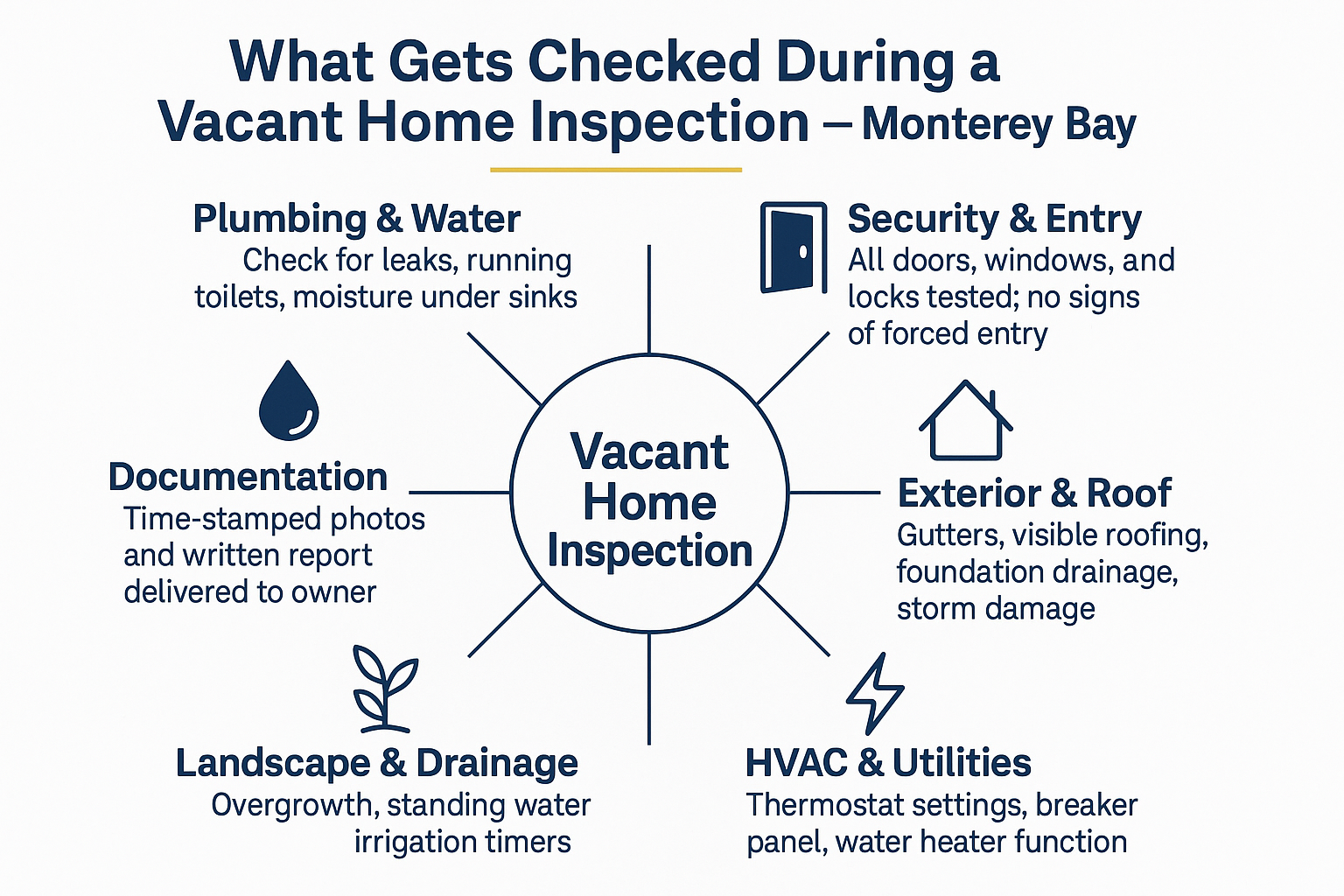
What Actually Happens During a Proper Check-In
A drive-by doesn’t count. Glancing at the front of the house from a car tells you almost nothing about what’s happening inside or around the perimeter.
A real vacant home inspection means someone physically enters the home, walks every room, and looks at specific systems with purpose. The goal is to catch the early signs of problems — not to confirm that everything looks fine from the driveway.
Here’s what a thorough check-in should cover:
- Interior moisture check — under sinks, in bathrooms, around water heaters, and in crawl spaces if accessible
- Plumbing function — running water briefly to test traps and confirm no leaks or unusual smells
- HVAC status — confirming the thermostat is set appropriately (usually 55–65°F in winter to prevent pipe stress) and the system is running
- Doors, windows, and locks — every point of entry tested, no signs of tampering or weather damage
- Roof and gutters visible from the exterior — checking for debris buildup, sagging, or storm damage after rain events
- Landscaping and drainage — standing water near the foundation is an early warning sign for moisture intrusion
- Signs of pest activity — droppings, mud tubes, or entry points along the exterior
- Photo documentation — time-stamped images sent to the owner after each visit
That last point matters more than people think. If a claim ever comes up — with an insurer, a contractor, or a future tenant — dated photographic records of the home’s condition are exactly what you need. Verbal reports don’t hold up the same way.
For owners who are managing a Carmel property from a distance and wondering what a professional caretaking relationship actually looks like, How Carmel Homeowners Are Protecting Properties Without Living in Them covers the practical side of that arrangement.
The Hidden Problems That a Vacant Home Accumulates Quietly
Most major vacant-home damage doesn’t announce itself. It builds up slowly while no one is watching, then presents as an emergency.
Mold is the most common example. A slow drip under a bathroom sink can grow into a significant mold colony in three to four weeks behind cabinetry. By the time it becomes visible, you’re often looking at remediation costs starting at $2,000 to $5,000 — and sometimes much more if it’s reached drywall or subfloor.
Pest intrusion follows a similar pattern. Rodents can establish nesting inside a vacant home within days of finding an entry point, especially in fall when they’re seeking warmth. In Salinas and Marina, where agricultural land borders residential neighborhoods, this is a real and recurring issue — not a theoretical one.
Vandalism and informal occupation are less common on the Peninsula but not unheard of. A home that shows clear signs of regular human attention — fresh tire tracks, varied trash pickup schedules, lights cycling — is meaningfully less likely to attract unwanted attention than one that looks frozen in time.
And for owners thinking about what happens when a property sits between tenants, What Happens to Your Monterey Property When You’re 500 Miles Away? gets into specific scenarios that distant owners rarely anticipate until they’re already dealing with one.
If you’re managing a seasonal home and also thinking about the caretaking side of things more broadly, the Caretaker Services for Seasonal Homes: Monterey Bay Guide covers the full scope of what professional oversight looks like for properties in this market.
Frequently Asked Questions About Vacant Home Inspections in Monterey Bay
Can I just ask a neighbor to keep an eye on the house?
You can, and a good neighbor adds real value as an extra set of eyes. But a neighbor isn’t going to enter the home, check under sinks, document what they see, or catch a slow moisture problem developing behind a wall. Neighbor check-ins work as a supplement — not as the primary inspection plan. And if something goes wrong, your insurer will likely want proof of formal, documented check-ins.
How much does a professional home watch service cost in Monterey County?
Rates vary by frequency and scope, but most professional home watch or caretaker services in the Monterey Bay area run $75 to $150 per visit for a thorough interior and exterior inspection with documentation. Monthly programs with weekly visits typically run $250 to $500 per month depending on the property size and what’s included. That’s a fraction of what a single mold remediation or water intrusion repair costs.
Does my insurance require documented check-ins, or just that someone visits?
Most vacancy endorsements that require check-ins specify written documentation — not just a visit. Time-stamped photos and a written log of findings are the standard. Verbal confirmation from a neighbor or family member typically won’t satisfy a claim adjuster if something goes wrong. Read your specific policy, or call your agent and ask directly: ‘What documentation do I need to maintain coverage on a vacant home?’
What’s the difference between a home watch service and a property manager for a vacant home?
A property manager’s focus is typically on an occupied or rented home — tenant relations, rent collection, leases, and ongoing management. A home watch or caretaker service is designed specifically for vacant, seasonal, or transitional properties where the primary goal is monitoring, documenting, and maintaining the home between occupancies. Some property management firms offer both under one roof, which can simplify things considerably if you’re also planning to rent the property eventually.
My Carmel home is vacant for six months every year. Is once a month enough?
For a coastal property vacant for six months, once a month is not enough — and most insurance policies covering vacant homes would agree. Weekly to biweekly inspections are the standard for extended vacancy on the Monterey Peninsula. Six months gives the marine layer, seasonal storms, pests, and potential intruders a lot of opportunity between monthly visits. The cost of more frequent check-ins is genuinely small compared to what a single undetected problem can cost.
Want Someone Local Handling This for You?
If you own a vacant, seasonal, or transitional home anywhere in Monterey County — from Carmel to Salinas to Pacific Grove — Torrente Property Management offers professional home watch and caretaking services built specifically for owners who aren’t on-site. Our team provides documented check-ins, photo reports, and hands-on coordination so you’re never left guessing about what’s happening at your property. Reach us at (831) 582-8916 or through the contact form at torrenteproperties.com.