
Direct Answer: Gather your lease, payment history, security deposit records, and maintenance notes. Then notify your tenant in writing. A property manager handles the rest from there.
Most landlords who reach out to us have already been managing on their own for one to three years. They handled the lease themselves, collected rent by check or Venmo, texted with the tenant when something broke, and assumed it would stay manageable. Then something shifted, a maintenance issue they couldn’t coordinate from a distance, a tenant situation that got uncomfortable, or just the slow accumulation of small decisions that never stop coming.
The question I hear most often is not whether to make the switch. It’s how. Owners in Salinas, Seaside, Marina, and across Monterey County want to know what actually needs to happen before a property manager can step in, especially when there’s already a tenant in place.
This guide walks through that process in plain terms. No guesswork, no vague advice. Just the real steps, in order.
Step 1: Gather Your Documentation Before Anyone Shows Up
The first thing a property manager needs is a clear picture of what they’re walking into. Before any agreement is signed or any tenant is contacted, you’ll want to pull together:
- The current lease, the full signed document, including any addenda or side agreements
- Tenant contact information, phone number, email, and emergency contact if you have it
- Rent payment history, ideally a written record, even if it’s a simple spreadsheet of dates and amounts
- Security deposit records, the amount collected, where it’s held, and what bank account or trust account it sits in
- Any open maintenance issues, things the tenant has mentioned or that you know need attention
If you’ve been collecting rent informally, cash, peer-to-peer payment apps, or handshake arrangements, that’s worth being upfront about. It doesn’t disqualify you from making the switch, but it means there are a few extra steps to establish a clean baseline before management begins.
Owners who have clear records from the start tend to have much smoother transitions. The documentation gap is almost always what slows things down, not the tenant, not the property itself.
Step 2: Understand What California Law Requires When Management Changes
This step surprises a lot of self-managing landlords. When you bring on a property manager in California, it’s not just a handshake agreement between you and the management company. There are legal requirements that protect the tenant too.
Under California law, two things have to happen:
- The tenant must be notified in writing of the change in management and the name and contact information of the new entity they should pay rent to
- The security deposit must be transferred to the incoming property manager, either placed in their trust account or formally documented as held by the owner on their behalf
The California Department of Consumer Affairs landlord/tenant guide outlines these obligations clearly. Skipping either step creates legal exposure, and it also sets a bad tone with a tenant who may already be uncertain about the change.
For properties in Salinas, there’s an additional layer: if your property is registered under the Salinas Residential Rental Registration program, the registration should reflect current ownership and management contact information. An experienced local manager will know to check that.
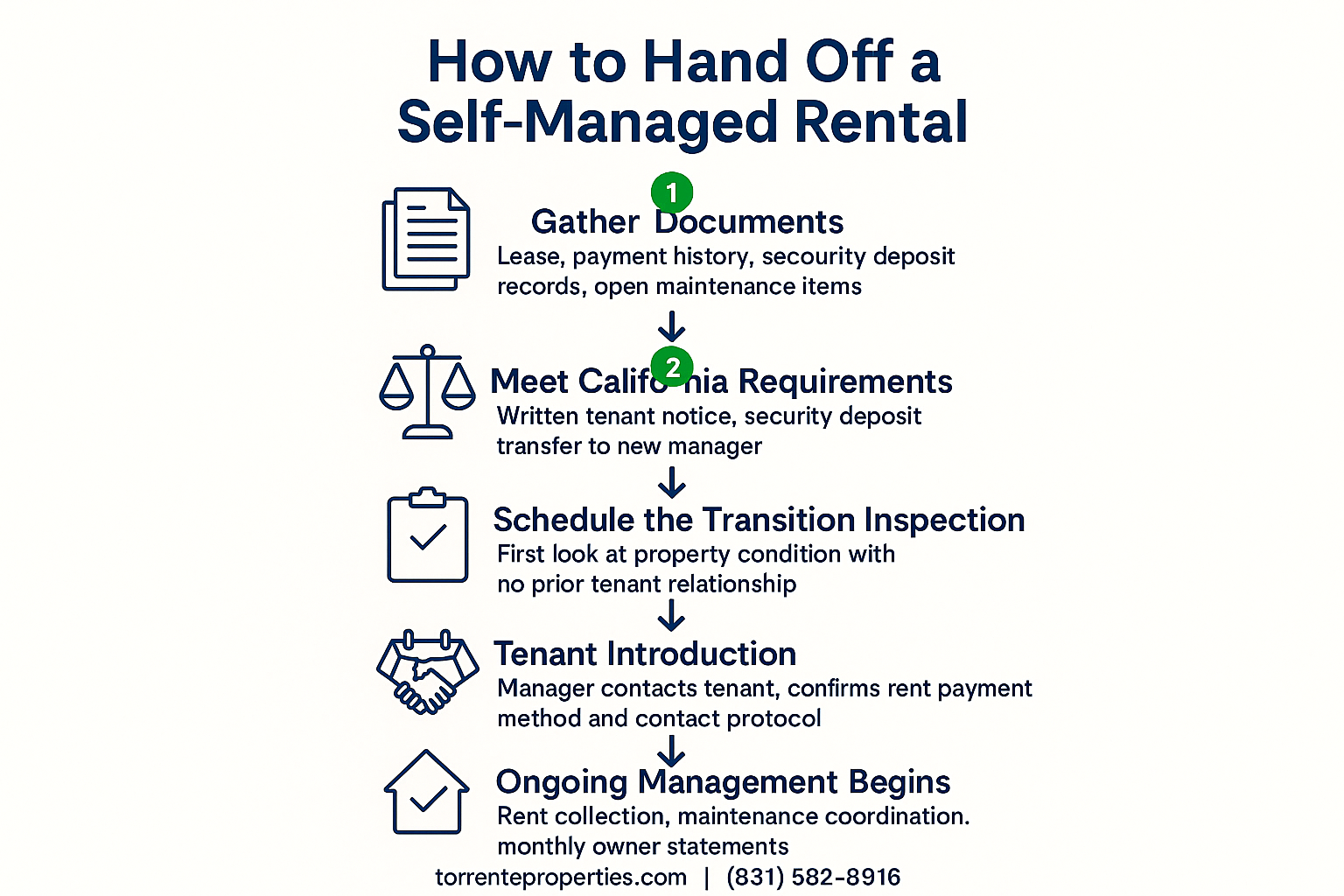
The Self-Management Handoff at a Glance
Here’s a quick look at the full transition sequence from self-managing landlord to professionally managed rental.

Step 3: The Transition Inspection, Expect to Learn Something
One of the most valuable parts of the handoff is also the one owners least expect: the property inspection.
When a manager who has no prior relationship with your tenant walks through the property, they often surface issues that have been quietly sitting there. Tenants who communicate directly with an owner they know personally sometimes avoid mentioning small problems, a slow drain, a window that sticks, a water stain on the ceiling, because they don’t want to cause friction or seem demanding.
A property manager asking those same questions in a routine, professional inspection gets different answers. And a fresh set of eyes catches things that neither party mentioned.
For owners in Salinas, Seaside, or Marina who live out of the area, that inspection is often the first current, objective look at their property’s condition in months, sometimes longer. What they find is rarely catastrophic, but deferred maintenance has a way of compounding quietly. Catching it early is almost always less expensive than catching it late.
This is also a good moment to review what actually needs to happen to get a Monterey Bay rental in shape, even for a property that already has a tenant in place.
Step 4: What Happens to the Existing Tenant
This is the part that makes a lot of self-managing landlords nervous: they’ve built a real relationship with their tenant, and they don’t want the transition to damage that.
The good news is that the tenant doesn’t have to move, doesn’t get re-screened, and doesn’t lose any of their existing rights. Here’s how it typically works:
- The current lease stays in place until its natural expiration or renewal date
- The property manager reaches out to introduce themselves and confirms the new process for rent payments and maintenance requests
- The tenant benefits from having a clear, professional point of contact, someone they can reach 24/7 for emergencies instead of texting a landlord at midnight
The lease review is where things get more nuanced. Even a lease from 2024 may be missing required disclosures tied to changes in California law that took effect in 2025 or 2026. Those gaps don’t have to be fixed mid-tenancy, but they do need to be corrected at renewal. If you want to understand what your rental lease may be missing under current California law, that’s worth reading before the next renewal comes up.
For owners who have been managing remotely, the handoff also means they stop being the person a tenant calls when the heater goes out at 10 p.m. That shift alone is significant.
Self-Management vs. Professional Management: What Changes at Handoff
Here’s a side-by-side look at what shifts when a self-managing landlord transitions to professional management, and what stays the same.
| Area | Self-Managing | After Handoff |
|---|---|---|
| Rent Collection | Owner collects directly, check, app, or cash | Manager collects through owner/tenant portal, deposits to owner |
| Maintenance Calls | Tenant calls or texts owner directly | Tenant contacts manager; 24/7 emergency line in place |
| Lease Compliance | Owner’s responsibility to track law changes | Manager reviews lease at renewal, flags required updates |
| Security Deposit | Held by owner, often in personal account | Transferred to manager’s trust account per California law |
| Property Inspections | Varies, often infrequent or owner-initiated | Scheduled move-in/move-out and routine inspections with photo records |
| Financial Reporting | Owner tracks manually | Monthly owner statements generated through management portal |
| Existing Tenant | No change in tenancy | No change in tenancy, lease stays, tenant is notified of new contact |
The Part Nobody Talks About: What the Transition Actually Feels Like
I’ve watched a lot of owners go through this process. The practical steps are manageable. What catches people off guard is how much mental weight they’d been carrying without fully realizing it.
Handling late-night maintenance calls, fielding tenant concerns directly, tracking rent payments manually, and staying current on California rental law changes, none of those tasks feel enormous on their own. But they accumulate. And for owners who are 50 or older, managing from out of the area, or dealing with an inherited property they never planned to have, that weight can quietly become exhausting.
One of our long-term clients who owns several properties in Salinas described it well: their review mentioned that ‘everything runs smoothly’, which sounds simple, but for someone who spent years troubleshooting on their own, smooth is everything. And one owner specifically shared this about working with our team: ‘Ashley has been very thorough with taking care of multiple rental properties in Salinas. It’s refreshing knowing we have that piece of mind…’, Hilda M.
That word, refreshing, comes up a lot. Not because management is magic, but because having a consistent, local, professional team carrying those daily decisions is a genuinely different experience than carrying them yourself.
If you’re wondering whether you’ve reached that point, this breakdown of when self-managing stops making sense is worth a few minutes of your time.
Frequently Asked Questions About Switching From Self-Management
Do I have to wait until my tenant moves out to make the switch?
No. The transition can happen with a tenant in place. The lease stays active, and the tenant is simply notified in writing that a new management company is handling things going forward. The handoff timing is a conversation between you and the property manager, it doesn’t require a vacancy.
What if I’ve been collecting rent informally and don’t have good records?
That’s more common than people expect, and it’s not a dealbreaker. It does mean there are a few extra steps to establish a clean starting point, confirming the deposit amount, documenting what’s been paid, and getting the tenant’s information on file properly. A property manager can walk you through exactly what’s needed. The goal is a clean baseline before ongoing management begins.
What happens to my security deposit when I bring on a manager?
Under California law, the security deposit needs to be transferred to the incoming manager, typically placed in their trust account. The tenant must also be notified in writing of where their deposit is being held. This is a required step, not optional, and a licensed property manager will handle the documentation for you.
Will the property manager raise my tenant’s rent right away?
Not automatically. Rent adjustments are something you discuss with your manager, and they’re subject to California’s rent increase rules, including AB 1482 protections that cap annual increases for many properties at 5% plus local CPI, or 10% total, whichever is lower. If you want to understand how rent changes work in 2026, this guide for Monterey Bay landlords covers it.
How much does professional property management cost in Monterey County?
Management fees vary depending on property type, location, and the scope of services. Generally speaking, monthly management fees for residential properties in Monterey County tend to fall somewhere in the range of 8% to 12% of collected rent, though that varies. There are often separate fees for leasing, inspections, and other services. For a specific quote based on your property, this breakdown of what property management costs in the Monterey Bay area is a good starting point.
What if my lease has outdated language or is missing required disclosures?
California rental law changes regularly, and leases from even a year or two ago may be missing required disclosures. The property manager will review the lease during the transition and flag anything that needs to be corrected at renewal. Mid-tenancy changes require tenant agreement, so most corrections happen at the renewal stage, not immediately.
Ready to Hand Off the Day-to-Day?
If you’ve been managing your own rental in Monterey County and you’re ready to understand what a transition actually looks like for your specific situation, we’re glad to walk through it with you. Whether you have a tenant in place, a property that needs some attention first, or just a lot of questions, our team is here to give you a straight answer. Reach us at (831) 582-8916 or through the contact form at torrenteproperties.com.