
Direct Answer: Set market rent, bring the home up to California habitability standards, use a compliant lease, document move-in condition with photos, and have a local person handle maintenance and monthly reporting.
You accepted a job in another state, or orders came through, or you just could not sell at the price you wanted. Either way, your Monterey home is about to become a rental, and you are about to become a landlord from 500 or 3,000 miles away.
The first 90 days decide almost everything. Rent price, prep work, the lease, the deposit, move-in photos, and that first 9 p.m. maintenance call all happen inside this short window.
I have watched owners handle this window well and I have watched it go sideways. Below is the timeline I would follow, week by week, for a home in Monterey, Seaside, Marina, Pacific Grove, or Salinas.
Days 1 to 10: Set the Rent Before You Set Anything Else
Almost every owner who contacts us about renting a home asks two questions in the same message: what do you charge, and what will my place rent for. That instinct is right. Everything else in the first 90 days depends on the rent number.
A real market rent analysis is not a Zillow guess. Here is what actually goes into it:
- Active comparables in the same submarket, because that is your live competition
- Recently leased comparables, which tell you what tenants actually paid, not what owners asked
- Size and condition adjustments for square footage, bed and bath count, parking, yard, and updates
- Neighborhood demand, which is very different in Pebble Beach than it is in the Alisal area of Salinas
- Seasonal timing, which people underestimate constantly
That last one matters more here than in most markets. Around the Peninsula, summer brings school moves, Naval Postgraduate School and DLI arrivals, and hospital hires. A 3-bedroom Monterey home listed in August often supports meaningfully more rent than the same home listed in November, and the spread can run in the range of a couple hundred dollars a month.
If your move date is flexible by even three weeks, that timing decision is worth having a conversation about before you list.
Days 5 to 25: Get the House Legally and Physically Rentable
This is the step first-time remote landlords skip, because when you lived there it felt fine. A home that was comfortable for you is not automatically a home that meets California habitability standards for a paying tenant.
At minimum, before anyone moves in, the property needs:
- Working plumbing with hot and cold water and no active leaks
- Working heat in every living area
- Safe electrical, including GFCI outlets near water and no exposed splices
- Smoke alarms in each bedroom, outside sleeping areas, and on every level
- Carbon monoxide alarms on every level with sleeping areas if there is gas, a fireplace, or an attached garage
- Working locks on all exterior doors and windows
Then there is the deferred stuff. Owner-occupied homes on the Peninsula almost always have a few of these waiting: a slow drain someone learned to live with, a sticking slider, dry rot on a south-facing trim board, a garage full of paint cans and holiday bins.
Clear all personal property out. Anything you leave behind becomes something you are responsible for repairing or replacing.
Cosmetics matter too, but only where they move the rent. Fresh paint, clean carpet, tidy landscaping, and clean windows typically pay for themselves in shorter vacancy. A remodeled kitchen usually does not, at least not in year one. If you want a fuller picture of what these line items add up to, we broke it down in the hidden costs of managing a Monterey home from out of state.

Days 20 to 40: The Lease Is Not a Formality
A lease you pulled off the internet or wrote from memory is where remote landlords get hurt. California requires specific disclosures in residential leases, and missing one can weaken your position later when it matters most.
The items that get left out most often:
- Megan’s Law disclosure, required in essentially every residential lease. The state maintains the official Megan’s Law database the notice points tenants toward.
- Lead-based paint disclosure and pamphlet for any home built before 1978, which covers a huge share of housing in Pacific Grove, downtown Monterey, and older Salinas neighborhoods
- Bed bug information notice
- Local addenda that apply to your specific city
On the deposit: as of July 1, 2024, most residential landlords in California are capped at one month’s rent for the security deposit, furnished or not. If you were planning on two months because that is what you paid as a tenant years ago, that plan is out of date.
City rules stack on top of state rules. Salinas runs a Residential Rental Registration program for rental properties. The City of Monterey prohibits residential rentals of fewer than 30 days, so your lease term needs to respect that. Santa Cruz has its own rental inspection requirements.
Sign electronically, keep the executed copy somewhere you can retrieve it in 30 seconds, and give the tenant a full copy the same day.
The First 90 Days at a Glance
Here is the same timeline in one view, along with the spot where I most often see owners lose money or leverage.
| Phase | What Gets Decided | Where Owners Slip |
|---|---|---|
| Days 1-10 | Market rent, listing timing, rent vs sell | Pricing off a website estimate instead of leased comps |
| Days 5-25 | Habitability items, deferred repairs, clean-out | Leaving personal property and unfinished repairs behind |
| Days 20-40 | Lease, disclosures, deposit, city registration | Generic lease form missing required California disclosures |
| Days 35-50 | Screening, approval, move-in condition report | No dated photo record of condition at handover |
| Days 50-90 | Maintenance protocol, first statement, first inspection | No local responder and no written reporting baseline |
Days 35 to 50: Screen Well, Then Document the Handover
Screening is the last moment you have full control. Once keys change hands, your options narrow considerably.
A real screen covers credit, nationwide criminal background, eviction history, income and employment verification, and calls to prior landlords. Apply the same written standard to every applicant, every time.
Then document condition. This is the single cheapest insurance policy in the whole process:
- Dated photos of every room, including inside cabinets, closets, and the garage
- Photos of all appliances and their serial plates
- Exterior shots of roof edges, gutters, fencing, decks, and drainage
- Meter readings and detector test dates
- A written move-in condition report signed by the tenant
Without that record, a deposit deduction 24 months from now is your word against theirs. With it, the conversation is short and usually friendly.
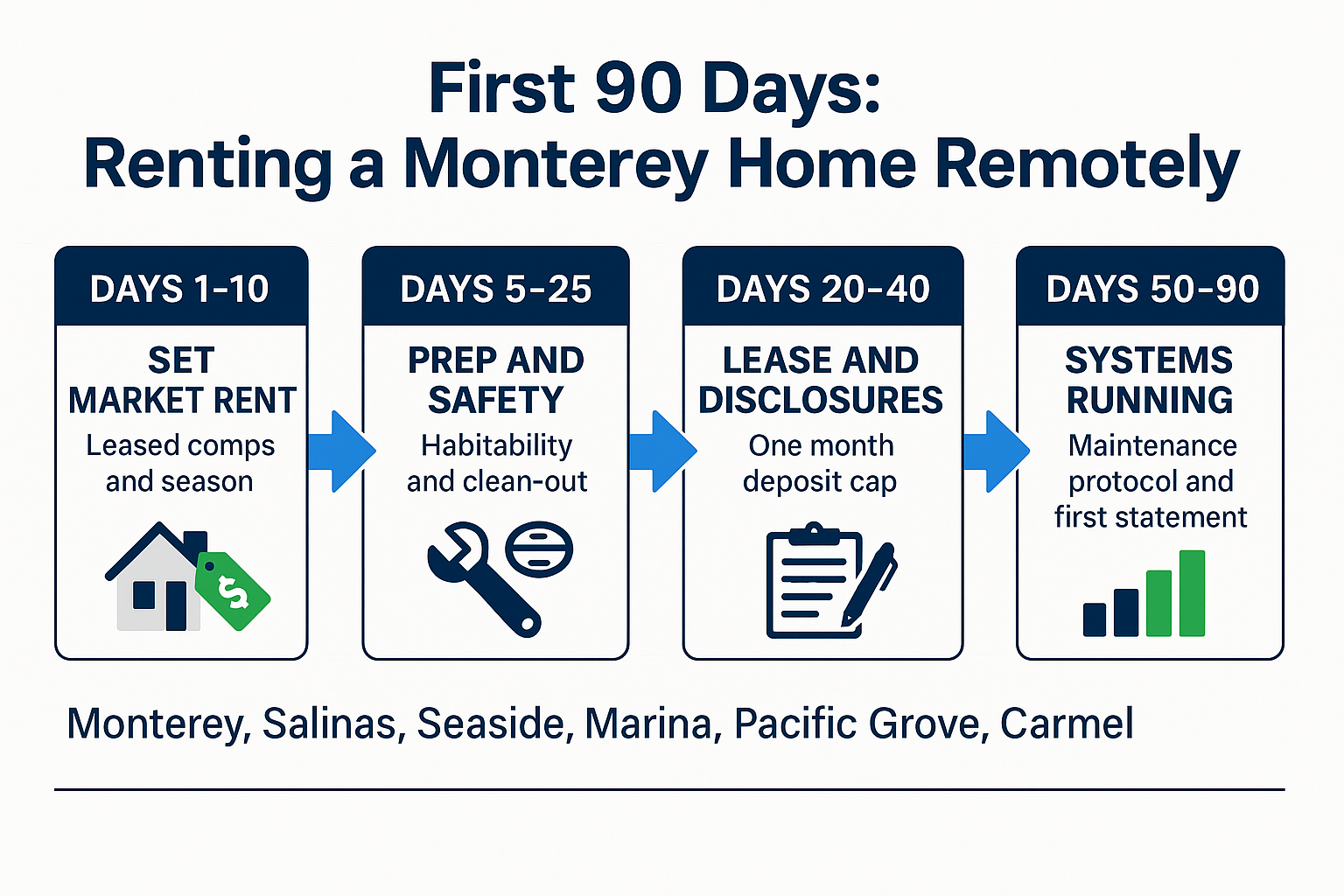
Your 90-Day Remote Landlord Sequence
This is the order I would run it in, and roughly when each piece should land.
Days 45 to 60: Decide Who Answers the Phone at 2 a.m.
This is the part remote owners underestimate most. A tenant who cannot reach anyone about a repair is a tenant building a paper trail, and in California an unaddressed habitability issue can turn into a rent withholding or repair-and-deduct problem fast.
Set the protocol in writing before move-in, not after the first call:
- How requests get submitted, ideally through one portal so there is a timestamp
- Response standard for non-emergencies, commonly acknowledged within one business day
- What counts as an emergency: no heat, no water, active leak, sewage backup, gas smell, lockout, broken exterior door
- Who physically shows up, with a licensed and insured vendor already lined up for plumbing, electrical, and roofing
That last bullet is the one you cannot solve from Denver or Virginia Beach. A phone number is not a response. When a water heater lets go in a Seaside single-story at midnight, somebody has to be able to reach the shutoff within the hour.
Winter storms make this concrete. Monterey Bay gets driving rain and wind off the water, and roof leaks, clogged gutters, and water intrusion cluster in January and February. We wrote more about how distance changes day-to-day response in how out-of-area owners actually manage a Monterey Bay rental.
Days 60 to 90: Your First Owner Statement Sets the Baseline
Month one reporting is not busywork. If you do not have a clean record of month one, you have nothing to compare month six against.
A monthly owner statement should show, at minimum:
- Rent collected, with the date received and any late fee applied
- Deposits held, listed separately from income, because that money is not yours
- Itemized expenses with vendor name, invoice number, and what was done
- Management fee and leasing fee, shown as line items
- Owner obligations paid on your behalf, such as mortgage, insurance, or property taxes if that is part of the arrangement
- Net disbursement to you and the date it was sent
Keep every one of them. That file does three jobs later: it makes your Schedule E straightforward at tax time, it supports an insurance claim if storm damage hits, and it becomes the income record a buyer’s lender asks for if you eventually sell with a tenant in place.
Round out the quarter with a first interior and exterior inspection. Ninety days in is early enough to catch a housekeeping problem, an unauthorized pet, or a slow leak while it is still cheap. For a sense of how fee structures work locally, see our breakdown of what property management really costs in Salinas.
A Few Monterey-Specific Wrinkles Worth Knowing
Some situations here come with their own rules and rhythms.
Military owners. PCS timelines rarely line up with the rental calendar, and deployment makes self-management close to impossible. We covered that in detail in PCS orders and your Monterey Bay home.
Furnished rentals. Plenty of Peninsula owners consider leaving the furniture, and it can work for the 30-day-plus corporate and academic market. It also changes your inventory, insurance, and condition documentation. Read renting your home furnished in the Monterey Bay area before you decide.
Vacancy between owner and tenant. If the home will sit empty for a stretch while you prep, it should still be checked on a schedule. Coastal moisture, wind, and unoccupied plumbing do not wait politely.
One more thing worth saying plainly. Our team works in both English and Spanish, which matters in Salinas and Seaside where a large share of owners and residents prefer Spanish. Communication gaps cause more landlord problems than almost anything else.
Frequently Asked Questions About Renting a Monterey Home From Out of State
How long does it usually take to get a Monterey home leased?
It depends on price, condition, and season. A well-priced, move-in ready home in Monterey or Marina during spring and summer often leases quickly, while the same home listed in late fall can take noticeably longer. Overpricing by even a small margin is the most common reason a listing sits.
Can I collect two months of security deposit if I am renting the home furnished?
Generally no. Since July 1, 2024, most California residential landlords are limited to one month’s rent for the security deposit regardless of whether the unit is furnished. There is a narrow exception for certain small landlords, so confirm your situation before you write the lease.
What does property management cost around Monterey County?
Fees vary by property type, unit count, condition, and what is included. Most owners here see a monthly management fee based on a percentage of collected rent, plus a separate leasing fee when a new tenant is placed. Because the details differ property by property, the honest answer is to ask for a quote on your specific home.
Do I need to register my rental with the city?
Possibly. Salinas operates a Residential Rental Registration program, Santa Cruz has rental inspection requirements, and multifamily owners statewide are subject to SB 721 and AB 2579 balcony and exterior elevated element inspection deadlines. Rules depend on your city and property type, so check before you list.
Should I just have a friend or family member check on the place?
It works until it does not. A neighbor can grab mail, but they cannot legally screen applicants, hold a deposit in compliance with state law, or dispatch a licensed plumber at 2 a.m. That arrangement also strains the relationship the first time something goes wrong.
Planning your first 90 days as a remote Monterey landlord?
If you are working through rent pricing, prep, or the lease for a home in Monterey, Salinas, Seaside, Marina, Pacific Grove, or Carmel, our team is here in Monterey County and happy to talk it through. You can reach us at (831) 582-8916 or through the contact form at torrenteproperties.com. We work in English and Spanish, and there is no pressure either way.