Direct Answer: Out-of-area owners manage Monterey Bay rentals successfully by building a local system for communication, maintenance response, and financial reporting, not by checking in occasionally and hoping for the best.
The question I hear most often from out-of-area owners isn’t ‘can I manage this from a distance?’ It’s ‘what does that actually look like in practice?’ And that distinction matters, because a general description of ‘remote property management‘ doesn’t prepare anyone for what running a rental in Seaside, Salinas, or Marina feels like when you’re living in Sacramento, Seattle, or San Antonio.
What I’ve seen, working with landlords across Monterey County for over two decades, is that the owners who struggle are almost never the ones with bad properties. They’re the ones without a real local system, no clear communication rhythm, no defined process for maintenance decisions, and no meaningful financial reporting. Distance doesn’t create problems on its own. The absence of structure does.
This article focuses on the three things that actually determine whether remote ownership works: how you stay informed, how maintenance gets handled, and what your monthly financials should actually tell you. I’m also going to address something most owners conflate, the rent-or-sell question versus the how-do-I-manage-it question, because answering one doesn’t answer the other.
The Rent-or-Sell Question Is Separate From the Management Question
A homeowner in East Garrison reached out not long ago, preparing to relocate and asking for a realistic rent estimate so they could ‘decide whether it makes more sense to rent or sell.’ That’s one of the most honest questions an owner can ask, and it’s actually two separate decisions that most people treat as one.
The rent-or-sell question is financial: what will the property realistically generate as a rental, what are the carrying costs, and does holding it make sense given your tax situation, equity position, and long-term goals? Getting a rental price analysis is the starting point for that conversation, but it’s not the whole conversation.
The management question is operational: if you decide to rent, what does your oversight structure look like? These two questions need different information and different conversations. Owners who skip the second one, who decide to rent without thinking through how they’ll actually manage it from a distance, tend to be the ones calling us six months later after something has gone wrong.
If you’re weighing this decision after a job relocation or military orders, this breakdown for owners leaving the Monterey Bay area covers the specific factors worth thinking through before you commit to either path.
What a Real Local Oversight System Looks Like
The most common thing remote landlords underestimate is how fast small problems compound when nobody is watching. A slow drip under a kitchen sink in Seaside can become a mold problem inside six weeks if the only person who might notice is a tenant who doesn’t want to bother anyone.
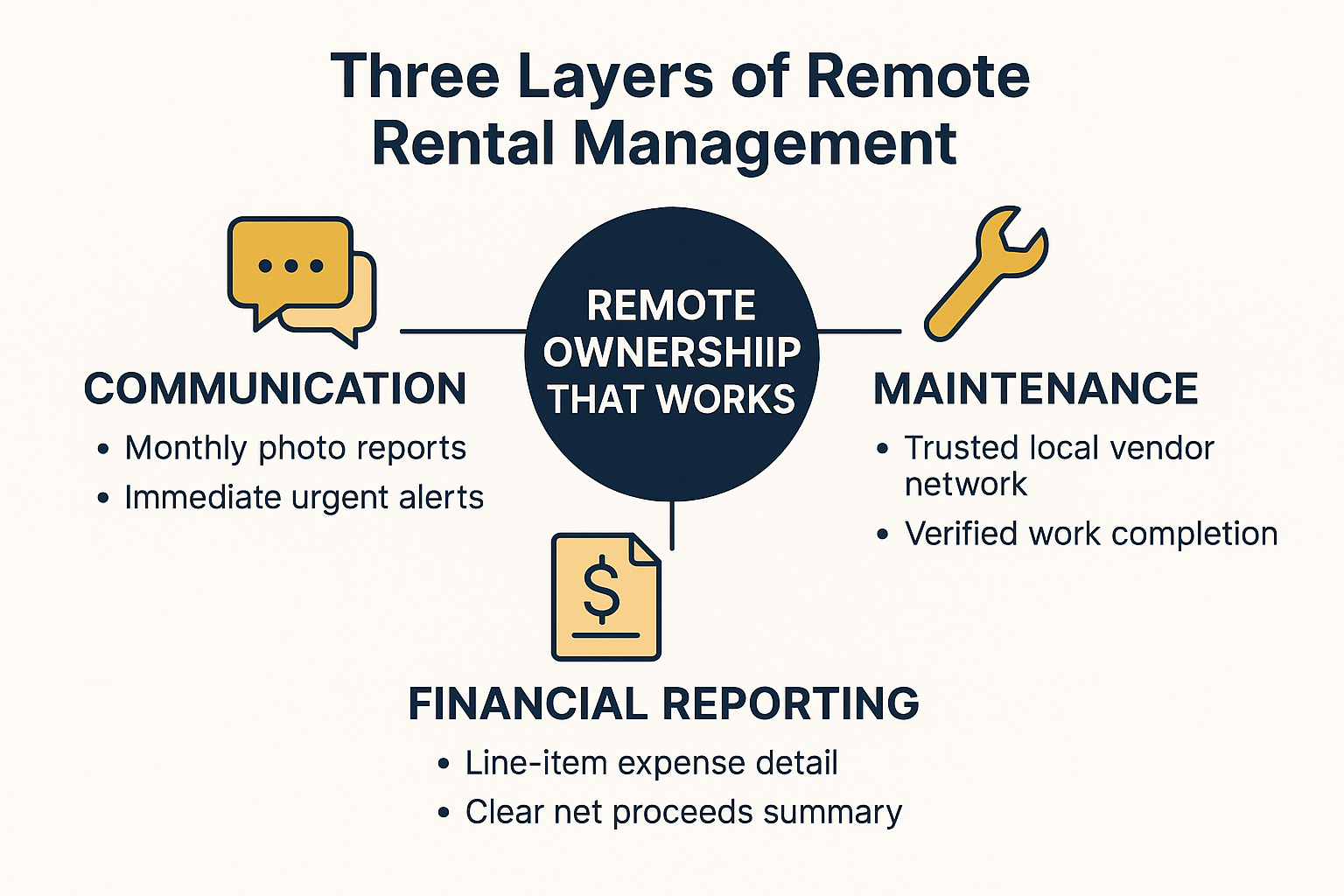
A real oversight system has three layers that work together:
1. Communication, How and how often you get information
Good management means you’re not waiting for something to go wrong to hear from your management team. You should receive:
– Monthly owner statements with income, expenses, and maintenance activity
– Inspection reports with photos at move-in, move-out, and at scheduled intervals
– Immediate notification when something urgent comes up, not a summary two weeks later
The cadence matters as much as the content. An owner in Pacific Grove or Prunedale shouldn’t be wondering what’s happening at their property. They should know.
2. Maintenance, Who decides, who acts, who verifies
This is where most remote arrangements break down. The question isn’t just ‘who coordinates repairs?’ It’s who decides whether a repair is urgent, who selects the vendor, and, critically, who verifies the work was actually done right.
A management team without a local vendor network will default to whoever answers the phone fastest, which isn’t always the best call for your property or your wallet. Our team works with vendors we know personally across Monterey, Salinas, Marina, and Seaside, which means we’re not guessing when a plumber shows up.
3. Financial oversight, What your statement should actually tell you
I’ll cover this in depth in the next section, because most owners have never seen a real property management statement, and don’t know what to ask for.
What a Monthly Owner Statement Should Actually Tell You
Most remote owners have never seen a real property management financial statement. They assume a rent deposit plus an occasional repair bill is sufficient reporting. It isn’t.
A well-structured monthly owner statement should include:
– Gross rent collected for the period
– Management fees and any leasing or placement fees charged that month
– Individual line items for every maintenance expense, not a lump-sum ‘repairs’ figure
– Vendor name and work description for each maintenance charge
– Net proceeds distributed to the owner, with a running balance
– Any reserves held and what they’re earmarked for
What a statement should not do is obscure expenses inside vague categories. If you can’t tell from your monthly report who was paid, for what, and when, that’s a gap worth asking about.
The flip side is equally important: a detailed statement isn’t a replacement for physical oversight. Numbers tell you what was spent. They don’t tell you whether the repair was done correctly, whether the property is being maintained between incidents, or whether a small issue is being caught before it becomes expensive. The hidden costs of managing a Monterey home from out of state are often the ones that don’t show up in any statement at all, until the damage is already done.
Owners managing from the Bay Area or further often describe peace of mind as the actual product they’re buying. One multi-property owner in Salinas put it plainly in a review: ‘It’s refreshing knowing we have that peace of mind.’ That framing is honest. The real value of a trustworthy local team isn’t just the task list, it’s the mental bandwidth you get back when you know someone with local knowledge is physically present and accountable.
Three Layers of Remote Rental Management
Here’s how the three core functions of remote property management connect, and what each one actually requires to work.
California Compliance: What Out-of-Area Owners Don’t See Coming
California rental law doesn’t pause because you moved away. And the rules aren’t uniform across Monterey County, each city has its own layer on top of state requirements.
A few of the compliance realities that catch remote owners off guard most often:
- Salinas landlords must register rental units through the city’s Residential Rental Registration program. Owners who’ve relocated and assumed their property would ‘run itself’ frequently discover this requirement after the fact, and ignorance of a local ordinance doesn’t excuse non-compliance.
- Monterey, Pacific Grove, and Seaside each have local rules around habitability notices, allowable rent increases, and tenant protections that differ in their specifics. A lease that works in one city isn’t automatically compliant in another.
- California’s security deposit cap, which dropped to one month’s rent effective July 1, 2024, changed the math for landlords who had been collecting two months. Owners who haven’t updated their lease terms may be holding deposits they’re no longer legally entitled to. Your lease terms may have changed in other ways too, 2026 brought additional landlord obligations worth knowing.
- Multifamily owners in the region also need to be aware of exterior elevated element inspection requirements under SB 721, which affects properties with decks, balconies, or elevated walkways.
The California Department of Consumer Affairs publishes a general landlord-tenant handbook, but it won’t capture city-specific local ordinances. That’s where local expertise makes a real difference. A management team that operates only in the region knows the specific rules in the cities where your property sits.
How Remote Ownership Risk Changes by Management Structure
This table shows how common remote ownership risks shift depending on whether you’re self-managing from a distance, using minimal oversight, or working with a full local management structure.
| Risk Area | Self-Managing Remotely | Full Local Management |
|---|---|---|
| Slow leak or water intrusion | May go undetected for weeks or months | Caught during routine or seasonal inspection |
| Local compliance (e.g., Salinas registration) | Owner must track and manage independently | Handled as part of ongoing management |
| Maintenance vendor selection | Owner calls blindly or relies on tenant referrals | Known, vetted local vendors with work verification |
| Tenant screening | Owner reviews applications without local market context | Full credit, background, and rental history screening |
| Monthly financial clarity | Owner tracks deposits and receipts manually | Itemized statements with every expense documented |
| California law changes | Owner must monitor independently | Local team tracks and applies updates as they occur |
The Real Cost of Peace of Mind, and What It’s Measured Against
Property management fees in California vary by market, property type, and scope of services. In the Monterey Bay area, full-service residential management typically runs somewhere in the range of 8% to 12% of monthly rent collected, though the actual number depends on factors like unit count, property condition, and what’s included in the agreement. Some firms charge separately for leasing, inspections, and maintenance coordination on top of a base rate. Others bundle it. Asking exactly what’s included, and what triggers an additional charge, is the right question before you sign anything.
What I’d encourage remote owners to weigh that cost against is the realistic alternative. A water intrusion event that goes undetected for six weeks in a Monterey or Salinas property can mean mold remediation costs that run into the thousands, sometimes far beyond. A bad tenant placement in a market you don’t know well can mean months of lost rent plus legal costs. What can go wrong in an empty house is a longer list than most owners expect before they’ve experienced it.
The owners I’ve worked with who are most at peace with remote ownership aren’t the ones paying the lowest fees. They’re the ones who know exactly what’s happening at their property, and aren’t spending mental energy worrying about what they don’t know.
Frequently Asked Questions About Managing a Monterey Bay Rental Remotely
How often should a property manager actually visit my rental property?
It depends on whether the property is occupied or vacant, but for occupied rentals, at minimum twice a year is a reasonable floor, move-in, move-out, and at least one mid-tenancy inspection. Vacant or seasonal properties need more frequent eyes on them. Our Seasonal Property Maintenance Program does quarterly inspections with photo documentation specifically for owners who aren’t local. For general guidance on check-in frequency, this breakdown is worth reading.
Do I need to tell my insurance company I’m renting out the property?
Yes, and this is one of the things that trips up accidental landlords most often. A standard homeowner’s policy typically doesn’t cover a rental property. You’ll want to talk to your insurance agent about converting to a landlord or dwelling policy, and make sure you do it before a tenant moves in, not after something goes wrong.
What’s the difference between a property manager and a caretaker?
A property manager handles an occupied rental, tenants, leases, rent collection, maintenance coordination, compliance. A caretaker or home watch service is for vacant or seasonal properties where there’s no tenant, but the property still needs regular eyes on it. Both involve physical inspections and maintenance coordination, but the relationship and legal structure are different. We offer both services across Monterey, Carmel, Pacific Grove, and surrounding areas.
How do I know what my Monterey Bay rental should actually rent for before I decide to hold the property?
A reliable rental price analysis looks at comparable active listings, recent lease transactions, and seasonal demand patterns in your specific area, not just Zillow estimates, which are often based on stale or thin data in smaller markets like Marina or Seaside. A local manager who works in the market daily can give you a more grounded number than any automated tool. Here’s how rental pricing actually works in the Monterey Bay market if you want to understand the inputs.
Can I manage a Salinas rental remotely without registering it with the city?
No. Salinas requires landlords to register rental units through the city’s Residential Rental Registration program regardless of where the owner lives. The registration requirement doesn’t go away because you’ve relocated. Failing to register can result in fines and creates complications if you ever need to pursue an eviction or code compliance issue.
What should I look for in a property management contract before signing?
The key questions are: what’s the base management fee, what triggers additional charges (leasing, inspections, maintenance markup), what’s the notice period to terminate, and how are maintenance decisions made and approved. Specifically, ask whether there’s a threshold, say, $200 or $300, below which the manager can authorize repairs without your approval. That threshold protects you from surprise bills and tells you a lot about how the relationship will actually work.
Ready to Know Exactly What’s Happening at Your Property?
If you own a rental in Monterey County and you’re managing it from a distance, or deciding whether to rent or sell before you relocate, our team at Torrente Properties is glad to talk through your specific situation. We’ve worked with owners across Salinas, Monterey, Pacific Grove, Seaside, Marina, Carmel, and beyond, and we know the local market in a way that a general description of ‘property management’ can’t capture. Reach us by phone at (831) 582-8916 or through the contact form at torrenteproperties.com.