
Direct Answer: Furnished rentals can command higher monthly rents in Monterey Bay, but the premium varies by neighborhood and property type, and the added risk to your furniture and contents is real, especially under California’s one-month security deposit cap.
Over the past several months, I’ve fielded the same question from multiple owners across Monterey Bay: does renting furnished actually pay off? One owner in Marina was preparing to leave in two to three months and wanted to rent a furnished studio. Another was targeting Naval Postgraduate School students in Monterey. A third had a fully remodeled condo and wanted to know whether adding furniture would justify a higher rent.
The honest answer is that it depends, and not in a vague way. The premium varies considerably by neighborhood, property size, and the quality of what you leave inside. A furnished one-bedroom in Seaside draws a different pool of tenants at a different price point than a furnished condo near downtown Monterey.
Before you decide to leave your furniture behind, there are three things worth understanding clearly: whether the premium is real in your specific submarket, what the California security deposit cap means for your contents, and why your documentation has to be airtight before the tenant moves in.
Does Furnished Actually Mean More Money in Monterey Bay?
Sometimes yes, sometimes the math is closer than people expect. Furnished units in Monterey Bay tend to draw a specific kind of tenant: someone on a temporary assignment, a military member at the Naval Postgraduate School or the Defense Language Institute, or a professional who relocated for work and hasn’t found a permanent home yet. These tenants are often reliable payers, but they also want shorter lease terms or a clear end date built in.
In submarkets with high military and government presence, like Monterey and parts of Seaside, furnished units can realistically see 15 to 30 percent higher monthly rents compared to an unfurnished equivalent, depending on condition and what’s included. But that range reflects general market context, not a guarantee for your specific property. I’ve seen furnished units sit longer than unfurnished ones when the furniture was dated or the location wasn’t well matched to the transient tenant pool.
For owners in Marina, Salinas, or Pacific Grove, the furnished premium tends to be smaller and harder to predict. How Monterey Bay rental prices actually get set is worth reading before you set any number, furnished or not. Accurate pricing is the single biggest factor in how fast your unit leases.
One thing owners consistently underestimate: furnished doesn’t just mean more rent, it also means more wear. A couch takes abuse. Mattresses get stained. Small appliances disappear or break. If those items belong to you, they’re your replacement cost.

The Security Deposit Problem Nobody Mentions Upfront
California tightened the security deposit cap on July 1, 2024. For most residential landlords, the limit is now one month’s rent, regardless of whether the unit is furnished or unfurnished. That cap has not changed to account for the higher value of contents inside a furnished unit.
Think about what that means in practice. If you’re renting a furnished home with a leather sofa, a bedroom set, a dining table, and appliances, you might have $8,000 to $15,000 or more in personal property inside that unit. Your deposit might cover $2,500 or $3,000. If a tenant causes serious damage to multiple pieces of furniture, you are absorbing the difference.
This doesn’t mean furnished rentals are a bad idea. It means you need to go in with clear eyes. A few things that matter here:
- Only leave furniture you can afford to lose or replace. Heirloom pieces and high-end items don’t belong in a rental.
- Photograph every item at move-in, with timestamps.
- Document condition in writing with a signed inventory addendum before the tenant takes possession.
- Price the rent to account for replacement risk over the likely tenancy period.
I’ve seen owners get surprised at move-out when a claim falls apart because there was no documentation. Without a signed, itemized inventory at move-in, deductions are almost impossible to defend, in California or anywhere else. The California Courts Self-Help Guide on security deposits outlines what landlords can and cannot deduct, and the rules favor documented evidence over memory.
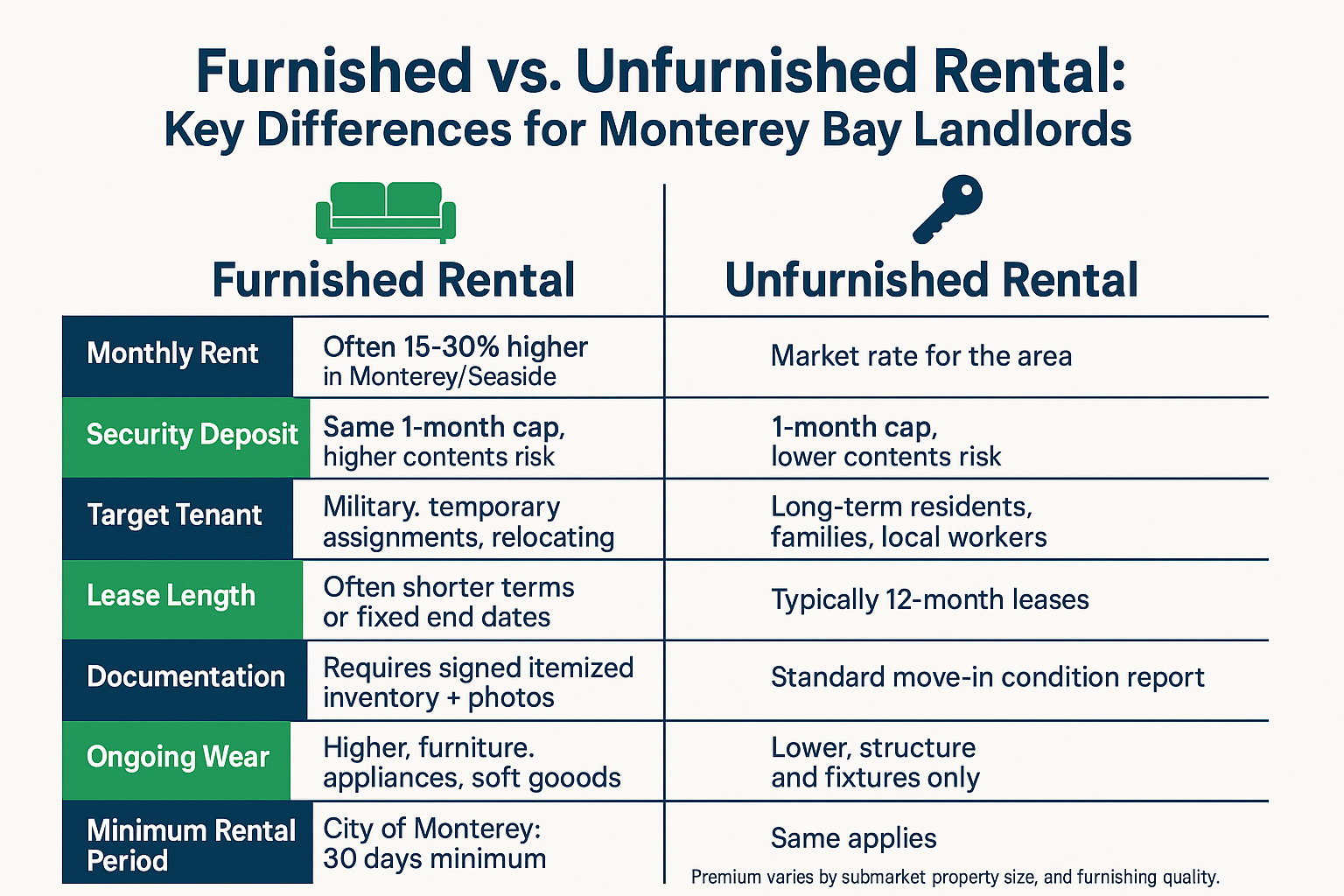
Furnished vs. Unfurnished Rental: What Changes for Monterey Bay Owners
This side-by-side comparison covers the key differences owners should weigh before deciding whether to rent their Monterey Bay home furnished.
Documentation Before You Leave Is Non-Negotiable
This point matters more for owners who are renting furnished because they’re relocating, which describes a large share of the owners I talk to. If you’re moving out of the area before your tenant moves in, you will not be there to observe anything firsthand. Every piece of protection you have will come from the paperwork you created before you left.
The baseline for a furnished rental should include:
- A complete itemized inventory listing every piece of furniture, every appliance, and every notable item by room
- Condition notes for each item (scratches, existing wear, age)
- Timestamped photographs of every room and every significant piece of furniture
- A signed inventory addendum attached to the lease, acknowledged by the tenant at move-in
Without all four, you’re relying on goodwill at move-out. That’s a bad position.
For owners leaving in a compressed timeline, this feels like a lot. But it’s the kind of thing that takes a few hours upfront and saves a real argument two years later. Getting a Monterey Bay rental ready before tenant move-in covers the broader preparation process, including compliance items that also need to be in order before anyone occupies the unit.
One thing that often gets missed: the City of Monterey prohibits rentals under 30 days, so if you’re thinking of a furnished rental there, you’re looking at traditional tenants on monthly or annual terms, not anything resembling a vacation rental. That shapes who you’re marketing to and what lease structure makes sense.
Furnished Rental Documentation Checklist
These are the documents and records I recommend every furnished rental owner have in place before the tenant takes possession.
| Document / Record | What It Covers | Why It Matters |
|---|---|---|
| Signed Lease Agreement | Rent amount, term, furnishing terms, tenant obligations | Establishes the legal relationship and any special furnished-unit clauses |
| Itemized Inventory Addendum | Every piece of furniture, appliance, and fixture by room | Required to support any deduction claim at move-out |
| Timestamped Move-In Photos | Visual condition of all rooms and items at occupancy | Backs up written condition notes in any dispute |
| Appliance Age and Condition Notes | Age, brand, and current condition of each appliance | Establishes baseline for wear vs. damage at move-out |
| Signed Tenant Acknowledgment | Tenant confirms inventory and condition at move-in | Prevents ‘I never saw that’ claims later |
Staying on Top of Condition When You’re Not Around
Furniture and soft goods deteriorate faster than a building does. A broken appliance, a water stain on an upholstered chair, or a damaged mattress doesn’t get reported by a tenant who either doesn’t notice or doesn’t want to cause friction. If you’re managing from out of the area, you may not know about it until move-out, when it’s too late to address it under the tenancy.
This is the same reason out-of-area owners benefit from regular in-person property checks, whether their home is rented or sitting empty. Out-of-area owners managing a Monterey Bay rental covers the practical logistics of remote ownership in more detail, including what things tend to go wrong when no one is physically checking.
For owners with furnished vacation or seasonal homes, similar logic applies. Even when a property is vacant, contents can be affected by humidity, pests, water intrusion, or deferred maintenance. Owning a second home on the Monterey Peninsula while you’re not there is worth reading if your situation involves extended absences rather than an active tenancy.
Regular inspections, documented with photos and condition notes, are the only way to stay ahead of deterioration in a furnished rental. Without them, you’re making decisions at move-out with incomplete information.
Frequently Asked Questions About Renting a Furnished Home in Monterey Bay
How much more rent can I realistically expect for a furnished unit in Monterey?
It varies by property type and location. In areas with strong military and government tenant demand, like central Monterey and parts of Seaside, furnished units have historically rented for 15 to 30 percent more than equivalent unfurnished units. But that’s a general range, not a promise for your specific address. Condition of the furnishings, unit size, and how well the property matches the furnished-tenant profile all affect the actual number.
Does the security deposit cap apply differently for furnished rentals?
No. Since July 1, 2024, California’s security deposit cap is one month’s rent for most residential landlords, and that cap does not change based on whether the unit is furnished. You’re taking on more contents risk with a furnished unit without any additional deposit protection. This is why keeping furniture values reasonable and documentation thorough is so important.
Can I rent my Monterey home for just a few weeks at a time to corporate tenants?
Not in the City of Monterey. The City of Monterey prohibits rentals under 30 days, which rules out anything resembling a short-term or corporate-week arrangement. If you’re in Monterey, you’re looking at month-to-month or longer-term tenancies. Other Monterey Bay cities have different rules, so it’s worth confirming the local requirements for wherever your property sits.
What furniture should I leave versus take with me?
Leave items that are in solid condition, easy to replace, and not personally valuable. A good quality sofa, a dining set, and a basic bedroom setup are reasonable. High-end furniture, family heirlooms, or anything you would be upset to replace should come with you. Assume everything you leave will show wear after a tenancy, and price the rent accordingly.
Is a furnished rental a good fit for military tenants from NPS or DLI?
Often yes. Military members and defense contractors on temporary assignments are among the most consistent furnished-rental tenants in Monterey Bay. They tend to be reliable payers and often prefer furnished units because they’re moving with limited household goods. The tradeoff is that they typically want defined end dates or short initial terms, so owners need to decide upfront whether they’re comfortable with that flexibility or prefer a longer commitment.
Do I need a separate addendum for the furniture inventory, or does the lease cover it?
A standard lease won’t capture the level of detail you need. A signed inventory addendum, listing every item by room with condition notes, is separate from the lease itself and should be signed by the tenant at move-in. Without it, you have almost no basis for deducting damage to specific items at move-out.
Have Questions About Renting Your Monterey Bay Home Furnished?
If you’re weighing whether to rent furnished, figuring out how to price it, or trying to get your documentation right before you leave the area, we’re happy to talk through your specific situation. Our team works with landlords across Monterey, Salinas, Pacific Grove, Seaside, and Marina every day, and furnished rentals come up often enough that we’ve seen most of what can go right and wrong. Reach us at (831) 582-8916 or through the contact form at torrenteproperties.com.