Direct Answer: On November 3, 2026, Salinas voters decide Ordinance No. 2687. A YES vote repeals four rental ordinances, including rent stabilization. A NO vote keeps them. All four stay in effect until then.
About half the Salinas owners I talk to have the November ballot measure backwards. They think a YES vote protects the rent cap. It does the opposite.
I do not blame anyone for the mix-up. The measure asks voters whether to adopt a repeal, so the two sides feel flipped from what people expect when they read the summary fast.
So let me cover the three things that actually matter to you as an owner: what Ordinance No. 2687 would do, who the Salinas rent cap reaches in the first place (most owners guess wrong here), and how to handle a rent increase or a lease renewal this winter while the rules are still unsettled.
What Ordinance No. 2687 Actually Puts on the November 3 Ballot
The Salinas City Council voted on September 23, 2025 to place a repeal ordinance on the ballot. Voters decide it on November 3, 2026.
The measure does not touch one rule. It would repeal four separate rental ordinances together:
- Residential Rental Registration
- Rent Stabilization
- Tenant Protection and Just Cause Eviction
- Tenant Anti-Harassment
So the vote reads like this. A YES vote adopts the repeal and removes all four. A NO vote keeps all four exactly as they are today.
Now the part owners most need to hear: nothing about this vote changes your obligations before election day. The City of Salinas confirms all four ordinances remain in effect until voters decide.
And even if the measure passes, it does not switch off the next morning. Results have to be certified first, which realistically puts any change in early 2027 at the soonest. I have already had owners ask whether they can hold off on registering until after November. The answer is no, and a separate piece on this site walks through the filing itself. This article is about the vote and the planning calls that hang on it.
Most Salinas Owners Assume the Rent Cap Applies to Them. Often It Does Not.
This is the single most useful thing I can explain, and it changes how much you should even care about the outcome.
Salinas rent stabilization reaches older multifamily buildings, meaning duplexes, triplexes, and apartment buildings with a certificate of occupancy issued before February 1, 1995. Single-family homes and condominiums sit outside the rent cap under state law.
Think about what that means on the ground:
- Own a rented house near Salinas Valley Memorial? The rent cap almost certainly does not apply to it.
- Own a condo in South Salinas? Same answer.
- Own a 1970s fourplex on the Alisal side of town? You are squarely in it.
That is a big difference in stakes for two people who both call themselves Salinas landlords. I have sat with owners who spent a year worried about a rule that never covered their property, and owners with two covered buildings who had no idea the cap applied at all.
One more thing. The rent cap and the just cause and anti-harassment rules are not identical in scope. A property can fall outside the rent cap and still sit inside other protections, including statewide ones. If you own more than one unit type in Salinas, write down which building is which before you make any decision.
Who the Salinas Rent Cap Reaches Today
Here is the dividing line in plain terms, based on the rules in effect right now, before the November vote.
| Property type | Salinas rent cap status today | What drives it |
|---|---|---|
| Apartment building, pre-Feb 1, 1995 | Covered | Age of the building and multiple units |
| Duplex or triplex, pre-Feb 1, 1995 | Covered | Age of the building and multiple units |
| Multifamily built after Feb 1, 1995 | Not covered by the local cap | Newer construction exemption |
| Single-family rental house | Not covered by the local cap | State law keeps single-family homes out |
| Condominium unit | Not covered by the local cap | State law keeps condos out |
The Increase Formula, and Why the Real Risk Is Paperwork
For covered units, the allowed annual increase is the lesser of 2.75 percent or 75 percent of the most recent twelve month CPI-U increase. That formula is built to land below inflation on purpose.
Now put that next to what the Salinas market is actually doing. Market reporting this year puts average apartment rent right around the mid $2,300s, with year over year growth under 1 percent. Figures move month to month, so treat that as general context rather than a number to plan on.
Which means a lot of Salinas owners are not raising rents anywhere near the cap anyway. I see it constantly. An owner with a good long-term tenant at $2,150 is not itching to push to the ceiling.
So the real exposure for most owners is not lost rent. It is procedure:
- An increase noticed the wrong way, or with the wrong notice period
- A just cause requirement missed at the end of a tenancy
- A unit that was never registered in the first place
One detail that surprises nearly every owner I explain it to: registration fees cannot be recovered from tenants, not through a pass through and not through any other route. If you assumed you could split that cost, budget it as an operating expense instead. If you are planning any increase in the next few months, my breakdown of raising rent in 2026 across the Monterey Bay covers notice mechanics in more detail.
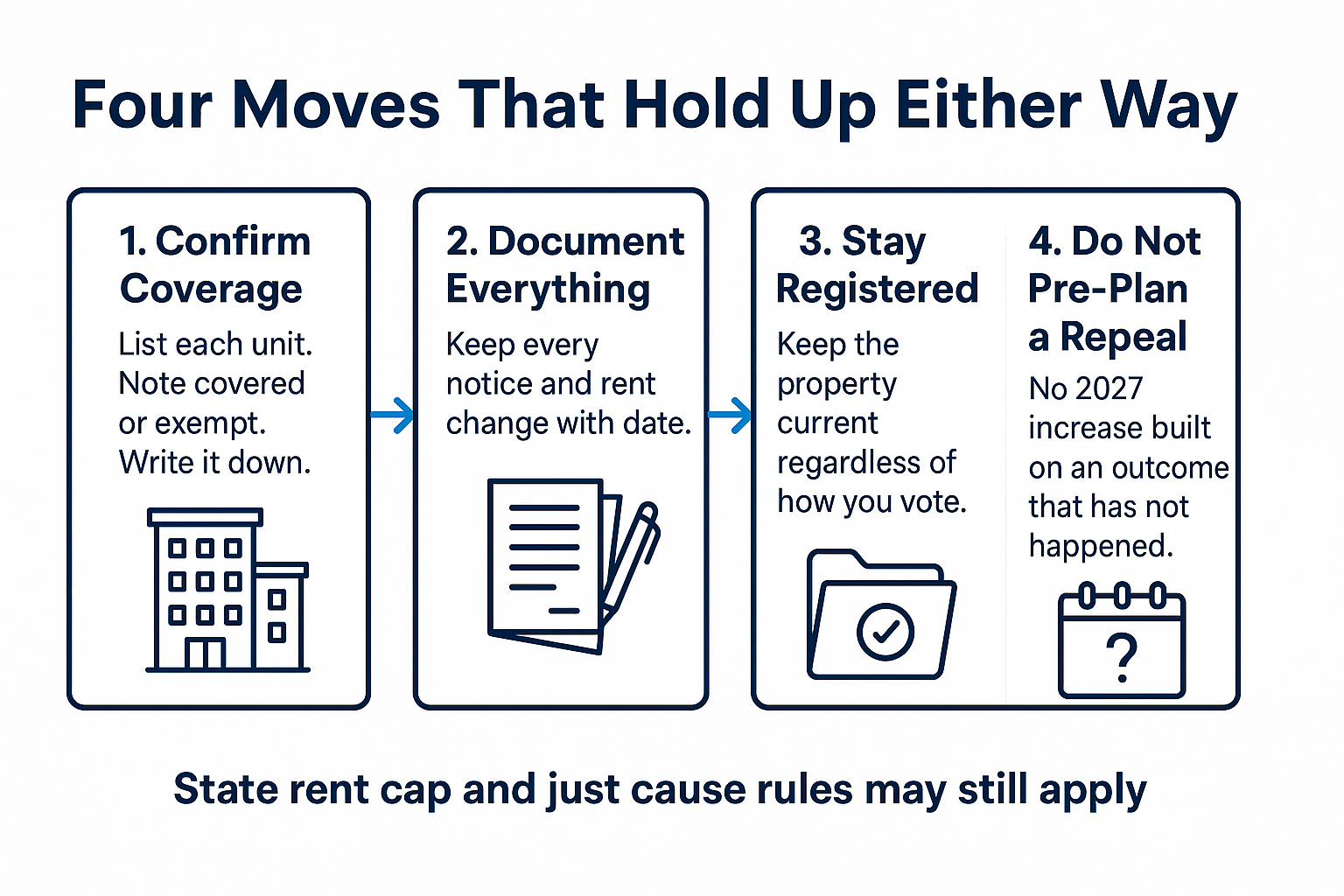
Four Moves That Hold Up No Matter How the Vote Goes
You do not have to guess the outcome to make good decisions this winter. These four steps are correct either way.
How I Would Write a Lease or Notice an Increase This Winter
The trap I keep watching owners walk toward is acting on an outcome that has not happened yet. I have already heard versions of “once this gets repealed I am going to reset that unit to market.”
Do not build a 2027 increase around a repeal. If it does not pass, you have either issued a notice you cannot support or talked yourself into a plan you now have to unwind with a tenant who heard about it.
For leases and renewals right now, a few habits keep you clean:
- Write to today’s rules. Draft as if all four ordinances stay in place, because until certification, they do.
- Avoid promises about future rent. No side agreements, no verbal assurances about what happens after the election.
- Date and save every notice. Delivery method, date served, copy retained. That file is what protects you later.
- Watch mid-term shifts. If the rules do change during a tenancy, you want a lease and a paper trail that are easy to review, not reconstructed from memory.
And here is the piece people skip. If the measure passes, Salinas does not become a rule free zone. State law protections still apply to many properties, including the statewide rent cap and statewide just cause rules. A repeal changes the local layer, not the California layer.
Who Keeps Asking Me About This
The owners contacting us about Salinas are often nowhere near Salinas. Washington. Texas. The Bay Area. Sometimes a few hours up the coast.
One owner with several Salinas rentals told us that self-managing them had gotten more demanding as she worked to grow her portfolio. Another had been handling a single-family home in North Salinas on his own for more than two years with a tenant in place and simply wanted to understand the cost and the handoff process.
That is the honest question underneath this whole topic. Not “how do I vote,” but “am I managing this well, or just getting away with it while the rules are unsettled?”
If you own one exempt house, you are probably fine with a tighter filing system and a calendar reminder. If you own a covered fourplex and you are tracking notices in your email inbox, that is a different situation. Owners weighing that line often find it helps to compare tenant placement against full management before deciding how much to hand off, and if you are newer to multifamily, what new multifamily owners need to know before renting covers the operational basics.
We work in Salinas every week, we track these ordinances as they move, and we handle this in English and Spanish, which matters in a city where a large share of both owners and residents would rather talk through something this consequential in Spanish. One owner with multiple Salinas rentals put it simply in a review: “It’s refreshing knowing we have that piece of mind…”
Frequently Asked Questions About the Salinas Rent Ordinance Vote
Does a YES vote keep rent stabilization in place?
No, and this is the most common misread I hear. A YES vote adopts the repeal and removes all four rental ordinances. A NO vote keeps them exactly as they are today.
Do I still have to keep my Salinas rental registered before the November vote?
Yes. All four ordinances stay in effect until voters decide, so registration obligations continue on their normal schedule. Skipping a filing because you expect a repeal is the riskiest move on the board.
Can I add the registration fee to my tenant’s rent?
No. The fee cannot be recovered from tenants through a pass through or any other route. Treat it as an operating expense on your own books.
My Salinas rental is a single-family home. Am I affected at all?
The local rent cap does not reach single-family homes or condos, so that piece likely never applied to you. But other protections, including statewide rent cap and just cause rules, can still apply depending on the property and the notices in your file. Worth confirming in writing rather than assuming.
If the measure passes, can I raise rent freely in 2027?
Not automatically. Results have to be certified first, which realistically means early 2027 at the soonest, and California’s statewide rent cap and just cause requirements would still apply to many properties. A local repeal is a change in one layer of rules, not the removal of all of them.
What does it cost to hand a Salinas rental off to a manager?
It depends on the number of units, the condition of the property, whether a tenant is already in place, and how much turnover work is needed up front. Rather than quote a number that may not fit your situation, we would rather look at the actual property and give you a straight figure.
Want a Straight Read on Your Own Salinas Property?
If you own a building in Salinas and you are not sure whether the rent cap reaches it, or you want a second set of eyes on how your notices and registration are handled, our team at Torrente Property Management is available to walk through the specific property with you in English or Spanish. We work across Monterey County every week and we follow these ordinances as they move. You can reach us at (831) 582-8916 or through the contact form at torrenteproperties.com.