
Direct Answer: In California 2026, most covered rentals can increase rent up to 6.3% through July 31, then up to 8.8% starting August 1. Written notice is required, and the rules differ by property type.
If you own a rental in Salinas, Seaside, Marina, or anywhere else in Monterey County and you’re thinking about raising rent this year, there’s one date you need to know: August 1, 2026. That’s when the AB 1482 rent cap resets, and the allowable increase jumps from 6.3% to 8.8%. Which side of that line you’re on when you send your notice makes a real difference in how much you can legally charge.
I’ve worked through this with a lot of property owners lately, and the questions I hear most often are: Does this law even apply to my property? Can I make up for the years I didn’t raise rent? And exactly what does the notice have to say? Those are the right questions, and this article answers them directly.
Before anything goes out to your tenant, you need to understand what applies to your property, what the numbers actually allow, and what happens if the notice isn’t done right. Getting it wrong isn’t just a paperwork problem. It can expose you to legal liability or make any future eviction much harder to pursue.
The August 1 Line, and Why the Math Changes
AB 1482 is California’s statewide rent cap law. For most covered properties in the Bay Area and Central Coast region, it limits annual rent increases to 5% plus the regional Consumer Price Index, with a ceiling of 10%. The CPI component resets every August 1 using updated regional data.
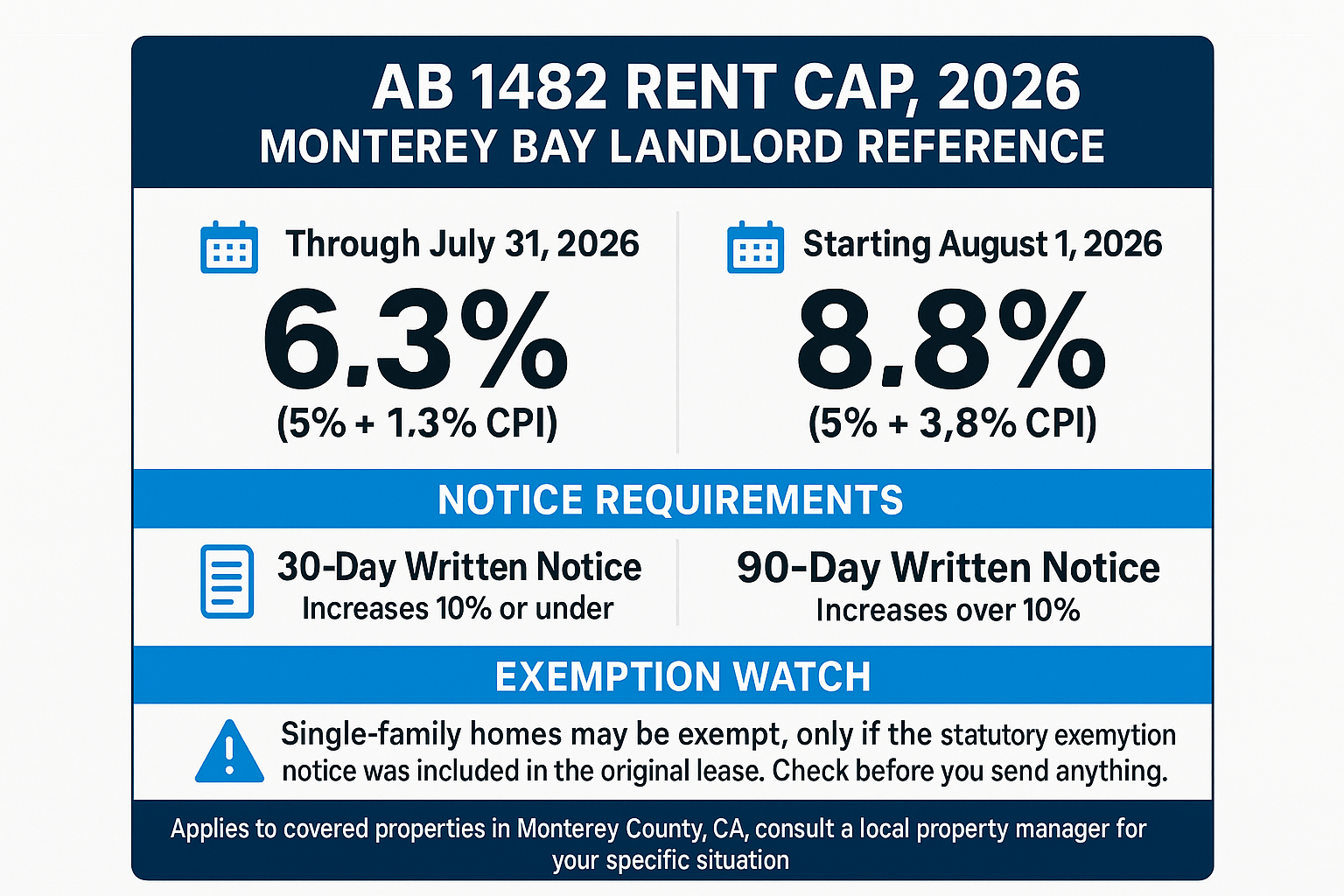
For the period running through July 31, 2026, the allowable cap is 6.3%, that’s 5% plus a 1.3% CPI figure. Starting August 1, 2026, the cap rises to 8.8%, because the April 2026 CPI came in at 3.8%. According to Marin County’s published AB 1482 rent increase schedule, this reset schedule applies consistently across the region each year.
What this means practically: if your notice goes out before August 1, you’re working with 6.3%. If it goes out on or after August 1, you have room for up to 8.8%. Using the wrong figure in either direction creates legal exposure. A notice that exceeds the applicable cap may be challengeable, and in a market like Salinas, where the city’s Residential Rental Registration program adds another layer of local compliance, that’s not a risk worth taking.
For owners who’ve been watching costs go up but holding rent steady, the August window may be worth planning around. A couple of percentage points on a $2,400 monthly rental is real money over the course of a year.
Does AB 1482 Even Cover Your Property?
This is where I see the most confusion, especially among owners who’ve held a property for years, inherited a rental, or recently converted a primary residence into a rental in Seaside or Marina.
AB 1482 does not apply to every property. Common exemptions include:
- Single-family homes and condos owned by individual people (not LLCs, REITs, or corporations)
- Properties built within the last 15 years
- Certain subsidized housing types
But here’s what trips people up on the single-family exemption: the lease must have included the required statutory exemption notice at signing. If that language was never in the lease, the exemption doesn’t apply, even if the home itself would otherwise qualify. I’ve seen this catch owners who had a verbal handshake arrangement years ago or who inherited a property and never updated the paperwork.
If you’re not certain whether your lease contains the right language, that’s worth checking before you send any increase notice. And if your property is covered by AB 1482, you also need to know that the just-cause eviction protections apply to the same covered properties once a tenant has lived there 12 months or more. The rent cap and the eviction rules travel together. Understanding which category your property falls into is step one, before any other math happens.
For a closer look at how local landlords in Salinas navigate compliance questions like this, our guide on what Salinas landlords actually need from a property manager covers some of this territory in practical terms.
AB 1482 Rent Cap at a Glance: 2026 Monterey Bay Reference
This reference covers the key numbers and rules Monterey Bay landlords need before sending a rent increase notice in 2026.
The Myth of Banking Skipped Increases
One of the most common misconceptions I hear from out-of-area owners goes something like this: “I haven’t raised rent in three years, so I should be able to catch up now, right?”
No. That’s not how California law works.
AB 1482 does not allow you to accumulate unused increases from prior years and apply them all at once. Each increase is evaluated independently against the cap for the 12-month window in which it applies. If you didn’t raise rent in 2023 or 2024, those allowable percentages don’t roll forward.
For landlords who have had the same tenant in a Salinas or Monterey property for several years and are now trying to get closer to market rate, this is genuinely costly to misunderstand. The path forward is a legally compliant increase now, at the current allowable rate, with proper notice. Not a catch-up lump sum.
If you’re also unsure what your property should be renting for in the current market, how Monterey Bay rental prices actually get set is a useful starting point before deciding how much to raise rent.
2026 Rent Increase Quick Reference for Monterey Bay Owners
Use this as a fast reference when planning your rent increase notice. Always confirm your property’s specific coverage before sending anything.
| Situation | Allowable Increase | Notice Required |
|---|---|---|
| Covered property, notice sent before Aug 1, 2026 | Up to 6.3% | 30 days (written) |
| Covered property, notice sent Aug 1, 2026 or later | Up to 8.8% | 30 days (written) |
| Any increase over 10% | Not permitted under AB 1482 for covered properties | 90 days (written) if applicable |
| Exempt SFH with proper exemption notice in lease | No statutory cap, market rate | 30 days (written) for increases 10% or under |
| Exempt SFH without exemption notice in lease | Likely covered by AB 1482 cap | Treat as covered property |
The Notice Itself, What Has to Be in Writing
California law is explicit here, and I want to be direct about it: a phone call, a text, or an email is not a valid rent increase notice. It has to be in writing, delivered properly.
The rules by increase size:
- 10% or less increase: A 30-day written notice is required
- Over 10% increase: A 90-day written notice is required (though AB 1482 generally prevents going above 10% for covered properties, so the 90-day rule applies mainly to exempt properties)
For owners with rentals in Salinas, there’s one more step: check whether your unit is registered under the city’s Residential Rental Registration program, and confirm whether any local requirements layer on top of state notice rules before you send anything. I’d also point owners to our breakdown of the Salinas Rental Registration program if you haven’t read through what that program requires in 2026.
And because it bears repeating: verbal communication is not enough. I’ve seen disputes arise from owners who had a good-faith conversation with a long-term tenant, assumed everyone was on the same page, and then found out the hard way that the increase wasn’t legally enforceable without written documentation. The writing requirement protects both sides.
Frequently Asked Questions About Raising Rent in California 2026
My tenant has lived in my Seaside rental for four years. Does AB 1482 apply?
It depends on the property type and the lease paperwork, not the length of tenancy. If your property is covered by AB 1482, the rent cap applies regardless of how long the tenant has been there. And if the tenant has been there more than 12 months, the just-cause eviction protections also apply, even on properties that are otherwise exempt from the rent cap. Check your lease for the statutory exemption language before assuming either way.
I inherited a rental in Salinas and have no idea what the original lease said. What do I do?
Start by getting a copy of the existing lease and reviewing it carefully. If it doesn’t include the required AB 1482 exemption notice, treat the property as covered by the rent cap until you can get legal clarity. Properties that qualify for exemption but are missing the notice language lose that protection. This is exactly the kind of paperwork gap that catches accidental landlords off guard.
Can I raise rent on a furnished rental the same way as an unfurnished one?
The AB 1482 caps apply to the total rent amount, furnished or unfurnished. The law doesn’t separate the furniture value from the rent. So yes, the same increase limits and notice requirements apply.
What if I haven’t raised rent in several years, can I go above the cap to make up the difference?
No. California law does not allow you to carry over or accumulate unused increases from prior years. Each increase is capped at the allowable rate for the 12-month period in which it is applied. The only legal path is raising rent at the current allowable rate with proper notice, then planning future increases from there.
I own a single-family home in Pacific Grove. Am I automatically exempt from the rent cap?
Probably, but only if the lease included the required statutory exemption notice when it was signed. If that language is missing, you likely don’t have the exemption. It’s worth reviewing the lease before assuming you’re outside the law’s reach.
Does the August 1 rate change apply automatically, or do I have to do something to get the higher cap?
The reset is automatic on August 1 each year based on updated CPI data. You don’t need to file anything. But the rate that applies to your specific notice is determined by when the notice is sent, not when the increase takes effect. If you send a notice in late July that takes effect in September, the 6.3% cap applies, not 8.8%.
Not Sure Which Rules Apply to Your Property?
Sorting through AB 1482 coverage, exemption notices, and notice timing is genuinely complicated, especially for owners who are managing from out of the area or dealing with a rental they didn’t plan to have. Our team at Torrente Property Management has worked with landlords across Monterey, Salinas, Seaside, Pacific Grove, and beyond on exactly these questions. If you’d like to talk through your situation, reach us at (831) 582-8916 or through the contact form at torrenteproperties.com.