
Direct Answer: Tenant placement is a one-time service covering pricing, marketing, showings, screening, the lease, and move-in. Full management adds rent collection, maintenance, inspections, and ongoing compliance for as long as you own the property.
A version of the same question lands in our contact form every few weeks from Salinas owners. It usually reads something like: can you just find and screen a tenant for me, write the lease, and then I will take it from there?
The answer is yes. That service exists, and in the industry it is called tenant placement or leasing-only service. It is a real, separate product, not a watered-down version of full management.
But the line between the two matters more than most owners expect, especially in Monterey County where rental law shifts every year or two. I want to walk you through what placement actually covers, where the value is concentrated, and how to do the honest math on which one fits your situation.
What tenant placement in Salinas actually includes
Tenant placement is a one-time engagement with a clear finish line. The work starts before the listing goes live and ends when the new tenant has keys in hand.
Here is what is typically in scope:
- Rental pricing analysis based on real comparable rents in your specific pocket of Salinas, not a statewide average
- Property prep guidance, meaning what to clean, paint, repair, or landscape before photos
- Listing and marketing, including photography and syndication to the major rental sites
- Showings handled by a real person who can answer questions on the spot
- Full screening, including credit, nationwide criminal background, eviction history, and income verification
- Lease drafting and execution with current California disclosures and any local addenda
- Move-in coordination, including the walkthrough, condition documentation, deposit collection, and detector checks
And here is what placement does not include, which is where owners sometimes get surprised:
- Monthly rent collection and chasing late payments
- Maintenance calls, vendor dispatch, and after-hours emergencies
- Routine inspections during the tenancy
- Notices, rent increase compliance, and lease renewals
- Move-out accounting and deposit itemization when the tenant leaves
Once the lease is signed, you are the landlord of record and the point of contact. That is fine for some owners and genuinely difficult for others.

Screening is where the value of a professional placement is concentrated
If I had to point to one part of placement that earns its fee, it is the screen. Everything else can be learned. A bad screen costs real money and takes months to undo.
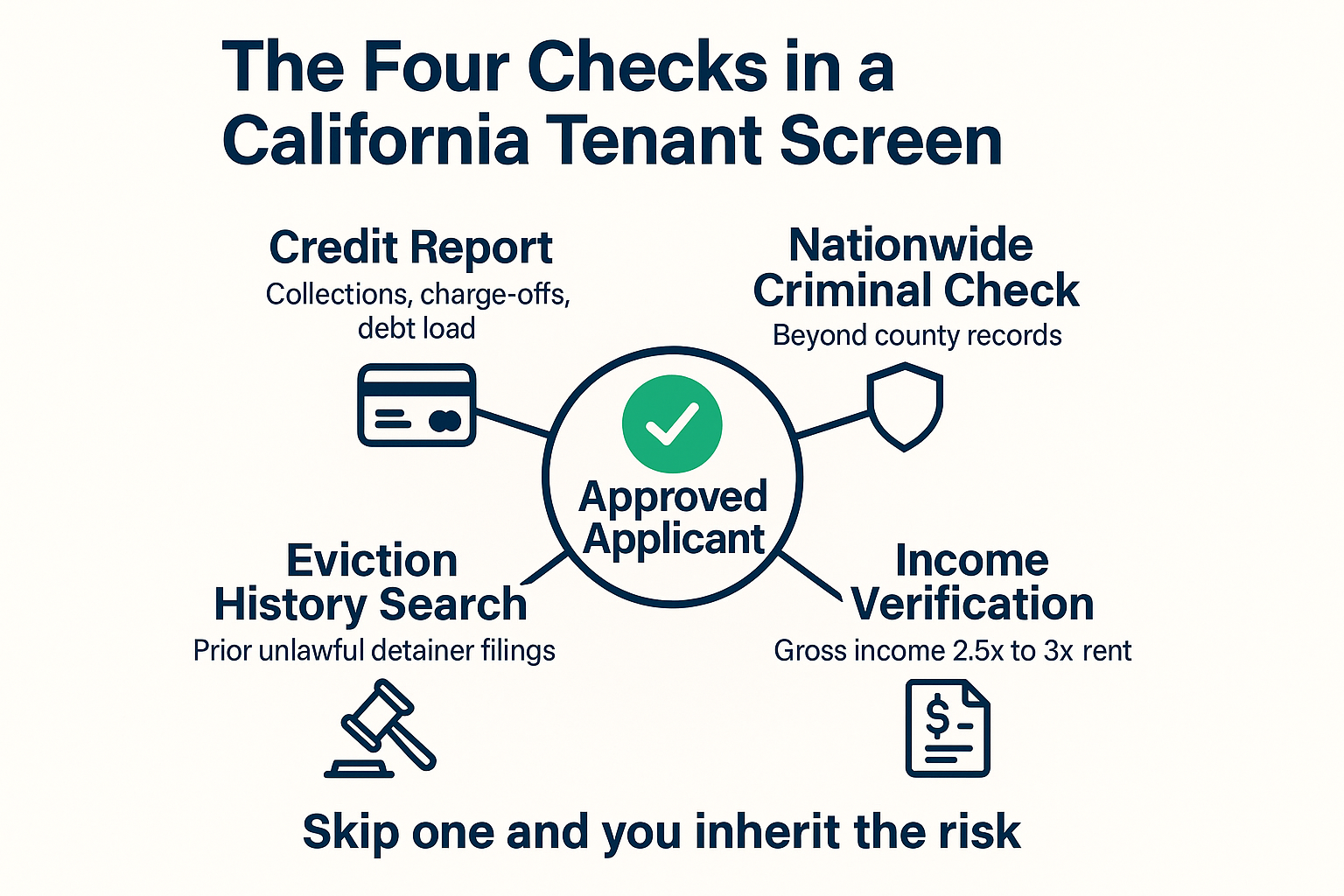
A thorough screen in California has four legs, and each one checks something different:
- Credit report. Not just the score. I look at collections, charge-offs, and whether the balances suggest an applicant is already stretched thin before rent is added.
- Nationwide criminal background check. County-only searches miss anyone who moved here from out of state, which is common along the Monterey Bay given military and agricultural relocation.
- Eviction history search. A prior unlawful detainer filing will not always show on credit. This is the check owners skip most often when they screen on their own.
- Income and employment verification. The common standard is gross monthly income of roughly 2.5 to 3 times the rent, confirmed with pay stubs or an employer, not just a stated number on the application.
One Salinas owner reached out to us wanting help screening applicants for a three-bedroom near Salinas Valley Memorial. That submarket draws a lot of healthcare employment, and owners there tend to assume a hospital paystub is the whole story. It is one data point out of four.
Missing a single leg of the screen is expensive. An unlawful detainer in Monterey County Superior Court can stretch out for months, and between lost rent, legal costs, and turnover repairs, owners often end up out far more than a year of management fees would have run. If you want the longer version, we broke down what a real tenant screening process looks like in its own guide.
The four checks behind a real tenant screen
Each of these checks catches something the others miss. Skipping one is where most placement problems start.
Side-by-side: tenant placement vs. full management
This is the breakdown I sketch out for owners on the phone. The left column ends at move-in. The right column keeps going.
| Task | Tenant Placement | Full Management |
|---|---|---|
| Rental pricing analysis | Included | Included |
| Property prep and listing | Included | Included |
| Showings and applications | Included | Included |
| Credit, criminal, eviction, income screening | Included | Included |
| Lease drafting and signing | Included | Included |
| Move-in walkthrough and documentation | Included | Included |
| Monthly rent collection | Owner handles | Included |
| Maintenance and 24/7 emergency response | Owner handles | Included |
| Routine and move-out inspections | Owner handles | Included |
| Notices, renewals, rent increase compliance | Owner handles | Included |
| Monthly statements and year-end summaries | Owner handles | Included |
| Re-leasing at turnover | New engagement | Included |
The lease is not paperwork, it is your liability document
This is the piece owners underestimate most. California rental law has changed enough in the last two years that a lease written in 2023 is already behind.
The biggest one: AB 12 took effect July 1, 2024, capping security deposits at one month’s rent for most residential rentals, whether the unit is furnished or not. You can read the bill text on the California Legislature’s site if you want the exact language.
I still see owners using a template pulled off the internet that allows two months plus a pet deposit. That single clause can turn a routine move-out into a dispute you lose.
There is also a local layer. Salinas runs a Residential Rental Registration program, and the City of Monterey prohibits rentals under 30 days, which changes how a lease term needs to be written on the Peninsula. A generic form does not know any of that.
So if you go the placement route, the lease is the one thing I would not hand back to yourself. Getting a current, locally correct lease drafted is a large share of what you are paying for.
Do the turnover math honestly before you decide
Here is the part I bring up even when it costs us the ongoing business. Placement makes real sense for some owners.
If you live in Salinas or Prunedale, you are handy, you have a plumber you trust, and you are comfortable answering the phone on a Sunday, placement-only can work well. You pay once, you get a screened tenant and a solid lease, and you run it from there.
But think through what happens in year two or three when that tenant gives notice. You are now on your own to:
- Re-screen a new applicant pool from scratch
- Draft a lease that reflects whatever the law says by then
- Coordinate the turn: paint, carpet, cleaning, landscaping
- Handle move-out accounting inside California’s deposit itemization deadline
Every turnover is a fresh placement decision. Fees vary by property and scope, but placement is commonly quoted as a percentage of one month’s rent or a flat fee, while ongoing management usually runs as a monthly percentage of collected rent. Ask for both numbers in writing so you can compare them over a three-year hold, not one month. We walk through the cost drivers in what property management really costs in Salinas.
Where placement tends to break down is distance. Several owners have come to us after a relocation, a deployment, or an inheritance, and the pattern is consistent: the placement went fine, then the first roof leak or the first late payment happened from four states away. If you are managing from outside the area, the time cost of self-management usually swallows the fee savings. Our team sees that math play out often enough that we now ask about it on the first call, and there is more on it in our guide to how out-of-area owners actually manage a Monterey Bay rental.
Frequently Asked Questions About Tenant Placement in Salinas
Can I hire someone just to screen applicants and write the lease?
Yes. That is exactly what tenant placement is, and it is one of the more common requests we get from Salinas and Prunedale owners. You get pricing, marketing, showings, full screening, lease drafting, and move-in coordination, then you take over as landlord.
How long does tenant placement usually take from listing to move-in?
It depends on price, condition, and season, but a well-priced Salinas single-family home in decent shape typically moves through marketing, showings, screening, and lease signing in a matter of weeks rather than months. Overpricing is the single biggest cause of a long vacancy, and a vacant month usually costs more than the pricing difference you were holding out for.
If I use placement and the tenant turns out badly, who handles it?
You do. That is the honest tradeoff. Once the lease is signed under a placement-only arrangement, notices, disputes, and any legal process are the owner’s responsibility, which is why the quality of the screen matters so much on the front end.
Can I start with placement and switch to full management later?
Usually, yes, and quite a few owners do exactly that. They try self-managing for a year, decide they would rather not be the emergency contact, and move to full management at renewal or at the next turnover.
Is placement a good fit for a furnished rental?
It can be, though furnished units add complications. You will want a detailed inventory and condition record at move-in, and remember the one month deposit cap under AB 12 applies to furnished units too, so the extra deposit cushion owners used to rely on is no longer available.
Still deciding which route fits your Salinas property?
If you are weighing placement against ongoing management for a home in Salinas, Marina, Seaside, or anywhere along the Peninsula, we are happy to talk it through and give you both sets of numbers so you can compare them side by side. You can reach our team at (831) 582-8916 or through the contact form at torrenteproperties.com. Whichever direction you go, knowing the tradeoffs before you list is worth the conversation.