Direct Answer: Salinas rent stabilization generally covers multifamily units built before February 1, 1995. Single family homes and condos usually sit outside the rent cap, though just cause eviction rules reach more property types.
Most owners who call me about Salinas rent rules are not asking about forms. They are asking a much simpler question: does any of this apply to my building at all?
That question matters more than the paperwork, because every other decision flows from it. The registration fee you pay, the rent increase percentage you can use, and the notice you mail all change depending on which side of the line your units land on.
The short version is that multifamily units built before February 1, 1995 generally sit inside Salinas rent stabilization, while single family homes and condos generally sit outside the rent cap. The longer version is what I want to walk through here, including how to actually verify a build date instead of trusting what the last owner told you.
The February 1, 1995 Line and What Sits on Each Side
California’s Costa-Hawkins law set a statewide boundary that local rent control has to respect. Cities cannot cap rents on units built after February 1, 1995, and they generally cannot cap rents on single family homes or individually owned condos.
Salinas built its ordinance inside that boundary. So the practical picture for a local owner looks like this:
- Two or more units in one building, built before February 1, 1995: generally covered by the local rent cap
- Anything built on or after February 1, 1995: outside the local cap
- A single family house rented to one household: generally outside the cap, but the exemption has to be disclosed in the lease
- A condo you own individually: generally outside the cap
Here is the part owners miss. The just cause eviction protections reach a broader set of property types than the rent cap does. A building can be exempt from the percentage limit and still be subject to rules about how and why a tenancy ends.
So “my building is exempt” is almost never a complete answer. It is only an answer about the rent number.
How I Verify a Build Date, Because the Listing Sheet Is Not Proof
I have lost count of how many times an owner has told me a Salinas building went up “sometime in the late nineties” because that is what the sale paperwork said. Then we pull records and find a 1972 permit.
Listing data gets copied forward for decades and nobody ever rechecks it. When a build date decides whether you are capped at under three percent or not capped at all, a guess is not good enough.
What I actually look at:
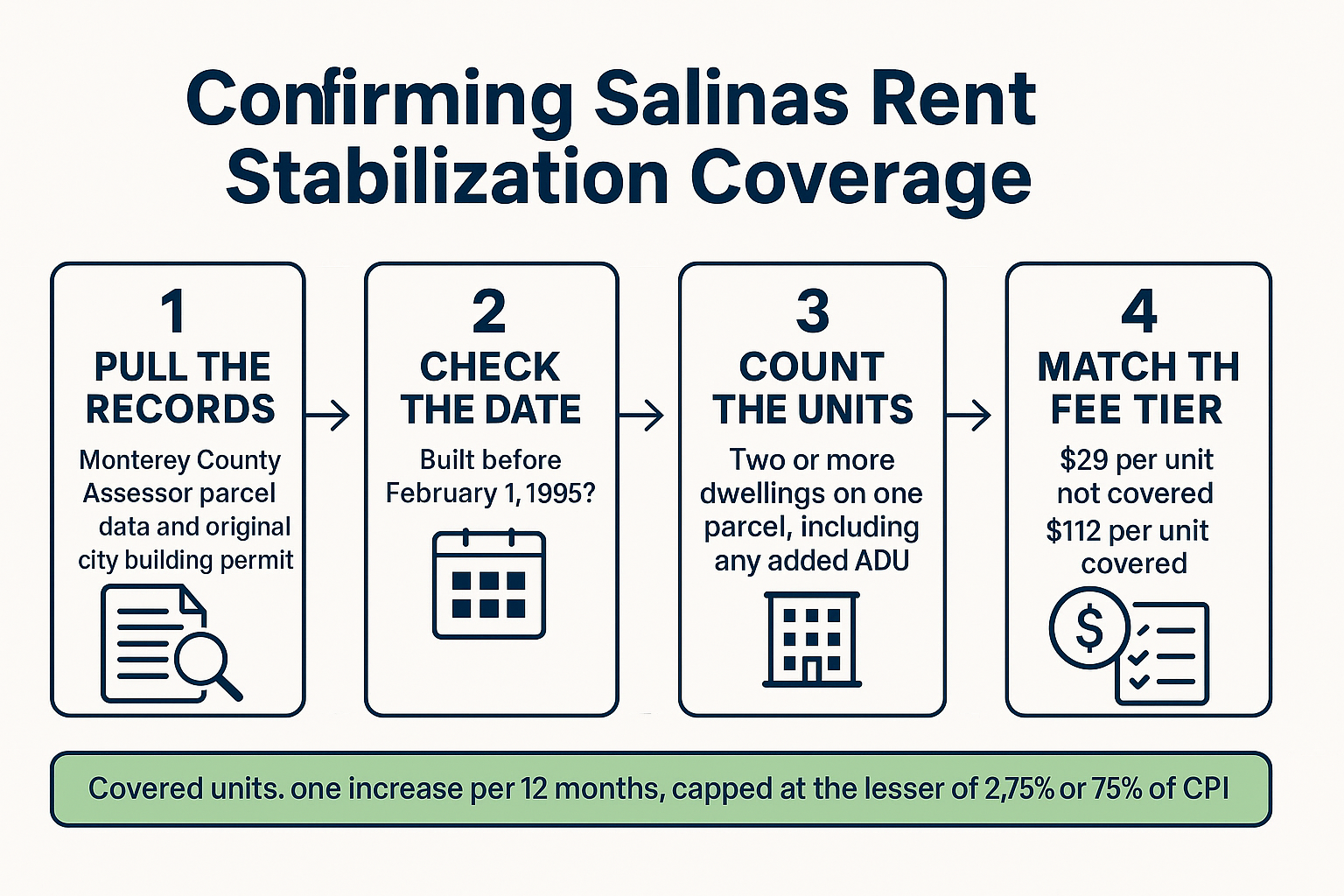
- Monterey County Assessor records for the parcel, which carry an effective year built and the unit count on the tax roll
- The original building permit from the city, which is the strongest evidence of when the structure was completed
- Permits for later additions, because a 1968 duplex that gained a third unit in 2004 is not one simple answer
- The recorded parcel and unit configuration, to confirm how many separate dwellings legally exist, not how many doors you rent
When assessor data and permit records disagree, I treat the permit as the stronger record and document both. If you are ever questioned on a rent increase, showing your work is worth far more than a confident memory.
The Registration Fee Tier Tells You What the City Thinks
Salinas runs an annual rental registration program, and the fee itself is the clearest practical signal of coverage. According to the City of Salinas rental registration and rent stabilization page, annual fees run $29 per unit for units not subject to rent stabilization and $112 per unit for units that are.
Those two numbers are a built-in self-check. If you own a pre-1995 fourplex in Salinas and you have been paying the lower rate, something is wrong with your classification.
City data from the January through March 2026 registration window is worth sitting with. Roughly 2,211 units registered at the $29 rate against about 6,165 at the $112 rate.
In other words, being in the covered tier is the norm in Salinas, not the exception. Most of the rental housing stock here was built well before 1995, and the registration numbers reflect that.
An owner who filed at the wrong tier has two problems, not one. There is the fee itself, and there is every rent increase notice issued under the wrong math while the misclassification stood.
Coverage at a Glance by Property Type
This is the quick reference I use when an owner describes their portfolio over the phone. Verify each property before relying on it, since build dates and unit counts decide the row you land in.
| Property type | Local rent cap | Likely fee tier | Increase basis |
|---|---|---|---|
| 2+ units, built before Feb 1, 1995 | Generally covered | Higher per unit tier | Lesser of 2.75% or 75% of recent CPI, one increase per 12 months |
| 2+ units, built Feb 1, 1995 or later | Not covered by local cap | Lower per unit tier | Statewide formula where it applies |
| Single family home, one household | Generally exempt | Lower per unit tier | Statewide formula, exemption must be disclosed in the lease |
| Individually owned condo | Generally exempt | Lower per unit tier | Statewide formula, exemption disclosure applies |
| ADU added decades after the main house | Depends on the door | Verify before choosing | Confirm build date and unit status before any notice |
Once You Are Covered, the Math Is Tighter Than You Think
This is where the coverage question turns into real money. Covered units in Salinas are limited to one increase per 12 month period, and the increase is capped at the lesser of 2.75 percent or 75 percent of the most recent CPI figure.
That is tighter than the statewide calculation many owners default to. I regularly see owners run the state formula on a covered building, mail the notice, and only later learn the notice was not compliant on the day it went out.
Fixing that after the fact is messy. You are unwinding a number a tenant already received in writing, which is exactly the kind of conversation that sours a long tenancy.
The fix is boring and it works: confirm coverage first, then pick your formula. If you want the broader walkthrough of increase mechanics and notice periods, I covered that in our guide to raising rent in 2026 for Monterey Bay landlords.
For a covered Salinas building, the order of operations is the whole ballgame. Coverage, then cap, then notice, then delivery.
Four Steps to Confirm Coverage on a Salinas Rental
Here is the sequence I follow before touching a rent number on any Salinas property.
Measure H Is on the Ballot, and Your Coverage Decides How Much It Matters
On November 3, 2026, Salinas voters decide Measure H, which asks whether Ordinance No. 2687 should be adopted. That ordinance would repeal all four of the city’s rental ordinances.
I try to keep this simple and neutral for owners. A yes vote repeals the four ordinances. A no vote keeps them in place. Either way, the current rules are enforceable law today.
Two things I tell owners who are tempted to wait. First, deferring a compliance decision until after the vote does not erase exposure that already exists, and a repeal result would not retroactively fix a notice mailed under the wrong formula. Second, if repeal did pass, the change would follow election certification rather than take effect on election night.
The honest takeaway is that coverage status determines how much the outcome matters to you. An owner of a pre-1995 fourplex on a Salinas side street has far more riding on this than someone renting out a single family house on the east side.
I wrote more about planning around the vote in what owners should plan for ahead of November 3.
Most Owners Here Do Not Hold One Clean Property Type
The inquiries that reach me rarely involve a tidy single asset. It is a house in Prunedale with an attached ADU, a condo in Pacific Grove, and a small building in Salinas, all held by the same family.
The assumption is that one rule covers all of it. It almost never does.
- An ADU added decades after the main house can have a different answer than the house in front of it
- Newer construction sits outside the local cap entirely
- A single family exemption only holds if the required disclosure is actually in the lease
- A building that gained units over time may need the unit count verified against permits, not against how many keys you hand out
What prevents the expensive mistake is unglamorous. A one page sheet listing each property, its build date, its unit count, its fee tier, and its increase basis.
I keep one for every owner we work with. It takes an afternoon to build and it answers in ten seconds the question that otherwise costs you a corrected notice.
In a Flat Rent Market, the Cap Is Rarely What Is Costing You
Here is the context that reframes all of this. Salinas average apartment rents have moved less than one percent year over year in recent market tracking, and separate Zillow figures put the average across all Salinas rentals somewhere in the mid $2,000s to around $2,750 depending on property type. Figures like these move, so treat them as a snapshot rather than a fixed number.
When the market is flat, the cap is not the thing limiting your return this year. Vacancy days are.
Where covered building owners actually lose money is a turn that drags three weeks longer than it should, a unit that sits because the listing went up without photos, and a deferred repair that becomes a February emergency at overtime rates. I broke the vacancy math down in detail in the real price of a slow unit turn.
So if you are choosing where to spend attention before the end of the year, I would put a coverage sheet and a maintenance calendar ahead of the increase percentage. One protects you from a compliance error. The other protects the income the cap was never really threatening.
Frequently Asked Questions About Salinas Rent Stabilization Coverage
My duplex was built in 1988. Is it definitely covered?
Most likely yes, since it is multifamily and predates February 1, 1995. But I would still confirm the build date against Monterey County Assessor records and the original city permit, and confirm that both units are legally recognized dwellings before you register or issue any increase.
I rent out a single family home in Salinas. Do I need to do anything?
Probably more than you think. The home is generally exempt from the local rent cap, but the exemption has to be properly disclosed in the lease, the city’s registration program still applies to rental units, and just cause eviction rules reach a broader set of property types than the cap does.
What if I have been paying the lower registration fee on a covered building?
Address it rather than waiting. The misclassification creates exposure on the fee itself and on any rent increase issued under the wrong formula while that classification stood. The sooner the record is corrected, the smaller the cleanup.
Should I hold off on compliance work until after the November vote?
I would not. The four ordinances are enforceable today, and a repeal would follow certification rather than take effect on election night. A notice mailed under the wrong math in the meantime does not get fixed by the result.
Does the ADU behind my house follow the same rule as the house?
Not automatically. The build date of the ADU, when it was permitted, and how the property is rented all factor in. This is exactly the situation where I pull permits for each structure separately instead of assuming one answer covers both doors.
Want a Second Set of Eyes on Your Coverage Status?
Our team handles multifamily compliance across Salinas and the wider Monterey County market, where owners routinely hold pre-1995 buildings with long tenured residents. Bilingual English and Spanish communication matters here in practice, since notices, rent increase letters, and maintenance coordination all have to be understood by the people living in the building. Aurelia Torrente is an Accredited Residential Manager with more than 25 years in Monterey County, and as one longtime owner put it, “They currently manage several of our properties and everything runs smoothly.” If you want to talk through where your buildings fall, we are reachable at (831) 582-8916 or through the contact form at torrenteproperties.com.