
Direct Answer: SB 1296 takes effect April 1, 2027. California landlords and their agents must have a written pet policy, share it with rental applications and applicable digital ads, and may owe refunds if they skip it.
Most owners I talk with in Monterey and Salinas already have a pet rule in their head. Dogs under 25 pounds, no cats, or no pets at all. The rule exists, it just lives in a phone call instead of a document.
That stops working on April 1, 2027. Governor Newsom signed SB 1296, the Pet Policy Transparency Act, on September 30, 2026, adding Section 1942.7.5 to the California Civil Code. From that date forward, your pet policy has to be in writing and it has to travel with your advertising and your rental applications.
And there is a money consequence attached. If you collect an application fee without meeting the disclosure requirement, you may have to give that fee back. Below is what the law covers, where the gaps usually show up on Monterey Peninsula and Salinas Valley rentals, and what I would put in writing now rather than next spring.
What the California pet policy disclosure law for rentals actually requires
SB 1296 was authored by Sen. María Elena Durazo. The short version, according to the California Apartment Association’s summary of the change, is that California rental housing providers must disclose their pet policies in writing to prospective tenants starting April 1, 2027.
A few details matter more than the rest:
- The requirements apply to policies that allow, restrict, or prohibit pets. A no-pets policy is still a policy, and it still has to be written down.
- The law reaches every residential landlord and their agent, which includes the property manager, leasing agent, or broker acting on your behalf.
- Written pet policies have to be supplied with rental applications and with applicable digital advertisements.
- Failure to meet the disclosure requirements may require refunding an application fee you already collected.
Mortgage Professional America and Multifamily Executive both covered the signing in early October 2026 and described it the same way: a new compliance layer, with a refund trigger behind it.
I would read the actual bill text before April 2027 rather than relying on any summary, mine included. The operative language sits in Civil Code Section 1942.7.5.

Where Monterey County owners are most likely to miss it
The written policy is the easy part. The distribution is where I expect owners to get tripped up, because a single Monterey rental usually shows up in more places than the owner realizes.
Think about how your last vacancy was marketed. A listing on the big rental search sites, a syndicated feed those sites pull from, maybe a social post, maybe a sign in the yard that sends people to a phone number. Each digital channel you control is a place the policy has to appear.
For out-of-area owners, this is the part worth paying attention to. If you are stationed elsewhere, living in another state, or managing a parent’s house from Southern California, you are relying on someone else to keep your advertising accurate. The law reaches your agent too, so the two of you need to agree on who updates what.
I see the same pattern in our own call log. Callers reach out about a specific address and the first question is almost always whether it is still available and what the rent is. Pets come up second. Once this law is in effect, the answer to that second question has to already be sitting in the ad they were looking at.
If you handle your own leasing from a distance, this is one more item on an already long list. I wrote more about that in how out-of-area owners actually manage a Monterey Bay rental.
Where your written pet policy has to show up
Here is how I would map the requirement across a typical Monterey County rental listing, and the gap I expect to see most often.
| Touchpoint | What belongs there | Common gap |
|---|---|---|
| Digital ads you control | The written pet policy, matching the lease terms | Old listing copy that says ‘pets negotiable’ with no detail |
| Rental search platforms | The policy provided to the platform | Syndicated feed never updated after the policy changed |
| Rental application packet | Policy included, with space for the applicant to acknowledge receipt | Application sent by email with no attachment |
| Lease or pet addendum | Terms that match what was advertised | Addendum allows a pet the ad said was not permitted |
| Application fee collection | Disclosure completed before the fee is taken | Fee collected over the phone before anything is sent |
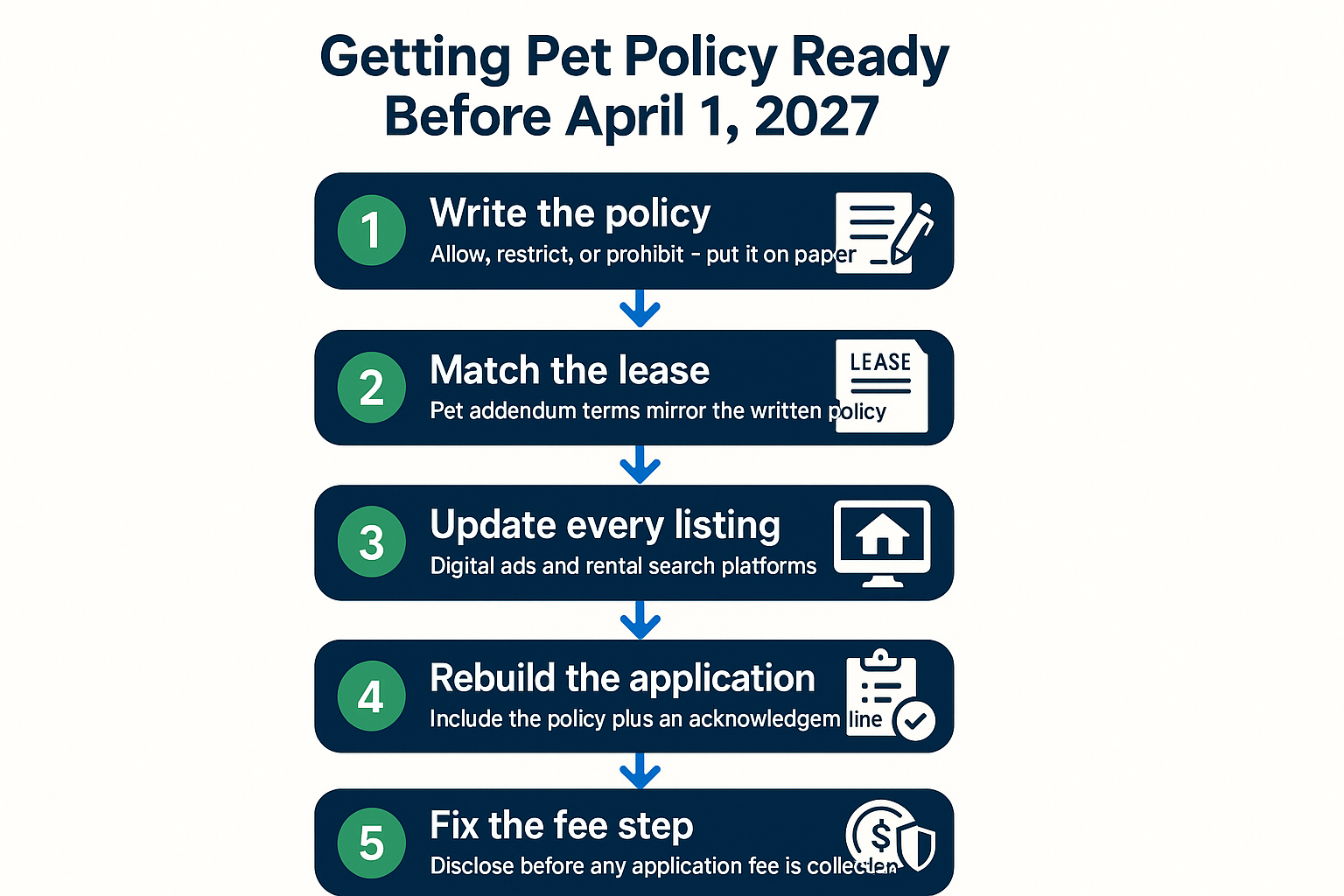
A simple sequence to be ready before the deadline
This is the order I would work through it, starting well before spring 2027 rather than the week of.
What I would actually put in the written policy
A one-line policy invites arguments later. I would rather see a short, plain document that answers the questions tenants ask anyway.
Things worth spelling out:
- Whether pets are permitted at all, and if so, which types
- Any weight or count limits, stated as numbers rather than words like ‘small’
- Where the animal may be on the property, including yards and shared outdoor areas
- What you require in writing before an animal moves in, such as vaccination records
- The financial terms, including any pet rent, and how they appear on the lease
- What happens if an unapproved animal shows up mid-tenancy
Two California rules sit next to this one. First, assistance animals are not pets under fair housing law, so your policy should say that requests for reasonable accommodation are handled separately. Second, California’s deposit cap from July 1, 2024 limits most residential security deposits to one month’s rent, which changes how owners used to handle pet deposits.
I covered that interaction in more detail in what owners can charge for pets and what they can’t, and the deposit math itself in security deposits in 2026.
If you own apartments in Salinas or Seaside, standardize before you scale
Single-family owners update one listing. Multifamily owners update a system.
For a 12-unit building in Salinas or a fourplex in Seaside, the risk is inconsistency. One unit advertised as pet friendly, another as no pets, and nothing in the file explaining why. That inconsistency is harder to defend than any single policy choice.
I would use the runway between now and April 2027 to do three things: write one building-level policy, push it into every ad and feed at once, and retrain whoever takes applications so the disclosure happens before a dollar changes hands.
There is also a practical upside. Monterey County has a lot of renters with animals, and a clear, written pet policy tends to shorten vacancy because applicants self-select instead of calling to ask. Vacancy costs more than pet wear in most buildings I have looked at, which is the same logic behind how maintenance decisions affect your rental’s bottom line.
New multifamily owners in particular should fold this into their first-year setup. I wrote about that groundwork in what new multifamily owners in Marina need to know.
Frequently Asked Questions About SB 1296 and Pet Policy Disclosure
I don’t allow pets at all. Does this still apply to me?
Yes. The requirements apply to policies that allow, restrict, or prohibit pets. A no-pets policy has to be written down and disclosed the same as a pet friendly one.
What happens if I take an application fee and forget the disclosure?
Failure to meet the disclosure requirements may require refunding that application fee. That is the enforcement hook in the law, so I would treat the disclosure as a step that happens before any fee is collected, not alongside it.
Do service animals and emotional support animals count as pets under this?
No. Assistance animals are handled under fair housing law as a reasonable accommodation, not as pets. Your written policy should say so plainly so applicants know a separate process exists.
I only rent out one house in Pacific Grove and I find tenants by word of mouth. Am I covered?
The written policy still has to go out with your rental application. If you are not running digital ads, the advertising piece is less of a lift, but the application packet piece applies regardless of how small your portfolio is.
Should I change my pet policy now or wait until 2027?
If you want to change the rule itself, do it at a renewal or a turnover rather than mid-lease. What I would not wait on is writing down the policy you already have. That part costs you nothing and removes the deadline pressure entirely.
Want a second set of eyes on your pet policy before 2027?
We work with owners across Monterey, Salinas, Pacific Grove, Seaside, and Marina, and we are already updating listing copy and application packets ahead of the April 2027 date. If you would like to talk through how your current policy and advertising line up, our team is reachable at (831) 582-8916 or through the contact form at torrenteproperties.com. Bilingual English and Spanish service is available.