
Direct Answer: Tenant screening is a documented, legally consistent process — income verification, credit, rental history, and background checks — applied the same way to every applicant, before anyone gets a key.
One of the most common things I hear from owners reaching out about their properties — in Salinas, Marina, Prunedale, and Monterey — is some version of: ‘I just need help finding good tenants.’ I understand why they frame it that way. But finding tenants and screening tenants are two completely different activities, and mixing them up is where most self-managing landlords run into serious trouble.
Marketing a vacancy — pricing it right, writing a good listing, getting it in front of qualified renters — is how you generate applications. Screening is the documented process that determines which applicant actually moves in. One fills your inbox. The other protects your property, your income, and your legal standing for the length of the tenancy.
With California’s one-month security deposit cap now in effect (as of July 1, 2024), there is less financial cushion at move-in than there used to be. That makes the screening decision more consequential, not less. Getting this step right is worth understanding in real detail — and that’s what this article walks through.
What the Screening Process Actually Covers
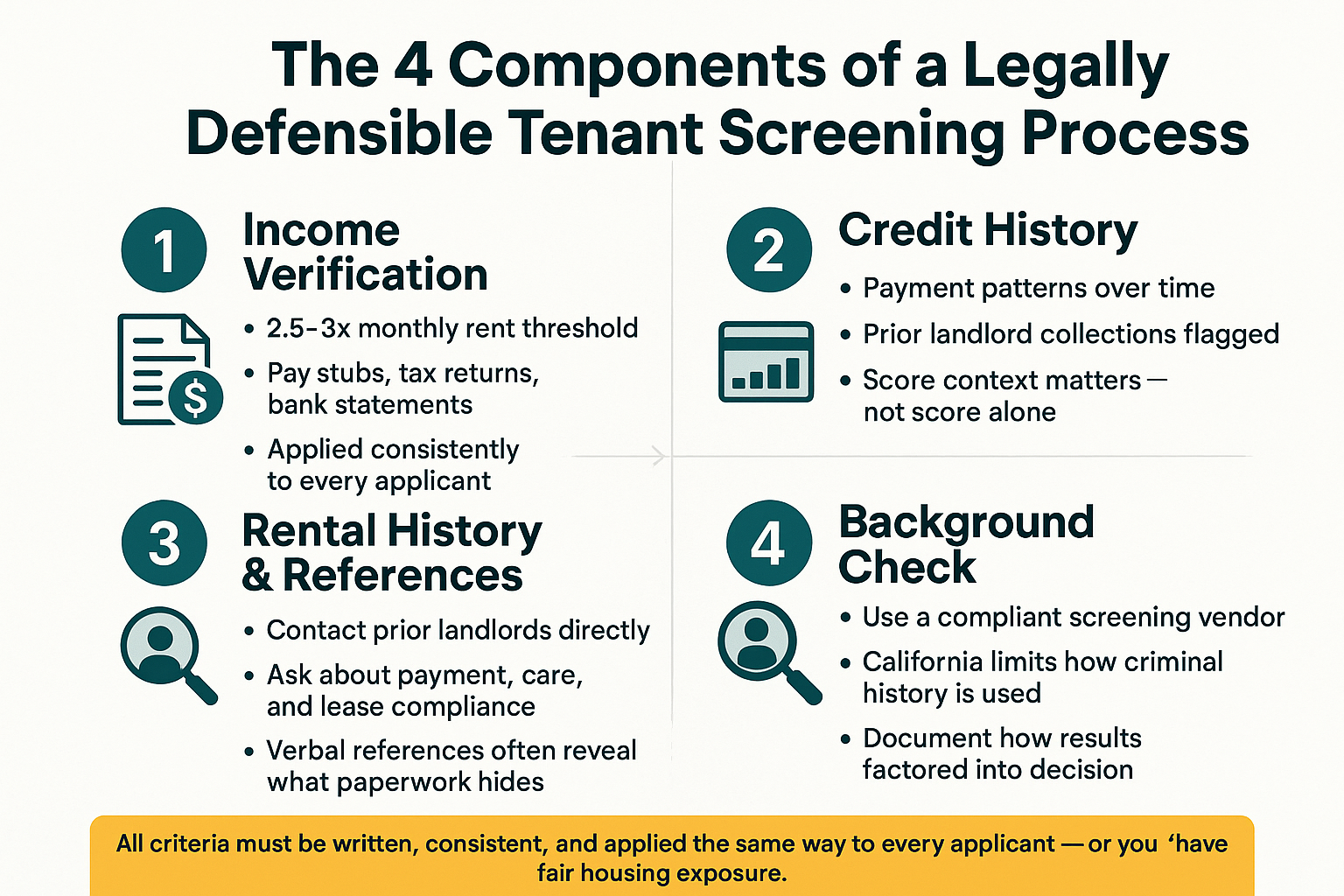
A real screening process has four components, and all four matter. Income, credit, rental history, and background — each one tells you something different about whether this person will pay on time, treat the property with care, and honor the lease.
Income verification is typically benchmarked at 2.5 to 3 times the monthly rent. For a $2,400/month rental in Salinas, that means the applicant’s gross monthly income should fall somewhere between $6,000 and $7,200. Pay stubs, employer verification letters, bank statements, and tax returns are all acceptable documentation — the key is consistency. Whatever you require from one applicant, you ask of all of them.
Credit history tells you how someone handles financial obligations generally. A strong credit score is a positive signal, but I pay more attention to patterns: recent missed payments, collections from former landlords, or a history of accounts sent to collections are all worth weighing carefully.
Rental history and references are often the most honest predictor of how a tenancy will go. I want to speak with a prior landlord — not just receive a name. A 5-minute phone call can surface information that no application form captures.
Background checks round out the picture. California law limits how criminal history can be used in tenant selection, so this component requires care. But it remains a legitimate part of a complete screening file when applied consistently and documented correctly.
The word I keep coming back to is documented. Every criterion needs to be written down before you review a single application — and applied the same way to every applicant who walks in the door.

What California Law Says You Cannot Use
This is the part of screening that catches self-managing landlords off guard — and creates real legal exposure when handled casually.
California’s Fair Housing Act and related state statutes prohibit using certain characteristics as screening criteria. A gut feeling from a showing is not a legal basis for denying an application. Neither are factors tied to protected classes. The characteristics that cannot factor into your screening decision include:
- Source of income — this includes Section 8 housing vouchers, which California law explicitly protects in most jurisdictions
- Familial status — whether an applicant has children
- Race, national origin, religion, sex, disability, marital status, or sexual orientation
- Immigration or citizenship status in many California contexts
The problem I see most often with self-managing landlords isn’t intentional discrimination — it’s undocumented decision-making. When you don’t have written criteria applied consistently, any denial can look discriminatory, even when the actual reason was financial. That’s a fair housing complaint waiting to happen.
If you’re managing properties in Salinas, where the rental population includes a large Spanish-speaking community, this matters especially. Applicants have rights, and those rights are actively enforced. The California Department of Fair Employment and Housing provides guidance on protected characteristics and what landlords must document when taking adverse action.
For a deeper look at the compliance obligations that come with renting in Salinas specifically, the Salinas Rental Registration Program landlord guide lays out what the city currently requires of property owners.
The 4 Components of a Legally Defensible Screening Process
This infographic breaks down the four required components of a compliant California tenant screening process and what each one involves.
AB 1414 and What ‘Compliant Screening’ Will Require Starting January 2026
Most self-managing landlords I talk to have no idea this law exists. AB 1414, effective January 2026, adds new requirements around how tenant screening vendors handle applicant data — and it puts more responsibility on landlords who use those vendors.
If you use an off-the-shelf background check service to screen tenants, you need to verify that the vendor maintains proper data security procedures and can issue legally compliant adverse action notices. An adverse action notice is what you’re required to send any applicant you deny, explaining what information contributed to that decision and where it came from.
Three things that make a screening process compliant under current and coming California requirements:
- Written screening criteria established before any applications are reviewed
- Documented adverse action notices sent to denied applicants — not just a ‘we went another direction’ email
- Vendor accountability — the background check service you use must be able to demonstrate data security compliance and proper breach notification procedures
Many popular consumer-facing background check apps were not built with AB 1414 compliance in mind. This is one of the reasons self-managing your rental becomes increasingly risky as California’s landlord-tenant law grows more specific each year.
Common Screening Criteria: Allowed vs. Not Allowed in California
California law is specific about what can and cannot factor into a tenant screening decision. This table summarizes the key distinctions.
| Criterion | Can Be Used? | Notes |
|---|---|---|
| Income verification (2.5–3x rent) | Yes | Must be applied consistently to all applicants |
| Credit history and payment patterns | Yes | Document how results were weighed |
| Rental history and prior landlord references | Yes | Verbal confirmation of references is best practice |
| Background check results | Yes, with limits | California restricts how criminal history can factor in; consult legal counsel |
| Section 8 / housing voucher (source of income) | No | Protected under California law in most jurisdictions |
| Familial status (having children) | No | Fair Housing violation |
| National origin, race, religion, sex, disability | No | Federal and California Fair Housing law |
| Gut feeling from a showing | No | Not a documented criterion; creates liability |
Why Move-In Documentation Is Part of the Screening Decision
Screening doesn’t end when you choose a tenant. The move-in process — specifically, how you document the property’s condition before handing over keys — is the final layer of protection that most self-managing landlords skip entirely.
With California’s deposit cap at one month’s rent, you have less financial buffer than you did before July 2024. If a tenant causes damage and disputes your deductions, the documentation you created at move-in is your entire evidence base. Without it, you’re arguing your word against theirs — and California’s small claims process tends not to favor undocumented landlord claims.
A complete move-in package includes:
- A written room-by-room inventory noting the condition of every wall, floor, fixture, and appliance
- Timestamped photos of every room and surface — not just the kitchen and bathrooms, but closets, baseboards, and exterior areas
- Tenant signature on the move-in condition report, acknowledging the documented state of the property
This documentation is not bureaucratic paperwork for its own sake. It’s the foundation that makes a legitimate deposit deduction defensible — and it’s what separates a smooth move-out from a dispute that drags on for months.
If you want to understand how lease terms connect to this, our article on what California landlords need to know about lease changes in 2026 covers the updated habitability and documentation standards now in effect.
Frequently Asked Questions About Tenant Screening for Monterey Bay Landlords
Can I just run a credit check and skip the other steps?
Not if you want to be protected. Credit alone won’t tell you whether someone has a history of disputes with prior landlords, whether their income is stable, or whether a previous property management company has notes on the file. A credit score is one data point. A complete screening file is what protects you when something goes wrong six months into a tenancy.
If I decide not to rent to someone, what do I have to send them?
Under California law, you’re required to send an adverse action notice to any applicant you deny based on information from a consumer report — which includes credit checks and background checks. The notice must identify the consumer reporting agency you used, explain that the agency did not make the rental decision, and inform the applicant of their right to dispute the information. AB 1414 adds additional requirements around how this process is documented starting in January 2026.
Can I decline an applicant who has a Section 8 voucher?
In most California jurisdictions, no. Source of income — including housing vouchers — is a protected characteristic under state law. Declining an otherwise qualified applicant solely because they use a Section 8 voucher creates fair housing liability. If you have specific questions about how this applies to your property in Salinas, Monterey, or elsewhere in the county, a licensed property manager or real estate attorney is the right resource.
How do I know if the background check service I’m using is compliant?
Ask the vendor directly — in writing — whether they maintain data security procedures that meet California’s consumer data protection requirements, and whether their adverse action notice process is compliant with AB 1414. If they can’t answer clearly, that’s a signal. Many consumer-facing apps were designed for convenience, not California legal compliance.
What if the tenant damages the property and disputes the deposit deduction?
This is where move-in documentation becomes everything. If you have a signed move-in report, timestamped photos, and a written inventory, you have an evidence base. Without those, a tenant’s word carries just as much weight as yours in a dispute — and California’s small claims process will often favor the tenant when the landlord’s records are thin. The time to build that evidence is the day before move-in, not the day after move-out.
Does the screening process change for furnished rentals?
The applicant screening criteria stay the same — income, credit, rental history, background. But the move-in documentation becomes even more important when furniture and personal property are included. Every piece of furniture, appliance, and fixture should be inventoried with photos and noted in the move-in report that the tenant signs.
Screening Is the Most Consequential Decision in the Entire Tenancy
I want to say this plainly, because it gets glossed over in most landlord guides: the tenant you choose at move-in determines almost everything that follows. Whether rent arrives on time. Whether maintenance calls are reasonable or constant. Whether move-out is clean or contentious. Whether you’re filing for eviction in six months or renewing a lease.
No property management system — no online portal, no inspection schedule, no lease clause — fully compensates for a poor placement decision upfront. The math is simple: a thorough screening process costs time before move-in. A bad tenant costs money, stress, and months of your life after.
For owners managing properties in Salinas, where the rental market moves quickly and competition for qualified tenants is real, understanding what a Salinas property manager is actually doing on your behalf gives a clearer picture of how this process should work in practice. And if you’re weighing whether the management model itself makes sense for your situation, this look at the hidden costs of managing a Monterey home from out of state puts the full picture in financial terms.
Questions About How Screening Works for Your Property?
Our team at Torrente Properties has been placing and screening tenants across Monterey County for over 25 years — from single-family homes in Salinas to townhouses in Monterey and studios in Marina. If you have questions about how a documented screening process works, what California law currently requires, or whether your current approach is creating exposure you’re not aware of, we’re glad to talk it through. Reach us at (831) 582-8916 or through the contact form at torrenteproperties.com.