
Direct Answer: Remote homeowners in Monterey keep control through a local manager who handles inspections, maintenance, financial reporting, and tenant issues on their behalf, before small problems become expensive ones.
A roof issue that goes unreported for two weeks during a Monterey Bay rainy season is not a $400 repair anymore. By the time a tenant finally mentions it, or you happen to ask, you are looking at drywall damage, possible mold, and a contractor schedule that stretches into spring. That gap between when something breaks and when you find out about it is the core problem every out-of-area owner faces.
I have worked with homeowners across Salinas, Monterey, Seaside, and Pacific Grove for over two decades, and the situation that comes up most is not bad tenants or high vacancy. It is distance creating a blind spot, a property quietly losing value while the owner manages it from a spreadsheet in another state.
This article is for property owners who either live out of the area already or are planning to leave. We will cover the three things that actually determine whether remote ownership works: maintenance response, financial visibility, and seasonal timing. Get those right, and managing a Monterey County property from a distance is genuinely doable.
The Real Problem With Managing Maintenance From a Distance
Over the past couple of years, I have heard a version of the same story from multiple owners who initially tried to handle their Monterey Bay rental by phone and email. The friction points were almost always identical.
First, they did not have a local vendor relationship. When a tenant called about a plumbing issue, they were Googling contractors in a market they no longer lived in, getting quotes they could not verify, and hoping the person who showed up was licensed. Second, they could not tell whether a maintenance request was urgent or optional. A tenant saying the garbage disposal is making noise is very different from a tenant saying water is coming through the ceiling, but from two states away, both arrive as a text message. Third, they had not physically seen the property in months, sometimes longer.
That last one is the one that costs people the most. What can go wrong in an empty house is a longer list than most owners expect, and the Monterey Bay climate, with its seasonal storms and persistent moisture, accelerates problems that drier climates might let sit for a while.
A manager with boots on the ground changes the entire equation:
- Maintenance requests get triaged by someone who knows what urgent actually looks like
- Trusted, licensed, insured local vendors respond faster because they have an established relationship
- 24/7 emergency coordination means a call at 2 a.m. does not land on your cell phone
- Routine and move-in/move-out inspections create a documented record before a dispute ever starts
For owners who have been coordinating repairs remotely, the shift in stress level when this function is handled locally is almost always the first thing they mention.

What a Monthly Owner Statement Actually Tells You
Monthly financial statements and an owner portal are not just administrative conveniences. For an absentee owner, they are the primary way you know whether your property is generating income or quietly losing it.
I have had owners log into their portal for the first time and realize they had never had a clear picture of what their property was actually netting month to month. A well-structured monthly statement should show you:
- Rent received and the date it was collected
- Any late fees collected, itemized separately
- Maintenance costs with the vendor name, the work performed, and the amount paid
- Owner disbursement, what actually hit your account
- Year-end summaries formatted for tax purposes
That level of detail matters when your accountant asks why a particular month was low. It also matters if you ever need to show a lender, a partner, or a family member what the property has been doing financially.
The owner portal takes this further. You can log in and see your current ledger, review past statements, and submit questions without a phone call. For someone managing from out of state, that kind of access removes a lot of the anxiety that comes with not being local. You can check in at midnight if you want to, and you do not have to wait for a return call.
For a broader look at how management fees factor into your net income, what property management actually costs in the Monterey Bay area breaks that down in plain terms.
Utility Oversight: A Specific Problem Most Owners Do Not See Coming
One situation that comes up more than people expect involves properties where utilities are not cleanly separated. I have seen this in Monterey specifically, a property with a single PG&E or Cal Am Water meter shared across two units, where the owner is paying the master bill and attempting to recover costs from tenants proportionally.
From across the country, that kind of arrangement is genuinely hard to manage. You are relying on the tenant to pay their share, manually reconciling bills, and hoping no one disputes the split. When something goes wrong, a spike in usage, a tenant who stops paying their portion, a billing error, you are dealing with it from a time zone away.
A local manager handles utility oversight as part of ongoing management: tracking which utilities are owner-paid, verifying that cost-recovery arrangements are documented in the lease, and flagging when something looks off. That is the kind of detail that falls through the cracks when you are self-managing from a distance.
For owners thinking through how this kind of management structure compares to handling things yourself, when self-managing your rental stops making sense is worth reading before you decide.
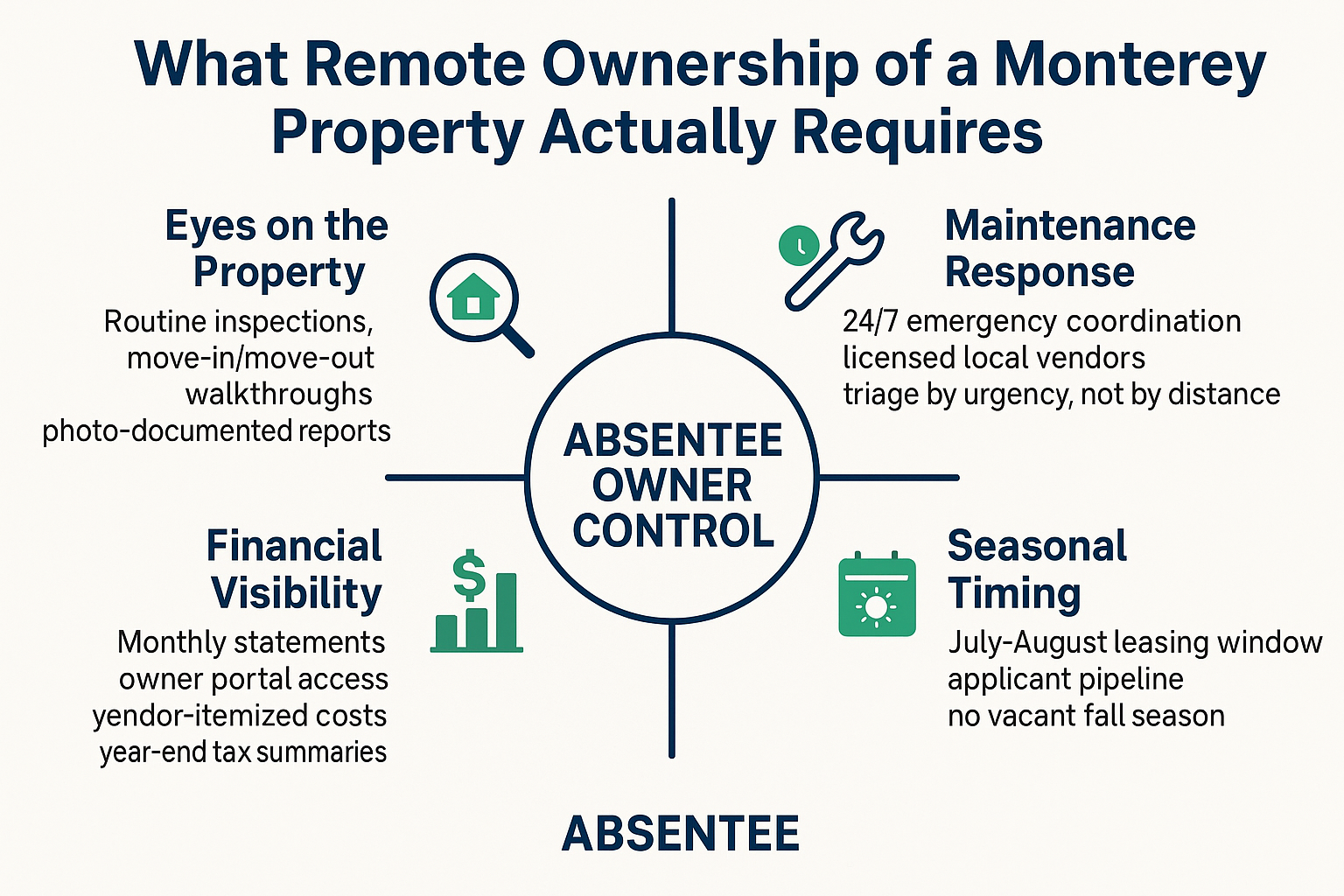
What Remote Ownership Actually Requires
This overview breaks down the four functions that determine whether absentee property ownership works, and what each one involves in practice.
Why Missing the Summer Leasing Window Costs More Than You Think
The Monterey Bay rental market has a seasonal rhythm that matters a lot if your property turns over in the summer. July and August are consistently the strongest months for tenant placement locally, demand is high, applicants are active, and well-priced properties in Monterey, Seaside, and Marina move quickly.
An out-of-area owner managing their own turnover often misses this window. They are coordinating repairs remotely, waiting on a vendor to finish a paint job, and posting the listing two weeks later than they should. By mid-September, the applicant pool is thinner and you may sit vacant into October or November.
A manager with an existing applicant pipeline and a team handling prep, photography, listings, and showings locally can move from vacancy to signed lease in a timeframe a remote owner working from a spreadsheet simply cannot match. Every week of vacancy in Monterey County represents real lost income, and the cost of a slow turnover often exceeds a full year of management fees.
For owners who have been through a turnover on their own and are considering handing it off, how to hand off a rental you have been managing yourself walks through what that transition actually looks like.
Self-Management vs. Local Manager: What Changes for Remote Owners
This comparison covers the functions that matter most when you are managing from out of the area, not every task, just the ones where distance creates the biggest risk.
| Function | Self-Managing Remotely | With a Local Manager |
|---|---|---|
| Maintenance triage | Tenant texts you; you judge urgency without seeing it | Manager assesses in person; dispatches appropriately |
| Emergency repairs | You find a contractor by phone from out of state | 24/7 coordination through established local vendors |
| Property inspections | Months may pass with no eyes on the property | Routine scheduled inspections with photo documentation |
| Leasing timing | Turnover pace depends on your availability | Local pipeline, active marketing during peak July-Aug window |
| Financial tracking | DIY spreadsheet; hard to share or audit | Itemized monthly statements and owner portal access |
| Utility oversight | Manual reconciliation; disputes handled by phone | Documented lease terms; manager monitors and flags issues |
| Insurance documentation | No inspection record if a claim is filed | Photo-documented reports create a defensible timeline |
Insurance, Liability, and Why Documentation Matters More Than Owners Expect
This is the one area where I see absentee owners most underprepared. A vacant or recently vacated property with no active inspection record creates real exposure, and most owners do not think about it until a claim is filed.
California’s Department of Consumer Affairs notes that documentation disputes are among the most common friction points between landlords and tenants at move-out. A photo-documented inspection report, completed by a licensed professional at regular intervals, does several things:
- It establishes the condition of the property before and after occupancy
- It creates a dated, verifiable record if a tenant disputes a deduction or an insurer questions a claim
- It demonstrates that the owner was exercising reasonable oversight, which matters in California, where the legal standard for habitability is well-defined and actively enforced
For vacant or seasonal properties, this is even more critical. A property sitting empty on the Monterey Peninsula during a wet winter, think the storms that hit Pebble Beach and Carmel hard in early 2023, can sustain water intrusion, roof damage, or drainage failures that go undetected for weeks. An inspection record showing the property was checked before and after that weather event is a meaningful asset if you ever need to file a claim.
Our Seasonal Property Maintenance Program addresses this directly: quarterly exterior and interior checks, water intrusion review, safety item verification, and a photo report delivered to the owner four times a year. For out-of-area owners, that program is often the first thing that gives them genuine peace of mind about a property they cannot see themselves.
If you own a second home on the Peninsula that spends part of the year vacant, owning a second home on the Monterey Peninsula while you are not there covers the specific risks and what to do about them.
Frequently Asked Questions About Remote Property Ownership in Monterey
How do I know what’s happening at my property if I live out of state?
The most reliable combination is regular scheduled inspections with photo reports plus access to an owner portal where you can see your financials at any time. You should not have to call to find out what is going on, a well-run management relationship means the information comes to you.
What happens if there’s an emergency at my property and I’m not reachable?
A local manager with 24/7 emergency maintenance coordination handles it without waiting for you to respond. Emergencies get triaged, the right vendor gets dispatched, and you get notified with the details after the situation is stabilized. You are informed, not the first call.
I’ve been managing my Monterey rental myself from out of state for two years. What am I probably missing?
In my experience, the most common gaps are: deferred maintenance that a tenant mentioned casually and you did not flag as urgent, a leasing timeline that missed the peak summer window, and no physical inspection record if something goes wrong. The financial side is also usually less clear than owners realize, most are netting less than they think once you account for vacancy, untracked maintenance, and time spent coordinating. Renting out your Monterey Bay home from a distance goes deeper on this.
How much does property management cost for a Monterey rental?
Management fees in the Monterey Bay area typically fall somewhere in a range based on the property type, the scope of services, and whether you need full-service management or just tenant placement. The fee structure varies, and the right way to get an accurate number is to have a conversation about your specific property. What property management really costs in Salinas covers how these fees are typically structured.
My property in Seaside has been vacant for a few months. Is that a problem from a liability standpoint?
It can be. A vacant property with no recent inspection record creates exposure if a visitor is injured, if a neighbor reports an issue, or if you need to file an insurance claim. Regular documented inspections, even quarterly, establish that you were exercising reasonable care as a property owner. California law does not take a forgiving view of neglected properties, occupied or not.
Can a property manager handle paying my mortgage, insurance, and property taxes from rental income?
Yes. Full-service management can include paying owner obligations directly from collected rent, mortgage, insurance premiums, property taxes, so you are not manually moving money every month. This is something we handle for a number of our out-of-area clients.
Ready to Stop Managing Your Monterey Property From a Distance?
If you own a rental or seasonal home in Monterey County and you have been trying to hold it together by phone and email, we are happy to walk through what a different approach would look like for your specific situation. Our team manages properties across Monterey, Salinas, Seaside, Pacific Grove, Marina, Carmel, and Pebble Beach, and we have been doing it for over 25 years. Reach us at (831) 582-8916 or through the contact form at torrenteproperties.com.