
Direct Answer: Property management fees in California typically include a monthly percentage of collected rent plus a separate leasing fee when a new tenant is placed. Exact costs vary by property type, firm, and scope of services.
The question I hear most often from first-time landlords is some version of: ‘What do you charge?’ It shows up in our contact form, on phone calls, and in every first conversation with a property owner who is just starting to research management companies. And honestly, that question makes complete sense, most people have no idea how property management fees are structured before they start looking.
What surprises me is how rarely anyone gets a straight, useful answer. A lot of firms list a percentage on their website and leave it there. But that number alone doesn’t tell you what you’re actually paying for, what’s not included, or how fees add up across the first year of management.
This is my attempt to answer the fee question honestly, using what I’ve seen working with landlords across Monterey, Salinas, Seaside, and the broader Monterey Bay area. I’ll cover how the two main fee types work, what affects the number you’ll be quoted, and what to actually compare when you’re evaluating firms.
How Are Property Management Fees Structured?
Almost every property management firm charges fees in two separate layers, and understanding both matters.
The first is the monthly management fee. This is an ongoing charge, usually calculated as a percentage of the rent collected each month. In California, this percentage generally falls somewhere in a range that varies depending on the market, the property type, and what the firm actually does for that fee. Because the Monterey Bay area carries higher prevailing rents than many California markets, even a modest percentage translates into a real dollar amount per month.
The second is the leasing or tenant placement fee. This is a one-time charge when a new tenant is placed. It compensates the management company for the time and cost of marketing the property, screening applicants, showing the unit, and executing the lease. Many firms charge the equivalent of half a month’s rent to one full month’s rent for this service.
The leasing fee is the one that catches new landlords off guard most often. I’ve spoken with owners who asked only about the monthly rate, then were surprised when their first statement showed a placement charge. Asking about both upfront is the right move.
For context on what the full process of getting a rental ready and leased actually involves, Getting a Monterey Bay Rental Ready: What Actually Has to Happen walks through the preparation side in detail.

What Factors Actually Move the Fee Up or Down?
Fee percentages are not one-size-fits-all, even within the same market. Several things affect where a quote lands:
- Property type. Single-family homes and smaller portfolios often sit at a higher percentage than large apartment complexes. The reason is simple: the fixed overhead per unit is greater when a manager is running one property versus twenty.
- Furnished versus unfurnished rentals. A furnished unit involves more coordination, inventory tracking, more frequent turnover prep, and sometimes more detailed inspections. Several owners who have contacted us about furnished condos in Monterey and Marina have asked specifically whether this changes the fee structure. It often does.
- Utility arrangements. Properties with shared or sub-metered utilities, or where the owner pays certain utilities directly, add a layer of billing and oversight. That complexity gets factored into how a scope of work is built.
- Portfolio size. An owner with several units in Salinas may be quoted differently than someone placing a single home in Carmel for the first time. Volume and relationship history both play a role.
- Scope of services included. This is the biggest variable of all, and I’ll come back to it.
The bottom line is that a percentage alone means nothing without knowing what work that percentage covers. A firm quoting a lower monthly rate that excludes routine inspections, after-hours emergency response, or detailed financial reporting is not the same offering as a slightly higher rate that includes all of that.
The Two Layers of Property Management Fees at a Glance
This infographic breaks down the two main fee categories and the key factors that affect where your quote lands.
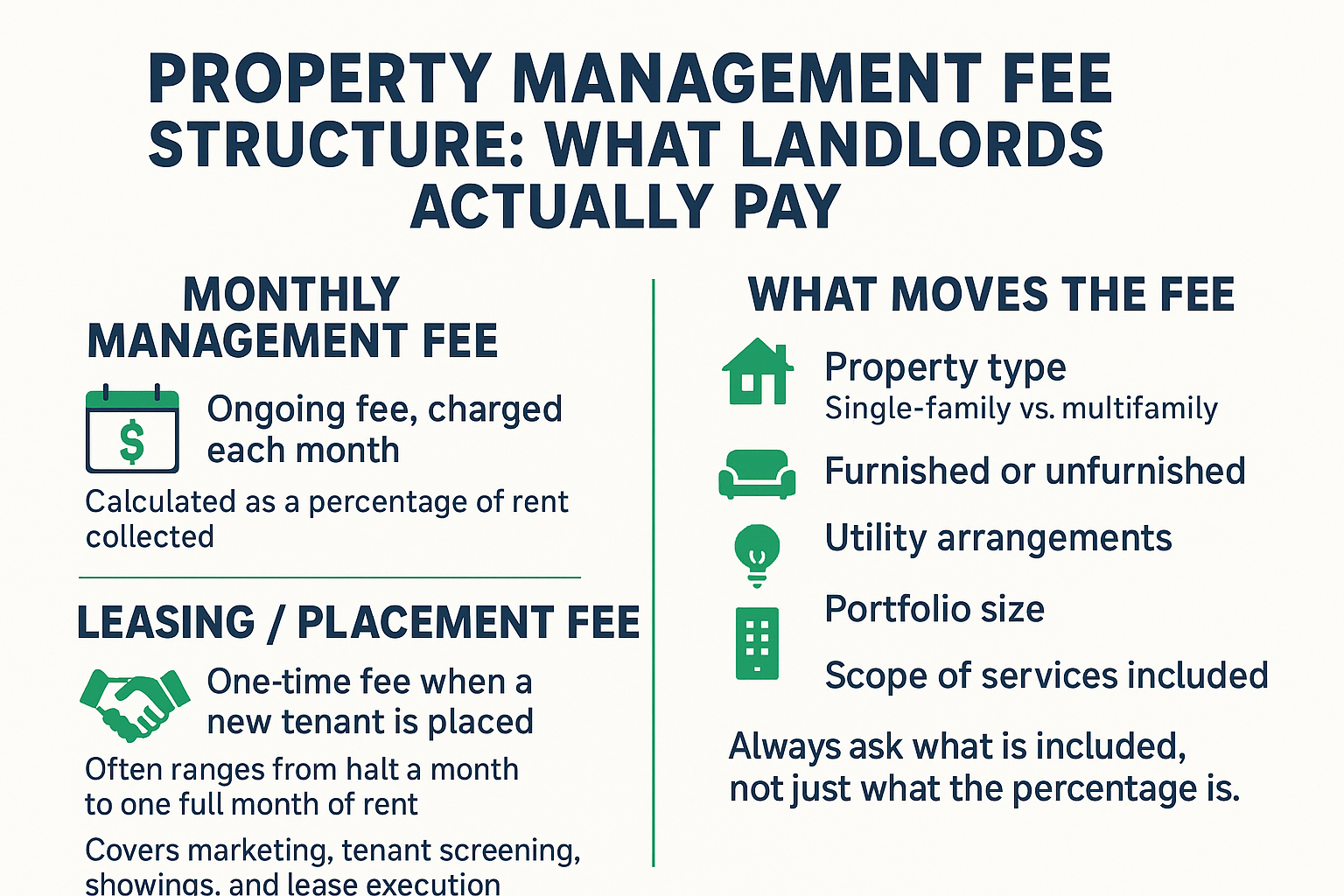
Monthly vs. Leasing Fee: What Each One Covers
Here is a quick reference for how the two main fee types differ in timing, purpose, and what they typically include.
| Fee Type | When It’s Charged | What It Generally Covers |
|---|---|---|
| Monthly Management Fee | Every month rent is collected | Rent collection, maintenance coordination, inspections, financial statements, tenant communication, owner portal access |
| Leasing / Placement Fee | Once per new tenant placement | Property marketing, rental pricing analysis, showings, credit and background screening, lease drafting and execution |
| Additional Fees (varies by firm) | Situational | Lease renewal fees, maintenance coordination markups, early termination fees, ask upfront what applies |
The Real Comparison Is About Scope, Not Just Price
When owners start comparing management companies, the instinct is to line up the percentages and pick the lowest one. I understand that instinct. But it leads to bad decisions more often than good ones.
The right question is: what does each firm actually do for that fee?
A management company that charges a lower monthly rate but does not include routine property inspections, after-hours emergency calls, or detailed monthly financial statements is not offering a lower-cost version of the same thing. It’s a different product. And the gaps tend to show up at the worst times, like when a pipe bursts at 11 p.m. or when you need documentation for an insurance claim.
Reviews from our clients consistently mention responsiveness and follow-through on maintenance as reasons they stay with us year after year. One long-term client who owns several properties in Salinas specifically described the peace of mind that comes from knowing everything is handled. That kind of operational consistency has real costs behind it, and firms with thinner fee structures are often not delivering it.
If you’re evaluating firms and want to understand what full-service management actually looks like in practice, When Self-Managing Your Rental Stops Making Sense is a good place to start. And for out-of-area owners trying to understand the true cost of going it alone, The Hidden Costs of Managing a Monterey Home From Out of State lays out what those gaps actually cost.
A Note on Vacant and Seasonal Properties
Not every property owner needs full rental management. Some of the inquiries we receive come from seasonal homeowners in Carmel or Pebble Beach who are not renting their property at all, they just need someone to check on it regularly while they’re away.
For those situations, caretaker and home watch services are a separate service category with their own pricing structure. The scope is different: scheduled property inspections, exterior monitoring, utility checks, landscaping coordination, and detailed reports to the owner. It’s not tied to rent collection because there’s no tenant.
For anyone wondering what can actually go wrong in a vacant property and why regular inspections matter, What Can Go Wrong in an Empty House, and Who’s Responsible covers the real risks in plain terms. And How Often Should Someone Check on a Vacant Home in Monterey Bay? gets into the practical question of frequency.
The point is that ‘what does property management cost’ has a different answer depending on what you’re actually asking for. A vacant home in Pacific Grove needs a different service than a rented four-unit building in Salinas, and the fee structure reflects that.
Frequently Asked Questions About Property Management Fees
What is your management fee?
This is the most common first question we get, and the honest answer is: it depends on the property and scope of work. We don’t post a flat percentage on the website because a furnished studio in Marina, a single-family home in Seaside, and a four-unit building in Salinas all involve different levels of work. The best way to get an accurate number is to contact us directly so we can understand your specific situation.
Is the leasing fee separate from the monthly management fee?
Yes, and this is the piece that surprises most new landlords. The leasing fee is a one-time charge when a new tenant is placed. The monthly management fee is an ongoing charge for day-to-day management. They are two separate costs, and any firm you evaluate should be willing to explain both clearly before you sign anything.
Do fees change if the property is furnished?
Potentially, yes. Furnished rentals involve more coordination, inventory tracking, move-in and move-out documentation, and sometimes more frequent unit prep between tenants. Several owners who have come to us about furnished condos in Monterey and Marina have asked exactly this question. It’s worth discussing during your initial conversation with any management company.
Are there fees when the property is vacant?
This varies by firm. Some charge a reduced fee or no management fee during vacancy periods. Others charge a flat monthly amount regardless. Ask this question directly, and also ask whether the company will actively work to minimize vacancy time through accurate pricing and responsive marketing. For background on how rental prices actually get set in this market, How Monterey Bay Rental Prices Actually Get Set is worth reading.
What other fees should I ask about?
Beyond the monthly and leasing fees, some firms charge separately for lease renewals, maintenance coordination markups, or early termination. Ask each company you speak with for a complete list of every fee that could appear on your owner statement, not just the headline rate. California’s Department of Real Estate requires property managers to be licensed brokers, so checking a firm’s license status is also a reasonable due-diligence step.
How do I know if I’m getting a fair deal?
Compare scope, not just price. Ask each firm what is included in the monthly fee: routine inspections, after-hours emergency response, financial reporting, tenant communication, portal access. A lower percentage that excludes those things is not a better deal, it’s fewer services. The real test is what happens when something goes wrong at midnight or when you need a clear monthly statement to review your property’s performance.
Ready to Get a Real Answer on What Management Would Cost for Your Property?
If you own a rental or vacant property anywhere in Monterey County, whether that’s a single-family home in Salinas, a condo in Pacific Grove, or a seasonal property in Carmel, we’re happy to have a straightforward conversation about what management actually looks like for your specific situation and what it would cost. You can reach our team at (831) 582-8916 or send us a message through the contact form at torrenteproperties.com.