
Find a Good Property Manager: A Monterey Bay Guide
Meta Description: Learn how to find a good property manager in Monterey Bay. Our guide covers screening, questions to ask, and red flags to avoid for your investment property.
Finding the right property manager in Monterey Bay is a key decision for your investment. A great manager does more than collect rent. They protect your asset, maximize your income, and handle the daily headaches of being a landlord.
This partnership is the secret to turning a good investment into a great one. With the U.S. property management market now a $134.2 billion industry, more owners see the value of expert help, as data from IBISWorld shows.
Why a Great Property Manager Is Your Best Asset

You are trusting someone with a major financial asset. In a unique market from Salinas to Carmel, local expertise is a must-have. A good manager lives and breathes this market.
They understand rental rates, local landlord-tenant laws, and who to call for a 2 a.m. emergency. An effective manager is a true partner who provides both peace of mind and solid financial results.
You will see their value in a few key areas:
- Minimized Vacancies: They know how to market your property effectively and screen tenants efficiently to get it rented faster.
- Quality Tenants: Their thorough background checks are your first line of defense against evictions and property damage.
- Consistent Cash Flow: They ensure steady rent collection and provide clear financial reports, keeping your investment on track.
Think of a great manager not as an expense, but as an investment in your property's long-term health. Their expertise directly boosts your bottom line.
This is especially true for out-of-town owners who need reliable eyes and ears on the ground. A trustworthy local partner is essential for protecting your home while you're away.
Key Qualities of a Top Property Manager
Before you search, know what separates an average manager from a great one. This table breaks down the essential traits to look for.
| Quality | Why It Matters for Your Investment |
|---|---|
| Local Market Expertise | They understand Monterey County's rental trends, ensuring your property is priced right to attract the best tenants. |
| Proactive Communication | You are never left in the dark. They keep you informed about maintenance, tenant issues, and financial performance. |
| Rigorous Tenant Screening | Their process protects your property from potential damage and income loss by placing reliable, long-term tenants. |
| Vetted Local Vendors | Access to a trusted network of contractors means quality repairs are done quickly and affordably, preserving your property's value. |
| Modern Technology | Up-to-date software for rent collection, maintenance requests, and financial reporting makes your life easier. |
Finding a manager with these qualities is the first step to a stress-free ownership experience.
How to Find a Good Property Manager: Your First Steps
The first real step is building a shortlist of local experts. You need partners who truly understand the Monterey Bay rental market.
A manager's knowledge of Salinas rental laws or Carmel's tenant expectations is crucial. This local insight affects how quickly they find qualified tenants and how they price your property for maximum return.
Ask for Local Referrals
Word-of-mouth is still one of the best ways to find a great property manager. Ask for recommendations from professionals you already trust in the Monterey Bay area.
- Real Estate Agents: Your agent likely works with property managers often. They know who is reputable and who to avoid.
- Accountants: These professionals often have contacts who serve other real estate investors and can offer solid recommendations.
- Local Landlord Groups: Connecting with other property owners is a great way to get honest feedback.
A strong referral from a trusted source is often the most reliable sign of quality. This is vital if you are an out-of-town owner and need a dependable local team. To learn more, read our guide on rental property management for out-of-town owners.
Check Their Online Presence and Reviews
Once you have a few names, do some online research. A professional, informative website is a strong signal of a well-run business.
When you read online reviews on sites like Google, look for patterns. A few negative reviews are normal. The important thing is how the manager responds. A professional and timely response shows they are proactive and care about communication.
Vetting Candidates and Their Services

You have a solid shortlist. Now, you must make sure they have the right qualifications and that their services fit your needs.
First, check their license. In California, anyone managing properties for others must hold a valid California Real Estate Broker License. This is non-negotiable. It ensures they meet the state’s legal and ethical standards.
Do Their Services Match Your Goals?
After confirming their license, dig into what they do. A great property manager will explain exactly how they handle core tasks that protect your investment.
Ask specific questions about their process:
- Tenant Screening: What are their exact screening criteria? A good approach includes credit checks, rental history review, and income verification.
- Property Marketing: How will they market your property? Expect a clear strategy with high-quality photos and listings on major rental sites.
- Maintenance: Do they have a trusted network of local vendors? Proactive maintenance is key to protecting your asset.
This is also the perfect time to ask about the structure of their property management contract. How these services are written down will tell you a lot.
Find the Right Company Size
The U.S. property management industry has over 304,000 businesses. They range from small shops to large national corporations. You need to find one whose size feels right for you.
Statistics show that about 35% of managers handle between 101 and 500 units, so you have many options. You can find more property management industry insights at Doorloop.com.
The key is finding the right balance. A larger firm may have better systems, but a smaller company can offer a more personal relationship. Choose what fits your property and communication style.
Ask the Right Interview Questions
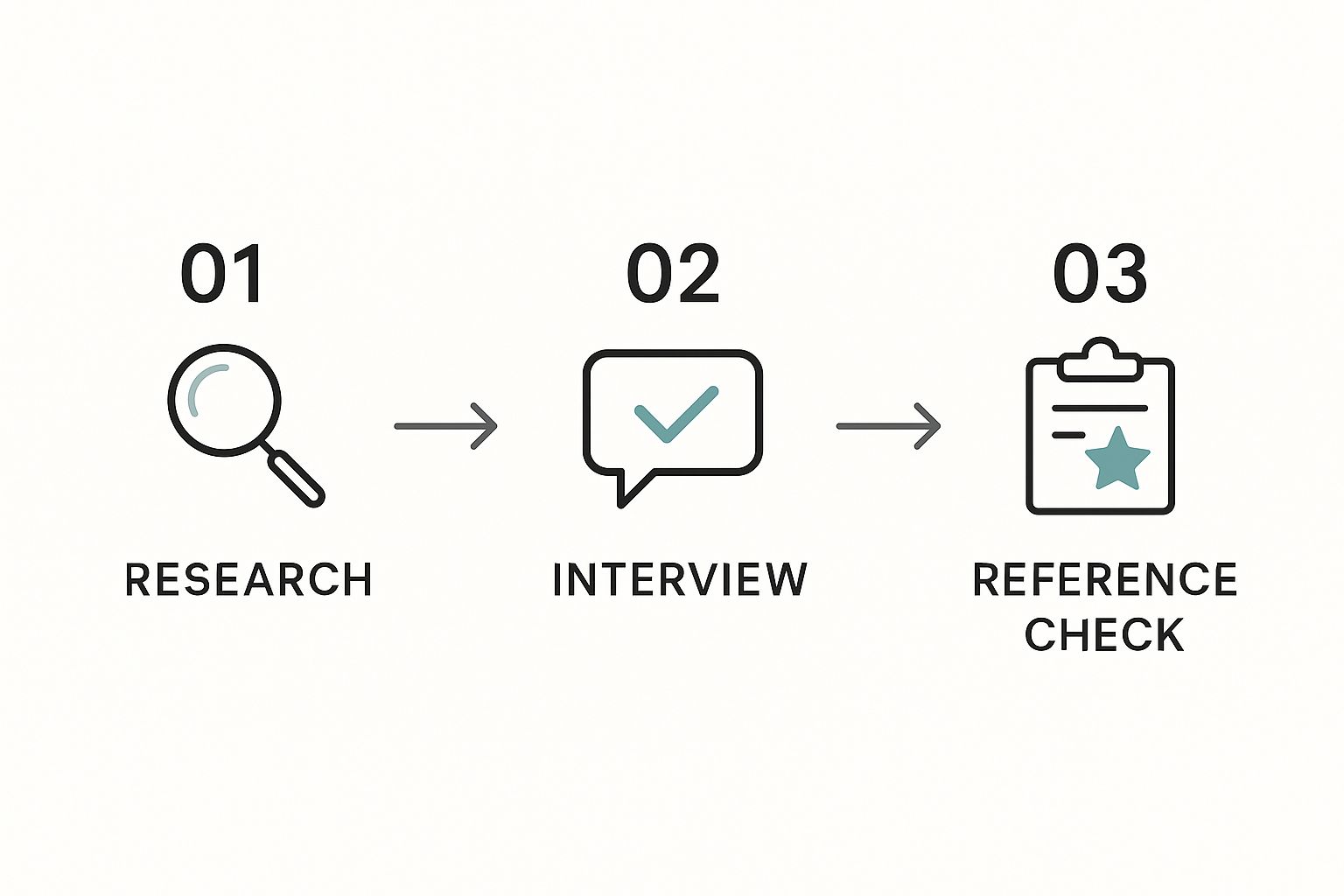
The interview is your chance to see how a potential manager really operates. You need to understand their communication style and problem-solving skills.
Forget simple "yes" or "no" questions. Instead, use realistic situations to test them.
Try this: “It’s 10 p.m. on a Saturday, and your tenant in Monterey calls about a burst pipe. Walk me through your exact process.” Their answer reveals their responsiveness and how they handle emergencies.
Check Their Technology and Screening Process
Today's rental market requires a tech-savvy manager. Modern software is essential for owner portals, financial reports, and screening applicants.
Ask them directly: "What technology and processes do you use to prevent fraudulent rental applications?" A top-tier manager will have a clear, data-driven answer. This shows they are serious about protecting you and finding reliable tenants.
By focusing on these practical questions, you will get a clear picture of how they will perform.
Understanding Management Fees and Contracts
Understanding fees and contracts is the foundation of a good partnership. When you know how your manager gets paid, you can avoid surprises.
Most property managers in Monterey Bay use a percentage of the monthly rent, usually between 8-12%. This structure puts you on the same team; the manager only makes money when you do. A flat-fee model offers a predictable cost, which is great for owners with a tight budget.
Know the Full Cost of Service
The monthly fee is just the start. You must look at the complete fee schedule to see the whole picture.
You will typically see other standard costs:
- Leasing Fee: A one-time charge for finding and placing a quality tenant.
- Maintenance Markups: Some firms add a small percentage to vendor invoices to cover coordination time.
- Eviction Costs: If an eviction is needed, there will be legal and administrative fees.
A trustworthy partner will provide a clear contract outlining every potential charge. For a closer look at what that document should include, read our guide on the property management agreement.
Pay close attention to the contract length and termination clauses. Getting these details right from the start protects you from hidden fees and ensures a fair arrangement.
Making Your Final Decision

You have done your research and compared your options. Before you decide, there is one last critical step: checking references.
Speaking with a manager’s current clients gives you an unfiltered look at their performance. Ask about their communication, how they handle emergencies, and the accuracy of their financial statements.
Trust Your Instincts and Begin Onboarding
After gathering facts, your intuition plays a big role. Do you feel a sense of partnership and trust? This feeling can be the tiebreaker between two good options.
Once you choose, the onboarding process should be seamless. A professional manager will take the lead, handling everything from notifying tenants to transferring documents and security deposits. This initial phase sets the stage for a successful, long-term relationship.
For more insights, check out these top 7 property management tips.
FAQs on Finding a Property Manager
Here are some common questions we hear from property owners in the Monterey Bay area.
What are typical property management fees in Monterey Bay?
Management fees in our area usually range from 8% to 12% of the monthly rent collected. Always ask for a full fee schedule to understand any additional costs for leasing, maintenance, or other services so you can compare offers accurately.
How important is it for a manager to be local?
Local expertise is essential. A manager in Monterey, Salinas, or Carmel understands neighborhood rental markets and has a network of trusted local vendors. This is critical for both routine maintenance and emergencies.
What are the biggest red flags to watch for?
Poor communication during the interview process is a major red flag. Also, be wary of unusually low fees, as this often means corners are being cut. A lack of transparency in their contract or an inability to provide solid references are also warning signs.
How does a manager handle tenant screening?
A good manager uses a rigorous process that includes credit checks, background checks, rental history verification, and income confirmation. This protects your investment by finding reliable, long-term tenants for your property.
What should I look for in a property management contract?
Your contract should clearly state all fees, the contract term, and the conditions for termination. It should also define the manager's responsibilities, including rent collection, maintenance protocols, and financial reporting.
Ready to find a property manager who treats your investment with the care it deserves? The team at Torrente Property Management brings the local expertise, integrity, and responsive service you need for true peace of mind.
Contact Torrente Property Management today at (831) 582-8916 or find your perfect management solution on our website.


What Is Net Operating Income? A Monterey Bay Guide
Imagine your rental property is a small business. Its profit, after paying daily bills but before the mortgage and taxes, is its Net Operating Income (NOI). This one number shows how profitable your investment truly is. It's a key metric for success.
For savvy real estate investors, understanding NOI is crucial. In fact, a Nareit T-Tracker report showed a 4.8% year-over-year increase in NOI for Real Estate Investment Trusts (REITs), showing how important it is for tracking performance.
Why NOI Matters to Monterey Bay Investors

As a property owner, you see rent coming in and bills going out. How do you know if your investment is doing well? The answer is your Net Operating Income.
NOI gives you a clear look at your rental's financial health. It focuses only on income and expenses from daily operations. This gives you a stable way to measure performance each year.
Your Most Valuable Metric
Whether you own a home in Salinas or a multi-unit property in Carmel, NOI is your most important number. It tells you if the property itself is a profitable business. This is separate from your personal financing choices.
A strong NOI is the foundation of smart real estate investing. It helps you:
- Make Better Decisions: Know when it's the right time to raise rents, invest in upgrades, or refinance.
- Assess Property Value: A higher NOI directly leads to a higher property valuation. It's that simple.
- Secure Financing: Lenders look at NOI to see if a property generates enough income to cover loan payments.
Understanding this concept is key. It helps you become a strategic investor managing a valuable asset right here in the Monterey Bay area.
Breaking Down the NOI Calculation
The formula for Net Operating Income (NOI) is simple. It comes down to two things: what your property earns and what it costs to run. Understanding these parts is key to measuring your property's financial performance.
The basic formula is: Gross Operating Income (GOI) - Operating Expenses = Net Operating Income (NOI). Let’s look at each part of that equation.
Your Property’s Total Earnings
First, we need to find your Gross Operating Income (GOI). This is more than just the rent you collect. GOI includes every bit of income your property generates in a year.
Think beyond the rent check. Do you charge for pets? What about parking or laundry machines? All that extra money is part of your GOI. This gives you a full picture of your property's earning potential.
This infographic shows the three steps for calculating your property's net operating income.
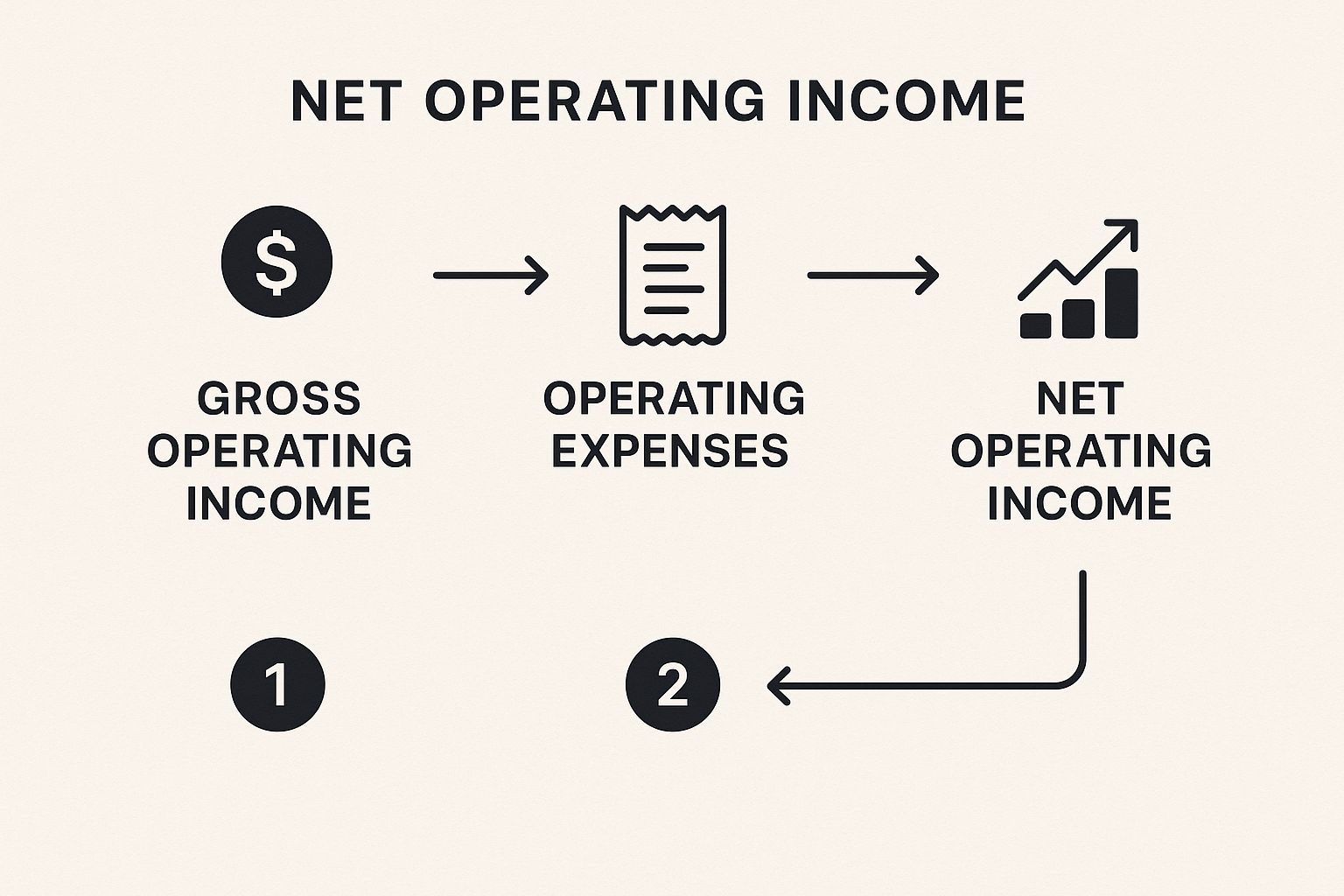
As you can see, NOI is the true profit left after you subtract the daily running costs from the total income.
What It Costs to Run Your Property
Next, you add up your Operating Expenses. These are all the necessary, regular costs to keep your Monterey Bay property safe, functional, and occupied. They are the predictable bills that come with being a landlord.
Common operating expenses include:
- Property Taxes: Your annual payments to the county.
- Insurance: Coverage for liability and property damage.
- Utilities: Costs not paid by tenants, like water for common areas.
- Routine Maintenance: Things like landscaping, pest control, and small repairs.
- Property Management Fees: The cost of having a professional team handle the daily tasks.
Keeping good track of these expenses is very important. If you need a better way to stay organized, our guide on the best accounting software for landlords can help you streamline everything.
Important Note: Operating expenses do not include your mortgage payment, income taxes, or large capital projects like a new roof. NOI focuses only on the operational health of the property itself.
When you subtract these operating costs from your gross income, you get your Net Operating Income. That number gives you an honest assessment of your property’s profitability.
A Practical Guide to Calculating Your NOI

Now you understand the theory behind NOI. Let’s put it into practice. Calculating your Net Operating Income is a simple process that shows you exactly how your property is performing.
The formula is your guide: NOI = Gross Operating Income (GOI) - Operating Expenses.
To make this real, we'll walk through an example. We'll use a rental home in Salinas, California. Follow along, and you’ll be able to run these numbers on your own Monterey Bay investment.
Step 1: Add Up Your Gross Operating Income
First, we need to add up every dollar the property brings in over a year. This total is your Gross Operating Income (GOI).
- Monthly Rent: Let’s say the home rents for $3,000 per month. Annually, that’s $36,000.
- Other Income: The tenant also pays a $50 monthly pet fee. This adds another $600 to your yearly income.
Add them together to get your GOI.
Gross Operating Income (GOI) = $36,000 (Rent) + $600 (Pet Fees) = $36,600
This number is the property's maximum earning potential before any bills are paid. It's our starting point.
Step 2: Calculate Your Total Operating Expenses
Next, we subtract all the regular costs that keep the property running. Remember, we are not including the mortgage or major improvements here.
Here is a breakdown of typical annual expenses for a Salinas rental:
- Property Taxes: About $4,500 for the year.
- Property Insurance: A standard policy is around $1,200 annually.
- Repairs & Maintenance: It’s smart to budget $1,800 for routine upkeep.
- Property Management Fees: A typical 8% fee on collected rent is $2,880.
- Vacancy: Always plan for empty periods. Budgeting for one month of vacancy, or $3,000, is wise.
Let's total these to get our annual operating costs.
Total Operating Expenses = $4,500 + $1,200 + $1,800 + $2,880 + $3,000 = $13,380
Step 3: Find Your Net Operating Income
This is the final step. We subtract the total operating expenses from our gross operating income.
$36,600 (GOI) - $13,380 (Operating Expenses) = $23,220 (NOI)
So, for our Salinas property, the Net Operating Income is $23,220. This number reveals the property's standalone profitability. It's a key metric for savvy investors and businesses.
Why NOI Is Crucial for Real Estate Investors
So, you've calculated your Net Operating Income. What does that number actually do for you? For real estate investors, lenders, and appraisers, your property’s NOI is the best way to judge its health and value. It is the most important number for making smart financial decisions.
Think of NOI as the engine of your investment. A bigger, more efficient engine makes the entire vehicle more valuable. In the same way, a higher NOI makes your property more profitable and worth more money.
How NOI Connects to Property Value
NOI directly shapes your investment’s worth through a metric called the Capitalization Rate, or "Cap Rate." This is a simple formula used in real estate to quickly compare different investments.
The formula is: Cap Rate = Net Operating Income / Property Value
This equation shows a direct link between your NOI and your property's value. If your NOI goes up while the market cap rate stays the same, your property’s value increases. Lenders and appraisers use this logic when deciding a property's worth.
For property owners in the competitive Monterey Bay market, maximizing NOI is the key to building a successful rental portfolio.
How a Higher NOI Boosts Your Bottom Line
Let's see how a small change in NOI can have a big impact on a property's value. We'll assume a market Cap Rate of 5%. Watch what happens when we improve the NOI.
| Property Scenario | Annual NOI | Cap Rate | Estimated Property Value |
|---|---|---|---|
| Baseline Property | $30,000 | 5% | $600,000 |
| Improved NOI Property | $33,000 | 5% | $660,000 |
By increasing the NOI by just $3,000 a year, the property's value jumped by $60,000. This could come from adding a small fee for storage or reducing utility costs.
This is why focusing on NOI is so important. Every dollar you add to your NOI directly builds your long-term wealth. For more ideas, check out our property management tips for local landlords.
Common Mistakes When Calculating NOI

Calculating your Net Operating Income is a powerful step. However, a simple mistake can mess up your financial picture. A wrong NOI can make a property seem more or less profitable than it really is. This can lead to bad investment decisions.
Let's break down the most common errors and how to avoid them.
Mixing Up Operating and Capital Expenses
This is the most common mistake. It is important to separate routine costs from major investments.
- Operating Expenses are daily costs like landscaping, insurance, and minor repairs.
- Capital Expenditures (CapEx) are big projects like a new roof or a full kitchen remodel.
Including a $15,000 roof replacement in your operating expenses would crush your NOI. It would make a healthy property look like a financial failure on paper.
Forgetting to Account for Vacancy
It is great to be optimistic. However, assuming your property will be occupied 100% of the time will inflate your NOI. Tenant turnover is a normal part of being a landlord, even in a strong market like Monterey County.
Smart investors always budget for vacancy, usually between 5% and 10% of the potential rent. This creates a realistic safety net in your numbers. Skipping this step can lead to a surprise income shortage.
For owners of second homes, managing empty periods is key. Our guide on vacant home caretaker services in Monterey Bay offers tips for protecting your asset during those times.
Ways to Boost Your Property's NOI
Understanding what net operating income is gives you a clear picture of your property's health. Improving it is how you build long-term wealth. Boosting your NOI is about two simple things: making more money and spending less.
Small, smart changes can have a huge impact on your property's cash flow and value. Let's look at some practical ways you can do this for your Monterey Bay rental.
How to Increase Your Revenue
The most obvious way to raise income is by increasing rent, but don’t stop there. Think creatively about how your property can earn extra money on the side.
- Add Profitable Amenities: Could you add coin-operated laundry? Or offer reserved parking for a monthly fee? These small additions create new income streams.
- Use a Utility Billing System: For multi-unit properties, a Ratio Utility Billing System (RUBS) is a great tool. It lets you charge tenants for their share of utilities like water, which can lower your costs.
- Review and Adjust Rent: Make sure your rent matches the current market rates in Salinas or Carmel. A professional market analysis can show if you are charging too little.
Even if you manage a property from far away, you can still optimize your revenue. Our guide on rental property management for out-of-town owners has great tips for maximizing returns.
How to Reduce Your Expenses
Cutting costs is the other side of the NOI coin. Smart expense management is about being efficient and proactive. This stops small problems from becoming expensive emergencies.
Here are a few ways to get your operating expenses under control:
- Use Preventative Maintenance: Don't wait for things to break. Regular service on HVAC systems and fixing small leaks prevents costly emergency calls.
- Invest in Energy Efficiency: Simple upgrades like LED lighting or low-flow toilets can lead to big savings on utility bills over time.
- Shop for Insurance Annually: Don't just auto-renew your landlord insurance. Get quotes from different providers each year to find the best price.
By working to increase what you earn and decrease what you spend, you directly improve your NOI. This puts more cash in your pocket today and makes your property more valuable for the future.
FAQs About Net Operating Income
It is normal to have a few questions about Net Operating Income. Here are quick answers to common questions from property owners in the Monterey Bay area.
What is net operating income in simple terms?
Think of Net Operating Income (NOI) as your property's annual profit. It is the money it earns from rent after paying its daily bills but before you pay your mortgage or income taxes.
Is a higher NOI always better?
Yes, a higher NOI is almost always better. It means your property is more profitable and running well. A strong NOI increases your property's value and makes it more attractive to lenders and buyers.
How is NOI different from cash flow?
NOI shows the property's earning power before financing. Cash flow is the money left after you pay the mortgage. The simple math is: Cash Flow = NOI - Mortgage Payments.
Are property management fees an operating expense?
Yes, they are. If you hire a professional property manager, those fees are a standard operating expense. You subtract them from your Gross Operating Income when calculating NOI.
Why aren't capital expenditures included in NOI?
Capital Expenditures (CapEx) are major upgrades, like a new roof. They are not regular costs but long-term investments that boost the property's value. Because of this, they are kept separate from the NOI calculation, much like items on a tenant move-out inspection checklist are handled.
Maximize Your Investment with Expert Guidance
Understanding and improving your Net Operating Income is the key to a successful real estate portfolio in Monterey Bay. By focusing on this critical number, you can make smarter decisions and build long-term wealth.
If you want to take your property's performance to the next level, our team at Torrente Property Management is here to help. We provide personalized service to help you get the most out of your investment.
Contact Torrente Property Management today at (831) 582-8916 to learn how we can boost your NOI.

What is a Property Manager? A Guide for Owners
Meta Description: What is a property manager? Learn how a professional partner handles tenants, maintenance, and finances to protect your Monterey Bay investment.
A property manager is a licensed professional you hire to handle the daily tasks of your rental property. Think of them as the CEO of your real estate investment. They manage tenants, finances, maintenance, and legal rules to make sure your property is profitable and well-cared for.
Your Investment's Most Valuable Partner
Owning a rental in the Monterey Bay area is a great way to build wealth. But it’s rarely a hands-off job. Late-night maintenance calls and California's complex tenant laws can feel like a full-time commitment.
This is where a professional property manager helps. They act as the link between you, your tenants, and your investment, giving you peace of mind.
A property manager's role is more than just collecting rent. According to the U.S. Census Bureau, the property management industry includes over 89,000 firms nationwide. This shows the level of expertise needed to do the job right. You can learn more about these property management industry statistics and trends.
For property owners, hiring a pro offers clear benefits:
- More Freedom: They handle the daily headaches, giving you back your time.
- Better Tenants: Their tough screening finds reliable tenants who pay on time.
- Maximized Profit: They use local market knowledge to set the right rent and keep costs down.
This image shows how a property manager acts as the central hub for all property-related activities.
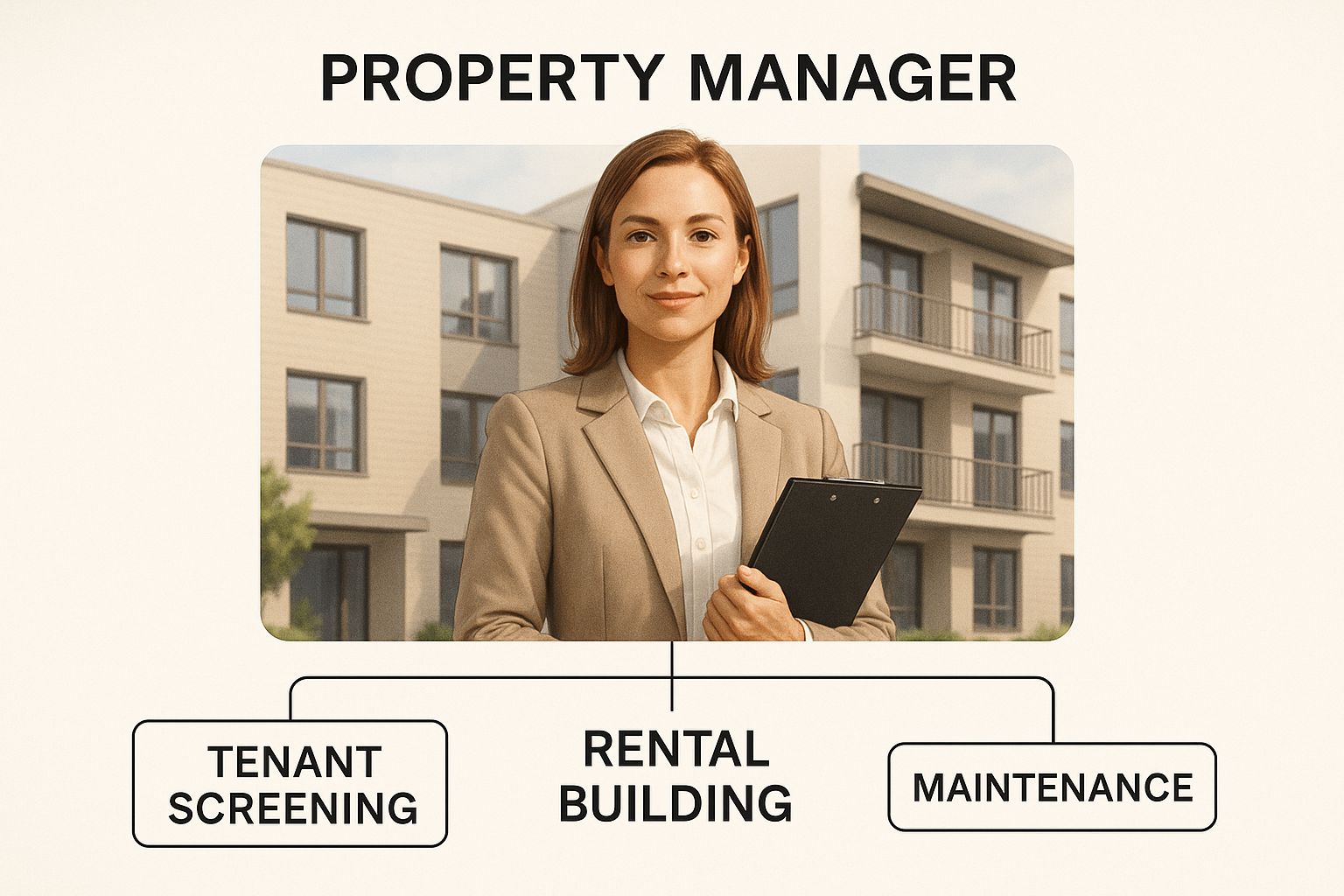
Ultimately, a good manager protects your asset and makes it perform better. They turn a stressful job into a passive investment for you.
DIY Landlord vs. Professional Property Manager
To see the value a professional brings, it helps to compare how tasks are handled. The difference is often night and day.
| Task | DIY Landlord Approach | Professional Manager Approach |
|---|---|---|
| Tenant Screening | Relies on basic applications and gut feelings. | Uses a multi-step process including credit, background, and eviction checks. |
| Rent Collection | Chases late payments with calls and texts. | Implements an automated system with clear policies and handles all follow-ups. |
| Maintenance | Tries to fix things or spends hours finding a contractor. | Dispatches trusted, vetted vendors from an established network. |
| Legal Compliance | Tries to keep up with changing laws, risking mistakes. | Stays current on all local, state, and federal regulations to ensure compliance. |
| Setting Rent | Guesses a price based on nearby listings. | Conducts detailed market analysis to set the optimal rent price. |
While the DIY route might seem cheaper, a professional manager's expertise often leads to a more profitable and stable investment.
Breaking Down a Property Manager's Key Duties

So, what does a property manager do all day? Their work is built on four key pillars that support your investment's success. Let's look at what these duties involve.
The Four Pillars of Property Management
1. Marketing and Leasing
An empty property doesn't make money. A manager's first job is to minimize vacancies by finding the best tenants. For a rental in Carmel, this means professional photos and compelling property descriptions to attract the right audience.
They handle all inquiries, schedule showings, and guide applicants through the process. It's about presenting your property in the best possible light.
2. Tenant Management
Once a lease is signed, the manager becomes the tenant's main contact. They handle rent collection, field complaints, and enforce lease terms. This creates a professional buffer, ensuring all communication is clear, documented, and follows fair housing laws.
A great manager builds positive relationships, which encourages tenants to stay longer and reduces turnover costs.
3. Financial Duties
A manager is responsible for your property's financial health. Their tasks include:
- Setting and collecting rent based on local market analysis.
- Paying all property-related bills, like landscaping or utilities.
- Tracking all income and expenses for your records.
- Providing clear monthly statements that make tax time easy.
Strong financial oversight is essential. To learn more, check out our guide on the best accounting software for landlords.
4. Property Maintenance and Repairs
A manager's job is to protect your asset by keeping it in great shape. They coordinate routine upkeep and are the first call for maintenance requests or emergencies.
They dispatch trusted vendors to get the job done right. This proactive approach keeps tenants happy and preserves your property's value.
Why a Local Property Manager Makes All the Difference
Hiring a property manager is an investment in local knowledge. An out-of-area manager can't grasp the unique details of Monterey County. A true local expert knows what rent to set for a home in Salinas or how to market a property in Pacific Grove.
This community insight translates into real savings. A local manager performs a sharp market analysis to maximize your income and minimize vacancy days. When a pipe bursts, they have a network of trusted local plumbers on speed dial, not just a name from a Google search.
Beyond the Balance Sheet
The biggest benefit of a local manager is peace of mind. Knowing a professional is handling emergency calls and navigating California's tricky tenant laws is priceless.
Your property transforms from a source of worry into a true investment. This frees you to focus on what matters most, confident that your asset is in capable, local hands. Overcoming these common property management challenges is often the most rewarding part.
How to Choose the Right Property Manager
Picking the right partner is a big decision. The ideal manager is a trusted steward of your investment. To make the right choice, you need to ask the right questions.
A professional firm should be transparent about their processes and fees. Don't be afraid to ask for specific details.
Key Questions to Ask
When interviewing managers, focus on their expertise, communication, and local knowledge. Here are a few questions to start with:
- What is your tenant screening process? A solid process includes credit, background, and rental history checks.
- Can you provide a full breakdown of your fees? You need clarity on management fees, leasing fees, and any maintenance mark-ups.
- Are you licensed and insured? Always verify their California DRE license and ask for proof of insurance.
- How do you handle maintenance and emergencies? Look for a clear system and a network of vetted local vendors.
Look for a Community-Focused Partner
Pay attention to how a company presents itself. A massive corporation may not give your Monterey Bay property the personalized attention it deserves. A community-focused partner brings deep local roots and responsive communication.
For example, our bilingual team can effectively serve a broader tenant base in communities like Salinas. It is also critical to understand your agreement. You can review key elements in our guide to the property management contract.
Choosing a local expert committed to integrity and personalized service is the surest path to your peace of mind. For out-of-town owners, this local presence is even more crucial. Learn more in our guide to rental property management for out-of-town owners.

Frequently Asked Questions About Property Management
Here are answers to some of the most common questions we hear from property owners like you.
How much does property management cost?
Most companies in our area charge a fee between 8% and 12% of the collected monthly rent. The exact rate depends on your property type, its location, and the services you need. Some firms also charge a one-time fee for placing a new tenant.
Will I lose control of my rental property?
Not at all. You are always the owner and have the final say on big decisions, like approving a new lease or a major repair. Think of your manager as a partner who handles the day-to-day work based on the guidelines you set together.
What happens if a tenant needs to be evicted?
A professional manager handles the entire eviction process. This protects you from legal headaches. They serve all required notices, file the correct paperwork, and ensure every step follows California's landlord-tenant laws.
Is one rental property too small to hire a manager for?
No. Professional management adds value no matter the size of your portfolio. Many owners with a single home or condo find that a manager saves them time and boosts their return on investment.
How do property managers find good tenants?
Finding great tenants is about having a solid process. A good manager uses professional marketing to attract a large pool of applicants. Then, they use a tough screening process that includes credit checks, background verification, income confirmation, and landlord references. Learn more about what a property management company does to secure great tenants.
Ready to turn your property into a stress-free investment? The local experts at Torrente Property Management are here to help. Contact us today at (831) 582-8916 to learn how we can protect your asset and maximize your returns.

How to Price Rental Property for Maximum Profit in 2024
Setting the right rent for your Monterey Bay property can feel like a tough balancing act. Price it too high, and you risk a long, costly vacancy. Price it too low, and you leave money on the table every month. A smart pricing strategy is essential for your success.
Balancing Profit and Market Demand
Finding the perfect rent price is both an art and a science. It blends sharp analysis of the local market with a clear understanding of your property's value and financial goals. Getting this right from the start is key to a profitable rental business.
The stakes are high for tenants as well. A staggering half of all renter households are cost-burdened, meaning they spend over 30% of their income on rent, according to Harvard’s Joint Center for Housing Studies. This fact shows how important it is to set a fair and competitive price. You can review the latest rental market research to understand this trend.
This guide will help you move beyond guesswork. We’ll show you how to:
- Analyze local comps from Salinas to Carmel.
- Calculate your property's real operating costs.
- Set a price that attracts quality tenants quickly.
Nail Your Local Market Analysis
To price your rental correctly, you must become an expert on your neighborhood. This process is called a comparative market analysis (CMA). It involves studying similar rental properties—your "comps"—in your immediate area.
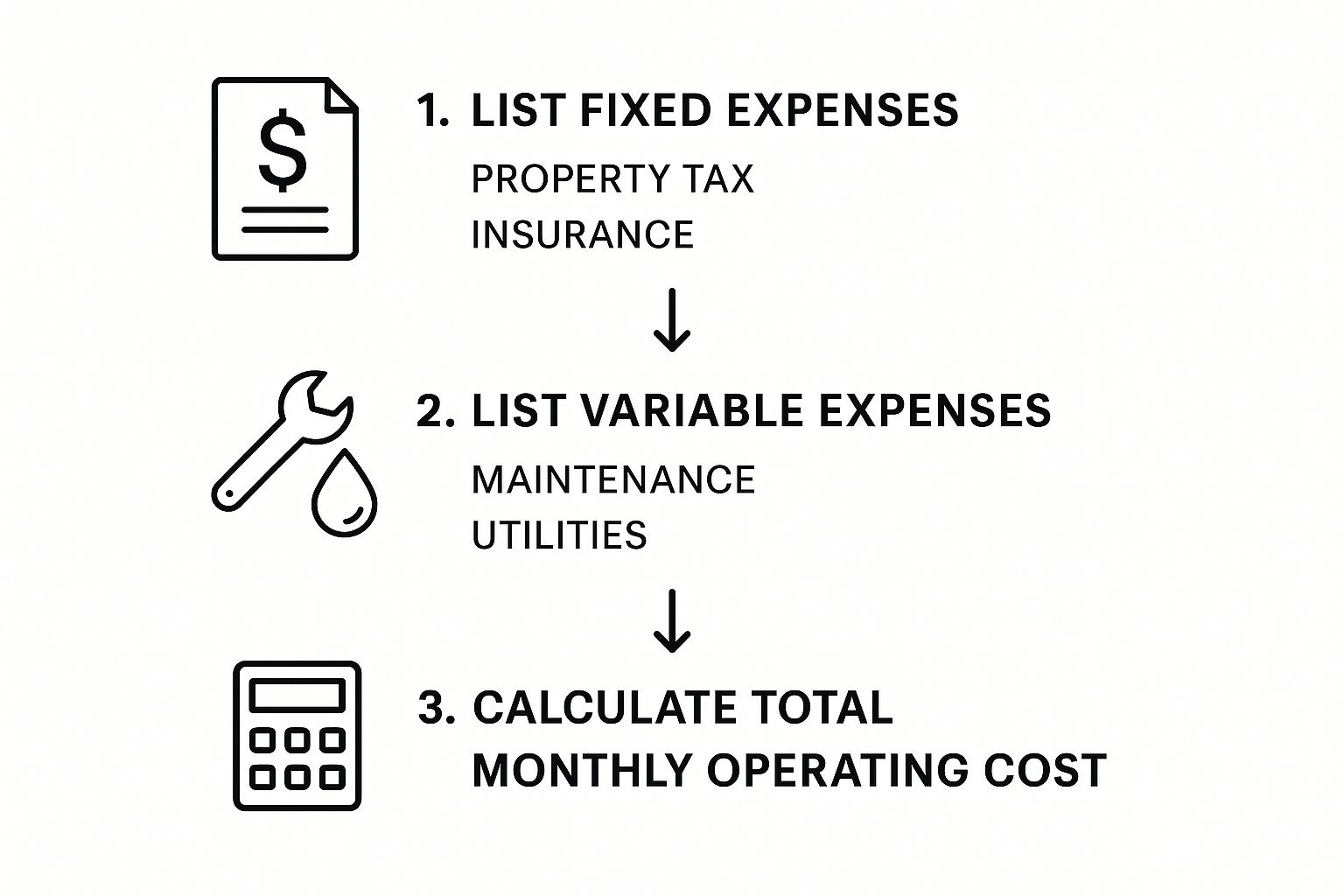
Before looking at what others charge, you need a firm grip on your own expenses. This includes both fixed and variable costs. This number is your baseline.
Understanding the local pulse is everything. While global trends offer perspective, real estate is intensely local. For example, some niche markets like the recreational and vacation camp market have unique valuation methods.
That’s why we focus on what’s happening right here in Monterey County. For specific advice, check our guide on how to maximize your rental profits in Salinas.
Systematically Comparing Your Property
Finding good comps means looking for properties a tenant would truly consider as an alternative to yours. A checklist is the best way to keep this process objective and thorough. It forces you to look at the details, not just the rent price.
Use this checklist to compare your rental to others in the local market.
Rental Comps Analysis Checklist for Monterey Bay
| Feature | Your Property Details | Comparable Property 1 | Comparable Property 2 | Price Adjustment (+/-) |
|---|---|---|---|---|
| Location/Neighborhood | e.g., Downtown Monterey | |||
| Bedrooms/Bathrooms | e.g., 2 bed / 2 bath | |||
| Square Footage | e.g., 1,100 sq. ft. | |||
| Condition & Age | e.g., Remodeled 2 yrs ago | |||
| Appliances | e.g., Stainless steel, new | |||
| Parking | e.g., 1-car garage | |||
| Outdoor Space | e.g., Small private patio | |||
| Amenities | e.g., In-unit laundry | |||
| Pet Policy | e.g., Small dogs allowed | |||
| Monthly Rent | (Your Target Price) | (Your Final Estimate) |
After filling this out, the "Price Adjustment" column guides you. If a comp has a new kitchen and yours doesn’t, you adjust your target price down. If you offer a garage and they don't, you can adjust yours up.
Calculate the True Cost of Your Rental Property
Profitability starts with knowing your numbers. A common mistake is for a new landlord to look only at their mortgage payment, set the rent a bit higher, and assume they are profitable. This often leads to pricing errors and surprise expenses.
To truly understand how to price your rental, you must create a complete expense sheet.

This means accounting for every cost, from property taxes to maintenance and vacancies. You can’t afford to guess at these figures. Getting organized is half the battle.
It is also vital to understand how property size affects your bottom line. A tool like a real estate square footage cost estimator can offer valuable insights.
Use Key Metrics to Finalize a Profitable Rent
You've done the market research and calculated your expenses. Now it's time to use key financial metrics to lock in a smart rental price. This is where you shift from thinking like a homeowner to thinking like a business owner.
Metrics like Return on Investment (ROI) and Capitalization (Cap) Rate are your best tools. They show you how your property is really performing. To see if your investment is working, use a rental property ROI calculator.
A common rule of thumb is the ‘1% Rule,’ which suggests your monthly rent should be at least 1% of the property's purchase price. This is a good starting point, but in a high-value market like Monterey, you must weigh it against other data.
Essential Rental Pricing Formulas
Here is a quick breakdown of the formulas every landlord should know. They are simple tools for checking your rental price and potential return.
| Metric | Formula | What It Tells You |
|---|---|---|
| Cash Flow | (Gross Rental Income) - (Operating Expenses + Mortgage) | The actual profit left in your pocket each month after all bills are paid. |
| Return on Investment (ROI) | (Annual Cash Flow / Total Cash Invested) x 100 | The percentage return you're earning on the money you personally put into the property. |
| Capitalization (Cap) Rate | (Net Operating Income / Property Purchase Price) x 100 | A quick way to compare the potential return of different properties, independent of financing. |
| The 1% Rule | (Monthly Rent / Property Purchase Price) ≥ 0.01 | A simple guideline to see if a property’s rent is in a healthy range relative to its cost. |
Think of these formulas as your dashboard for making smart pricing decisions. They provide the clarity you need. For more hands-on advice, explore our other property management tips.
How Amenities and Condition Impact Rental Value
The features and condition of your property play a huge role in setting the rent. A home with a dated kitchen will not command the same price as one with a modern remodel. Tangible benefits like a private yard or off-street parking directly increase your property’s value to a renter.

From our experience, Monterey Bay tenants will pay more for certain features.
- In-unit laundry is a huge convenience that tops most tenants' wish lists.
- Pet-friendly policies open your property to a much larger pool of applicants.
- Updated appliances signal that the home is well-cared-for.
Smart, tenant-focused upgrades are a direct investment in your rental income. Managing these upgrades is crucial, especially from a distance. Our guide on rental property management for out-of-town owners offers more insight.
Answering Your Rental Pricing Questions
When you're finalizing your rental price, a few common questions always come up. Here are straightforward answers to what we hear most from property owners in the Monterey Bay area.
How often should I adjust my rental price?
You should review your rent annually, about 90 days before a lease expires. This gives you time to check current market conditions in Monterey County and decide if a price change is needed. This practice keeps your property competitive.
Should I include utilities in the rent?
This depends on your property type and local norms. For single-family homes, tenants usually pay their own utilities. For multi-unit properties, including water or trash can be an attractive perk, but be sure to factor that cost into your rent.
What is the biggest mistake landlords make when pricing?
The most common and costly mistake is pricing based on emotion. Many owners use their mortgage payment or what they feel the property is worth, ignoring market data. This leads to a vacant property, which costs far more than setting a competitive rent from day one.
How do I handle security deposits?
In California, the maximum security deposit is one month's rent for an unfurnished unit and two months' for a furnished one. Always follow state laws for handling and returning deposits. Proper procedure, like using a tenant move-out inspection checklist, protects both you and your tenant.
Can I charge more for a pet-friendly rental?
While California law doesn't allow a separate "pet rent," having a pet-friendly policy is a smart move. It dramatically widens your pool of qualified applicants. With more great tenants to choose from, you can often secure your full asking price much faster.
Partner with Monterey Bay’s Pricing Experts
Setting the right rental price is the foundation of a successful investment. By combining market analysis, accurate expense tracking, and an understanding of what local tenants value, you can maximize your income and minimize vacancies.
Ready to take the guesswork out of pricing your rental property? The local experts at Torrente Property Management are here to help. Contact Torrente Property Management today at (831) 582-8916 for a free rental analysis.

A Landlord's Guide to California Tenant Laws
Navigating California's landlord-tenant laws can feel complex. But the main goal is simple: to create a fair and safe system for property owners and tenants. If you own a rental in the Monterey Bay area, understanding these rules is key. It protects your investment and helps build good relationships with your tenants.
Your Guide to California Rental Rules

For property owners in Monterey, Salinas, and Carmel, California’s rental laws are the foundation of a successful investment. They cover nearly every part of the landlord-tenant relationship. Think of them as a clear roadmap, not a set of hurdles.
Following these rules helps you avoid legal issues and build a trustworthy reputation. The rental market here is large. According to the Public Policy Institute of California, renters occupy 44% of households statewide. When you respect the law, you serve your tenants well. This often leads to longer, more stable tenancies.
Key Areas Covered by State Law
California’s landlord-tenant laws provide a full framework for managing your rentals. The details are important.
Here are the key areas you must understand:
- Lease Agreements: What your rental contracts must legally include.
- Habitability Standards: Your duty to provide a safe and livable home.
- Security Deposits: Strict limits on how much you can collect and firm rules for returning it.
- Rent Increases: Statewide caps and how to properly notify tenants.
- Eviction Procedures: The legal "just cause" reasons and the exact steps to follow.
- Tenant Privacy: A tenant's right to privacy and the rules for entering the property.
A strong grasp of these laws allows you to act confidently and fairly. This prevents small problems from becoming expensive disputes and is the foundation of professional property management.
This guide breaks down these topics into simple, actionable information. We want to bring clarity to Monterey Bay landlords. While we focus on statewide laws, remember that local rules can also apply. Property owners should always know local guidelines, like those in this guide to San Diego Short Term Rental Laws.
Your Core Duties as a California Landlord

At the heart of California law is the implied warranty of habitability. This is a basic promise in every lease, written or not. It guarantees your rental is safe and livable from day one.
Meeting this standard is your legal duty. It builds the trust needed for stable tenancies in communities like Salinas and Monterey.
Providing a Safe and Livable Home
The warranty of habitability is specific. California law lists the conditions a property must meet. Failing to meet them can lead to serious legal and money troubles.
Your main duties include ensuring the property has:
- Effective Weatherproofing: The roof and walls must not leak. Windows and doors must be intact.
- Working Utilities: This includes safe plumbing, gas, and electrical systems that meet code.
- Hot and Cold Running Water: You must provide a system that delivers both, plus a working heater.
- Clean and Sanitary Conditions: The property and common areas must be clean and free of pests.
- Secure Premises: Tenants need to feel safe. This means working locks on all entry doors and windows.
Keeping good records of repairs is smart. It proves you are meeting your duties. Many landlords use the best accounting software options for landlords to track these expenses and create a clear paper trail.
Respecting Tenant Privacy: The Right of Entry
Even though you own the property, your tenant has a right to privacy. This means you cannot just show up unannounced. California law is clear about when a landlord can enter an occupied rental.
You must provide reasonable written notice before entering. This is usually 24 hours. The notice must state the date, approximate time, and reason for your visit.
Important Takeaway: Unless there is a true emergency—like a fire or major flood—entering without proper notice is a serious violation of a tenant's rights.
Legally accepted reasons for entry include:
- To make necessary or agreed-upon repairs.
- To show the unit to new tenants, buyers, or lenders.
- In a genuine emergency.
- With a court order.
- If you believe the tenant has abandoned the property.
Always document every notice of entry. A simple log can prevent misunderstandings. It shows you acted in good faith and respected the landlord-tenant laws California requires.
Key Landlord Responsibilities and Tenant Rights
| Landlord Responsibility | Corresponding Tenant Right |
|---|---|
| Provide a habitable dwelling with working utilities, plumbing, and heat. | The right to a safe, sanitary, and livable home. |
| Maintain common areas and keep them free of hazards and pests. | The right to use shared spaces without risk of injury or infestation. |
| Give proper 24-hour written notice before entering the rental unit. | The right to privacy and "quiet enjoyment" of their home. |
| Make necessary repairs in a timely manner after being notified. | The right to have maintenance issues addressed promptly. |
| Ensure all entry doors and windows have working security locks. | The right to a secure home protected from unauthorized entry. |
By meeting these duties, you follow the law and create a respectful rental environment for everyone.
How to Handle Security Deposits Correctly

Security deposits are a common source of conflict. When you handle them by the rules, they protect your property without causing problems. Following California’s guidelines is your best defense against future disputes.
A security deposit is a safety net. It is refundable and belongs to the tenant until you have a valid reason to make deductions. Understanding the rules for every property owner in the Monterey Bay area is essential.
How Much Can You Legally Collect?
Rules on security deposit amounts have changed. As of 2024, a new law limits security deposits to just one month's rent for most rentals. This change helps reduce high move-in costs for renters.
There is one key exception. Small landlords who own no more than two properties (with four or fewer units total) can still ask for up to two months' rent.
It’s critical to remember that you can't charge a "non-refundable" deposit. California law treats all deposits, including pet or cleaning fees, as part of the refundable security deposit.
Making Lawful Deductions
When a tenant moves out, you can only use the security deposit for specific reasons. Deducting for "normal wear and tear" is a common mistake.
California law allows deductions for only four reasons:
- Unpaid Rent: To cover any rent the tenant still owes.
- Damage Beyond Normal Wear and Tear: This is for fixing damage caused by the tenant, like a large hole in the wall. It does not include faded paint or minor scuffs.
- Cleaning Costs: To return the unit to the same level of cleanliness it was at move-in.
- Restoring or Replacing Personal Property: If your lease allows, you can use the deposit to fix items like furniture you provided.
The Critical 21-Day Return Deadline
California gives you a firm deadline: 21 calendar days after a tenant moves out to handle their deposit. Within that time, you must either:
- Return the full security deposit.
- Send an itemized list of all deductions, plus any remaining balance.
This itemized statement must be detailed. You need to include receipts for any repairs or cleaning services. If you did the work yourself, you must describe the work and charge a reasonable hourly rate.
Missing this deadline has serious consequences. A court can order you to return the entire deposit and pay extra damages. A thorough tenant move-out inspection checklist helps create a clear record to justify any deductions.
Navigating the California Eviction Process
Evicting a tenant is a serious legal process. In California, you cannot just change the locks. The process is ruled by "just cause" eviction laws. This means you must have a valid, legal reason to end a tenancy.
For property owners in Monterey County, understanding these rules is non-negotiable. A small mistake, like serving the wrong notice, can derail the entire process. This forces you to start over, costing you time and money.
The Two Types of Just Cause Eviction
California law divides valid eviction reasons into two types: "at-fault" and "no-fault." Each has its own rules and notices.
At-Fault Just Cause means the tenant did something wrong. These are common reasons for eviction:
- Failure to Pay Rent: The tenant has not paid their rent on time.
- Lease Violations: Breaking a major rule in the lease, like having an unauthorized pet.
- Creating a Nuisance: The tenant’s behavior disturbs other residents.
- Illegal Activity: Using the property for an unlawful purpose.
No-Fault Just Cause happens when the landlord needs the property back for reasons unrelated to the tenant. Landlords often must pay relocation assistance in these cases. Common reasons include:
- Owner Move-In: The owner or a close family member will live in the unit.
- Substantial Remodel: Major renovations make it unsafe for the tenant to live there.
- Removing the Property from the Rental Market: The owner decides to stop renting the property.
The eviction process is a specific legal path. The chart below shows the first steps every landlord must follow.
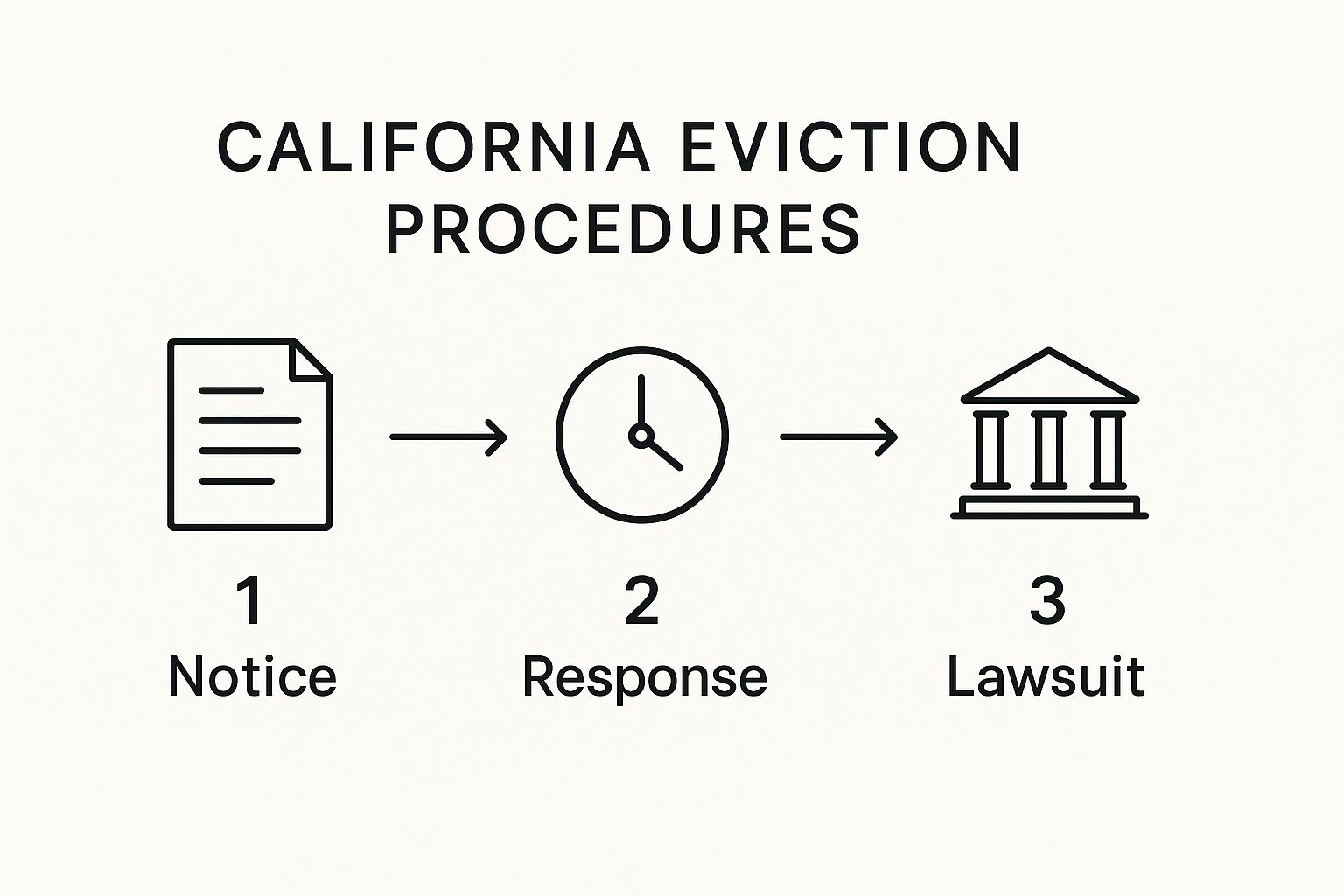
As you can see, everything starts with serving the correct legal notice. This gives the tenant time to respond before you can file with the court.
Understanding the Proper Eviction Notices
The type of notice you serve depends on the reason for the eviction. Using the wrong one will get your case dismissed.
For example, if a tenant is behind on rent, you must serve a "3-Day Notice to Pay Rent or Quit." This notice gives them three days to pay the full amount or move out. It must state the exact rent due.
If a tenant breaks another lease rule, you use a "3-Day Notice to Cure or Quit." This gives them three days to fix the problem. If they don't, they must move out.
The Tenant Protection Act of 2019 was a major game-changer. This law established the "just cause" rules for most properties over 15 years old. It also required relocation assistance for no-fault evictions.
The Unlawful Detainer Lawsuit
What if the tenant ignores your notice? If they don't fix the issue or move out, your next step is to file an unlawful detainer lawsuit. This is the formal court process for eviction in California.
You cannot physically remove the tenant yourself. Only a sheriff with a court order can legally do that.
Crucial Point: An unlawful detainer is a fast legal process, but it requires perfect paperwork. Any error can cause a judge to dismiss your case, forcing you to start over.
An eviction is one of the biggest property ownership challenges without a property management company. The legal details are complex. That’s why many owners in the Monterey Bay area rely on professional help to ensure every step is handled correctly.
A Landlord's Guide to Rent Increases and Rent Control
Managing rent increases while following California's laws can be tricky. The Tenant Protection Act (TPA) of 2019 placed a cap on annual rent hikes. It was designed to prevent sudden, large increases that force good tenants to move.
Getting this right is a must for any landlord. The statewide rule limits annual rent increases to 5% plus the local inflation rate, with a hard cap of 10%. This is the law for properties covered by the TPA.
Does Statewide Rent Control Apply to Your Property?
Before raising the rent, you must first know if the TPA covers your property. While the law is broad, many common rental types are exempt.
Your property is likely exempt from the state cap if it is:
- Newer Construction: Housing built within the last 15 years.
- Single-Family Homes: Most single-family homes and condos, unless owned by a corporation or a real estate investment trust (REIT).
- Duplexes: If you own a duplex and live in one of the units as your main home.
If your property in Monterey or Salinas doesn't fit into one of these groups, you must follow the statewide limits. For more on managing your property's finances legally, check out our expert property management tips.
Navigating Local Rent Control Ordinances
While the state law sets a baseline, some cities have their own rent rules. About 14 California cities have local ordinances, and some are stricter than the state's. You can learn more about the history of rent control in California to understand its background.
The good news for Monterey County landlords is that cities like Monterey, Salinas, and Carmel do not currently have their own local rent control laws. This simplifies things, as you only need to follow the statewide Tenant Protection Act. Still, it's always smart to stay informed.
Providing Proper Notice for Rent Increases
Legally raising the rent is also about giving proper written notice. The amount of time you must give depends on how much you increase the rent.
- For an increase of 10% or less, you must give at least 30 days' written notice.
- For an increase of more than 10% (only possible on exempt properties), you must give at least 90 days' written notice.
Key Takeaway: Serving notice correctly is a legal requirement. If you fail to do this, your rent increase could be invalid, leading to disputes with your tenant.
Partnering with a Property Manager to Stay Compliant
Keeping up with California’s changing rental laws can feel like a full-time job. One small mistake can lead to big financial penalties or legal trouble. This is where a knowledgeable property manager becomes so valuable.
For property owners, especially those living outside the Monterey Bay area, a local expert is a necessity. A property manager is your compliance partner. We are here to make sure your investment runs smoothly and legally.
The Value of Local Expertise
A professional property manager understands the local real estate market. At Torrente Property Management, our team knows the unique challenges in places like Monterey, Salinas, and Carmel. We handle the complex details so you can avoid stress.
This local expertise provides real benefits:
- Ironclad Leases: We create leases that follow the latest landlord tenant laws California has enacted, protecting you from common legal traps.
- Correct Procedures: We manage every step with precision, from handling security deposits by the 21-day rule to serving proper notices.
- Navigating Disputes: If a conflict arises, we act as a professional buffer. We aim to resolve issues legally before they escalate.
By trusting your property to a management team, you protect your asset from the risks of non-compliance. It's an investment in your peace of mind.
A Partner in Protection and Profitability
Managing a rental is about more than collecting rent. It's about protecting its physical and financial health. A great manager also thinks about the property's security, which helps tenants feel safe. For more on this topic, you can explore residential manager security resources.
This is especially important for absentee owners. Managing from afar brings its own challenges. Our services are designed to bridge that distance. We provide the hands-on care needed to maintain your property's value. Learn more about how we support rental property management for out-of-town-owners.
Partnering with Torrente Property Management means you have a team committed to your success. We handle the daily legal and operational work. This allows you to enjoy the benefits of your investment without the headaches.
Common Questions About California Rental Laws
Landlords in the Monterey Bay area often have the same questions about the law. Here are some of the most common queries with simple answers to give you quick clarity.
Can a Landlord Enter a Property Without Notice?
No, unless there is a true emergency like a fire or major flood. For all other reasons—like repairs or showings—California law requires "reasonable" written notice.
Legally, 24 hours is considered reasonable. Your notice must state the date, a general time, and the reason for the visit.
How Much Can I Legally Raise the Rent?
This can be tricky. For properties covered by the state's Tenant Protection Act (TPA), you can raise the rent by 5% plus the local inflation rate, but never more than 10% in total per year.
Many properties are exempt, including most single-family homes and buildings less than 15 years old. You must confirm if your property is covered by these rules before raising the rent.
What Is Considered "Normal Wear and Tear"?
"Normal wear and tear" is the minor, expected decline of a property from everyday living. This includes things like slightly faded paint, small scuffs on walls from furniture, or worn carpet in high-traffic areas.
You cannot deduct the cost to fix these items from a security deposit. Damage is different. It results from neglect or accidents, like a large hole in a wall or a cracked window. You can deduct for damage.
Key Distinction: Wear and tear is an expected cost of being a landlord. Damage is a result of a tenant's actions and can be charged to them.
What Happens If I Miss the 21-Day Security Deposit Deadline?
Missing this deadline is a serious mistake. You have 21 days after a tenant moves out to return their deposit or provide an itemized list of deductions. If you miss it, a court can order you to return the entire security deposit.
If a judge finds you acted in "bad faith," they can award the tenant extra damages, up to twice the deposit amount. This is a deadline you cannot ignore.
Do I Have to Provide a Lease in Spanish?
Yes, but only if you negotiated the lease terms mainly in Spanish. California law requires this to ensure tenants understand what they are signing.
If you discussed the rental terms in Spanish, you must provide a translated copy of the lease in Spanish before the tenant signs the English version. This is important in Monterey County, where many community members are Spanish-speaking.
Keeping up with these laws is essential for protecting your investment. At Torrente Property Management, our deep local expertise means we manage your properties in full compliance, giving you peace of mind. Call us today at (831) 582-8916 or learn more about how our team can help.

Monterey Bay’s Best Neighborhoods for Families (2025)
Choosing the right neighborhood is a big decision for a family. It affects everything from your daily commute to your long-term happiness. In Monterey Bay, the options are as beautiful as the local scenery.
Finding the perfect fit means looking beyond just the house. You need to match your family’s needs with the right community. This means a place with great schools, safe streets, and things to do that fit your lifestyle. According to recent data, 44% of homebuyers choose their neighborhood for the quality of the school district (Source: National Association of Realtors). This shows how much community features matter.
This guide will help simplify your search. We will look at the best neighborhoods for families across Monterey Bay. We will explore quiet suburbs with top-rated schools and lively urban villages where you can walk everywhere. Before you start looking, it's a good idea to figure out how much house you can truly afford. This will help you set realistic goals. Our guide will give you useful information on local schools, parks, safety, and rental costs. This will help you make a smart choice for your family's future.
1. Suburb with Top-Rated Schools
For many families, good schools are the most important thing. Neighborhoods with top-rated schools are often the best neighborhoods for families. They create a community that values education and helps children grow.
These areas usually have well-funded public schools. This means smaller class sizes, more advanced courses, and strong programs in sports and arts.
What Defines a Top-Tier School District?
A focus on education is clear inside and outside the classroom. You will find active parent-teacher groups and strong community support for school events.
High graduation rates and good test scores are common. These show that students are learning and teachers are effective. When looking at these areas, think about the whole learning environment that will shape your child's life.
For property investors, homes in these districts are very popular. This demand keeps property values stable and provides a steady stream of tenants. If you own a rental in an area like Salinas with good schools, professional help can maximize your investment. Learn how expert house rental management in Salinas can bring you success.
This infographic shows key features of a top-rated school district.
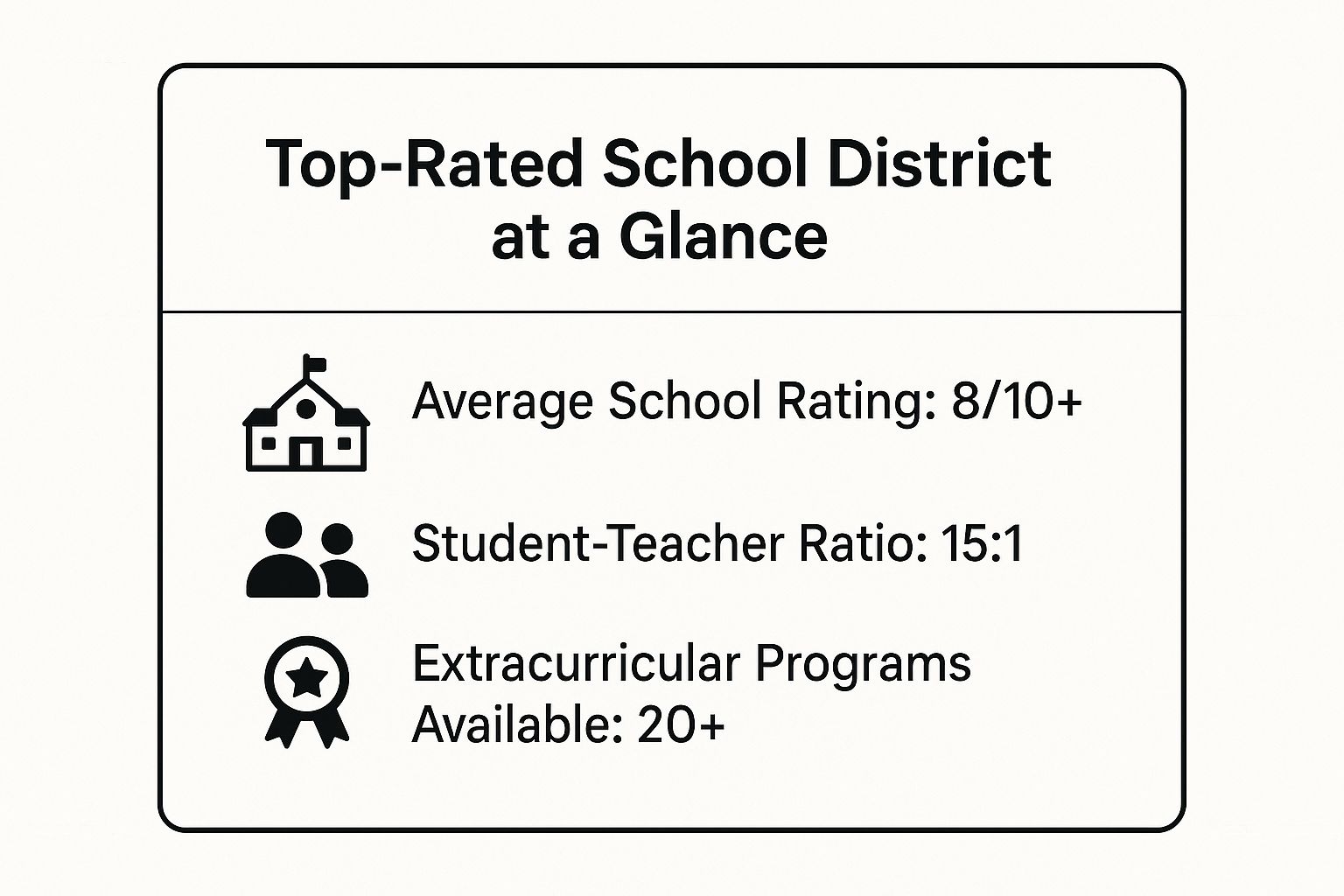
These numbers show how good school ratings, low student-teacher ratios, and diverse programs create a better place to learn.
2. Master-Planned Community
Master-planned communities are built from the start with families in mind. These neighborhoods have parks, schools, and shops all connected in one design.
The layout often makes it easy to walk, with plenty of green spaces and shared facilities for families. This creates an all-in-one living space.
What Defines a Master-Planned Community?
The key feature is their careful design. Unlike neighborhoods that grow over time, everything here is planned to work together.
You will find a consistent look, well-kept common areas, and features like community pools and trails. This structured setting helps build a strong community and offers a safe place for kids.
For property investors, the popular features of these communities can mean steady rent and rising property values. Managing properties here requires knowing the community rules. For expert advice, check out these property management tips to protect your investment.
3. Historic Neighborhood with Character
For families who love charm and a strong sense of community, historic neighborhoods are a great choice. These areas have unique old homes, streets with big trees, and local traditions.
Living in a historic district connects you to the past. It offers a stable place where neighbors care about preserving the area's special character.
What Defines a Charming Historic Neighborhood?
Besides the beautiful old houses, these neighborhoods have a strong identity. You might find local parades, active neighborhood groups, and small businesses that have been there for years.
The well-kept parks and unique home designs create a beautiful setting that feels both timeless and friendly. If you like the charm of older homes, you might look into historic properties with character, which are often found in these areas.
For property investors, the lasting appeal of these areas means steady demand and stable property values. Tenants are often drawn to the charm and community feel. A good inspection is important to understand any maintenance needs for an older home.
4. Transit-Oriented Development (TOD)
For families who want city convenience with suburban comfort, Transit-Oriented Development (TOD) is a great option. These neighborhoods are built around public transportation like train stations.
This design reduces the need for cars and creates a walkable, connected community. This makes it one of the best neighborhoods for families who value easy travel and a close community.

What Defines a Strong TOD Community?
A good TOD neighborhood is more than just a train stop; it's a lively place to live. You will find homes, shops, parks, and restaurants all within walking distance. This encourages an active lifestyle.
Urban planner Peter Calthorpe notes that this model creates more sustainable and livable communities. When considering a move, it's smart to check commute times and see how often the transit runs.
For property investors, the high demand for housing in TOD areas is a big plus. These properties attract many types of tenants. This leads to fewer vacancies and stable rental income.
5. Suburban Cul-de-Sac Community
For families who put safety first, the classic suburban cul-de-sac is a perfect choice. These areas have quiet, dead-end streets that keep out extra traffic.
This creates a safe place where kids can play outside and neighbors can get to know each other. The design helps build a close-knit community. This makes them some of the best neighborhoods for families looking for a traditional lifestyle.
What Defines a Cul-de-Sac Community?
These neighborhoods are designed for quiet family life. You will usually find single-family homes with yards, giving kids and pets space to play.
The layout encourages neighbors to talk and build relationships. It's perfect for those who want to know the people on their street.
The limited traffic also means less noise and more safety. Before choosing a home here, it's a good idea to check local rules, internet service, and how close you are to schools and stores.
6. Walkable Urban Village
For families who love the energy of city life but still want a community feel, a walkable urban village is a great fit. These areas mix city features with family-friendly spaces.
Residents can walk to grocery stores, cafes, parks, and local shops. This reduces the need for cars and builds a lively, connected community.

What Defines a Family-Friendly Urban Village?
A true urban village offers a complete lifestyle. These areas have different types of housing, from apartments to houses, mixed with green spaces and important services.
You can find everything you need for daily life just a short walk away. This promotes an active lifestyle and creates more chances to meet neighbors.
For property owners, the high demand for rentals in these areas is a big benefit. The appeal of a walkable life ensures a steady stream of potential tenants. Managing properties in these busy areas requires local knowledge to handle the market and tenant needs.
7. Waterfront/Lakefront Community
Living in a waterfront community offers a unique lifestyle. These neighborhoods feel like a resort with beautiful views and easy access to fun activities like boating and swimming.
This setting encourages an active, outdoor life. It's one of the best neighborhoods for families who love nature and peace.
What Defines a Family-Friendly Waterfront Lifestyle?
Besides the great views, these communities often have a strong, close feel. Life is centered around shared spaces and a relaxed pace.
They mix the fun of a vacation spot with the practical needs of a family, like good schools and local stores. The connection to nature can be calming and good for both kids and adults.
These properties are also great investments or second homes. The demand for waterfront living can lead to strong property values. For those with a second home in a place like Monterey, professional help is key. Find out how expert Monterey second home property management can give you peace of mind.
8. Family-Focused New Development
For families who want a modern lifestyle, new developments offer a great package. These communities are designed with today's families in mind.
They include modern home designs, energy-saving features, and smart-home technology. They are often some of the best neighborhoods for families because they are built around a vision of community, safety, and convenience.
What Defines a Modern Family Community?
These developments are more than just houses; they create a whole environment. You'll find well-planned layouts with sidewalks, bike paths, green spaces, and community centers.
This setup encourages people to be active and social. The homes are built with the latest codes, which means better energy efficiency and lower utility bills.
For investors, these new homes are attractive because they need little maintenance at first and are popular with tenants. For owners of new properties that might be empty between tenants, it's important to keep them safe. Learn how professional vacant home caretaker services in the Monterey Bay area can protect your investment.
9. Multi-Generational Friendly Neighborhood
As family structures change, many are looking for communities that work for everyone, from young children to older grandparents. These multi-generational neighborhoods are designed to support everyone's needs.
They offer a mix of accessible homes, walkable shops, and services for all ages. This makes them some of the best neighborhoods for families who want to stay together long-term.
What Defines a Multi-Generational Community?
A true age-friendly neighborhood offers more than just easy-to-use sidewalks. These areas focus on designs that work for everyone. They provide different housing styles, like single-story homes, and have programs that bring different age groups together.
You'll find healthcare, parks, and senior centers close by. This creates a supportive environment for the whole family.
For property investors, especially those who serve military families, these neighborhoods are a great choice. The need for flexible housing is growing. Learn more about military family home management in Monterey County to better serve this community.
10. Small Town Main Street Community
For families who want a traditional lifestyle, a small town with a historic main street is a great choice. These neighborhoods have walkable downtowns, local shops, and a close-knit feel where neighbors know each other.
This setting builds strong community bonds and family values. It often provides modern conveniences just a short drive away.
What Defines a Main Street Community?
Inspired by movements that focus on people-first living, these communities put people over sprawl. You’ll find farmers' markets, local parades, and community festivals that bring everyone together.
The architecture often shows a rich history, with old buildings now home to bakeries and shops. These areas are great for families who want a slower pace of life.
For investors, the charm of these towns can mean a stable rental market. The unique character attracts long-term tenants. Managing properties in these areas requires a local touch. Partnering with a good property manager ensures your investment does well.
Finding the Right Fit: FAQs
How do I research school quality in a neighborhood?
You can check school ratings on websites like GreatSchools.org or Niche.com. It's also a good idea to visit the schools, talk to teachers, and connect with other parents in the community to get a full picture.
What is the most important factor when choosing a family neighborhood?
This depends on your family's unique priorities. Key factors often include school quality, safety (crime rates), commute times, and access to parks and kid-friendly activities. Make a list of your "must-haves" before you start your search.
How can I find out if a neighborhood is safe?
Use online tools like CrimeReports or NeighborhoodScout to check local crime statistics. Visiting the neighborhood at different times of the day and night can also give you a better feel for its safety and atmosphere.
Are new developments a better choice than established neighborhoods?
Both have their pros and cons. New developments offer modern, low-maintenance homes but may lack mature trees and established community traditions. Older neighborhoods often have more character and walkability but may require more home maintenance.
Why is local expertise important when looking for a rental?
A local property manager has deep knowledge of the community. They can provide insights on fair rental prices, school districts, and the unique character of different neighborhoods, helping you make a more informed decision.
Your Partner in Finding the Perfect Home
Choosing a place for your family to grow is a major decision. We've explored many types of communities in the Monterey Bay area, each with its own lifestyle. From suburbs with great schools to modern planned communities, the right fit is out there.
We've looked at the charm of historic neighborhoods and the convenience of transit-focused areas. Whether you want the safety of a quiet cul-de-sac or the energy of a walkable village, the key is to know what matters most to you.
Making the Right Choice
Finding the best neighborhoods for families is about finding a personal fit. The perfect community for one family may not be right for another. Think carefully about what your family needs.
Keep these key points in mind:
- List Your Priorities: What are your "must-haves"? Is a top school most important? Do you need a short commute? A big yard?
- Visit in Person: Photos don't tell the whole story. Spend time in your top choices. Walk around, visit the parks, and talk to people who live there.
- Think Long-Term: Your family's needs will change. Think about what will work for you in the years to come, like community centers and activities for teenagers.
Navigating the Monterey Bay rental market requires local knowledge. An expert can help you understand rental rates, find well-kept properties, and make the application process easier.
Your home is where your family will make memories. By thinking through your options and working with a trusted local expert, you can choose a community that will enrich your family’s life for years to come.
Whether you're an owner looking for good tenants or a family searching for the perfect rental, an expert can help. Torrente Property Management Inc. helps connect families with quality homes in Monterey Bay's best neighborhoods. Contact Torrente Property Management today at (831) 582-8916 to see how our bilingual, full-service management can help you.

CA Landlord Responsibilities: An Essential Guide
Understanding your duties as a California landlord can feel complicated, but it boils down to a few key rules. This guide outlines the essential landlord responsibilities in California, giving Monterey Bay property owners a clear roadmap. Your main job is to provide a safe home, handle money like security deposits correctly, and respect tenant privacy.
Over 56% of California renter households spend more than 30% of their income on housing, making them "rent burdened" (California Budget & Policy Center). This financial pressure means it's more important than ever for landlords to follow the rules and maintain their properties.
The Foundation of California Landlord Duties
Knowing your legal duties is the first step to a successful rental business. It also helps you build good relationships with your tenants. For landlords in Salinas or Carmel, this means balancing state laws with our local market needs.
These rules aren't just red tape. They create a fair and stable system for everyone. Following them protects your investment and reputation.
For property owners who live far from their rental, managing these duties can be a challenge. Many seek professional help to ensure everything is done right. If this sounds like you, our guide on rental property management for out of town owners offers practical advice.
Key Areas of Landlord Responsibility
We can group the core landlord responsibilities in California into a few main categories. Mastering these will set you up for success.
- Habitability: This is the most important one. You must make sure the property is safe, clean, and livable. This includes working plumbing, heating, and electrical systems.
- Financial Duties: You must manage all money matters correctly. This means handling security deposits by the book and following legal limits on rent increases.
- Tenant Rights: You must respect a tenant's right to privacy. This includes giving proper notice before entering the unit and following all fair housing laws.
- Legal Procedures: California has specific legal processes for things like ending a lease or eviction. You must follow them exactly.
This guide will explain each of these areas, giving you the knowledge to manage your Monterey Bay property with confidence.
Providing a Safe and Habitable Home
Every lease in California includes an "implied warranty of habitability." This is a legal promise that you will provide a home that is safe and livable. It's one of the most basic landlord responsibilities in California.

This promise goes beyond appearances. It means the core systems that make a house a home must work correctly.
The Habitability Checklist
To meet this legal standard, your rental property must have several key features in good working order. These are non-negotiable items that protect your tenant's health and safety.
A property is considered habitable if it has:
- Effective Weatherproofing: A solid roof, unbroken windows, and walls that keep the weather out.
- Functional Plumbing and Gas: Working toilets, sinks, and gas lines that meet code.
- Reliable Water Supply: Access to both hot and cold running water.
- Adequate Heating: A functioning heating system is required by law.
- Safe Electrical Systems: All wiring, outlets, and lights must be safe.
- Clean and Sanitary Conditions: The building and grounds must be clean and free of pests and garbage.
For landlords in coastal areas like Monterey, our damp climate adds another task. You must be proactive about preventing mold to keep the home habitable.
Responding to Repair Requests
When a tenant reports a serious issue, like a broken heater, the clock starts ticking. California law says you must make necessary repairs in a reasonable time, usually 30 days. For urgent issues, you must act much faster.
Ignoring repairs can have serious consequences. A tenant might use the "repair and deduct" remedy, where they fix the issue and subtract the cost from their rent. Responsive maintenance is a critical legal duty.
What Is Normal Wear and Tear?
Landlords often get confused about the difference between damage and normal wear and tear. You are responsible for fixing things that break down from normal use. Tenants are responsible for damage they cause.
- Normal Wear and Tear (Landlord's Job): Includes faded paint, minor carpet wear, or loose grout.
- Damage (Tenant's Job): Covers things like a hole in the wall, a broken window, or deep pet scratches on the floor.
Knowing this difference is key to managing your budget and your tenant relationships. Properly maintaining your property fulfills your legal duty and protects you from liability claims. You can learn more about premises liability in California to understand these risks.
Understanding Rent Control and Increase Limits
In California, you can't just raise the rent whenever you want. The state has specific rules to prevent sudden, large rent hikes that can force good tenants to move.
The most important law is the Tenant Protection Act, also known as AB 1482. This law sets clear caps on how much you can increase rent each year. This creates a more stable financial situation for both you and your tenants.

While you can set the initial rent at the market rate, any future increases must follow these strict rules.
The Statewide Rent Cap Formula
The law limits annual rent increases to 5% plus the local inflation rate, or a maximum of 10%, whichever is lower. This cap applies to most rental properties that are more than 15 years old.
The goal is to stop extreme rent gouging while letting landlords keep up with costs. Newer buildings (under 15 years old) are exempt to encourage new construction. You can review the research on California's rent control laws for more details.
It's critical to know the inflation rate for your area to calculate the increase correctly. Landlords in Monterey County follow this state law, as we have no stricter local rent control rules.
Providing Proper Notice for Rent Increases
A legal rent increase is only half the battle. You must also give your tenant proper written notice. The state is very strict about this.
- For increases of 10% or less: You must give at least a 30-day written notice.
- For increases over 10%: A longer 90-day written notice is required.
This must be a formal written notice, not a text or email. If you don't give proper notice, the rent increase is not valid.
Key Exemptions to Rent Control
While AB 1482 covers many properties, some are exempt. Knowing if your property is exempt is very important.
Here are the main exemptions:
- Newer Construction: Properties built within the last 15 years.
- Single-Family Homes: Most single-family homes and condos, unless owned by a corporation or real estate investment trust (REIT).
- Duplexes: A duplex where the owner lives in one of the units.
Even if your property is exempt from rent caps, you must still give proper written notice for all rent increases.
Managing Security Deposits the Right Way
Handling a security deposit is a legal trust. In California, you can only collect a deposit equal to one month's rent for most properties. This helps keep moving costs down for tenants in the Monterey Bay area.
There is no such thing as a "non-refundable" deposit in California. The money belongs to the tenant until you have a legal reason to use it.
Returning Deposits and Making Deductions
Once a tenant moves out, a strict 21-day countdown begins. Within this time, you must either return the full security deposit or provide an itemized list of deductions.
Failing to meet this deadline can result in serious penalties. A court could order you to pay the tenant up to three times the deposit amount for mishandling it. Using the best accounting software for landlords can help you track these details accurately.
What You Can and Cannot Deduct
Understanding what you can legally deduct from a deposit is critical. This is one of the most important landlord responsibilities in California. The law separates tenant-caused damage from "normal wear and tear."
Here’s a table to help you tell the difference.
| Deduction Type | Allowable Examples | Prohibited Examples |
|---|---|---|
| Damage | Large hole in a wall, cracked window, badly stained carpet. | Faded paint, minor scuffs on walls, worn-out carpet from normal use. |
| Cleaning | Leaving the unit extremely dirty, requiring deep cleaning. | Standard cleaning that would be needed between any two tenants. |
| Unpaid Rent | Rent the tenant still owes after they move out. | Charging for future rent after a new tenant has already moved in. |
Always document the property's condition with photos at move-in and move-out.
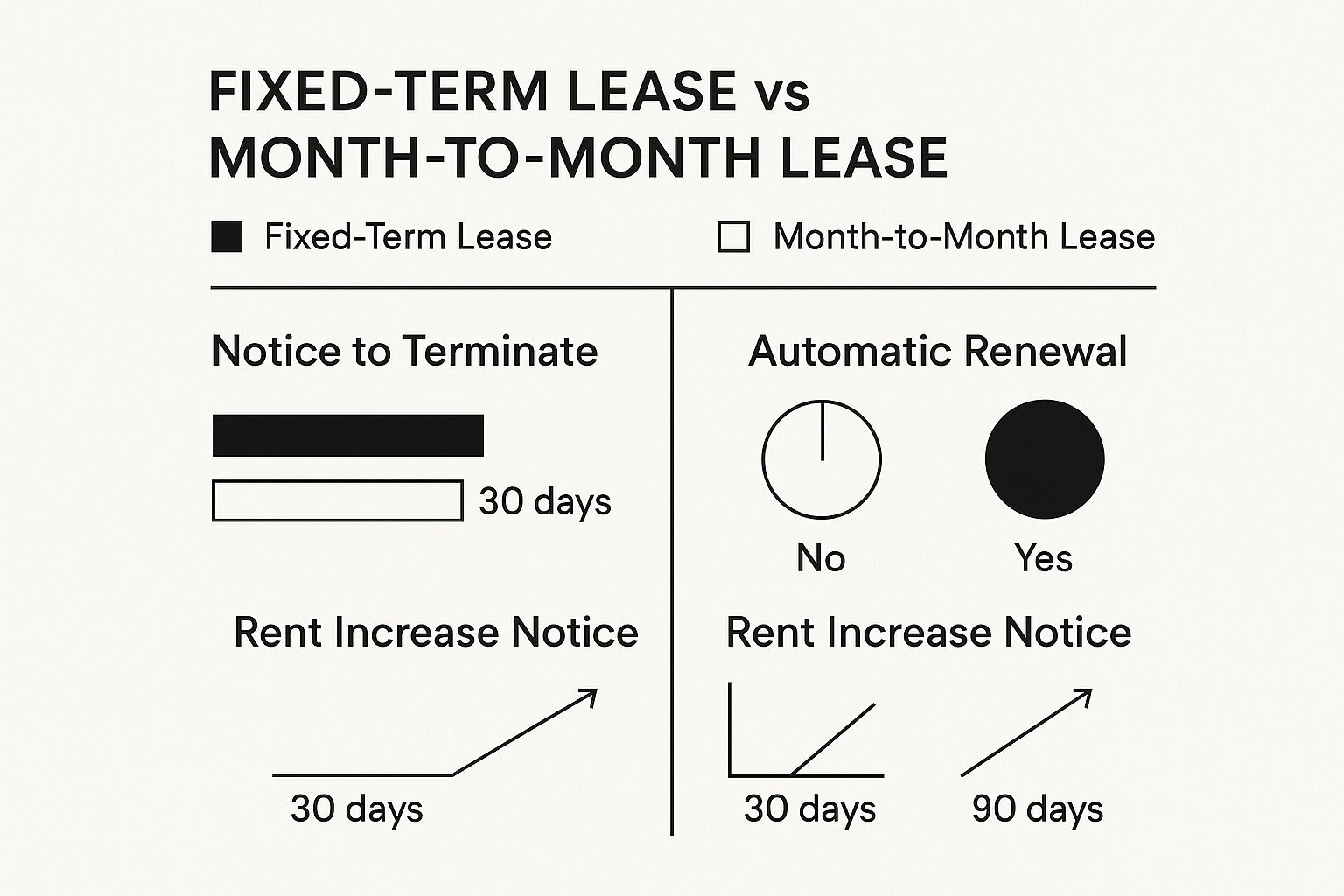
This chart shows how different lease types have different notice rules, highlighting the need for landlords to know the specifics of their agreements.
Navigating Evictions and Tenant Disclosures
Every tenancy ends eventually. In California, eviction is a strict legal process, not a personal decision. For most tenants, you must have a valid reason, known as "just cause," to ask them to leave.
Your duty to be transparent starts when you first list the property. California law requires you to provide tenants with several written disclosures. Getting these rules right is a key part of your landlord responsibilities in California.
Understanding Just Cause Eviction
The Tenant Protection Act (AB 1482) requires landlords to have a "just cause" to evict tenants in properties over 15 years old. Without a valid reason, you could be responsible for the tenant's moving costs.
"Just cause" reasons are split into two types:
- At-Fault Just Cause: These are related to the tenant's actions, like not paying rent or causing major damage.
- No-Fault Just Cause: These are related to your own needs, like moving into the unit yourself or taking the property off the rental market.
For no-fault evictions, you usually must provide relocation assistance equal to one month's rent.
Required Disclosures Before Move-In
The law requires you to provide a checklist of written disclosures before a tenant signs a lease. This builds trust and sets a positive tone for your relationship.
Some common required disclosures include:
- Lead-Based Paint: For homes built before 1978, you must provide a pamphlet on lead hazards.
- Pest Control: If you use a regular pest control service, you must give tenants a copy of the notice.
- Demolition Permits: If you plan to tear down the unit, you must inform potential tenants.
- Flood Zone: You must state in the lease if the property is in a designated flood hazard area.
Before you get to the lease, it's vital to screen applicants well. This should always include the need to perform comprehensive credit checks to assess their financial history.
The Right to Privacy and Proper Entry
A tenant's home is their private space. You cannot just show up and enter whenever you want. Except in an emergency, the law requires you to give reasonable written notice before entering.
"Reasonable" usually means at least 24 hours' notice. The notice must state the date, approximate time, and reason for the visit. Following this simple rule respects your tenant's right to quiet enjoyment of their home. To prepare for the end of a tenancy, use our tenant move-out inspection checklist to ensure a smooth process.
FAQs About California Landlord Laws
Understanding landlord responsibilities in California can be tough. Here are answers to some common questions we hear from property owners in the Monterey Bay area.
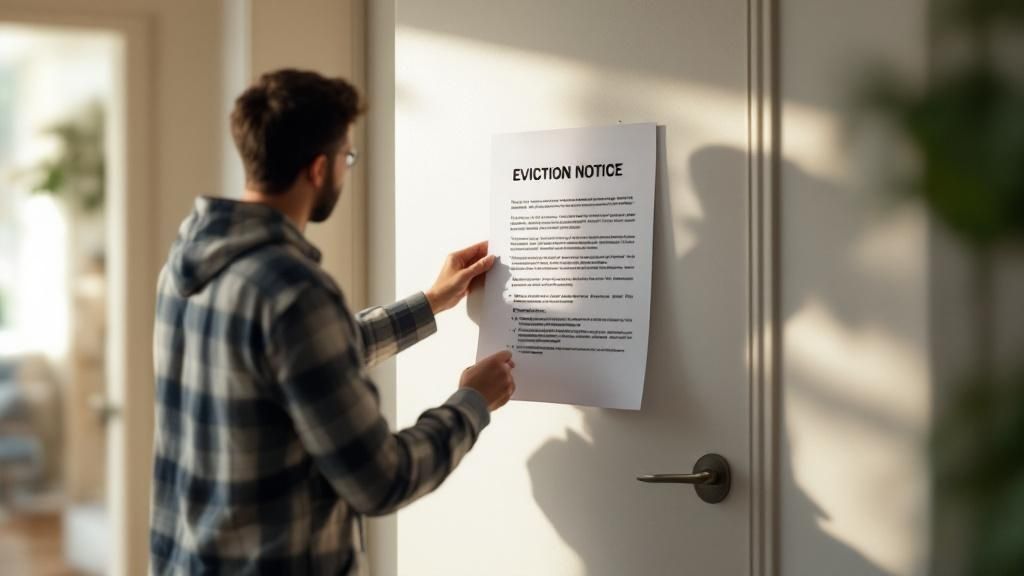
This section can serve as a quick guide for managing your property correctly.
What happens if I do not make required repairs?
If you fail to fix serious habitability issues, tenants have legal options. They could withhold rent, use the "repair and deduct" remedy, or even break the lease and move out without penalty. Promptly handling maintenance is the best way to avoid costly legal disputes.
Can I prohibit pets in my California rental?
Yes, you can generally enforce a "no pets" policy. However, you must make an exception for service and assistance animals, which are protected under the Fair Housing Act. You cannot charge a pet deposit or extra rent for these animals. For more practical advice, see our collection of property management tips.
How much notice must I give a tenant to move out?
For a month-to-month tenant who has lived in the property for less than one year, you must give a 30-day written notice. If they have lived there for a year or more, you must provide a 60-day written notice. If your property is covered by the Tenant Protection Act, you also need a "just cause" reason.
Do I have to pay interest on a security deposit?
No, California state law does not require you to pay interest on security deposits. While a few cities have local rules requiring it, this is not the case for properties in Monterey, Salinas, or Carmel. Landlords in Monterey County are not obligated to pay interest on these funds.
What are the main financial duties of a landlord?
Your main financial duties include collecting rent, managing security deposits according to state law (returning them within 21 days with an itemized list of any deductions), and following the legal caps for any rent increases. Keeping clear and accurate records is essential for all financial matters.
Staying on top of these responsibilities is key to running a successful rental business. If you need an expert to help manage your property, Torrente Property Management is here for you. Call us today at (831) 582-8916 to see how we can protect your investment and give you peace of mind.

Maximize Your Rental Property Tax Deductions
Owning rental property in Monterey Bay is a great investment, but its true power comes from maximizing your returns. The secret? Mastering your rental property tax deductions. These are legitimate business expenses the IRS allows you to subtract from your rental income.
This lowers your tax bill and keeps more money in your pocket. Understanding these deductions is key to your financial success.
Your Guide to Lowering Your Tax Bill

If you own property in the Monterey Bay area, understanding these deductions is essential. Think of your Salinas or Carmel rental as a small business. Like any business, it has operating costs you can write off.
The impact can be massive. According to the U.S. Census Bureau, over 44 million housing units in the country are renter-occupied, making smart tax strategy more important than ever. Nearly every dollar you spend to manage and maintain your property can be a potential deduction.
Smart Landlording Starts Here
When you start tracking these write-offs, you see your investment differently. You shift from simply collecting rent to actively managing a powerful financial asset. The key is to look at every expense and ask, "Is this deductible?"
This guide will break down the key deductions every landlord needs to know. We'll simplify the confusing topics and show you why good record-keeping is the cornerstone of a stress-free tax season.
Why Every Dollar Counts
Careful tracking separates successful investors from those who leave money on the table. Every missed deduction is a direct hit to your bottom line.
By understanding the rules, you can make smarter decisions for your portfolio. For a deeper look at maximizing your rental's tax benefits, check out these essential rental property tax deductions to maximize your savings.
Claiming Your Core Landlord Deductions
Think of your rental property as a business. The IRS lets you deduct operating costs to lower your taxable income. These core deductions are the foundation of a smart tax strategy for every Monterey Bay property owner.
Mortgage Interest: Your Biggest Deduction
For most landlords, the single largest tax deduction is the interest paid on the mortgage. You can deduct 100% of the interest portion of your monthly payment.
Thankfully, this is easy to track. Your lender sends you a Form 1098 at the end of the year, which clearly shows the total mortgage interest you paid.
Example: You own a rental home in Salinas and paid $20,000 in mortgage payments. Your Form 1098 shows that $15,000 of that was interest. You can deduct the entire $15,000 from your rental income.
Property Taxes: A Necessary Expense
As a property owner in Monterey County, you pay annual property taxes. The good news is the IRS allows you to deduct the full amount you pay each year for your rental property. This is a simple but powerful deduction.
Insurance Premiums: Protecting Your Asset
Protecting your investment is a critical business expense, and your insurance premiums are fully deductible. This includes landlord, flood, fire, and general liability insurance policies related to your rental business.
Keeping good records is key. A system for efficient real estate invoice management ensures you have clear proof of every premium you've paid.
Costs of Finding and Keeping Tenants
Any money you spend to find, screen, and place a quality tenant is a deductible operating cost. The IRS recognizes that these costs are essential to running your rental business.
These marketing and administrative costs often include:
- Advertising Fees: Paying for online listings or local ads.
- Tenant Screening Fees: The cost of background and credit checks.
- Leasing Commissions: Fees paid to an agent or property manager.
Managing these tasks from afar can be tough. For investors who don't live locally, our article on rental property management for out-of-town-owners offers helpful insights.
Repairs vs. Improvements: A Critical Difference
One of the most common mistakes landlords make is mixing up repairs and improvements. The IRS draws a very sharp line between the two, and getting this right is critical for maximizing your rental property tax deductions.
A repair keeps your property in good, habitable shape. These costs are great because they are fully deductible in the same year you pay for them.
An improvement enhances the property or adapts it for a new use. These are capital expenses, which means you must depreciate them over several years.
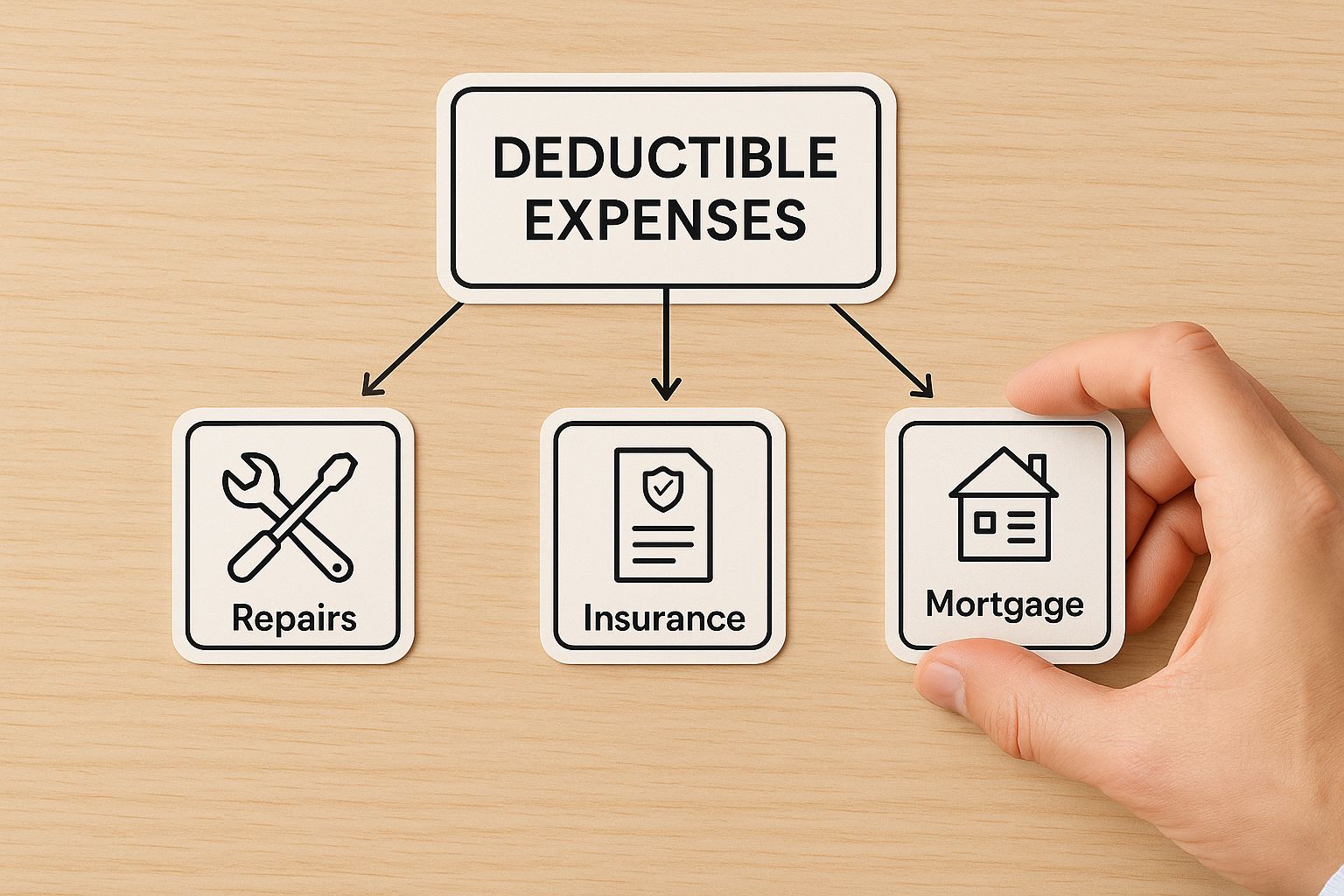
What Counts As a Repair?
A repair is work you do to maintain the property's current condition. It doesn’t add significant value; it just keeps things running as they should.
Examples of common repairs include:
- Fixing a leaky faucet in your Carmel rental.
- Replacing a single broken window pane.
- Patching a small hole in the drywall.
Understanding Capital Improvements
An improvement is a bigger deal. It's a significant investment that adds value to your property or prolongs its life.
You can't write off the entire cost of an improvement at once. Instead, you recover the cost through depreciation over the property's useful life, which is typically 27.5 years for residential rentals.
Common examples of improvements on Salinas properties are:
- Replacing the entire roof.
- Adding a brand-new deck.
- A full kitchen remodel.
Key Takeaway: If the job restores the property to its original working state, it’s a repair. If it makes the property better than it was before, it’s an improvement.
The De Minimis Safe Harbor Election
The IRS created a rule to simplify things for smaller expenses. The De Minimis Safe Harbor Election lets you treat certain smaller-cost improvements as if they were simple repairs.
This allows you to deduct them in the current year. For most independent landlords, the limit is $2,500 per invoice.
Unlocking the Power of Depreciation
Of all the rental property tax deductions, depreciation is the most powerful. It lets you save thousands on taxes every year without spending any extra money.
The IRS understands that buildings wear out over time. Depreciation is the formal way you deduct a piece of your property's value each year to account for that wear and tear.
How Depreciation Really Works
The IRS sets the useful life of a residential rental property at 27.5 years. This means you can write off a portion of your property's value every single year for nearly three decades.
This is a non-cash expense. It lowers your taxable income on paper, but the money never leaves your bank account.
Understanding Your Cost Basis
Before you can start depreciating, you need to find your property's cost basis. This is the total amount you invested to acquire the property.
Start with the purchase price, then add other buying expenses. These costs can include title insurance, legal fees, and transfer taxes.
You Cannot Depreciate Land
You can only depreciate the building, not the land it sits on. Land doesn't wear out, so there's no deduction for its value.
You must split your property's total value between the structure and the land. Your Monterey County property tax assessment is the easiest place to find this breakdown.
Example: You buy a rental in Salinas for $500,000. Your tax statement says the land is worth $150,000 and the building is worth $350,000. You can only depreciate the $350,000 value of the building.
Spreading this over 27.5 years gives you an annual deduction of about $12,727. For more details, check out Rentastic.io's tax guide for rental properties.
What is Depreciation Recapture?
When you sell the property, the IRS wants its piece back. This process is called depreciation recapture. All the depreciation you claimed over the years gets taxed, usually at a maximum rate of 25%.
This isn't a reason to skip depreciation. It just means you need to plan for this future tax bill. A professional property management contract can help you prepare.
Taking the Bite Out of Travel and Operating Costs
The everyday costs of running your rental are valuable rental property tax deductions. Many owners miss out on deducting smaller operating expenses, especially travel costs.
Every trip you make to your rental property for a business reason is a potential write-off. This includes driving to your Salinas rental for an inspection or meeting with your property manager.
Choosing Your Mileage Deduction Method
You can use the standard mileage rate or track your actual expenses.
The standard rate is simple. Track your business miles and multiply by the IRS rate. For 2024, that rate is 67 cents per mile.
Tracking actual expenses takes more effort but can lead to a bigger deduction. This method involves adding up all car costs, including gas, repairs, insurance, and depreciation.
Professional and Management Fees
Money you spend on professional services for your rental property is 100% deductible. This includes fees for your CPA, a lawyer, or a property management company like Torrente.
Home Office Deductions
If you use a specific area in your home exclusively for managing your rentals, you may claim the home office deduction. This lets you write off a portion of your home's expenses.
The IRS offers a simplified option. You can deduct $5 per square foot of your home office, up to 300 square feet.
Other Key Operating Expenses
Don't let these often-missed deductions slip through:
- Education: Seminars or books to become a better landlord.
- Bank Fees: Monthly charges on your rental's bank account.
- Supplies: Office supplies and bookkeeping software.
- Maintenance: Our guide on property maintenance services in Salinas explains how this investment is also a business expense.
Managing Taxes on International Rentals

Owning rental properties abroad adds complexity to your taxes. U.S. citizens must report all worldwide income, including rent from foreign properties.
The good news is that the same rental property tax deductions still apply. You can deduct ordinary and necessary expenses for your foreign rental just like a local one.
Navigating Foreign Tax Obligations
To avoid double taxation, you can claim a foreign tax credit for income taxes you paid to another country. This directly reduces your U.S. tax bill.
All financial reporting must be in U.S. dollars. This means you need to convert your rental income and expenses using an accepted exchange rate.
Penalties for failing to report foreign rental income can be severe. This makes staying on top of your obligations a must. You can learn more directly from the IRS about these tax implications.
FAQs: Your Rental Deduction Questions Answered
Here are answers to a few of the most common questions we hear from property owners in the Monterey Bay area.
Can I deduct the cost of my own labor for repairs?
No, the IRS does not allow you to deduct the value of your own time or labor. You can, however, deduct the full cost of any materials, tools, or supplies you purchased for the job.
What happens if my rental expenses exceed my income?
If your expenses are more than your income, you have a rental loss. You may be able to deduct this loss against other income, but it depends on your income level and involvement in the property.
How long should I keep my rental property records?
You should keep all receipts, bank statements, and invoices for at least three years after you file your tax return. For records of the property purchase and major improvements, keep them for as long as you own the property plus three years.
Are mortgage principal payments deductible?
No, the part of your mortgage payment that pays down the loan balance (the principal) is not deductible. You can only write off the interest portion of your payment.
Should I use a separate bank account for my rental?
We highly recommend it. A dedicated bank account for your rental income and expenses creates a clean paper trail and simplifies your bookkeeping. For local landlords, our team providing expert property management in Salinas can share more tips.
Take Control of Your Investment
Mastering your rental property tax deductions is a key part of being a successful landlord. By tracking expenses carefully and understanding the rules, you can significantly increase your return on investment. This guide gives you a solid foundation for a less stressful and more profitable tax season.
At Torrente Property Management, we help property owners navigate these complexities every day. If you have more questions or need help maximizing your investment's potential in the Monterey Bay area, contact Torrente Property Management today at (831) 582-8916.

CA Warranty of Habitability: A Landlord & Tenant Guide
Meta Description: Understand California's warranty of habitability with this guide for Monterey Bay landlords and tenants. Learn the rules, rights, and responsibilities.
In California, every residential lease includes an unspoken promise: the warranty of habitability. This is a legal guarantee that a rental home is safe and livable. It’s a landlord’s duty to provide essentials like working plumbing, heat, and a pest-free home.
This implied warranty is the foundation of the rental agreement. In fact, California is home to over 17 million renters whose housing security depends on this rule (California Department of Finance). For property owners in Monterey County—from Salinas to Carmel—understanding this duty is key to avoiding legal trouble.
What Makes a Home "Habitable"?
The warranty of habitability is a core part of California law. You cannot sign it away in a lease. It ensures every rental home meets basic living standards.
This protection was established in the landmark 1974 case, Green v. Superior Court. This ruling placed the duty for property maintenance on landlords. It gave tenants legal options when their homes become unsafe.
What This Means for You
Understanding the warranty is vital for both landlords and tenants.
- For Tenants: You have the right to a safe home. You do not have to live with serious issues like a leaking roof, a broken heater, or a pest problem.
- For Landlords: You have a legal duty to make timely repairs. Proper maintenance protects your investment and keeps your tenants safe. For those who own property from afar, this is even more critical, as our guide on rental property management for out-of-town owners explains.
This principle guides the relationship between a landlord and a tenant. It sets the rules for a safe and secure home.
The Essential Checklist for a Habitable Home

So, what does the warranty of habitability in California require in practice? California Civil Code 1941.1 provides a clear checklist.
This list helps landlords in Salinas and Carmel with maintenance. It also helps tenants in Monterey identify valid repair needs.
Structural Soundness and Weather Protection
A safe home starts with a solid structure. This is vital in Monterey County, where coastal fog can test a building's strength.
Your rental must have a roof, walls, windows, and doors that keep wind and rain out. This prevents water damage, which leads to mold and rot. Landlords must also ensure the building is sound, including safe stairs and railings.
Functional Plumbing and Gas Facilities
Working plumbing is non-negotiable. Every rental unit must have plumbing and gas that met code when installed.
This includes a few key areas:
- Hot and Cold Running Water: Tenants must have access to both.
- Proper Drainage: All sinks, tubs, and toilets must connect to a working sewage system.
- Working Toilets: A clean, functional toilet is a basic need.
A slow drain is an annoyance, but a total plumbing failure can make a home unlivable.
Reliable Heating
California law requires a working heating system. Even with our mild coastal climate, a heater is a necessity for health and safety.
The system must be able to heat the main living areas. For more proactive advice, check out our property management tips to keep your property in top shape.
Safe Electrical Systems
Faulty wiring is a major fire risk. It is a clear violation of the habitability warranty. All electrical lighting and wiring must be safe and up to code.
This means working lights in each room and safe outlets. Any exposed wiring is a red flag that needs immediate attention.
Clean and Sanitary Conditions
A landlord must provide a clean rental free from pests and trash at move-in. This means no existing rodent or cockroach infestations.
The building and common areas must also be kept clean. Landlords must provide enough trash cans for tenants.
Essential Safety Features
A habitable home must be secure. The law requires several key safety features.
- Secure Locks: Every entry door needs a working deadbolt.
- Window Security: Windows that open must have a proper lock.
- Smoke and Carbon Monoxide Detectors: Landlords must install and maintain working smoke and CO detectors as required by law.
These features are essential for a tenant's safety. Following this checklist ensures a rental meets the legal standard for a safe home.
When a Landlord Fails to Make Repairs

What happens if a landlord breaks the warranty of habitability in California? A landlord must act after a tenant requests a fix. If they don't, the law gives tenants powerful tools to solve the problem.
For landlords in Monterey and Salinas, ignoring repair requests leads to legal trouble. For tenants, knowing your options helps you get your home back into a safe condition.
The First Step: Proper Notification
You must give your landlord a fair chance to fix the problem. Send a formal, written notice that details the issue. Allow a "reasonable" amount of time for the repair.
What is "reasonable"? It depends on the problem's seriousness. A broken heater in winter needs a faster response than a dripping faucet. Without a written record, a landlord can claim they never knew about the problem.
Tenant Remedy 1: The "Repair and Deduct" Option
If you give notice and the landlord doesn't act, you can use the "repair and deduct" remedy. You hire a professional to fix the problem and subtract the cost from your next rent payment.
However, strict rules apply:
- The repair cost cannot be more than one full month's rent.
- You can only use this option twice in a 12-month period.
- The issue must be a true habitability problem, not a cosmetic one.
Keep every receipt and give copies to your landlord to prove the expense.
Tenant Remedy 2: Withholding Rent
Withholding rent is another powerful but risky option. You may be able to stop paying rent if the property is truly unlivable and the landlord has failed to act.
This is a major step. It is wise to put the withheld rent money into a separate bank account. This shows you intend to pay once the repairs are made and strengthens your case in court.
Important: Withholding rent will likely lead to an eviction lawsuit. The landlord’s failure to maintain the property is a strong defense, but you should get legal advice before you stop paying rent.
Tenant Remedy 3: Moving Out
In extreme cases, a tenant may break the lease and move out. This is known as "constructive eviction." It means the conditions are so bad that the landlord has effectively forced you out.
This option is for severe problems, like a roof collapse or a total lack of water. Just like the other remedies, you must first provide written notice and give the landlord a chance to fix the issue. When a landlord fails to make major fixes, like costly structural repairs such as termite treatment, they are often in clear violation of their duty.
Understanding Your Role as a Tenant

The warranty of habitability in California is a partnership. While landlords must provide a livable home, tenants also have responsibilities.
Understanding your role helps prevent disputes. It also builds a positive relationship with your landlord. As any property manager in Salinas will tell you, responsible tenants are always in demand.
Keeping Your Space Clean and Safe
Your basic duty is to keep your living space clean and sanitary. This means preventing conditions that could cause health hazards or damage the property.
Key responsibilities include:
- Proper Waste Disposal: Get rid of trash in a clean, safe way.
- Preventing Pests: Keep kitchens clear of food scraps to stop infestations.
- Avoiding Hazards: Do not create fire hazards or block emergency exits.
For example, if a drain is clogged with hair you let build up, fixing it is your job. But if old pipes are the cause, that's the landlord's problem.
Using Fixtures and Appliances Correctly
You must also use electrical, gas, and plumbing fixtures correctly. Operate appliances as they were designed to be used. Do not cause damage through misuse.
The law expects tenants to act with reasonable care. Willful damage to the property is a violation of your duties. It can lead to financial liability or even eviction.
The Duty to Report Issues Promptly
This is your most critical role. As the person living in the home, you are the first to notice when something goes wrong.
You must let your landlord know about serious problems right away. A small leak can turn into major water damage if you don't report it. Quick reporting allows the landlord to fix it before it becomes a bigger headache. It's also smart to learn about the steps you can take to help protect your home when renting.
Navigating Habitability Issues the Right Way
When a problem arises, how you handle it matters. For tenants and landlords in the Monterey Bay area, a clear process is key to solving issues before they become legal conflicts.
Following the right procedure protects everyone. It creates a documented case that turns a complaint into a formal request for action.
Step 1: Give Formal Written Notice
This is the most critical first step. A casual phone call is not enough. A formal written notice creates an official paper trail.
Your notice should be clear and specific.
- Describe the Problem in Detail: Be specific. Instead of "plumbing is broken," say "the toilet is constantly running."
- Include Dates and Times: Note when you first saw the issue and the date of the letter.
- Request a Specific Action: Clearly state that you are requesting repairs.
- Provide Your Contact Information: Make it easy for your landlord to reach you.
Send the notice via certified mail with a return receipt for undeniable proof of delivery.
Step 2: Allow a Reasonable Time for Action
California law requires you to give the landlord a "reasonable" amount of time to make repairs. "Reasonable" depends on the urgency.
No heat in winter is an emergency that needs action within a day or two. A cracked tile is less urgent and might take a few weeks to fix.
Step 3: Keep Meticulous Records
Documentation is your best friend. From the moment you see a problem until it's fixed, keep detailed records of everything.
Good records are not hard to keep. Use this checklist to build a solid case file.
| Documenting Habitability Issues: A Checklist |
| :--- | :--- |
| Documentation Step | Why It's Important |
| Photos & Videos | Visual proof is powerful. It shows the exact condition of the problem. |
| Communication Log | Creates a timeline of every interaction, proving you were proactive. |
| Copies of All Documents | This is your paper trail. It includes your notice and mail receipts. |
| Receipts for Related Costs | Receipts prove your financial damages if you had to buy a space heater. |
Step 4: Know Your Next Steps
If the landlord still hasn't fixed the problem, you have legal options. These include the "repair and deduct" remedy, withholding rent, or moving out. Because you have documented everything, you are in a stronger position to use these remedies.
For landlords, responding quickly is the best way to avoid conflict. Having strong tenant selection and screening practices helps ensure you have responsible tenants. Proper procedures protect your property and your reputation.
How Professional Management Upholds Your Rights
Navigating the warranty of habitability in California can be complex. Clear communication is the only thing that keeps small problems from becoming legal headaches. This is where professional property management makes a difference.
For property owners in the Monterey Bay area, a firm like Torrente Property Management turns a legal duty into a smooth operation. We use scheduled maintenance and regular checks to get ahead of problems. This approach protects your real estate investment from costly, unexpected repairs.
A Clear Process for Peace of Mind
For tenants, professional management means there is a reliable system for getting things fixed. Your rights are always a priority.
This infographic shows the typical repair timeline with a professional manager.
This structured process ensures issues are handled quickly. We use efficient systems, including real estate document automation solutions, to manage paperwork and communication. This ensures every landlord obligation is met, giving everyone peace of mind.
Protect your investment and ensure your tenants' rights are respected. Contact Torrente Property Management today at (831) 582-8916 to see how our expertise can bring calm and confidence to your rental property experience.
FAQs: California Habitability Law
Here are answers to common questions about the warranty of habitability in California.
Can I stop paying rent if my landlord won’t make repairs?
While you may have the right to withhold rent, you must follow a strict legal process. First, give your landlord formal, written notice and allow a reasonable time for the repair. Since not paying rent can lead to an eviction lawsuit, it is highly recommended to seek legal advice before taking this step.
What is a reasonable time for a landlord to make repairs?
"Reasonable" depends on the problem’s severity. An urgent issue like no heat in winter requires a fast response, often within 24-48 hours. A minor problem, like a dripping faucet, has a longer but still reasonable timeframe for repair.
Does the warranty cover things like AC or a broken garage door?
Usually, no. The warranty covers essentials like plumbing, heat, and safe electrical systems. Amenities like air conditioning or a pool are generally not included unless they were promised in your lease agreement.
What if I caused the damage myself?
The landlord is not responsible for repairing damage caused by you, your family, or guests. If you break a window or clog a drain through misuse, that repair bill is your responsibility. The warranty protects you from normal wear and tear.
Can my landlord evict me for requesting essential repairs?
No. It is illegal for a landlord in California to retaliate against you for exercising your legal rights. If a landlord tries to evict you or raise your rent within 180 days of a repair request, the law may see it as an unlawful retaliatory eviction.
Navigating these rules is what we do best. At Torrente Property Management, we handle maintenance and tenant communications with professionalism and integrity, ensuring every property is safe and every owner is protected. For peace of mind, visit us online at https://torrenteproperties.com or call us today.

Top Tips for Property Management in Monterey Bay
Meta Description: Boost your rental income with our top tips for property management in Monterey Bay. Learn about tenant screening, maintenance, and legal compliance.
Owning a rental property in Monterey Bay is a great investment. But turning that property into steady income takes work. Managing tenant needs, repairs, and local laws can be a lot for any property owner.
In fact, a survey by Buildium found that 44% of landlords manage their own properties. They often don't realize how much time it takes. This guide gives you key tips for property management to help you protect your investment and earn more money.
These tips are made for the Monterey and Salinas rental markets. Whether you are new to owning property or have many, you will learn smart ways to handle your rental. These ideas will help your property do well.
1. Screen Every Tenant Carefully
A good tenant screening process is the most important step in property management. It protects you from late rent, property damage, and other problems. A full screening looks at more than just a credit score. It checks an applicant's money situation and rental history to make sure they are a good fit.

This step helps you build a good relationship with your tenant from the start. To learn more, see these detailed strategies for prospect screening.
How to Build a Strong Screening Process
A good screening process is fair and consistent for everyone. The goal is to create a system that follows the law and finds reliable tenants. You can find more tenant selection and screening tips on our blog.
Here are some tips to use:
- Set Clear Standards: Write down your rules for credit scores, income, and rental history. Apply these rules to every applicant to follow fair housing laws.
- Verify Income: Ask for proof that an applicant earns at least 2.5 to 3 times the monthly rent. Pay stubs or bank statements work well for this.
- Check Past Landlords: Call the applicant's previous landlord, not just the current one. The last landlord will often give a more honest review.
- Use a Professional Service: A screening service can run a full background check. This includes criminal records and past evictions.
- Keep Good Records: Write down why you approved or denied each applicant. This is very important if someone questions your decision.
2. Stay on Top of Maintenance
Being proactive with maintenance is a smart part of property management. It means you fix small issues before they become big, expensive problems. A good plan includes regular checks and scheduled upkeep. This keeps your property in great shape and makes tenants happy.

This approach saves you money and shows tenants you care. If you own a property but live far away, our vacant home caretaker services in Monterey Bay can help.
How to Create a Maintenance System
A good maintenance system is organized and well-documented. It helps you protect your investment and keep your tenants satisfied.
Here are some tips for your maintenance plan:
- Make Seasonal Checklists: Create lists for spring, summer, fall, and winter. Include tasks like cleaning gutters, testing smoke detectors, and servicing the heater.
- Do Regular Inspections: Always do a full inspection when a tenant moves in and out. Taking photos and videos is a great idea. A check-up once a year also helps catch problems early.
- Find Reliable Contractors: Build a list of trusted plumbers, electricians, and other repair professionals. Having good people to call in an emergency is a huge help.
- Respond Quickly: Try to answer every maintenance request within 24 hours. Even if you can't fix it right away, quick communication shows tenants you are on it.
- Keep Detailed Records: Save all emails, invoices, and notes about repairs. These records help you track costs and prove the property has been well-maintained.
3. Communicate Clearly and Keep Records
Good property management relies on clear communication. Having a set way to talk with tenants and document everything is key. It helps prevent arguments and legal issues. It also builds a professional relationship with your tenants.

This system creates trust and makes sure everyone is on the same page. Knowing the essential clauses to look for in a lease agreement is also important.
How to Improve Communication
A smart plan for documentation protects you. It means using the right tools and having clear rules for every conversation.
Here are some tips to build a better system:
- Put Everything in Writing: Use email for important things like repair requests or late rent notices. This creates a record with a date and time.
- Use Templates: Create templates for common messages like welcome letters or rent reminders. This keeps your communication professional and consistent.
- Set Expectations: Let tenants know when they can expect a reply, like within 24 business hours. This helps manage their expectations.
- Follow Up on Phone Calls: If you have an important phone call, send a quick email after. Summarize what you talked about and what you agreed on.
- Use Technology: Property management software can help you keep all messages and documents in one place. This makes it easy to stay organized.
4. Price Your Rental Smartly
Setting the right rent price is a balance. You want to make the most money you can without leaving the property empty for too long. Smart pricing uses market data, not guessing. It means watching the local market in places like Salinas to stay competitive.

This data-driven method takes the emotion out of pricing. It helps you make smart choices for your investment.
How to Set the Right Price
Good pricing is an ongoing job. You need to combine online tools with your knowledge of the local area.
Here are some tips for your pricing plan:
- Check Local Listings: Look at similar properties for rent in your area. See what they are charging and how long they stay on the market.
- Price Based on Features: Think about what makes your property special. A great view or a new kitchen can let you charge a little more than a nearby, older unit.
- Watch Local Trends: Pay attention to job growth or new companies coming to Monterey Bay. A strong economy often means you can raise the rent.
- Adjust at the Right Time: The best time to change the rent is when a lease is up for renewal. You can also adjust it when you list a vacant unit.
- Track Vacancy Rates: If similar homes are renting in less than two weeks, your price might be too low. If they sit for over a month, it might be too high.
5. Handle Tenant Turnovers Efficiently
A smooth process between tenants is one of the most important tips for property management. A quick turnover saves you money on lost rent and gets the property ready for the next person fast. This system covers everything from when a tenant gives notice to when the new one moves in.
This helps you avoid losing money. A tenant move-out inspection checklist can help you make sure you don't miss any steps.
How to Make Turnovers Faster
A good turnover is a well-planned project. The goal is to create a process that is fast and repeatable every time.
Here are some tips to manage your turnovers:
- Market Early: Start advertising your property 30 to 60 days before the current tenant moves out. Good photos and virtual tours can attract new people quickly.
- Use a Checklist: Create a standard checklist for every turnover. This should include scheduling cleaners, painters, and other repair workers.
- Do a Pre-Move-Out Walkthrough: Walk through the property with the tenant about two weeks before they leave. This helps you find repairs needed and set expectations for the security deposit.
- Have a Team Ready: Build relationships with good cleaners and handymen who can work quickly. Having a team ready to go saves valuable time.
- Document Everything: Take lots of photos before the old tenant leaves and after the cleaning and repairs are done. This is helpful for security deposit discussions.
6. Manage Your Finances and Budget
Good financial management is key to a successful rental property. You need a system to track income, manage costs, and plan for the future. This includes creating a budget and planning for big repairs down the road.
This careful approach makes managing your property more like running a business. Knowing the 5 key metrics for real estate investors will help you make smart decisions.
How to Set Up a Financial System
A clear financial process protects your investment. There are many tools that can help you stay on top of your finances. You can explore some of the best accounting software for landlords to find what works for you.
Here are some tips for managing your money:
- Use Separate Bank Accounts: Never mix your personal money with rental income. Open a separate bank account for your rental business to make tracking easy.
- Create a Reserve Fund: Unexpected repairs happen. Set aside 5-10% of your monthly rent in a savings account for these costs.
- Use Technology: Accounting software can track your expenses and create reports. This saves time and helps you see how your investment is doing.
- Keep Great Records: Save every receipt and invoice. Good records are very important for tax time.
- Review Your Finances Monthly: Don't wait until the end of the year. A quick review each month helps you stay on budget and spot any issues early.
7. Follow the Law and Manage Risk
Understanding property law is one of the most critical tips for property management. Staying up to date on local, state, and federal rules is a must. It protects you from expensive legal trouble. This means knowing tenant rights, fair housing laws, and eviction rules.
This legal awareness protects your property and your reputation. You have to follow all laws, including California's rules on rent increases and evictions.
How to Stay Compliant
A good compliance plan is based on knowledge and good advice. It means having fair and legal processes for everything you do.
Here are some tips to manage your legal risk:
- Know Local Laws: Rules can be different in each city. Stay informed about rent control or tenant protection laws in Salinas and Monterey.
- Talk to a Lawyer: Have a real estate lawyer review your lease agreement. This is a small cost that can save you a lot of trouble later.
- Document Your Decisions: Keep records of all conversations with tenants and notes on why you denied an applicant. This proves you are being fair.
- Get Good Insurance: Make sure you have enough liability and property insurance. Review your policy each year to be sure you are covered.
- Create Standard Procedures: Write down your process for everything, from handling security deposits to evictions. Being consistent is key to being fair and lawful.
FAQs: Top Tips for Property Management
What is the most important tip for a new landlord?
The most important tip is to implement a thorough tenant screening process. Finding a reliable tenant from the start prevents most future problems, like late rent and property damage. This is your best first step to protect your investment.
How often should I inspect my rental property?
You should conduct a detailed inspection at move-in and move-out. Additionally, performing a routine inspection once or twice a year is a good practice. This helps you catch maintenance issues early and ensure the tenant is following the lease terms.
How do I determine the right rent price in Monterey County?
To set the right rent, research comparable properties (comps) in your specific area, like Salinas or Carmel. Look at similar homes and see what they are renting for. Adjust your price based on your property's unique features, like recent upgrades or a better location.
Why is keeping written records so important?
Written records of all communication and transactions create a clear history. This documentation protects you in case of a dispute with a tenant. It provides proof of agreements, maintenance requests, and important notices.
What's the best way to handle maintenance requests?
Acknowledge every request within 24 hours to show you are responsive. Have a network of trusted contractors ready to handle repairs quickly and professionally. Keeping tenants happy with prompt service is key to retaining them long-term.
Let Us Handle the Hard Work
Good property management is more than just collecting rent. It's about protecting your investment through smart, consistent actions. From careful tenant screening to proactive maintenance, each step helps your property succeed.
These seven tips for property management are connected. They work together to build a strong foundation for your rental business. By staying organized and informed, you can turn your property into a source of reliable income.
For many owners in the Monterey Bay area, balancing this work with daily life is a challenge. That's where local experts can make a difference. A professional manager can handle these tasks for you, giving you peace of mind and protecting your asset.
Ready to apply these expert tips for property management without the hands-on stress? Let Torrente Property Management Inc. use our local Monterey Bay knowledge and bilingual services to protect your investment and maximize your returns. Contact Torrente Property Management today at (831) 582-8916 for a personalized consultation.