Direct Answer: In California, defensible space is the owner’s legal duty under Public Resources Code 4291. A lease can hand mowing to a tenant, but the citation and the liability still land on the owner.
A tenant wrote to us last summer about a home she had rented for years in the Monterey Bay area. The owner had let the landscaper go the year before and never hired anyone else.
She described the yard as totally overgrown and a fire hazard. The sprinkler system was broken, she was still paying a water bill, and nothing was actually getting watered. Her ask was simple: could someone please clean it up before the fire department showed up with a defensible space warning?
That message is what deferred landscaping looks like from inside a rental. And it is the exact message an out-of-area owner never wants to open. Below is how defensible space requirements for rental properties in Monterey County actually break down, who carries the risk, and what changed in 2026.
Who Is Legally Responsible, the Owner or the Tenant?
The owner. In California, defensible space duties under Public Resources Code 4291 and local vegetation rules attach to the person who owns the parcel, not the person living in it.
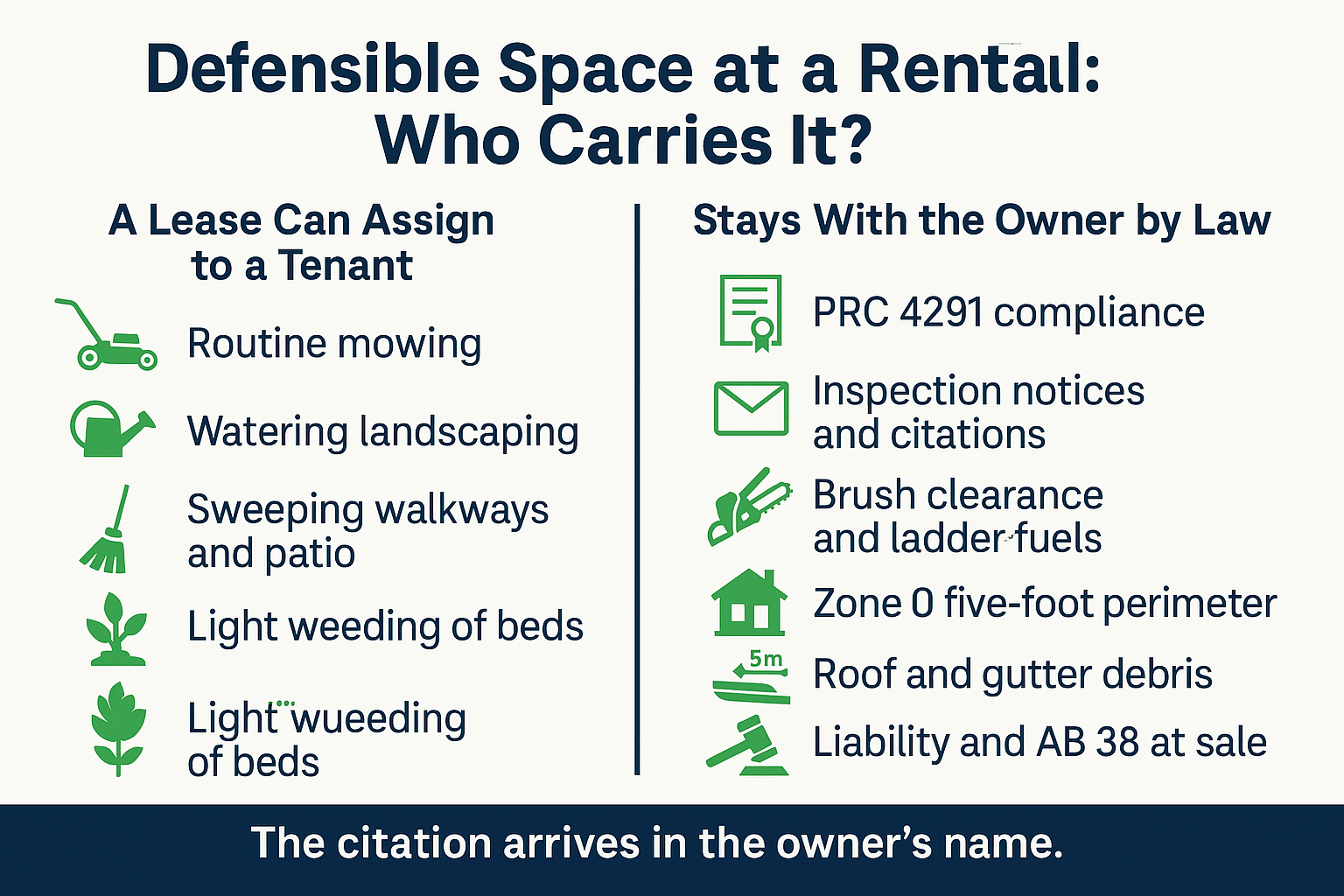
Your lease can assign day to day yard work. Plenty of single-family leases in Monterey County put mowing, watering and basic weeding on the tenant, and that is allowed. But the inspection notice, the citation and any liability still come back to your name.
So the practical question is not “who is supposed to do it” but “who will actually do it to a fire inspector’s standard.” Those are two different things. A tenant may keep a tidy lawn and still have nothing to do with:
- Brush and dead fuel out at the 30 to 100 foot line
- Tree limbs that need to be cut back off the roof
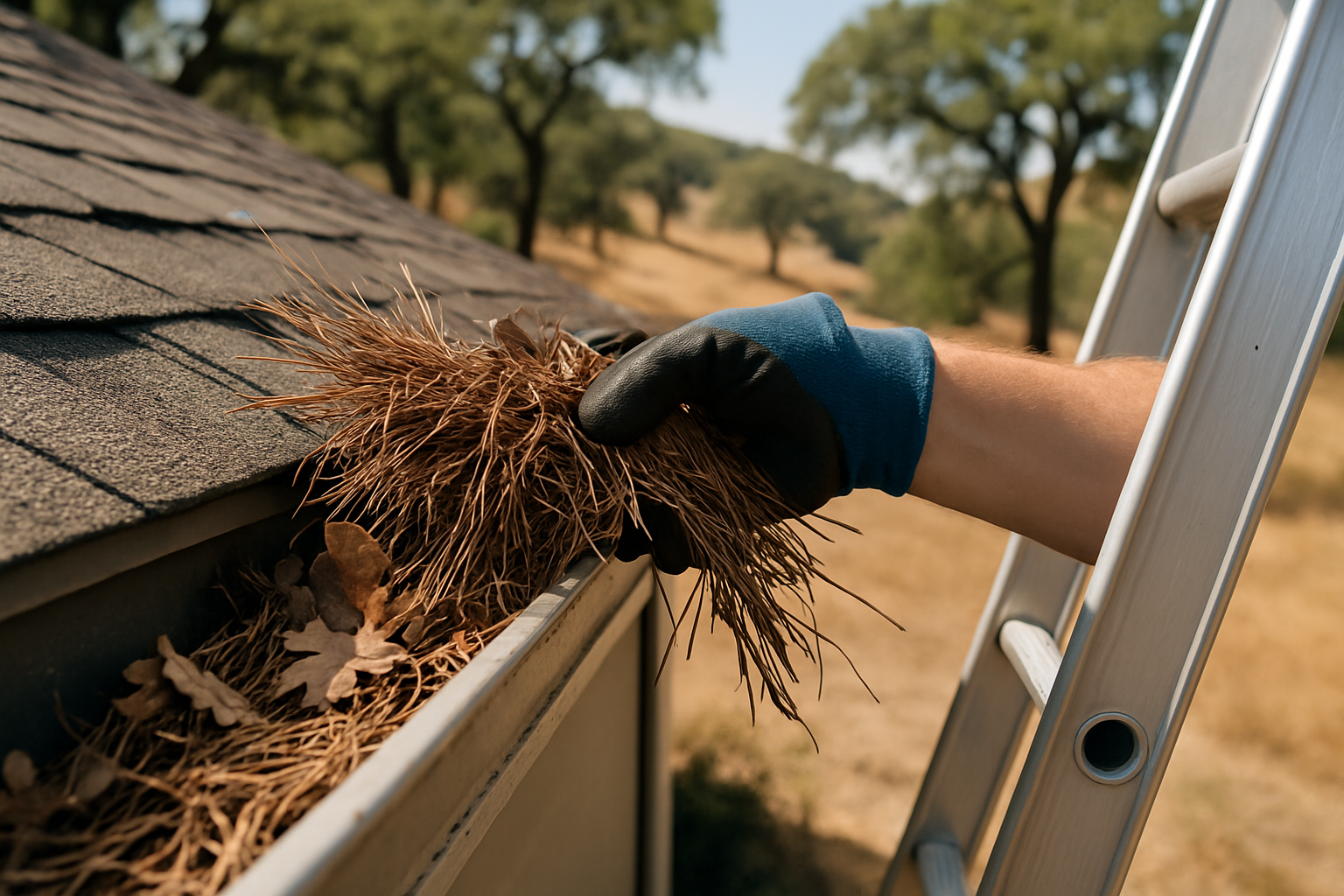
- Gutters packed with oak and pine debris
- Dead or dying shrubs planted tight against the siding
- A failed irrigation system that is killing everything it was supposed to water
For a home in or near a fire hazard zone, I tell owners to keep a landscaping vendor in place and build the cost into the rent rather than hope a tenant handles brush clearance. It is cheaper than a correction notice, and it protects the asset. How maintenance decisions affect your rental’s bottom line goes deeper on that math.
How Inspections Actually Work Across Monterey County
This is where a national article cannot help you. Enforcement here is local, and it changes depending on which side of the county your rental sits on.
The Monterey Fire Department runs an annual defensible space inspection program and opened its 2026 season on May 1, mailing checklists to property owners in Monterey, Carmel and Pacific Grove. In north county, the North County Fire Protection District handles inspections for Prunedale, Castroville, Royal Oaks, Las Lomas, Moss Landing and Pajaro, partly under a local vegetation management ordinance.
In unincorporated parts of the county, guidance calls for clearing flammable vegetation a minimum of 30 feet around buildings, or out to the property line if that is closer, with dry and dead grass cut to no more than four inches.
Here is the trap for absentee owners. Those notices arrive by mail, and some arrive as a flyer left at the door. If your tax bill goes to an address in Arizona or Texas, your tenant may be the only person who sees the warning. I have seen owners learn about a clearance problem months late, after the window to fix it quietly had already closed. That gap is one of the main reasons out-of-area owners hand off a Monterey Bay rental in the first place.
Who Inspects What, by Area
Enforcement varies by jurisdiction. Use this to figure out who is likely knocking on your rental’s door.
| Where the property sits | Who typically inspects | What gets checked first |
|---|---|---|
| Monterey, Carmel, Pacific Grove | Monterey Fire Department, annual season opening in spring | Mailed checklist items, clearance around structures, roof and gutter debris |
| Prunedale, Castroville, Royal Oaks, Las Lomas, Moss Landing, Pajaro | North County Fire Protection District | Local vegetation management ordinance compliance, dry grass and brush |
| Unincorporated Monterey County | County guidance and local fire agency | 30 feet of clearance minimum or to the property line, grass cut to four inches or less |
| Parcels in a State Responsibility Area | CAL FIRE under Public Resources Code 4291 | 100 feet of clearance or to the property line, ladder fuels, dead material |
Zone 0: The New Five-Foot Rule Owners Should Plan For
On August 19, 2026, the California Board of Forestry and Fire Protection approved the final draft of the state’s first Zone 0 defensible space regulations. Zone 0 is the first five feet around a home or structure.
The rules apply in State Responsibility Areas and in Very High Fire Hazard Severity Zones inside local responsibility areas. The target is wind-driven embers, which is how most homes actually ignite.
In plain terms, that five-foot strip is no longer a storage shelf. Expect these points:
- Combustible material out, including firewood stacked against the house, bark mulch, wood chips and dead leaves
- Dead and dying vegetation removed, not trimmed back
- Roofs and gutters kept clear of needles and leaf buildup
- Maintained plants can stay if they meet spacing and trimming standards
Timing matters here. New construction is subject on the effective date, and existing homes phase in over as much as five years. This is a maintenance calendar item, not an emergency. But if your rental has firewood against the siding and mulch beds ringing the foundation, that is a change worth budgeting now rather than scrambling later.
Lease Duties vs Owner Duties at a Glance
A lease can move yard chores to a tenant. It cannot move the legal responsibility. Here is the split I walk owners through.
Why Distance Is the Real Problem, Not Neglect
Most owners I meet with overgrown rentals are not careless. They are far away, and overgrowth is gradual.
If you visit twice a year, the yard looks about the same as last time. The tenant living there watches it creep past the fence line week by week. Those are two very different data sets, and only one of them shows up in your inbox.
A rent payment arriving on time tells you nothing about the property. A walkthrough that photographs specific things does:
- The roofline and gutters
- The five-foot perimeter around the structure
- The fence line and anything stacked against it
- Irrigation heads, running, so you can see what is actually getting water
- Dead shrubs, poison oak and volunteer growth at the edges
That last one matters more than people think. A sprinkler system can run up a water bill every month while watering dirt, which is exactly what the tenant I mentioned earlier was living with.
Weather makes this worse on a two-year cycle. Forecasters are expecting a strong El Nino pattern through spring, and a heavy rain year grows heavy fuel that cures out brown by June. That makes next summer’s clearing bigger than last summer’s. Clearing roof and gutter debris pulls double duty, since the same buildup drives both ember ignition and winter water intrusion. We cover the wet side of that in getting a Monterey Bay rental ready for a Super El Nino winter.
Defer It Now, Pay for It at Escrow Later
Here is the part that catches owners who plan to sell someday.
Under AB 38, since July 1, 2021, a seller of a home in a high or very high fire hazard severity zone has to provide documentation of a compliant defensible space inspection before close of escrow. That inspection has to have been completed within six months of the sales contract.
If the property fails, you get a deficiency report listing the corrections. If the seller cannot finish them in time, the law allows a written agreement shifting compliance over to the buyer, which is a negotiation you would rather not be having.
Inspections can take weeks to schedule. So brush a landlord defers this fall quietly turns into an escrow delay, or a price concession, a year or two down the road. If selling is anywhere on your horizon, what buyers check before closing on a Monterey County rental is worth reading from the other side of the table.
What a Repeating Routine Actually Looks Like
The fix is boring and that is the point. Clearance is not a one-time project, it is a calendar.
Our quarterly seasonal maintenance program exists for exactly this gap. It is a scheduled exterior check of roof, gutters, siding and drainage, plus plumbing and leak risk, water heater condition and smoke and carbon monoxide detectors, with landscaping and vendor coordination handled from here.
The owner gets a photo-documented report four times a year. What owners tell us they value is the follow-through, knowing something was looked at and handled without a chain of phone calls. One longtime client put it simply in a review: the service has been “consistent, reliable, and always professional.”
For vacant homes, seasonal second homes on the Peninsula, and owners living out of state, that rhythm is the whole difference between finding a problem in a photo and finding it in a notice.
Frequently Asked Questions About Defensible Space at Monterey County Rentals
Can I put defensible space in the lease and make the tenant handle it?
You can assign routine yard work like mowing and watering, and that is common. But the legal obligation under Public Resources Code 4291 stays with you as the owner. If an inspector finds a problem, the notice and the liability come to you, not the tenant.
What does brush clearance usually cost on a Monterey County rental?
It varies a lot based on lot size, slope, access and how long the work has been deferred. A routine seasonal cleanup on a small Peninsula lot sits at the low end, while a neglected acre in Prunedale or Carmel Valley with heavy brush and poison oak can run several times that. The honest answer is that the first year after years of deferral is always the expensive one. Call us at (831) 582-8916 and we can walk you through what drives the number on your specific property.
I live out of state. How would I even know if my rental got a notice?
That is the real risk. Inspection notices and checklists often go out by mail or get left at the door, so if your tenant does not forward it, you may never see it. Owners who manage from a distance usually need someone local who checks the property on a schedule and reports back with photos.
Is the new Zone 0 rule in effect right now?
The final draft was approved by the state Board of Forestry and Fire Protection in August 2026. New construction is subject on the effective date, and existing homes phase in over as much as five years. Treat it as a planning item for your maintenance budget, not something to panic about this week.
Does any of this apply to apartment buildings, or just single-family homes?
Clearance rules around structures apply to multifamily buildings too, and the exposure is larger because you have more roofline, more landscaping and more people. Multifamily owners also have separate items on their plate, including exterior elevated element inspections. We cover that in our SB 721 balcony inspection guide.
Thinking Through Defensible Space on Your Own Property?
We work with owners in Monterey, Salinas, Carmel Valley, Prunedale and the surrounding communities, including plenty who have not set foot on their property in a year or more. If you want a second opinion on what your rental needs before the next inspection season, our team can be reached at (831) 582-8916 or through the contact form at torrenteproperties.com.