

Your Monterey rental needs a written pet policy before April 1, 2027
Most owners I talk with in Monterey and Salinas already have a pet rule in their head. Dogs under 25 pounds, no cats, or no pets at all. The rule exists, it just lives in a phone call instead of a document.
That stops working on April 1, 2027. Governor Newsom signed SB 1296, the Pet Policy Transparency Act, on September 30, 2026, adding Section 1942.7.5 to the California Civil Code. From that date forward, your pet policy has to be in writing and it has to travel with your advertising and your rental applications.
And there is a money consequence attached. If you collect an application fee without meeting the disclosure requirement, you may have to give that fee back. Below is what the law covers, where the gaps usually show up on Monterey Peninsula and Salinas Valley rentals, and what I would put in writing now rather than next spring.
What the California pet policy disclosure law for rentals actually requires
SB 1296 was authored by Sen. María Elena Durazo. The short version, according to the California Apartment Association's summary of the change, is that California rental housing providers must disclose their pet policies in writing to prospective tenants starting April 1, 2027.
A few details matter more than the rest:
- The requirements apply to policies that allow, restrict, or prohibit pets. A no-pets policy is still a policy, and it still has to be written down.
- The law reaches every residential landlord and their agent, which includes the property manager, leasing agent, or broker acting on your behalf.
- Written pet policies have to be supplied with rental applications and with applicable digital advertisements.
- Failure to meet the disclosure requirements may require refunding an application fee you already collected.
Mortgage Professional America and Multifamily Executive both covered the signing in early October 2026 and described it the same way: a new compliance layer, with a refund trigger behind it.
I would read the actual bill text before April 2027 rather than relying on any summary, mine included. The operative language sits in Civil Code Section 1942.7.5.

Where Monterey County owners are most likely to miss it
The written policy is the easy part. The distribution is where I expect owners to get tripped up, because a single Monterey rental usually shows up in more places than the owner realizes.
Think about how your last vacancy was marketed. A listing on the big rental search sites, a syndicated feed those sites pull from, maybe a social post, maybe a sign in the yard that sends people to a phone number. Each digital channel you control is a place the policy has to appear.
For out-of-area owners, this is the part worth paying attention to. If you are stationed elsewhere, living in another state, or managing a parent's house from Southern California, you are relying on someone else to keep your advertising accurate. The law reaches your agent too, so the two of you need to agree on who updates what.
I see the same pattern in our own call log. Callers reach out about a specific address and the first question is almost always whether it is still available and what the rent is. Pets come up second. Once this law is in effect, the answer to that second question has to already be sitting in the ad they were looking at.
If you handle your own leasing from a distance, this is one more item on an already long list. I wrote more about that in how out-of-area owners actually manage a Monterey Bay rental.
Where your written pet policy has to show up
Here is how I would map the requirement across a typical Monterey County rental listing, and the gap I expect to see most often.
| Touchpoint | What belongs there | Common gap |
|---|---|---|
| Digital ads you control | The written pet policy, matching the lease terms | Old listing copy that says 'pets negotiable' with no detail |
| Rental search platforms | The policy provided to the platform | Syndicated feed never updated after the policy changed |
| Rental application packet | Policy included, with space for the applicant to acknowledge receipt | Application sent by email with no attachment |
| Lease or pet addendum | Terms that match what was advertised | Addendum allows a pet the ad said was not permitted |
| Application fee collection | Disclosure completed before the fee is taken | Fee collected over the phone before anything is sent |
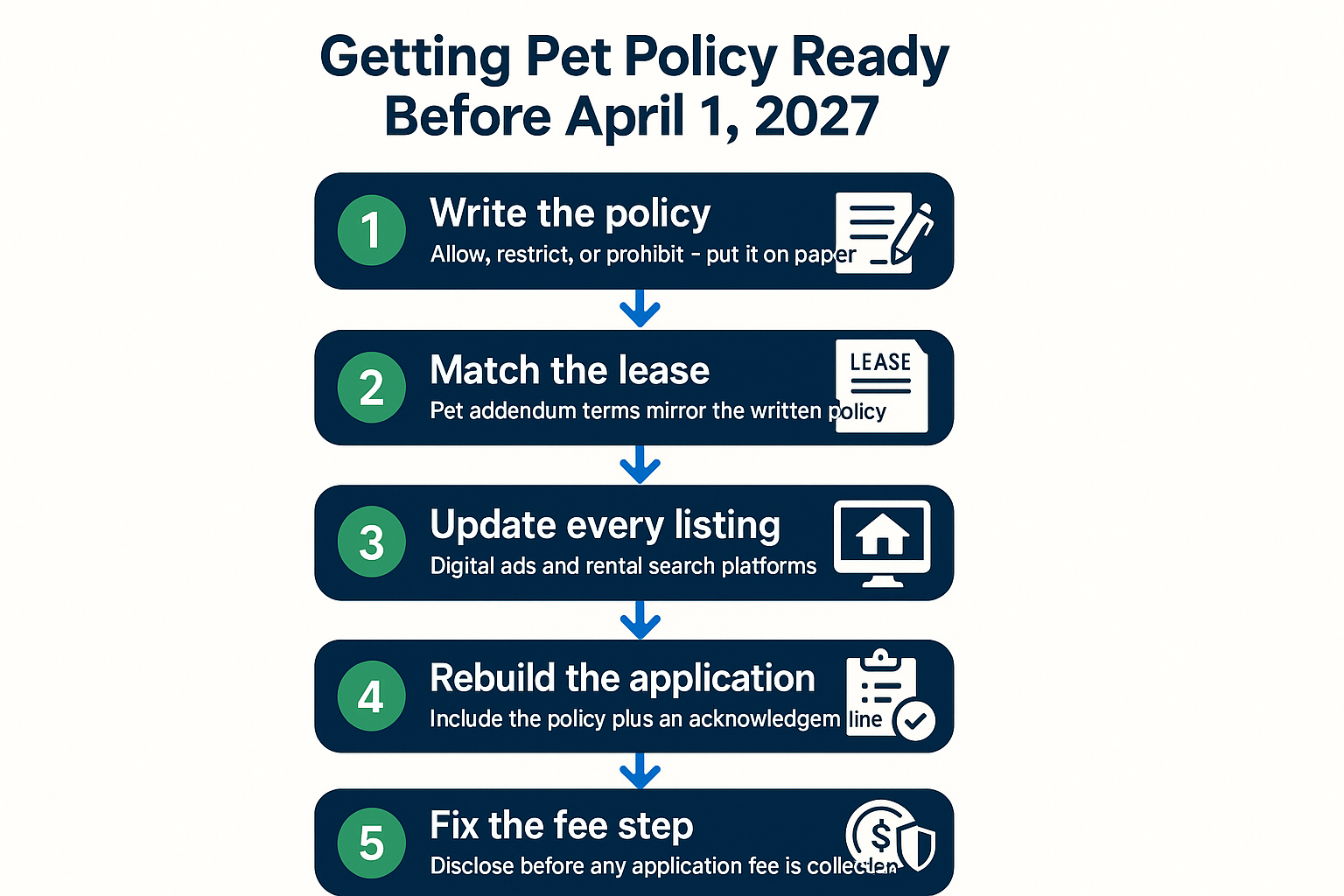
A simple sequence to be ready before the deadline
This is the order I would work through it, starting well before spring 2027 rather than the week of.
What I would actually put in the written policy
A one-line policy invites arguments later. I would rather see a short, plain document that answers the questions tenants ask anyway.
Things worth spelling out:
- Whether pets are permitted at all, and if so, which types
- Any weight or count limits, stated as numbers rather than words like 'small'
- Where the animal may be on the property, including yards and shared outdoor areas
- What you require in writing before an animal moves in, such as vaccination records
- The financial terms, including any pet rent, and how they appear on the lease
- What happens if an unapproved animal shows up mid-tenancy
Two California rules sit next to this one. First, assistance animals are not pets under fair housing law, so your policy should say that requests for reasonable accommodation are handled separately. Second, California's deposit cap from July 1, 2024 limits most residential security deposits to one month's rent, which changes how owners used to handle pet deposits.
I covered that interaction in more detail in what owners can charge for pets and what they can't, and the deposit math itself in security deposits in 2026.
If you own apartments in Salinas or Seaside, standardize before you scale
Single-family owners update one listing. Multifamily owners update a system.
For a 12-unit building in Salinas or a fourplex in Seaside, the risk is inconsistency. One unit advertised as pet friendly, another as no pets, and nothing in the file explaining why. That inconsistency is harder to defend than any single policy choice.
I would use the runway between now and April 2027 to do three things: write one building-level policy, push it into every ad and feed at once, and retrain whoever takes applications so the disclosure happens before a dollar changes hands.
There is also a practical upside. Monterey County has a lot of renters with animals, and a clear, written pet policy tends to shorten vacancy because applicants self-select instead of calling to ask. Vacancy costs more than pet wear in most buildings I have looked at, which is the same logic behind how maintenance decisions affect your rental's bottom line.
New multifamily owners in particular should fold this into their first-year setup. I wrote about that groundwork in what new multifamily owners in Marina need to know.
Frequently Asked Questions About SB 1296 and Pet Policy Disclosure
I don't allow pets at all. Does this still apply to me?
Yes. The requirements apply to policies that allow, restrict, or prohibit pets. A no-pets policy has to be written down and disclosed the same as a pet friendly one.
What happens if I take an application fee and forget the disclosure?
Failure to meet the disclosure requirements may require refunding that application fee. That is the enforcement hook in the law, so I would treat the disclosure as a step that happens before any fee is collected, not alongside it.
Do service animals and emotional support animals count as pets under this?
No. Assistance animals are handled under fair housing law as a reasonable accommodation, not as pets. Your written policy should say so plainly so applicants know a separate process exists.
I only rent out one house in Pacific Grove and I find tenants by word of mouth. Am I covered?
The written policy still has to go out with your rental application. If you are not running digital ads, the advertising piece is less of a lift, but the application packet piece applies regardless of how small your portfolio is.
Should I change my pet policy now or wait until 2027?
If you want to change the rule itself, do it at a renewal or a turnover rather than mid-lease. What I would not wait on is writing down the policy you already have. That part costs you nothing and removes the deadline pressure entirely.
Want a second set of eyes on your pet policy before 2027?
We work with owners across Monterey, Salinas, Pacific Grove, Seaside, and Marina, and we are already updating listing copy and application packets ahead of the April 2027 date. If you would like to talk through how your current policy and advertising line up, our team is reachable at (831) 582-8916 or through the contact form at torrenteproperties.com. Bilingual English and Spanish service is available.

Your Parents Own the Home, You Do the Work: Renting It Out in Salinas
Most of the time, the message does not come from the owner. It comes from the son or the daughter. One family put it to us about as plainly as it can be put: their parents were looking to rent out the home, it was the family's first time doing this, and they wanted someone to explain how the process actually works.
That is a very different situation from inheriting a house. Your parent is alive, still owns the property, and the decision is still theirs. You are the one doing the legwork, making the calls, and probably driving over on Saturdays with a truck.
I have walked a lot of Monterey County families through this exact spot. Below is what I would tell you if you called me today about a home in Salinas, Prunedale, or anywhere else on this side of the county.
Sort Out Who Has Authority Before Anything Else
Families skip this step almost every time, and it is the one that causes real trouble later. Before a single photo gets taken, get clear answers on paper.
Here is what needs to be settled:
- Who is the owner of record right now. Pull the deed. Do not assume.
- Whether the home sits in a family trust, and who the current trustee is.
- Whether a durable power of attorney exists, and whether it actually covers real property and leasing.
- Who signs the lease. The owner, the trustee, or an agent acting under written authority.
- Which account rent and the security deposit flow into. Deposits in particular are held money and need a clean paper trail.
A lease signed by an adult child with no documented authority is a weak document if there is ever a dispute over rent, repairs, or a deposit. I have seen that weakness surface at the worst possible moment, usually in front of a judge or a mediator.
Sorting this out normally takes a week or two with your parent's estate attorney or whoever drafted the trust. It is the cheapest problem your family will ever fix, and the only one that gets more expensive the longer you wait.

The House Sets the Timeline, Not the Marketing
A Salinas, Prunedale, or Seaside home your parent has owned for thirty or forty years is rarely rent ready. It is lived in, and that is a different standard.
What usually needs attention:
- Decluttering and a full cleanout. Decades of belongings, a packed garage, a shed nobody has opened since 2009.
- Deferred repairs the owner stopped noticing. The sticking back door, the slow drain, the fence section leaning into the neighbor's yard.
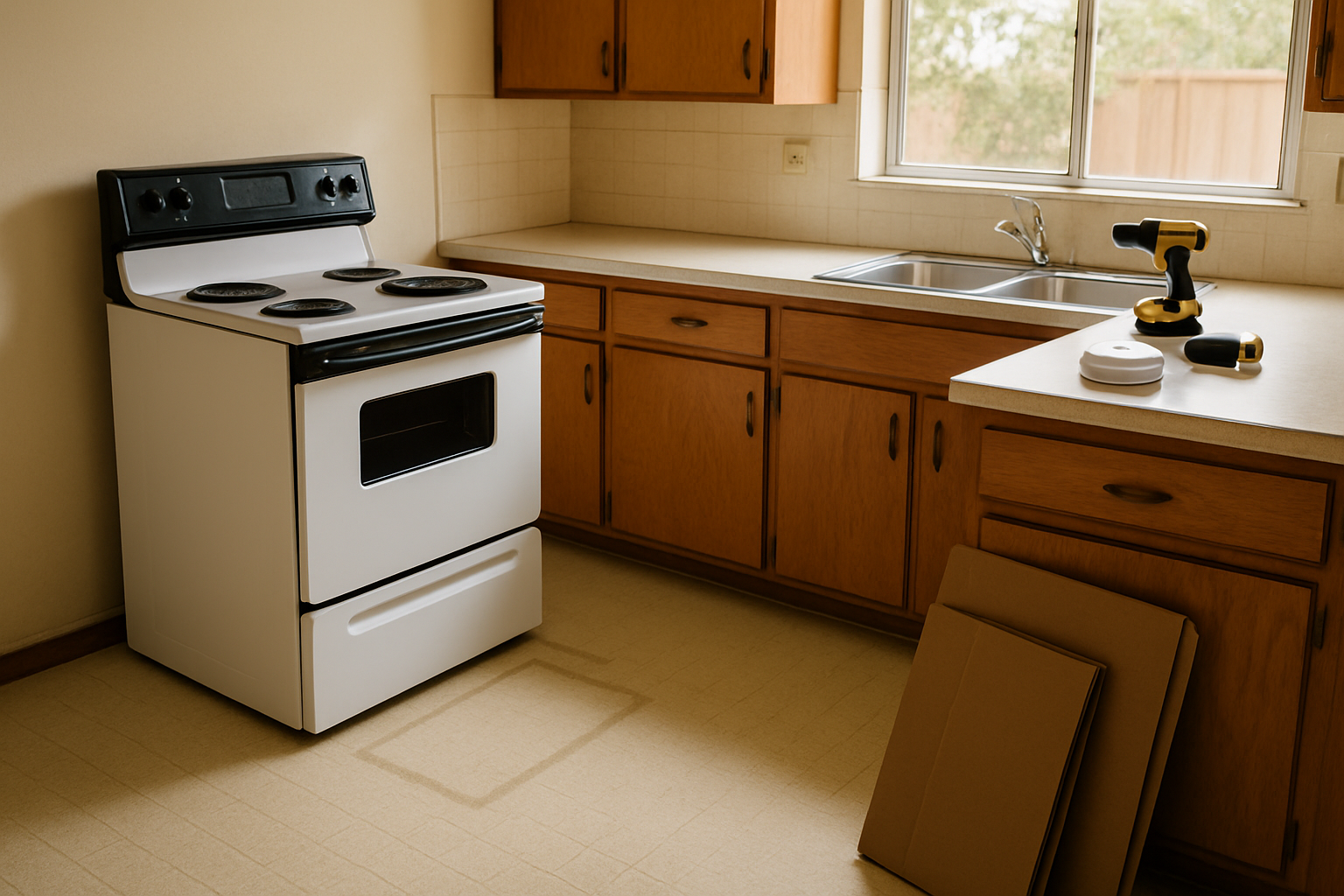
- Smoke and carbon monoxide detectors brought current. This is a compliance item, not a nice to have.
- A hard look at the kitchen. Since January 1, 2026, California requires a working stove and refrigerator in most residential rentals. A 1990s range that still works fine for mom may not clear the bar for a tenant.
Sequence matters more than speed. Clear the house out first, because you cannot see the real condition of floors, walls, or plumbing until the rooms are empty.
Then handle repairs, then landscaping and exterior cleanup, then the deep clean. Photos and the listing come last. A home that hits the market half finished sits longer and attracts weaker applications, which is the opposite of what your family is trying to accomplish. If you want a realistic view of the calendar, I wrote about how long it takes to rent out a Monterey Bay home, week by week.
A Realistic Prep Sequence for an Older Family Home
Timelines vary a lot based on how full the house is and what the repairs turn up. This is the order I recommend and the windows I typically see.
| Step | What It Involves | Typical Window |
|---|---|---|
| 1. Confirm authority | Deed, trust, power of attorney, signer, bank account | 1 to 2 weeks |
| 2. Cleanout | Furniture, garage, shed, donations, hauling | 1 to 3 weeks |
| 3. Repairs | Plumbing, electrical, dry rot, doors, appliances, detectors | 1 to 4 weeks |
| 4. Exterior and landscaping | Overgrowth, irrigation, pressure washing, gutters | 3 to 7 days |
| 5. Deep clean and photos | Final clean, pricing analysis, listing goes live | 3 to 5 days |
Reset the Family Math for a Flat Rent Market
This is usually the hardest conversation, and it often happens between siblings rather than with me. Somebody has an old number in their head from 2022.
Recent market figures put average apartment rent in Salinas somewhere around $2,350 and Monterey closer to $2,795, with year over year growth well under one percent. Those are general market numbers, not a quote for your parent's house, and a single family home in Prunedale prices differently than a unit near Alisal. But the direction is clear: nobody is making this work by asking a big number.
The return on a rental in this market comes from three unglamorous places:
- Fewer vacancy days. Every empty month erases a year of an aggressive rent increase.
- A tenant who renews. Turnover is the single biggest cost in any rental, including your parent's.
- Small repairs caught in October instead of February. A gutter cleared in fall is cheap. Water intrusion after a January storm is not.
One more thing your family should know up front. California has capped most security deposits at one month's rent since July 1, 2024, with a narrow exception for owners of no more than two properties totaling four or fewer units. So you cannot cushion the family's risk with a big deposit. The protection comes from screening and documentation instead, which is also why deposit deductions after move-out have to be supported by move-in photos you take before anyone has keys.
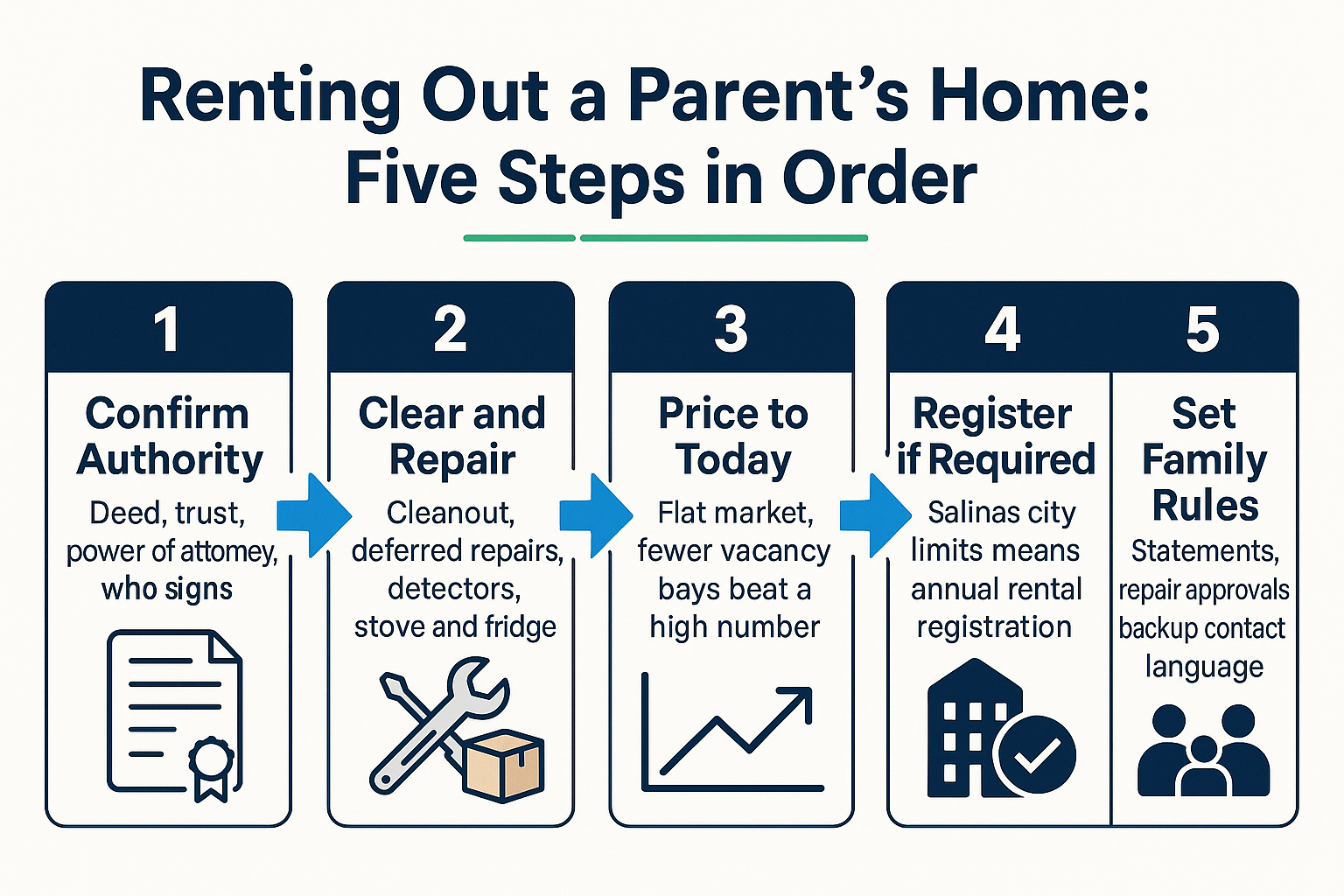
The Order Families Should Work In
Here is the same process in one view, in the order I recommend tackling it.
Inside Salinas City Limits, Local Rules Stack on Top of State Law
If the home sits inside Salinas city limits, state law is only half the picture. The city runs a Residential Rental Registration program that requires annual registration.
Fees currently run in the neighborhood of $29 per unit per year, and closer to $112 per unit for units subject to rent stabilization, which generally means multifamily built before February 1, 1995. Check the city's current schedule before you budget, since fees get adjusted.
Here is the part families get wrong. All four Salinas rental ordinances remain in effect while voters decide Measure H on November 3, 2026. The City of Salinas confirms the ordinances stay in place pending that vote.
Some families have told me they assumed the ballot measure put everything on pause. It did not. And a repeal would not undo anything an owner did wrong before the vote, so registering and following the rules now is the only safe move. I broke down what the vote could mean in this look at the Salinas ballot measure.
Decide How Your Family Will Actually Run the Property
This is where relationships fray, and it almost never happens over money. It happens over a decision somebody made without telling anyone else.
Settle these in one conversation, before the first tenant moves in:
- Who receives the monthly statement. One person, every month, consistently.
- What dollar amount a repair can reach before someone has to approve it. Pick a real number so a water heater at 9pm does not require a family meeting.
- Which sibling is the backup contact when the primary is traveling or unreachable.
- Who answers a burst pipe call at two in the morning. Honestly answer this one. If the answer is nobody, that tells you something.
In Salinas especially, plenty of these households have a parent who prefers Spanish and an adult child handling email in English. Agree on which language each conversation happens in, and keep both people looped into the same documents through an owner portal so nobody is getting the story secondhand.
If you live out of the area, the coordination problem gets bigger, not smaller. I covered that in how out-of-area owners actually manage a Monterey Bay rental, and a lot of it applies here too.
Why Families in This Spot Often Bring In Help
Not every family needs a manager. Some do this well on their own, especially if they live nearby and have the time.
But when the owner is an 80 year old parent and the person handling the paperwork is their son or daughter, the dynamic is different. Someone has to be comfortable talking to both people, in two languages if that is what the household needs, with patience for questions that get asked more than once.
Our team is owner led. Aurelia Torrente has spent more than 25 years in Monterey County real estate and holds the Accredited Residential Manager designation, and the office is bilingual in English and Spanish. One reviewer described the experience this way: "Their patience, kindness, and genuine care turned what could have been a stressful process into something exciting and enjoyable." That tone matters more in this situation than it does in most.
Frequently Asked Questions About Renting Out a Parent's Home in Salinas
Can I sign the lease if my mom still owns the house?
Only if you have documented authority, such as a durable power of attorney that covers real property or a trustee role under the family trust. Otherwise the owner of record signs. A lease signed without that backing is a weak document if a dispute ever comes up.
Should we transfer the house into my name first?
That is a question for your parent's attorney and tax advisor, not for me or any property manager. A transfer can affect property tax basis and estate planning in ways that dwarf anything you'd gain in convenience. Most families I work with leave title alone and solve the signing issue with proper documentation instead.
Does my parent's home have to be registered with the City of Salinas?
If it sits inside Salinas city limits, the Residential Rental Registration program applies and registration is annual. Homes in Prunedale, unincorporated county areas, or other cities follow different rules, so confirm the jurisdiction by address rather than by ZIP code.
How much security deposit can we collect?
Most owners are capped at one month's rent under the rule effective July 1, 2024. There is a narrow exception for owners of no more than two properties totaling four or fewer units. Your protection comes from thorough screening and good move-in documentation, not from a bigger deposit.
My mother prefers Spanish and I handle the email in English. How does that work in practice?
It works fine as long as everyone agrees up front on which conversations happen in which language. We handle calls and documents in both, and a shared owner portal keeps your parent and you looking at the same statements and work orders instead of relaying information back and forth.
How long until the house is actually rented?
For an older family home, budget roughly four to eight weeks from the first conversation to a signed lease, with most of that time spent on cleanout and repairs rather than marketing. A home that is already clear and in good shape moves much faster.
Thinking Through a Parent's Rental in Salinas or Monterey?
If your family is at the research stage and you want a straight answer about what this would look like for a specific house, our team is available to talk it through. We work across Salinas, Monterey, Prunedale, Seaside, and the rest of the Monterey Bay area, in English or Spanish. You can reach us at (831) 582-8916 or through the contact form at torrenteproperties.com.

Defensible Space at a Monterey County Rental: Owner's Job or Tenant's?
A tenant wrote to us last summer about a home she had rented for years in the Monterey Bay area. The owner had let the landscaper go the year before and never hired anyone else.
She described the yard as totally overgrown and a fire hazard. The sprinkler system was broken, she was still paying a water bill, and nothing was actually getting watered. Her ask was simple: could someone please clean it up before the fire department showed up with a defensible space warning?
That message is what deferred landscaping looks like from inside a rental. And it is the exact message an out-of-area owner never wants to open. Below is how defensible space requirements for rental properties in Monterey County actually break down, who carries the risk, and what changed in 2026.
Who Is Legally Responsible, the Owner or the Tenant?
The owner. In California, defensible space duties under Public Resources Code 4291 and local vegetation rules attach to the person who owns the parcel, not the person living in it.
Your lease can assign day to day yard work. Plenty of single-family leases in Monterey County put mowing, watering and basic weeding on the tenant, and that is allowed. But the inspection notice, the citation and any liability still come back to your name.
So the practical question is not "who is supposed to do it" but "who will actually do it to a fire inspector's standard." Those are two different things. A tenant may keep a tidy lawn and still have nothing to do with:
- Brush and dead fuel out at the 30 to 100 foot line
- Tree limbs that need to be cut back off the roof
- Gutters packed with oak and pine debris
- Dead or dying shrubs planted tight against the siding
- A failed irrigation system that is killing everything it was supposed to water
For a home in or near a fire hazard zone, I tell owners to keep a landscaping vendor in place and build the cost into the rent rather than hope a tenant handles brush clearance. It is cheaper than a correction notice, and it protects the asset. How maintenance decisions affect your rental's bottom line goes deeper on that math.

How Inspections Actually Work Across Monterey County
This is where a national article cannot help you. Enforcement here is local, and it changes depending on which side of the county your rental sits on.
The Monterey Fire Department runs an annual defensible space inspection program and opened its 2026 season on May 1, mailing checklists to property owners in Monterey, Carmel and Pacific Grove. In north county, the North County Fire Protection District handles inspections for Prunedale, Castroville, Royal Oaks, Las Lomas, Moss Landing and Pajaro, partly under a local vegetation management ordinance.
In unincorporated parts of the county, guidance calls for clearing flammable vegetation a minimum of 30 feet around buildings, or out to the property line if that is closer, with dry and dead grass cut to no more than four inches.
Here is the trap for absentee owners. Those notices arrive by mail, and some arrive as a flyer left at the door. If your tax bill goes to an address in Arizona or Texas, your tenant may be the only person who sees the warning. I have seen owners learn about a clearance problem months late, after the window to fix it quietly had already closed. That gap is one of the main reasons out-of-area owners hand off a Monterey Bay rental in the first place.
Who Inspects What, by Area
Enforcement varies by jurisdiction. Use this to figure out who is likely knocking on your rental's door.
| Where the property sits | Who typically inspects | What gets checked first |
|---|---|---|
| Monterey, Carmel, Pacific Grove | Monterey Fire Department, annual season opening in spring | Mailed checklist items, clearance around structures, roof and gutter debris |
| Prunedale, Castroville, Royal Oaks, Las Lomas, Moss Landing, Pajaro | North County Fire Protection District | Local vegetation management ordinance compliance, dry grass and brush |
| Unincorporated Monterey County | County guidance and local fire agency | 30 feet of clearance minimum or to the property line, grass cut to four inches or less |
| Parcels in a State Responsibility Area | CAL FIRE under Public Resources Code 4291 | 100 feet of clearance or to the property line, ladder fuels, dead material |
Zone 0: The New Five-Foot Rule Owners Should Plan For
On August 19, 2026, the California Board of Forestry and Fire Protection approved the final draft of the state's first Zone 0 defensible space regulations. Zone 0 is the first five feet around a home or structure.
The rules apply in State Responsibility Areas and in Very High Fire Hazard Severity Zones inside local responsibility areas. The target is wind-driven embers, which is how most homes actually ignite.
In plain terms, that five-foot strip is no longer a storage shelf. Expect these points:
- Combustible material out, including firewood stacked against the house, bark mulch, wood chips and dead leaves
- Dead and dying vegetation removed, not trimmed back
- Roofs and gutters kept clear of needles and leaf buildup
- Maintained plants can stay if they meet spacing and trimming standards
Timing matters here. New construction is subject on the effective date, and existing homes phase in over as much as five years. This is a maintenance calendar item, not an emergency. But if your rental has firewood against the siding and mulch beds ringing the foundation, that is a change worth budgeting now rather than scrambling later.
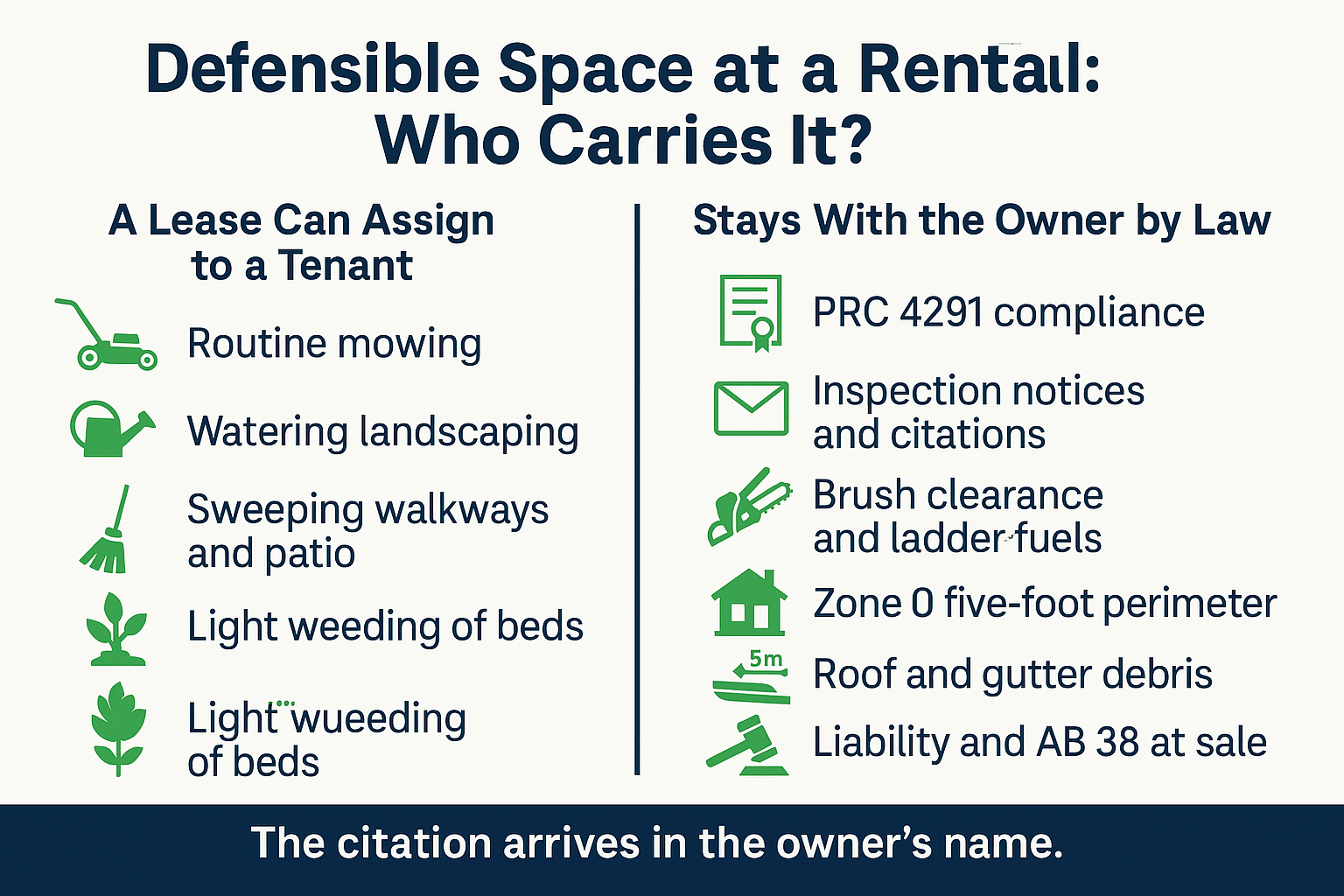
Lease Duties vs Owner Duties at a Glance
A lease can move yard chores to a tenant. It cannot move the legal responsibility. Here is the split I walk owners through.
Why Distance Is the Real Problem, Not Neglect
Most owners I meet with overgrown rentals are not careless. They are far away, and overgrowth is gradual.
If you visit twice a year, the yard looks about the same as last time. The tenant living there watches it creep past the fence line week by week. Those are two very different data sets, and only one of them shows up in your inbox.
A rent payment arriving on time tells you nothing about the property. A walkthrough that photographs specific things does:
- The roofline and gutters
- The five-foot perimeter around the structure
- The fence line and anything stacked against it
- Irrigation heads, running, so you can see what is actually getting water
- Dead shrubs, poison oak and volunteer growth at the edges
That last one matters more than people think. A sprinkler system can run up a water bill every month while watering dirt, which is exactly what the tenant I mentioned earlier was living with.
Weather makes this worse on a two-year cycle. Forecasters are expecting a strong El Nino pattern through spring, and a heavy rain year grows heavy fuel that cures out brown by June. That makes next summer's clearing bigger than last summer's. Clearing roof and gutter debris pulls double duty, since the same buildup drives both ember ignition and winter water intrusion. We cover the wet side of that in getting a Monterey Bay rental ready for a Super El Nino winter.
Defer It Now, Pay for It at Escrow Later
Here is the part that catches owners who plan to sell someday.
Under AB 38, since July 1, 2021, a seller of a home in a high or very high fire hazard severity zone has to provide documentation of a compliant defensible space inspection before close of escrow. That inspection has to have been completed within six months of the sales contract.
If the property fails, you get a deficiency report listing the corrections. If the seller cannot finish them in time, the law allows a written agreement shifting compliance over to the buyer, which is a negotiation you would rather not be having.
Inspections can take weeks to schedule. So brush a landlord defers this fall quietly turns into an escrow delay, or a price concession, a year or two down the road. If selling is anywhere on your horizon, what buyers check before closing on a Monterey County rental is worth reading from the other side of the table.
What a Repeating Routine Actually Looks Like
The fix is boring and that is the point. Clearance is not a one-time project, it is a calendar.
Our quarterly seasonal maintenance program exists for exactly this gap. It is a scheduled exterior check of roof, gutters, siding and drainage, plus plumbing and leak risk, water heater condition and smoke and carbon monoxide detectors, with landscaping and vendor coordination handled from here.
The owner gets a photo-documented report four times a year. What owners tell us they value is the follow-through, knowing something was looked at and handled without a chain of phone calls. One longtime client put it simply in a review: the service has been "consistent, reliable, and always professional."
For vacant homes, seasonal second homes on the Peninsula, and owners living out of state, that rhythm is the whole difference between finding a problem in a photo and finding it in a notice.
Frequently Asked Questions About Defensible Space at Monterey County Rentals
Can I put defensible space in the lease and make the tenant handle it?
You can assign routine yard work like mowing and watering, and that is common. But the legal obligation under Public Resources Code 4291 stays with you as the owner. If an inspector finds a problem, the notice and the liability come to you, not the tenant.
What does brush clearance usually cost on a Monterey County rental?
It varies a lot based on lot size, slope, access and how long the work has been deferred. A routine seasonal cleanup on a small Peninsula lot sits at the low end, while a neglected acre in Prunedale or Carmel Valley with heavy brush and poison oak can run several times that. The honest answer is that the first year after years of deferral is always the expensive one. Call us at (831) 582-8916 and we can walk you through what drives the number on your specific property.
I live out of state. How would I even know if my rental got a notice?
That is the real risk. Inspection notices and checklists often go out by mail or get left at the door, so if your tenant does not forward it, you may never see it. Owners who manage from a distance usually need someone local who checks the property on a schedule and reports back with photos.
Is the new Zone 0 rule in effect right now?
The final draft was approved by the state Board of Forestry and Fire Protection in August 2026. New construction is subject on the effective date, and existing homes phase in over as much as five years. Treat it as a planning item for your maintenance budget, not something to panic about this week.
Does any of this apply to apartment buildings, or just single-family homes?
Clearance rules around structures apply to multifamily buildings too, and the exposure is larger because you have more roofline, more landscaping and more people. Multifamily owners also have separate items on their plate, including exterior elevated element inspections. We cover that in our SB 721 balcony inspection guide.
Thinking Through Defensible Space on Your Own Property?
We work with owners in Monterey, Salinas, Carmel Valley, Prunedale and the surrounding communities, including plenty who have not set foot on their property in a year or more. If you want a second opinion on what your rental needs before the next inspection season, our team can be reached at (831) 582-8916 or through the contact form at torrenteproperties.com.

Pets in Your Monterey Bay Rental: What Owners Can Charge and What They Can't
Roughly one in twelve rental inquiries that reach our contact form bring up a pet before anyone asks about it. People list their dog's weight, their cat's age, and their references in the same sentence, almost apologizing. One household relocating to the Monterey and Pacific Grove area flagged that they needed pet friendly before asking about price or availability.
That tells me something owners should pay attention to. Pet owners in this market screen themselves out, which quietly shrinks your applicant pool before the first showing ever happens.
So the real question is not whether pets are a hassle. It is what a pet policy costs you in vacancy, what California actually lets you charge, and where the legal lines sit. That is what I want to walk through here.
A no pets rule is really a vacancy decision
Rents around Monterey Bay have gone mostly sideways. Apartment averages in Salinas have been sitting somewhere in the mid $2,000s, with Monterey running in the high $2,000s, and year over year movement under one percent in recent market reporting. Figures shift by unit and submarket, so treat those as context rather than a price for your property.
What that flat picture means is simple. You are not going to improve your return by asking for more rent.
Returns come from two places instead:
- Filling the unit faster
- Keeping a good tenant longer
- Avoiding a second turnover you did not plan for
I have watched a no pets rule add real weeks to a lease-up on a single family home in Seaside or Marina, where families with dogs make up a big slice of the demand. Three extra weeks of vacancy on a home renting in the high $2,000s usually costs more than replacing the carpet you were protecting.
If you want a sense of the normal timeline before you narrow your pool further, our breakdown of how long it takes to rent out a Monterey Bay home lays out the weeks involved.
What the one month deposit cap left room for
This is where I see owners get it wrong most often. Since July 1, 2024, the total security deposit for most residential tenancies in California is capped at one month's rent.
That cap covers everything you collect up front as a deposit. A pet deposit is not a separate bucket that sits on top of it. It has to fit inside the same one month ceiling.
So if you rent a Monterey home at $3,000 and want to hold $500 against pet damage, your general deposit drops to $2,500. The total does not change.
There is a narrow exception. Certain small owners who are natural persons with limited holdings may collect more, and that exception does not apply when the tenant is a service member. In a market with tenants from the Presidio of Monterey and the Naval Postgraduate School, that matters more here than it does in most of California.
I am not rehashing general deposit rules in this piece. If you want the full picture, our guide to what Monterey Bay landlords can collect now covers it. The question here is narrower: once the cap is applied, how much room is actually left for pet risk? Usually less than owners assume.

Pet rent works differently than a pet deposit
Pet rent is a recurring monthly charge, not money you hold in trust for the tenant. Because it is rent and not a deposit, it does not count against the one month cap.
Two conditions come with that. It has to be written into the lease in plain language, and it has to be applied the same way to every applicant.
I am not going to quote a dollar figure for the Monterey Peninsula, because the right number depends on the property. What drives it:
- Flooring type. Carpet carries more risk than tile, vinyl plank, or sealed hardwood.
- Yard condition. A fenced yard with established landscaping is a different exposure than a bare side lot.
- Unit size and layout. A three bedroom house absorbs a dog differently than a small second floor unit.
- What comparable listings are asking. Pacific Grove, Salinas, and Carmel do not price the same way.
One warning worth bolding. Calling a move in charge "nonrefundable" does not make it nonrefundable under California rules. If the money functions as a deposit, it gets treated as one, cap and all, and you will owe an accounting at move out. Pet rent charged monthly is the cleaner structure.
If you are unsure where your property sits in the market, how rental prices actually get set here explains the comparison work behind the number.
Pet charges and where they land
Here is the quick reference I give owners when they ask what they can actually collect.
| Charge type | Counts inside the one month cap? | What owners should know |
|---|---|---|
| Pet deposit | Yes | Reduces the general deposit dollar for dollar. Must be accounted for at move out. |
| Pet rent (monthly) | No | Recurring charge, not held in trust. Must be stated in the lease and applied consistently. |
| "Nonrefundable" pet fee | Usually treated as a deposit | The label does not control. If it functions as a deposit, it falls under the cap. |
| Assistance or support animal | No charge allowed | Not a pet under the law. No pet rent, no pet deposit, no breed or weight exclusion. |
| Damage caused by any animal | Charged against the deposit | Requires documented move in condition to support the deduction. |
Pet charges at a glance
This breaks down which pet charges sit inside California's deposit cap and which do not.
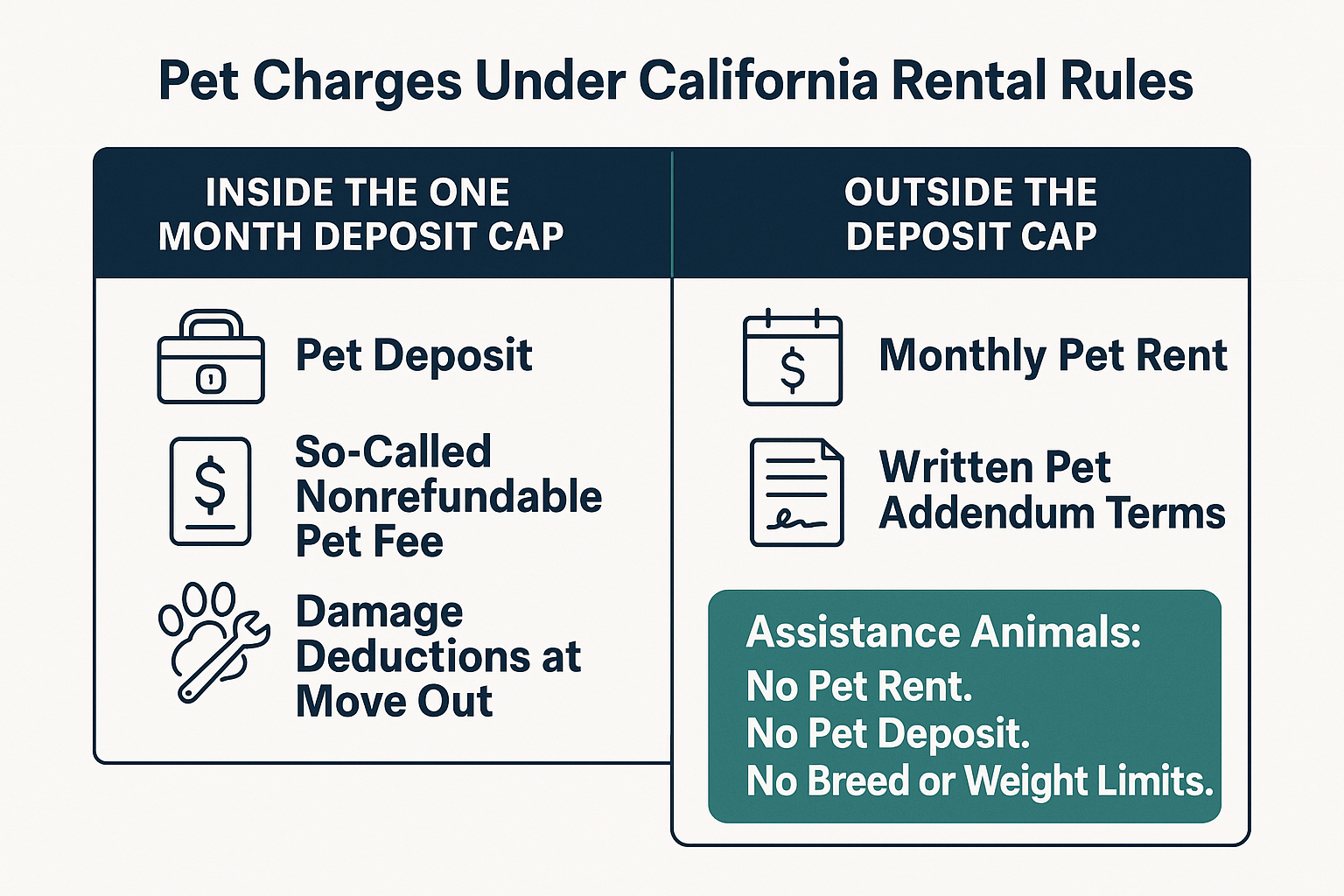
Assistance animals are not pets, and that line matters
This is the mistake that turns into a fair housing complaint, and it happens to well meaning owners.
A service animal or a documented support animal is not a pet under the law. That means:
- No pet rent and no pet deposit
- No breed restriction and no weight limit
- No blanket "no animals" denial
The tenant still stays responsible for any damage the animal causes. You can document condition, and you can deduct for real damage at move out using the standard deposit process.
What you cannot do is price the animal differently or screen it out on breed. The protection that works best here is boring and simple: a written pet policy applied the same way to every applicant, with the assistance animal exception stated in it. Consistency is what holds up if anyone ever questions a decision.
One bill worth watching, not following yet
A bill moving through the Legislature this session, SB 1296, would change how pet terms get disclosed. As written, it would require owners who do not allow pets to say so clearly in advertising and rental documents, and would require pet addenda to itemize upfront fees, refundable deposits, and monthly pet rent separately.
The proposed operative date is April 1, 2027. It had not become law as of this summer, so treat it as something to track rather than a rule to follow. You can read the official bill text on the California Legislature's site.
The practical takeaway is reassuring. Owners who already spell out their pet terms in writing will not have to change much of anything if it passes.
The part self-managing owners skip: documentation
Applicants with animals tend to lead with their credentials. A version of "we have great credit and excellent references" shows up in inquiry after inquiry, and it is often true.
But good references at move in do not protect you at move out. Records do.
Three things make the difference:
- A detailed move in condition report with photos, room by room, including flooring, baseboards, doors, and yard
- A pet addendum that names the specific animal, not just "one dog," so a swapped or added pet is obvious
- A move out inspection compared against that same record, not against memory
Our team runs move in and move out inspections with photo documentation on the properties we manage. That file is usually the entire difference between a clean deposit accounting and a six week argument over carpet.
If you want the deduction side in more detail, we covered what owners must document after move-out separately.
Frequently Asked Questions About Pet Policies in Monterey Bay Rentals
Can I charge a pet deposit on top of the regular security deposit?
No. Since July 1, 2024, the total collected up front is capped at one month's rent for most residential tenancies. A pet deposit has to fit inside that number, not sit on top of it.
Is pet rent legal in California?
Yes, when it is written into the lease and applied consistently. Because it is a recurring monthly charge rather than money held in trust, it falls outside the deposit cap. Just do not use it to price one applicant differently than another.
What if a tenant shows up with an emotional support animal after signing a no pets lease?
A documented support animal is not a pet, so a no pets clause does not apply to it. You cannot charge pet rent or a pet deposit for it, and you cannot exclude it by breed or weight. The tenant is still on the hook for damage the animal causes, which is exactly why your move in photos matter.
Does allowing pets actually help me rent faster in Salinas or Marina?
In my experience, yes, especially for single family homes with yards. A pet friendly listing pulls from a much larger pool, and with rents flat across the area, filling the unit sooner is one of the few levers you have left.
How do I charge for pet damage without a fight?
Photograph everything at move in, name the specific animal in a pet addendum, and compare the move out walkthrough against that same record. Normal wear is not chargeable, but documented damage usually is.
Thinking through a pet policy for your property?
Every property in Monterey County handles animals differently, and the right answer for a Carmel condo is not the right answer for a Marina house with a fenced yard. If you would like a second opinion on your pet terms, your lease language, or your move in documentation, our team is reachable at (831) 582-8916 or through the contact form at torrenteproperties.com. No pressure either way.

Monterey's Annual Rental Registration: What Owners File and When
Most owners I talk to did not learn about this from the city. They heard it from a neighbor at a barbecue, or they half-read a notice that came in the mail and set it on the counter for later.
Then the question starts nagging: does this apply to one condo, or only to apartment buildings? And did I already miss something?
Here is the plain version. The City of Monterey rental inventory registration for landlords is an annual filing tied to each rental unit inside city limits, and it catches a lot of out-of-area owners off guard. I will walk through who files, when the window opens, what the city is actually collecting, and why a property in Salinas does not cover you here.
Who Has to Register a Rental Unit in Monterey
The Monterey City Council adopted Ordinance 3671 in November 2023. Registration of residential rental units began January 1, 2024, and it was phased in.
That phase-in is where the confusion started. Some owners were exempt at first, so they assumed the program was for bigger buildings. A later amendment ended the remaining exemptions as of June 30, 2025, with every rental unit expected to be registered by July 1, 2025.
So if you own residential rental property inside Monterey city limits, plan on registering. That includes:
- A single condo you rent out near downtown or on the Peninsula side of town
- A single-family house you moved out of and kept as a rental
- A duplex or fourplex
- Larger apartment buildings
Two details matter more than people expect. First, this is annual, not a one-time signup. Second, the city treats a registration as complete only once all required information is submitted and any outstanding fees or penalties are paid.
I have seen owners assume they were done because they started an application. A partially filled form with an unpaid fee sitting behind it is not a finished registration.

The Filing Window Is the Part Owners Get Wrong
Timing trips people up more than paperwork does. The city runs a defined window each year rather than accepting filings whenever you remember.
For Year 3, the city accepted registrations from May 1, 2026 through July 1, 2026. If you are reading this in late summer, that window has closed, and the right move is to contact the city's Community Development department directly instead of waiting for next spring's cycle.
Waiting is usually the worse choice, because the code also contemplates late penalties. Reaching out on your own is a shorter conversation than being found later.
This hits out-of-area owners hardest, and that is most of who I work with. If you live in Sacramento or Texas or you are deployed, a notice mailed to a Monterey address you left years ago does not reach you.
A few habits that actually prevent this:
- Put the spring window on your calendar with a reminder in mid-April, every year
- Save the submission confirmation as a PDF, not just as an email you will lose
- Tell whoever collects mail at the property, including your tenant, what to forward
- Keep your mailing address current with the city, not just with your lender
If you are handling a rental from far away, the same discipline that keeps out-of-area owners on top of a Monterey Bay rental applies here. Calendar the deadline once and it stops being a surprise.
The Annual Registration Cycle at a Glance
Here is how the yearly rhythm works for a rental unit inside Monterey city limits.
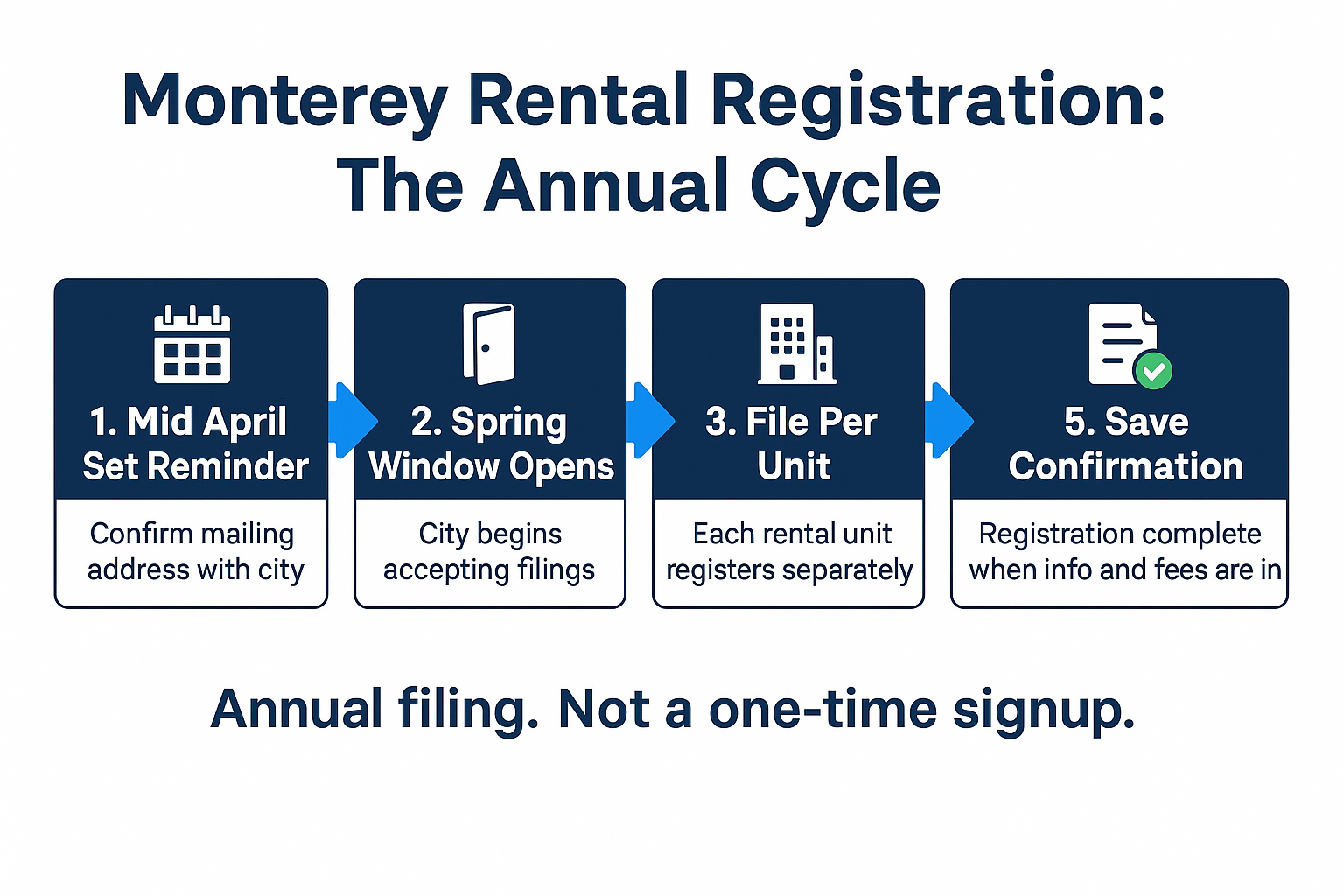
What the City Collects, and Why Owners Get Nervous About It
The moment a city asks for rent figures, owners tense up. I understand why, so let me report this accurately rather than guess at motives.
The stated purpose of the ordinance is to let the city collect and analyze the characteristics of rental units and the rents actually being charged, so the City Council has data when it makes future housing policy decisions. In December 2024, the city launched a public rental inventory database built from that information.
The city's own program material stated that rent control was not being considered at the time the inventory was created. That is what the record says. I am not going to predict what a future council may or may not do, and neither should anyone else.
On the fee: the ordinance sets an annual fee on a per rental unit basis, adopted through the City Council's master fee schedule by resolution. That structure matters to you for one practical reason.
- The number lives on the city fee schedule, not in the ordinance text, so it can change
- It is charged per unit, so a fourplex is not the same bill as a condo
- It is separate from any business license tax you may already pay
- Late penalties are contemplated in the code
I would rather you get the current figure from the source than from me. You can find the program details and current requirements on the City of Monterey's housing programs page.
Monterey and Salinas Are Two Separate Filings
Plenty of owners in this market hold property in both cities and assume one registration covers everything. It does not.
| What to check | City of Monterey | City of Salinas |
|---|---|---|
| Program | Rental inventory registration under Ordinance 3671 | Its own residential rental registration program |
| How often | Annual, during a defined spring window | Set by the city's own schedule, confirm current cycle |
| Fee basis | Per rental unit, set by City Council master fee schedule | Separate fee structure set by that city |
| Tenancy length | Rentals under 30 days are not permitted in city limits | Confirm current city rules directly |
| If you own in both | File here under these rules | File there under those rules, separately |
The ADU Question That Comes Up Constantly
One owner I spoke with had a main house and a back guest house sharing a single lot in Monterey, and wanted to know whether that was one filing or two.
Registration is per unit, not per parcel. So when a property has a main house plus a guest house or an ADU, the count matters, and it changes the paperwork, not just the rent math.
My advice is to confirm directly with the city how many units your parcel represents before you file. Guessing low is the kind of small error that turns into a correction and a penalty conversation later.
One more Monterey specific point: only long term tenancies are on the table inside city limits, since rentals under 30 days are not permitted. That simplifies the question of what you are registering, but it also means your lease structure needs to line up.
If you own in both markets, the Salinas rental registration program has its own requirements that run on a separate track. And since registration season lands close to the time many owners adjust rents, it is worth reviewing how rent increases work in 2026 at the same sitting.
A Free Local Place to Ask Questions in Person
If you would rather ask a person than read a code section, the city is hosting a landlord workshop on August 27, 2026, from 6:00 to 8:00 p.m. at El Estero Park Center, 777 Pearl Street in Monterey.
It is run in partnership with the Housing Resource Center of Monterey County. It is free, and it is a straightforward way to get your specific question answered by the people who administer the program.
I point owners there regularly. A twenty minute conversation at El Estero often clears up something that would otherwise sit unresolved for a year, especially for owners who also need to sort out what the current security deposit rules allow.
Frequently Asked Questions About Monterey Rental Registration
I only rent out one condo. Do I really have to register?
Yes. The program covers residential rental units inside city limits, and the remaining exemptions ended as of June 30, 2025. A single condo counts the same as a unit in a larger building, it just means one filing instead of several.
I missed the window this year. What now?
Contact the Community Development department directly rather than waiting for next spring. The code contemplates late penalties, and reaching out yourself is a much simpler conversation than being contacted later. Registration is treated as complete only once the required information is in and any fees or penalties are paid.
Does the city publish my rent figures?
The city launched a public rental inventory database in December 2024 built from the data it collects. The stated purpose is to give the City Council information on rental unit characteristics and actual rents for future housing policy work. If you have questions about how your specific data appears, the city is the right place to ask.
How much is the annual fee?
I will not quote a number, because the fee is adopted by resolution through the City Council's master fee schedule and can change. It is charged per rental unit and is separate from any business license tax. Check the current fee schedule on the city's website.
I registered my Salinas duplex. Am I covered for my Monterey condo?
No. Those are two different programs with two sets of rules, fees, and deadlines. An owner with property in both cities files in both places.
My property has a main house and a back guest house. Is that one registration or two?
Registration is per unit, so a second livable unit generally means additional paperwork. Confirm the unit count with the city before filing, because getting it wrong is easier to fix upfront than after the fact.
Want a Second Set of Eyes on Your Registration?
Our team tracks city filing windows for the owners whose properties we manage across Monterey, Seaside, and Marina, and we talk through this with owners in English or Spanish. If you are unsure how many units your Monterey County property represents or whether your filing went through, you are welcome to reach us at (831) 582-8916 or through the contact form at torrenteproperties.com.
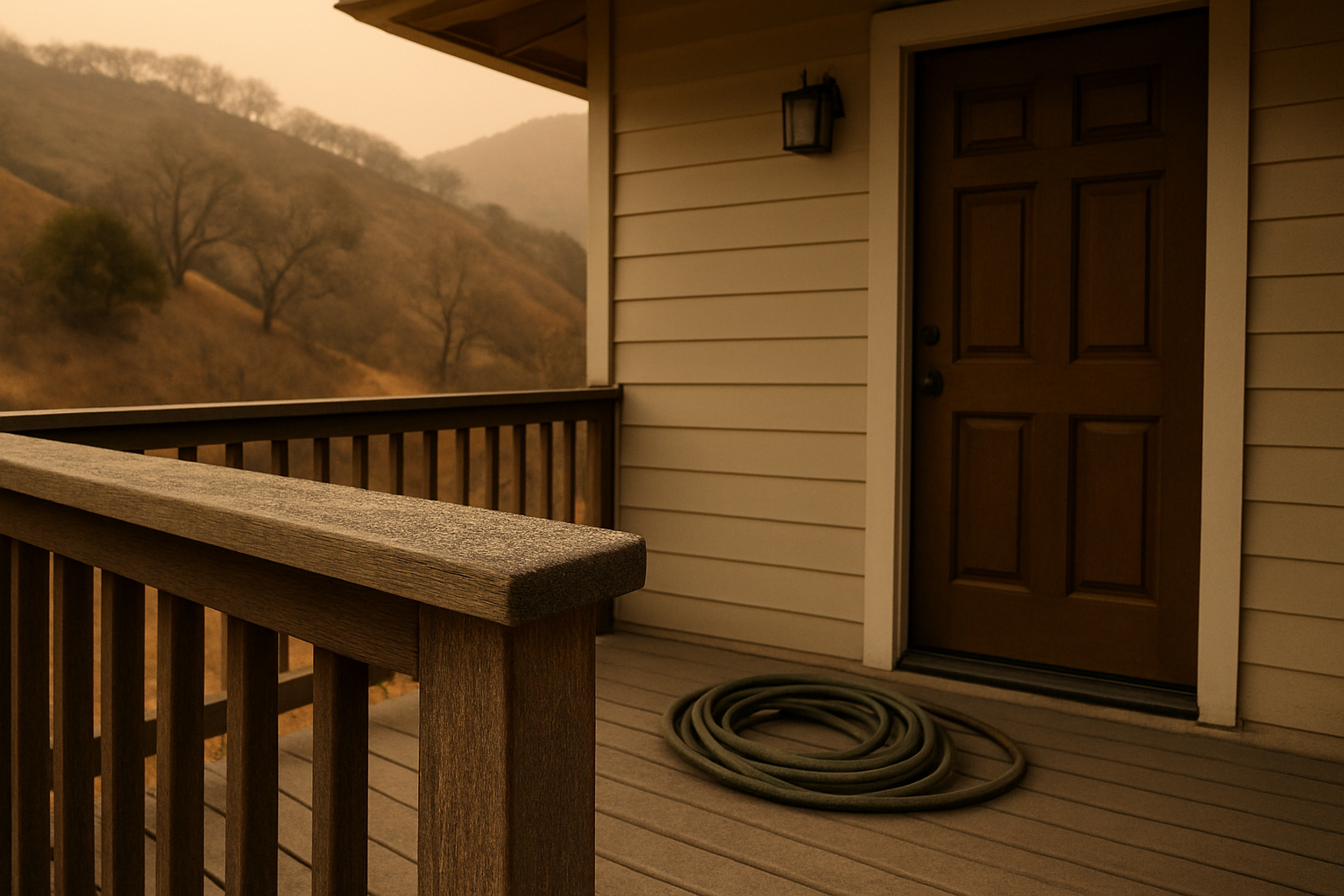
Evacuation Orders and Monterey County Rentals: Does Rent Still Get Paid?
The call I get in a situation like this is never about statutes. It is an owner in another state who just saw a mandatory evacuation order for the neighborhood where their rental sits, somewhere off Carmel Valley Road or out in the Salinas Valley, and they want two answers fast.
Is rent still owed while nobody can live there? And when the order lifts, who pays to clean the place up?
As of January 1, 2026, California answers both of those questions directly. I am going to give you the plain answer first, then walk through the conditions around it, the cleanup duty that costs owners real money, and the paper file that decides how your insurance claim goes.
The Plain Answer on SB 610 California Landlord Disaster Obligations
SB 610 was signed in October 2025 and took effect January 1, 2026. It added Civil Code sections 1941.8 and 1941.9.
Here is what it does in practical terms:
- Rent and other fees are suspended for the period a mandatory government evacuation order is in place for the rental.
- If the unit becomes uninhabitable, prepaid rent must be returned to the tenant within 10 calendar days.
- Disaster cleanup is the landlord's responsibility, not the tenant's.
- A tenant who returns comes back at the same rent they were paying before the disaster.
That last point surprises people. You may spend real money on remediation, and there is no rent bump available to recover it. That is a separate conversation from the normal rules covered in our guide on raising rent in 2026.
One more thing worth saying up front: this article answers a narrow question about evacuation and disaster duties. It is not a roundup of every 2026 rental law change, and it is not a winter prep checklist.
What Actually Triggers the Law (Owners Guess Wrong Here)
The main requirements do not switch on just because something bad happened to the house. They switch on when a disaster is tied to a declared state of emergency by the Governor or the President.
The covered events are broad: wildfire, flood, earthquake, and other emergencies that prompt a mandatory evacuation. The protections apply to residential rentals broadly, including single family homes.
That matters more here than it would in a big metro. Most of what owners rent out in Seaside, Marina, North Salinas, and Pacific Grove are single family homes, duplexes, or small buildings, not large complexes. There is no small landlord carve-out to hide behind.
So draw the line this way:
- A bad storm cracks a roof and water gets in. Ordinary habitability and repair rules apply. You fix it on a reasonable timeline and rent keeps running unless the unit is genuinely unlivable.
- A declared disaster hits and officials order a mandatory evacuation. SB 610 rules apply. Rent is suspended for that period and the cleanup duty shifts to you.
If you are not sure which bucket you are in, the test is simple: was there a state or federal emergency declaration, and was there a mandatory evacuation order for that area.
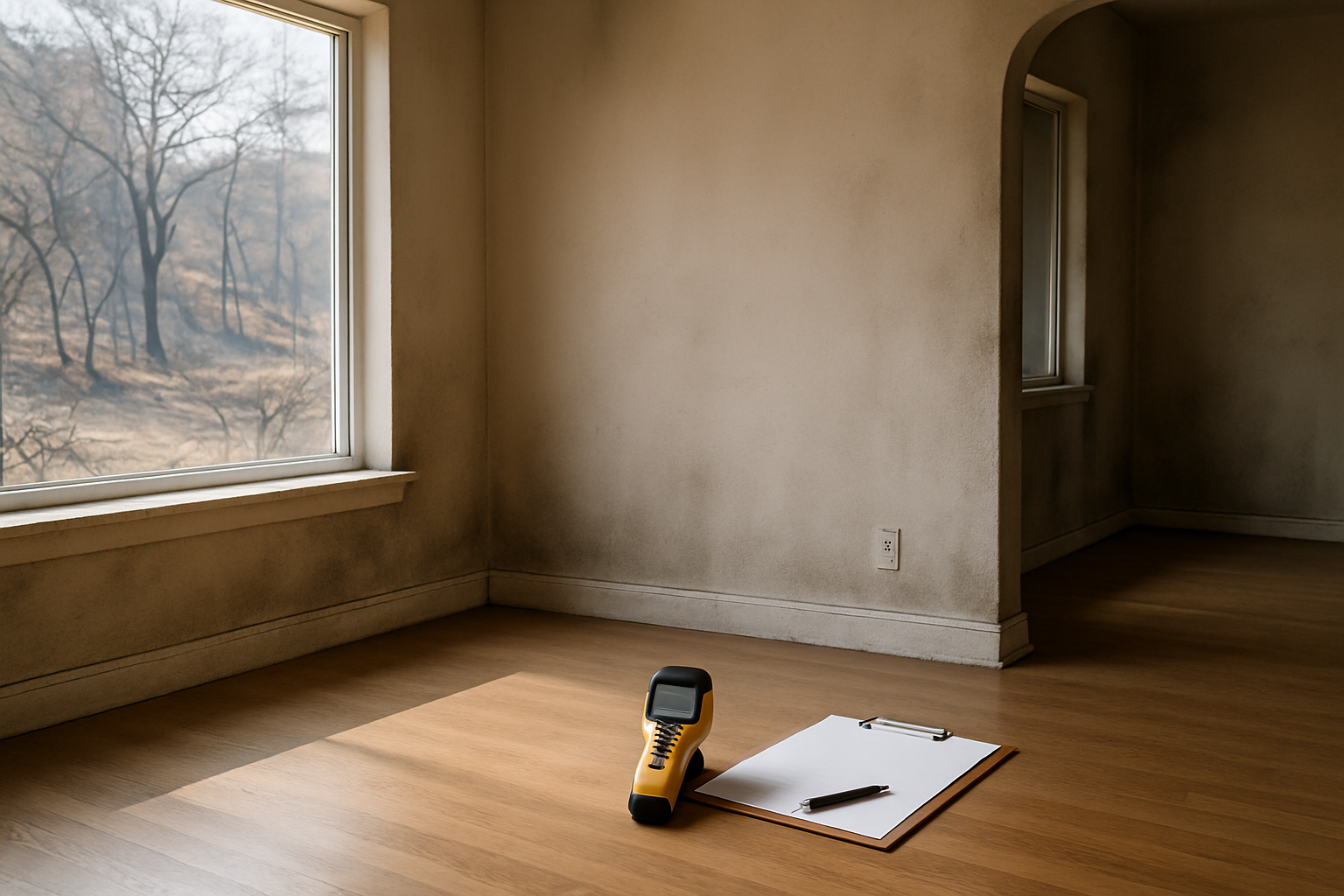
Debris and Remediation: The Part That Costs Owners Money
This is the provision I would read twice if I owned a rental anywhere near a fire footprint or a flood-prone creek.
SB 610 puts disaster cleanup on the landlord. That includes more than the visible mess:
- Ash and soot
- Smoke residue and lingering odor
- Mold
- Asbestos disturbed by the event
- Water damage caused by the disaster
The presence of that debris creates a legal presumption that the unit is uninhabitable. The presumption holds until a local public health agency or official determines no toxic substances are present.
Read that again, because it is the trap. You cannot sweep up, run a fan for a weekend, and hand back the keys. A legal aid fact sheet on SB 610 confirms the removal and mitigation duty and also notes the law does not spell out exactly which cleaning or remediation services are required.
What is expected of you in practice:
- Use licensed remediation contractors, not a general handyman with a shop vac.
- Follow any government cleaning protocols issued after the event.
- Notify the tenant in writing once remediation is finished.
Remediation pricing swings widely depending on square footage, how deep the smoke or water got, and whether testing flags asbestos. I will not pretend there is a standard number. But smoke and mold work on a Monterey Peninsula home routinely runs into the thousands, and how much of it your policy covers depends on your coverage and your documentation.
Storm Damage vs Declared Disaster: How the Rules Differ
Owners mix these two up constantly. Here is the short version side by side.
| Situation | What happens to rent | Who handles the cleanup |
|---|---|---|
| Winter storm damages a roof, no emergency declaration | Rent continues unless the unit is truly unlivable; standard repair duties apply | Owner handles the repair on a reasonable timeline |
| Declared disaster plus mandatory evacuation order | Rent and other fees suspended for the period of the order | Owner, including ash, smoke, mold, asbestos, and disaster water damage |
| Unit left uninhabitable after the order lifts | Prepaid rent returned to the tenant within 10 calendar days | Owner, using licensed remediation and any official cleaning protocols |
| Tenant returns after remediation is finished | Same rent as before the disaster | Owner provides written notice that remediation is complete |
The Owner's Documentation File
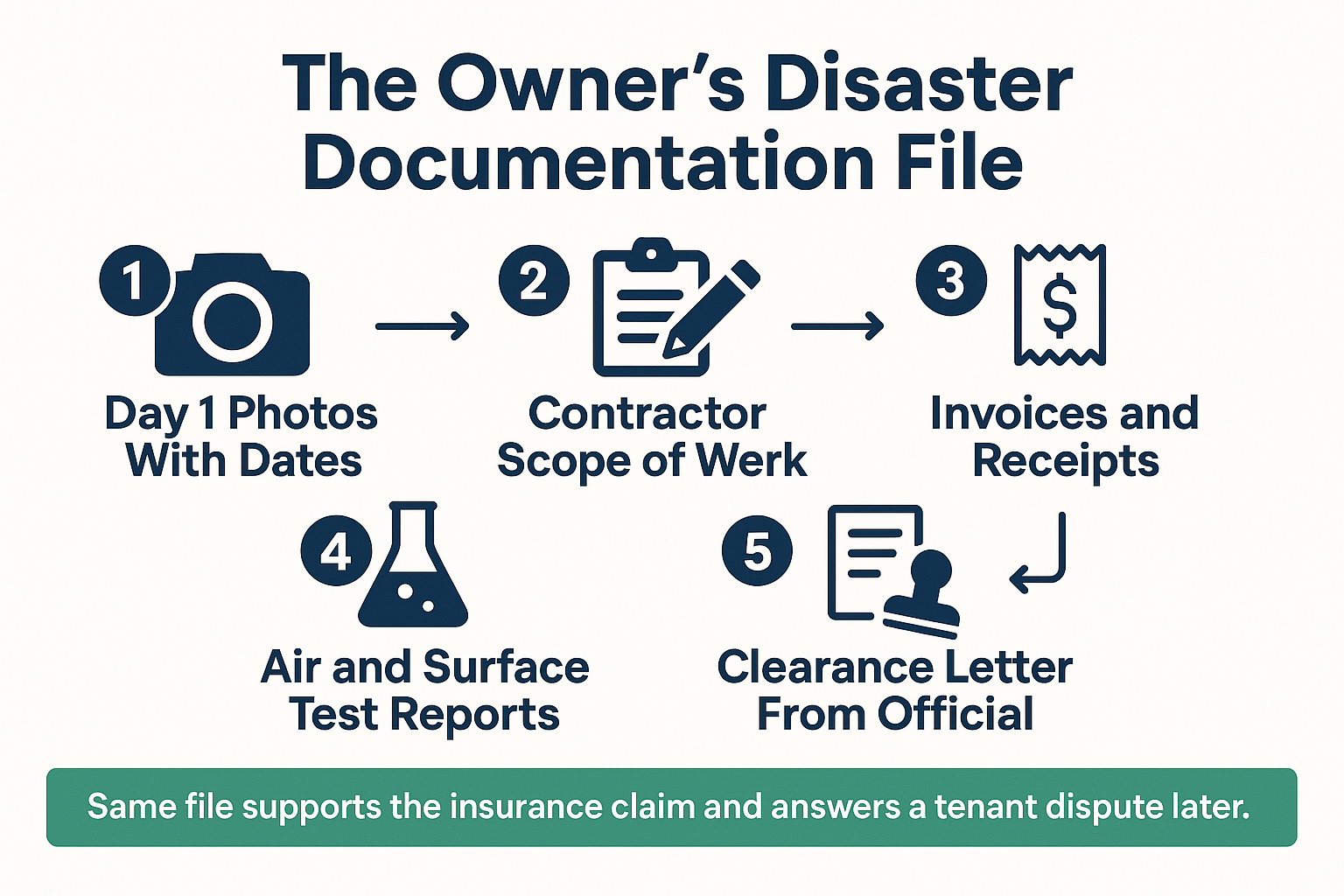
When an adjuster or a tenant dispute shows up months later, your file is the whole argument. This is what belongs in it.
What You Should Physically Keep, and Why Remote Owners Lose Here
Adjusters and remediation companies move on documentation. They do not move on an owner's memory of what the house looked like.
Keep all of this in one place:
- Photos with dates from the day damage is found, wide shots and close-ups
- The contractor's written scope of work
- Every invoice for cleaning, remediation, and repairs
- Any environmental or air and surface testing reports
- The clearance letter or official determination once the property is cleared
Here is the hard part. Insurance-related repair coordination normally lives or dies in the first 48 hours, and an owner who is 300 or 3,000 miles away rarely has anyone on the ground taking timestamped photos in that window.
I have watched that gap cost people real money. By the time someone gets out to a Prunedale or Soledad rental two weeks later, the before-and-after comparison is gone and so is the leverage.
This is the same structural problem I wrote about in our guide on how out-of-area owners actually manage a Monterey Bay rental. Distance does not change your legal duties. It only changes how fast you can meet them.
The Local Risk Picture and the October Through February Window
I am not going to talk you into worrying. But the numbers are public and they are worth knowing.
Publicly available 30-year risk models flag a majority of Monterey County homes for some level of wildfire exposure, and roughly 8 percent of properties for severe flood exposure. The Peninsula's winter pattern of atmospheric river storms produces the water intrusion and drainage problems that turn into mold claims months after the rain stopped.
The useful response is preventive, and it is not complicated:
- Gutter and drainage checks before winter, not after the first big storm
- A documented photo record of the property's normal condition, so you have a before picture that exists before anything goes wrong
- Current tenant contact information, including a phone number that reaches them if they evacuate
- A written plan for who calls whom when an order drops, and who has keys
Think of October through February as the window when this preparation actually gets used. That is also when our super El Niño winter readiness guide matters most, and when the habitability standards covered in our 2026 lease and habitability breakdown get tested for real.
Frequently Asked Questions About SB 610 and Evacuation Orders
If rent is suspended, do I still owe the mortgage?
Yes. SB 610 suspends the tenant's rent obligation, not yours to your lender. Many landlord policies include loss of rent coverage, but whether it applies to an evacuation period depends entirely on your policy language. Call your carrier and your loan servicer early rather than after a missed payment.
Can I ask my tenant to clean up the ash and smoke smell?
No. The law puts disaster debris removal and hazard mitigation on the landlord, and the presence of that debris is presumed to make the unit uninhabitable until a local public health agency or official says no toxic substances are present. Handing a tenant a mop is not an option.
Does this apply to a single rental house, or only apartment buildings?
It applies to residential rentals broadly, including single family homes. For most Monterey County owners, that is the whole point, since so much of the rental stock here is houses, duplexes, and small buildings.
Can I raise the rent afterward to recover remediation costs?
Not on a returning tenant. They come back at the same rent they were paying before the disaster. Any future increase has to follow the normal state and local rules on timing and amount, and has nothing to do with what you spent on cleanup.
What if my tenant decides not to come back?
Then you are into normal end-of-tenancy territory, including deposit accounting under California's current rules. Just be careful not to charge a tenant for damage the disaster caused. That is not deductible from a deposit, and our 2026 security deposit guide covers what you can actually withhold.
Questions About Your Own Property in Monterey County?
The real value of a local manager in a situation like this is simple: someone who can be at the property, coordinate licensed vendors, and document the condition while you are out of the area, which is exactly what owners of second homes on the Peninsula and out-of-state owners of Salinas rentals cannot do themselves. Our team already handles storm damage response, water intrusion inspections, and insurance-related repair coordination, and our quarterly inspection reports are photo-documented, so a before picture exists before anything goes wrong. One owner put it this way in a review: "Whenever maintenance issues came up, their coordination and follow-through were timely and effective." If you want to talk through how this applies to your property, we can be reached at (831) 582-8916 or through the contact form at torrenteproperties.com.

Security Deposits in 2026: What Monterey Bay Landlords Can Collect Now
The question I still get most often about deposits comes from owners renting a place furnished. They assume a furnished unit lets them ask for more money up front, because for decades in California it did.
That changed on July 1, 2024. And it caught a lot of Monterey Peninsula owners off guard, because furnished rentals are common here. In the last stretch alone I have talked with owners about a Marina studio they wanted to rent furnished while away, a fully furnished Monterey condo, and a partially furnished house up in Prunedale.
Below I walk through what you can actually collect in 2026, the one narrow exception that survives, and the rule that quietly cancels that exception for a big share of tenants in Monterey, Seaside, and Marina.
The 2026 rule: one month's rent, furnished or not
Before mid-2024, California allowed up to two months' rent for an unfurnished unit and three months' rent for a furnished one. That gave owners of furnished homes a real cushion.
AB 12 replaced all of that with a single limit: one month's rent, regardless of whether the place comes with furniture. You can read the bill history on the California Legislature's official AB 12 page, which amended Civil Code 1950.5 and set the July 1, 2024 effective date.
So a furnished townhouse in Monterey and an empty three-bedroom in Salinas now sit under the exact same ceiling. The furniture, the appliances, the linens, the flat screen: none of it buys you extra deposit room.
What that actually means for owners renting furnished:
- The first month's rent is still collected separately and does not count toward the cap
- Your protection against damage to furnishings is the same as an unfurnished rental
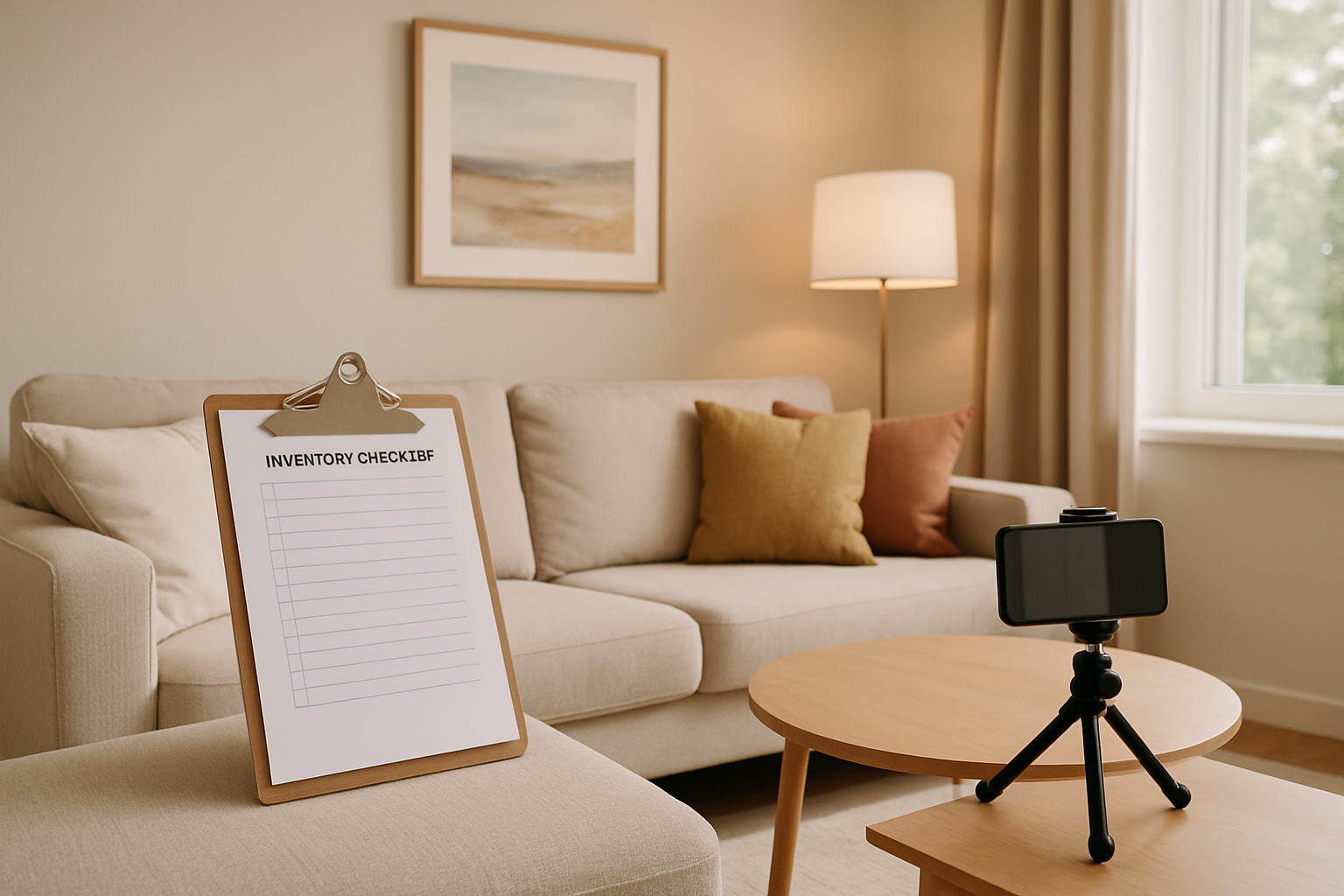
- A detailed furnishings inventory with photos does more for you now than deposit math ever did
- Higher-end furnished placements lean harder on screening than on cash held
If you are weighing furnished versus unfurnished at all, I have covered the trade-offs in more detail in our guide to renting your home furnished in the Monterey Bay area.
What the cap looks like in real Monterey County dollars
The math is where this stops feeling abstract. Consumer rent indices have reported average rents somewhere in the neighborhood of $2,750 in Monterey and around $2,595 in Salinas, with Santa Cruz running higher. Treat those as general market context, not a quote on your property.
Run your own rent figure through the old rules and the new ones. A furnished unit renting near that Monterey average could once support a three-month deposit. Today it supports one.
That is a swing of several thousand dollars in up front protection on a single door. On a Salinas duplex where both sides turn in the same year, the gap compounds.
I am not sharing that to alarm anyone. I am sharing it because owners who still budget for the old cushion tend to under-invest in the two things that now carry the weight: screening depth and move-in condition records.
Before and after July 1, 2024
Here is the shift in plain terms. The rent column is illustrative market context only, not a pricing quote.
| Scenario | Old limit (before 7/1/2024) | Limit in 2026 |
|---|---|---|
| Unfurnished 3-bedroom, Salinas | Up to 2 months' rent | 1 month's rent |
| Furnished condo, Monterey | Up to 3 months' rent | 1 month's rent |
| Furnished studio, Marina | Up to 3 months' rent | 1 month's rent |
| Qualifying small owner, non-service-member tenant | Up to 2 or 3 months' rent | Up to 2 months' rent |
| Any owner, service member tenant | Up to 2 or 3 months' rent | 1 month's rent, no exception |
The small landlord exception, and where owners get it wrong
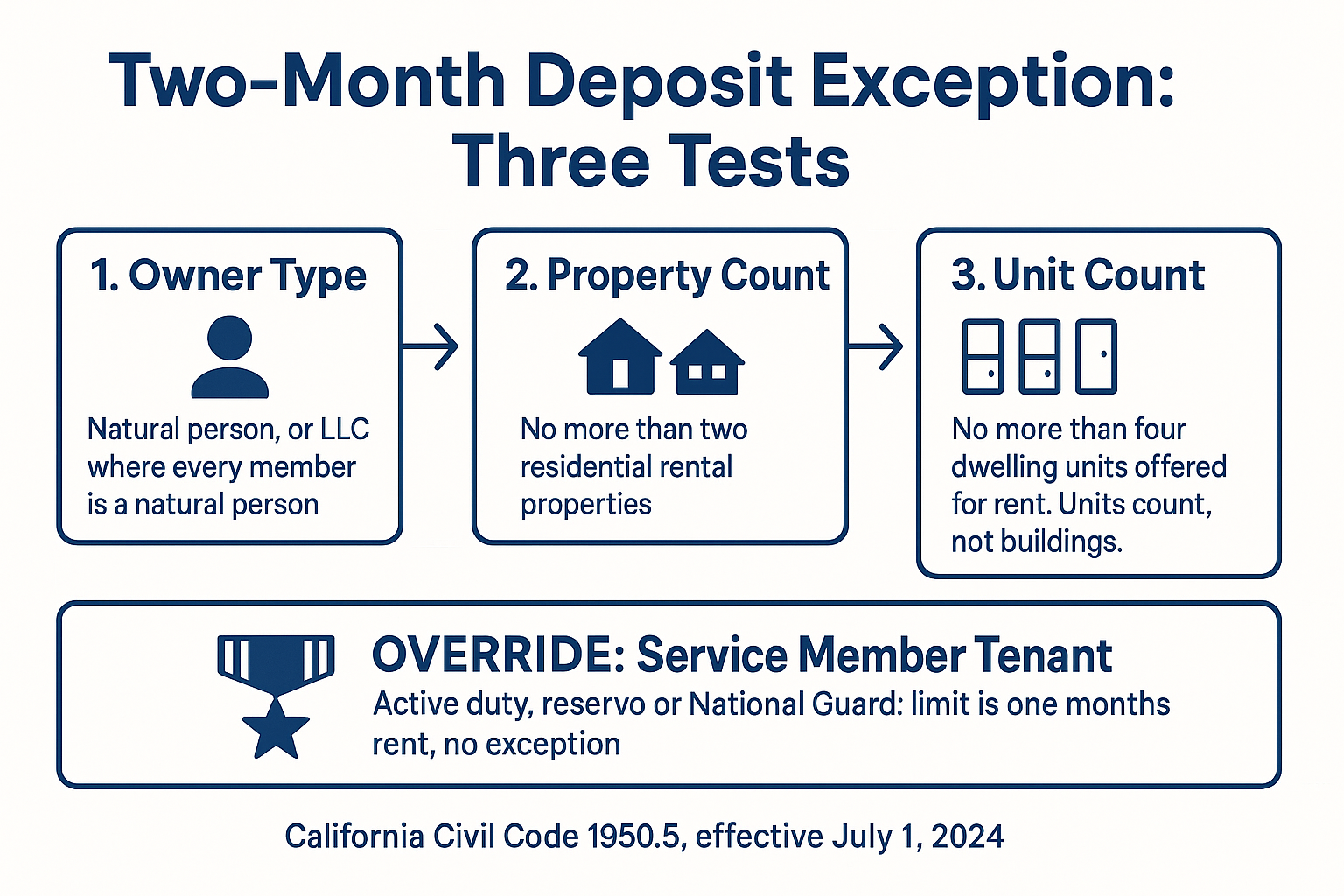
A two-month allowance does survive, but only for a narrow group. Every one of these conditions has to be true:
- The owner is a natural person, or an LLC in which every member is a natural person
- The owner owns no more than two residential rental properties
- Those properties collectively include no more than four dwelling units offered for rent
The unit count is the part that trips people up. Units count, not buildings. An owner with a duplex plus a triplex has five units and does not qualify, even though that is only two properties.
This lands hard in Monterey County because so many local properties are a house plus a guest house, or a house plus a carriage suite. One owner wrote in about three homes with carriage suites down in Greenfield, which fails the two-property test outright. Another asked about a Prunedale house and a studio separated by a breezeway, and that is exactly the setup where counting units decides the answer.
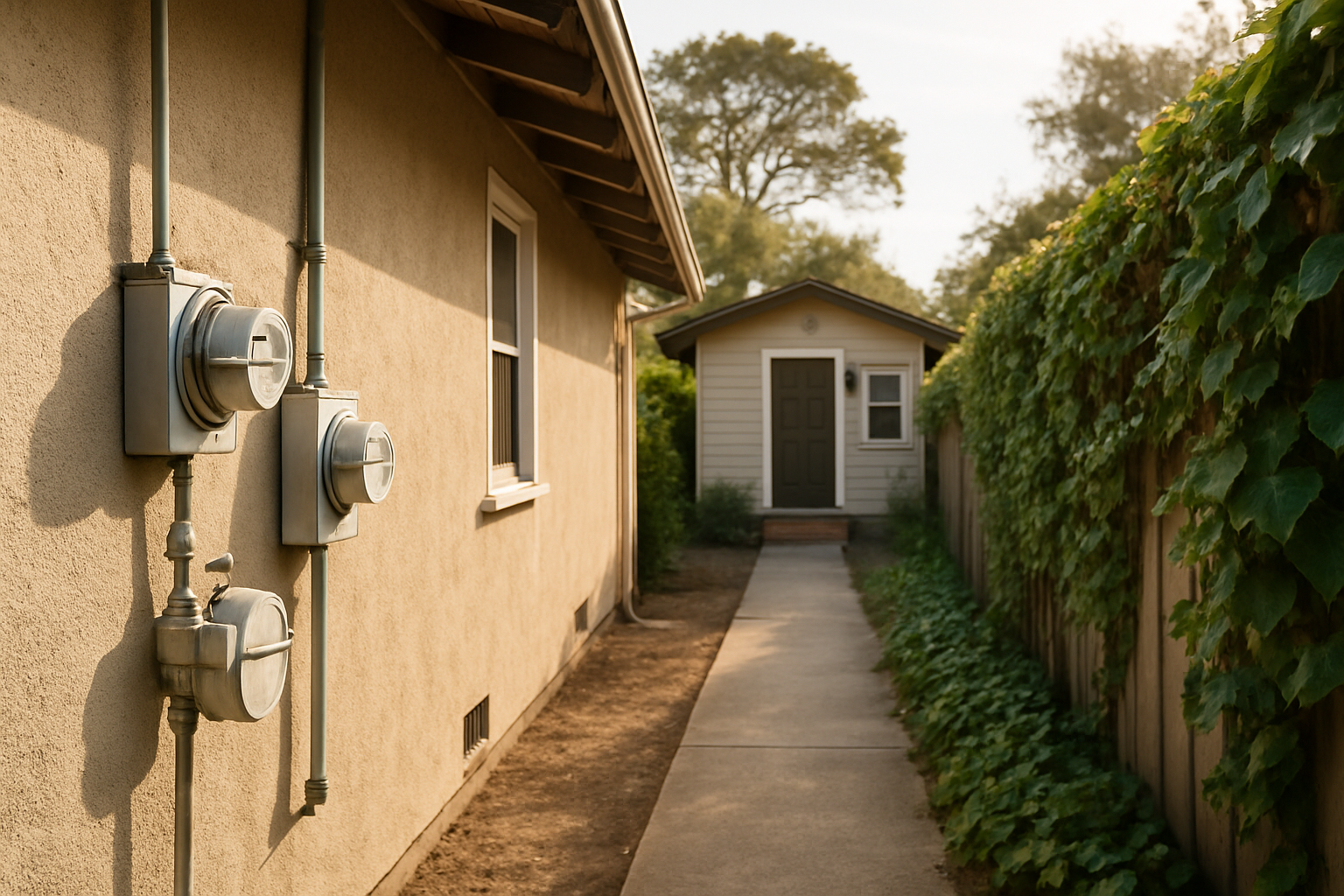
If your second unit shares utilities with the main house, there are separate headaches worth understanding too. We covered those in your guest house shares one meter with the main house.
Do you qualify for the two-month exception?
This walks through the three tests in order, in the sequence I actually check them.
The service member rule that overrides everything
This is the single most relevant wrinkle in our market, and plenty of owners have never heard it.
The two-month exception never applies when the prospective tenant is a service member. That includes active duty, reserve, and National Guard. An owner also may not refuse to rent to a service member because of that limit.
Now think about who fills the tenant pool here. Between the Naval Postgraduate School, the Defense Language Institute, and the Presidio of Monterey, a large share of applicants in Monterey, Seaside, and Marina are service members or connected to them.
So many owners who technically qualify for the exception will never actually get to use it. One Monterey condo owner told me plainly they wanted a long term tenant or a student from the Naval Postgraduate School, which is about as typical a peninsula preference as you will hear. If that is your target renter, plan your numbers around one month's rent and move on.
You cannot rebuild the cushion by renaming it
The second most common mistake I see is stacking charges. California defines a security deposit broadly: essentially any payment beyond the first month's rent that secures the tenant's performance under the lease.
That means all of these count toward the same cap:
- Pet deposits
- Cleaning deposits
- Key or remote deposits
- Last month's rent collected up front
Lease language calling any part of a deposit non-refundable is not enforceable in California. Writing it in anyway does not help you and can hurt you in a dispute.
So for a Salinas or Seaside owner hoping to piece the old cushion back together under different labels: it does not work. What does work is documenting condition well enough that legitimate deductions hold up, which I get into in our breakdown of deposit deductions after move-out.
What about tenants who have been in place for years?
This describes a real slice of local owners. The cap applies to deposits collected on or after July 1, 2024.
A larger deposit that was lawfully collected before that date does not have to be partially refunded in the middle of an ongoing tenancy. But when that tenant leaves and you sign someone new, the new tenancy falls squarely under the current rule.
Renewals and material lease changes are the gray zone. That is a conversation worth having with a real estate attorney rather than guessing.
And this is not a hypothetical scenario around here. One Seaside owner reached out about tenants who had been renting for four years, and a Monterey owner had main house tenants move out after 31 years. Old deposits and old paperwork are still sitting in file drawers all over this county.
A smaller cushion changes the rest of the job
One month's rent does not stretch far when unpaid rent and real damage show up together. I have seen a single turnover eat the whole deposit on carpet and paint alone, before you get to anything else.
So the work shifts upstream. Three things carry more weight than they did three years ago:
- Screening depth. Credit, nationwide criminal background, eviction history, and verified income and employment, every time
- Condition documentation at move-in. Room by room, with dated photos and a signed checklist
- Move-out records. Photos and vendor invoices that match specific line items
Owners who call me usually ask about fees first and screening second. I understand why, but the screening side is what protects the money now. If you want to see what a real process looks like, we laid it out in what a real tenant screening process looks like.
Frequently Asked Questions About CA Security Deposit Law in 2026
Can I charge more for a furnished rental in Monterey?
No. Since July 1, 2024, furnished and unfurnished units share the same one month's rent cap. The old three-month allowance for furnished rentals is gone.
Does the first month's rent count toward the deposit cap?
No. The first month's rent is collected separately. Almost everything else you collect up front, including pet deposits, cleaning deposits and last month's rent, does count toward the cap.
I own a duplex and a triplex. Do I qualify for the two-month exception?
No. That is five dwelling units, and the exception tops out at four units across no more than two properties. Units are what get counted, not buildings, which surprises a lot of owners with a main house plus a guest unit.
What if my tenant is stationed at the Presidio or attending DLI?
Then the two-month exception does not apply, even if you otherwise qualify. Service members, including reserve and National Guard, are limited to a one month's rent deposit, and you cannot decline to rent to them because of that.
Do I have to refund part of an older, larger deposit?
Not for a deposit lawfully collected before July 1, 2024 during an ongoing tenancy. A new tenancy after that tenant moves out follows the current one-month rule. Renewals and material lease changes are nuanced enough that I would run them by a real estate attorney.
Can I write in the lease that the cleaning deposit is non-refundable?
You can write it, but it will not hold up. California does not allow non-refundable security deposits. Deductions have to be tied to documented, legitimate costs at move-out.
Want a second set of eyes on your deposit paperwork?
Our team has spent more than 25 years working Monterey County rentals under owner-broker Aurelia Torrente, and we handle screening, lease drafting and deposit accounting in both English and Spanish, which matters in the Salinas and Monterey markets. One longtime owner client put it simply in her review: "It's refreshing knowing we have that piece of mind..." (Hilda M.). If you have questions about how the current cap applies to your property, we are reachable at (831) 582-8916 or through the contact form at torrenteproperties.com.
Before You Close on a Monterey County Rental: What Buyers Should Check
Most people call me after they close. The purchase price is set, the loan is funded, and only then does someone ask what the place will actually rent for.
So I paid attention when an owner reached out and said, in plain words, that he planned to buy an investment property in Monterey County and wanted a relationship with a property manager before doing it. That is the right order. Almost every question in this article is cheap to answer during escrow and expensive to answer after.
This is a due diligence piece for buyers. Not a lecture on cap rates, and not a rent-versus-sell debate. Just the checks I would want done on a Salinas, Seaside, or Pacific Grove property before the contingencies come off.
Get a rent number for the actual address, not the county average
The single most common mistake I see in buying a rental property in Monterey County is underwriting with a countywide rent figure. Consumer rent indices have generally put average rents in Monterey and Salinas somewhere in the mid to high $2,000s, with Santa Cruz running noticeably higher. Those are averages across very different housing stock.
A 2 bedroom in North Salinas and a 2 bedroom in Seaside do not behave the same way. Different tenant pools, different commute patterns, different vacancy rhythms, different price ceilings.
Run the math on what a miss costs you:
- A rent estimate that is off by $250 a month is $3,000 a year
- Over a five year hold, that is $15,000 of income you already spent on the buy side
- It also changes your reserve budget, your loan comfort, and your willingness to hold through a soft stretch
For purchase-side context, Redfin reported a median home sale price of about $873,000 in Monterey County in March 2026, down roughly 2.5 percent year over year, with homes going in about 28 days compared to 46 days a year earlier. Faster market, slightly softer prices. That combination means less time to think during escrow, which is exactly why I would rather talk to a buyer before an offer than after.
Ask someone who leases in that specific neighborhood every month what the unit will actually rent for, and what condition it has to be in to get there.
The rules follow the address, and the city line matters more than buyers expect
In this county, two similar houses eight miles apart can carry completely different obligations. Buyers routinely miss this because the listing does not mention it.
A few that come up constantly:
- Salinas runs a residential rental registration program with annual registration and fees. That obligation transfers with the property on day one. If the seller was registered, you inherit the file. If the seller was not, you inherit the cleanup. My guide to what the Salinas rental registration program requires right now walks through the current process.
- City of Monterey prohibits rentals of under 30 days, and the county has been tightening enforcement on short term rentals generally. If anyone is showing you nightly income projections on a Monterey property, rework the entire underwriting around a long term lease before you go further.
- Santa Cruz has its own rental inspection requirements. For buyers looking north of the county line, that is a real operating difference, not a formality.
I would confirm the jurisdiction on the parcel itself during escrow, not from the listing. Unincorporated pockets near Prunedale and Corral de Tierra sit outside city rules but come with their own septic, water, and access questions.
This is a phone call and an hour of reading. After closing, it becomes a compliance problem with a deadline attached.
What rides along with the address
Here is how I frame the jurisdiction question for buyers comparing properties in different cities.
| Where the property sits | What comes with it | Ask during escrow |
|---|---|---|
| Salinas | Residential rental registration program with annual registration and fees | Is the property currently registered, and what is the renewal date? |
| City of Monterey | Rentals under 30 days are prohibited; long term lease income only | Has any income here been generated by short term stays? |
| Santa Cruz | Local rental inspection requirements | When was the last inspection and were any items cited? |
| Unincorporated county (Prunedale, Corral de Tierra area) | Septic, well or water district service, private road access | Pump records, water source, and who maintains the road |
| Any building with 3 or more units | SB 721 and AB 2579 exterior elevated element inspections | Copy of the completed inspection report and any repair records |
If it is a duplex, fourplex, or small apartment building, ask for paper
Small multifamily is where I see the biggest gap between what a buyer assumes and what actually transfers. Ask for documents, not descriptions.
The list I would send to the seller's agent:
- The exterior elevated element inspection report. Under SB 721 and AB 2579, buildings with three or more units have inspection requirements for balconies, decks, stairs, and walkways. Those deadlines have already passed. A missing report becomes your problem the day you take title, along with any repairs it would have flagged.
- The current rent roll with actual lease start dates. Not a summary. Real dates, because they drive rent increase timing and renewal notices.
- Deposit amounts actually held, and written confirmation those funds transfer at closing.
- Any AB 1482 exemption notices that were or were not served to tenants. A missing notice changes what you can do with rent later.
- Copies of every current lease, including any side agreements about parking, storage, or utilities.
One more that surprises buyers: if the building includes deed-restricted affordable units, income certification and ongoing compliance documentation come with it. We have had Marina developers describe exactly that setup. It is manageable, but it is a real administrative job and it has to be priced into your plan. If small multifamily is new to you, what new multifamily owners in Marina need to know covers the operating side.
The escrow checklist I would run
This is the order I would work through the questions while contingencies are still in place.
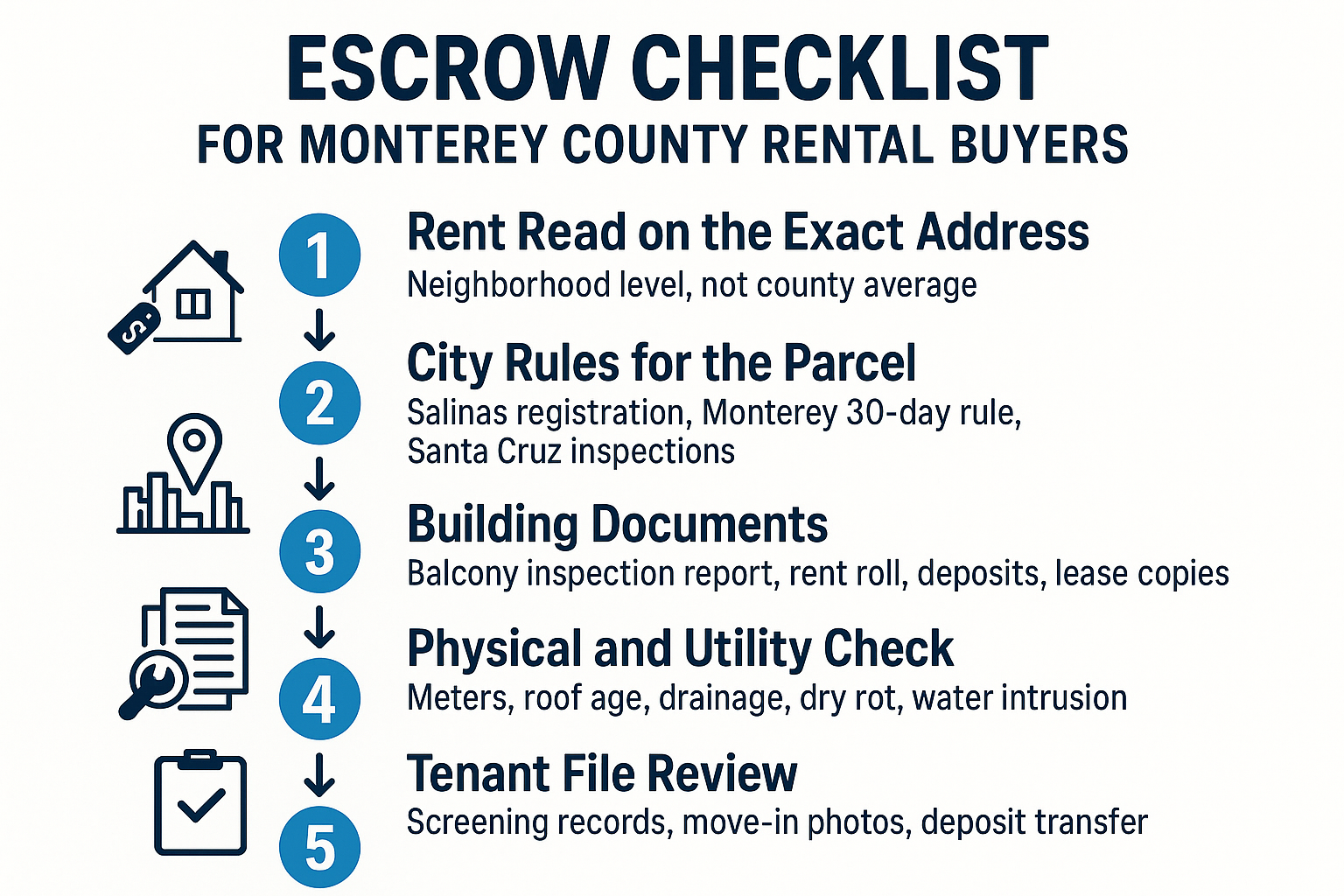
The physical questions a walkthrough usually skips
Coastal buildings age differently than inland ones. On the Peninsula, water intrusion and deferred exterior maintenance are the two repairs that most often turn a good first year into a break even one.
Before removing contingencies, I would confirm:
- Meter configuration. Older Monterey and Pacific Grove properties often have a main house and a back unit sharing a single PG&E and Cal Am meter. One longtime owner told me he split the bill two thirds and one third by hand for decades.
- Water service and irrigation. Who pays, how it is billed, and whether the sprinkler system actually works.
- Roof age and gutter condition, with an eye on the first real storm of the season.
- Drainage and grading, especially anywhere water runs toward the foundation.
- Dry rot exposure on trim, decks, stairs, and window frames.
That shared meter arrangement is legal to inherit, but it shapes how the lease has to be written and what you can reasonably charge. It is much easier to price into your offer than to renegotiate with a tenant later.
If the property has been sitting vacant, add a real look at plumbing and the water heater. Our pre-rain check list for Monterey Bay properties covers what I look at on the exterior heading into winter, and most of it applies just as well during a buyer walkthrough.
Deposit rules changed the risk math, and 2026 added more
California capped security deposits at generally one month's rent effective July 1, 2024. For a buyer, that matters more than it sounds. The financial cushion against damage is thinner than it used to be.
That pushes the weight onto three things: screening quality, documented move-in condition, and photo records. All of which happen before a tenant ever hands you a problem.
If you are inheriting existing tenants, ask:
- What screening was done, and does any record of it still exist?
- Were deposits actually collected, and are they being transferred at closing?
- Does any move-in condition documentation exist, with photos and dates?
If the answer is a shrug, that tells you something useful about how the property has been run. It is not automatically a deal killer, but it means your first six months will include rebuilding a paper trail.
You also take on the 2026 law changes the moment you close. Industry summaries of the 2026 California rental law changes cover AB 628 appliance habitability requirements, AB 414 rules on electronic security deposit returns, and AB 747 upfront fee disclosure in advertising. Our breakdown of what AB 628 changed for California landlords goes deeper on the habitability side.
Frequently Asked Questions About Buying a Rental in Monterey County
Should I talk to a property manager before I make an offer?
Yes, and it costs you nothing. A rent read on the specific address, a note on city rules, and a quick opinion on condition are all things worth knowing before the price is locked in.
Can I buy a Monterey property and rent it out short term?
The City of Monterey prohibits rentals under 30 days, and county enforcement on short term rentals has been tightening. If a seller or agent is showing nightly income figures, rebuild the numbers around a long term lease before you go any further.
The seller says the balcony inspection was done but cannot find the report. Is that a problem?
It can be. For buildings with three or more units, SB 721 and AB 2579 inspection deadlines have already passed, and a missing report becomes the new owner's obligation. I would ask for the actual document in writing during escrow rather than accepting a verbal assurance.
What if the tenants come with the building and I do not like the leases?
You generally step into those leases as written. That is why the rent roll, actual lease start dates, and any AB 1482 exemption notices matter so much during due diligence. Once you close, changing terms is slow and rule-bound.
How much should I budget for management?
Fees vary by property type, unit count, and scope of service, so the honest answer is that it depends on the building. Our overview of what property management actually costs in the Monterey Bay area explains what drives the number, and we are glad to give a straight quote on a specific address.
Thinking about a property in Monterey County?
Aurelia Torrente is a licensed California broker, DRE #01335107, and an Accredited Residential Manager with more than 25 years in Monterey County, so a buyer can get a realistic rent read on a specific address from the same person who would later manage it. Our team works across Monterey, Salinas, Seaside, Marina, Pacific Grove, Carmel, and Pebble Beach, and we hold a 5-star Google rating from owners and tenants. As one owner put it, "They have all the qualities of someone we can trust with our properties." If you want to talk through a property you are considering, we are available at (831) 582-8916 or through torrenteproperties.com.

Deposit Deductions After Move-Out: What Monterey Bay Owners Must Document
The tenant hands back the keys. The carpet has a stain in the hallway, two blinds are cracked, and the oven has not been cleaned since the day they moved in. You add it up, subtract it from the deposit, and mail a check.
Then the letter arrives. The tenant is disputing every line, and now you are trying to prove damage you never photographed to a judge who has never seen the house.
I have watched this play out with owners across Salinas, Seaside, and Marina, and the pattern is almost always the same. The charges were fair. The paper trail was not. Since California tightened both the deposit limit and the photo rules, that gap costs owners real money.
The One Month Deposit Cap Changed the Math on Every Deduction
For most tenancies starting on or after July 1, 2024, California generally caps the security deposit at one month's rent. There is a narrow carve-out for some small owners who hold only a couple of residential properties, and separate treatment for service members, so confirm where your situation falls before you collect.
Here is why that matters for move-out. As general market context, asking rents around Salinas have been running in the low to mid $2,000s, and Monterey often sits closer to the high $2,000s. Numbers move, so treat those as a rough frame, not a quote.
So the cushion behind a rough move-out is roughly one month of rent, and nothing more.
That one number has to absorb:
- Unpaid rent or fees left on the ledger
- Cleaning back to the condition at move-in
- Repair of damage beyond ordinary wear
- Restoration of personal property named in the lease
When a tenant leaves owing three weeks of rent and a damaged slider, the deposit runs out fast. And any deduction you cannot support on paper is money you simply do not get back. The smaller the deposit, the more weight every piece of documentation carries.
The Three Sets of Photos California Now Expects
This is where I see self-managing owners get caught more than anywhere else. California now generally expects photo documentation at three separate points, and the images travel with the itemized statement.
- Before move-in. The unit's condition at the start of the tenancy. This applies to tenancies that began after mid-2025.
- After the tenant leaves, before any work starts. Not after the cleaner has been through. Before.
- After the repairs and cleaning are finished. This shows what the charge actually paid for.
Skipping a set does not just make a claim weaker. It can cost you the right to take the deduction at all.
My working standard for our own files, which any owner can copy:
- Dated wide shots of every room, including closets, the garage, and the exterior
- Close-ups of anything you intend to charge for, taken from two distances so the location is obvious
- Stored somewhere you can actually retrieve them eight months later, not buried in a phone that gets replaced
One more piece worth knowing. Cleaning charges are generally limited to returning the unit to the level of cleanliness it had at the start of the tenancy. You cannot bill a tenant to make a place cleaner than you gave it to them, which is exactly what the move-in photo set proves.
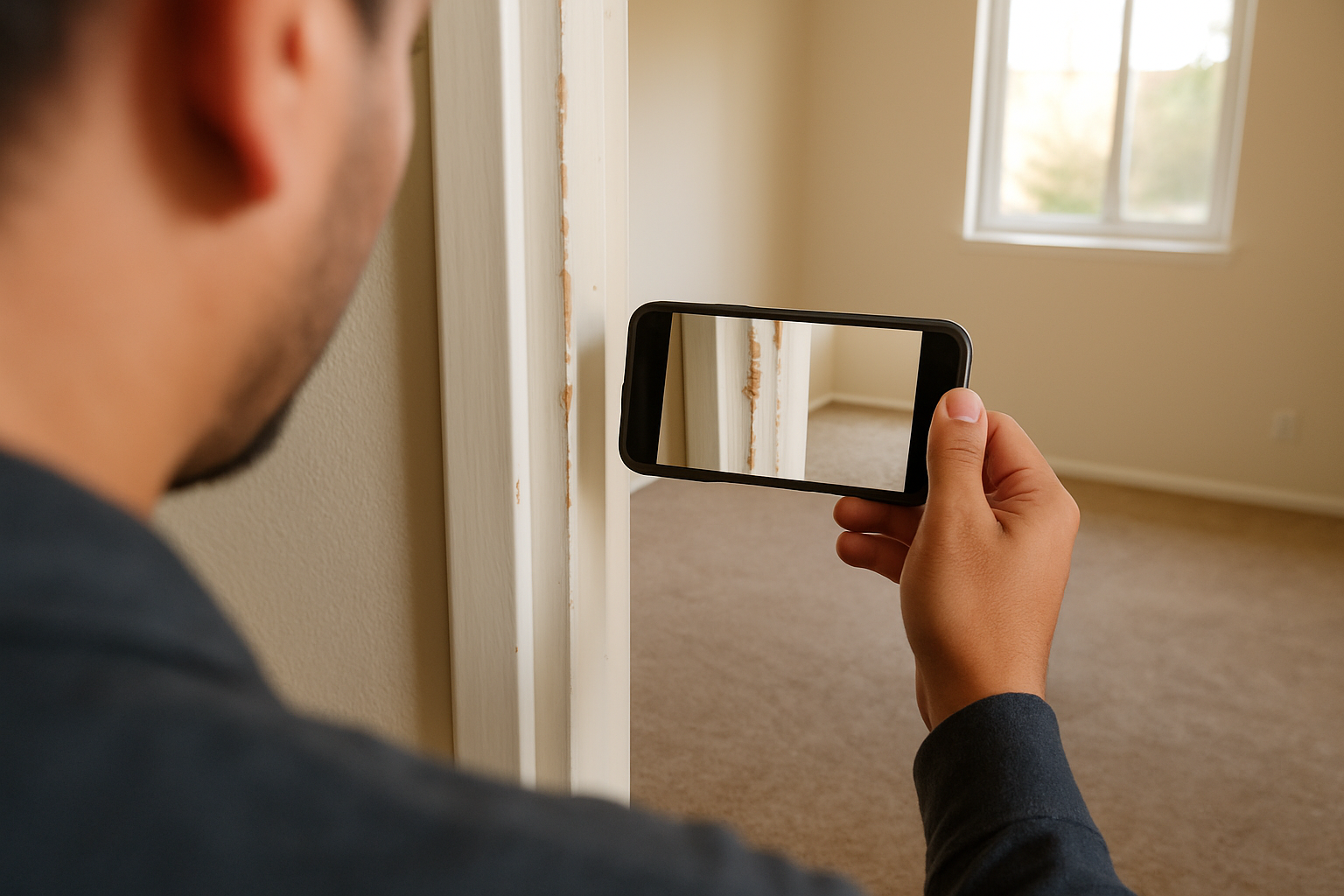
The Pre-Move-Out Walkthrough Feels Risky and Protects You Anyway
Owners push back on this one constantly. Telling the tenant they can request an inspection before they leave feels like handing over leverage.
Here is the trade-off, honestly. When a tenant is told of that right and asks for the inspection, items you fail to note at that walkthrough generally cannot be charged against the deposit later. The usual exception is anything hidden behind the tenant's belongings at the time.
But look at what the walkthrough actually buys you:
- You see the unit with time left on the lease instead of after the truck is gone
- The tenant gets a written list and often fixes half of it themselves
- The remaining charges arrive with no surprise, which is what most disputes are really about
In small claims, an owner who did the walkthrough and documented it is in a completely different position than one who did not. I would rather lose a $90 charge I missed than lose a $1,400 claim because the tenant told a judge nobody ever mentioned a problem.
Then comes the hard deadline. Within 21 calendar days of the tenant giving up possession, you generally owe an itemized statement of deductions, the remaining balance, and copies of receipts or invoices for the work. If your own labor did the work, describe it and the reasonable value. Miss the window and you can lose the ability to keep any of it.
Ordinary Wear or Chargeable Damage on the Monterey Peninsula
The line I give owners is simple. Ordinary aging from coastal exposure and normal living sits with you. Broken, missing, filthy, or clearly abused sits with the tenant. Here is how that plays out on the kinds of items we see most often around the Bay.
| Condition at move-out | Usually the owner's cost | Usually chargeable to the tenant |
|---|---|---|
| Exterior paint chalking and fading | Salt air and fog exposure in Pacific Grove, Seaside, and Marina | Paint damaged by a tenant's own alterations or mounted hardware |
| Window tracks and door hardware | Corrosion and stiffness from coastal air over several years | Cranks snapped off, screens torn, locks broken |
| Bathroom mildew | Surface mildew in a poorly ventilated bath during winter storm season | Long-term buildup where the fan was never used and it was never reported |
| Carpet | Traffic-lane wear on carpet nearing the end of its useful life | Burns, pet stains, tears, or a single ruined section |
| Walls | Small nail holes, scuffs behind furniture | Large anchor holes, crayon, unapproved paint colors |
| Appliances | A unit that failed from age | A cooktop caked in grease or a fridge left with spoiled food |
Why Coastal Wear Trips Up Owners Here Specifically
Properties three blocks from the water in Pacific Grove or Marina age differently than a house off Boronda Road in Salinas. Salt air and near-daily fog work on exterior paint, window tracks, hinges, and light fixtures at a pace inland owners never deal with.
I have seen owners try to charge a departing tenant for pitted hardware and sun-bleached trim that were quietly failing for six years. A judge is not going to call that tenant damage.
Winter is the other flashpoint. Storm season brings moisture, condensation, and mildew questions, and the honest answer usually depends on whether the tenant reported it and whether the property had working ventilation and drainage. If the gutters were never cleaned before the first big rain, that outcome belongs to the owner.
The depreciation point catches people too. A five year old carpet cannot be billed as new. Flooring, paint, and blinds all have a useful life, and a deduction has to reflect the remaining value, not the replacement invoice. Charging full price for a worn item is one of the fastest ways to lose an otherwise solid claim.
The Move-Out Paper Trail, Step by Step
This is the sequence I follow on every unit turn, from the walkthrough offer through the final statement.
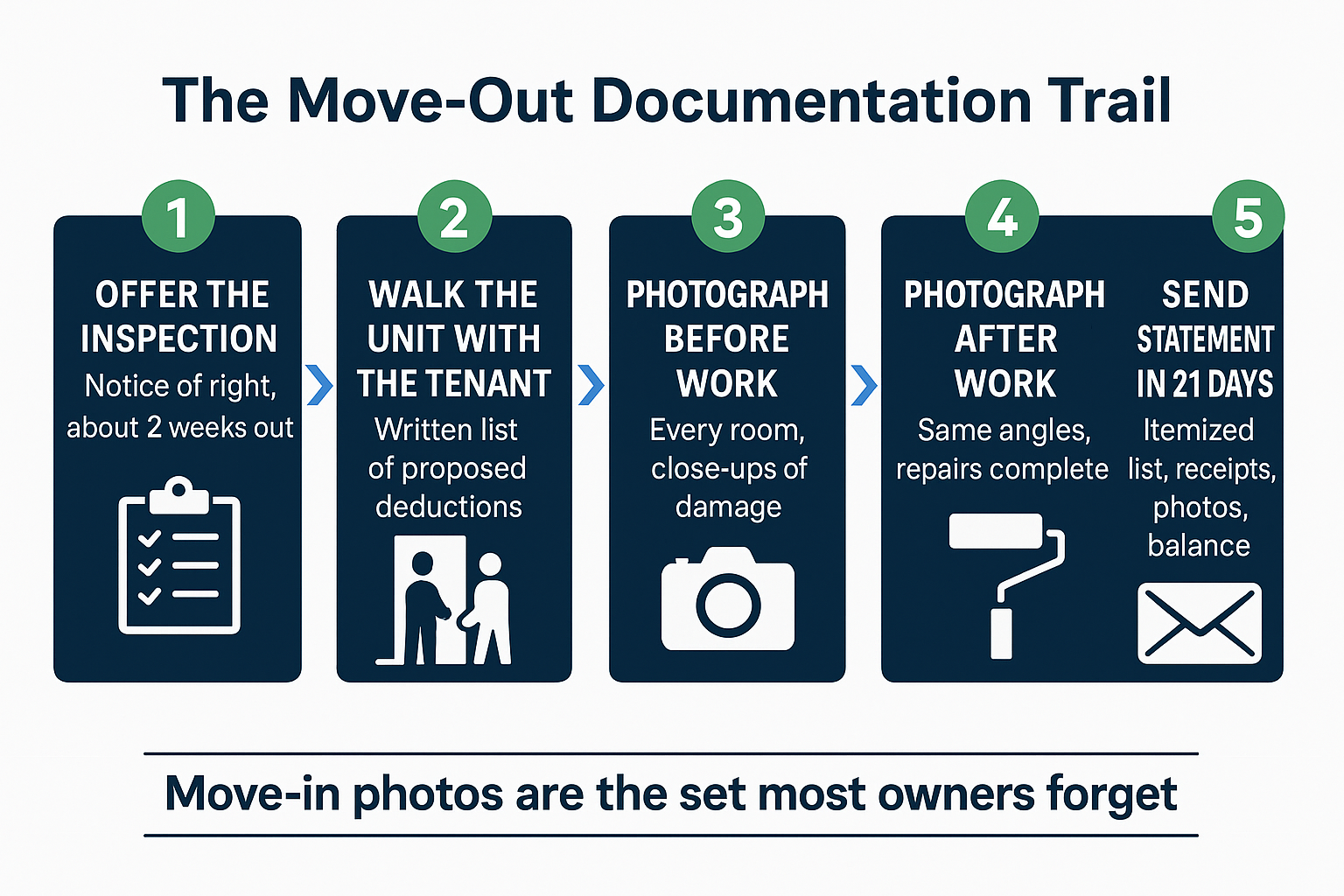
What Changes January 1, 2026 for Returning the Balance
If you are an owner in Texas or Arizona handling a Salinas rental by mail, pay attention to this one. It is a workflow change, not a footnote.
Starting January 1, 2026, under updates summarized in the California Apartment Association's 2026 compliance guidance, the rules around returning a deposit shift:
- If the tenant paid rent or the deposit electronically, the remaining balance generally has to be offered back electronically
- The tenant has to be told about that right
- The itemized statement can travel by email when that is the tenant's stated preference
- When several adults share one lease, the owner has to ask how the refund should be split and how it should be delivered
That last one is the trap for houses rented to roommates or two working adults. Mailing one check to one name at a forwarding address you guessed at is how a clean move-out turns back into an argument.
Set the question up front. I ask about refund delivery at the same time I collect the forwarding address, and I put the answer in writing.
If You Have Been Self-Managing Without a Condition Report
One owner in North Salinas described his situation to me in a single sentence: he has a single family home he has been self managing for over two years.
That is an extremely common position around here, and it usually means the same three things. No move-in photo set. No signed condition report. No vendor invoices, because the work was done by a friend or by the owner on a weekend.
When move-out comes, that deduction rests on your memory against the tenant's memory. That is not a fight worth having over $600.
The fix does not start at move-out. It starts at the next renewal or the next routine inspection:
- Do a documented interior and exterior walkthrough now, dated and photographed, and share the report with the tenant
- Get a signed acknowledgment of current condition attached to the renewal
- Move all repairs to licensed vendors who issue invoices, even small ones
- Log every maintenance request and every response with dates
- Confirm smoke and carbon monoxide detectors at the same visit, since compliance questions surface at move-out too
You cannot recreate move-in condition. But you can establish a clear condition line from today forward, and everything after that line is documentable. Owners who are managing a Salinas house from out of the area benefit most from getting this in place early.
The Cost Owners Never Price In
Move-out disputes are the most common source of angry landlord reviews in this market. Not usually because the charges were made up.
It is because the tenant never received receipts or a plain explanation, so the story they tell online becomes "they charged for everything they could."
In a rental market where your next applicant reads reviews before they ever tour the property, that story has a price. It shows up as longer vacancy and a thinner applicant pool the next time you list, which affects how you can price the unit.
A deduction delivered with photos, invoices, and a short explanation of each line protects two things at once. The money, and the listing. I have never seen a tenant leave a bad review over a charge they could see the evidence for.
Frequently Asked Questions About Security Deposit Deductions in California
Can I charge the tenant for professional carpet cleaning?
Generally only if it is actually needed to return the carpet to the condition it was in at move-in. A blanket professional cleaning charge written into every lease does not hold up well anymore. If the carpet came back stained beyond normal use, document it with photos before the cleaner arrives and keep the invoice.
What happens if I miss the 21-day deadline?
It is serious. Missing the window can cost you the ability to keep any of the deposit, and courts have discretion to award additional damages where the retention was made in bad faith. If you are waiting on a vendor invoice, send what you have with a good faith estimate and follow up, rather than letting the clock run out.
The tenant asked for a pre-move-out inspection. Do I have to do it?
Yes, once they request it after receiving notice of the right. And I would encourage it even if you dread the conversation. The inspection is the strongest defense you have if the deduction ends up in small claims.
I never took move-in photos on my current tenant. What now?
Start where you are. Do a documented inspection at the next renewal with the tenant present, photograph everything, and get a signed acknowledgment of condition. You will not recover the original baseline, but you will have a defensible line going forward, and that is a lot better than memory.
Can I deduct unpaid rent from the deposit?
Yes, unpaid rent is one of the allowable deductions along with cleaning, repair of damage beyond ordinary wear, and restoration of personal property when the lease provides for it. Itemize it separately on the statement with the exact dates and amounts owed.
Does the deposit cap apply to a tenant who has been in the home since 2019?
The one month cap generally applies to tenancies starting on or after July 1, 2024, and there were transition provisions for existing tenancies. If you are holding more than one month's rent on a long-running tenancy, it is worth confirming your specific situation before the next renewal.
Building a Move-Out File That Holds Up
Our process on every unit we handle in Monterey County is the same: move-in and move-out inspections with photo documentation, itemized owner statements, and a walkthrough conducted in English or Spanish, which heads off a lot of move-out misunderstandings in Salinas and Monterey before they start. Aurelia Torrente is a licensed broker and Accredited Residential Manager with more than 25 years in this county, and our firm holds a 5-star Google rating. As one Seaside owner put it, "They have all the qualities of someone we can trust with our properties."
If you want to talk through how your own documentation stacks up before the next move-out, our team can be reached at (831) 582-8916 or through the contact form at torrenteproperties.com.
Inheriting a Rental Property in Monterey Bay: What Comes Next
Almost nobody plans to become a landlord this way. A parent passes, a house in Salinas or Seaside changes hands, and suddenly you are responsible for a property you may not have set foot in for years.
I have sat with a lot of families in this exact spot in Monterey County. The grief is real, the family conversations are complicated, and on top of all that, the house needs decisions made about it.
The good news is that most of what matters happens in the first 60 to 90 days. Below is how I would walk through it: who is living there, what the insurance company thinks about it, and what California expects from you once you take the keys.
First Question: Is Someone Already Living There?
If a tenant is in the home, you did not inherit a blank slate. You inherited an active lease, and California expects you to honor it.
That means the remaining lease term stays in place, the rent stays where it is until you follow the proper process to change it, and the tenant keeps every protection they already had. If the property qualifies under AB 1482, that includes rent cap limits and just cause rules for ending a tenancy under California Civil Code Section 1946.2.
This is where I see heirs get into trouble. Several owners have come to me after assuming they could simply ask a long-term tenant to move out so the house could be sold or remodeled.
Here is what actually needs to happen when you step into the landlord role:
- Find the lease. If there is no written lease, the tenancy is likely month to month, and that still carries protections.
- Track down the security deposit. You are responsible for it, even if you never received the money.
- Notify the tenant in writing of the ownership change and where rent goes now.
- Document the current condition of the unit with dated photos before anything changes.
- Get clear on rent history before you consider any increase. Our guide on raising rent in 2026 walks through the limits.
A tenant who has lived there four or five years under a handshake arrangement with your parent is common around here. That relationship deserves care, and it also deserves paperwork.
If the House Is Sitting Empty, Your Insurance Is the Clock
An empty inherited home feels like the safe option. It is usually the riskiest one.
Most standard homeowner policies contain a vacancy clause. After roughly 30 to 60 days with nobody living there and no documented oversight, an insurer can deny a claim for water damage, vandalism, or theft. That is a brutal thing to learn after a pipe lets go.
Call the insurance carrier early and tell them the truth about occupancy. You may need a vacant property endorsement, and the premium change is far cheaper than a denied claim.
The other thing empty houses do around here is quietly fall apart:
- Coastal moisture in Pacific Grove, Carmel, and Monterey feeds dry rot and mildew in closed-up rooms.
- Winter storms overload clogged gutters and find every soft spot in a roof.
- Water heaters and supply lines fail with nobody there to hear it.
- Landscaping and mail pileup advertise that the place is unoccupied.
This is why I push for scheduled, photo-documented inspections on any vacant home. Our seasonal maintenance program checks the exterior, plumbing, leak risk, water heater, and smoke and carbon monoxide detectors four times a year and sends the owner a report with photos.
Even if you never hire anyone, put your own inspection dates on a calendar and keep the photos. Documentation is what protects you with the insurance company.
Three Paths for an Inherited Monterey Bay Property
Every heir I work with ends up choosing one of three directions. Each has a different cost profile and a different set of obligations.
| Path | What It Requires | Main Risk to Watch |
|---|---|---|
| Rent it long term | Property prep, market pricing, screening, lease, ongoing maintenance and reporting | Under-screening the first tenant to fill the vacancy fast |
| Hold it vacant while the estate settles | Insurance review, documented inspections, utilities kept on, landscaping upkeep | Vacancy clause denials and unnoticed water damage |
| Prepare it for sale | Repairs, cleaning, landscaping, staging, and a realistic pricing analysis | Trying to remove a sitting tenant without following the legal process |
The First 90 Days, In Order
This is the sequence I recommend to heirs, and the order genuinely matters.
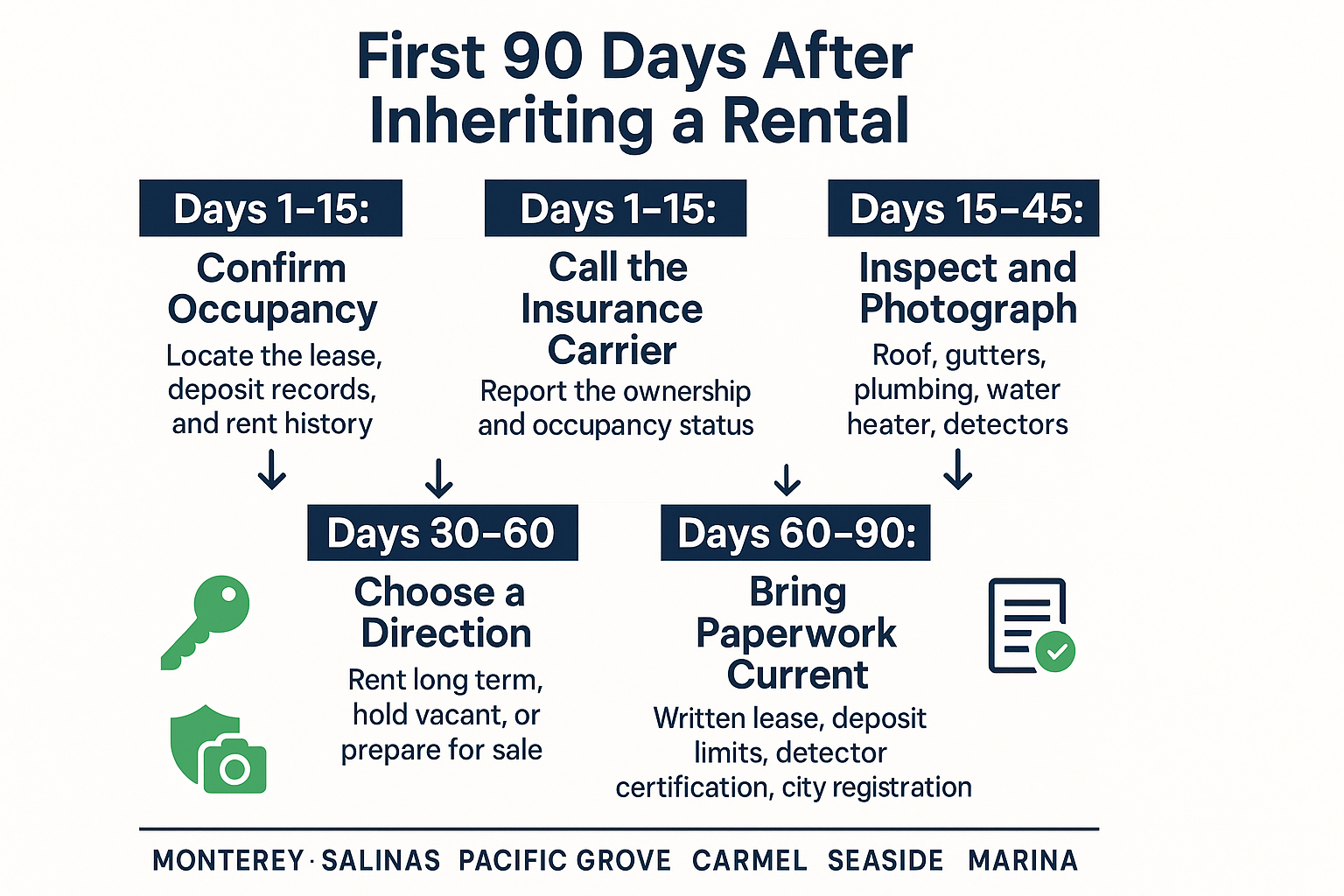
The Rules Changed Since Your Parent Was the Landlord
If you decide to rent, understand that the rulebook is not the one your parent used. Two changes matter most.
First, the security deposit. Since July 1, 2024, California caps residential security deposits at the equivalent of one month's rent for most owners, furnished or unfurnished.
That used to be two months. If you inherited a home full of your parent's furniture and good condition you want to protect, your cushion just got cut in half.
What replaces that cushion is process:
- Real screening. Credit, nationwide criminal background, eviction history, and verified income and employment. Our tenant screening walkthrough covers what a thorough process includes.
- Move-in documentation. Dated photos and video of every room, appliance, and surface before keys change hands.
- A written lease that spells out condition, maintenance responsibilities, and notice terms.
Second, compliance. A home your parent managed informally for thirty years often has gaps. Working smoke and carbon monoxide detectors are required. Cities have their own layers too, including the Salinas rental registration program and Monterey's rule against residential rentals under 30 days.
Deferred maintenance shows up here as well. Getting a house from "Dad kept it running" to a documented, legal rental is real work, and what actually has to happen before a rental goes live is worth reading before you list it.
When Siblings Own It Together
Shared ownership is where good intentions go sideways. Three heirs with three opinions about repairs, rent, and whether to sell will stall a property for months.
Settle a few things in writing early:
- One point of contact for decisions, vendors, and any manager you hire.
- A spending limit that one person can approve without a family meeting.
- How rent income and expenses get split and who handles the tax reporting.
- A timeline for revisiting the keep-or-sell question.
And if most of you live out of the area, plan for that reality. Many of the owners I work with are in Southern California, out of state, or overseas, which is exactly why how out-of-area owners manage a Monterey Bay rental is one of the questions I answer most.
Frequently Asked Questions About Inherited Rental Property in Monterey Bay
Can I ask the tenant to move out so I can sell the house?
Not casually. If the property falls under AB 1482, you need a legally recognized reason and proper written notice, and some reasons require relocation assistance. Selling a home with a tenant in place is often the cleaner path. Talk to a real estate attorney before you send any notice.
What if there is no written lease, just a verbal agreement my parent had?
That is still a tenancy, usually month to month, and the tenant still has full protections. The transition is a reasonable time to put a written lease in place going forward, but you cannot change the terms retroactively or without proper notice.
How long can the house sit empty before insurance becomes a problem?
Many policies start limiting coverage somewhere around 30 to 60 days of vacancy. The exact language varies by carrier, so read your policy and call your agent. Documented, scheduled inspections help, and a vacant property endorsement may be the right fix.
What does property management cost if I decide to rent it out?
Fees in Monterey County generally run as a percentage of collected rent, with a separate leasing fee when a new tenant is placed. The range depends on property type, unit count, and condition. We break the factors down in our cost guide, and we are happy to quote your specific property.
Do I really need to redo the smoke and carbon monoxide detectors?
Yes. California requires working smoke alarms and carbon monoxide detectors in rental homes, and this is one of the most common gaps I find in a house that has been owner-occupied for decades. It is inexpensive to fix and a serious liability if you skip it.
Thinking Through an Inherited Property in Monterey County?
If you are sorting out a home in Monterey, Salinas, Seaside, Marina, or anywhere on the Peninsula, we are glad to talk it through, in English or Spanish. Our team has worked with Monterey County families in this situation for more than 25 years, and sometimes the most useful thing is just a clear read on your options. You can reach us at (831) 582-8916 or through the contact form at torrenteproperties.com whenever you are ready.