
Direct Answer: California owners must send an itemized statement with receipts within 21 days of move-out, and back most deductions with photos taken before move-in, after move-out, and after repairs.
The tenant hands back the keys. The carpet has a stain in the hallway, two blinds are cracked, and the oven has not been cleaned since the day they moved in. You add it up, subtract it from the deposit, and mail a check.
Then the letter arrives. The tenant is disputing every line, and now you are trying to prove damage you never photographed to a judge who has never seen the house.
I have watched this play out with owners across Salinas, Seaside, and Marina, and the pattern is almost always the same. The charges were fair. The paper trail was not. Since California tightened both the deposit limit and the photo rules, that gap costs owners real money.
The One Month Deposit Cap Changed the Math on Every Deduction
For most tenancies starting on or after July 1, 2024, California generally caps the security deposit at one month’s rent. There is a narrow carve-out for some small owners who hold only a couple of residential properties, and separate treatment for service members, so confirm where your situation falls before you collect.
Here is why that matters for move-out. As general market context, asking rents around Salinas have been running in the low to mid $2,000s, and Monterey often sits closer to the high $2,000s. Numbers move, so treat those as a rough frame, not a quote.
So the cushion behind a rough move-out is roughly one month of rent, and nothing more.
That one number has to absorb:
- Unpaid rent or fees left on the ledger
- Cleaning back to the condition at move-in
- Repair of damage beyond ordinary wear
- Restoration of personal property named in the lease
When a tenant leaves owing three weeks of rent and a damaged slider, the deposit runs out fast. And any deduction you cannot support on paper is money you simply do not get back. The smaller the deposit, the more weight every piece of documentation carries.
The Three Sets of Photos California Now Expects
This is where I see self-managing owners get caught more than anywhere else. California now generally expects photo documentation at three separate points, and the images travel with the itemized statement.
- Before move-in. The unit’s condition at the start of the tenancy. This applies to tenancies that began after mid-2025.
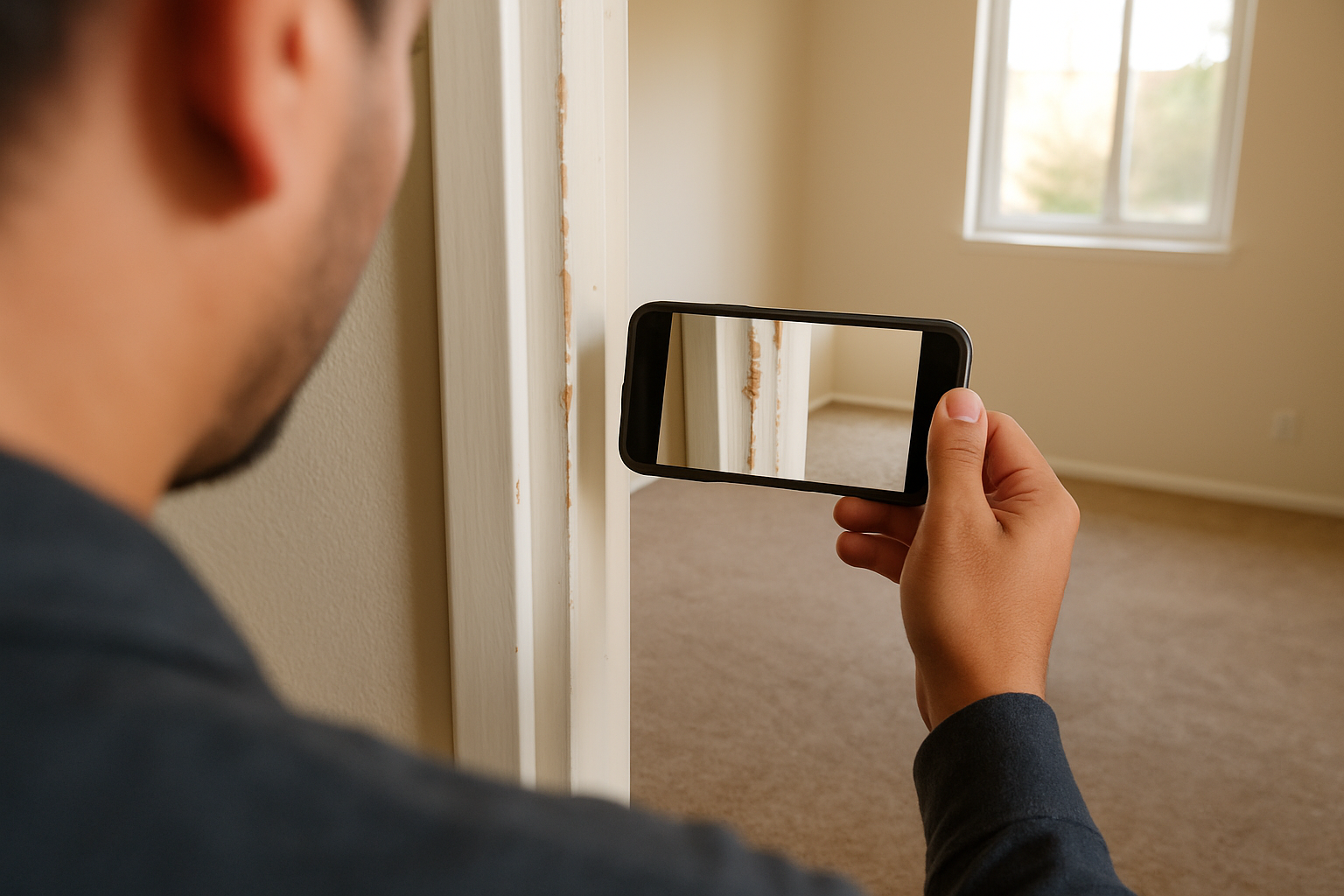
- After the tenant leaves, before any work starts. Not after the cleaner has been through. Before.
- After the repairs and cleaning are finished. This shows what the charge actually paid for.
Skipping a set does not just make a claim weaker. It can cost you the right to take the deduction at all.
My working standard for our own files, which any owner can copy:
- Dated wide shots of every room, including closets, the garage, and the exterior
- Close-ups of anything you intend to charge for, taken from two distances so the location is obvious
- Stored somewhere you can actually retrieve them eight months later, not buried in a phone that gets replaced
One more piece worth knowing. Cleaning charges are generally limited to returning the unit to the level of cleanliness it had at the start of the tenancy. You cannot bill a tenant to make a place cleaner than you gave it to them, which is exactly what the move-in photo set proves.
The Pre-Move-Out Walkthrough Feels Risky and Protects You Anyway
Owners push back on this one constantly. Telling the tenant they can request an inspection before they leave feels like handing over leverage.
Here is the trade-off, honestly. When a tenant is told of that right and asks for the inspection, items you fail to note at that walkthrough generally cannot be charged against the deposit later. The usual exception is anything hidden behind the tenant’s belongings at the time.
But look at what the walkthrough actually buys you:
- You see the unit with time left on the lease instead of after the truck is gone
- The tenant gets a written list and often fixes half of it themselves
- The remaining charges arrive with no surprise, which is what most disputes are really about
In small claims, an owner who did the walkthrough and documented it is in a completely different position than one who did not. I would rather lose a $90 charge I missed than lose a $1,400 claim because the tenant told a judge nobody ever mentioned a problem.
Then comes the hard deadline. Within 21 calendar days of the tenant giving up possession, you generally owe an itemized statement of deductions, the remaining balance, and copies of receipts or invoices for the work. If your own labor did the work, describe it and the reasonable value. Miss the window and you can lose the ability to keep any of it.
Ordinary Wear or Chargeable Damage on the Monterey Peninsula
The line I give owners is simple. Ordinary aging from coastal exposure and normal living sits with you. Broken, missing, filthy, or clearly abused sits with the tenant. Here is how that plays out on the kinds of items we see most often around the Bay.
| Condition at move-out | Usually the owner’s cost | Usually chargeable to the tenant |
|---|---|---|
| Exterior paint chalking and fading | Salt air and fog exposure in Pacific Grove, Seaside, and Marina | Paint damaged by a tenant’s own alterations or mounted hardware |
| Window tracks and door hardware | Corrosion and stiffness from coastal air over several years | Cranks snapped off, screens torn, locks broken |
| Bathroom mildew | Surface mildew in a poorly ventilated bath during winter storm season | Long-term buildup where the fan was never used and it was never reported |
| Carpet | Traffic-lane wear on carpet nearing the end of its useful life | Burns, pet stains, tears, or a single ruined section |
| Walls | Small nail holes, scuffs behind furniture | Large anchor holes, crayon, unapproved paint colors |
| Appliances | A unit that failed from age | A cooktop caked in grease or a fridge left with spoiled food |
Why Coastal Wear Trips Up Owners Here Specifically
Properties three blocks from the water in Pacific Grove or Marina age differently than a house off Boronda Road in Salinas. Salt air and near-daily fog work on exterior paint, window tracks, hinges, and light fixtures at a pace inland owners never deal with.
I have seen owners try to charge a departing tenant for pitted hardware and sun-bleached trim that were quietly failing for six years. A judge is not going to call that tenant damage.
Winter is the other flashpoint. Storm season brings moisture, condensation, and mildew questions, and the honest answer usually depends on whether the tenant reported it and whether the property had working ventilation and drainage. If the gutters were never cleaned before the first big rain, that outcome belongs to the owner.
The depreciation point catches people too. A five year old carpet cannot be billed as new. Flooring, paint, and blinds all have a useful life, and a deduction has to reflect the remaining value, not the replacement invoice. Charging full price for a worn item is one of the fastest ways to lose an otherwise solid claim.
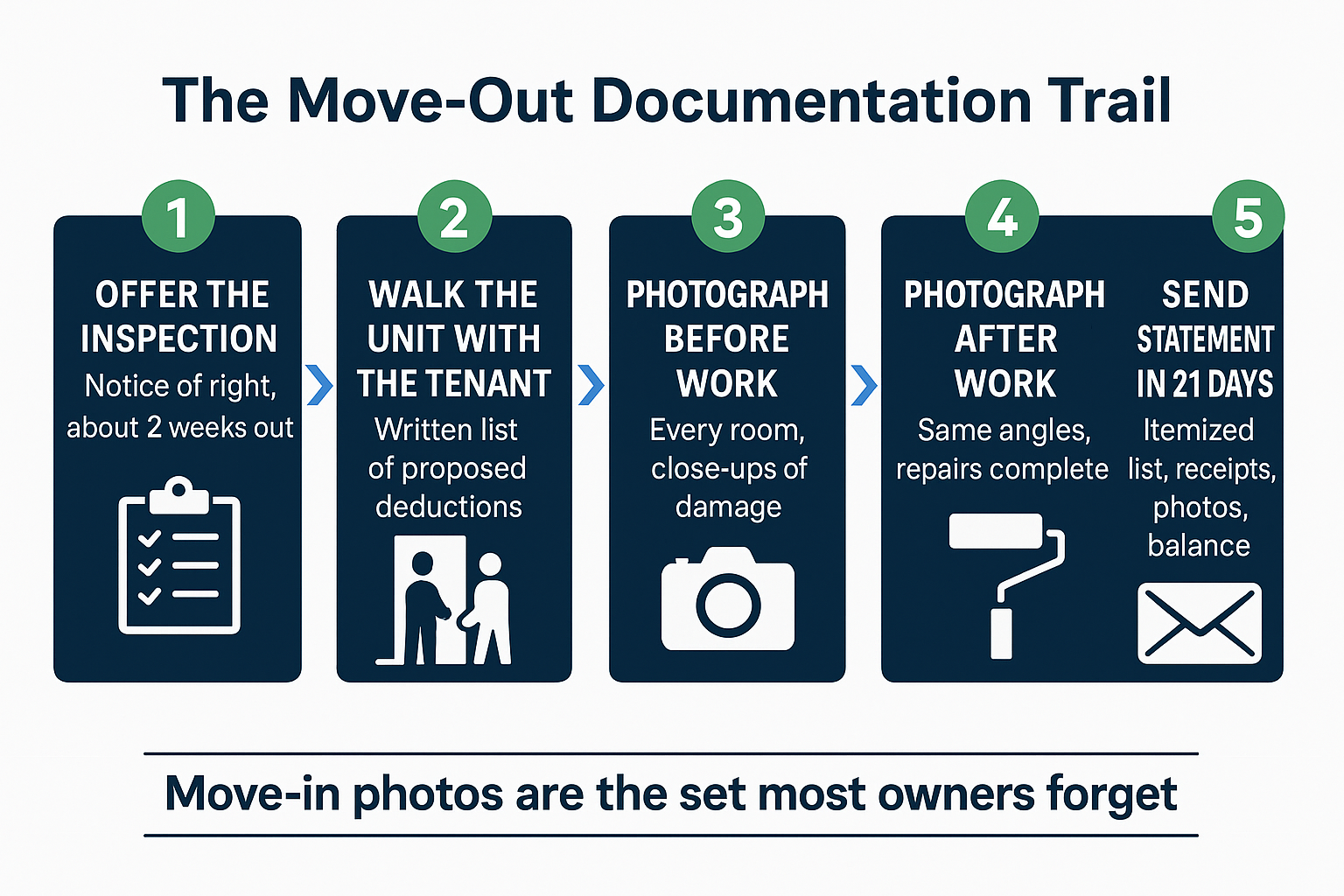
The Move-Out Paper Trail, Step by Step
This is the sequence I follow on every unit turn, from the walkthrough offer through the final statement.
What Changes January 1, 2026 for Returning the Balance
If you are an owner in Texas or Arizona handling a Salinas rental by mail, pay attention to this one. It is a workflow change, not a footnote.
Starting January 1, 2026, under updates summarized in the California Apartment Association’s 2026 compliance guidance, the rules around returning a deposit shift:
- If the tenant paid rent or the deposit electronically, the remaining balance generally has to be offered back electronically
- The tenant has to be told about that right
- The itemized statement can travel by email when that is the tenant’s stated preference
- When several adults share one lease, the owner has to ask how the refund should be split and how it should be delivered
That last one is the trap for houses rented to roommates or two working adults. Mailing one check to one name at a forwarding address you guessed at is how a clean move-out turns back into an argument.
Set the question up front. I ask about refund delivery at the same time I collect the forwarding address, and I put the answer in writing.
If You Have Been Self-Managing Without a Condition Report
One owner in North Salinas described his situation to me in a single sentence: he has a single family home he has been self managing for over two years.
That is an extremely common position around here, and it usually means the same three things. No move-in photo set. No signed condition report. No vendor invoices, because the work was done by a friend or by the owner on a weekend.
When move-out comes, that deduction rests on your memory against the tenant’s memory. That is not a fight worth having over $600.
The fix does not start at move-out. It starts at the next renewal or the next routine inspection:
- Do a documented interior and exterior walkthrough now, dated and photographed, and share the report with the tenant
- Get a signed acknowledgment of current condition attached to the renewal
- Move all repairs to licensed vendors who issue invoices, even small ones
- Log every maintenance request and every response with dates
- Confirm smoke and carbon monoxide detectors at the same visit, since compliance questions surface at move-out too
You cannot recreate move-in condition. But you can establish a clear condition line from today forward, and everything after that line is documentable. Owners who are managing a Salinas house from out of the area benefit most from getting this in place early.
The Cost Owners Never Price In
Move-out disputes are the most common source of angry landlord reviews in this market. Not usually because the charges were made up.
It is because the tenant never received receipts or a plain explanation, so the story they tell online becomes “they charged for everything they could.”
In a rental market where your next applicant reads reviews before they ever tour the property, that story has a price. It shows up as longer vacancy and a thinner applicant pool the next time you list, which affects how you can price the unit.
A deduction delivered with photos, invoices, and a short explanation of each line protects two things at once. The money, and the listing. I have never seen a tenant leave a bad review over a charge they could see the evidence for.
Frequently Asked Questions About Security Deposit Deductions in California
Can I charge the tenant for professional carpet cleaning?
Generally only if it is actually needed to return the carpet to the condition it was in at move-in. A blanket professional cleaning charge written into every lease does not hold up well anymore. If the carpet came back stained beyond normal use, document it with photos before the cleaner arrives and keep the invoice.
What happens if I miss the 21-day deadline?
It is serious. Missing the window can cost you the ability to keep any of the deposit, and courts have discretion to award additional damages where the retention was made in bad faith. If you are waiting on a vendor invoice, send what you have with a good faith estimate and follow up, rather than letting the clock run out.
The tenant asked for a pre-move-out inspection. Do I have to do it?
Yes, once they request it after receiving notice of the right. And I would encourage it even if you dread the conversation. The inspection is the strongest defense you have if the deduction ends up in small claims.
I never took move-in photos on my current tenant. What now?
Start where you are. Do a documented inspection at the next renewal with the tenant present, photograph everything, and get a signed acknowledgment of condition. You will not recover the original baseline, but you will have a defensible line going forward, and that is a lot better than memory.
Can I deduct unpaid rent from the deposit?
Yes, unpaid rent is one of the allowable deductions along with cleaning, repair of damage beyond ordinary wear, and restoration of personal property when the lease provides for it. Itemize it separately on the statement with the exact dates and amounts owed.
Does the deposit cap apply to a tenant who has been in the home since 2019?
The one month cap generally applies to tenancies starting on or after July 1, 2024, and there were transition provisions for existing tenancies. If you are holding more than one month’s rent on a long-running tenancy, it is worth confirming your specific situation before the next renewal.
Building a Move-Out File That Holds Up
Our process on every unit we handle in Monterey County is the same: move-in and move-out inspections with photo documentation, itemized owner statements, and a walkthrough conducted in English or Spanish, which heads off a lot of move-out misunderstandings in Salinas and Monterey before they start. Aurelia Torrente is a licensed broker and Accredited Residential Manager with more than 25 years in this county, and our firm holds a 5-star Google rating. As one Seaside owner put it, “They have all the qualities of someone we can trust with our properties.”
If you want to talk through how your own documentation stacks up before the next move-out, our team can be reached at (831) 582-8916 or through the contact form at torrenteproperties.com.