
Direct Answer: Walk the property in the order water travels: roof and flashing, gutters and downspouts, grading and drains, then crawlspace. Then check the building envelope for wind-driven rain damage. Do it by October.
Every fall I get the same call from owners across Monterey County. The first real storm hits, water shows up somewhere it should not be, and now everyone on the Peninsula is trying to book the same roofer at the same time.
The forecast is worth planning around this year. NOAA’s Climate Prediction Center is carrying an El Nino Advisory with a greater than 90% chance of a very strong event through fall and winter 2026-27, and roughly 97% odds the pattern holds into early spring 2027. On the Central Coast, that setup has historically meant a wetter season with a more active atmospheric river track.
We have written before about getting a Monterey Bay rental ready for a Super El Nino winter at a high level. This piece is different. This is the physical walkthrough itself, done in order, with what to look at first and why. You are protecting an asset that in Monterey County carries a median value somewhere around $781,000, and north of $1 million inside the city of Monterey.
Step 1: Start Where the Water Starts
Almost everything that fails here fails because of water and where it went. So walk the property the way rain does, from the top down.
Start at the roof surface. You are not climbing up unless you do that for a living, but you can see a lot from the ground with binoculars or from a second story window.
- Missing, lifted, or curled shingles, especially on the windward face
- Flashing at chimneys, skylights, and valleys, which is where most leaks actually begin
- Debris piles sitting in valleys or behind chimneys
- Sagging or separated gutter seams
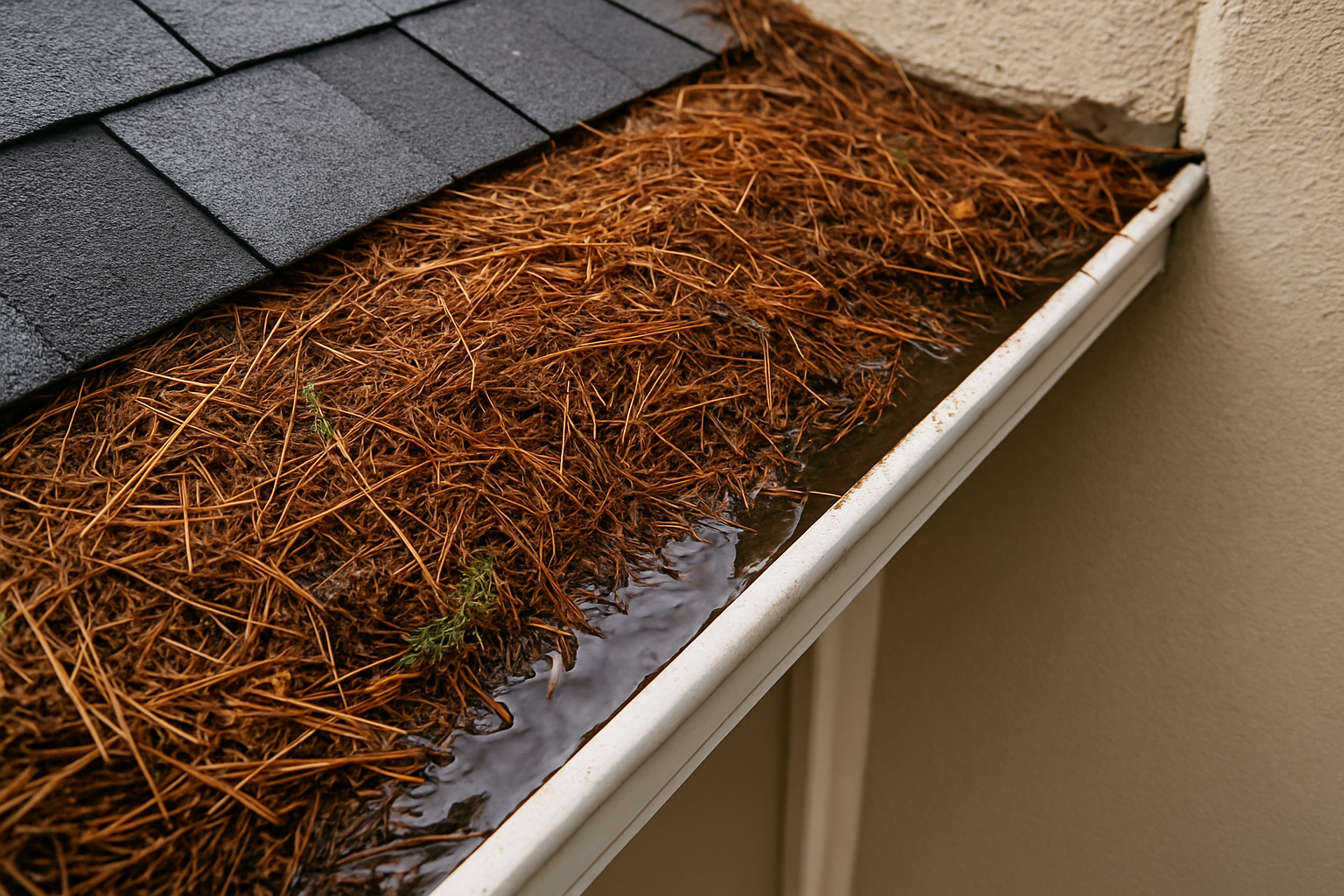
Then the gutters and downspouts. This is the single highest return item on the whole list, and it is the one owners skip most.
Homes under the Monterey pine and cypress canopy in Carmel, Pebble Beach, and Pacific Grove fill with needles fast. I have seen gutters packed solid by mid-November on houses that were cleaned in August. Needles mat down and hold water like a sponge.
A clogged downspout is a couple hundred dollar problem in October. That same clog in February can mean a soaked subfloor and dry rot repairs that run into the thousands. Costs vary with roof height, pitch, and access, so get your own quotes.
Step 2: Follow the Water Away From the Foundation
Getting water off the roof is only half of it. The other half is where it lands.
Stand at the base of each downspout during or right after a rain if you can. That is the fastest way to spot trouble.
- Does the downspout have an extension carrying water at least a few feet out, or is it dumping right against the stem wall?
- Is soil sloped away from the house, or has it settled into a low spot that ponds?
- Are area drains and their outlets clear, or is the grate covered in leaves?
- Where does the drain line actually daylight? If nobody knows, that is worth finding out before December.
Grading matters more in some parts of the county than others. Around Salinas, heavier clay soils and flatter lots hold standing water long after the rain stops. Water that sits next to a foundation finds its way in.
Last stop on this leg is the crawlspace. Check that vents are open and not blocked by soil or plantings, and look for standing water, damp insulation, or a musty smell under the floor. A flashlight and five minutes at the access hatch tells you a lot.
Step 3: Check the Building Envelope for Wind-Driven Rain
This is where Monterey Bay is different from inland California, and it is the step most generic checklists miss.
Our storms arrive with sustained wind and gusts strong enough to push rain sideways. Water gets driven into places a vertical rain never touches, then sits there.
Walk the outside of the building and look hard at the south and west faces:
- Window and door sills, especially where caulk has cracked or pulled away
- Siding penetrations for hose bibs, dryer vents, cable, and electrical
- Deck ledger connections where the deck attaches to the house
- Exterior stairs, railings, and the underside of landings
- Any spot where paint is failing, bubbling, or chalky
Press on suspect trim with a screwdriver. Older housing stock in Seaside, Pacific Grove, and parts of Salinas commonly hides dry rot behind trim that looks perfectly fine from ten feet away. If the tip sinks, you found it early, which is the good version of that discovery.
One note for multifamily owners: buildings with elevated walkways and balconies have separate state inspection obligations under SB 721, on their own deadlines. That is a different conversation from storm prep, but do not let it fall off your radar.
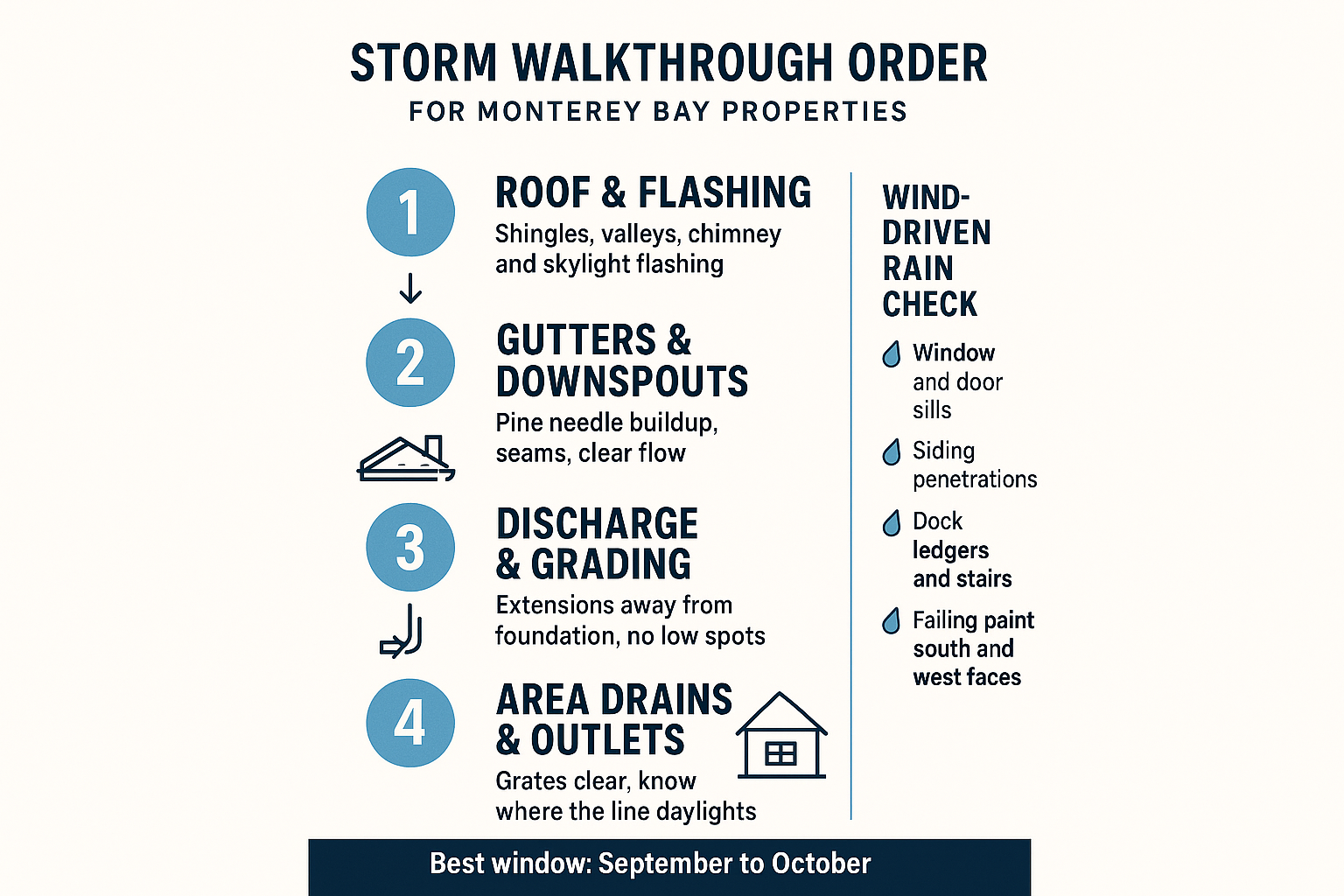
The Walkthrough, In Order
This is the same sequence I use on a property, top down and outward. Following the order keeps you from missing the cause while you chase the symptom.
Step 4: The Empty House Gets Its Own List
If nobody lives at the property, you have the most exposure and the least visibility. A slow leak in an occupied home gets noticed in a day. In a vacant Carmel second home, it can run for two months.
One seasonal Carmel owner reached out to us asking for exactly this: scheduled inspections of the home during long stretches away. That request comes in more than any other from second home owners on the Peninsula.
For a vacant or seasonal property, add these before the season starts:
- Water heater age and condition. Look at the manufacture date, the base of the tank, and any rust at fittings.
- Supply lines and angle stops under sinks and behind the washer. Braided steel lines age out.
- Main shutoff. Is it labeled, accessible, and does it actually turn?
- Heat left on low to keep interior moisture and condensation down.
- Photo documentation with dates, so if something does go wrong, you can pin it to a window of time.
One more call to make: your insurance carrier. Ask directly how your policy treats an extended vacancy, because many carriers limit coverage once a property sits empty past a set number of days. Do not assume, and do not take a number off the internet. Ask your agent about your policy.
If you are weighing how often someone should actually be laying eyes on the place, we covered that in detail in our guide on how often a vacant home in Monterey Bay should be checked.
Timing: What to Do When
Sequencing is most of the value here. Once the first real storm lands, the trades book out and pricing changes.
| Task | Best Window | Why the Timing Matters |
|---|---|---|
| Gutter and downspout cleaning | Late September to October | Pine and cypress needle drop peaks before the rain arrives |
| Roof and flashing inspection | September | Roofers on the Peninsula book out for weeks after the first storm |
| Tree trimming and limb removal | September | Crews get slammed after the first wind event of the season |
| Drainage and grading work | September to early October | Needs dry soil to do the work properly |
| Water heater and supply line check | Anytime before November | Owner-level check, no contractor needed |
| Sandbags on hand (if you are in a flood-prone spot) | October | County seasonal supply, do not wait for the storm watch |
Step 5: Local Logistics Owners Often Miss
A few things that are specific to this county and easy to set up now.
Sandbags and sand are available seasonally through Monterey County, generally with ready-made or fill-your-own bags at local fire stations and free sand stockpiles for unincorporated areas. Availability and locations change year to year, so check with the county before you drive out.
ALERT Monterey County lets residents register a phone number for emergency notifications. If you own here but live somewhere else, register anyway. Knowing an evacuation order went out near your property is worth the two minutes.
Risk is not even across the county. Owners near the 2020 burn scars and along the Pajaro River corridor carry a different profile after the 2023 levee breach that put thousands of people under evacuation orders. If that is you, your prep list starts earlier and includes debris flow and access planning, not just gutters.
On cost, I will not quote you numbers I cannot stand behind. Gutter cleaning, tree work, and drainage repair all price off scope, roof height, and access, and emergency call-out rates during a storm are a different conversation entirely. Get two or three quotes in September while contractors still have room on the calendar. For a broader look at budgeting, our breakdown of what property management actually costs in the Monterey Bay area walks through how these expenses tend to show up over a year.
Step 6: Make It Repeating Instead of a Scramble
The owners who come through winter clean are almost never the ones who did a heroic October weekend. They are the ones with a schedule.
A documented walkthrough four times a year covers the same ground every time:
- Roof, gutters, siding, and drainage
- Plumbing and visible leak risk
- Water heater condition
- Smoke and carbon monoxide detectors
The part that matters most for out-of-area owners is the photo report with dates. When you can compare October to January photos of the same corner of the same wall, you catch slow problems early and you can prove when something started.
That repeating, documented check is the gap most national firms and larger offices leave wide open for second homes and vacant properties on the Peninsula. It is also why one Seaside owner of four-plus years wrote that we “have all the qualities of someone we can trust with our properties.”
If you are managing a property from another state, our guide on how remote homeowners keep control of a Monterey property covers the systems side of this.
Frequently Asked Questions About Storm Prep on Monterey Bay Properties
When is the real deadline to get this done?
September and October. Once the first significant storm lands, roofers, gutter cleaners, tree crews, and drainage contractors across the Peninsula and Salinas Valley are booked out for weeks.
How likely is a wet winter this year, really?
NOAA’s Climate Prediction Center is carrying an El Nino Advisory with a greater than 90% chance of a very strong event for fall and winter 2026-27. You can read the current status yourself in the ENSO Diagnostic Discussion. Strong El Nino has historically tilted the Central Coast toward a wetter, more active storm track, though no forecast is a guarantee for any one address.
Does my homeowners insurance cover the house while it sits empty?
Maybe, and maybe not past a certain point. Many carriers limit or change coverage once a property has been vacant beyond a set number of days. Call your agent and ask about your specific policy language rather than guessing.
What if I already have a tenant in place? Is this still on me?
Yes for the building systems. Tenants may keep an eye on things day to day, but roof, gutters, drainage, and structural items sit with the owner. Setting expectations in writing before the season starts prevents most of the disagreements I see in December.
I live out of state. Can I skip the walkthrough if the house looks fine on the last visit?
A house that looked fine in July can hide a clogged drain line and a soft deck ledger. The value of a fall check is catching the cheap version of a problem instead of the expensive one.
Want a set of eyes on the property before the rain starts?
Our team is based in Monterey County, works across Monterey, Salinas, Pacific Grove, Carmel, Pebble Beach, Seaside, and Marina, and speaks both English and Spanish. If you would like to talk through what your property needs before the season turns, Torrente Property Management can be reached at (831) 582-8916 or through the contact form at torrenteproperties.com. No rush and no pressure, just a conversation about the place.