
Direct Answer: You stop fielding tenant calls, repairs, and rent chasing. A manager takes over daily operations, the lease and tenant stay in place, and you follow along through monthly statements and an owner portal.
Most owners I talk to did not decide to hire help on a calm Tuesday. They decided after one bad night. A tenant stopped paying, a water heater let go at 11 p.m., or a lease renewal got handled the wrong way and suddenly the whole arrangement felt heavier than it did a year ago.
One owner in North Salinas reached out after self-managing for more than two years. He was not in crisis. He just wanted to know the cost and the process of handing things over with a tenant already in place.
That question comes up more than any other, so this article walks through what actually changes when you stop managing yourself. What the handoff looks like, what leaves your plate, and how the fee stacks up against what you are already paying in time and risk.
The mid-tenancy handoff is quieter than owners expect
The biggest hesitation I hear is not about money. It is about rocking the boat with a good tenant.
One Seaside owner had tenants who had been in the home for four years and paid on time the whole way. She worried that bringing in a manager would unsettle a relationship that took years to build. It does not work that way.
A mid-tenancy handoff is mostly paperwork on our end and one letter on the tenant’s end. Here is what typically happens in the first couple of weeks:
- The existing lease stays exactly as written. Rent amount, term, pet terms, and renewal dates all carry over.
- The tenant gets a written notice with the new management contact, the new place to send rent, and how to submit maintenance requests.
- The security deposit transfers to the new management trust account, with the amount documented in writing.
- We collect the lease, any addenda, the move-in inspection record, and the payment history from you.
- A walkthrough gets scheduled so someone has actually laid eyes on the roof, water heater, and detectors.
For a tenant who is already paying on time, almost nothing about their life changes except a better way to report a leaking faucet. If you want the step by step version, we covered it in detail in how to hand off a rental you have been managing yourself.

What actually stops landing on your plate
The part owners underestimate is the mental weight, not the task list. Several owners have described the same pattern to me: long conversations, excuses, late payments, and a slow drift into being a friend instead of a landlord.
If you are conflict-avoidant, self-managing punishes you. Every awkward conversation costs you something, so you put it off, and putting it off costs more.
After a handoff, these come off your plate entirely:
- Rent collection and late notices. You are not the one sending the text on the sixth.
- After-hours calls. A burst pipe in Pacific Grove at midnight goes to a coordinator, not to you.
- Vendor scheduling. Getting a licensed plumber out to Marina and confirming the work got done.
- Turnover coordination. Cleaning, paint, landscaping, and re-listing between tenants.
- Detector and safety checks. Smoke and carbon monoxide compliance at move-in and turnover.
What stays with you is oversight, and that is the point. Monthly statements show income, expenses, and what was repaired. The owner portal holds the documents. Big spending decisions still come to you before the money is spent.
One owner told me it felt like buying back mental bandwidth. That is honest. You still own the asset. You just stop being the front desk.
Self-managing versus managed: who handles what
This is the split I walk owners through on a first call. It is not about capability. It is about where your hours go each month.
| Task | Self-managing owner | After the handoff |
|---|---|---|
| Rent collection and late follow-up | You text, call, and negotiate | Handled through the portal with a set process |
| 11 p.m. emergency repair | You find a vendor from bed | 24/7 coordination with local licensed vendors |
| Annual lease renewal and rent review | You guess at market rent | Priced against current Monterey County comparables |
| Move-out inspection and deposit accounting | You document it and hope it holds up | Photo documented, itemized within the legal window |
| Salinas rental registration paperwork | Yours to track and renew | Tracked as part of ongoing administration |
| Financial records for taxes | Shoebox or spreadsheet | Monthly statements plus a year-end summary |
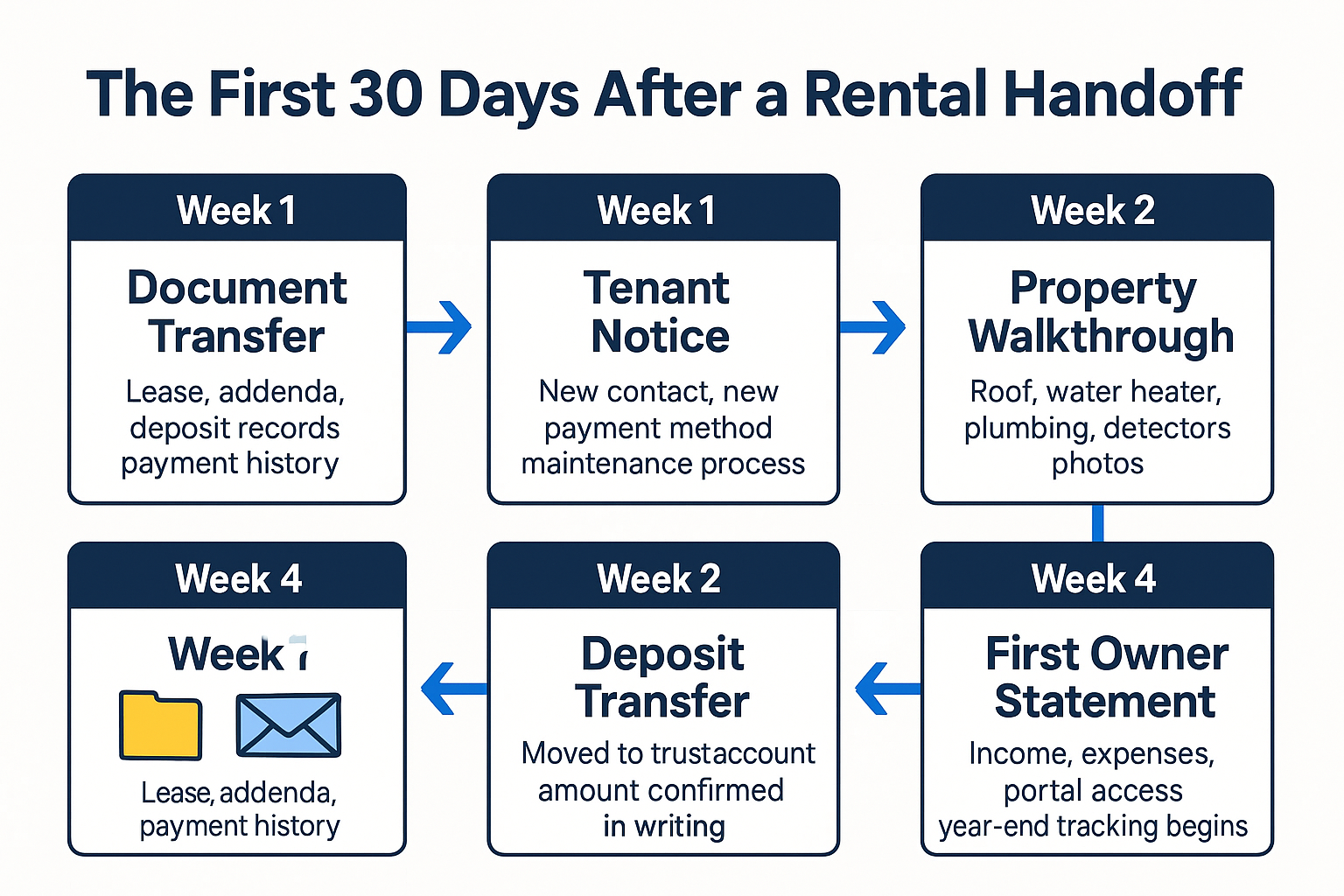
The first 30 days after you hand over the keys
Here is the typical sequence for an owner switching mid-tenancy with a paying tenant already in the home.
The fee you see versus the cost you are already paying
Owners compare a management fee against zero. That is the wrong comparison, because self-managing is not free. It is just billed in hours and risk instead of dollars.
On cost, I will be straight with you: rates vary by property type, unit count, and how much turnover work is involved. Across the Monterey Bay area, monthly full-service management is commonly quoted as a percentage of collected rent, with leasing or tenant placement often billed separately as a one-time fee. Anything more specific than that depends on your actual property, so ask for a written quote rather than trusting a number in an article. We break the structure down further in what a property management fee actually covers in California.
Now the invisible side. Compliance mistakes are where self-managing owners get hurt, and California has moved fast in the last two years:
- Security deposits are capped at one month’s rent for most residential rentals as of July 1, 2024, under California Civil Code Section 1950.5. Collecting more, or holding an older larger deposit incorrectly, creates real exposure.
- Deposit accounting has a strict deadline after move-out, with itemized documentation. Missing it is one of the most common and most expensive errors I see.
- Salinas runs a Residential Rental Registration program, which means ongoing registration and renewal for covered rentals. Owners often forget it exists between renewal cycles. We keep a current rundown in the Salinas rental registration guide.
- The City of Monterey prohibits rentals under 30 days, so lease terms need to reflect that.
Add up an improperly handled deposit, a mispriced renewal, and a vacancy that ran two weeks long, and the math on a management fee looks different than it did at the start of the year. If you are still weighing it, when self-managing your rental stops making sense walks through the tipping points I see most often.
What it feels like a year in
The honest answer is that it feels boring, in the best way. You get a statement each month, an occasional note about a repair, and a call before anything expensive happens.
One Salinas owner with multiple rentals put it plainly in a review: “Ashley has been very thorough with taking care of multiple rental properties in Salinas. It’s refreshing knowing we have that piece of mind…”
That is roughly the experience owners describe after the first six months. Not excitement. Just a property that runs without needing you in the middle of it.
For owners who live out of the area, from Prunedale to out of state entirely, the shift is even sharper. There is more on that in how out-of-area owners actually manage a Monterey Bay rental.
Frequently Asked Questions About Handing Off a Rental You Manage Yourself
Can I hire a property manager if I already have a tenant in the home?
Yes, and it is one of the most common situations we take on. The lease stays in force as written, the tenant keeps their same terms, and they simply receive notice of who to pay and who to contact for repairs.
Will switching upset a long-term tenant who has been reliable?
In my experience, good tenants usually welcome it. They get a real maintenance process instead of texting the owner and waiting. The change they notice most is a faster response when something breaks.
What happens to the security deposit I am holding?
It transfers into the management trust account and the amount is documented in writing for both you and the tenant. If your deposit predates the one month cap that took effect July 1, 2024, that gets reviewed as part of the handoff so the accounting is clean at move-out.
How long does the whole handoff take?
For a single-family home with a tenant in place, expect a couple of weeks from signed agreement to the first full month of managed operations. Properties with missing lease documents or deferred maintenance take longer, because we want a walkthrough on record before we take responsibility for the condition.
Do I lose control over decisions about my own property?
No. Routine repairs get handled under an approval limit you set. Anything above that comes to you first, and you see every dollar in and out on the monthly statement.
Is this available in Spanish?
Yes. Our team works in both English and Spanish, which matters in the Salinas and Monterey markets for both owners and tenants.
Thinking through a handoff on your own rental?
If you are self-managing a property anywhere from Salinas and Seaside to Carmel and Pacific Grove and want to understand what the transition would actually look like, our team is happy to walk you through it, tenant in place or not. You can reach us at (831) 582-8916 or through the contact form at torrenteproperties.com. No pressure either way, just a straight answer about your property and the Monterey County market it sits in.