
Direct Answer: Good tenants come from a documented screening process: credit, nationwide criminal and eviction checks, income verification at 2.5 to 3 times rent, and calls to two prior landlords, not just the current one.
Almost every owner who calls me about a Salinas rental says some version of the same thing: they just want good tenants. Sometimes it is a first-time landlord near Salinas Valley Memorial. Sometimes it is someone who already lived through a bad placement and is not willing to roll the dice again.
That worry is fair. Salinas has a deep, active renter pool, but the range in applicant quality is real, and one bad decision can cost you a year of income and repairs.
Here is what I have learned after years of placing tenants across Salinas, Seaside, and the Peninsula: the difference between a tenant who stays three years and one who leaves after eight months is almost never luck. It is screening, property prep, and how the tenancy is handled after move-in.
What a Real Screening Process Actually Includes
Most owners who self-manage run a credit check and call it done. A credit report is useful, but by itself it tells you very little about how someone treats a house.
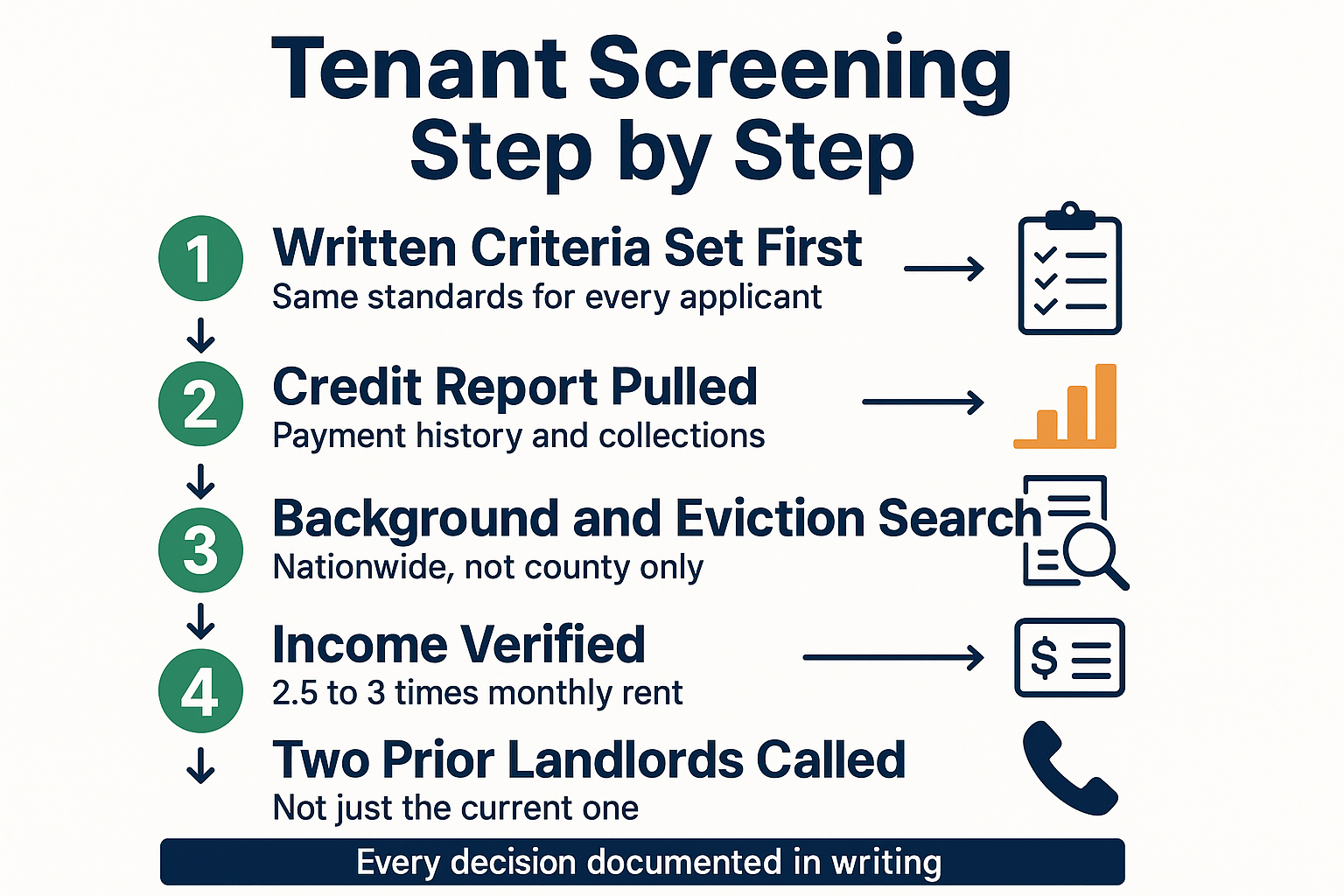
A complete screening for a Salinas rental should include all of the following, every time, for every adult applicant:
- A full credit report, not just a score
- A nationwide criminal background check, not a county-only search
- An eviction history search across California and other states
- Income or employment verification, typically at 2.5 to 3 times the monthly rent in gross income
- Calls to at least two previous landlords, not only the current one
That last item is the one I care about most. A landlord who is trying to get rid of a problem tenant has every reason to give a glowing reference and move the problem along.
The landlord before them has nothing to gain and usually tells you the truth. When I call two back, I ask specific questions: Did rent arrive on time? What did the unit look like at move-out? Would you rent to them again?
If you want the longer version of how this works step by step, I wrote about it in what a real tenant screening process looks like.
What Each Screening Step Catches and What It Misses
No single check gives you the whole picture. This is how I think about what each one is actually good for.
| Screening Step | What It Reveals | What It Misses |
|---|---|---|
| Credit report | Payment patterns, collections, debt load, prior rental collections | Cash-based finances, how someone treats a property |
| Criminal background check | Convictions across states, not just Monterey County | Nothing about payment reliability |
| Eviction search | Prior court filings and judgments | Move-outs settled informally with no filing |
| Income verification | Whether rent is realistically affordable | Job stability, hours that fluctuate seasonally |
| Prior landlord calls | Real behavior: late rent, damage, neighbor complaints | Only as good as the questions you ask |

The Applicant Pool Is Decided Before Anyone Applies
You cannot screen your way to a great tenant if only weak applicants apply. The listing itself sets the pool.
A Salinas rental posted on one free classified site with four dark cell phone photos pulls a different crowd than the same home listed with clean photography and pushed to the major rental platforms. Same house, different applicants.
Property prep before the photos matters just as much. Small things signal how you will run the tenancy:
- Deep clean, including inside appliances and window tracks
- Fresh paint on scuffed walls and touched-up trim
- Working light fixtures in every room, blinds open, photos shot in daylight
- Yard cut back and edged, exterior pressure washed if needed
- Smoke and carbon monoxide detectors tested and current
When someone walks into a unit that is clean and cared for, they read that as a landlord who pays attention. Applicants who plan to be careless self-select out. The ones who want a place they can settle into lean in.
I have seen owners save a few hundred dollars skipping prep and then lose far more sitting vacant an extra three weeks. There is a real checklist to this, and I walked through it in getting a Monterey Bay rental ready.
Pricing plays into it too. Overpriced listings sit, and the applicants who eventually apply are often the ones who could not qualify elsewhere. How rental prices actually get set is worth reading before you pick a number.
The Screening Sequence I Follow
This is the order I work through an application, and why each step comes where it does.
Fair Housing Rules Limit What You Can Screen On
This is where self-managing owners get into trouble without meaning to. California fair housing law applies in full in Salinas, and it is stricter than federal law in a few places.
A few things owners often get wrong:
- Source of income is protected. You cannot reject an applicant because they hold a Section 8 voucher. When a voucher covers part of the rent, the income test applies to the tenant’s share, not the full rent.
- Screening standards must be identical for everyone. Asking one applicant for extra documentation and not another is how complaints start.
- Advertising language matters. Phrases describing who the home would “suit” can be read as steering.
The California Civil Rights Department publishes the current protected classes and enforcement process, and it is worth a read if you are placing a tenant yourself.
The protection here is documentation. When I have written criteria applied the same way to every applicant, and a file showing exactly how each application was scored, a complaint has something factual to run into.
One more Salinas-specific item: the city’s Residential Rental Registration program applies to rental properties in city limits, and California capped most security deposits at one month’s rent as of July 1, 2024. That cap changes the math on how much cushion you have if a placement goes badly, which is another reason to get the screening right upfront.
Keeping the Tenant Is Where the Money Actually Is
Owners think hard about placement and almost never think about retention. That is backwards, because turnover is expensive.
Every turnover in Salinas costs you some mix of:
- Lost rent during the vacant weeks
- Cleaning, paint, carpet, and repair between tenants
- The leasing fee if a professional handles the placement
- Your own time on showings and paperwork
Costs vary by property and condition, but a single turnover often runs into the equivalent of a month or more of rent once everything is added up. A tenant who renews for one extra year keeps that money in your pocket.
Retention starts at placement, with honest conversations. If the water heater is on its last legs or street parking is tight, say so before they sign. Tenants who feel misled at move-in start looking early.
After that, it comes down to boring consistency: maintenance requests answered quickly, clear communication about lease terms, and rent increases handled with proper notice. Our reviews say it better than I can, with tenants describing the process as “straightforward and fast” and repairs handled “timely.”
That is not a courtesy. It is what makes someone renew instead of packing. If you are weighing how much of this you want to handle yourself, tenant placement versus full management breaks down where the line usually falls.
Frequently Asked Questions About Finding Good Tenants in Salinas
How much income should a Salinas applicant have?
The common standard is gross monthly income of 2.5 to 3 times the rent. Whatever number you pick, apply it identically to every applicant and put it in writing before you start showing the property.
Can I refuse an applicant with a Section 8 voucher?
No. Source of income is a protected class in California, and that includes housing vouchers. You can still screen for credit, rental history, and background, and you apply your income standard to the tenant’s portion of the rent rather than the full amount.
How long does it usually take to fill a Salinas rental?
It depends heavily on price, condition, and time of year. A well-priced, clean home with good photos generally moves faster than an overpriced or dated one. Listings that sit for weeks are almost always telling you something about the rent number or the prep work.
Is it worth checking landlords beyond the current one?
Yes, and I would call it the single highest-value step. A current landlord who wants a problem tenant gone has a reason to be generous. The landlord two moves back usually gives you the honest version.
What if I already have a tenant I inherited when I bought the property?
You take the tenancy as it stands, including the existing lease terms. Get the lease, deposit records, and payment history in hand right away, then focus on clean communication going forward. Many inherited tenants turn into long-term ones once someone starts answering the phone.
Thinking Through Your Next Placement in Salinas?
If you own a rental in Salinas, Monterey, or anywhere along the Monterey Bay and want to talk through screening criteria, prep, or what your home would realistically rent for, our team at Torrente Property Management is happy to have that conversation. You can reach us at (831) 582-8916 or through the contact form at torrenteproperties.com. We work in both English and Spanish, and we are here in Monterey County year-round.