
Direct Answer: A California monthly management fee usually covers rent collection, tenant communication, maintenance coordination, monthly owner statements, and lease compliance. Tenant placement is almost always billed separately, often around half to one month’s rent.
Almost every owner who calls me asks the same two things in the same breath: what would my place rent for, and what do you charge? The second question is the one people misread most often.
A monthly management fee and a leasing fee are two different things. So is a vendor invoice. When owners compare companies without knowing which is which, they end up comparing numbers that were never the same number to begin with.
I want to walk through the line items the way I would on a phone call with a homeowner in Salinas or Pacific Grove. What the monthly fee usually buys, what tends to be billed on the side, and the questions worth asking any manager before you sign.
What does the monthly management fee actually cover?
In California, the monthly fee is typically a percentage of collected rent. It pays for the ongoing, unglamorous work of keeping a tenancy running.
In most agreements you should expect it to include:
- Rent collection and follow-up on late payments
- Tenant communication, including after-hours calls
- Maintenance coordination with vendors and follow-through
- Monthly owner statements showing income and expenses
- Lease compliance monitoring, including notices and renewals
- Routine and move-in/move-out inspections
Compliance is the part owners tend to undervalue until it bites. California capped most residential security deposits at one month’s rent as of July 1, 2024, and the city of Monterey does not allow residential rentals under 30 days. Salinas owners also have the city’s Residential Rental Registration program to keep current.
If you own a multifamily building with balconies or elevated walkways, AB 2579 and SB 721 inspection deadlines apply to you as well. Ask directly whether tracking that sort of thing sits inside the monthly fee or outside it. For a broader look at local rates, this breakdown of what property management costs in the Monterey Bay area is a reasonable starting point.
Why is tenant placement billed separately?
Because it is a different job with a different workload. Placing a tenant is front-loaded work that happens once, while the monthly fee covers work that repeats.
Across the industry, a leasing or placement fee commonly lands somewhere between half a month’s rent and one full month’s rent, though it varies by firm and by property. That charge generally covers property prep and staging advice, rental pricing analysis, photos and listings, showings, full credit, background and rental history screening, and drafting and executing the lease.
A few things to pin down before you assume anything:
- Is the fee charged again at renewal, or only for a new tenant?
- Is there a re-leasing discount if a tenant leaves early?
- Are marketing costs like photography included or added?
Some owners only want this piece and plan to handle the rest themselves. That is a real option, and the tradeoffs are covered well in this comparison of tenant placement versus full management.

How is maintenance billed, and where do owners get surprised?
This is the murkiest line item in the whole agreement, and it is where I see the most confusion.
“We coordinate maintenance” can mean three very different billing models:
- The owner pays only the vendor’s invoice, with coordination included in the monthly fee
- The owner pays the vendor invoice plus a flat coordination fee per work order
- The owner pays the vendor invoice with a percentage markup added
None of those is automatically wrong. But you should know which one you are agreeing to, in writing, before the first repair happens.
The second question matters just as much: who is doing the work? A manager with standing relationships with licensed and insured local vendors gets a plumber to a Seaside duplex faster and at a more predictable price than someone calling whoever answers. On the Peninsula, where salt air chews through exterior finishes and winter storms find every soft spot in a roof, response speed is not a small thing.
Ask how emergencies are handled at 11pm on a Sunday, and ask what dollar threshold requires your approval before work begins.
Fee line items and the question to ask about each
Here is the quick version I would run through with an owner comparing two proposals side by side. Every firm handles these differently, so treat the middle column as typical, not universal.
| Line item | Usually part of the monthly fee? | What to ask |
|---|---|---|
| Rent collection and late follow-up | Yes | How are late fees handled and who keeps them? |
| Tenant placement and screening | No, billed separately | Is it charged again at renewal? |
| Maintenance coordination | Depends on the firm | Flat fee, markup, or included? |
| Monthly owner statements | Yes | Can I see a sample statement? |
| Year-end income and expense summary | Often yes | Is it formatted for Schedule E? |
| Paying mortgage, insurance, property taxes | Sometimes an add-on | Can you pay these from collected rent? |
| Routine inspections | Usually limited number | How many per year, with photos? |
| Eviction handling and court time | No | What is billed hourly versus included? |
Annual cost of management versus annual risk of going it alone
Several owners have written in asking about fees and a rent estimate in the same message, which tells me they are doing the math before they commit. This is the math worth doing.
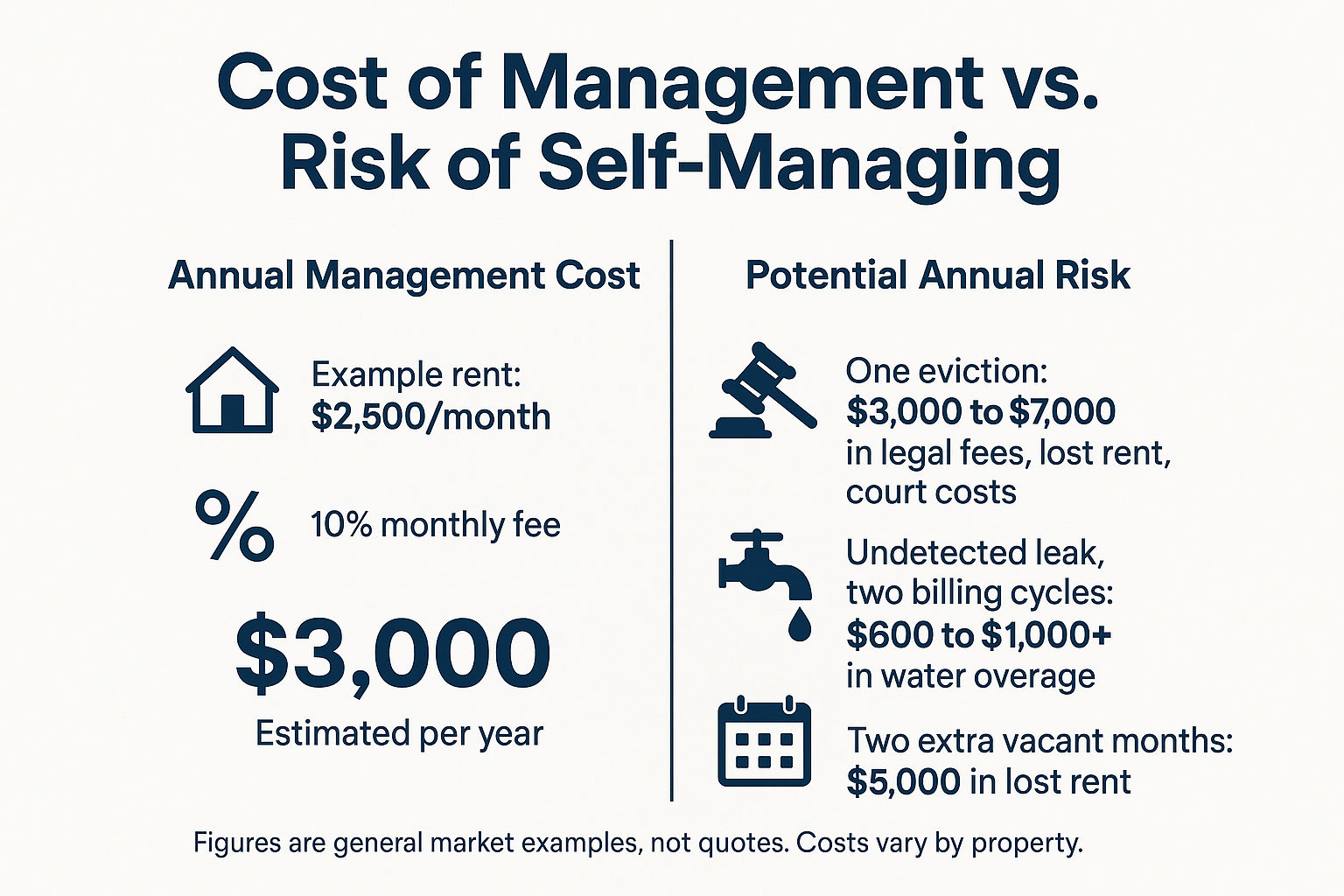
Is the fee worth it on a $2,500 Salinas rental?
Run the numbers rather than guessing. On a rental collecting $2,500 a month, a 10% monthly management fee works out to roughly $3,000 a year. That is the number to hold up against what can go sideways.
General market context, not a promise: an eviction in California often runs somewhere in the range of $3,000 to $7,000 once you add legal fees, lost rent, and court costs, and the process is slower than most first-time landlords expect. The California courts’ self-help guide to eviction lays out the steps and gives you a realistic sense of the timeline.
A single undetected leak is smaller but still real. Two billing cycles of water running unnoticed on a Cal Am account can easily add $600 to $1,000 or more in overage before anyone notices the meter.
And two extra months of vacancy on that same Salinas house is $5,000 gone, which no fee structure can recover after the fact. Slow marketing and mispricing are the usual culprits.
What about tax season and owner reporting?
Owners underestimate this one until March. A clean monthly statement plus a year-end income and expense summary turns Schedule E preparation from an afternoon of shoebox archaeology into a short conversation with your accountant.
Some firms also pay owner obligations directly out of collected rents:
- Mortgage payments
- Property insurance
- Property taxes
That removes the timing headache entirely, which matters a lot for out-of-area owners and military families juggling a move. Ask whether it is included in the base fee or billed as an add-on.
Owner portal access belongs in the same conversation. One reviewer put it simply: “everything from payments to communication is easy to manage.” If you are 500 miles away, that access is not a nicety. It is how you keep control of a Monterey property from a distance.
Does a manager increase profit or just maintain the property?
Honest answer: it depends on what you are comparing against.
Compared to a vacancy that stretched two extra months because of slow marketing, or a roof leak that turned into dry rot because nobody looked, professional management nearly always improves net annual income. Compared to an attentive local owner who already has a good plumber, knows California notice rules, and lives fifteen minutes from the property, the margin narrows considerably.
The owners who benefit most in my experience are the ones who are far away, stretched thin, or newly inherited into a rental they never planned to own. If you want the longer version of that argument, we wrote it up here: do property managers really increase profit.
At Torrente Property Management, we would rather an owner do that math clearly than sign up on a hunch.
Frequently Asked Questions About California Property Management Fees
What does the monthly property management fee cover in California?
Typically rent collection, tenant communication, maintenance coordination, monthly owner statements, lease compliance monitoring, and routine inspections. Tenant placement is a separate charge in most agreements.
Why is the leasing fee charged on top of the monthly fee?
Placing a tenant is one-time, front-loaded work: pricing, prep, photos, listings, showings, full screening, and lease drafting. Across the industry it commonly runs from about half a month’s rent up to a full month’s rent, depending on the firm and the property. Ask whether it is charged again at renewal, because that answer varies.
Do managers mark up repair invoices?
Some do, some charge a flat coordination fee, and some pass the vendor invoice through at cost. Get the model in writing before the first work order, and ask whether their vendors are licensed and insured.
Can a property manager pay my mortgage and property taxes from rent?
Many can, including us. It is worth asking whether that service sits inside the monthly fee or is billed as an add-on, since it varies by company.
Is management worth it on a single rental in Salinas or Marina?
On a $2,500 rental, a 10% fee is roughly $3,000 a year. If that single property is your only rental and you live nearby with good vendor contacts, the math is closer. If you are out of the area, or if one bad tenancy would genuinely hurt, the coverage usually pays for itself.
What is never included in a management fee?
Court costs and attorney fees for an eviction, capital improvements, insurance deductibles, and the actual cost of repairs. Those are owner expenses no matter who manages the property.
Want the numbers for your own property?
Every property in Monterey County is a little different, so the only fee figure that means anything is the one written against your actual address, rent, and condition. Our team works across Monterey, Salinas, Seaside, Marina, Pacific Grove, Carmel, and Pebble Beach, in English and Spanish. If you would like a straight walk-through of the line items for your place, we are reachable at (831) 582-8916 or through the contact form at torrenteproperties.com.