
Direct Answer: A vacant home on the Monterey Peninsula faces real risks from coastal weather, pests, and slow-developing failures. Scheduled professional inspections catch problems before they become expensive.
A Carmel homeowner reached out to us not long ago asking for regularly scheduled home inspections during my absence from the property. That’s an exact quote. She wasn’t dealing with a crisis — she just knew what she didn’t know: what was happening to her house while she was gone.
That’s a question we hear often from seasonal owners across Carmel, Pacific Grove, and Pebble Beach. Many of them are away for four to six months at a stretch, returning in spring to find problems that didn’t exist when they left in the fall. Sometimes it’s a minor landscape issue. Sometimes it’s a lot worse.
This article is about what actually happens to a vacant home on the Monterey Peninsula during an extended absence — and what a professional caretaker service for seasonal homes actually does to protect it.
The First Few Weeks Are When the Most Damage Happens
Most owners picture vacancy risk as something that builds slowly — a gradual decline over many months. In my experience, that’s not how it works. The most consequential failures tend to happen early, and they compound fast if no one catches them.
A slow drip under a sink goes unnoticed for six weeks. The subfloor absorbs moisture. Mold begins growing inside the cabinet. What would have been a $150 plumber visit turns into a flooring and remediation job that costs far more — and your insurance company will want to know why no one caught it sooner.
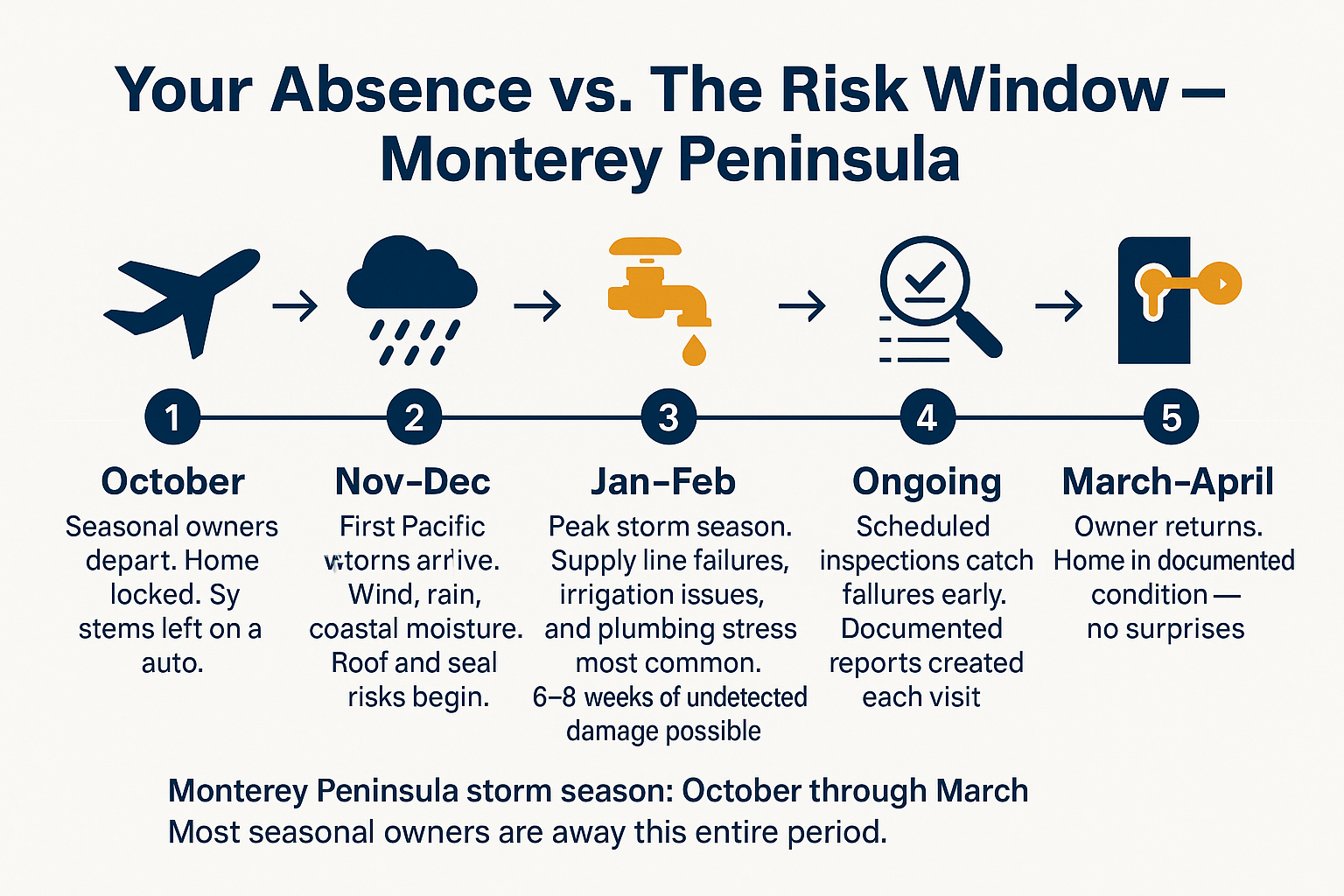
On the Monterey Peninsula specifically, the coastal environment accelerates all of this. The marine layer keeps exterior wood surfaces damp for long stretches. Wind drives moisture into roofline details and window seals. Pacific storms between October and March — exactly when most seasonal owners are away — can move tree limbs, strip flashing, and send water into places it was never meant to go.
The risks I see most often with vacant Peninsula homes:
- Water intrusion through roof, windows, or failed door seals
- Plumbing failures, including supply line leaks and drain line issues
- Irrigation system failures that cause erosion or standing water near the foundation
- Pest activity — rodents and insects move into vacant structures quickly
- Landscape overgrowth or storm damage that affects fences, drainage, or the structure itself
None of these announce themselves. They sit and get worse until someone walks through the door. If that someone is you, returning after five months away, the damage is already done.
What a Professional Home Watch Visit Actually Covers
When homeowners hear “caretaker service” or “home watch,” they often picture someone walking through the front door, glancing around, and leaving. That’s not what a structured inspection looks like.
A thorough visit to a vacant home covers specific, concrete items — not a general impression. Here’s what we’re actually checking:
- Water leaks — under sinks, at supply lines, around the water heater, and at the washing machine connection
- Running fixtures — briefly running faucets and flushing toilets to prevent stagnant water in drain lines, which can create odor and pest attraction
- HVAC function — verifying the system is cycling properly and filters aren’t clogged
- Security systems — confirming sensors are active and no alerts have been triggered
- Pest indicators — checking for droppings, entry points, nesting material, or signs of recent activity
- Exterior review — roof visible from ground level, gutters, downspouts, perimeter fencing, and any storm damage
- Landscape condition — irrigation running as set, no dead vegetation creating fire risk, no overgrowth blocking drainage
- Utility parameters — confirming water, gas, and electricity are operating within normal ranges
For owners who rely on a neighbor or a housekeeper to “keep an eye on things,” I’d gently push back on that. A friendly check-in isn’t the same thing as a structured walk-through. And a neighbor has no obligation to escalate anything or coordinate a repair vendor when something goes wrong.
You can read more about the specific risks that develop in vacant homes — and who bears responsibility when they do — in what can go wrong in an empty house.
The Seasonal Absence Risk Window on the Monterey Peninsula
This timeline maps the most common seasonal absence period against the weather events and property risks that occur during those same months.
The Paper Trail Most Owners Don’t Think About Until They Need It
One benefit of professional home watch service that almost never comes up in initial conversations — but matters a lot later — is documentation.
Every inspection visit should produce a dated report with written notes and photos. Over time, that record becomes something genuinely useful:
- Insurance claims: If damage is discovered, a documented inspection history establishes when the damage first appeared and what the property’s prior condition was. Carriers look for evidence of neglect in vacant home claims. Dated photos showing clean, maintained conditions are your defense.
- Maintenance planning: When you can see that a particular roof section has shown minor granule loss across three consecutive inspection photos, you can plan a repair before it becomes an emergency replacement.
- Contractor accountability: If a vendor tells you a repair is needed because of long-term neglect, your inspection record either confirms or contradicts that assessment. Owners who rely on informal check-ins rarely have this kind of organized baseline.
The National Association of Insurance Commissioners notes that standard homeowners insurance policies often have specific vacancy clauses — some as short as 30 to 60 days — after which coverage for certain types of damage may be reduced or denied. A documented inspection program is one of the clearest ways to demonstrate that a property was being actively monitored.
For a deeper look at how inspection frequency should be set, how often someone should check on a vacant home in Monterey Bay walks through the variables that should drive that decision.
Informal Check-In vs. Professional Home Watch: What’s Actually Different
Owners often assume a neighbor’s visit covers the same ground as a professional inspection. Here’s how the two actually compare.
| What Gets Checked | Neighbor / Housekeeper | Professional Home Watch |
|---|---|---|
| Visual walk-through | Varies — usually quick | Structured, every visit |
| Plumbing and leak check | Rarely | Standard item |
| Running fixtures to clear drain lines | Almost never | Standard item |
| HVAC verification | No | Standard item |
| Pest activity review | Unlikely | Standard item |
| Exterior and roof-line review | Occasional | Standard item |
| Irrigation and landscape status | Varies | Standard item |
| Written report with photos | No | Every visit |
| Vendor coordination if issue found | No | Yes |
| Escalation protocol for emergencies | No | Yes |
What Happens When Something Actually Goes Wrong
Detection is only half of the value. The other half is what happens after a problem is found.
An owner who’s 500 miles away — or in another time zone — can’t call a plumber, meet a roofer, or get three quotes for a fence repair. If the person checking on the property doesn’t have vendor relationships and the authority to act, the discovery of a problem just creates a new problem: who handles it?
A professional caretaker service maintains relationships with licensed, insured local contractors. When we find something that needs attention, we can coordinate the response, get work authorized by the owner, supervise the repair, and document the outcome — all without the owner having to fly back or manage phone tag across time zones.
We’ve written about the hidden costs of managing a Monterey home from out of state before — and this is exactly the kind of friction those costs come from. A small unresolved issue, multiplied by the difficulty of managing it remotely, becomes expensive fast.
For owners who are also thinking about renting their Peninsula property rather than leaving it vacant, how Carmel homeowners are protecting properties without living in them covers the decision-making involved in both paths.
Frequently Asked Questions About Caretaker Services for Seasonal Homes
How often should a vacant home on the Monterey Peninsula be inspected?
It depends on the property’s age, systems, and the time of year. During the October through March storm season, we generally recommend visits every two to four weeks at minimum. A newer home with modern plumbing and a recently replaced roof can tolerate longer intervals between checks than an older Carmel cottage with original wood windows and aging fixtures. The specific inspection frequency should be set based on the actual risk profile of the property — not a one-size schedule.
What’s the difference between home watch and property management?
Home watch or caretaker service is specifically for vacant or seasonally unoccupied homes — there are no tenants, no rent to collect, and no lease to manage. Property management covers occupied rental properties: tenant placement, rent collection, maintenance coordination, and legal compliance. Some owners eventually decide to rent their seasonal home rather than leave it vacant, at which point the service transitions. But the two are distinct and serve different needs.
Will my homeowners insurance cover damage that occurs while my home is vacant?
Possibly — but with important limitations. Most standard homeowners policies include a vacancy clause that reduces or excludes coverage for certain damage types after the home has been unoccupied for 30 to 60 days. The exact terms vary by carrier and policy. A documented inspection program, showing the home was being actively monitored, can be critical evidence in a claim. You should review your specific policy’s vacancy provisions and speak with your insurance agent before leaving for an extended period.
Can a caretaker service also handle landscaping, utilities, and vendor coordination?
Yes — this is part of what separates a professional service from a simple check-in. Coordinating with landscaping contractors, verifying that utility accounts are active and within normal parameters, and managing vendor relationships for routine maintenance are all components of a full caretaker arrangement. The Pacific Grove owner who reached out to us about a vacant building specifically asked about general landscaping and on-site inspection — those two things naturally go together because landscape neglect creates its own structural and drainage risks.
What if I only need someone to check in a few times, not on a regular schedule?
For very short absences, an informal check-in may be sufficient. But for absences of six weeks or more — especially during storm season — a structured, recurring schedule produces meaningfully better outcomes than ad hoc visits. The value of regular inspection is the ability to catch a slow-developing problem before it becomes acute. A one-time check-in two months into an absence may find a problem that’s already been sitting for eight weeks.
Thinking About Who’s Watching Your Property While You’re Away?
If you own a seasonal or second home in Carmel, Pacific Grove, Pebble Beach, or elsewhere on the Monterey Peninsula, we’re happy to talk through what a home watch arrangement would look like for your specific property. Torrente Properties has been working with Monterey County owners for over 25 years, and we understand the coastal environment and the real risks that come with extended vacancy. Reach us at (831) 582-8916 or through the contact form at torrenteproperties.com.