Direct Answer: Under SB 610, effective January 1, 2026, rent and fees are suspended while a mandatory evacuation order is in place, and disaster cleanup falls on the landlord, not the tenant.
The call I get in a situation like this is never about statutes. It is an owner in another state who just saw a mandatory evacuation order for the neighborhood where their rental sits, somewhere off Carmel Valley Road or out in the Salinas Valley, and they want two answers fast.
Is rent still owed while nobody can live there? And when the order lifts, who pays to clean the place up?
As of January 1, 2026, California answers both of those questions directly. I am going to give you the plain answer first, then walk through the conditions around it, the cleanup duty that costs owners real money, and the paper file that decides how your insurance claim goes.
The Plain Answer on SB 610 California Landlord Disaster Obligations
SB 610 was signed in October 2025 and took effect January 1, 2026. It added Civil Code sections 1941.8 and 1941.9.
Here is what it does in practical terms:
- Rent and other fees are suspended for the period a mandatory government evacuation order is in place for the rental.
- If the unit becomes uninhabitable, prepaid rent must be returned to the tenant within 10 calendar days.
- Disaster cleanup is the landlord’s responsibility, not the tenant’s.
- A tenant who returns comes back at the same rent they were paying before the disaster.
That last point surprises people. You may spend real money on remediation, and there is no rent bump available to recover it. That is a separate conversation from the normal rules covered in our guide on raising rent in 2026.
One more thing worth saying up front: this article answers a narrow question about evacuation and disaster duties. It is not a roundup of every 2026 rental law change, and it is not a winter prep checklist.
What Actually Triggers the Law (Owners Guess Wrong Here)
The main requirements do not switch on just because something bad happened to the house. They switch on when a disaster is tied to a declared state of emergency by the Governor or the President.
The covered events are broad: wildfire, flood, earthquake, and other emergencies that prompt a mandatory evacuation. The protections apply to residential rentals broadly, including single family homes.
That matters more here than it would in a big metro. Most of what owners rent out in Seaside, Marina, North Salinas, and Pacific Grove are single family homes, duplexes, or small buildings, not large complexes. There is no small landlord carve-out to hide behind.
So draw the line this way:
- A bad storm cracks a roof and water gets in. Ordinary habitability and repair rules apply. You fix it on a reasonable timeline and rent keeps running unless the unit is genuinely unlivable.
- A declared disaster hits and officials order a mandatory evacuation. SB 610 rules apply. Rent is suspended for that period and the cleanup duty shifts to you.
If you are not sure which bucket you are in, the test is simple: was there a state or federal emergency declaration, and was there a mandatory evacuation order for that area.
Debris and Remediation: The Part That Costs Owners Money
This is the provision I would read twice if I owned a rental anywhere near a fire footprint or a flood-prone creek.
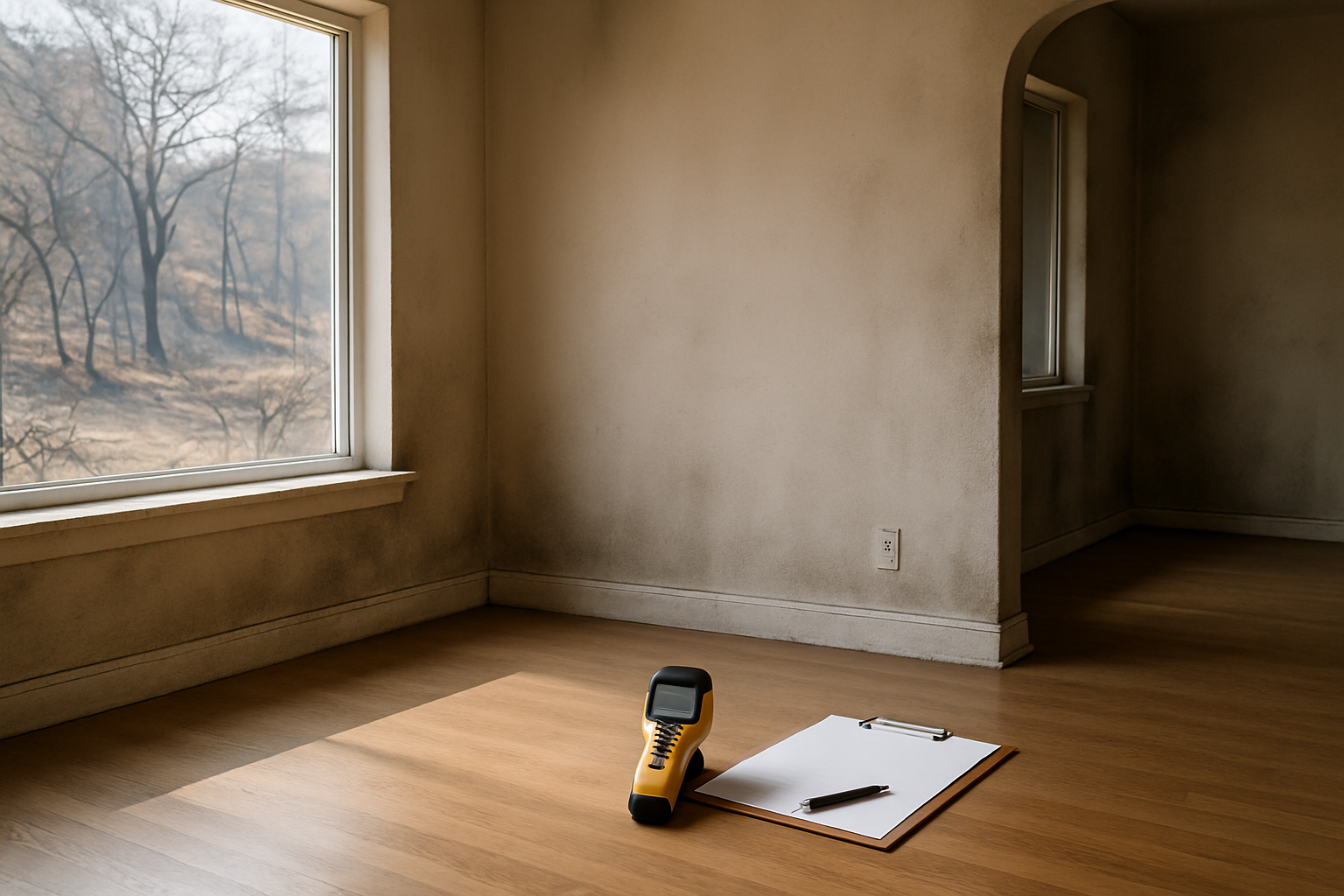
SB 610 puts disaster cleanup on the landlord. That includes more than the visible mess:
- Ash and soot
- Smoke residue and lingering odor
- Mold
- Asbestos disturbed by the event
- Water damage caused by the disaster
The presence of that debris creates a legal presumption that the unit is uninhabitable. The presumption holds until a local public health agency or official determines no toxic substances are present.
Read that again, because it is the trap. You cannot sweep up, run a fan for a weekend, and hand back the keys. A legal aid fact sheet on SB 610 confirms the removal and mitigation duty and also notes the law does not spell out exactly which cleaning or remediation services are required.
What is expected of you in practice:
- Use licensed remediation contractors, not a general handyman with a shop vac.
- Follow any government cleaning protocols issued after the event.
- Notify the tenant in writing once remediation is finished.
Remediation pricing swings widely depending on square footage, how deep the smoke or water got, and whether testing flags asbestos. I will not pretend there is a standard number. But smoke and mold work on a Monterey Peninsula home routinely runs into the thousands, and how much of it your policy covers depends on your coverage and your documentation.
Storm Damage vs Declared Disaster: How the Rules Differ
Owners mix these two up constantly. Here is the short version side by side.
| Situation | What happens to rent | Who handles the cleanup |
|---|---|---|
| Winter storm damages a roof, no emergency declaration | Rent continues unless the unit is truly unlivable; standard repair duties apply | Owner handles the repair on a reasonable timeline |
| Declared disaster plus mandatory evacuation order | Rent and other fees suspended for the period of the order | Owner, including ash, smoke, mold, asbestos, and disaster water damage |
| Unit left uninhabitable after the order lifts | Prepaid rent returned to the tenant within 10 calendar days | Owner, using licensed remediation and any official cleaning protocols |
| Tenant returns after remediation is finished | Same rent as before the disaster | Owner provides written notice that remediation is complete |
The Owner’s Documentation File
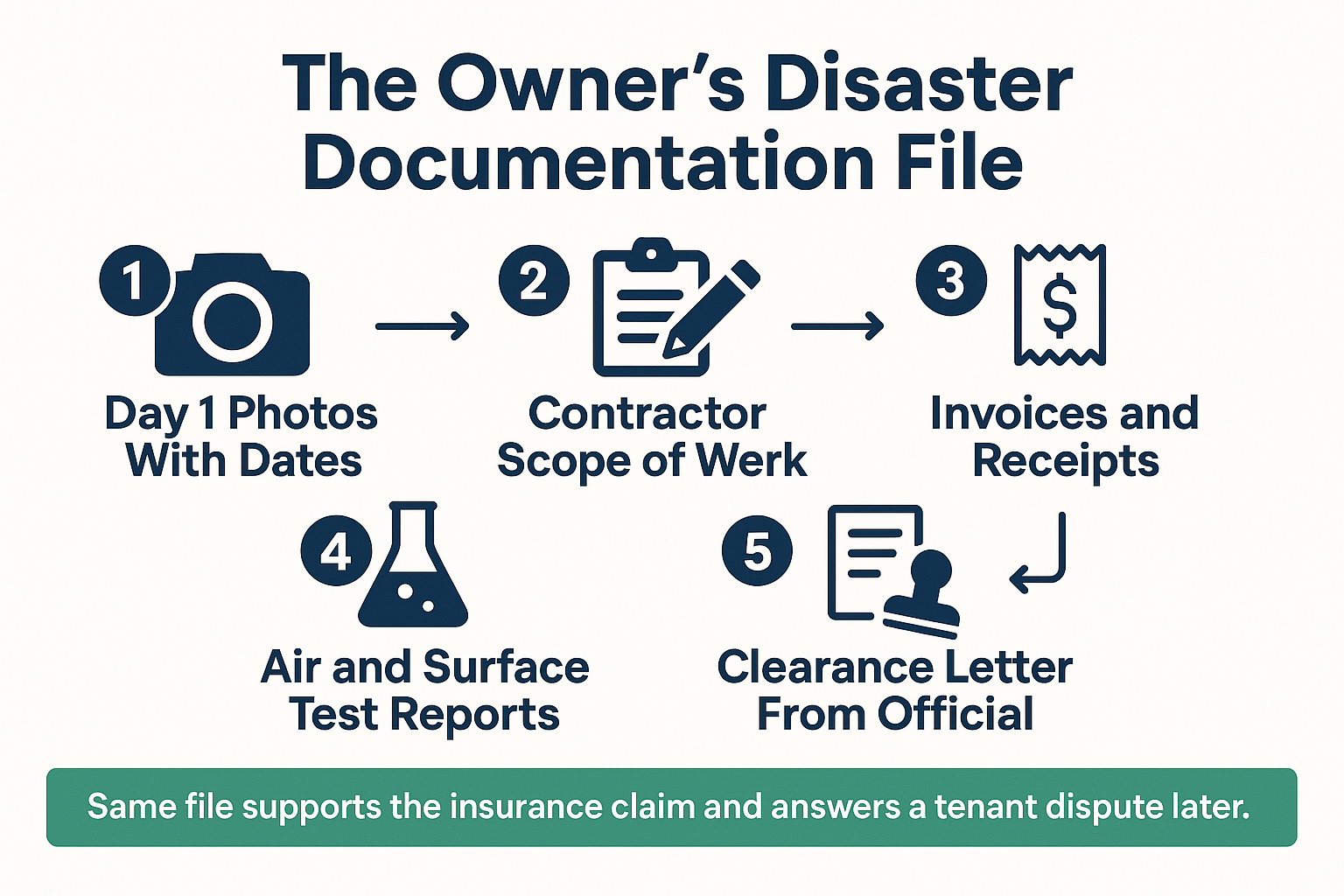
When an adjuster or a tenant dispute shows up months later, your file is the whole argument. This is what belongs in it.
What You Should Physically Keep, and Why Remote Owners Lose Here
Adjusters and remediation companies move on documentation. They do not move on an owner’s memory of what the house looked like.
Keep all of this in one place:
- Photos with dates from the day damage is found, wide shots and close-ups
- The contractor’s written scope of work
- Every invoice for cleaning, remediation, and repairs
- Any environmental or air and surface testing reports
- The clearance letter or official determination once the property is cleared
Here is the hard part. Insurance-related repair coordination normally lives or dies in the first 48 hours, and an owner who is 300 or 3,000 miles away rarely has anyone on the ground taking timestamped photos in that window.
I have watched that gap cost people real money. By the time someone gets out to a Prunedale or Soledad rental two weeks later, the before-and-after comparison is gone and so is the leverage.
This is the same structural problem I wrote about in our guide on how out-of-area owners actually manage a Monterey Bay rental. Distance does not change your legal duties. It only changes how fast you can meet them.
The Local Risk Picture and the October Through February Window
I am not going to talk you into worrying. But the numbers are public and they are worth knowing.
Publicly available 30-year risk models flag a majority of Monterey County homes for some level of wildfire exposure, and roughly 8 percent of properties for severe flood exposure. The Peninsula’s winter pattern of atmospheric river storms produces the water intrusion and drainage problems that turn into mold claims months after the rain stopped.
The useful response is preventive, and it is not complicated:
- Gutter and drainage checks before winter, not after the first big storm
- A documented photo record of the property’s normal condition, so you have a before picture that exists before anything goes wrong
- Current tenant contact information, including a phone number that reaches them if they evacuate
- A written plan for who calls whom when an order drops, and who has keys
Think of October through February as the window when this preparation actually gets used. That is also when our super El Niño winter readiness guide matters most, and when the habitability standards covered in our 2026 lease and habitability breakdown get tested for real.
Frequently Asked Questions About SB 610 and Evacuation Orders
If rent is suspended, do I still owe the mortgage?
Yes. SB 610 suspends the tenant’s rent obligation, not yours to your lender. Many landlord policies include loss of rent coverage, but whether it applies to an evacuation period depends entirely on your policy language. Call your carrier and your loan servicer early rather than after a missed payment.
Can I ask my tenant to clean up the ash and smoke smell?
No. The law puts disaster debris removal and hazard mitigation on the landlord, and the presence of that debris is presumed to make the unit uninhabitable until a local public health agency or official says no toxic substances are present. Handing a tenant a mop is not an option.
Does this apply to a single rental house, or only apartment buildings?
It applies to residential rentals broadly, including single family homes. For most Monterey County owners, that is the whole point, since so much of the rental stock here is houses, duplexes, and small buildings.
Can I raise the rent afterward to recover remediation costs?
Not on a returning tenant. They come back at the same rent they were paying before the disaster. Any future increase has to follow the normal state and local rules on timing and amount, and has nothing to do with what you spent on cleanup.
What if my tenant decides not to come back?
Then you are into normal end-of-tenancy territory, including deposit accounting under California’s current rules. Just be careful not to charge a tenant for damage the disaster caused. That is not deductible from a deposit, and our 2026 security deposit guide covers what you can actually withhold.
Questions About Your Own Property in Monterey County?
The real value of a local manager in a situation like this is simple: someone who can be at the property, coordinate licensed vendors, and document the condition while you are out of the area, which is exactly what owners of second homes on the Peninsula and out-of-state owners of Salinas rentals cannot do themselves. Our team already handles storm damage response, water intrusion inspections, and insurance-related repair coordination, and our quarterly inspection reports are photo-documented, so a before picture exists before anything goes wrong. One owner put it this way in a review: “Whenever maintenance issues came up, their coordination and follow-through were timely and effective.” If you want to talk through how this applies to your property, we can be reached at (831) 582-8916 or through the contact form at torrenteproperties.com.