
Direct Answer: You can change property managers mid-tenancy. Give written notice under your current agreement, move the full tenant file and deposit funds to the new manager, then notify the tenant in writing before the cutover date.
Most owners who call me about switching managers are not unhappy shoppers. They are people whose situation changed suddenly, and there is a tenant living in the house while they figure it out.
One owner in Seaside reached out after her property manager passed away. Her tenants had been in the same house for four years, rent was current, and she had no idea who was holding the deposit or the lease.
Another owner up in North Salinas simply wanted to know what professional management would cost and how the process worked, because there was a tenant already in place and he did not want to disturb anything.
This article is about that exact situation: changing property management companies with a tenant already in place, not a first-time handoff from self-managing. If you have been running the property yourself, handing off a rental you have been managing yourself covers different ground.
The Lease Keeps Running While You Change Who Manages It
Here is the part that puts a lot of owners at ease. Changing managers does not change the lease.
The tenant’s rights, the rent amount, the due date, the lease end date, and the deposit all carry forward exactly as written. You are swapping the company that collects and coordinates, not rewriting the deal.
That also means you cannot use the switch as a reason to raise rent early, shorten a term, or ask a tenant to re-apply. A new manager steps into the shoes of the old one.
What actually changes for the tenant is small on paper and large in practice:
- Where rent goes starting on the cutover date
- Who to call for a leaking water heater at 11 p.m.
- Which portal holds their lease and payment history
- Who holds the security deposit
Get those four things communicated clearly and most transitions are uneventful. Miss one and you create a problem that did not need to exist.

What Physically Has to Move From the Old Manager to the New One
This is where most transitions quietly go wrong. Money transfers fine. Paper does not.
Here is the file I want in hand before I take over an occupied property:
- The signed lease and every addendum, including pet, parking, and utility agreements
- The security deposit funds themselves, wired or delivered, not just reported
- The original itemized deposit receipt showing what was collected and when
- Move-in condition photos and the signed checklist
- The full rent payment ledger for the tenancy
- Any prior rent increase notices, with dates and amounts
- Any written warnings, cure notices, or complaints
- Keys, mailbox keys, gate remotes, and any access codes
- Appliance and roof warranty paperwork
- Smoke and carbon monoxide detector installation and test records
The deposit and the move-in photos matter most, and they matter together. A deposit that arrives without move-in photos is nearly impossible to defend at move-out, because you have no baseline to compare the property against.
Also pay attention to deposit size. California has capped most residential security deposits at one month’s rent since July 1, 2024 under AB 12, so a tenancy that started before that date may legally hold more. That history needs to travel with the file instead of getting rebuilt from memory two years later.
The Handoff File: What Each Item Actually Protects
I use a version of this list every time I take over an occupied home in Monterey or Salinas. The right column is the part owners tend to underestimate.
| File Item | Why It Matters | What Happens Without It |
|---|---|---|
| Signed lease and addenda | Sets rent, term, and every rule you can enforce | No enforceable terms beyond what the tenant agrees to remember |
| Security deposit funds | Belongs to the tenant, held on their behalf | Owner may owe it out of pocket at move-out |
| Itemized deposit receipt | Proves the exact amount collected and when | Disputes over the balance owed back |
| Move-in photos and checklist | The baseline for judging damage vs. normal wear | Deductions are hard to justify and easy to challenge |
| Rent payment ledger | Shows payment history and any balance | Late payment patterns and credits disappear |
| Rent increase notices | Establishes the last increase date and amount | Risk of an improper increase under state limits |
| Detector records | Documents smoke and CO compliance | No proof of installation or testing dates |
| Keys, remotes, access codes | Basic access for maintenance and inspections | Rekeying costs and delayed emergency response |
Read Your Termination Clause Before You Do Anything Else
Owners often assume they can walk away whenever they like. Your management agreement usually says otherwise.
Most agreements require written notice, and 30 to 60 days is common in the Monterey Bay market. The number that governs you is whatever your own contract says, so read it first.
Three clauses to look at closely:
- The termination clause, including how notice must be delivered and whether there is an early exit fee
- Any leasing fee already earned on the current tenant, and whether the outgoing company claims a share of future rent for that placement
- Whether the agreement auto-renews on an anniversary date you are about to pass
Then think about timing. Cut over on a clean rent cycle so the tenant never pays two different companies in the same month.
I also try to avoid July and August cutovers. Peak moving season on the Peninsula stretches every vendor, lender, and locksmith thin, and a fall transition is simply easier to coordinate.
The Mid-Tenancy Switch, Start to Finish
This is the order I work in when an owner brings me an occupied property in Monterey County.
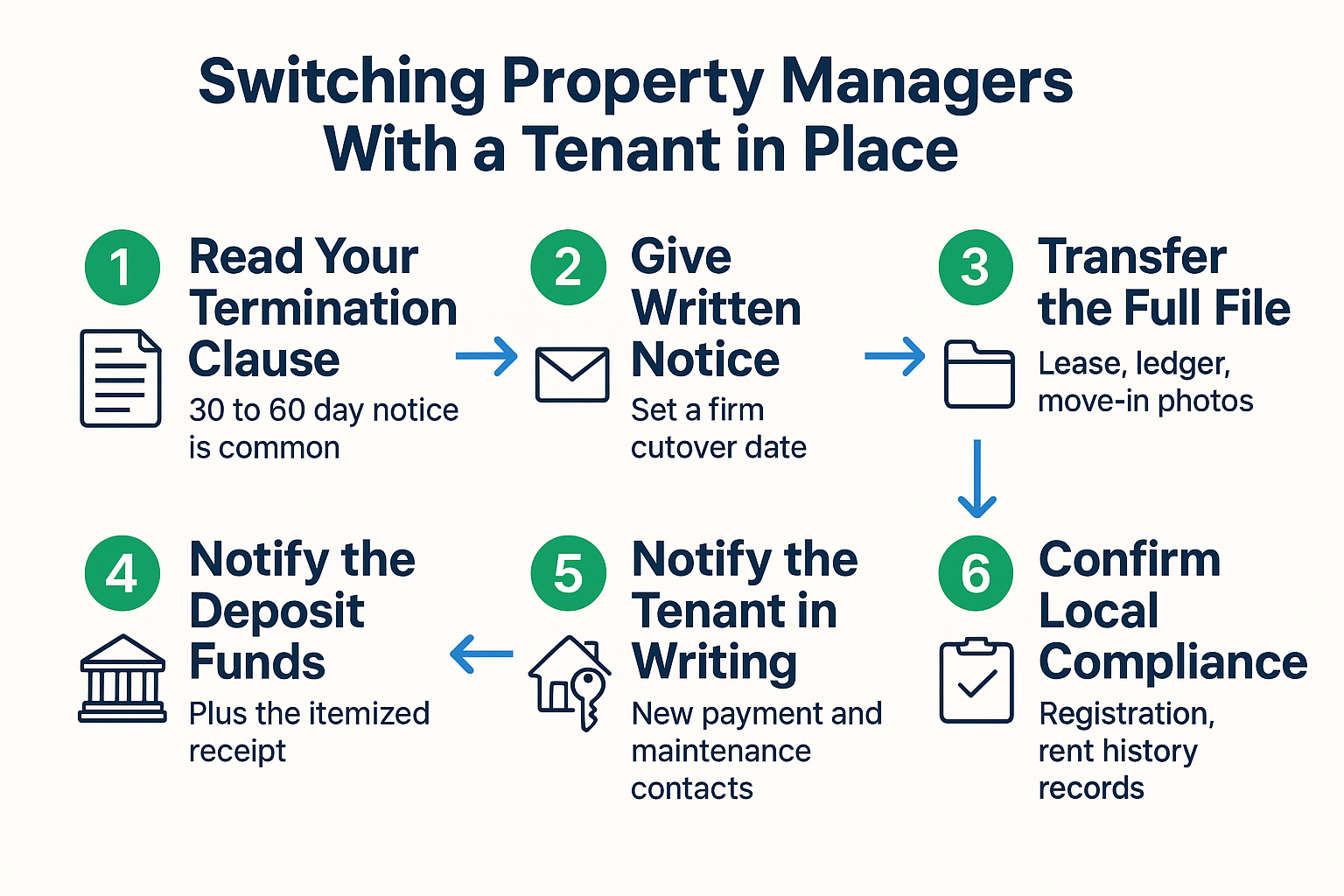
A Manager Change Is When Good Tenants Start Looking Around
Read enough rental reviews around Monterey Bay and a pattern shows up. Tenants read silence as being ignored, and confusion about where to send rent turns into a payment problem within one cycle.
A long-term tenant who has paid on time for four years is an asset. Rattle that person and you can lose them over something that cost you nothing to prevent.
So I send a written notice to the tenant before the cutover, and it says all of this plainly:
- The exact date the new company takes over
- Where and how to pay rent, starting with that first payment
- The maintenance number and the after-hours emergency number
- Portal login instructions for rent, work orders, and lease documents
- Clear confirmation that the deposit transferred with the file and was not spent
That last line does more work than owners expect. Deposits are the number one thing tenants worry about when a company name changes on the rent envelope.
The math is not close either. In a market where a Monterey two-bedroom commonly rents somewhere in the $3,000 range, losing a paying tenant over a communication gap costs far more than the entire transition. Vacancy, turnover cleaning, and re-leasing add up fast.
The Local Rules Do Not Pause While You Are Between Managers
Compliance keeps running whether or not anyone is watching the file. A few items matter specifically here.
In Salinas, the Residential Rental Registration program requires registration and annual fees. Decide during the handoff who files and who pays for the year in question, in writing, rather than assuming the other party has it.
Rent increase history under AB 1482 matters too. Your new manager needs the date and amount of the last increase before touching rent, and that information should come from the ledger, not from recollection.
If you own a multifamily building, pull the exterior elevated element inspection records tied to SB 721 and AB 2579. Balcony, stair, and walkway inspection reports belong in the transferred file, because those deadlines follow the building, not the manager.
None of this is a lecture. It is the paper trail that protects you if a dispute ever lands in front of a judge or an insurance adjuster. Owners managing from out of the area feel this most, which is why keeping control of a Monterey property from a distance comes down to documentation more than anything else.
What to Look for in the Company Taking Over
A mid-tenancy takeover is one of the moments where a small local office beats a call center. Someone has to chase down a deposit receipt from a company that may be winding down, and that takes phone calls and relationships.
When you interview a replacement, ask how they handle the file transfer specifically. If the answer is vague, keep looking. If you are still comparing options, choosing a rental management company in Monterey Bay and what management actually costs in the Monterey Bay area are both worth reading before you sign anything.
Our office is owner-led by a licensed broker with more than 25 years in Monterey County, holds the Accredited Residential Manager credential, and works in both English and Spanish across the Salinas and Monterey markets. Our 5-star Google rating comes largely from owners describing steady communication over years, including one who wrote that we have managed several properties and “everything runs smoothly.”
That is really what a good transition should feel like from the owner’s side. Quiet.
Frequently Asked Questions About Changing Property Managers Mid-Tenancy
Can I switch property managers if my tenant is in the middle of a lease?
Yes. The lease belongs to you and the tenant, not to the management company. The rent, term, and deposit all carry forward unchanged, and the new manager takes over administration on the cutover date.
How much notice do I have to give my current property management company?
Check your agreement, because that document controls. Thirty to sixty days of written notice is common around Monterey County, and some contracts also auto-renew on an anniversary date, so read the whole termination section before you send anything.
What happens to the security deposit when I change companies?
The actual funds should transfer to the new manager’s trust account, along with the itemized receipt showing what was collected and when. Do not accept a summary line on a statement in place of the money. Also confirm the deposit amount matches the lease, since tenancies that began before July 1, 2024 may legally hold more than one month’s rent.
My property manager passed away and I do not know who has my records. What do I do?
Start with the tenant, who usually has a copy of the lease and payment confirmations, then contact the brokerage of record and the bank holding the trust account. This happens more often than people expect, and it is workable. It just takes someone local making calls on your behalf.
Will my tenant have to sign a new lease?
No. The existing lease stays in force. The new manager may add a short notice of change in management for the file and set the tenant up in a new portal, but that is administrative and does not alter the tenant’s terms.
What is the worst time of year to make the switch?
Midsummer. July and August are peak moving months on the Peninsula, so vendors and schedules are stretched. A fall cutover on a clean rent cycle is easier on everyone, including the tenant.
Thinking Through a Mid-Tenancy Transition?
If you own a rental anywhere from Salinas and Prunedale down to Carmel and Pebble Beach and you are weighing a change while a tenant is still in the home, we are happy to talk through the file, the timing, and the notice period on your specific agreement. Our office is at (831) 582-8916, and there is a contact form at torrenteproperties.com. No rush and no pressure, just a straight conversation about what your situation actually needs.