
Direct Answer: California caps security deposits at one month’s rent, furnished or not. A narrow exception lets some small owners collect two months, but it never applies to service member tenants.
The question I still get most often about deposits comes from owners renting a place furnished. They assume a furnished unit lets them ask for more money up front, because for decades in California it did.
That changed on July 1, 2024. And it caught a lot of Monterey Peninsula owners off guard, because furnished rentals are common here. In the last stretch alone I have talked with owners about a Marina studio they wanted to rent furnished while away, a fully furnished Monterey condo, and a partially furnished house up in Prunedale.
Below I walk through what you can actually collect in 2026, the one narrow exception that survives, and the rule that quietly cancels that exception for a big share of tenants in Monterey, Seaside, and Marina.
The 2026 rule: one month’s rent, furnished or not
Before mid-2024, California allowed up to two months’ rent for an unfurnished unit and three months’ rent for a furnished one. That gave owners of furnished homes a real cushion.
AB 12 replaced all of that with a single limit: one month’s rent, regardless of whether the place comes with furniture. You can read the bill history on the California Legislature’s official AB 12 page, which amended Civil Code 1950.5 and set the July 1, 2024 effective date.
So a furnished townhouse in Monterey and an empty three-bedroom in Salinas now sit under the exact same ceiling. The furniture, the appliances, the linens, the flat screen: none of it buys you extra deposit room.
What that actually means for owners renting furnished:
- The first month’s rent is still collected separately and does not count toward the cap
- Your protection against damage to furnishings is the same as an unfurnished rental
- A detailed furnishings inventory with photos does more for you now than deposit math ever did
- Higher-end furnished placements lean harder on screening than on cash held
If you are weighing furnished versus unfurnished at all, I have covered the trade-offs in more detail in our guide to renting your home furnished in the Monterey Bay area.
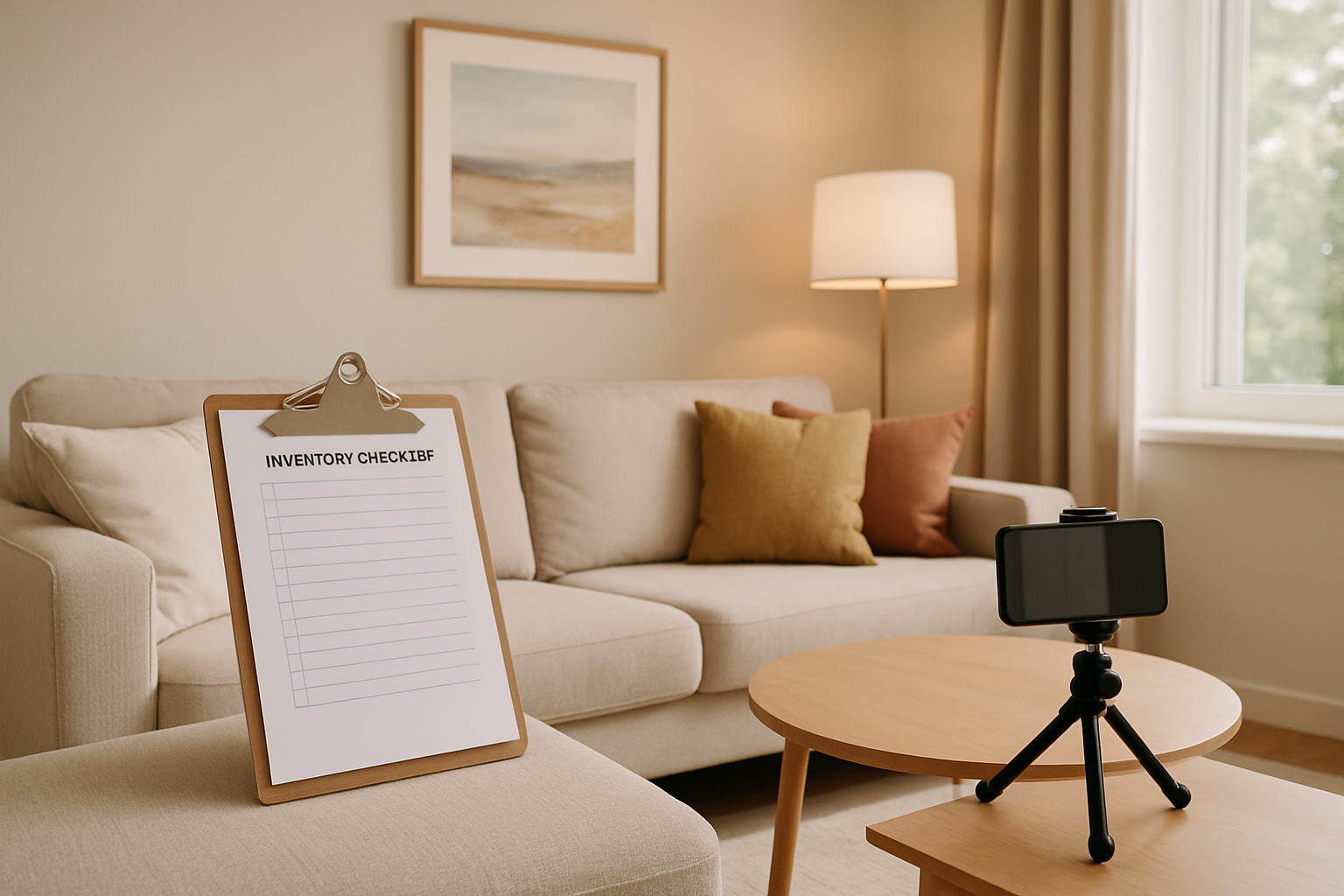
What the cap looks like in real Monterey County dollars
The math is where this stops feeling abstract. Consumer rent indices have reported average rents somewhere in the neighborhood of $2,750 in Monterey and around $2,595 in Salinas, with Santa Cruz running higher. Treat those as general market context, not a quote on your property.
Run your own rent figure through the old rules and the new ones. A furnished unit renting near that Monterey average could once support a three-month deposit. Today it supports one.
That is a swing of several thousand dollars in up front protection on a single door. On a Salinas duplex where both sides turn in the same year, the gap compounds.
I am not sharing that to alarm anyone. I am sharing it because owners who still budget for the old cushion tend to under-invest in the two things that now carry the weight: screening depth and move-in condition records.
Before and after July 1, 2024
Here is the shift in plain terms. The rent column is illustrative market context only, not a pricing quote.
| Scenario | Old limit (before 7/1/2024) | Limit in 2026 |
|---|---|---|
| Unfurnished 3-bedroom, Salinas | Up to 2 months’ rent | 1 month’s rent |
| Furnished condo, Monterey | Up to 3 months’ rent | 1 month’s rent |
| Furnished studio, Marina | Up to 3 months’ rent | 1 month’s rent |
| Qualifying small owner, non-service-member tenant | Up to 2 or 3 months’ rent | Up to 2 months’ rent |
| Any owner, service member tenant | Up to 2 or 3 months’ rent | 1 month’s rent, no exception |
The small landlord exception, and where owners get it wrong
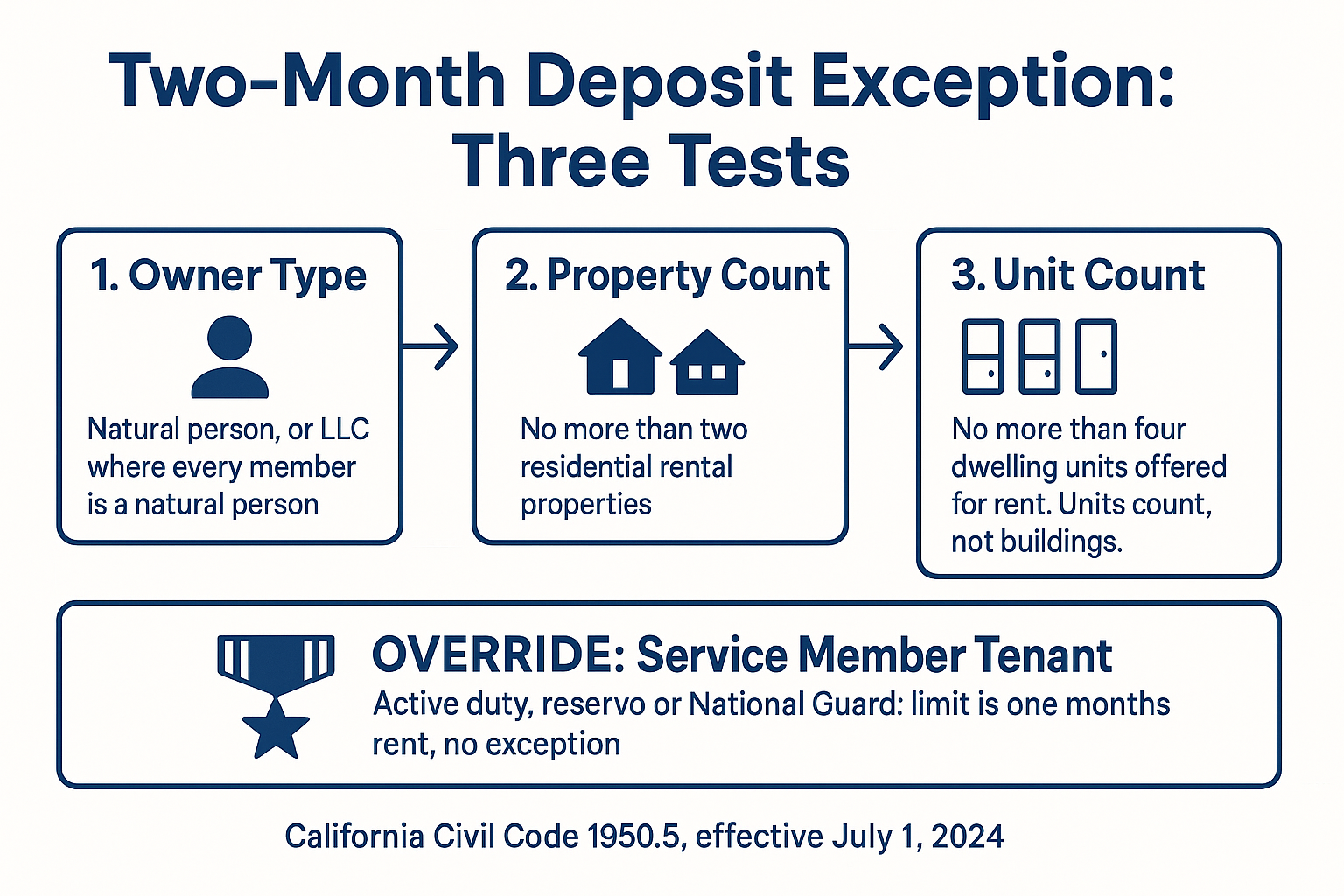
A two-month allowance does survive, but only for a narrow group. Every one of these conditions has to be true:
- The owner is a natural person, or an LLC in which every member is a natural person
- The owner owns no more than two residential rental properties
- Those properties collectively include no more than four dwelling units offered for rent
The unit count is the part that trips people up. Units count, not buildings. An owner with a duplex plus a triplex has five units and does not qualify, even though that is only two properties.
This lands hard in Monterey County because so many local properties are a house plus a guest house, or a house plus a carriage suite. One owner wrote in about three homes with carriage suites down in Greenfield, which fails the two-property test outright. Another asked about a Prunedale house and a studio separated by a breezeway, and that is exactly the setup where counting units decides the answer.
If your second unit shares utilities with the main house, there are separate headaches worth understanding too. We covered those in your guest house shares one meter with the main house.
Do you qualify for the two-month exception?
This walks through the three tests in order, in the sequence I actually check them.
The service member rule that overrides everything
This is the single most relevant wrinkle in our market, and plenty of owners have never heard it.
The two-month exception never applies when the prospective tenant is a service member. That includes active duty, reserve, and National Guard. An owner also may not refuse to rent to a service member because of that limit.
Now think about who fills the tenant pool here. Between the Naval Postgraduate School, the Defense Language Institute, and the Presidio of Monterey, a large share of applicants in Monterey, Seaside, and Marina are service members or connected to them.
So many owners who technically qualify for the exception will never actually get to use it. One Monterey condo owner told me plainly they wanted a long term tenant or a student from the Naval Postgraduate School, which is about as typical a peninsula preference as you will hear. If that is your target renter, plan your numbers around one month’s rent and move on.
You cannot rebuild the cushion by renaming it
The second most common mistake I see is stacking charges. California defines a security deposit broadly: essentially any payment beyond the first month’s rent that secures the tenant’s performance under the lease.
That means all of these count toward the same cap:
- Pet deposits
- Cleaning deposits
- Key or remote deposits
- Last month’s rent collected up front
Lease language calling any part of a deposit non-refundable is not enforceable in California. Writing it in anyway does not help you and can hurt you in a dispute.
So for a Salinas or Seaside owner hoping to piece the old cushion back together under different labels: it does not work. What does work is documenting condition well enough that legitimate deductions hold up, which I get into in our breakdown of deposit deductions after move-out.
What about tenants who have been in place for years?
This describes a real slice of local owners. The cap applies to deposits collected on or after July 1, 2024.
A larger deposit that was lawfully collected before that date does not have to be partially refunded in the middle of an ongoing tenancy. But when that tenant leaves and you sign someone new, the new tenancy falls squarely under the current rule.
Renewals and material lease changes are the gray zone. That is a conversation worth having with a real estate attorney rather than guessing.
And this is not a hypothetical scenario around here. One Seaside owner reached out about tenants who had been renting for four years, and a Monterey owner had main house tenants move out after 31 years. Old deposits and old paperwork are still sitting in file drawers all over this county.
A smaller cushion changes the rest of the job
One month’s rent does not stretch far when unpaid rent and real damage show up together. I have seen a single turnover eat the whole deposit on carpet and paint alone, before you get to anything else.
So the work shifts upstream. Three things carry more weight than they did three years ago:
- Screening depth. Credit, nationwide criminal background, eviction history, and verified income and employment, every time
- Condition documentation at move-in. Room by room, with dated photos and a signed checklist
- Move-out records. Photos and vendor invoices that match specific line items
Owners who call me usually ask about fees first and screening second. I understand why, but the screening side is what protects the money now. If you want to see what a real process looks like, we laid it out in what a real tenant screening process looks like.
Frequently Asked Questions About CA Security Deposit Law in 2026
Can I charge more for a furnished rental in Monterey?
No. Since July 1, 2024, furnished and unfurnished units share the same one month’s rent cap. The old three-month allowance for furnished rentals is gone.
Does the first month’s rent count toward the deposit cap?
No. The first month’s rent is collected separately. Almost everything else you collect up front, including pet deposits, cleaning deposits and last month’s rent, does count toward the cap.
I own a duplex and a triplex. Do I qualify for the two-month exception?
No. That is five dwelling units, and the exception tops out at four units across no more than two properties. Units are what get counted, not buildings, which surprises a lot of owners with a main house plus a guest unit.
What if my tenant is stationed at the Presidio or attending DLI?
Then the two-month exception does not apply, even if you otherwise qualify. Service members, including reserve and National Guard, are limited to a one month’s rent deposit, and you cannot decline to rent to them because of that.
Do I have to refund part of an older, larger deposit?
Not for a deposit lawfully collected before July 1, 2024 during an ongoing tenancy. A new tenancy after that tenant moves out follows the current one-month rule. Renewals and material lease changes are nuanced enough that I would run them by a real estate attorney.
Can I write in the lease that the cleaning deposit is non-refundable?
You can write it, but it will not hold up. California does not allow non-refundable security deposits. Deductions have to be tied to documented, legitimate costs at move-out.
Want a second set of eyes on your deposit paperwork?
Our team has spent more than 25 years working Monterey County rentals under owner-broker Aurelia Torrente, and we handle screening, lease drafting and deposit accounting in both English and Spanish, which matters in the Salinas and Monterey markets. One longtime owner client put it simply in her review: “It’s refreshing knowing we have that piece of mind…” (Hilda M.). If you have questions about how the current cap applies to your property, we are reachable at (831) 582-8916 or through the contact form at torrenteproperties.com.